Pervious vs. Impervious Hardscaping for Grass
Compare pervious and impervious hardscaping for grass, including runoff, heat, salt, site limits, material choices, and ways to fix a struggling lawn edge.
The quick answer
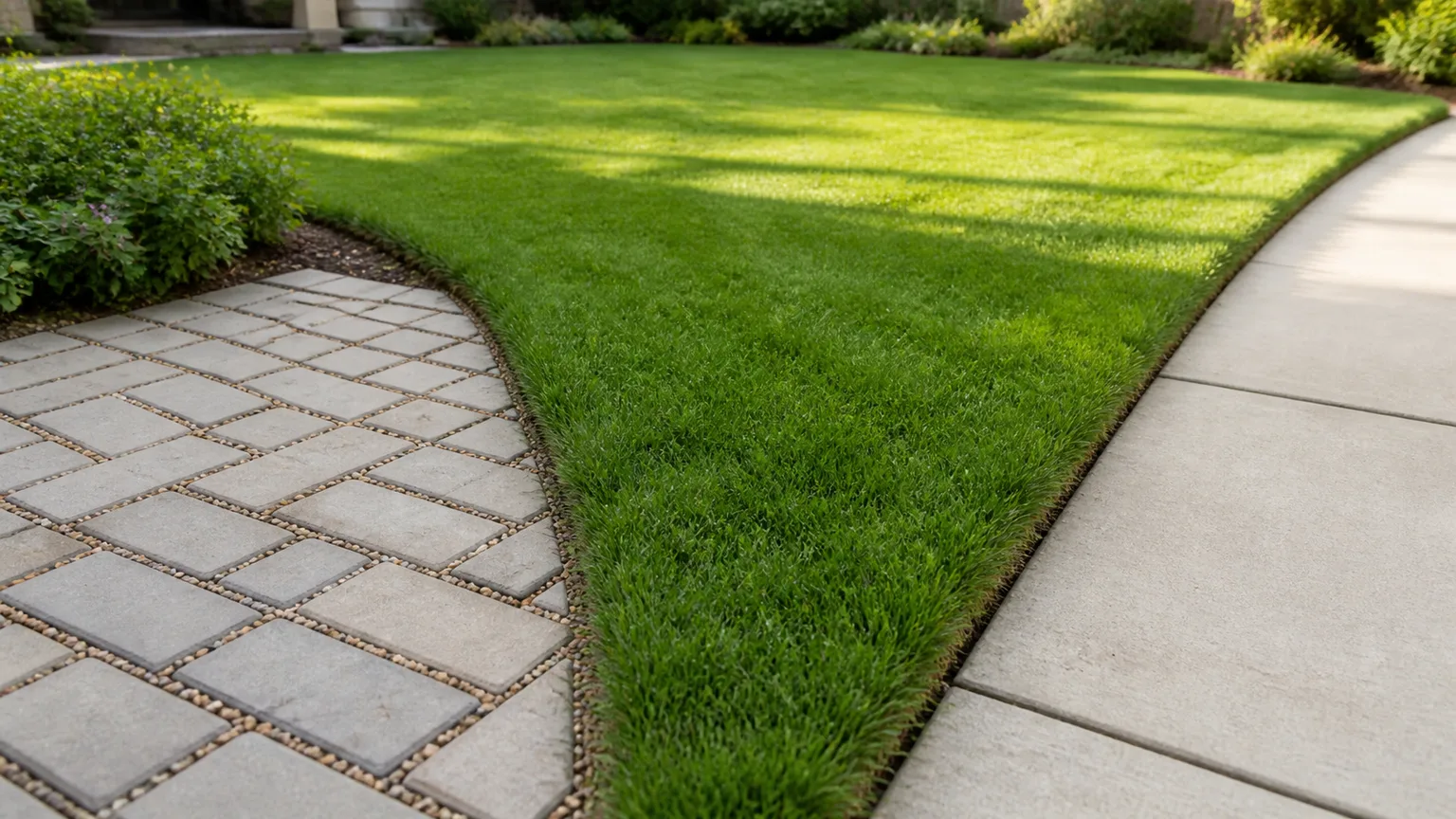
Pervious hardscaping is usually the better starting point when your main problem is runoff, puddling, or erosion—but it is not automatically the best choice for every yard. A permeable paver patio or gravel path can let rain move into a prepared base instead of rushing across the surface toward your lawn. That can reduce concentrated flows and keep water from carrying sediment and deicing residue into planting areas.
The catch is that “pervious” describes how the surface handles water, not whether the whole installation will work on your property. A permeable surface over compacted clay, a high seasonal water table, or a poorly graded site can still pond, overflow, or push water toward a foundation. A conventional concrete walkway can also be a perfectly reasonable choice when it is correctly sloped, its runoff is directed to a safe receiving area, and the lawn beside it is not expected to absorb a sudden sheet of water.
The best choice for grass comes down to five questions: Where will the water go? Can the soil accept it? What load will the surface carry? How much maintenance will you do? And what does the nearby lawn actually need? Answer those before comparing colors, patterns, or prices.
Pervious vs. impervious hardscaping: What the terms mean
Pervious or permeable hardscaping allows water to pass through the surface itself or through designed openings between units. Impervious hardscaping blocks infiltration at the surface, so rain and snowmelt must travel across it until they reach an edge, drain, swale, or collection system. Virginia Cooperative Extension explains the practical difference plainly: water infiltrates through surfaces such as soil and vegetative cover, while roads, driveways, and rooftops generate runoff that can carry sediment, fertilizer, pesticides, vehicle fluids, and debris. Read the Virginia Cooperative Extension stormwater guidance.
Those labels can hide an important detail. A permeable paver is not a magic tile that drains through any ground. The pavers, joint material, bedding layer, open-graded stone base, subgrade, edge restraints, and overflow plan work together. Penn State Extension describes porous pavement as a system that may include a carefully prepared stone subsurface, storage, piping, or a basin—not simply a top layer with visible gaps. Penn State Extension’s guide to porous and permeable paving is a useful reference when a project is larger than a small garden path.
Pervious options: permeable pavers, gravel, and grass pavers
Common pervious choices include permeable interlocking pavers with open joints, porous or pervious concrete, porous asphalt, gravel, crushed stone, decomposed granite, and grid-style grass pavers. The first three are engineered paving products. The loose materials are simpler on the surface but can move, rut, wash, or become muddy when the base and edge details are weak.
Permeable pavers drain through the spaces between units and need a compatible aggregate base. Pervious concrete and porous asphalt contain larger voids than their conventional counterparts, so they must be mixed, placed, and cured for that purpose. A standard concrete paver set tightly on a dense, compacted base is not equivalent to a permeable paver system just because the units are individual pieces.
Gravel and crushed stone are naturally open at the surface, but “drains” does not mean “stays firm.” A narrow footpath may work beautifully with angular aggregate and a well-compacted base. A driveway needs stronger confinement and a design that tolerates turning tires. Decomposed granite can create a smooth, walkable path, but loose DG is more vulnerable to erosion and mud in heavy rain; stabilized DG is firmer but costs more and changes the way the surface behaves. Horticulture’s comparison of loose and stabilized decomposed granite covers that trade-off well.
Grass pavers combine a load-bearing grid with growing medium and turf or low groundcover. They can reduce mud in occasional parking areas, but they are not a substitute for a lawn that must tolerate daily traffic, repeated turning, shade, or long periods of standing water. The grass still needs light, air, root space, and a watering plan; the grid only addresses some of the traffic and erosion problem.
Impervious options: concrete, asphalt, and mortared surfaces
Conventional concrete, asphalt, mortared brick, and tightly fitted pavers over a dense base are typical impervious hardscapes. They are often chosen because they provide a predictable, firm surface for wheelchairs, carts, furniture, snow removal, and vehicles. Their drainage behavior is not inherently careless: the surface can be pitched toward a drain, vegetated swale, rain garden, or other approved outlet.
The risk appears when a solid surface is installed without a receiving plan. Water then leaves the low edge in a concentrated stream, cuts a channel through the lawn, exposes roots, or deposits sediment at the grass border. A concrete patio may be structurally sound and still be a poor landscape installation if every downspout and storm flows toward one narrow strip of turf.
Artificial turf deserves its own check rather than an automatic label. Some products have perforated backing and a designed drainage base; others shed or slow water depending on the backing, infill, and subgrade. If you are replacing living grass with synthetic turf to solve drainage, inspect the full assembly and outlet rather than assuming the green surface is pervious.
How hardscaping affects nearby grass
The lawn does not care whether a brochure calls a material sustainable or traditional. It responds to the water, heat, salts, air, and traffic that arrive at its root zone. Two yards with the same concrete walkway can have opposite outcomes because one has a permeable soil and a broad, planted receiving area while the other has compacted clay and a downspout aimed at the sidewalk.
Runoff, erosion, and soil moisture
An impervious surface converts rainfall into runoff quickly. The larger the paved area and the steeper the grade, the more important the edge treatment becomes. Water moving off a driveway may first appear as a thin sheet, but repeated storms can scour a bare line through turf and carry soil into a storm drain or low planting bed.
Runoff can also create a false watering signal. The grass at the low edge may look wet or even flooded while the higher lawn stays dry. Then the surface dries and the compacted edge becomes hydrophobic or crusted, so the next storm runs off even faster. Watering more often does not repair a grade or compaction problem; it can keep the weak strip shallow-rooted and vulnerable.
Pervious systems slow that abrupt handoff by allowing water into the surface and base. Penn State Extension notes that well-designed porous and permeable paving can reduce surface puddles, standing water, and downhill runoff, while the base stores water until it infiltrates or moves to a planned outlet. That benefit belongs to a functioning installation, not to the word “permeable” alone.
The lawn beside a permeable surface may still struggle if the underlying soil is dense, the base is saturated, or the paved area receives more water than the site can absorb. In that situation, the surface can act like a hidden collection basin. Plan an overflow route before the first storm exposes the problem.
Heat, salt, and winter stress
A sunny concrete or asphalt edge can become hotter than the nearby soil and reflect heat into a narrow band of turf. The result is often a crisp, thin, or prematurely dormant strip rather than a whole-lawn failure. Dark paving, south- and west-facing exposure, wind, shallow soil, and irregular irrigation make the edge effect more noticeable.
Winter adds another pathway. Snow pushed from a walkway or driveway may carry deicing salt into the same grass border every storm. Salt can injure foliage and disrupt the soil environment, while repeated freeze-thaw cycles can widen cracks, loosen paver joints, and move fine sediment into drainage openings. Gardening Know How notes that runoff from traditional paving can carry salts, deicing chemicals, and vehicle fluids into lawns and garden areas, and that permeable paving can reduce pooling and refreezing when the system is correctly built. See its overview of permeable pavement benefits and care.
Pervious paving is not salt-proof. Salt-laden meltwater still goes somewhere, and a permeable base may move it into soil instead of across the surface. Keep salt use targeted, shovel snow away from planting beds when practical, and route meltwater so it does not collect at one lawn edge. In regions with regular winter treatment, make salt exposure part of the material and planting decision from the start.
Why pervious is not automatically better
Permeability solves one problem—surface runoff—only when the ground, grade, and receiving area can handle the water. If the site cannot infiltrate, a pervious surface may hold water below the pavement, settle unevenly, or send overflow toward the very grass or foundation you hoped to protect.
When infiltration can cause problems
Be cautious with infiltration-focused hardscaping near a basement or crawl-space foundation, on a steep slope, over compacted fill, above a seasonal high water table, or in soil that drains very slowly. Virginia Cooperative Extension’s guidance for grass swales recommends evaluating foundation distance, slope, soil compaction, clay content, and seasonal high water table because those conditions change whether water-management features can infiltrate safely. A permeable patio is not identical to a swale, but the site logic is the same: water needs somewhere safe to go.
Look for warning signs before choosing a system: puddles that remain for a day or more after ordinary rain, gray or blue mottling in a soil pit, a shallow bedrock layer, a basement that has seeped after storms, or a slope that sends water downhill at speed. A simple infiltration test can reveal a problem, but a homeowner test is not a substitute for professional design when the project is large, close to a structure, or subject to local stormwater rules.
Also ask what happens when the system is full. Every permeable installation needs a controlled overflow or emergency path. Without one, intense rain can turn an apparently low-impact surface into a hidden source of runoff and erosion.
When a solid surface is the right choice
Choose conventional concrete, asphalt, or tightly set pavers when the project needs a highly predictable, smooth, accessible, or heavy-load surface and you can manage its runoff. A small, correctly graded sidewalk may create fewer landscape problems than a poorly installed permeable path. A driveway that handles frequent deliveries, snowplows, or tight vehicle turns may need a structural system that is not compatible with a lightly built gravel or grass-paver surface.
Solid paving can also make sense where infiltration should be limited. The important shift is to design the water route deliberately: pitch the surface away from the foundation, use a drain or channel where needed, and lead the flow toward a stable swale, rain garden, or other permitted outlet. Do not treat the lawn as the default drain simply because it is the nearest soft surface.
Choose by job: path, patio, driveway, or parking
The right comparison is not “pervious versus impervious everywhere.” It is which surface handles this job, on this soil, under this traffic, with this maintenance capacity? Use the table as a first filter, then check the site constraints.
| Yard job | Strong pervious candidates | When impervious may be better | Grass-first caution |
|---|---|---|---|
| Footpath | Permeable pavers, angular gravel, crushed stone, stabilized DG | Smooth concrete for accessibility or frequent rolling loads | Confine loose aggregate and keep edge runoff from cutting the turf |
| Patio | Permeable pavers or a properly designed aggregate surface | Concrete or mortared pavers where furniture, cleaning, or accessibility demands a firm plane | Keep roof and patio runoff from collecting at the lawn’s low edge |
| Driveway | Engineered permeable pavers, porous asphalt, or a professionally designed system | Concrete or asphalt for heavy, frequent, or turning traffic | Design for snow, oil drips, salt, and overflow; do not rely on grass alone |
| Occasional parking | Grass pavers or reinforced turf where light and soil support recovery | A stable hard surface where use is frequent or the area is shaded | Grass pavers still need establishment time and should not be treated like a normal driveway |
Walkways and patios
For a garden path used by people on foot, the surface can be relatively simple if it is stable, well edged, and compatible with the surrounding grade. Angular gravel locks together better than rounded pea gravel. A compacted base reduces ruts, but the base should be chosen for the intended drainage behavior; a dense, fine-heavy layer can undermine the purpose of a permeable assembly.
Permeable pavers are a good middle ground when you want a defined pattern without giving up infiltration. Ask the installer what fills the joints, how deep the stone base is, where the water goes during a cloudburst, and how the edges are restrained. If the answer is only “the gaps let water through,” the system has not been explained well enough.
For a patio beside grass, look at the low side before you select the surface. A permeable patio may reduce the volume leaving the edge, but it will not save a lawn if the entire yard slopes toward that edge and the subgrade is already saturated. A shallow planting strip, broad swale, or rain garden can give the water a wider receiving area than a narrow line of turf.
Driveways and grass-paver areas
Driveways magnify every weakness. Tires apply concentrated loads, turning wheels shear loose material, and cars bring oil, sediment, and winter salts onto the surface. Penn State Extension shows why design load matters: a pervious paver system that was not designed for heavy truck traffic can fail even when conventional concrete nearby remains intact.
For a normal residential driveway, compare a professionally designed permeable paver or porous asphalt system with conventional paving plus a drainage plan. Consider the vehicle weight, turning radius, snow equipment, slope, local freeze-thaw conditions, and whether you can maintain the surface. A low-cost surface that ruts and sends muddy water into the lawn is not a drainage success.
Grass pavers are best treated as a specialized occasional-use surface. Give the grass enough sunlight, avoid parking on saturated soil, and allow the turf to recover between uses. If the space will hold a daily commuter car, delivery vans, or stacked trailers, choose a structural surface that does not depend on living grass staying healthy under repeated compression.
Plan a grass-safe hardscape before installation
Good hardscaping protects grass by deciding what happens to water before the first material arrives. Draw the roof downspouts, existing pavement, lawn low points, planting beds, property lines, and foundation on a simple site sketch. Walk the area during a heavy rain if it is safe and note where water starts, where it accelerates, and where it stops.
Test soil, slope, and drainage
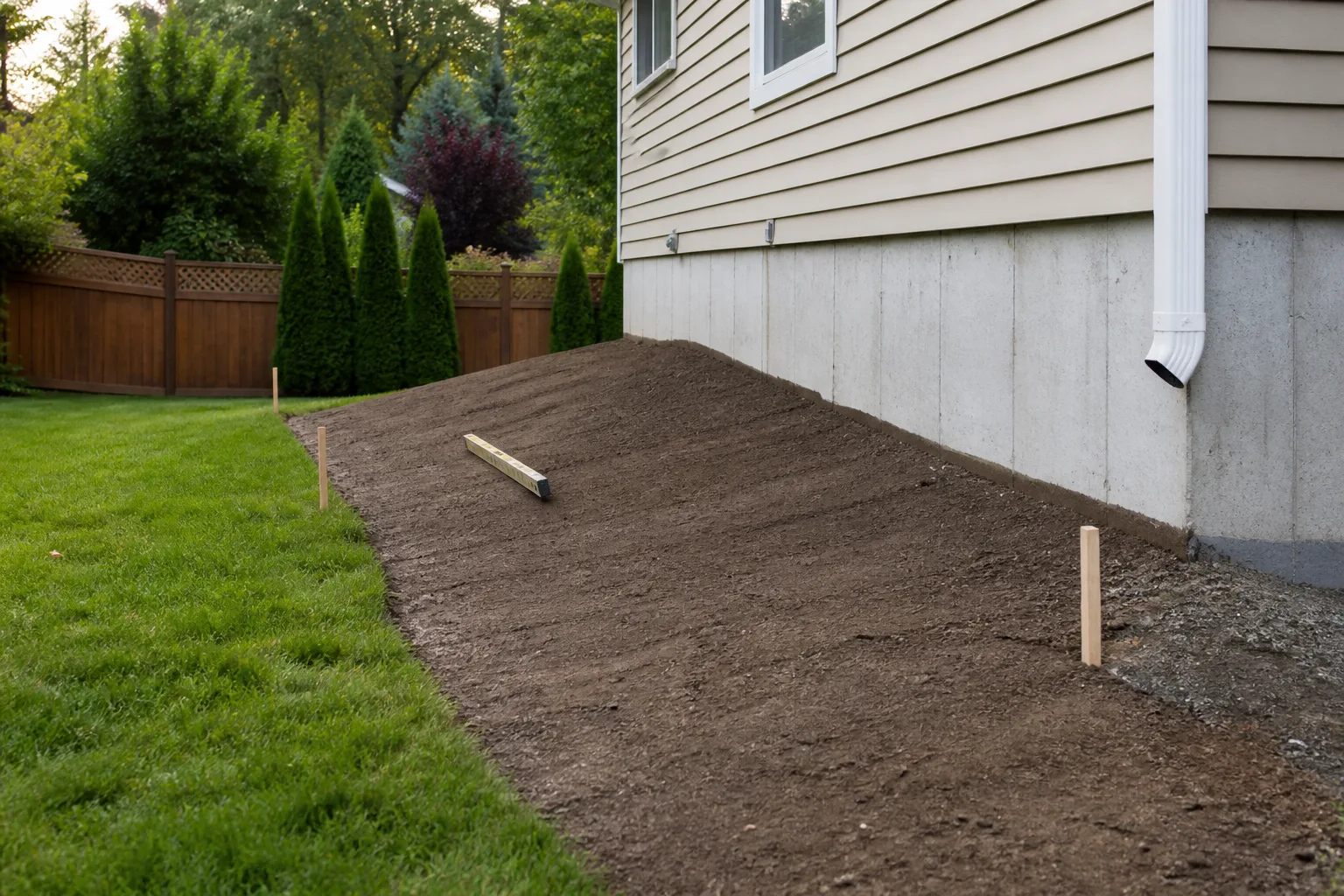
Start with the ground, not the paver catalog. A percolation or infiltration test can help estimate whether water will move through the subgrade. Check for compacted construction soil, shallow bedrock, clay, buried debris, and a seasonal high water table. If the project is near a foundation or could affect a neighbor, local stormwater rules may require a formal plan or permit.
The surface slope matters even on a permeable project because the top layer still experiences overflow. The base needs a stable aggregate profile, clean drainage paths, and enough capacity for the rainfall and traffic the site receives. Ask for the cross-section in writing: surface, joint or bedding material, base, subbase, geotextile if used, edge restraint, subgrade, and outlet.
Do not confuse a hole that drains once with a site that can safely accept repeated storms. Test after the soil is representative of normal moisture, and be skeptical of a design that depends on perfect infiltration during the wettest season.
Route overflow away from foundations and lawn
Even an infiltration system should have a planned overflow. It might feed a broad planted area, grass swale, rain garden, drain inlet, or another approved outlet, depending on the site and local rules. Virginia Cooperative Extension describes swales as shallow, gently sloping channels that slow, spread, and filter runoff, while also warning that slope, foundation distance, soil, and water-table conditions determine where they belong.
Keep the overflow broad and stable. A narrow outlet aimed at a lawn corner creates a miniature waterfall that strips turf and soil. Use a planted or armored transition, spread the flow across a wider area, and keep water away from basement walls and neighboring properties. If you cannot explain the overflow route in one sentence, pause the project and resolve that design question first.
Fix grass struggling beside existing hardscaping
Do not remove a sound patio just because the grass beside it is brown. First identify whether the strip is too wet, too dry, too hot, compacted, salted, or simply receiving the wrong kind of traffic. Look at the pattern after rain, dig a small inspection hole at the lawn edge, and compare it with healthy grass several feet away.
Ponding or a fresh erosion channel points to grade and runoff. Stop adding irrigation, clear blocked drains, and find the higher surface sending water to the strip. A shallow diversion, wider planted receiving area, or repaired edge may solve the problem; major regrading should be planned so it does not send water toward a building or another property.
A narrow crispy strip beside sunny concrete points more toward heat and moisture stress. Check whether sprinklers miss the edge, whether the concrete reflects afternoon sun, and whether the grass species is suited to the exposure. Adjust irrigation coverage, widen the edge into a mulched bed, or replace a persistently failing strip with a regionally appropriate groundcover or planting rather than watering a hot, compacted ribbon forever.
Hard, bare soil with footprints or tire marks suggests compaction. Relieve compaction only when the grass is actively growing and the soil is not saturated, then repair the grade, add a thin compatible topdressing if needed, and reseed with a locally suitable grass. Do not bury a drainage problem under compost or seed; the new roots will encounter the same constraint.
Tan grass after snowmelt or repeated deicing points to salt exposure. Reduce and target salt, keep plowed snow away from the planting edge when possible, and improve the route of meltwater. If the soil is well drained, a deep clean-water rinse during the growing season may help move soluble salts below the root zone, but do not flush a site that already ponds or drains toward a stream.
If the edge fails only where people cut across the lawn, create a path. Repeated foot traffic is a design problem, not a fertilizer deficiency. A narrow permeable walkway can protect the remaining grass more effectively than trying to revive a compacted desire line every spring.
Maintain pervious surfaces so they keep draining
Permeable hardscaping trades some surface maintenance for better water management. Leaves, soil, mulch, sand, and fine sediment can fill the openings and reduce infiltration. Penn State Extension recommends regular cleaning to prevent clogging, and Gardening Know How notes that vacuuming twice a year is a practical maintenance approach for many permeable pavements.
Use that twice-yearly idea as a starting checkpoint, not a guarantee. Inspect after leaf fall, after winter sanding, and after any nearby construction or soil disturbance. If joints are filling, remove the sediment with the method specified by the installer; a pressure washer used carelessly can blast joint material into the base or onto the lawn.
Keep adjacent beds from washing soil across the surface. Direct downspouts away from the pavement unless the system was designed to receive roof runoff, sweep rather than push fine soil into joints, and repair ruts or settled edges before they concentrate flow. Watch the first several storms each season. Standing water on top, muddy discharge at the low edge, or a surface that dries much more slowly than before is a maintenance signal.
Inspect the lawn as part of the hardscape inspection. A pervious surface that is technically draining may still be sending overflow into one weak turf strip. Maintain the receiving area, remove sediment from swales, and keep grass dense enough to resist erosion. If the design no longer matches how the yard is used, change the use or redesign the surface rather than expecting maintenance to overcome an undersized system.
Conclusion
For grass, pervious hardscaping is often the better choice when it is sized, installed, and maintained as a complete drainage system. It can reduce concentrated runoff, puddling, erosion, and some winter surface hazards. But a pervious label cannot compensate for compacted clay, a high water table, a steep slope, a foundation too close to the infiltration area, or a base that was never designed for the traffic.
Impervious concrete and asphalt are not automatic lawn killers. They become a problem when their runoff is dumped onto a narrow turf edge, when heat and salt are ignored, or when the site has no safe outlet. Start your decision with a rain map, soil and slope check, traffic estimate, overflow route, and maintenance plan. Then choose the surface that fits the job—and give the grass a receiving area that can actually handle the water.



