Philodendron ‘Prince of Orange’ Care Guide
Find the right light and watering rhythm for Philodendron ‘Prince of Orange,’ plus clear guidance on orange new leaves, soil, pests, repotting, and pet safety.
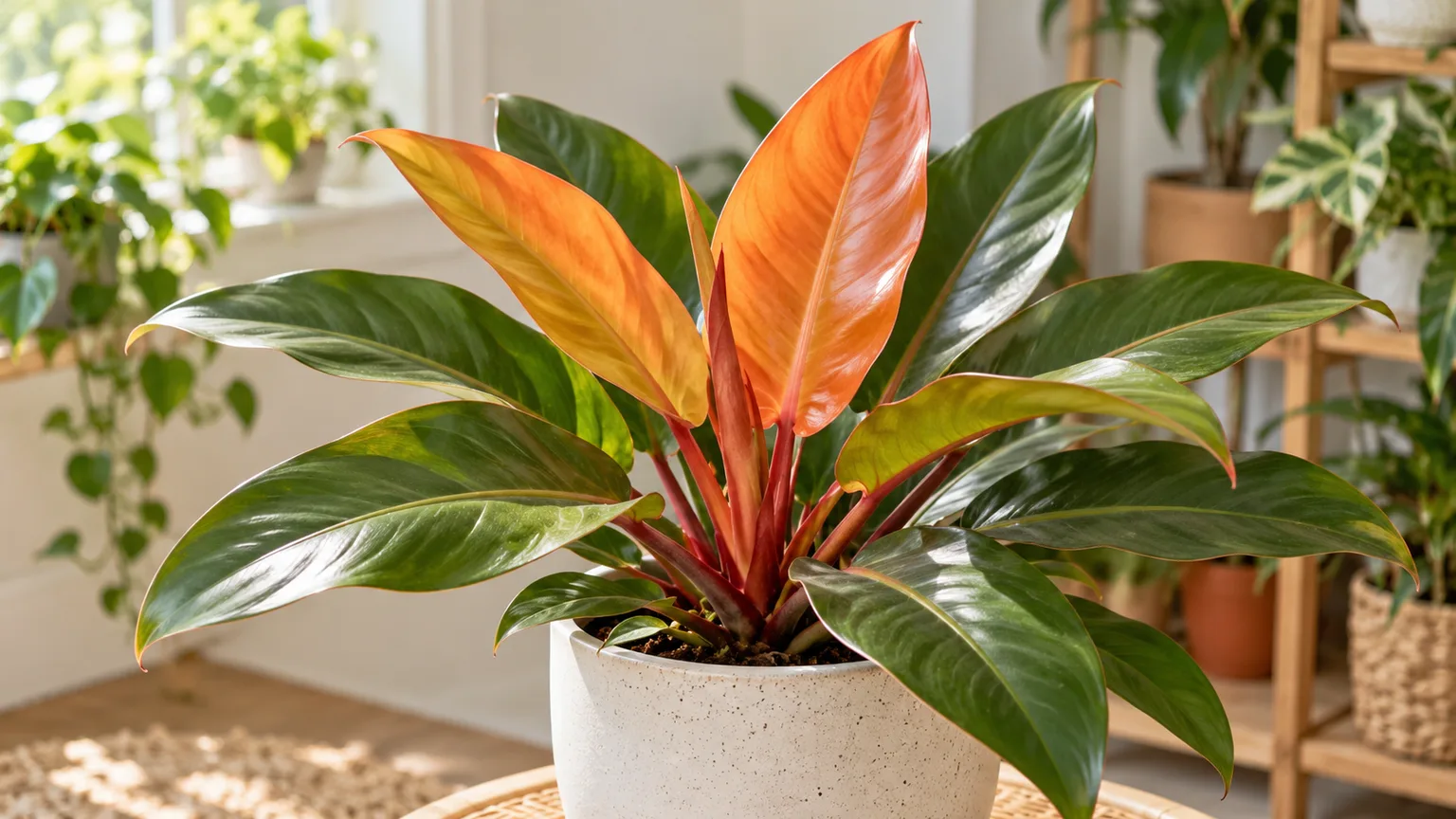
A Philodendron ‘Prince of Orange’ is easiest to care for when you understand its two defining traits: it grows as an upright rosette rather than a trailing vine, and its new leaves are naturally orange before they mature to green. Give it bright filtered light, an airy potting mix, and a thorough watering only after the mix has partly dried. That simple routine does more for the plant than misting it daily or following a fixed weekly schedule.
The color transition is part of the plant’s normal growth, not a sign that the leaves are losing variegation. The Royal Horticultural Society describes the cultivar as upright, with bright yellow leaves changing through copper-orange to dark green; the original plant patent describes a compact self-heading rosette with orange juvenile leaves and mature foliage that greens with age. (RHS cultivar profile; original U.S. plant patent)
Know the rosette before you copy generic philodendron advice
‘Prince of Orange’ is a self-heading hybrid cultivar: its leaves emerge from a short central crown and form a dense, upright clump. It is not the long, node-spaced vine sold as heartleaf philodendron, so advice about training a philodendron up a pole or taking several stem cuttings from a trailing vine does not automatically fit this plant. NC State Extension separates philodendrons into climbing and self-heading forms, while the original cultivar patent describes ‘Prince of Orange’ specifically as a compact rosette. (NC State Extension’s philodendron overview; USPP6797P)
The cultivar is grown for colorful new growth, not for leaves that stay orange forever. A fresh leaf opens in orange or apricot tones, may pass through yellow-green, then settles into green as it hardens; a healthy plant can therefore carry several leaf ages and colors at once. This is a developmental sequence, not true variegation, so an older green leaf is not “reverting” and does not need more fertilizer.
Size depends on starting age, pot, light, and growing season. The patent reports an average height of about 18–20 inches and a spread of roughly 36 inches for a one-year plant grown from a tissue-culture liner under described production conditions; treat that as a cultivar reference, not a promise for a household pot. The RHS gives a broad mature range of 0.5–1 meter, and both sources support planning for a wider footprint than the narrow pot suggests. Rotate the plant so its leaves have space on all sides, and avoid squeezing the crown against a wall.
Give it bright, filtered light
Light is the main controllable factor for compact growth and fresh orange color. Iowa State Extension notes that philodendrons with bright foliage generally need moderate to indirect light, while UF/IFAS lists ‘Prince of Orange’ as a self-heading hybrid whose orange juvenile leaves and continued growth require high interior light levels. The aim is bright but filtered light: enough for active growth, without hours of hot direct sun beating on the leaves. (Iowa State Extension; UF/IFAS commercial philodendron guidance)
A bright east-facing window is a dependable starting point. A south- or west-facing window can also work if a sheer curtain diffuses the strongest sun or the pot sits back from the glass; in a dim room, move closer to the window before buying a grow light. A north-facing window may keep the plant alive in some homes but often produces slower growth and less striking new foliage, especially in winter.
Choose a window by the light that reaches the leaves
Look at the plant’s actual position, not only the window direction. If a hand held near the leaves casts a clear-edged shadow for much of the day, the light may be stronger than expected; if the leaf surface stays dim even at noon, a spot closer to the glass or an appropriately placed grow light may help. The plant should not touch a hot pane, and direct afternoon sun should not leave bleached patches or dry scorch marks.
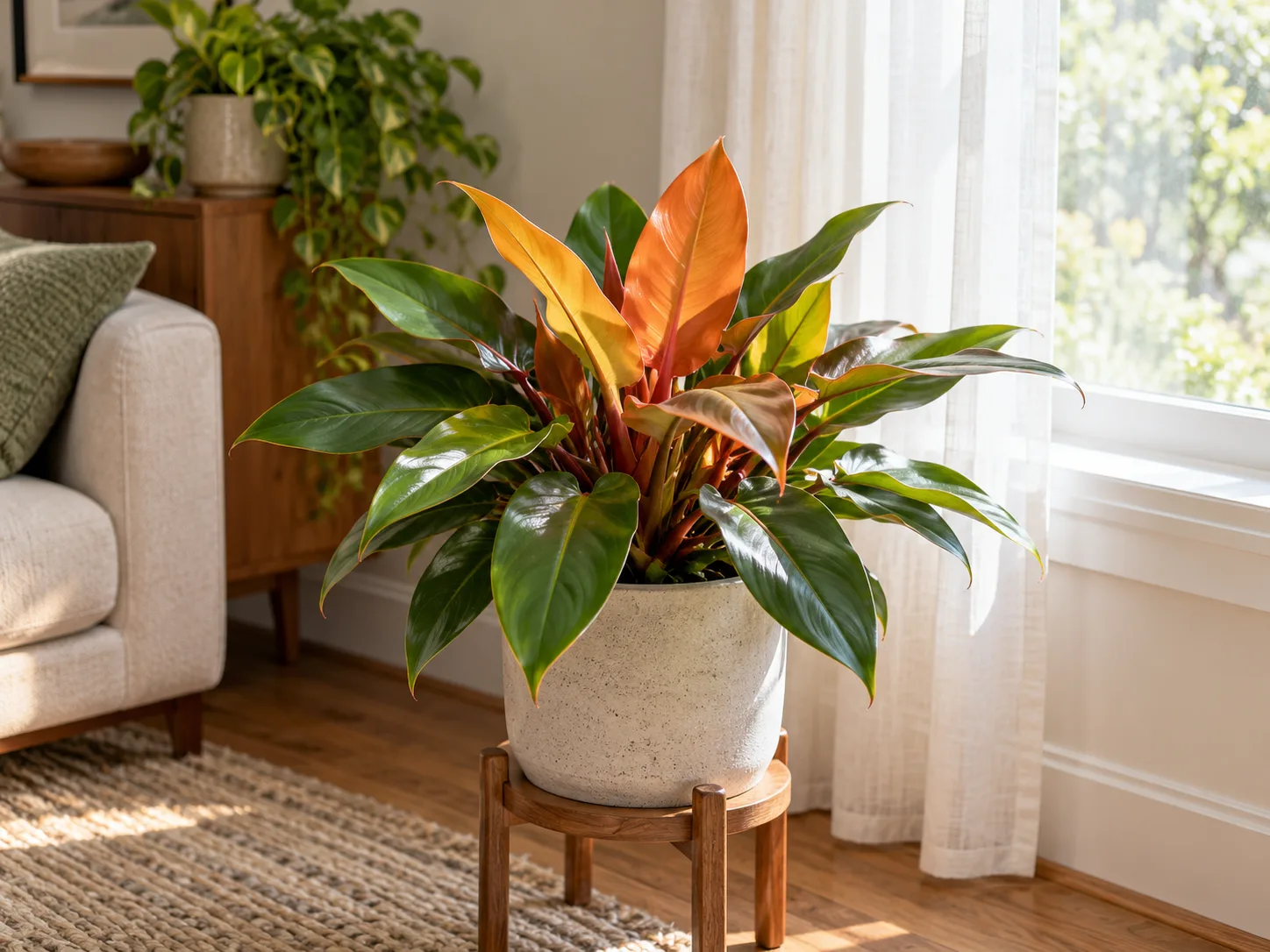
Rotate the pot a quarter turn every week or two if it leans toward one window. A plant that grows asymmetrically is responding to directional light; pruning the crown to “even it out” can remove healthy leaves without correcting the cause. After moving it, judge the next leaf rather than expecting old foliage to change color or shape.
More light is not always better. The original patent describes color shifts under very high light and heat, while extension guidance warns that harsh direct sun can scorch philodendron leaves. If fresh growth looks dull bronze or the window-facing leaves develop pale, crispy patches, soften the exposure rather than moving the plant into deeper shade.
Water by checking the mix, not the calendar
Water when the top portion of the mix has dried, then water through the whole root ball until excess drains from the bottom. For a medium pot, check about 1–2 inches below the surface; in a small starter pot, use a shallower check so the entire root zone is not allowed to dry out. Iowa State Extension recommends watering when the surface soil is dry and keeping philodendrons evenly moist but not wet; that balance matters more than matching a weekly interval. (Iowa State Extension)
Use a finger, a clean wooden skewer, or pot weight. If the surface feels dry but the mix deeper down is cool and damp, wait and check again in a day or two; if the upper root zone is dry and the pot feels noticeably lighter, water thoroughly. Empty the cachepot or saucer after it drains so the roots do not sit in runoff.
Do not give small sips every few days. Frequent surface watering can leave the deeper root ball alternately dry and wet, while the owner may read drooping as thirst and add even more water. A complete soak followed by a drying interval helps the mix re-wet evenly and lets the roots access both moisture and air.
Slow the routine as growth and light slow
A plant pushing leaves in a warm, bright room uses water faster than one sitting in a cool, low-light winter corner. Check the soil on a regular day if that helps you remember, but let the soil—not the calendar—decide whether to water. Iowa State’s general houseplant guidance explains that watering frequency changes with light, temperature, humidity, soil, pot, plant size, and season. (Iowa State Extension houseplant guidance)
If the plant is newly purchased, recently repotted, or recovering from root damage, check more often but do not water just because it looks stressed. Drooping can come from either very dry mix or roots that are too wet to function; inspect soil before choosing a fix. Water droplets at the leaf tips after a thorough watering can be guttation, so they are not a reason to add more water.
Build an airy soil and pot setup
The roots need a mix that holds some moisture but does not stay airless for days. A practical home blend is two parts quality indoor potting mix or coir-based mix to one part orchid bark and one part perlite or pumice; adjust toward more water retention in a hot, dry home or more aeration in a cool, humid room. The point is not a magic recipe but a coarse, stable structure that lets water move through and roots breathe. UF/IFAS commercial production guidance similarly calls for media with both moisture-holding capacity and aeration. (UF/IFAS philodendron production guidance)
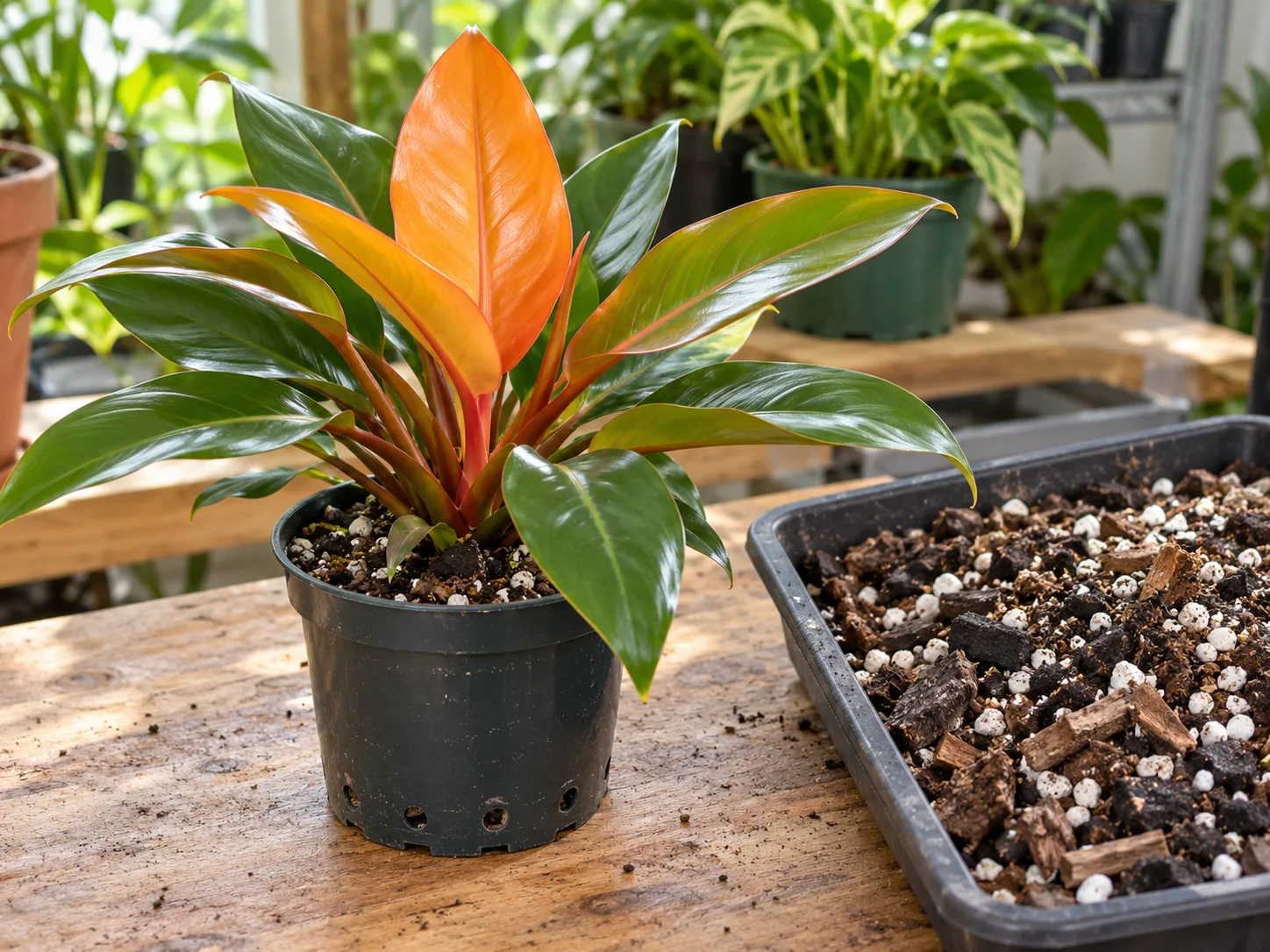
Use a pot with an open drainage hole. A decorative cover pot is fine if the inner nursery pot can be lifted out for watering and fully drained; a sealed container makes it difficult to know whether the center of the root ball is still saturated. Do not add a gravel layer to the bottom as a substitute for drainage: it does not create an exit for excess water, and the root zone still depends on the mix and the pot’s actual hole.
If water races down the sides without wetting the mix, the soil may have become hydrophobic or compacted. Water slowly in two passes, letting the first pass soak in, then inspect whether the core has rehydrated; persistent channeling is a reason to refresh the mix. If water remains pooled on top for several minutes, the mix is likely too fine or broken down for the conditions.
Keep it warm and use humidity as a fine-tuning tool
Normal warm indoor temperatures suit the plant. Keep it away from cold window glass, open winter doors, and air-conditioning vents that blow directly over the leaves; sudden chills are more stressful than ordinary room-to-room temperature changes. NC State Extension gives 65–85°F as a general philodendron range, and Iowa State Extension says typical home temperatures of 65–80°F are well tolerated. Those are genus-level ranges, not a cultivar-specific thermostat target. (NC State Extension; Iowa State Extension)
Higher humidity can support tropical foliage, but ‘Prince of Orange’ does not need a greenhouse to live in a home. Start by keeping it out of dry drafts and grouping it with other plants; if indoor air is persistently very dry and new leaves repeatedly develop crisp margins despite sound watering and roots, a room humidifier can help. A pebble tray has only a small local effect, and daily misting does not hold room humidity up for long.
Do not leave foliage wet for hours in a cool, poorly ventilated corner. Humidity describes water vapor in the air; wet leaf surfaces are a different condition and can encourage spotting when air movement is poor. Wipe dust from the broad leaves with a damp cloth and let them dry, rather than misting them as a substitute for watering.
The plant may spend a warm summer outdoors in a sheltered, bright-shade location after gradual acclimation, but it is not frost hardy. Move it back inside before nights turn cool, and inspect it for insects before bringing it near other houseplants. In a tropical, frost-free climate, an outdoor container can work if rain drains freely and midday sun is filtered; the indoor pot remains the safer choice where cold snaps occur.
Feed lightly while new leaves are forming
A balanced liquid houseplant fertilizer is enough during active growth. Follow the product label and begin conservatively—half-strength once a month in spring and summer is a reasonable household routine for a plant producing new leaves, especially if it is in fresh potting mix. The RHS recommends a balanced liquid feed monthly through the growing season for this cultivar; Iowa State Extension gives a broader once-or-twice-monthly schedule for actively growing philodendrons. (RHS cultivar profile; Iowa State Extension)
Pause feeding when growth slows in winter, when the soil stays wet, or when the roots are damaged. Fertilizer cannot make old leaves orange again, and extra nutrients will not compensate for dim light. If the potting mix already contains slow-release fertilizer, wait until the label’s feeding window has passed before adding more.
A white crust on the mix or pot rim can be fertilizer or mineral-salt buildup. Flush the mix with plain water in a sink, allow it to drain completely, and reduce the dose or frequency at the next feeding. Brown edges alone do not prove that the plant needs more food; check light, moisture, root health, and salt buildup first.
Repot when the root ball gives you a reason
Repot when roots circle densely, emerge from the drainage hole, or the plant dries unusually fast despite normal light and temperature. A plant that is simply top-heavy may need a more stable outer cachepot, not a large increase in soil volume. The RHS lists repotting every two to three years as a general interval, but root and mix condition are better triggers than an anniversary. (RHS cultivar profile)
Choose a pot only one size larger, roughly 1–2 inches wider than the root ball, with drainage. An oversized pot holds a large volume of mix that the existing roots cannot use; in a dim room that extra soil can stay wet long enough to invite root rot. If the root ball is healthy and the pot still drains and dries normally, refreshing the top layer or waiting is often kinder than repotting on schedule.
Spring or early summer is the easiest time because the plant can resume growth as days lengthen. Loosen only the outer circling roots, remove sour or collapsed mix if present, and set the crown at the same height it occupied before; burying the central growth point can keep new foliage too wet. Water the fresh mix through once and let it drain, then wait to fertilize until the plant has settled and resumes growth.
Propagate only from a real growth point
Propagation is possible, but this is a harder philodendron to divide than a vine. Its short central stem and tight rosette do not provide a string of obvious nodes to cut into many pieces. The original patent describes propagation from crown offshoots and commercial tissue culture; the RHS lists stem-tip or leaf-bud cuttings, while practical horticulture guidance notes that the self-heading habit limits ordinary cuttings. (USPP6797P; RHS propagation guidance; Houseplant Central’s cultivar guide)
The safest home opportunity is a basal offset that has its own growing point and, ideally, a few roots. Unpot the plant when it is actively growing, brush away enough mix to see where the offset joins the parent, and separate only if there is a clear division line. Use a sterile blade to make one clean cut, keeping a portion of crown or bud tissue and roots with the offset; a detached leaf and petiole without a bud cannot grow into a full plant.
Pot the division into a small container with drainage and fresh airy mix, firm it gently, and keep it warm in bright indirect light. Keep the medium lightly moist while the new roots establish, not saturated; avoid a sealed humidity dome if condensation stays on the leaves or the mix remains wet. Do not divide a single crown just to make more plants, and do not cut into the central growth point unless you can identify a viable bud section.
An outdated patent warning sometimes attached to this plant should not deter ordinary home propagation in the United States: the original U.S. plant patent is listed as expired. That status concerns this specific patent and jurisdiction; it does not settle trademark rights or plant-protection rules elsewhere, especially for commercial production. For a household collection, wait for a real offset rather than forcing a weak cutting.
Prune gently and keep the leaves clean
The compact rosette largely maintains its own shape, so routine tip-pruning is unnecessary. Remove a fully yellowing or damaged outer leaf by cutting its stalk close to the base with clean snips, taking care not to nick the central crown where new leaves emerge. One old outer leaf yellowing at a time can be normal as the plant adds foliage.
Do not remove every leaf that has turned green with age. Mature green leaves still photosynthesize and help support the next flush of growth; pruning for color would remove the normal older stage of the plant’s foliage cycle. If the plant leans, rotate it toward the light instead of repeatedly cutting leaves on one side.
Dust can dull the gloss and make it harder to inspect for pests. Wipe each leaf with a soft damp cloth, supporting it from below so the petiole does not bend; avoid oil-based leaf-shine products that can leave residue. Wear gloves when trimming or dividing, then wash the tools and your hands.
Catch pests before they settle in
Inspect the undersides of leaves, the tight leaf bases, and the crown every week or two, especially after bringing home a new plant or moving this one outdoors. Scale insects look like fixed brown or tan bumps; mealybugs form white cottony clusters; spider mites cause fine stippling and sometimes webbing; thrips can leave silvery scarring and tiny dark specks. The RHS identifies scale and glasshouse red spider mite as possible pests, while NC State Extension lists mealybugs, aphids, thrips, and spider mites across the genus. (RHS cultivar profile; NC State Extension)
Isolate a plant with suspected pests before treating it. Wipe or rinse what you can see, then use a product labeled for the pest and indoor ornamental plants, following its directions and testing a small area first; do not improvise a strong dish-soap mixture or apply oil in direct sun. Repeat inspections matter because eggs or hidden insects may survive the first pass.
Fungus gnats are a different clue: adults hovering above the mix often mean the soil is staying wet for too long. Let the mix dry to the plant’s normal watering point, empty standing water, and check drainage rather than spraying the leaves. Persistent yellowing, soft stems, or a sour smell calls for a root check, since chronic soggy mix can cause root loss even if no visible pest is present.
Troubleshoot the leaves in context
A single symptom rarely names the cause by itself. Read the leaf’s age and position, feel the mix, and check the window exposure before changing care; the newest leaf is usually the best report card for current conditions. Make one adjustment, then watch the next growth rather than trying brighter light, extra water, fertilizer, and humidity at the same time.
Orange leaves aging to green versus green new growth
An orange leaf in the center that later becomes green is following its normal maturation pattern. Do not cut it off, move the plant, or increase feeding just because the color faded; the next leaf will emerge orange again when the plant has enough energy and is actively growing. UF/IFAS describes the orange juvenile foliage as a key cultivar trait and says high interior light helps maintain color and continued growth. (UF/IFAS commercial philodendron guidance)
If new leaves emerge mostly green, first check whether the plant is farther from the window than it used to be, shaded by a curtain or furniture, or growing through a low-light season. Increase filtered brightness gradually and avoid sudden hot sun; then judge the next one or two leaves, since existing foliage will not recolor. If new growth remains consistently unlike the cultivar’s usual orange stage under good light, verify the plant’s label and compare its upright rosette and red petioles with a reliable cultivar description.
A new leaf that looks folded or curled while it is still emerging may simply be unfurling. If fully expanded leaves continue to curl, inspect the mix for both dryness and saturation, look for pests in the crown, and check for cold drafts before raising humidity. Curling alone is not a reliable signal to water.
Yellowing, brown edges, curling, and drooping
One older outer leaf turning yellow at a time can be normal; several leaves yellowing together deserve investigation. If the soil is wet days after watering, the pot has no drainage, or roots are dark and mushy, address excess moisture and root health first. If the mix is dry well below the surface and the pot is light, water thoroughly and then resume checking before the next watering.
Crispy brown margins can follow a dry root ball, hot direct sun, a cold draft, or fertilizer salts. Check these in order: soil moisture at root depth, contact with intense afternoon sun, the plant’s distance from heating or cooling vents, and any white crust on the mix. Humidity may contribute, but adding a humidifier will not fix roots sitting in cold wet soil.
Soft dark patches after a cold night point to chilling injury; pale patches that crisp on the window side suggest too much direct sun. If there is a spreading wet-looking lesion, isolate the plant, keep the leaves dry, and improve airflow while checking for a pest or disease source. The original patent reported resistance to some leaf rots and spots under its trial conditions, but that is not immunity under every indoor environment.
Keep the plant away from pets and chewing children
Philodendron foliage contains insoluble calcium oxalate crystals. Poison Control explains that the needle-like crystals can cause immediate mouth pain and swelling if chewed, and sap can irritate skin or eyes; the RHS likewise lists this cultivar as harmful if eaten and an irritant/allergen. Keep it out of reach of pets and young children, and wear gloves if you are cutting or dividing it. (Poison Control; RHS cultivar profile)
If sap gets in an eye or on skin, rinse with clean water. If a person or pet chews the plant, contact a local poison center, veterinarian, or emergency service for case-specific advice rather than trying a home remedy; seek urgent care for breathing difficulty, severe swelling, or worsening symptoms. A high shelf is not safe if a cat can jump to it or a fallen leaf can land within reach, so choose a stable, inaccessible location and remove pruned leaves promptly.
Conclusion
Give ‘Prince of Orange’ bright filtered light, a warm stable spot, and an airy pot with drainage. Water when the upper mix has dried, then let excess drain; feed lightly only while it is growing, and repot when the root ball—not the calendar—shows it needs room.
Expect its orange juvenile leaves to mature to green, and judge light by the next new leaf rather than by old foliage. The rosette habit also changes propagation: wait for a genuine offset or viable bud instead of treating it like a long-stemmed vine. With those cultivar-specific expectations in place, the plant’s routine is straightforward, and yellowing, curling, or brown edges become clues to inspect rather than reasons to overhaul every part of its care.



