20 Plants With Purple and Green Leaves for Indoors & Out
Discover 20 plants with purple and green leaves, from trailing houseplants to shade-tolerant perennials and edible greens, with practical light and care notes.
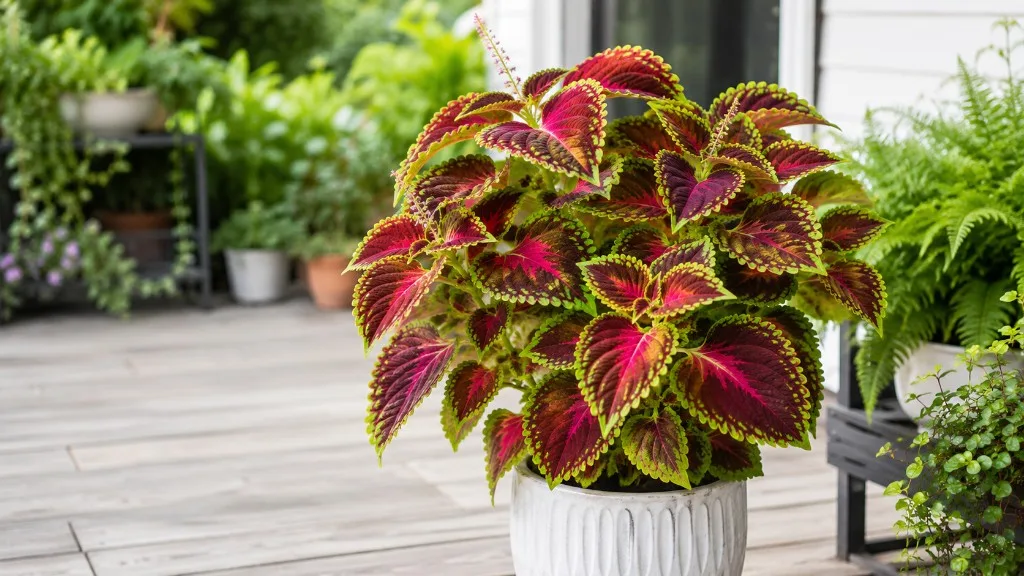
Purple-and-green foliage can mean a leaf striped down the center, a purple underside that flashes when the plant moves, or a green leaf marked with a dark cross. Those are different looks, and they do not all want the same window, garden bed, or watering routine.
The choices below cover houseplants, outdoor accents, and edible greens. Start with the place you can offer, then pick the leaf pattern you like; that order saves more disappointment than buying the most colorful plant in the shop and trying to make it fit later.
Choose for the Place You Have
| If you want… | Start with… | Why it fits |
|---|---|---|
| A colorful indoor pot | Rex begonia, coleus, Persian shield, or prayer plant | Their patterned leaves show well at eye level; light needs vary, so match the cultivar to the window. |
| A trailing shelf or basket | Inch plant, purple waffle plant, or purple heart | Their stems spill over a pot and can be trimmed to keep the outline full. |
| A part-shade garden accent | ‘Green Spice’ coral bells or a suitable coleus | They bring leaf color without requiring a hot, exposed bed. |
| A large tropical statement | ‘Black Magic’ taro | Its oversized leaves need room, warmth, and consistently moist soil. |
| Color you can harvest | Shiso, tatsoi, Red Russian kale, or Dark Opal basil | These are edible foliage crops, but they have different season and light preferences. |
Read the tag for the cultivar, not only the common name. Coleus is a good example: current selections range from shade-tolerant plants to sun-tolerant ones, so old blanket advice can mislead; NC State Extension describes the familiar species as best in moist, rich soil and part shade, while newer cultivars may be bred for sunnier exposures (NC State Extension Plant Toolbox; Country Living’s coleus growing guide).
20 Plants With Purple and Green Leaves
The shortlist focuses on plants whose leaves carry both colors, including plants where the purple sits underneath. A few have white, silver, pink, or red mixed in too; those extra tones are part of the pattern, not a guarantee that every leaf will match a catalog photo.
Houseplants for Color at Close Range
1. Persian shield (Strobilanthes dyerianus). Its long, textured leaves flash metallic purple, green, and silver, so it reads as a bold focal plant rather than a subtle accent. Give it bright filtered light and evenly moist, well-drained soil; in a cold winter it is usually treated as a seasonal outdoor plant or moved inside before temperatures drop.
2. Coleus (Coleus scutellarioides). Choose named cultivars such as ‘Wizard Mosaic,’ ‘El Brighto,’ or a purple-and-green ColorBlaze selection for scalloped leaves with clear color contrast. Coleus makes a fast, flexible pot or summer-bed choice, but check the tag for sun tolerance and pinch the tips if you want a compact mound instead of a lanky stem.
3. Purple passion plant (Gynura aurantiaca). Fine violet hairs give its dark green leaves a velvety purple halo, especially where light reaches the leaf edges. It suits a bright room with filtered light and a potting mix that drains; let the surface begin to dry between waterings, and avoid misting the fuzzy leaves as a shortcut to humidity.
4. Purple waffle plant (Hemigraphis alternata). The puckered leaves often show green-purple coloring on top and a richer burgundy underside, which makes a shallow pot or hanging basket especially effective. It appreciates warmth, bright indirect light, and steady but not stagnant moisture; do not put it in the same dry-down routine as a succulent.
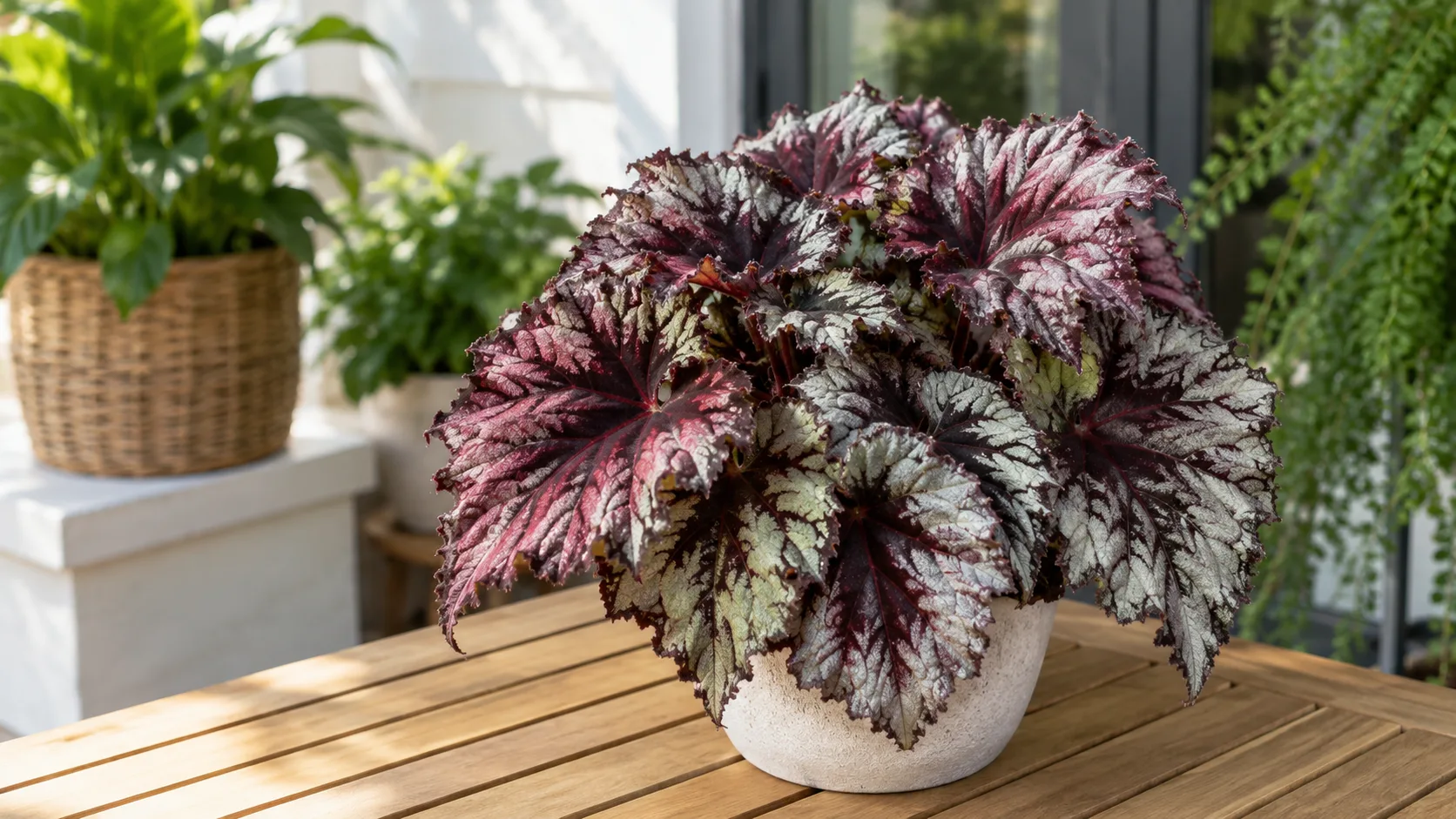
5. Rex begonia (Begonia rex-cultorum). Rex begonias are a group of foliage hybrids, not one uniform pattern: look for cultivars with green or silver areas crossed by plum, violet, or wine-colored centers. Their leaves are the feature, so choose a cultivar you like in person when possible, then give it bright indirect light and a porous mix that does not stay waterlogged.
6. Boat lily, or oyster plant (Tradescantia spathacea). This upright rosette keeps its purple largely underneath long green leaves, so the color appears when leaves arch or the pot is viewed from below. It works in a warm, bright spot indoors or outdoors in frost-free conditions; in colder regions, use a container and bring it inside rather than expecting it to overwinter in the ground.
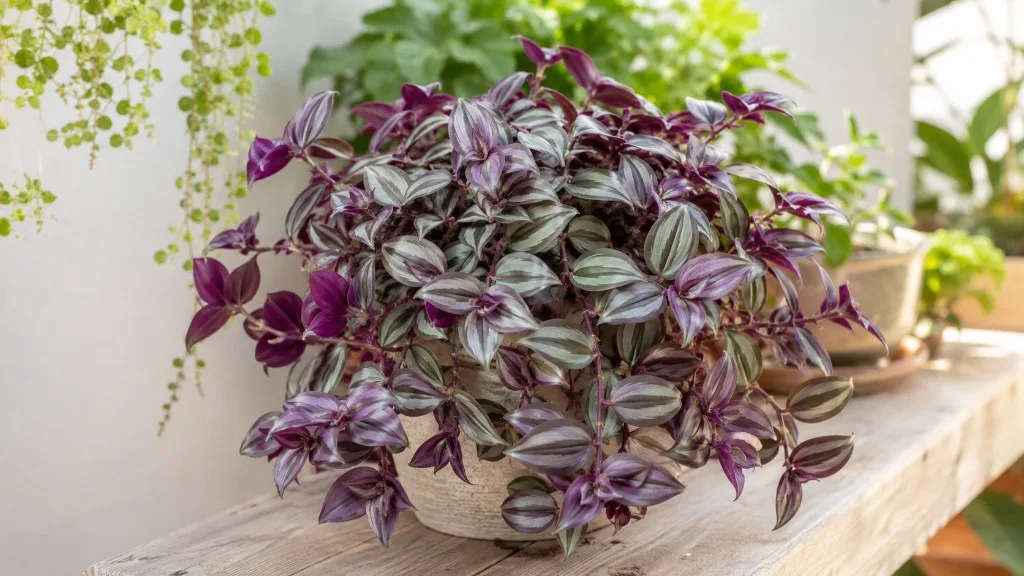
7. Inch plant (Tradescantia zebrina). Its trailing leaves have silvery-green bands over purple, making the contrast easy to see from across a room. Give it bright indirect light for shorter, denser growth, trim stems when they become sparse, and root healthy cuttings in water or moist potting mix to refresh the pot rather than letting a long bare center remain.
8. Purple heart (Tradescantia pallida). This plant is usually more purple than green, but the leaf undersides and stems can show contrasting green tones, especially where the plant receives less light. It makes a vigorous warm-weather spiller for a patio pot; use sharp drainage, trim it before stems become tangled, and keep it contained if you do not want a fast-growing trailer to spread beyond its space.
9. ‘White Fusion’ calathea (sold as Calathea ‘White Fusion’; botanically Goeppertia lietzei). The green-and-white marbling on top is paired with purple undersides, so it offers a layered effect rather than a solid purple leaf. Keep it in bright indirect light, away from harsh afternoon sun, and aim for even moisture without leaving the roots in a cachepot full of water.
10. Watermelon peperomia (Peperomia argyreia). Rounded leaves have alternating silvery-green bands, while their backs can carry a reddish-purple cast. This compact option is easier to fit on a desk than the broad-leaved tropicals; use a light, airy mix and let the upper layer dry before watering again, since a small pot can stay wet longer than its foliage suggests.
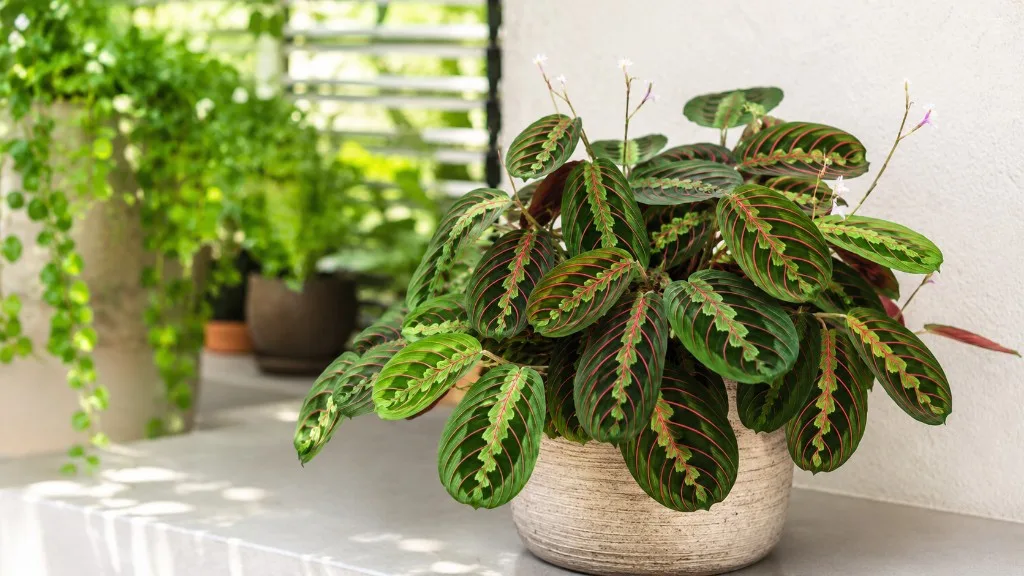
11. Red-veined prayer plant (Maranta leuconeura var. erythroneura). The green upper surface is marked with red-to-purple veins, and some plants show a burgundy underside when their leaves fold at night. Choose it for a warm room with bright indirect light, not a dim corner; the moving leaves make the color change through the day part of its appeal.
Perennials and Container Accents
12. Four-leaf sorrel, or Iron Cross (Oxalis tetraphylla). Each green leaflet carries a maroon-purple mark near its base, making the pattern look like a cross when the four leaflets open flat. It stays small enough for a windowsill or patio pot and may pause or die back when conditions are too hot or dry; reduce watering while it is resting instead of assuming every bare stem needs more fertilizer.
13. ‘Green Spice’ coral bells (Heuchera ‘Green Spice’). This cultivar pairs silvery-green leaves with crisp purple veins, a quieter effect than a solid burgundy perennial. Plant it where it gets morning sun or bright shade and where the crown will not sit in wet soil; in a container, use a pot with drainage and check it more often during hot, dry weather.
14. Chinese fringe flower (Loropetalum chinense var. rubrum). This evergreen shrub can push out burgundy-purple new growth that matures toward deeper green, while pink or white fringe-like flowers add a separate seasonal feature. Cultivars vary in mature size and foliage color, so check the plant label before placing it beside a path or foundation; a dwarf selection is a better container candidate than a full-size shrub.
15. ‘Black Magic’ elephant ear (Colocasia esculenta ‘Black Magic’). Oversized smoky-purple leaves bring a tropical scale that smaller houseplants cannot match, and the green cast is easiest to see in bright, filtered light. This is a warm-season, moisture-loving plant for a large pot or sheltered garden spot; NC State notes that taro needs rich, moist soil and that all parts are poisonous unless cooked, so keep ornamental stock out of mouths and never treat it as a ready-to-eat crop (NC State Extension Plant Toolbox).
Edible Foliage and Cool-Season Color
16. Purple tatsoi (Brassica rapa subsp. narinosa). Purple selections form a low rosette of spoon-shaped leaves with green stems or veins, and the young leaves can be harvested like other tatsoi. It is a cool-season crop, so try it in mild spring or fall weather rather than expecting the same color or leaf quality through hot summer conditions.
17. Ornamental cabbage and kale (Brassica oleracea). These cool-weather plants form a central rosette where purple or pink leaves contrast with green outer foliage. Their best color develops as temperatures cool, but ornamental selections are bred for appearance and may be treated with products not intended for food crops; buy food-labeled kale or cabbage if you plan to eat the leaves.
18. Purple shiso (Perilla frutescens var. crispa). Some selections have green upper surfaces and wine-purple undersides, while others are almost entirely purple; inspect the seed packet or seedling rather than relying on the word “purple.” Shiso is an aromatic edible herb used in Japanese and other East Asian cooking, and it can self-seed, so remove flower spikes if you want to limit volunteer seedlings.
19. Red Russian kale (Brassica napus). This cold-season kale has green, oak-shaped leaves with purple stems, veins, and edges, so it gives a softer two-color effect than a fully purple cultivar. Grow it where it gets several hours of sun and keep the soil evenly moist while leaves are developing; harvesting the outer leaves first lets the center continue producing.
20. Dark Opal basil (Ocimum basilicum ‘Dark Opal’). Its glossy leaves range from purple to burgundy, often with green flecks or margins, and the same leaves can be used like other culinary basil. Give it warmth and a sunny position, pinch flower buds to prolong leafy growth, and do not plant it in a cold bed simply because another purple-leaf plant nearby tolerates chill.
Match a Plant to Your Light and Climate
For Bright Rooms Without Hot Direct Sun
Start with a Rex begonia, prayer plant, watermelon peperomia, or purple passion plant if your brightest window gets filtered light. A coleus or Persian shield can also work indoors, but both usually look fuller when they receive more brightness than a deep interior corner provides; if stems stretch toward the window and new leaves shrink, increase light gradually or add a grow light.
For Shade Beds and Containers
Try ‘Green Spice’ coral bells for a perennial border, or use a shade-tolerant coleus cultivar for seasonal color in a pot. The phrase “part shade” is not a promise of zero sun: morning sun with afternoon protection is often easier to manage than a dark, still corner, while wet soil and poor air movement can create a different set of problems.
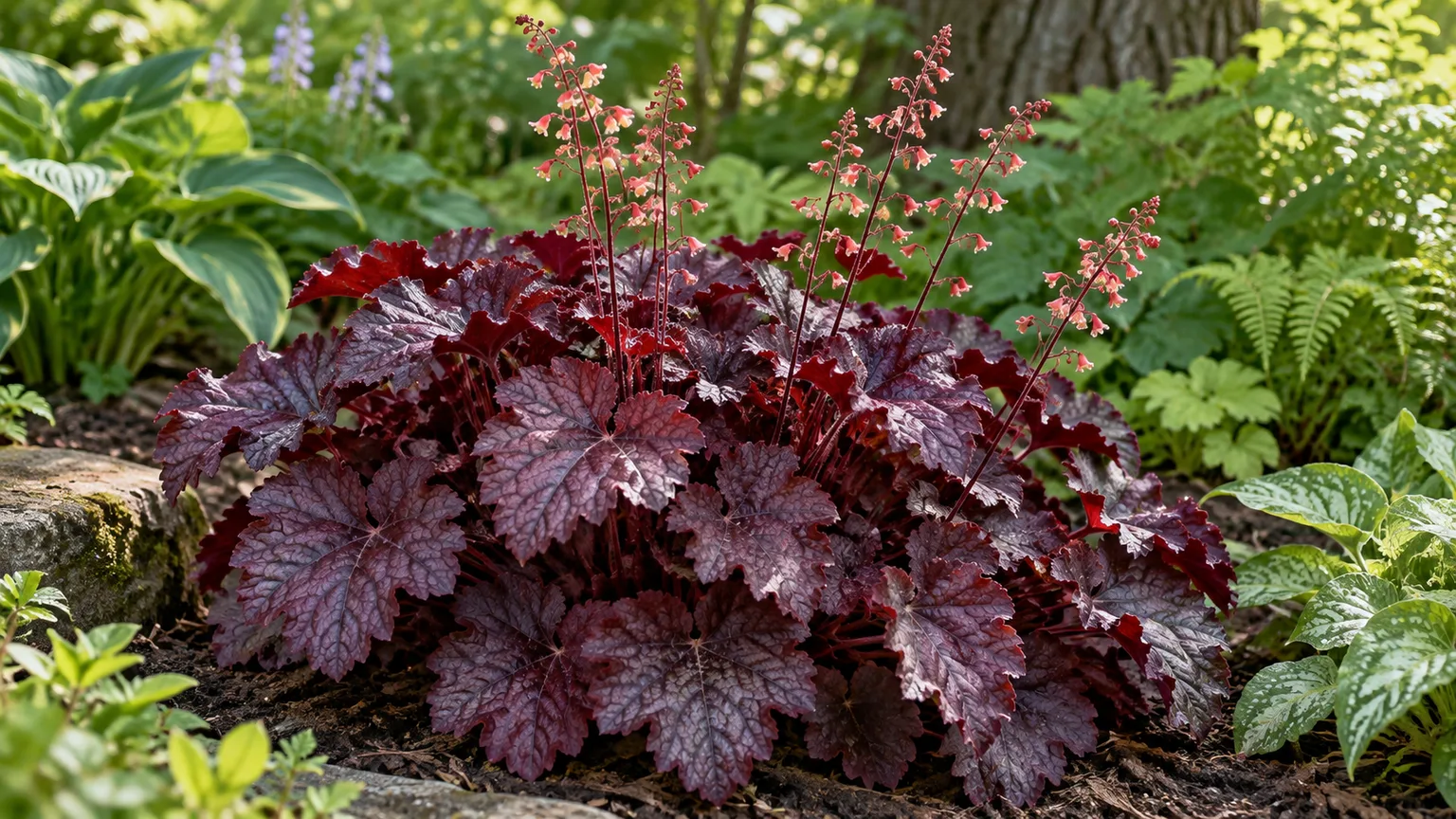
Heuchera also shows why the cultivar name matters: some coral bells are nearly black-purple, while ‘Green Spice’ is silver-green with purple veins. A darker-leaved Heuchera is a useful visual contrast in the garden, but it is not a photo of the ‘Green Spice’ pattern; when buying, compare the plant tag and actual leaf to the effect you want.
For Edible Leaves and Seasonal Color
Shiso, tatsoi, kale, and basil belong in the edible-garden plan, not the same care group as a prayer plant. Container-grown vegetables need enough light for the crop, a pot deep enough for its roots, and drainage holes; Fine Gardening’s container guidance emphasizes matching exposure and container size to the crop rather than treating all edible foliage alike (Fine Gardening). For a mixed summer display, a pot can combine coleus with flowering annuals, but a vegetable planter is easier to harvest when ornamental flowers do not crowd the leaves.
If you are planting for food, sow or buy the variety for the season you actually have. Cool-season tatsoi and kale can bolt or turn coarse in sustained heat, while basil wants warm soil and a longer, sunnier stretch; a packet’s days-to-maturity and temperature notes are more useful than matching every edible plant to a single calendar date.
Keep Purple and Green Leaves Looking Their Best
Light Brings Out Color, but More Is Not Always Better
Foliage color is partly a cultivar trait, and light changes how strongly it shows. Many coleus varieties intensify in brighter conditions, but a shade-grown plant can wilt or scorch when moved straight into hot midday sun; move it outdoors over several days and watch the leaves before increasing exposure again. NC State’s profile notes both the benefit of part shade and the risk of wilting in full sun for coleus, while modern varieties can have different sun tolerances (NC State Extension Plant Toolbox; Country Living).
Use new growth as your signal. If a plant keeps producing mostly green leaves, confirm that it is the colorful cultivar you bought, then adjust light in small steps; if the purple areas bleach, turn crisp, or show dry patches on the window-facing side, back it away from direct sun rather than adding fertilizer.
For a plant that spent weeks indoors, outdoor sun is a new growing condition even if the weather feels mild. Start it in bright shade, add a little morning sun after a few days, and pause the move if leaf margins pale or curl; acclimation protects leaves while the plant adjusts to stronger light and moving air.
Water to the Plant’s Roots, Not the Calendar
A plant with a purple underside may still have different water needs from a plant with a purple top. Feel the mix and consider pot weight: water a moisture-loving coleus or taro before its root ball dries hard, but let a peperomia’s upper mix dry between waterings. For houseplants, WSU Extension recommends judging moisture from the medium and plant conditions rather than using a fixed watering schedule; it also cautions that indoor mixes need both aeration and drainage (WSU Extension’s houseplant guide).
When you do water a pot with drainage holes, wet the mix evenly and let extra water escape, then empty the saucer or decorative cachepot. Repeated small sips can leave the lower root ball dry, while a pot left standing in water can starve roots of air; neither problem is solved by misting the leaves.
Pinch Stems and Remove Flowers Selectively
Pinching the growing tip of coleus or a trailing plant encourages branching and keeps a container from becoming a few long stems with a bare center. Use clean scissors, cut just above a leaf joint, and stop once the plant has the shape you want; pruning is for form, not a required ritual for every foliage plant.
Some coleus owners remove flower spikes to keep the display focused on leaves, but a flower does not mean the plant is failing. Let an edible herb like basil flower if you want to support pollinators or collect seed, and pinch it only when your priority is more leafy growth; the choice depends on whether you value foliage, flowers, or seed.
Bring Tender Plants Inside Before Frost
Persian shield, coleus, taro, and many purple-green tropicals are treated as seasonal outdoor plants in cold-winter areas. If you plan to overwinter one, inspect for pests, trim damaged growth, and move it inside before cold nights; place it in the brightest suitable window and reduce watering as growth slows. The RHS describes coleus as a warm, slightly shaded plant, and its seed-growing guidance is useful when restarting it indoors rather than trying to preserve an outdoor plant through winter (RHS coleus growing tips).
Hardiness labels describe outdoor survival, not a universal houseplant promise. A plant may live as a perennial in a warm climate, grow only as a summer annual elsewhere, and still be kept as a potted indoor specimen if its light and temperature are suitable.
Mistakes That Make Colorful Plants Struggle
Treating Every Purple Leaf as a Full-Sun Plant
“Purple” is a color description, not a light requirement. A sun-loving basil and a shade-oriented Rex begonia can both show purple, but direct midday sun that helps one may scorch the other; identify the plant first and acclimate it to any brighter location over a week or two.
Grouping Plants With Incompatible Water Needs
Putting taro beside peperomia because both have purple leaves creates a watering compromise that suits neither. Group by growing conditions instead: moist-soil plants together, plants that prefer partial dry-down together, and edible crops in a separate container where you can water and harvest them without disturbing ornamental roots.
Ignoring Size, Spread, or Pet Access
A compact rosette, a trailing basket plant, and a shrub do not belong in the same spot just because their leaves share a palette. Check the mature width and growth habit before planting, keep fast trailers in pots if their spread is uncertain, and verify each plant by botanical name where pets or small children can reach it. ASPCA Poison Control notes that its plant lists are not exhaustive, that common names can vary, and that eating any plant material can cause gastrointestinal upset; use the exact plant identity and contact a veterinarian if an animal may have eaten a toxic plant (ASPCA Poison Control plant list).
In an outdoor bed, also consider the plant’s winter behavior and what might happen after a mild season: a tender plant may disappear with frost, but a vigorous tropical trailer can keep rooting wherever it touches soil in a warm climate. Container growing makes that spread easier to control and also lets you move a frost-sensitive plant under cover without digging it up.
Conclusion
The prettiest plant for your home is the one whose color pattern suits the light you can provide and whose care fits your routine. Choose a coleus or Rex begonia for close-up leaf pattern, a Tradescantia for a trailing display, coral bells for an outdoor border, or an edible crop when you want color you can harvest.
Before buying, turn the leaves over, read the cultivar label, and decide whether the plant is staying indoors, spending a season outside, or going into the ground permanently. That quick check helps you get the purple-and-green effect you want without asking a shade plant to bake, a dry-soil plant to sit wet, or a tender tropical to survive a winter it cannot handle.