How to Grow and Care for Ponderosa Pine
Ponderosa pine care starts with space and drainage. Learn where to plant, how to establish roots, when to prune, and which warning signs call for an arborist.
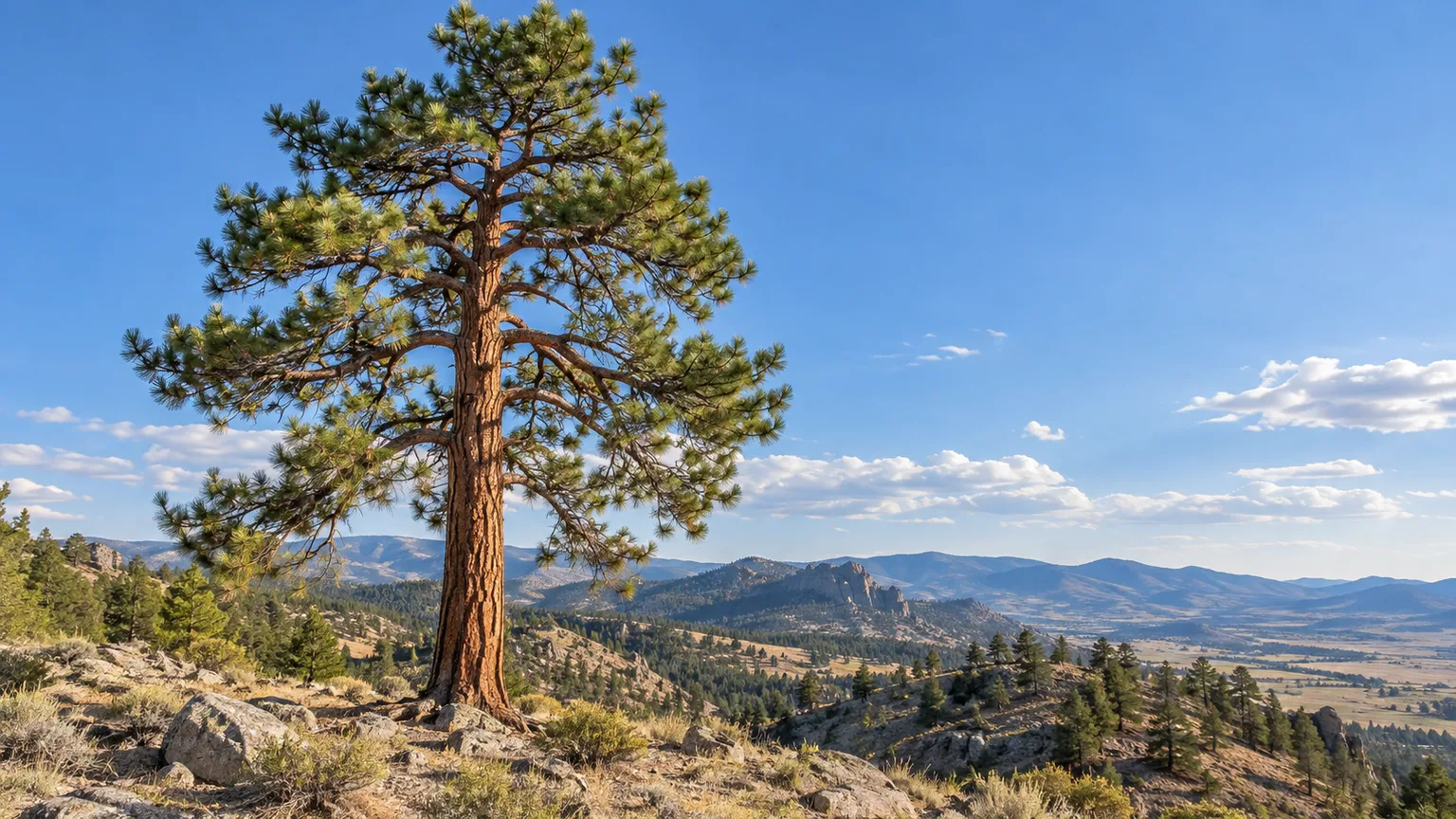
Ponderosa pine (Pinus ponderosa) is a striking western evergreen, but its adult dimensions make it a poor fit for many ordinary yards. Before buying one, picture a tree that can reach roughly 60 to 125 feet tall and 25 to 30 feet wide, not the compact nursery specimen sitting beside the checkout. NC State Extension’s plant profile describes it as a full-sun tree for large landscapes that dislikes shade, flooding, and poorly drained soil.
The care plan is straightforward once the location is right: plant in a sunny, freely draining site, keep the root ball evenly moist while it establishes, and leave a healthy mature tree mostly alone. The hard part is matching this long-lived tree to the property’s climate and future space. A hardy zone number cannot compensate for a damp, humid site or a crown that will eventually meet a roof or power line.
Decide Whether a Ponderosa Pine Fits Your Property
Start with the space, not the price or current height of the sapling. A standard ponderosa pine is a large landscape or park tree; it is not a foundation plant, privacy hedge, or specimen that can be kept small with annual topping. Plan for the listed mature spread and height, then leave additional room for branches, roots, snow load, and access for future maintenance.
Walk the site and look up as well as down. Avoid planting below power lines, beside a narrow drive, next to a building that needs clear roof access, or where the mature crown will block a view you want to keep. A small tree’s shade pattern also changes as it grows, so think about future garden beds and the light they will lose. Epic Gardening’s tree-selection guidance makes this useful planning point: choose a tree by its mature size and role in the landscape, not by the size of the planting hole you can dig today.
Climate fit is just as important. Ponderosa pine is native across much of western North America, but “native” spans very different elevations, rainfall patterns, and regional forms. If you live outside its native range—especially in a warm, humid region—ask a local Extension office or an experienced arborist whether the species performs reliably there before ordering one. If the answer is uncertain, choose a locally adapted pine rather than treating a broad hardiness rating as a guarantee.
Understand the Tree You’re Buying
A young ponderosa pine usually has a narrow, upright shape; older trees develop a taller trunk and a broader, more open crown. Mature bark becomes orange to yellow-brown and breaks into large plates, while the resinous needles are typically bundled in threes. The cone and needle details can vary among regional forms, so a bundle count alone is not a reliable way to identify a nursery tree.
The species has a wide natural range and recognizable regional variation. NC State Extension notes that Pacific, Rocky Mountain, and Arizona forms can differ in needle and cone traits; ask the nursery where its seed or stock originated if you need a tree adapted to a particular western region. For landscape use, the most important label details are botanical identity, expected mature dimensions, cold hardiness, and whether the plant is a species seedling or a named cultivar.
There is a meaningful difference between a small tree and a dwarf cultivar. A young standard pine is small because it has not grown yet; it will not stay that way. Some compact selections are sold for smaller gardens, but names and mature-size claims can vary among nurseries. Get the expected height and spread at 10 years and at maturity in writing, and do not assume that a plant labeled “dwarf” will remain suitable for a patio pot.
Choose a Site for Mature Growth
Ponderosa pine needs full sun—at least six hours of direct light, with open exposure preferred—and soil that drains rather than holding water against the roots. It can tolerate a range of soil textures and pH, including some alkaline soils, but it does not tolerate a chronically wet root zone. A sunny slope or broad, well-drained upland site is generally a better match than a low spot that collects runoff.
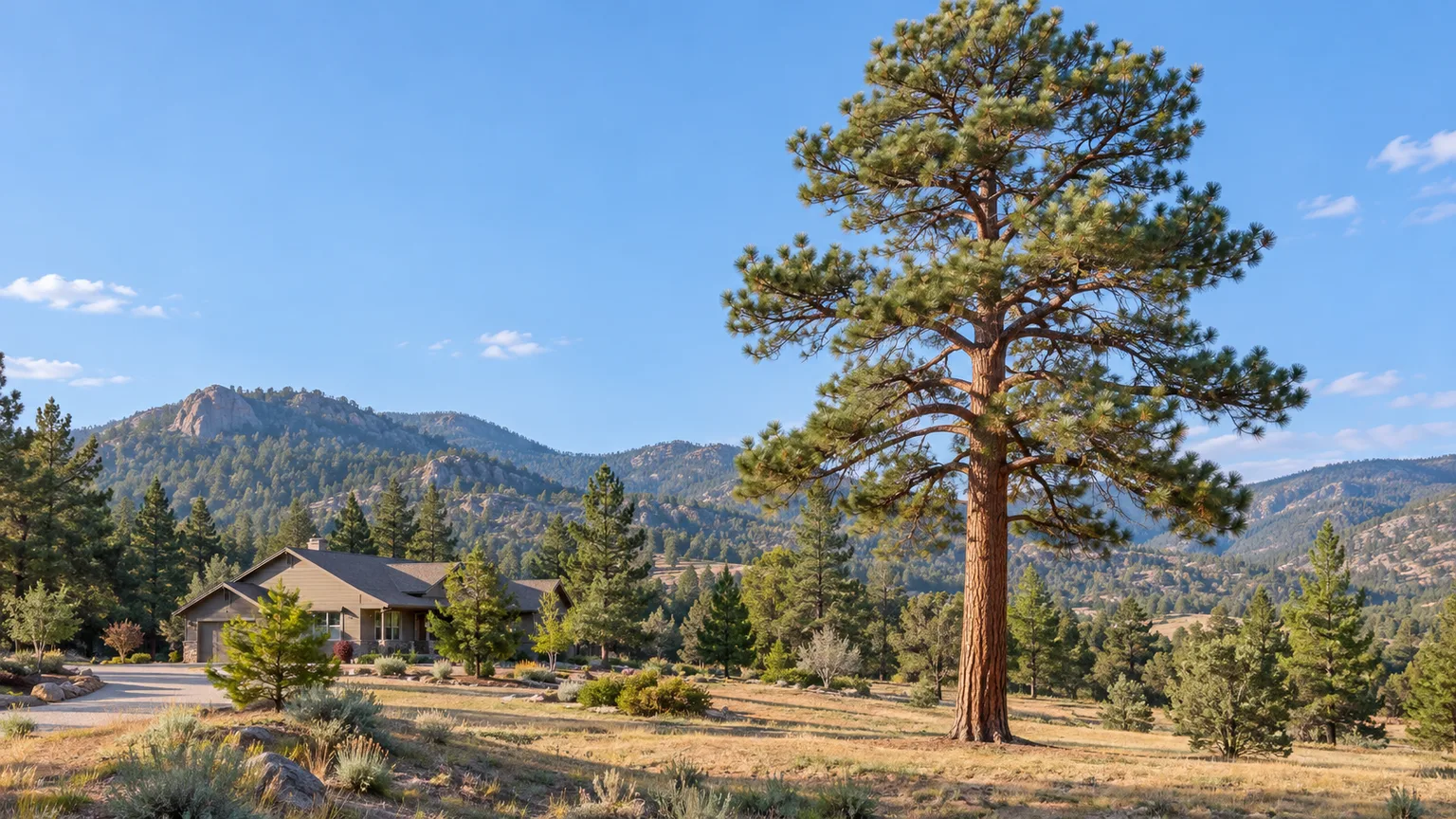
The phrase “moist, well-drained” can sound contradictory. It means the soil can supply water when roots need it, then drain enough air back into the pore spaces; it does not mean the tree wants to stand in wet soil. After a hard rain, check whether water remains around the proposed planting spot the next day. If the ground stays saturated, fix the drainage problem across a broad area or move the tree. A layer of gravel at the bottom of a planting hole will not turn a wet site into a well-drained one.
Consider the local summer climate too. NC State Extension lists the tree for USDA Zones 3a–7b, but that rating describes winter cold tolerance, not universal suitability in hot, humid, or rainy regions. Extension’s profile also warns against poorly drained and flooded sites. The Gymnosperm Database’s species account describes substantial variation across the range, reinforcing why a western native from one elevation or climate is not automatically the best stock for another.
Check Sun, Drainage, and Climate Together
Use these three checks before you reserve a tree: does the site get full sun through the growing season, does water drain after storms, and does the local climate resemble a region where this pine is grown successfully? A “yes” to the hardiness zone alone is not enough. If you are outside the natural range, ask a regional Extension educator about humidity, summer rainfall, and known disease pressure for your area.
Also check underground and overhead constraints. Call the local utility-locating service before digging, and confirm the mature crown will not conflict with wires, roof edges, fences, sidewalks, or the neighbor’s property. If your available planting space is much narrower than the expected 25- to 30-foot spread, choose a smaller tree rather than planning to prune the pine into a shape it was not bred to hold.
Planting Ponderosa Pine Step by Step
Plant during cool weather when the soil is workable and the tree can begin rooting before severe heat or frozen ground. In many areas that means early fall or spring, but local climate and nursery stock condition matter more than a universal calendar date. Avoid planting during a heat wave, drought emergency, or period when the site is waterlogged.
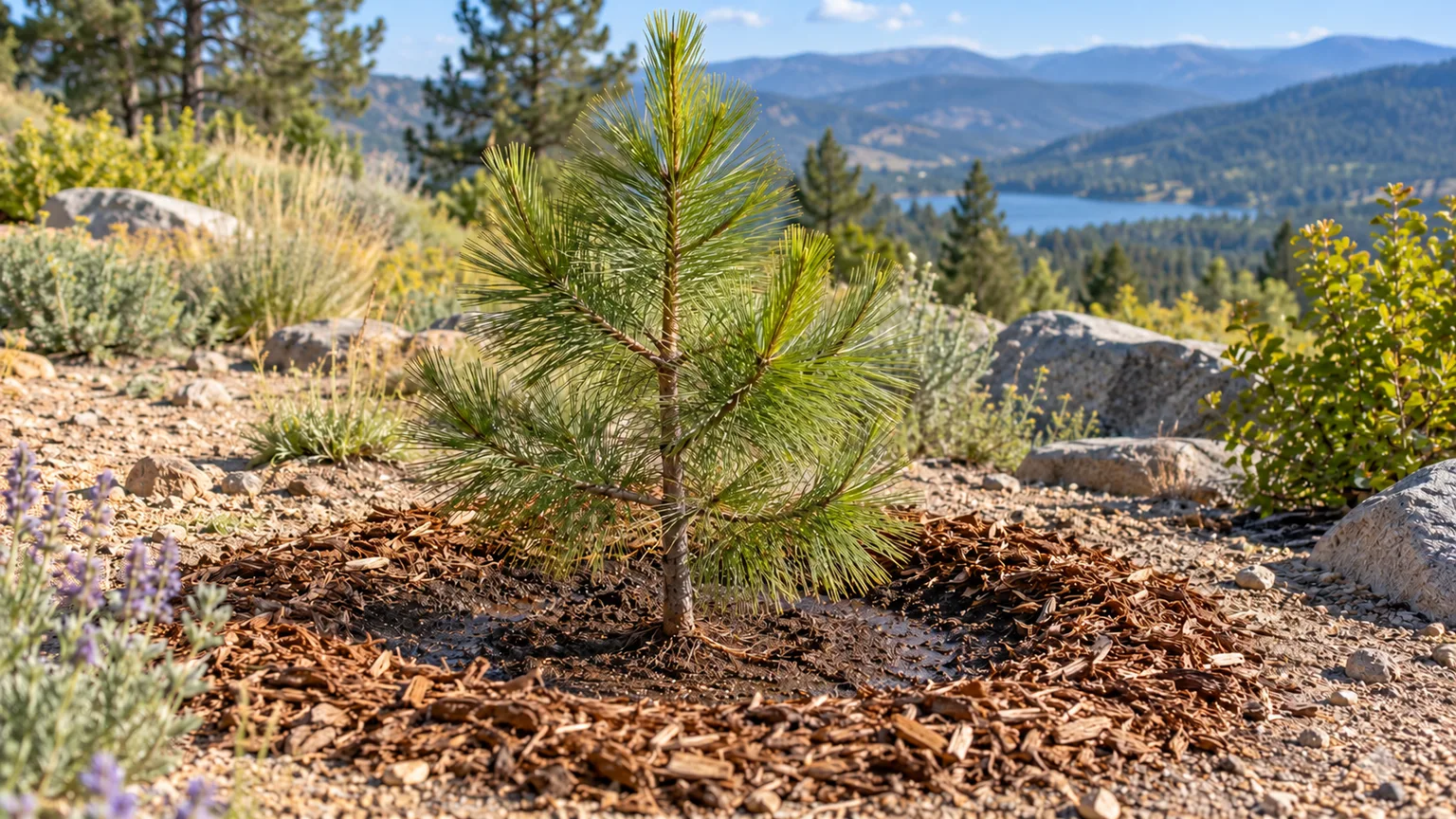
Dig a broad, shallow hole rather than a deep one. Make it about two to three times the width of the root ball, with the center no deeper than the root ball’s measured height. Find the root flare—the point where the trunk widens and the first structural roots begin—and set it at or just above the finished soil grade. Planting too deeply is a common, avoidable source of decline because buried bark stays damp and roots may struggle to get oxygen.
Place the tree upright, backfill with the native soil you removed, and firm gently to remove large air pockets without compacting the ground. Water slowly as you backfill so soil settles around the roots. Build a low watering basin outside the root ball if it helps direct irrigation, then apply a loose mulch layer over the root zone, keeping mulch several inches away from the trunk.
Do not add fertilizer, compost, or a concentrated soil amendment to the planting hole by default. A rich pocket can hold more moisture than the surrounding soil and discourage roots from expanding outward. If a soil test identifies a specific limitation, follow the local recommendation for the full root zone rather than guessing at a handful of amendments beside the trunk.
Container and Balled-and-Burlapped Stock
For a container tree, slide it out and inspect the roots before planting. If roots are circling tightly around the outside, gently tease or make a few shallow vertical cuts through the outer mat so new roots can grow outward; do not strip away the root ball. Loosen the soil surface enough to find the root flare, because nursery media can cover it before the plant reaches the garden center.
For a balled-and-burlapped tree, position the root ball before removing the support. Once it is stable, remove or fold back as much burlap and twine from the top and sides as possible, and remove the wire basket’s upper portion if the handling situation allows without disturbing the root mass. Confirm the flare is visible and the top of the root ball is not buried under several inches of backfill.
Stake only if the root ball shifts, the site is unusually windy, or the trunk cannot stay upright on its own. Use broad, flexible ties and leave enough movement for the trunk to strengthen; remove supports after the tree is stable, usually by the end of the first growing season. Gardening Know How’s ponderosa guide also emphasizes supplemental water and support for newly planted trees, but staking should answer a real stability problem rather than become an automatic step.
Water a New Tree Through Establishment
A newly planted ponderosa pine needs deliberate watering even though an established tree tolerates drought. During the first growing season, the nursery root ball can dry faster than the soil around it, and new roots have not yet spread far enough to use moisture across the landscape. Keep checking the tree through at least its first two growing seasons; continue longer in sandy soil, dry climates, or after a stressful transplant.
Water slowly over the root ball and the nearby backfill so moisture reaches the full depth of the roots. A drip line or hose set to a gentle trickle is usually easier to manage than a quick splash from a nozzle. After watering, wait briefly and check soil at root depth; the goal is evenly moist soil, not a muddy basin that stays saturated.
Use rainfall, temperature, soil texture, and root-ball moisture to set the interval. Hot, windy weather and sandy soil can require more frequent checks; cool weather, clay, and recent rain call for less. Do not follow a daily schedule blindly or water lightly every day without checking—the upper surface may look dry while the root zone remains wet, or the surrounding soil may be moist while the original root ball is bone dry.
A recent peer-reviewed study of ponderosa seedlings tested nursery irrigation levels and then a controlled outplanting environment. It found that seedling conditioning and available soil moisture affected performance under dry conditions; it does not supply a household gallons-per-day formula, but it supports the practical distinction between an established drought-tolerant pine and a vulnerable young transplant. The study in Frontiers in Plant Science is especially relevant when a planting site is harsh or water is limited.
Use the Root Ball, Not the Calendar, as Your Guide
Push a finger or soil probe into the root ball and the soil just outside it. If the root ball is dry at the depth of the roots, water slowly until it is moist throughout; if it is still damp, wait and check again rather than adding more. Checking both areas helps catch a common failure: the backfill is wet, but the original container soil has shrunk away from it and stayed dry.
A soaker hose or drip emitter can reduce runoff on a slope, but keep water distributed around the root zone rather than pressed against the trunk. After a long rain-free stretch, repeat the moisture check before deciding that the tree “must be fine” because the foliage is evergreen. Needles may not show drought injury until the tree is already stressed, so monitor the soil instead of waiting for a color change.
Ongoing Care After Establishment
Once the tree has rooted into surrounding soil and is producing normal new growth, reduce supplemental irrigation. In its native climate, a mature ponderosa pine is adapted to seasonal dry periods; routine lawn-style watering can create the persistently wet conditions associated with root problems. During an unusually prolonged drought, a slow, occasional deep soak may help a tree in a managed landscape, especially if it is surrounded by turf or paving, but first check that the soil can drain.
Keep grass and vigorous weeds from competing directly with a young tree. A broad mulch ring helps conserve moisture and reduces mowing or string-trimmer damage, which can injure thin bark near the base. Expand the ring as the tree grows, but do not pile mulch against the trunk or cover the root flare.
A healthy, established ponderosa usually needs little routine intervention. Monitor new growth, the pattern of needle color, and the trunk for damage; avoid frequent digging or planting under the canopy as surface roots spread. If you see sudden crown thinning, resin flow, or branches dying from the top down, investigate the cause instead of responding with fertilizer or extra water by default.
Fertilizer and Mulch: Less Is Usually Better
Do not fertilize a mature pine simply because it grows slowly or because evergreen fertilizer is on sale. If growth is weak, first check root-zone moisture, drainage, light, planting depth, and root injury. A soil test is the right next step when those basics look sound and nutrient deficiency is plausible; apply only the nutrient and amount the test or a local Extension recommendation supports.
For young trees, a modest mulch ring is often more useful than fertilizer. Use a loose organic mulch such as arborist chips, spread it broadly over the root zone, and keep it a few inches away from the trunk. Mulch should protect soil and roots, not become a damp volcano that hides bark or invites damage.
Avoid changing soil pH based on the idea that every pine requires strongly acidic soil. NC State Extension notes that ponderosa pine can tolerate alkaline soils, and site drainage matters more than forcing a particular pH when no soil test calls for adjustment. Do not routinely incorporate compost or manure beneath the root ball; improving the entire planting area is different from creating a rich, wet pocket around one tree.
Pruning and Structural Work
Prune to remove dead, broken, rubbing, or hazardous branches, not to keep a standard ponderosa pine small. Do not top the tree or cut back the central leader to control height; that can leave an unstable structure and does not change the tree’s eventual space requirements. Young trees may benefit from limited structural correction when a competing leader or damaged branch is obvious, but severe shaping is not a substitute for choosing the right site.
Make cuts just outside the branch collar, where the branch joins the trunk or larger limb, and avoid flush cuts that remove trunk tissue. Never strip out a large portion of the crown in one session. If the tree has large limbs over a home, is taller than you can safely reach, or shows cracks, cavities, or a sudden lean, hire a qualified arborist rather than climbing or making a large cut yourself.
Late winter or early spring is a practical window for routine pruning in many climates because the tree is not actively elongating, but dead or hazardous limbs should not be left in place just to wait for a season. Sanitize tools between diseased cuts when local guidance recommends it, and do not cut into obvious pitch masses before you know whether an insect or injury is involved.
Seasonal Needle Drop Versus a Declining Tree
Pines retain needles for more than one year, not forever. It can be normal for older needles closer to the trunk to yellow or brown and fall while the newest outer growth remains green and the branch tips continue to develop. A few scattered older needles are a different pattern from a whole branch turning brown or a crown thinning from the top downward.
Check where the discoloration starts and how widely it is spreading. If browning is limited to interior, older needle growth in late summer or fall, and the current-year candles and branch tips look healthy, monitor rather than treating immediately. If current-year needles brown, entire shoots wilt, several branches die, or the pattern advances through the crown, inspect the soil moisture and root collar and arrange a professional diagnosis.
Drought, waterlogged soil, root disturbance, winter injury, insects, and fungal disease can all produce overlapping symptoms. Do not assume every brown needle is a nutrient deficiency, and do not pour fertilizer or pesticide onto an unidentified problem. Take clear photos of the whole tree, the affected branch, the needle pattern, and any pitch or boring dust; note when symptoms began and recent watering or construction work, then share that evidence with a local Extension office or arborist.
Pests, Diseases, and Stress Signals
NC State Extension lists several possible problems on ponderosa pine, including root rot, blister rust, needle blight, bark beetles, adelgids, aphids, pine sawfly, and pine shoot moths. That list is not a diagnosis: the same “brown pine” appearance can arise from insects, disease, drought, or poor drainage, and the relevant pests vary by region. A local arborist can identify which organisms are actually active before anyone recommends treatment.
Look for patterns rather than one isolated symptom. Fine webbing, visible larvae, sticky honeydew, or clusters of feeding damage suggest different problems from a branch that suddenly browns after a dry spell. Inspect the trunk and root collar for fresh holes, sawdust-like boring material, resin flow, mechanical wounds, and soil piled against the bark.
Root-zone problems deserve attention early because a sick-looking crown may be the late result of roots sitting in wet soil or drying repeatedly. Do not excavate large roots or pour chemicals around the base to “kill fungus.” If roots are exposed, the trunk is unstable, or the entire crown is changing rapidly, stop home diagnosis and call a qualified arborist.
Pitch Masses and Bark Beetles Deserve a Prompt Response
Ponderosa pine can push resin from wounds, so one pitch spot does not prove a beetle infestation. However, multiple fresh pitch tubes or resin masses, tiny entry holes, boring dust, and fading foliage together warrant prompt inspection—especially if the tree is drought-stressed or several nearby pines are declining.
Do not peel bark, cut into the trunk, or apply a broad-spectrum insecticide based only on a photo. Bark beetles can occupy wood below the visible surface, and treatment choices depend on the insect, timing, tree condition, and local rules. Photograph the pattern, keep the tree adequately watered if it is still establishing and the soil drains, and have an arborist or Extension specialist identify the cause.
Winter Care and Fire-Aware Placement
An established ponderosa pine is cold hardy across much of its range and usually needs no winter wrapping. A newly planted tree still needs moisture before the ground freezes if autumn has been dry; water only while the soil can absorb it, and avoid leaving the root ball saturated going into winter. A mulch ring can moderate soil temperature, but keep it off the trunk.
Wind can break limbs or loosen a new root ball, so inspect stakes after storms and remove them when the tree is stable. Do not wrap the whole crown or use salt around the root zone. In regions with snow, leave lower branches intact unless they are damaged; they help preserve the tree’s natural form and should not be removed to make the plant look like a lollipop.
The species has traits associated with fire adaptation, but that does not make a planted pine fireproof. Needles and small twigs can accumulate beneath it, and local fire risk depends on surrounding vegetation, slope, weather, and maintenance. If you live in a fire-prone area, follow local defensible-space guidance and site a large conifer where its mature branches and litter can be managed safely. NC State Extension also flags ponderosa pine as a potential problem for horses; if livestock can browse the tree or its fallen material, check with a local veterinarian or Extension specialist before planting.
Propagation and Dwarf Selections
Ponderosa pine is usually grown from seed, but seedlings vary genetically and do not reliably reproduce the form or size of a named cultivar. NC State Extension lists seed as the recommended propagation strategy. If you want a specific compact habit, buy a correctly labeled nursery plant rather than sowing seeds from a dwarf specimen and expecting a clone.
Named dwarf selections may make the species accessible to a larger garden, but confirm the actual dimensions and regional hardiness with the nursery. NC State’s plant profile lists ‘Dixie’ as a dwarf form; that label is a starting point, not a reason to skip questions about mature spread, growth rate, and local performance. A compact tree still needs sun, drainage, and an appropriate root zone.
Avoid buying a standard tree for a small space with the plan to transplant it later. Trees establish roots in the landscape, and a mature pine is difficult to move without specialized equipment and a substantial risk of failure. If no cultivar has a verified mature size that fits, choose another species that naturally stays within the available footprint.
Why a Container Is a Poor Long-Term Home
A nursery pot is a temporary way to sell and transport a tree, not a realistic long-term home for a large pine. Ponderosa pine develops a substantial root system and eventually a tall crown; a pot restricts roots, dries quickly, and can make wind stability difficult. Even a dwarf cultivar should be planted in the ground unless its nursery label explicitly gives container culture directions and a truly compact mature size.
If you already have a pine in a pot, do not respond to slow growth by adding more fertilizer. Check whether the root mass is circling, whether water drains freely, and whether the plant is a dwarf selection or a standard seedling. If it is a standard ponderosa, plan a permanent outdoor site while the tree is still manageable.
Conclusion
The best ponderosa pine care begins before planting: confirm that your climate is suitable, that the soil drains, and that the future tree has enough sun and room to reach its natural size. Plant with the root flare visible, mulch broadly without touching the trunk, and keep the young root ball moist through establishment by checking soil rather than following a rigid watering calendar.
After roots are established, keep routine care light. Skip fertilizer unless testing supports it, prune only for sound structure or safety, and investigate rapid browning, pitch masses, or whole-branch decline instead of treating symptoms blindly. If your yard cannot accommodate a tree measured in dozens of feet, a smaller pine or another locally adapted tree is the better long-term choice.