10 Ornamental Sedges for Color, Texture, and Shade
Compare 10 ornamental sedges for shady beds, rain gardens, containers and sunny borders, with notes on mature size, drainage, spread and winter limits.
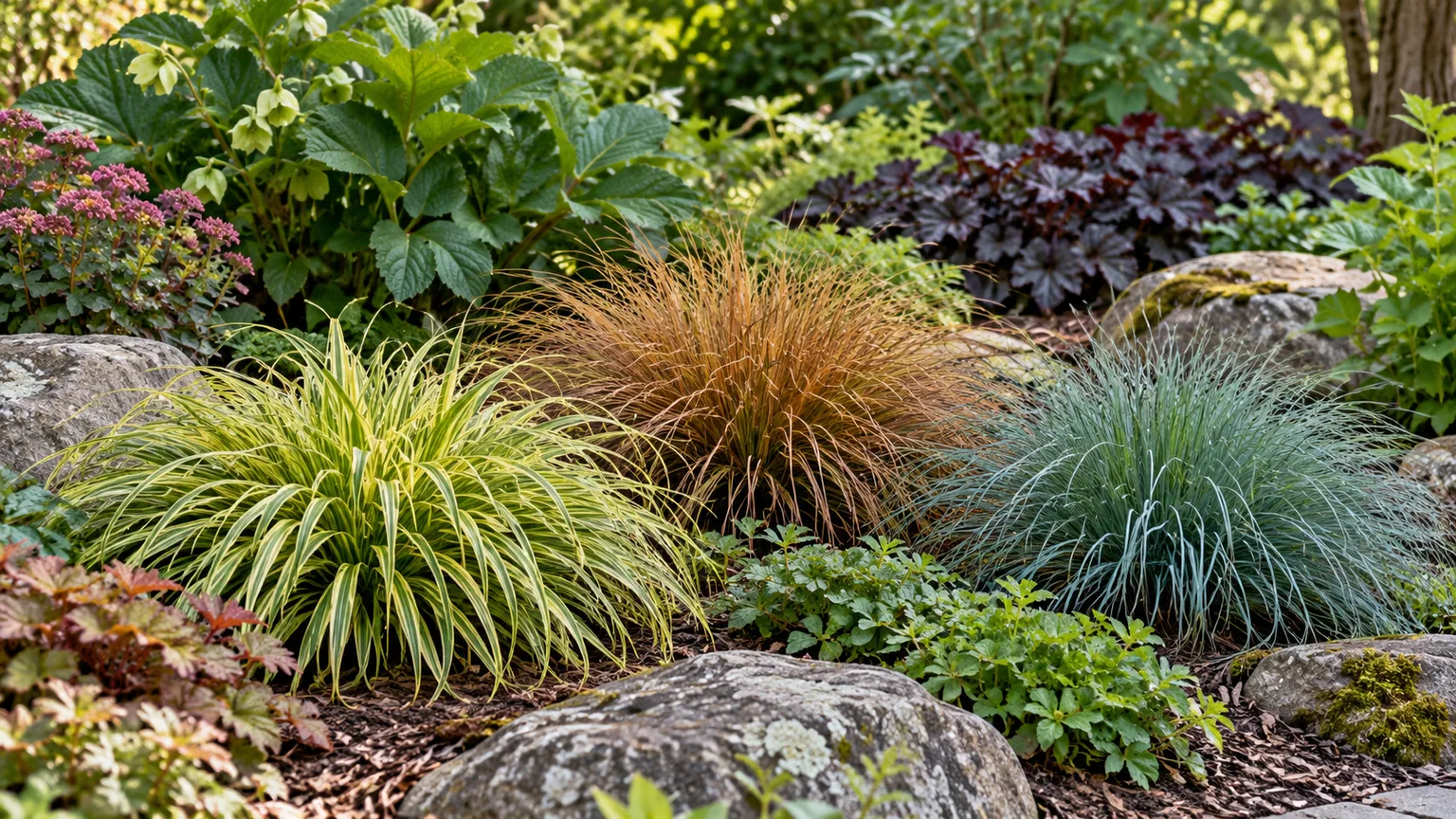
Ornamental sedges earn their place through foliage: narrow blades that arch, stand upright, or spill over a pot, often in colors ornamental grasses rarely offer. A bronze tuft beside a path, a gold-striped mound in shade, or a blue-green clump among stones can add texture long after flowers fade. The catch is that “sedge” describes a huge group of plants, not one set of care instructions.
Most of the selections here are Carex, a genus in the sedge family, Cyperaceae. North Carolina State Extension describes roughly 2,100 grass-like perennial Carex species worldwide; some clump while others spread by rhizomes or stolons, and species differ in light and soil needs. Many have triangular stems, a useful field clue, but a nursery label is more reliable than treating the old “sedges have edges” rhyme as a full identification key. (NC State Extension’s Carex overview)
Choose a plant by the conditions you can provide. “Moist” soil drains between rains; “wet” soil stays saturated or may hold standing water. Those are not interchangeable, and a wetland sedge placed under a dry maple can struggle just as badly as a shade sedge planted in a hot, waterlogged pocket.
Choose a Sedge by Site First
Start with three observations: how much direct sun reaches the planting area, how quickly the soil drains after rain, and whether the soil dries between waterings. Check those conditions in the season when the plant will be actively growing; a bed that seems damp in spring may bake dry beneath a tree in July. If you are planting near a downspout or pond, distinguish occasional runoff from soil that remains saturated for days.
Then decide how much maintenance you will accept. A clump-forming sedge can stay near its original footprint for years, while a rhizomatous selection may need edging or periodic division. A golden or blue foliage color is only an advantage if the plant receives the light that keeps it attractive; full sun may intensify some colors but scorch others or dry their roots.
Use this quick rule before comparing varieties: for damp ground or a rain-garden edge, look first at wet-tolerant species such as Bowles’ golden sedge; for average, well-drained beds, consider Japanese sedges; for a sunny, draining border, look at leatherleaf or hair sedges and watch moisture during establishment. For a dry, root-filled shade bed, none of the showier picks here is a guaranteed fix—ask a local native-plant nursery about a locally adapted sedge instead of trying to make a moisture-loving cultivar tolerate drought.
Ten Ornamental Sedges Worth Considering
The ten plants below cover markedly different roles. Height and hardiness figures on plant tags can vary by cultivar, local climate, and whether the plant is grown in a container, so treat the exact label as the final reference for your location. Where a seller uses a slightly different botanical name, check that the cultivar name and growth habit match the plant you intend to buy.
Spark Plug Palm Sedge
Spark Plug is a variegated form of Carex phyllocephala, sometimes sold under the palm-sedge name. Its upright leaves are broader and arranged in a way that gives the plant a miniature palm-like silhouette, so it reads differently from the fine, fountain-shaped sedges elsewhere in this list. Use one as a container accent or in a sheltered, bright-shade border where its bold shape will not be lost among larger foliage.
This is the least reliable outdoor perennial choice for cold-winter gardens. Treat it as a warm-climate or container plant where winter temperatures suit the nursery label; gardeners outside that range can grow it as a seasonal accent or move a pot to frost protection. Keep the root zone evenly moist but not stagnant, and avoid assuming that the word “sedge” makes it hardy or suitable for a wet bog.
Leatherleaf Sedge
Leatherleaf sedge (Carex buchananii) has fine, copper-bronze foliage that curls at the tips and holds a narrow, upright-to-arching shape. It is a strong choice for a sunlit path edge, gravel garden, or large container where its color can stand apart from green leaves. North Carolina State Extension describes it as a clumping, roughly 2-foot plant with good drainage needs; it tolerates partial shade but performs best with sun. (NC State Extension’s leatherleaf sedge profile)
Do not read “moist” on a tag as “waterlogged.” This sedge dislikes overly wet winter soil, so heavy clay in a low spot is a poor match unless drainage is improved. It can also be short-lived and may self-seed, so check the clump and seedlings rather than expecting it to behave like a permanent evergreen hedge. A light late-spring trim can remove tired foliage; avoid cutting hard into the crown before you know how it responds in your climate.
Bowles’ Golden Tufted Sedge
Bowles’ golden tufted sedge (Carex elata ‘Aurea’) is the best fit here for soil that stays consistently wet. Its upright, golden-chartreuse leaves brighten a pond margin, rain garden, or damp low area where many border plants languish. NC State Extension notes that the species can tolerate shallow standing water and does not tolerate drought; it grows in full sun or partial shade. (NC State Extension’s Carex elata profile)
Use it where water is a real site condition, not as a universal “wet-soil solution.” A garden with damp spring soil but hot, dry summers may need supplemental irrigation or a different sedge. Give the clump room to expand and place it where its bright upright leaves can contrast with broad-leaved plants. If you want to contain it, mark the intended edge at planting and check for movement as the clump matures.
Gold Fountains Sedge
Gold Fountains (Carex dolichostachya ‘Gold Fountains’) forms a low mound of narrow, arching leaves with a softer green-and-gold effect than the vivid, upright foliage of Bowles’ golden sedge. It works along a woodland path, at the front of a partly shaded border, or in a container where the cascading blades can spill just over the rim. Its visual job is fine texture and a bright edge rather than height.
Give it light shade or gentle morning sun in a site that does not dry sharply. It can tolerate conditions that are less than ideal, but prolonged hot sun and dry soil tend to make the foliage look stressed; deep shade may mute its color and reduce growth. Nursery names and sizes are not always consistent for this cultivar, so check the mature dimensions and winter range on the specific plant label before using it as a mass groundcover.
Blue Sedge
Blue sedge (Carex flacca, often labeled C. glauca) offers cool blue-green foliage that softens a sunny or partly sunny border. Its color gives a useful contrast to gold and bronze leaves, and its low, spreading habit can cover ground more quickly than a tight tuft. It suits a well-drained bed with regular moisture better than a permanently boggy planting hole.
The spreading habit is a design advantage only where the plant has room. Set it between stones, at an open bed edge, or in a container if you want a visible boundary; do not tuck it into a tiny mixed perennial pocket and assume it will remain an isolated accent. Full sun can make the blue color more pronounced, but watch for drying in heat and give newly planted clumps consistent water while roots establish.
Variegated Japanese Sedge
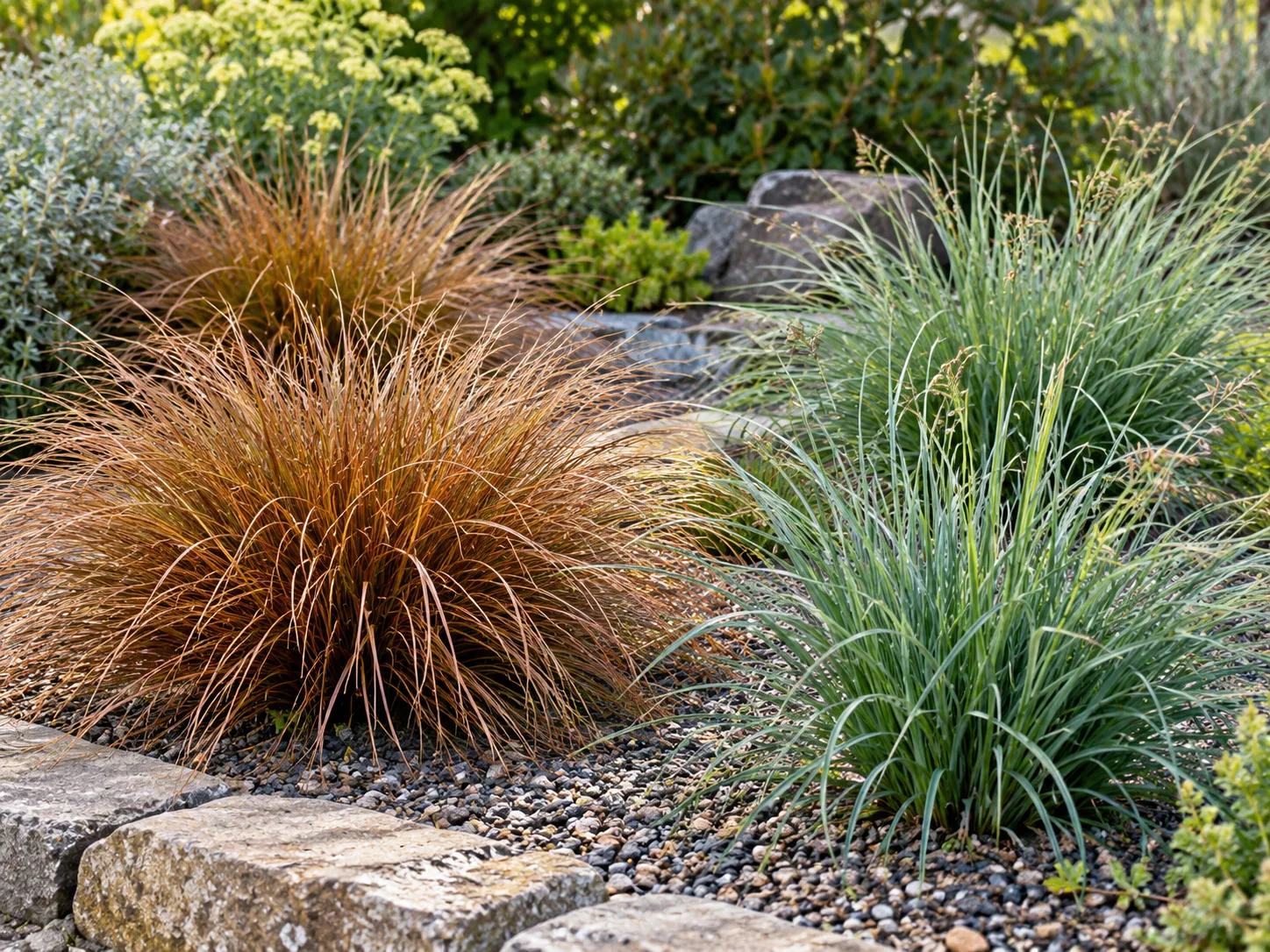
Variegated Japanese sedge (Carex morrowii ‘Variegata’) has narrow green blades edged in cream or white. It is a practical choice for bright shade, where the pale margins lift a dark path or the front of a woodland border without relying on flowers. The species forms clumps and can slowly spread, so it usually fills an area more gradually than an aggressive groundcover.
Use it in evenly moist, well-drained soil and protect it from the hottest afternoon sun, which can bleach or scorch foliage in exposed sites. A dry root zone beneath a mature tree is still dry shade; shade alone does not provide the moisture this plant prefers. If you want a neat edge, inspect the perimeter once or twice a season and divide or lift any offsets that have moved beyond the intended space.
Bronze New Zealand Hair Sedge
Bronze New Zealand hair sedge (Carex comans ‘Bronze Form’) is prized for hair-fine, coppery leaves that arch outward from a compact tuft. It brings movement to a sunny border, rock garden, or container without the tall flower plumes of a conventional ornamental grass. The soft form pairs especially well with broad, upright leaves and pale stone, which make the fine blades easier to see.
Choose a sunny or lightly shaded position with good drainage and enough moisture to prevent the root ball from drying completely. In winter-wet soil, the crown can decline even if the plant looked healthy through summer. Cold tolerance varies among sources and growing conditions; where winters are harsher than the nursery label recommends, use a pot you can shelter or select a locally proven alternative rather than relying on a zone number as a guarantee.
Orange New Zealand Hair Sedge
Orange New Zealand hair sedge (Carex testacea ‘Prairie Fire’) has especially warm orange-to-copper foliage, often most vivid where it receives ample light. It makes a strong single accent among greens, blues, and silvers, and its narrow leaves can soften the edge of a sunny patio or gravel path. Like other fine-leaved sedges, its appearance depends on drainage and moisture, not color alone.
Plant it in full sun to partial sun where water drains freely, and do not let a container dry hard during hot weather. In a cold or wet-winter region, check local performance before using it as a long-lived bed plant; it may be better treated as a protected container specimen or replaced with a hardy native sedge. Avoid putting it beside a wetland species in a bed that is watered to suit only one of them.
Evergold Japanese Sedge
Evergold Japanese sedge (Carex oshimensis ‘Evergold’, also sold as C. hachijoensis ‘Evergold’) has arching leaves with a bright cream-to-yellow stripe framed by green edges. It creates a clean, low mound for a container, walkway border, or small group in partial shade. NC State Extension recognizes it within C. oshimensis; a named horticulture profile notes that the plant is also sold under C. hachijoensis and emphasizes the need for humus-rich, well-drained soil. (NC State Extension’s C. oshimensis profile; Nature & Garden’s Evergold guide)
The drainage point matters more than a simplistic “likes wet soil” label. Keep the root zone lightly and consistently moist while it establishes, but do not leave it sitting in cold, saturated soil all winter. In harsh afternoon sun the pale stripe may scorch or fade; deep shade can also reduce vigor. Use it where you can control watering and see the arching shape, rather than burying it behind taller plants.
Mountain Sedge
Mountain sedge (Carex montana) is a compact, low-growing European species often used where a small-scale, grassy texture is needed. Its short stature makes it a possible edging plant for a rock garden or the front of a border, and it can suit gardeners who want a sedge that does not dominate nearby perennials. Unlike many showier wet-ground choices, it is not the one to put into a pond margin by default.
Give it an open, well-drained position with sun to light shade and ordinary garden moisture; avoid planting it in soil that remains saturated. Height, spread, and hardiness can vary between seed-grown stock and named selections, so check the nursery description before calculating spacing. If a locally native low sedge is available and fits the site, compare it first, especially where the garden transitions into natural habitat.
Compare Sedges by Light, Moisture, and Form
Use the table to narrow the list, then verify the plant label for mature size and regional hardiness. “Average moisture” means the soil is not allowed to dry hard during establishment; it does not mean watering to a fixed weekly schedule. Plants under trees, in pots, and beside paving often dry at different rates even within the same bed.
| Sedge | Best starting site | Foliage and habit | Main caution |
|---|---|---|---|
| Spark Plug palm sedge | Bright shade, warm site, or movable pot | Upright, palm-like variegated leaves | Tender in cold climates; verify label |
| Leatherleaf | Sun to light shade; freely draining soil | Fine copper-bronze tuft | Winter-wet clay and short-lived clumps |
| Bowles’ golden | Wet border or rain garden | Upright golden-chartreuse mound | Drought-sensitive; can outgrow a small pocket |
| Gold Fountains | Part shade; evenly moist soil | Low, arching green-gold leaves | Hot, dry exposure can stress it |
| Blue sedge | Sun to part sun; draining soil | Blue-green, spreading foliage | Give rhizomes room or contain them |
| Variegated Japanese | Bright shade; moist but drained bed | Cream-edged leaves, clumping | Dry tree-root competition and hot sun |
| Bronze hair sedge | Sunny, well-drained bed or pot | Fine bronze leaves, fountain form | Cold and winter moisture limits vary |
| Orange hair sedge | Sunny, freely draining site | Bright orange-copper tuft | Summer drying and cold-wet winters |
| Evergold Japanese | Partial shade; humus-rich soil | Cream-yellow center stripe, green margins | Avoid extremes of drought and saturation |
| Mountain sedge | Open, well-drained border | Compact green mound | Not a bog sedge; confirm local stock details |
For shade, start with Variegated Japanese sedge or Evergold if you can keep the soil from drying; Gold Fountains is another option for a partly shaded, moist edge. For standing water, Bowles’ golden sedge is the clearer match. For hot, bright, freely draining spots, consider leatherleaf, bronze hair, or orange hair sedge, then check local hardiness. This simple sorting prevents one of the most common planting errors: choosing by leaf color first and discovering later that the root conditions are incompatible.
Plant for the Mature Clump, Not the Nursery Pot
Plant in spring or early fall when the soil is workable and temperatures are moderate. In regions with severe winters, spring planting gives marginally hardy sedges more time to establish roots; in hot-summer climates, fall planting can reduce heat stress if enough growing time remains before frost. Water the pot before planting, loosen circling roots gently, and set the crown at the same depth it grew in the container.
Space plants according to their expected mature width and the job you want them to do. For separate accents, leave enough room for each mound to develop; for a continuous edge, place plants closer but still avoid forcing crowns together. A one-inch gap between young pots is rarely a sensible universal rule: mature size and spread vary widely across Carex, and close planting can create crowded, poorly ventilated foliage while still failing to form a uniform carpet on schedule.
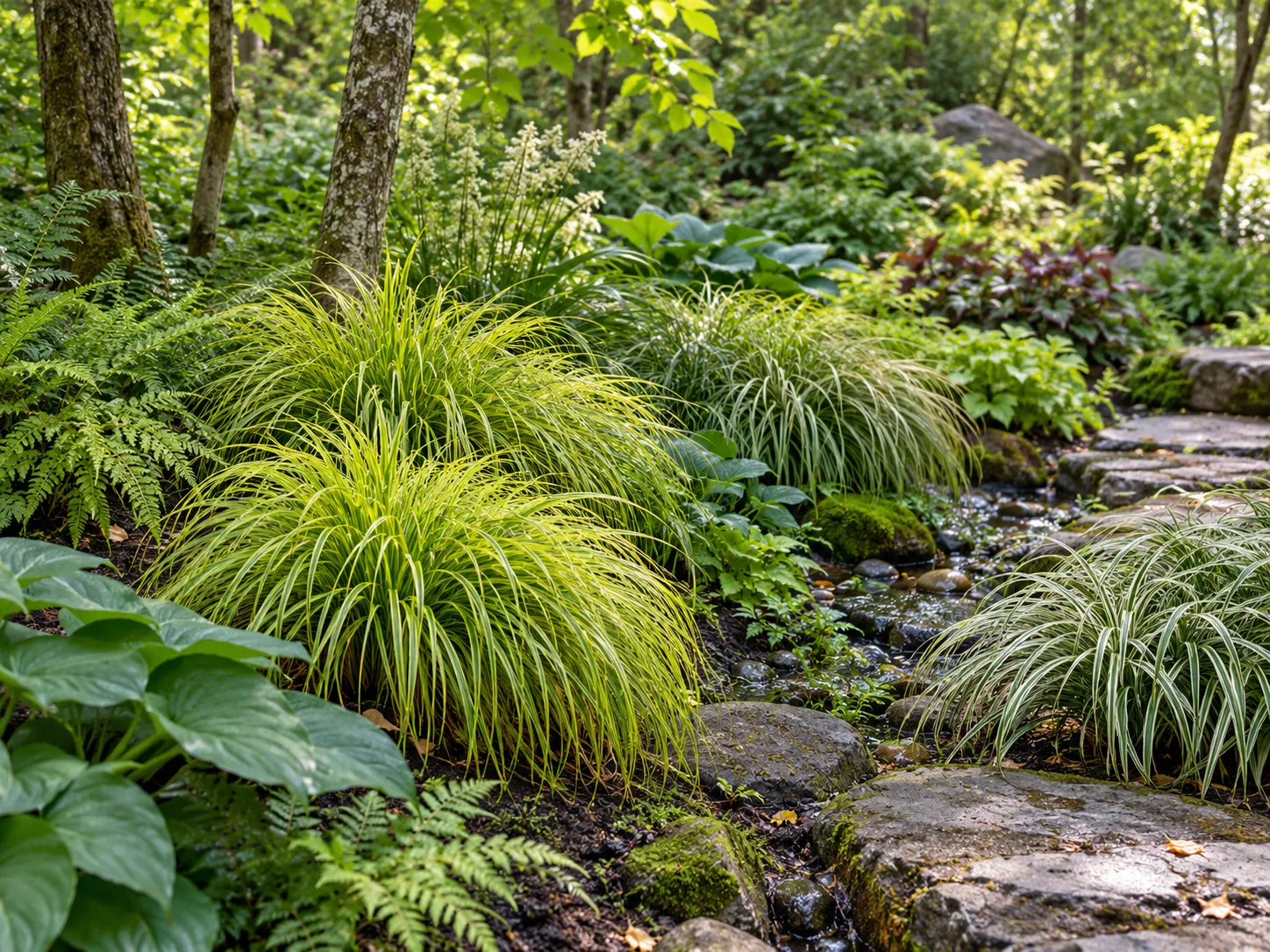
Improve the whole planting area rather than putting gravel in the bottom of an individual hole. A coarse layer under a small pocket of amended soil does not reliably correct poor drainage and can leave roots sitting in a perched, wet zone. For a moisture-loving sedge, improve organic matter across the bed and water steadily; for leatherleaf and hair sedges, choose a naturally draining site or raise the bed instead of trying to keep a bog plant dry. GardenSeeker’s practical Carex overview similarly distinguishes moist ground from waterlogging and notes that certain evergreen forms work well in containers. (GardenSeeker’s Carex guide)
In a container, choose a pot with open drainage holes and a mix that retains some moisture without turning airless. Do not bury the nursery pot in the ground to control spreading: roots may escape through drainage openings, water management becomes awkward, and the buried pot can trap roots or collect water. If containment is essential, use a genuinely movable container or a stable physical barrier installed before planting.
Water, Groom, and Divide at the Right Time
Water newly planted sedges deeply enough to wet the root ball and surrounding soil, then check moisture before repeating. During the first growing season, do not let a small root system swing from saturated to bone dry. After establishment, reduce irrigation for drought-tolerant selections only if the plant and site can handle it; Bowles’ golden sedge is a poor candidate for dry neglect, while a container can dry faster than any in-ground bed.
Avoid routine heavy fertilizer. NC State Extension notes that sedges can show stress when over-fertilized or over-watered, and many garden forms maintain a compact habit in moderately fertile soil. If growth is weak, first check light, drainage, root competition, and planting depth rather than adding nitrogen by default. A struggling plant in dry shade will not be fixed by feeding, and a wet crown is not helped by fertilizer.
Treat grooming as a species-specific job. Evergreen sedges often need only removal of dead or damaged leaves; comb through the clump with gloved fingers or snip individual brown blades. A late-winter or early-spring shearing may suit some deciduous selections, but cutting every Carex down to the crown can remove attractive winter foliage and leave slow-growing plants looking bare. NC State’s leatherleaf profile recommends a selective rejuvenation cut in late spring, which is a reminder to follow the species profile and local growth pattern rather than a universal calendar. (NC State Extension on leatherleaf sedge)
Divide a clump when its center thins, the plant exceeds its space, or you want more plants—not automatically every few years. Water the soil a day ahead if it is dry, dig around the whole clump, and lift as much root as practical. Use a sharp spade or knife to split it into sections with healthy roots and several growing points; discard dead, woody centers and replant divisions at their original depth. Keep them evenly moist while new roots form. Many named cultivars are best propagated by division because seedlings may not retain the parent’s leaf pattern.
Manage Spread Before It Becomes a Chore
Some sedges make tight tufts; others expand through underground rhizomes or aboveground stolons. The genus-wide description from NC State Extension covers both habits, which is why a blanket claim that ornamental sedges spread at one predictable rate is not useful. Look up the specific species and cultivar, then ask the nursery how it behaves in your region; growth can be much slower in a dry or cold site than in ideal moist conditions.
At planting, decide what the boundary is. Set a rhizomatous sedge inside a path edge, install a root barrier if the site and plant warrant one, or choose a naturally compact clumper for a small mixed bed. Inspect the perimeter during the growing season and lift new shoots while they are small. Pulling the leaves alone may leave underground rhizomes intact, so dig out the connected root section if the goal is removal.
If a sedge is already escaping, trace the runners back toward the original clump and remove the full section you can reach. Recheck the bed later because small remaining pieces can resprout. Do not apply a herbicide casually around desirable plants or near water; follow the product label and local rules, and first consider whether digging or replacing the plant is the simpler fix. Choosing the right growth habit at purchase is easier than repeatedly correcting a poor site match.
Use Sedges to Add Rhythm and Contrast
Sedges are most effective when their leaves solve a composition problem. Repeat a low variegated mound along a path to make a visual guide, use a bronze tuft as a warm punctuation point among gray stone, or group golden foliage where a shady bed needs light. A single plant can disappear in a broad border; three or five repeated clumps usually read as a deliberate pattern, provided their mature width fits the space.
Pair fine-textured sedges with broad leaves such as hosta or heuchera, then allow enough room for both plants to keep their shape. Use the very golden, wet-tolerant C. elata where the soil stays damp; do not pair it in the same irrigation zone with a hair sedge that needs winter drainage. A container solves this mismatch by giving each plant a separate root environment, and it lets you move tender selections to shelter before hard freezes.
The purpose of using a sedge is not to make every corner look like an ornamental-grass border. Let leaf color, curve, and scale repeat in a few places, and vary the backdrop with stones, shrubs, or broad-leaved perennials. If a sedge is valued for winter foliage, leave healthy blades until spring; if its leaves look ragged after winter, remove only the damaged material and wait to see whether fresh growth fills the clump.
Conclusion
The best ornamental sedge is the one that matches the site you actually have. Bowles’ golden sedge suits persistent moisture, Japanese sedges brighten part shade, and bronze or orange hair sedges bring fine texture to sunnier, well-drained places. Spark Plug palm sedge is better treated as a tender accent where winter conditions allow, while spreading types need a planned boundary.
Before buying, check the botanical and cultivar name, mature width, hardiness guidance, and whether the plant clumps or travels. Plant it at the right depth, water by soil condition while it establishes, and groom or divide only when the foliage and crown show a reason. Those choices make sedges reliable garden structure rather than a one-season color experiment.