Pothos vs. Philodendron: Key Differences and Care Explained
Learn how to identify pothos vs. philodendron from leaves, stems, and cataphylls, then compare light, watering, toxicity, and which plant suits your space.
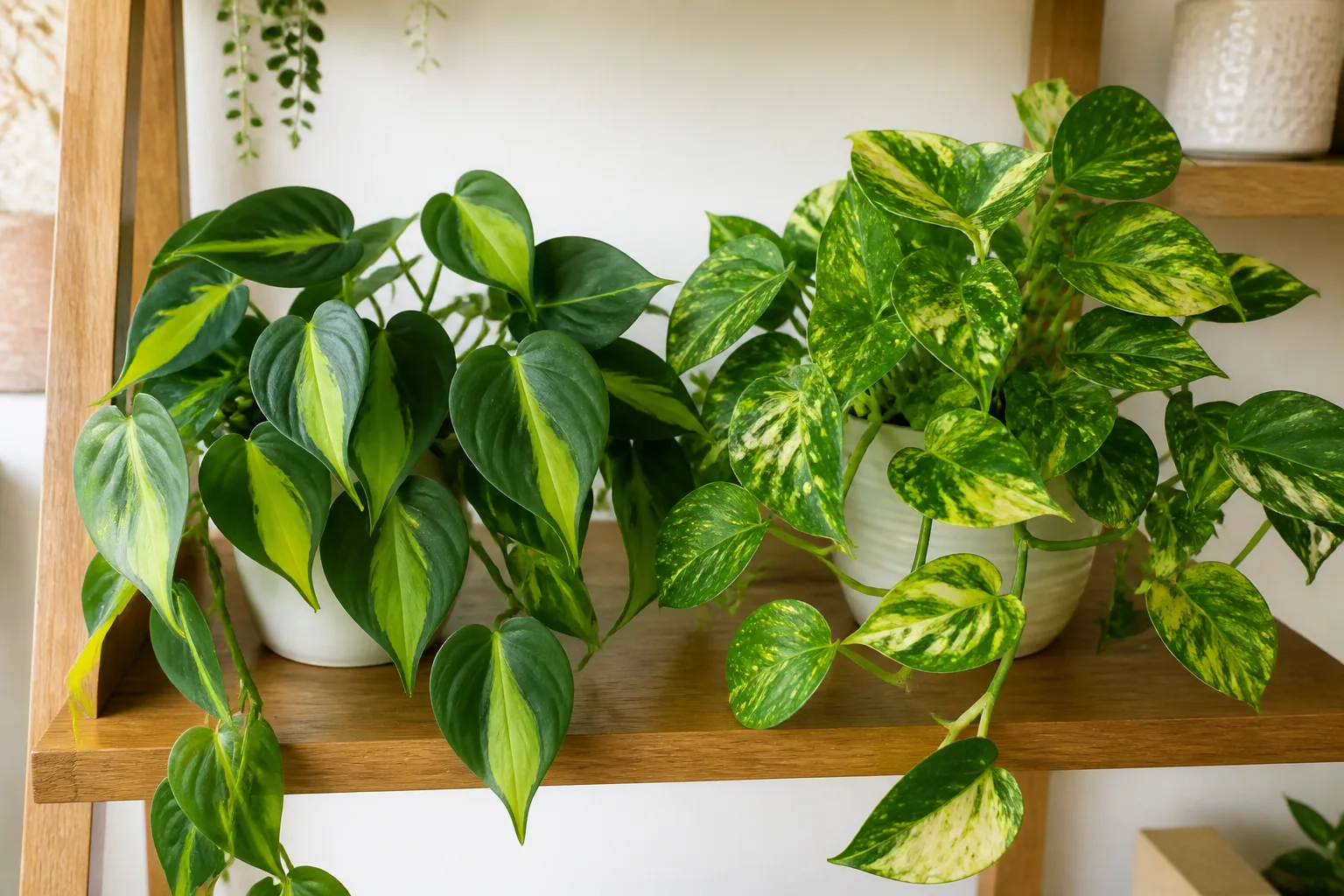
If the plant has a trailing stem and green, heart-shaped leaves, it could be pothos or a heartleaf philodendron. The quickest reliable check is to examine the leaf stalk, or petiole: pothos petioles have a groove, while heartleaf philodendron petioles are rounded.
Then look at new growth. A philodendron leaf emerges inside a small protective sheath called a cataphyll; pothos does not make that sheath.
Those clues matter more than color. Pothos (Epipremnum aureum) and heartleaf philodendron (Philodendron hederaceum) belong to the same aroid family, so they share a vining habit and several care preferences, but they are different plants.
This guide compares those two common trailing houseplants. “Philodendron” is a much larger genus that also includes upright, self-heading plants with very different leaves, so the comparison does not describe every philodendron species.
Quick identification in 30 seconds
Start with the petiole where it joins the vine, then check a fresh growing tip. A groove along the top of the petiole points to pothos; a papery sheath around a new philodendron leaf points to heartleaf philodendron. If neither feature is visible, compare several mature leaves: pothos foliage is often thicker and glossier, while heartleaf philodendron tends to feel thinner and more flexible.
No single leaf-color test is dependable. Golden pothos is variegated, but Jade pothos is nearly solid green; heartleaf philodendron is often green, but ‘Brasil’ has a lime-colored stripe and ‘Micans’ has bronze, velvety foliage. When you are unsure, combine two structural clues rather than making a call from one photo or a nursery tag.
Why these two vines are easy to confuse
Both plants are tropical climbers in the aroid family, Araceae. Indoors they are commonly sold as young trailing vines with simple, pointed, heart-shaped leaves, and both can live in hanging pots, on shelves, or trained up a support. At a glance, especially in a retail pot containing several cuttings, their overall silhouettes can look nearly identical.
The name “philodendron” adds another source of confusion. It covers hundreds of species and hybrids: some trail, some climb, and some form upright clumps.
When comparing it with pothos, people usually mean heartleaf philodendron, not a tree philodendron, split-leaf philodendron, or another self-heading type. If the plant has large lobed leaves arising from a central base rather than a vine with nodes, it is outside this comparison.
Same plant family, different genera
Pothos commonly refers to Epipremnum aureum, a species in the genus Epipremnum. Heartleaf philodendron is Philodendron hederaceum, in the genus Philodendron.
Both are Araceae, which helps explain their shared growth pattern, but a shared family does not make one a variety of the other. NC State Extension’s pothos profile and heartleaf philodendron profile classify them separately, and Clemson Extension’s comparison specifically describes their identifying features.
The distinction has a practical use: a name on a handwritten pot label may be wrong, but botanical cues remain available. Once the plant is identified, you can search for the right species-specific advice, keep accurate care notes, or choose a cultivar without confusing a satin pothos with either of these vines.
Compare leaf shape and texture
The leaves are useful, but treat shape as a clue rather than a verdict. A heartleaf philodendron usually has a more pronounced heart-shaped notch at the base, a softer blade, and a smoother or slightly matte surface.
A pothos leaf is often thicker, firmer, and glossier, with a less deep or less even heart-shaped base. Both can have pointed tips and both can be heart-shaped, so a single leaf may not settle the question.
The way the leaf attaches to the petiole can help. Look for the small indentation at the base of the blade, where the two lobes meet. Heartleaf philodendron often forms a deeper, more obvious sinus; pothos leaves may appear broader or less symmetrical.
These tendencies become easier to compare when the plants are side by side and at a similar age. A very young leaf, a crowded vine, or a cultivar with unusual color can blur them.
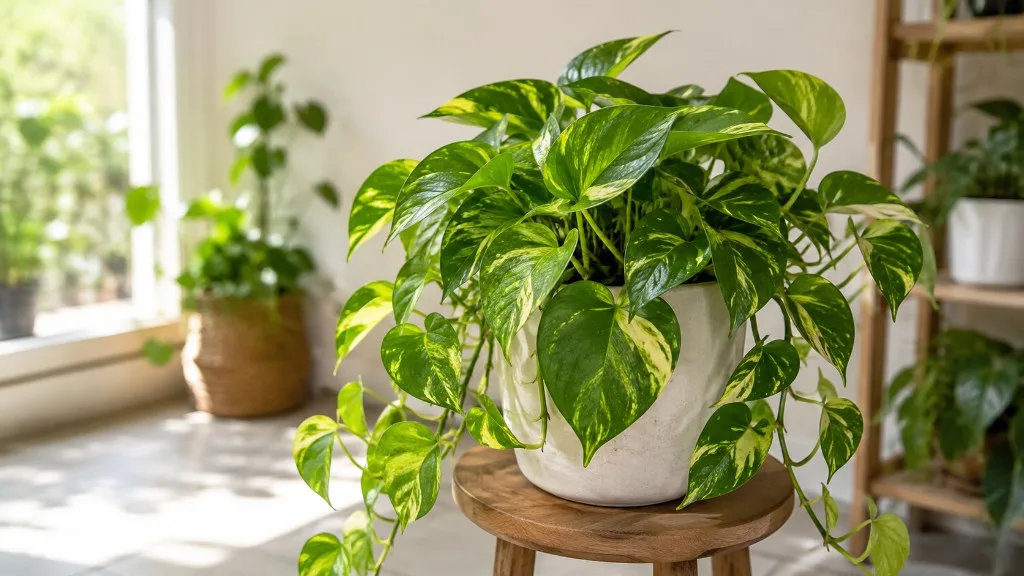
Pothos’ waxier leaf surface is one useful visual and tactile cue, but it should be checked alongside the petiole and new growth.
Check the petiole, not just the blade
The petiole is the short stalk between a leaf blade and the main vine; it is not the vine itself. On common pothos, the upper side of this leaf stalk has a noticeable groove or channel.
On heartleaf philodendron, the petiole is generally round and smooth. Clemson Extension and Penn State Extension describe this grooved-versus-rounded difference as a useful way to separate the common plants.
Inspect more than one leaf stalk. A leaf can twist toward the light, and a dry or damaged petiole may be difficult to read. Turn the leaf gently so you can see where its stalk meets the vine; do not pull or cut the leaf.
If several petioles consistently show a channel, that supports pothos. If they are smoothly rounded, move to the new-growth clue before deciding.
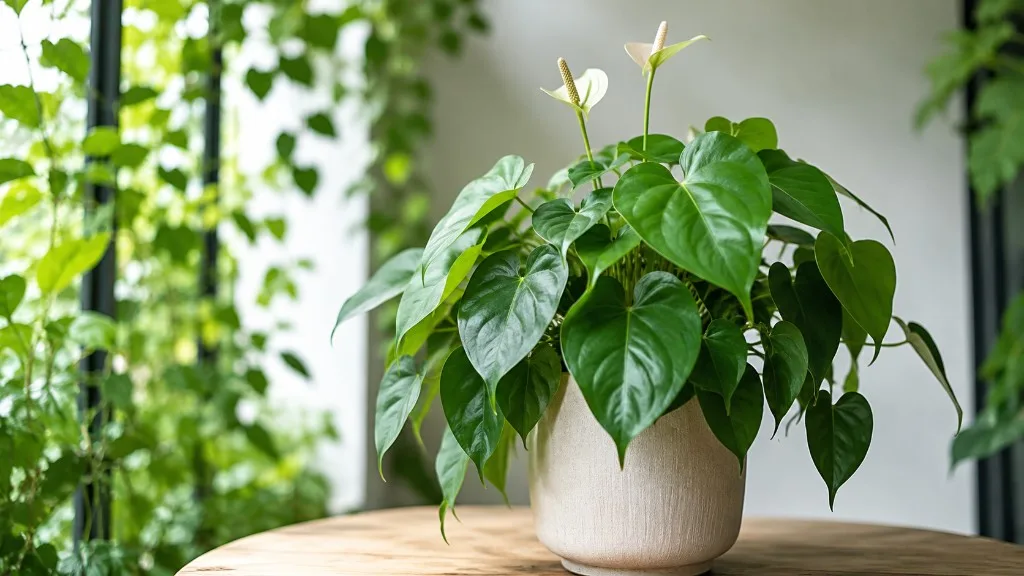
Heartleaf philodendron’s rounded petioles are easier to assess on a healthy, established vine than on a tiny cutting.
Watch new growth for a cataphyll
A cataphyll is a modified leaf-like sheath that protects a developing philodendron leaf. On heartleaf philodendron, the new blade comes through this sheath; after the leaf opens, the cataphyll usually dries and may remain on the stem before eventually falling.
Pothos does not produce this protective sheath around each new leaf. Clemson Extension and Penn State Extension both call out the sheath as a distinguishing feature.
This can be the clearest test when a growing tip is active, but it is not always available. A plant that has not produced a leaf recently may have no fresh cataphyll to inspect, and an old, dried sheath can be easy to overlook among leaf scars.
Do not diagnose by the absence of a visible sheath on a quiet vine. Instead, inspect the next new leaf or use the petiole groove as the more immediate clue.
Use aerial roots as a supporting clue
Both plants produce aerial roots at stem nodes, the points where leaves attach. These roots help a vine cling to a support and can develop into longer roots in humid conditions or when they contact a suitable surface. You can train either plant on a trellis, coir pole, or moss pole, though a trailing plant does not need a support simply to stay healthy.
Pothos often shows a larger, more obvious root at a node; heartleaf philodendron may show several finer roots. That pattern can vary with the age and growing conditions of the vine, so it is a supporting clue, not a strict species test.
Aerial roots are also easy to confuse with a leafless node or an old root scar. Avoid pulling them off to identify the plant; look at their position and combine what you see with the petiole and new leaf.
Treat color and variegation as secondary clues
Pothos cultivars offer a wide range of foliage patterns: ‘Golden’ has yellow markings, ‘Marble Queen’ is white and green, ‘Neon’ is chartreuse, and ‘Jade’ is mostly solid green. Heartleaf philodendron also has colored forms, including ‘Brasil’ with a lighter central stripe and ‘Micans’ with bronze, velvety leaves. NC State Extension and UConn Extension list multiple heartleaf cultivars, so “variegated means pothos” is not a safe rule.
Color can change with light and maturity. A low-light pothos may produce less conspicuous variegation, while a new philodendron leaf can emerge bronze before becoming greener. When the label is missing, prioritize petiole structure and a fresh growth point; use color only to check whether the identification fits the cultivar you think you have.
A five-minute identification sequence
If the plant is unidentified, take it near a bright window and examine it without removing leaves. First, confirm that it is a vine with alternating leaves at visible nodes; this makes the common pothos-versus-heartleaf comparison relevant. Then use the clues in this order:
- Turn over two or three petioles. A groove on the top side supports pothos; a smooth, rounded stalk supports heartleaf philodendron.
- Check a fresh growing tip. A developing leaf wrapped in a cataphyll supports philodendron. Pothos does not make that sheath.
- Compare mature leaves. Thick, glossy, firm foliage leans toward pothos; thinner, softer leaves with a deeper heart-shaped base lean toward heartleaf philodendron.
- Use roots and color as tie-breakers only. These features are variable, especially among cultivars and young cuttings.
If the clues conflict, wait for a new leaf, check several nodes, or compare a well-lit photograph of the whole vine with the plant’s growth habit. It is better to record “likely heartleaf philodendron” than to treat one uncertain feature as proof. For a costly rare plant, ask the seller for the botanical name and the source plant’s label; do not assume a common name identifies a particular species.
How different is their care?
The care overlap is real: both prefer warmth, a draining mix, and light that is bright but filtered rather than hours of harsh midday sun. Both tolerate some shade, though slow growth and stretched stems are signs that “survival” has fallen short of good growth.
The differences are tendencies, not radically separate care systems. Clemson Extension notes that pothos generally needs somewhat brighter light and warmer conditions than philodendron; Penn State Extension emphasizes that pothos is forgiving when the mix dries.
A practical starting point for either is a bright room with indirect window light, a pot with drainage, and watering based on the mix. Then adjust to the plant’s cultivar and the speed at which its own pot dries. A small plant in a warm, bright room can use water far faster than a larger pot in a cool corner, so copying a calendar from another home often causes trouble.
Light: bright indirect works for both
Give both vines bright, indirect light for steady growth and to maintain strong foliage. An east-facing window is often a good starting place; a bright south- or west-facing window may work if the plant sits back from direct rays or behind a sheer curtain. If leaves bleach, scorch, or turn pale on the window side, move the pot farther from the glass and observe the next leaves.
Pothos can persist in a dimmer position, but it may grow slowly and variegated cultivars can lose contrast. Heartleaf philodendron also tolerates lower light, although a very dark spot can lead to longer bare stretches between leaves.
If you must place one in a dim room, the greener, less variegated pothos may cope better, but neither is a no-light plant. Penn State Extension and the Royal Horticultural Society both recommend avoiding excessive direct sun while giving pothos enough usable light.
Water: use the mix, not the calendar
Let the upper portion of the potting mix dry before watering again, then water thoroughly until the excess drains. Empty the saucer or cachepot so the roots are not left standing in water. In a warm, bright room this may happen sooner; in winter or in a low-light room, the same pot may stay wet for much longer.
Pothos is generally more forgiving of a missed watering. Its sturdier foliage may look fine after a short dry spell, while heartleaf philodendron can droop sooner when it becomes too dry. That does not mean either plant benefits from repeated drought or that philodendron should be kept soggy.
If a plant droops, test the soil before adding water: wilt in wet mix points toward a drainage or root problem, not a need for another drink. Penn State Extension advises letting pothos soil dry, while Clemson Extension describes philodendron as preferring evenly moist—not waterlogged—soil; that difference supports a slightly more cautious dry-down for philodendron.
Soil, temperature, and humidity
Use a standard indoor potting mix that drains freely, with a container that has open drainage holes. If the mix remains dense and wet for many days, improve aeration with a suitable chunky amendment or repot into fresh mix rather than trying to compensate with smaller sips of water. Neither plant needs a specialty “aroid recipe” to live, but roots need both moisture and air.
Keep both away from cold drafts, hot heating vents, and sudden temperature swings. Ordinary comfortable indoor temperatures suit them; the tropical vines are not frost-tolerant outdoor plants in most climates.
Moderate household humidity is usually manageable, though dry air can make leaf edges crisp or new leaves harder to unfurl. If you raise humidity, use a room humidifier and leave space for airflow; misting does not replace watering or fix roots sitting in saturated mix.
Feeding, pruning, and propagation
Feed during active spring and summer growth with a balanced houseplant fertilizer at the label rate or a conservative dilution. Pause or reduce feeding when growth slows in winter, and do not use fertilizer to solve weak growth until you have checked light, roots, and drainage. Pothos and heartleaf philodendron can both be kept compact by pruning above a node with clean scissors; save healthy node-bearing cuttings if you want to start another pot.
Both are commonly propagated from stem cuttings that include a node, because that is where new roots and shoots can form. A leaf alone without a node is not a reliable way to create a new vine.
Root the cutting in water or a lightly moist, aerated medium, then move water-rooted cuttings to soil once the new roots are established. Penn State Extension describes pothos propagation from stem cuttings, and the same node-based principle applies to heartleaf philodendron.
Choose the vine that fits your room and routine
Choose pothos if your priority is a resilient trailing plant that tolerates a little more neglect, or if you want many foliage patterns to compare. It is a sensible choice for a bright shelf or a room where you sometimes forget to check the pot, provided you still give it light and a container that drains. A variegated cultivar needs more usable light than a solid-green one if you want its pattern to remain strong.
Choose heartleaf philodendron if you prefer a softer leaf texture, a more pronounced heart-shaped base, or a familiar green vine that can climb or trail. It rewards fairly steady care and offers distinctive cultivars such as ‘Brasil’ and ‘Micans’. Neither plant is universally “easier”; pothos tends to give more margin for a missed watering, while the heartleaf can suit a grower who checks the mix before it becomes completely dry.
Do not choose either as a safe plant for a pet that chews foliage. If the plant will sit where a cat or dog can reach trailing stems, consider a verified non-toxic alternative instead of relying on a high shelf that the animal can climb to.
Pet and child safety
Pothos and philodendron are both listed as toxic to cats and dogs. Their tissues contain insoluble calcium oxalate crystals that can irritate the mouth and digestive tract if chewed or swallowed. The ASPCA’s pothos listing and heartleaf philodendron listing support treating both as plants to keep away from curious animals; Clemson Extension also warns against ingestion by pets and young children.
Place the pot where animals cannot reach dangling stems or fallen leaves, and wash your hands after pruning if sap contacts your skin. If a pet chews a plant, contact a veterinarian or animal poison-control service for guidance rather than waiting for a blog description to predict the outcome. The exact risk depends on what was eaten and the animal’s condition, so avoid claims that ingestion is harmless or always severe.
A third look-alike: satin pothos
Satin pothos is usually Scindapsus pictus, a different aroid rather than a true pothos or a philodendron. The common name causes confusion, but the silver patches on its darker, more matte leaves are often a useful giveaway. NC State lists Scindapsus pictus separately from Epipremnum aureum and Philodendron hederaceum.
If a plant has pronounced silvery markings, do not force it into either side of this comparison just because it trails. Identify it first, then look up the care for Scindapsus pictus; its watering preferences and growth can differ enough that a pothos label is not a good substitute.
Common identification and care mistakes
Using color as the whole answer is the most common identification shortcut. Cultivars overlap in green, yellow, cream, and bronze tones, and light changes how vivid those colors look. Confirm the petiole and the new-growth structure before labeling the plant.
Calling every philodendron a heartleaf vine leads to wrong comparisons. A self-heading philodendron has a different shape and often different space needs from P. hederaceum. Check the growth habit and, when possible, the botanical name on the original tag.
Watering because a leaf drooped can make a wet-root problem worse. Check below the surface, confirm that the pot drains, and smell or inspect the mix if it stays wet unusually long. A healthy care routine follows root-zone conditions, not a weekly reminder alone.
Treating “tolerates low light” as “thrives in darkness” also creates disappointment. A pothos or philodendron may survive for a while in a dim corner but produce long bare stems, smaller leaves, or weaker variegation. Move it gradually toward brighter indirect light, and judge the change by new growth rather than expecting old leaves to transform.
Conclusion
To tell pothos from heartleaf philodendron, inspect the petiole and the next new leaf before relying on color. A grooved petiole favors pothos; a protective cataphyll around new growth favors philodendron. Leaf texture, shape, and aerial roots add confidence, but those clues can overlap, especially on young or variegated plants.
Once you know which vine you have, keep care simple: bright indirect light, a draining pot, and watering after checking the mix. Pothos usually forgives a longer dry interval, while heartleaf philodendron benefits from a more even moisture rhythm. Both are attractive, easy-to-propagate aroids, and both should be kept away from pets and children who might chew them.