How to Prune Lilac Bushes the Right Way
Prune lilacs with a simple cut-by-cut method: identify the right stems, use the right tool, and shape common, dwarf, and tree lilacs without topping them.
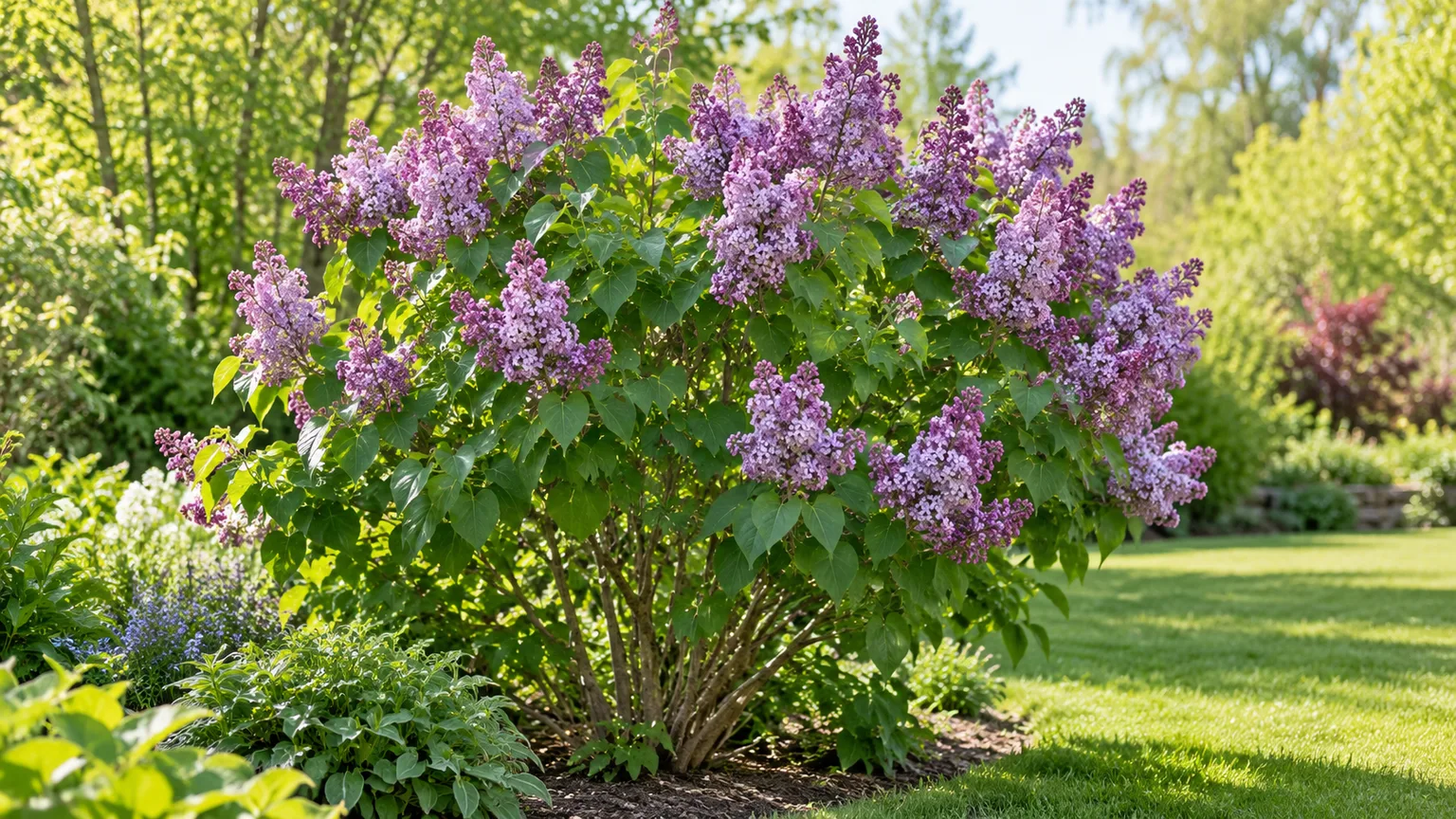
For a routine lilac pruning, start just after the flowers fade, then remove only the stems that have a clear reason to go. A dead cane, a rubbing branch, a spent flower cluster, and a healthy shoot that has grown too tall do not get the same cut. Choose the cut that solves the problem while leaving sound flowering wood in place.
This matters because lilacs form flower buds on growth made during the previous growing season. The Royal Horticultural Society’s lilac guide recommends summer pruning directly after flowering and light annual cuts; cuts made later can remove buds already developing for the following spring. The practical aim is not to make every lilac look clipped. It is to improve its structure with the smallest useful set of cuts.
Choose a pruning window that protects next spring
For ordinary deadheading, shaping, or thinning, wait until the lilac has finished flowering and prune soon afterward. Follow the shrub’s bloom, not a fixed calendar date: a lilac that flowers in a cool northern garden may finish weeks after one in a milder region. The bloom window gives you a clear view of the branch tips and lets the plant produce the new shoots that will mature into next year’s flowering wood.
You can remove a storm-broken or clearly dead branch whenever it becomes a problem. Keep that off-season work narrow: remove the hazard and leave healthy branch tips alone until the normal post-bloom window. If you need a complete guide to timing and a multi-year plan for an old, overgrown shrub, see our guide to when and how to prune lilacs; the cut procedure below is for routine work on a lilac you want to keep flowering.
Read the shrub before you prune
Walk around the whole plant before opening your pruners. Look at the base, center, and outer edge from more than one angle, because a branch that seems crowded from one side may be the stem holding up the best part of the shrub from another. Identify the exact branch you might remove and trace it down to where it joins a larger stem or enters the soil.
Identify the lilac’s growth form
A common lilac (Syringa vulgaris) is usually a multi-stemmed shrub. Its framework is a group of canes rising from the base, so meaningful thinning often means removing an entire older or poorly placed cane rather than cutting every stem at the same height. Dwarf lilacs such as Meyer ‘Palibin’ and ‘Miss Kim’ are naturally compact and typically need less corrective pruning.
A Japanese tree lilac (Syringa reticulata) is trained with a trunk and canopy. Treat it as a small ornamental tree, not a multi-stemmed shrub that can be cut down and allowed to resprout into the same form. If you cannot tell whether a plant is a tree form, a grafted standard, or a shrub, identify it before making a major structural cut.
Name one goal and set a limit
Choose one primary goal before you start: remove a hazard, clear rubbing stems, deadhead faded flowers, open a crowded center, or redirect one wayward shoot. If the lilac needs several kinds of work, do them in that order and pause after each round. A useful stopping rule is to step back once the obvious problem is solved; do not keep cutting merely because the shrub now looks uneven from close range.
Do not set an arbitrary percentage or height as the goal for every lilac. A vigorous common lilac may tolerate more selective renewal than a compact cultivar, a grafted specimen, or a plant stressed by drought or root damage. The Space for Life botanical garden pruning guide distinguishes maintenance cuts from renovation and notes that lilac type and suckering habit affect the appropriate method.
Prepare the shrub and tools
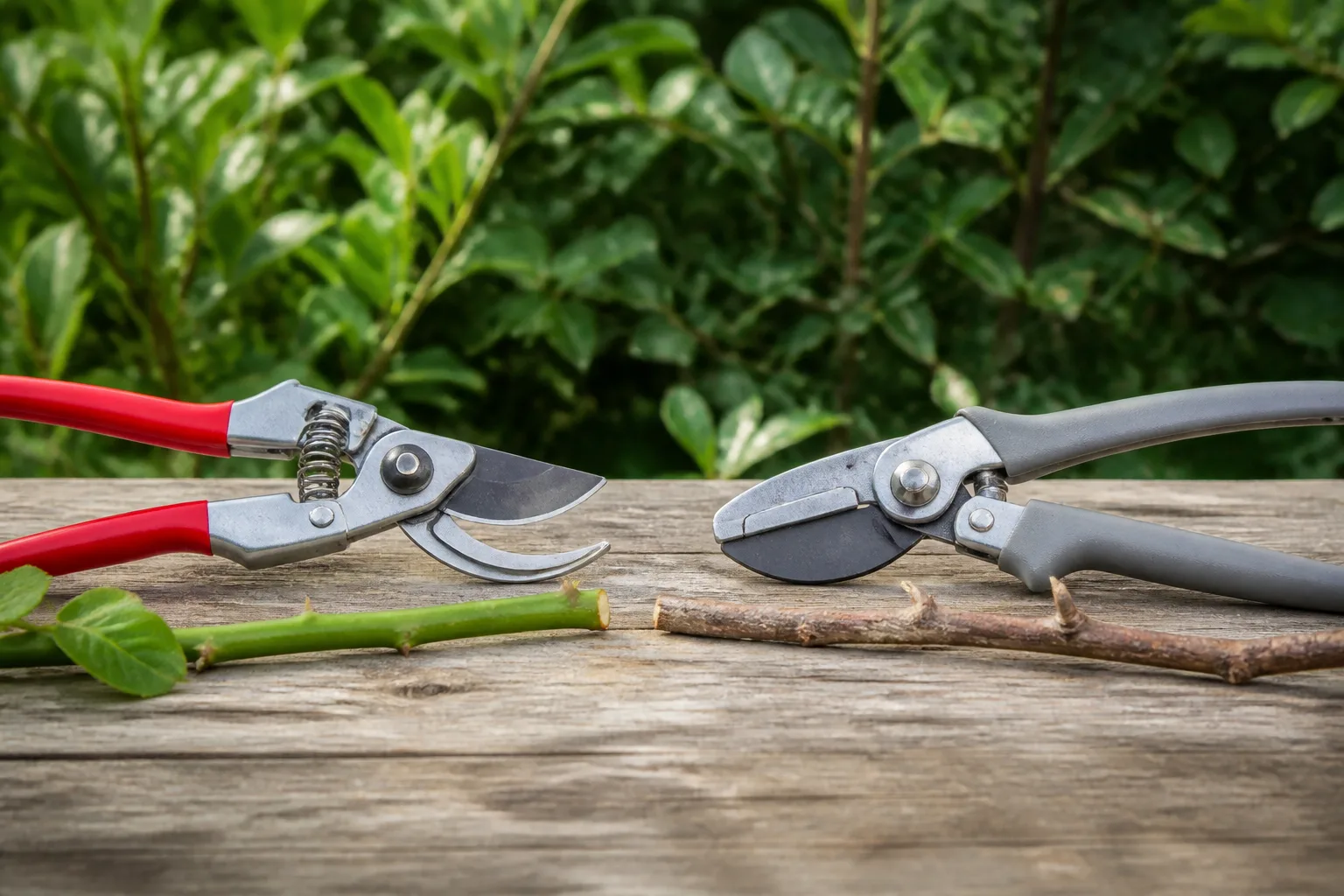
Use clean, sharp bypass pruners for flower stems and small shoots, loppers for canes that exceed your pruners’ rated capacity, and a pruning saw for larger wood. Choose by branch thickness and the tool maker’s cutting limit, not by how hard you can squeeze; crushing or twisting a stem leaves a ragged wound and makes precise placement harder. A long-handled tool is not automatically safer if you cannot see the branch junction clearly.
Clear leaves and loose debris from around the base so you can see where canes enter the soil. Wear eye protection when working inside a dense shrub, and keep both feet on stable ground; do not stretch sideways from a ladder to reach a branch. If a thick limb is overhead, under tension, or too large to control safely from the ground, stop and get qualified help instead of trying to force a cut.
Learn the cuts that shape a lilac
Before you cut, decide whether the branch should disappear entirely or simply become shorter. The cut location determines what grows next: removing a cane opens space at the base, while shortening a shoot leaves part of it in place and redirects growth to a bud or side branch. Most routine lilac work uses these three cuts.
| Cut | Where it goes | Use it for |
|---|---|---|
| Deadheading | Just above the first sound pair of shoots or leaves below the faded panicle | Removing spent flowers without cutting far down the branch |
| Thinning | At the cane’s point of origin, close to the soil or parent branch without leaving a stub | Removing dead, weak, crossing, crowded, or selected old stems |
| Heading | Just beyond a healthy outward-facing bud or back to a suitable side shoot | Redirecting one sound shoot that is too long or poorly placed |
Deadheading: remove only the spent panicle
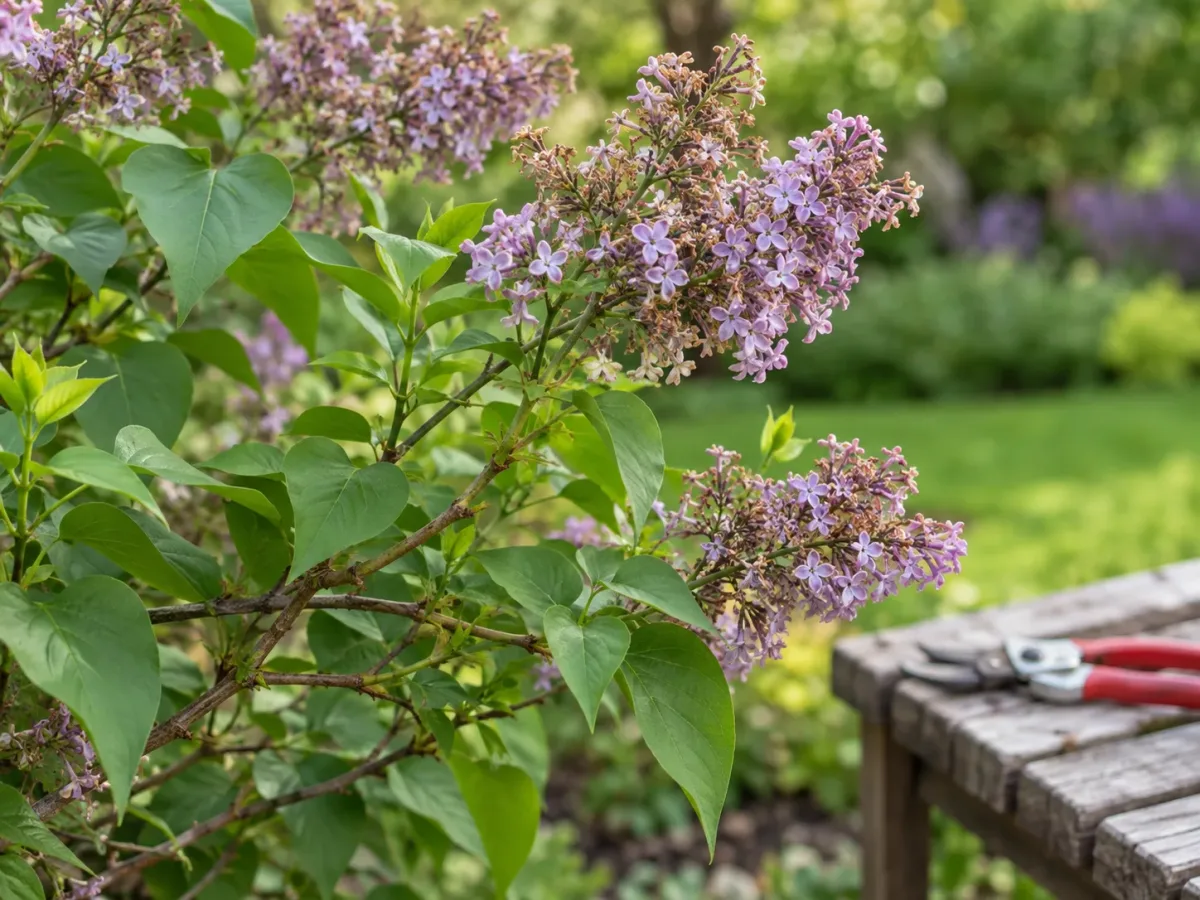
A lilac flower cluster is a panicle at the end of a leafy shoot. To deadhead it, follow the flower stalk down until you reach the first healthy pair of leaves or new shoots, then cut just above that junction. Do not keep cutting down the branch looking for a more dramatic cleanup; that extra length is where the next flower-bearing growth is developing.
Deadheading is mainly a tidiness choice on an established lilac, not a promise of extra blooms. If the shrub is large, the clusters are small, or removing them would require unsafe reaching, it is reasonable to leave them. The RHS recommends removing faded flowers where practical, while Fine Gardening’s lilac pruning guide treats deadheading as one part of a broader maintenance routine; neither reason justifies stripping healthy shoots from the shrub.
Thinning: remove a whole stem at its origin
A thinning cut removes a whole cane where it begins, rather than cutting across its top. On a multi-stem lilac, trace an unwanted cane to the soil line and cut it as low as you can without gouging the crown or neighboring stems. On a branch growing from another branch, cut just outside the branch collar—the slightly raised tissue at the junction—rather than cutting flush into the parent stem or leaving a long stub.
Use thinning when a cane is dead, damaged, rubbing another stem, growing through the center, or no longer contributing useful structure. Choose the weaker-positioned of two competing stems, not automatically the thicker one. A clean opening should let light and air reach the interior while preserving a balanced outline; an empty hole on one side is a cue to stop and reassess before removing more.
Heading: shorten to a healthy side shoot
A heading cut shortens a stem but leaves a portion of it attached. Make it just above a healthy outward-facing bud, or cut back to a strong side shoot that can continue the branch. The RHS guidance recommends light pruning to an outward-facing bud; Fine Gardening also describes reducing an overly tall, productive shoot back to one or two side shoots at the desired height.
Use a heading cut for one branch that disrupts the shape or grows past the space you have. Avoid cutting into a long section of bare stem with no viable buds or side shoots, because the remaining stub may die back and the resulting growth may be weak or crowded. If there is no suitable point to shorten to, remove the whole cane with a thinning cut or leave it for a broader renovation plan.
Follow a step-by-step pruning sequence
Work from obvious and low-risk cuts toward choices that change the shrub’s shape. This sequence makes it easier to see the lilac’s framework as it opens and reduces the chance that you remove a useful stem before noticing what it supports.
Remove dead, broken, diseased, and rubbing stems
Start with dead or broken wood. Follow each branch back to living tissue, then cut it out at a natural junction or remove the entire dead cane at ground level. A questionable twig may be brittle and dry, but do not scratch large stems extensively; inspect a small area only if you need to confirm that the branch is alive.
Next, remove branches that cross and rub. Keep the stem with the better angle and healthier growth, then remove its competitor where it originates. If you see a canker, unusual dieback, or insect damage, avoid carrying contaminated debris through the shrub and clean the tool before using it on another plant; routine healthy cuts do not require sterilizing the blade after every branch.
Deadhead selectively, without shortening healthy shoots
Once the structure is visible, remove faded panicles that are easy and safe to reach. Find the new pair of shoots directly below each cluster and stop the cut above them. A common mistake is to shear across all the flowering tips at once; that can remove more developing growth than deadheading requires.
If the flower stalk has already begun to form seed capsules, you can still remove it for appearance, but do not cut into the shoot below it simply because the cluster is dry. On a mature lilac, skipping some panicles will not harm the plant. Save your time for dead or crowded wood if the shrub is too large for careful deadheading.
Thin crowded canes and keep suitable replacements
Look from above and from the side to find canes that crowd the center or lean into walkways. Remove the least useful canes at the base, then check whether the remaining stems are spaced well enough to grow without rubbing. Fine Gardening recommends retaining strong, well-positioned new shoots while removing weak or crowded growth; the right choice is about placement and vigor, not just age or diameter.
A young shoot from the base may be a replacement cane rather than a nuisance. Keep one or a few that are strong and positioned where an aging stem is missing, and remove extras at ground level. Do not leave a forest of new shoots; too many stems create the same congestion you are trying to fix.
Shorten only shoots that disrupt the outline
After thinning, step back and inspect the silhouette. If one healthy shoot rises above the rest or sticks into a path, shorten that shoot to an outward-facing bud or side branch that points into open space. Keep the cut localized instead of leveling all branch tips to an imagined line.
This is also where it helps to distinguish an open, natural shrub from a hedge. Lilacs generally look and flower better with selective cuts than with repeated shearing. Shearing trims the outer surface but leaves the crowded interior and can remove many branch tips at once, including the growth that would carry the next season’s flowers.
Handle suckers according to graft status
A sucker is a vigorous shoot rising from the root or base of the shrub. On an own-root common lilac, a well-placed sucker may be genetically the same lilac and can replace an old cane. On a grafted lilac, a shoot emerging below the graft union belongs to the rootstock and may not have the same flowers or growth habit as the named cultivar.
Look near the base for a change in stem thickness, a bend, swelling, or a distinct graft scar. Remove shoots that clearly emerge below the graft union, cutting them back to their origin rather than clipping them at soil level where they can resprout. If the plant is own-root, keep a few useful replacements and remove the rest so the center remains open. The RHS and Space for Life both distinguish sucker treatment according to whether the lilac is grafted.
If you cannot identify the graft point, do not build the shrub around a mystery shoot. Photograph the base and ask the nursery that sold it or a local extension service to help identify the plant before making a permanent framework change. In the meantime, you can still remove a broken or rubbing branch that is clearly part of the desired canopy.
Reduce height without topping the shrub
A tall lilac is not improved by cutting every cane to the same height. That creates a flat row of stubs, leaves old stems in place, and often triggers dense shoots near each cut rather than a balanced lower framework. If the goal is a lower canopy, select the tallest individual canes and either remove them at the base or reduce them to healthy side branches at a lower point.
Take height down gradually if you want the shrub to keep most of its flowering structure. Make a few well-placed cuts, step back, and check whether the remaining canopy still looks balanced. If every branch needs a large reduction to fit the site, the shrub may have outgrown its location; repeated topping will not turn a large cultivar into a compact one. Horticultural educator Melinda Myers describes a staged approach for shrinking a tall lilac: remove part of the older framework at ground level, reduce some remaining stems, then repeat the work over several post-bloom seasons (Melinda Myers’ lilac-pruning guidance). It takes longer than a one-session cutback, but it spreads the change across a functioning framework.
Do not confuse a precise heading cut with topping. A heading cut ends at a live bud or side shoot that can take over the branch, while topping cuts through empty stem indiscriminately. If an overgrown lilac needs wholesale rebuilding, use a dedicated renovation plan rather than making dozens of arbitrary height cuts during a routine pruning session.
Adjust cuts for dwarf, reblooming, and tree lilacs
Compact lilacs usually need a lighter hand than common lilac. ‘Palibin’ and ‘Miss Kim’ can be deadheaded or tidied with a few selective cuts; remove a whole old stem only when it is weak, crowded, or damaging the plant’s form. Routine shearing can erase their naturally rounded outline and create more work than it solves.
Reblooming cultivars such as Bloomerang may produce a later flush after their main spring bloom. If you prune, keep the post-spring work light and localized; do not cut back the entire canopy expecting that to trigger the repeat flowering. The pruning response depends on the cultivar and its growth cycle, so follow the plant label or breeder’s guidance if a specific reblooming selection has different instructions.
A Japanese tree lilac needs tree-form cuts: remove suckers from the base, dead branches, and branches that cross or crowd the canopy. Do not cut its trunk to ground level as if it were a common multi-stem shrub. For a large limb or a tree close to a building, have an arborist handle structural pruning rather than using a pruning saw from an unstable ladder.
Avoid common errors and reassess after cutting
The easiest way to over-prune is to treat every visual imperfection as a problem. A branch that flowers slightly above the others may be worth keeping; a few missed flower clusters are harmless; and a lilac does not need an annual haircut just because the season has arrived. Let the plant’s structure and vigor, not a fixed schedule of cuts, determine how much work it needs.
Avoid these errors: cutting all tips before the flowers fade, leaving stubs after removing canes, cutting flush into a parent stem, retaining all basal shoots, removing every replacement sucker, shearing the exterior into a dense shell, and cutting into a grafted plant below its union. Each mistake either wastes flowering wood, weakens the framework, or encourages the wrong growth to dominate.
After the last cut, collect diseased or infested debris and dispose of it according to local guidance; healthy small trimmings can be composted if they are disease-free. Water during prolonged drought, but do not try to compensate for pruning with heavy fertilizer. A lilac in a sunny site with room to grow usually needs ordinary care, not a growth stimulant.
If the shrub looks lopsided after careful pruning, wait before making corrective cuts. New growth can fill an open area, and your perspective from the ground is often more useful than a close-up view of one branch. Reassess the plant after the next flush of growth, then return to selective cuts after the following bloom if another adjustment is still needed.
Conclusion
Prune lilac bushes by matching each cut to a specific job: deadhead just below the faded panicle, thin an unwanted cane at its origin, and shorten a useful branch only to a healthy bud or side shoot. Do routine work soon after flowering, identify whether the lilac is grafted, and stop when the shrub’s structure is clear and balanced.
The best result is not the most heavily cut lilac. It is a plant with sound canes, room for well-placed new growth, and enough healthy branch tips left to flower next spring.