How to Grow and Care for a Quaking Aspen Tree
Learn how to grow a quaking aspen: choose a cool site, plant it correctly, water through establishment, manage root suckers, and spot leaf or trunk problems.
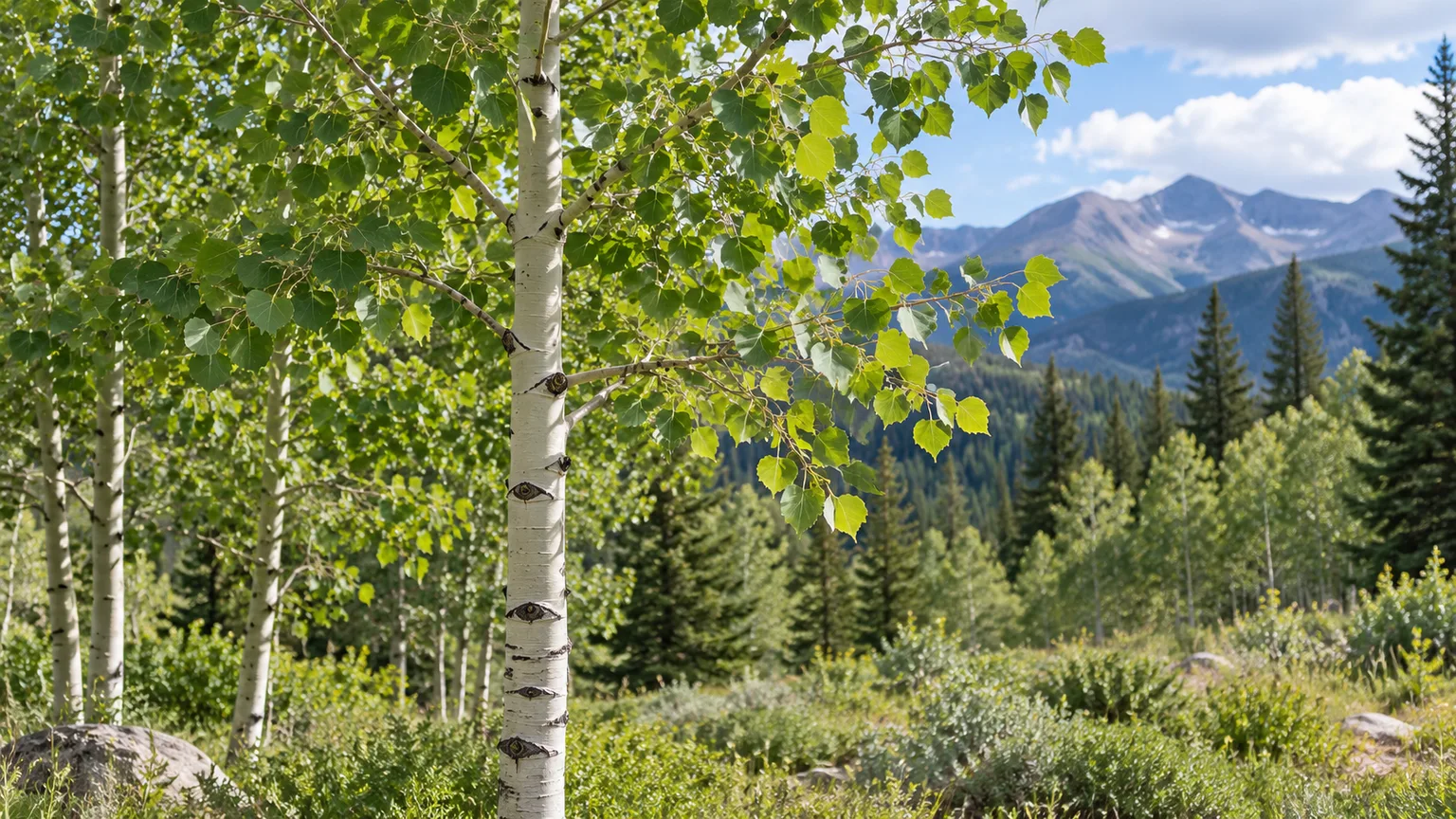
Choose the site before you choose the tree. Quaking aspen is striking in the right cool, moist landscape, but its shallow roots can send up a widening patch of new trunks, and heat, drought, or compacted soil can shorten its life. If you can give it room and accept some ongoing sucker control, planting and care are straightforward; if you need one tidy, low-maintenance specimen, another species is usually a better fit.
Decide whether quaking aspen fits your yard
Quaking aspen (Populus tremuloides) is native across much of North America, but “native” does not mean equally comfortable in every yard within that enormous range. In mountain regions, cool northern areas, and other sites with suitable moisture and summer temperatures, it can grow vigorously. In hot, dry lowlands, humid heat, compacted fill, or a small irrigated lawn, it may become stressed and invite problems that are less common in favorable forest sites.
This is a tree for a naturalized grove, a large managed bed, a cool rural property, or a landscape where new trunks are welcome. It is a poor match for a narrow foundation strip, a tiny urban lot, a manicured lawn where every shoot is unwelcome, or a site where roots must stay on one side of a fence. Plan for the planting to occupy more space over time than the nursery tag’s canopy measurement suggests.
Match its climate, light, and soil needs
Aspen grows best with abundant light and cool growing conditions. Utah State University Extension describes full sun as the preference and warns that lower, hotter, drier Utah valleys are poor substitutes for the species’ mountain habitat; North Carolina State Extension likewise notes its sensitivity to heat and humidity. The species’ enormous natural range includes several climates, so these cautions are most useful as a rule for matching local conditions, not as a claim that only one region can grow it. USU’s landscape guide explains the trade-offs in home plantings, and NC State Extension summarizes the tree’s regional hardiness and traits.
Hardiness-zone listings differ: NC State lists zones 1a through 6b, while Utah State’s tree browser lists 3 through 7, and a Fine Gardening garden profile cites a broader 2 through 8 range. These numbers describe winter minimum temperatures, not whether a site has cool summers, adequate water, or soils the roots can use. Check a locally appropriate Extension or nursery source, and compare the planting site’s elevation and summer climate with established aspens nearby rather than relying on a zone number alone.
Give the tree full sun if possible, shelter from the strongest prevailing winds, and soil that holds moisture without staying waterlogged. Aspen tolerates a wide range of textures, from rocky ground to clay, but good drainage and an aerated rooting zone matter. A hot south-facing slope with thin, dry soil may be a worse fit than a cooler site with morning sun and reliable deep soil moisture; a low spot that remains saturated can also suffocate roots.
Make room for its spreading root system
Aspen’s roots are not confined to the area beneath the crown. The U.S. Forest Service describes its sucker-producing lateral roots as shallow, cordlike roots often only 1 to 4 inches below the surface; buds on those roots can produce shoots when the connected tree or clone is disturbed. As the root system expands, shoots may appear in turf, borders, or beds well beyond the original trunk. The Forest Service’s Silvics profile explains how clones and root suckers form.
That does not mean an aspen root will automatically crack every nearby foundation or pipe. It does mean you should not plant it where repeated shoots, shallow roots, or future excavation would cause conflict. Keep it well away from septic fields, buried utilities, paving, foundations, property boundaries, and irrigation infrastructure; contact your local utility-marking service before you dig, and ask local authorities about setbacks. Utah State Extension notes that ordinary concrete curbing does not reliably contain the roots and that even barriers can be bypassed, so a barrier is not a substitute for choosing a suitable site.
If your goal is shade, ask whether the tree’s eventual spread is acceptable before purchase. A single nursery trunk may be only the beginning of a clone; several years later, a young shoot can become another tree, and removing the original stem may stimulate still more growth. A large isolated bed makes this habit easier to manage than turf or a tight row of shrubs.
Recognize the tree and set realistic expectations
The leaves are nearly round to broadly oval with finely toothed edges. Their flattened stalks let even a light breeze make the foliage flutter, which gives the species its common name. Smooth greenish-white to pale gray bark, dark knots or horizontal marks, and yellow to golden fall color are other useful clues; older trunks develop rougher bark near the base. Small catkins appear before the leaves, and plants are usually male or female, so seed-bearing fluff depends on having a female tree and successful pollination.
In a yard, the final size is highly variable. Sources commonly place trees around 20 to 50 feet tall and roughly 20 to 30 feet wide, but an open-grown trunk, a crowded stand, elevation, soil, and water all change the shape. More important than the canopy estimate is the clone’s footprint: a 20-foot crown does not promise a 20-foot root zone or a permanent single-stem tree.
Aspen is fast growing in favorable conditions but comparatively short-lived as a landscape tree. Its soft, weak wood, recurring sucker growth, and susceptibility to insects and diseases can make it a temporary shade or screening tree rather than a “plant it once and forget it” investment. Fine Gardening describes using trembling aspen for quick patio shade while a slower-growing replacement matured, and acknowledges that suckering comes with that choice. If you want a columnar form, check the exact botanical name and mature habit: a narrow selection may reduce the crown footprint, but it does not automatically remove the species’ root behavior.
Plant nursery stock at the right time and depth
Buy healthy nursery-grown stock suited to your region rather than digging from a wild grove or assuming a local volunteer sucker is easy to transplant. Choose a straight, sturdy trunk with a sound root ball, no trunk wounds, and no obvious cankers or dieback. Ask where the nursery stock was grown and whether its source is adapted to your elevation and summer heat; an aspen raised for a cool mountain site may struggle when moved to a hot, low valley.
Plant in early spring once the ground can be worked, or in early fall while roots still have time to establish before the soil freezes. Avoid hot, windy, drought-prone weather and do not plant when the root ball is dry, frozen, or saturated. In places with short growing seasons or dry autumns, local Extension guidance can help decide which window gives roots the better start.
Expose the root flare and protect the root zone
Before digging, mark utilities and measure the planting space. Dig a broad hole about two or three times the root ball’s width, but no deeper than its height; loosen glazed sides in compacted soil so roots can move outward. Find the point where the trunk widens into the first structural roots. Set that root flare at or slightly above finished grade, not buried beneath the nursery soil line, which can be too high on a container-grown tree.
Remove containers, twine, and synthetic wrapping; remove or fold back the upper portion of burlap and wire when safe, and straighten circling roots rather than leaving them to grow around the trunk. Backfill with the native soil, water slowly to settle it, and avoid fertilizer or rich compost in the planting hole. Utah State’s landscape tree planting guide emphasizes correct root-collar placement and cautions that fertilizer at planting does not improve root establishment.
Spread 2 to 3 inches of organic mulch over a broad circle to reduce turf competition and conserve moisture, but leave a clear gap around the trunk. Do not build a mulch volcano against the bark. Stake only if the root ball cannot stay stable in wind, use loose ties, and remove them once the tree can stand firmly on its own.
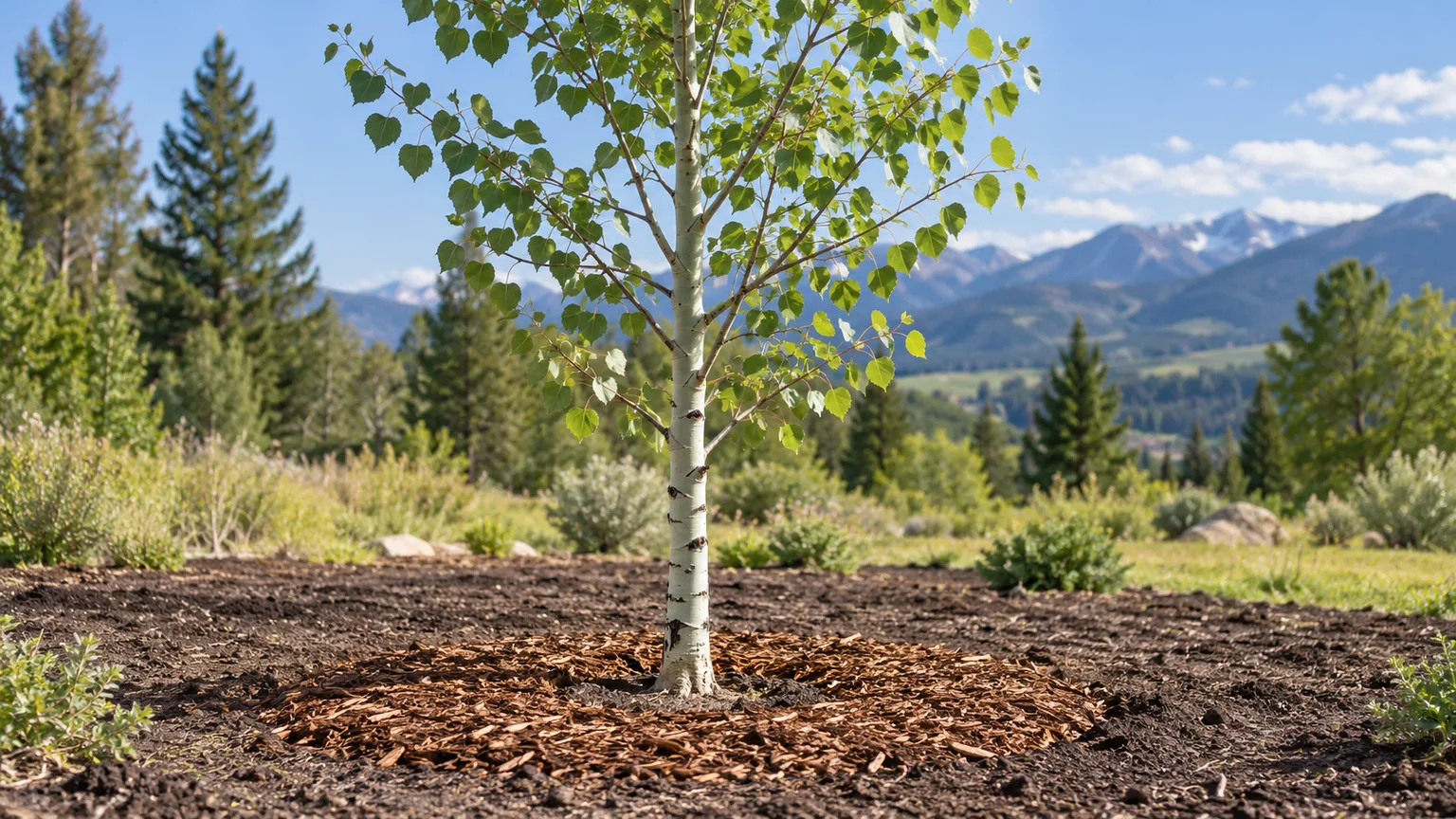
Water by establishment stage and soil moisture
Water the root ball thoroughly at planting, then keep it and the surrounding backfill consistently moist while roots establish. The first weeks need closer checks than later seasons; rain, wind, temperature, root-ball size, soil texture, and drainage all change how quickly it dries. Feel the soil several inches down at the edge of the original root ball, not just the mulch surface. If it is dry at root depth, water slowly and deeply; if it is cool and wet, wait.
Do not copy a fixed schedule from a different climate. Minnesota Extension provides frequent intervals for newly planted trees, while Utah State’s aspen guidance focuses on deep, roughly biweekly summer watering in its dry western setting and recommends checking that moisture reaches at least a foot deep. Those are regional examples, not universal prescriptions. Use your local establishment schedule as a starting point, then adjust by probing soil and watching the tree rather than running a lawn sprinkler briefly every day. UMN’s current watering guide explains how tree size, establishment, and moisture affect the amount and timing.
Once established, an aspen can tolerate some drying between soakings, but prolonged drought and hot weather can cause leaf scorch and decline. In a dry summer, water over a wide root area, not only against the trunk, and let excess drain before watering again. A probe or screwdriver that enters moist soil but meets resistance in dry soil can help you check depth; do not use it to spear roots repeatedly. Utah State’s aspen care guide offers a deep-water check for dry western summers, but rainfall and soil drainage still determine when to irrigate. In winter, water only when the ground is unfrozen and the soil has been dry for an extended period, especially after a dry autumn; snow and rainfall count toward the tree’s supply.
Mulch and fertilize only when the soil calls for it
Aspen does not need special potting soil or a strongly acidic bed. It grows across a broad range of mineral soils, but it performs best when roots can access moisture, oxygen, and organic matter without sitting in stagnant water. If you are unsure about pH, compaction, or drainage, test the soil before trying to correct it. Amending only the planting hole with a rich mix can create a sharp boundary that holds water differently from the surrounding soil.
Keep turf and machinery away from the trunk and root flare. A wide mulch ring makes the soil easier to keep evenly moist, reduces competition from grass, and lowers the chance of mower or string-trimmer wounds. Replenish mulch as it decomposes, but do not add layer after layer; deep mulch can hold too much moisture against the trunk and reduce oxygen to roots.
Skip routine fertilizer, especially at planting. Utah State Extension says fertilizer is generally unnecessary for aspen, and an application is not a reliable fix for weak growth caused by heat, poor drainage, compaction, drought, or root damage. If leaves are pale or growth is unusually poor, check the pattern, soil moisture, root flare, and soil test first. In high-pH or compacted soils, iron chlorosis can look like a nutrient deficiency even when the soil contains iron; Colorado State Extension advises confirming soil conditions before choosing an iron treatment because products and results vary.
Prune for structure without topping
A young tree may need a small amount of corrective pruning to maintain one dominant leader and remove branches that rub, cross, or grow dangerously low. For an established aspen, prune only for a clear reason: dead or broken limbs, a damaged branch, or clearance from a path. Remove a branch just outside its collar rather than cutting flush to the trunk or leaving a long stub. Routine small cuts can usually be made during dormancy or before spring growth; follow local disease timing if an issue is present.
Do not top an aspen to make it shorter or keep it from spreading. Topping removes the natural crown, creates large wounds, and often leaves weakly attached shoots; it also does not eliminate the connected root system that produces suckers. The International Society of Arboriculture’s TreesAreGood pruning guidance recommends pruning with a reason and explains why topping damages trees. Hire an arborist for large limbs, overhead hazards, climbing work, or trees near power lines; never prune near a utility line yourself.
Propagate carefully from roots or fresh seed
Aspen reproduces both sexually by seed and vegetatively through root suckers, but suckering is the usual way a stand renews itself. If you only want one tree, propagation is rarely a benefit: moving or cutting roots can disturb the connected system, and a new sucker may become another trunk in the landscape. Buy a nursery tree if the source is not on land you own or manage, and ask permission before removing any sucker from a natural grove. The Forest Service’s species review explains why seed is a less predictable way to reproduce aspen in ordinary landscape conditions.
Transplant a small root sucker
A small sucker dug with a piece of its parent root has a better chance than a shoot pulled from the soil with few roots. Work in early spring while the plant is dormant, choose a vigorous shoot, and carefully expose the shallow root without tearing it. Cut a manageable section on both sides with a sharp spade, lift the sucker with as much fine root as possible, and replant it promptly at the same depth. Keep the root zone moist and shaded from harsh afternoon sun while it reestablishes, and expect some losses; do not dig widely around a mature parent tree just to collect shoots.
Start seed while it is fresh
Growing aspen from seed is possible, but it is a poor shortcut for most home landscapes. The U.S. Forest Service reports that fresh seed can germinate well under suitable laboratory conditions but remains viable for only a short window—often a few weeks in favorable storage—and seedlings need a moist, exposed seedbed. Sow fresh seed on the surface of a clean, fine-textured medium, keep it continuously moist without flooding it, and protect tiny seedlings from drying, heat, and competition. Do not expect a fixed 24-hour germination time or a mature tree in one season; germination speed and survival depend on seed freshness and conditions.
Prevent browsing, mowing, and trunk damage
Deer, elk, rabbits, and other browsers can strip tender shoots or rub and chew young bark, especially when other forage is scarce. Utah State’s aspen forage research documents that young suckers are favored browse for deer and elk. A sturdy, ventilated cage around a young tree is more dependable than a loose wrap or a repellent alone. Keep guards from constricting the trunk, inspect them through the season, and remove or adjust them as the tree grows. In a region with high deer pressure, protect the root suckers you want to keep as well as the original trunk.
Lawn equipment is another preventable source of decline. Aspen bark is thin when young, so a mower or string trimmer wound can damage the trunk and give pests or decay fungi an opening. Keep the mulch ring wide enough that you can mow outside it, and do not cultivate deeply over shallow lateral roots. If the tree is in a windy location, inspect after storms for hanging limbs or cracks instead of trying to shape the crown preemptively.
Diagnose leaf, bark, and branch problems
Start with timing and pattern before reaching for a treatment. Is the change happening in autumn across the whole crown, in midsummer on the sunny side, on a few leaves, or on one branch? Check recent heat, rainfall, irrigation, soil drainage, trunk injury, and nearby construction. A single symptom rarely proves a specific pest or deficiency, and aspen can show more than one stress at once.
Separate scorch, chlorosis, and leaf spots
| What you see | What it may suggest | First check |
|---|---|---|
| Brown, crisp leaf edges during hot, dry weather | Drought or heat stress; sometimes root restriction or damage | Soil moisture at root depth, irrigation coverage, recent construction, and exposure |
| Newer leaves yellow while veins stay green | Iron chlorosis, often associated with high pH, compaction, or excess water | Soil test, drainage, root flare, and irrigation before adding iron |
| Dark spots or blotches followed by early leaf drop in cool, wet weather | Fungal leaf spot such as Marssonina or ink spot | Whether affected leaves are scattered or widespread, and whether the crown otherwise grows normally |
| Small pale mines, galls, or chewing damage | Leaf miners, gall insects, or browsing; some are mostly cosmetic | Identify the insect and estimate how much of the canopy is affected |
Aspen naturally turns yellow in fall, so leaf color alone is not a diagnosis. Colorado State Forest Service notes that leaf-spot fungi are common, often become more apparent in cool, wet weather, and may cause premature drop; some infestations are primarily cosmetic, while repeated heavy defoliation deserves attention. Rake and dispose of heavily diseased fallen leaves where practical, avoid wetting foliage late in the day, and keep irrigation focused on the root zone. Do not apply fungicide just because a few leaves have spots; confirm the problem and follow local Extension guidance first. CSFS describes common aspen insects and diseases and their relative risks.
Look for borers, cankers, and structural decay
Branch dieback, sunken or cracked bark, cankers, sawdust-like material, exit holes, or a sudden change in one part of the canopy can point to trunk injury, a borer, disease, or structural decay. Poplar borers and several canker fungi are among the problems documented on aspen, but a hole or dark mark does not identify the cause by itself. Look for repeated patterns and recent injury rather than scraping healthy bark or applying a general insecticide.
When a large limb is dying, a canker wraps around much of a trunk, the tree leans suddenly, or a trunk cavity or fungal conk appears, ask a certified arborist to assess risk. A county Extension office can help with leaf and insect identification, especially if you provide clear photos of the whole tree, affected leaves, trunk, and underside of leaves. Do not climb a weak-wooded tree or try to remove a heavy dead limb yourself.
Manage suckers as part of the whole clone
Some root suckers are normal; you can remove unwanted shoots by cutting or mowing them at ground level before they become woody, but expect to repeat the work. Utah State Extension explains that roots can extend under common edging and hard surfaces and that sucker shoots may cross into lawns and neighboring beds. Colorado State Forest Service advises mowing lawn sprouts rather than spraying them, because shoots remain connected to the mother tree; its aspen health guidance also recommends protecting the main tree from mower and string-trimmer wounds. Repeatedly cutting every shoot is containment, not a way to make the root system disappear.
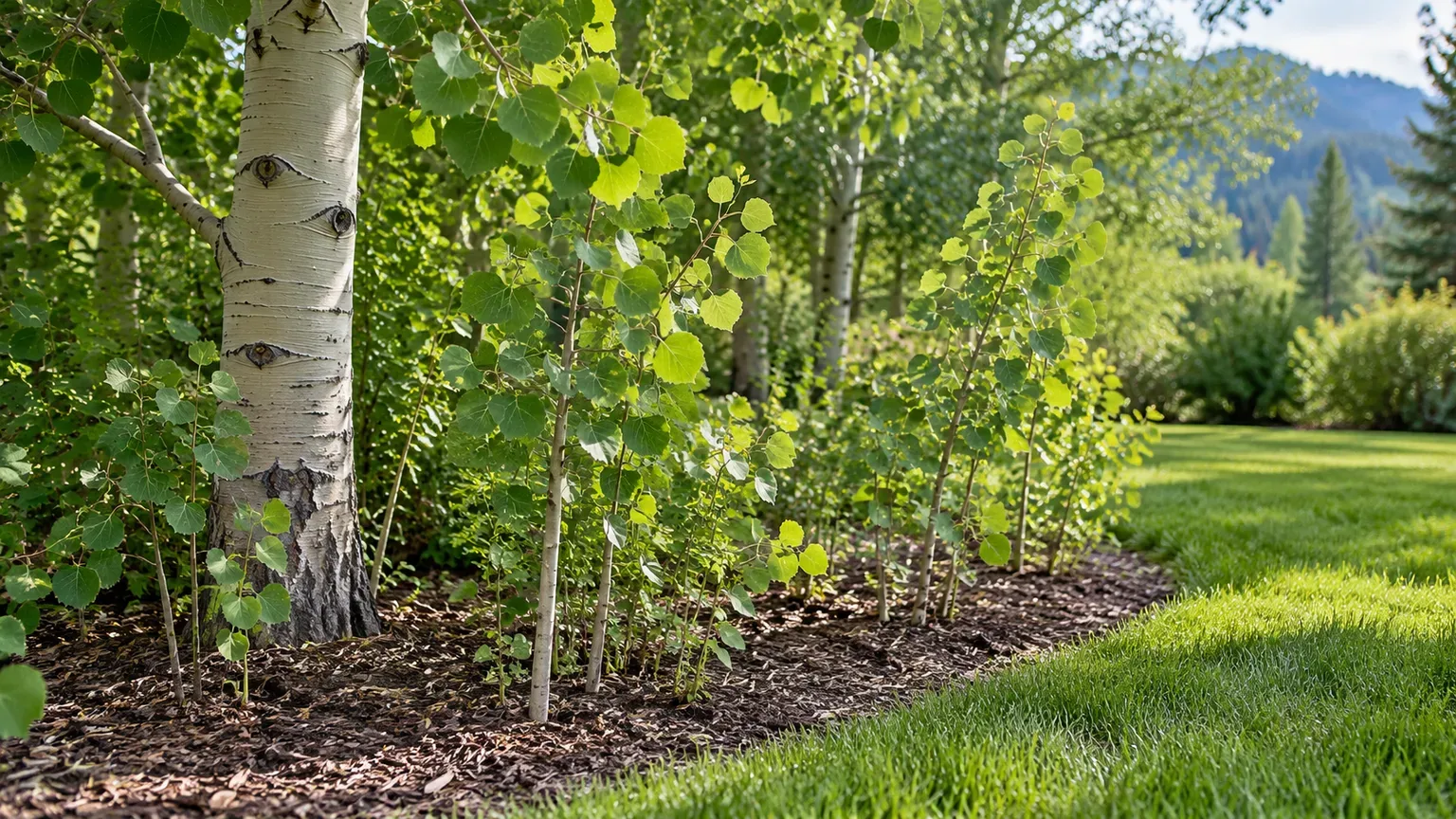
If a sucker appears in turf, mow it with the lawn or cut it at the base and keep monitoring. In a planted bed, remove unwanted shoots cleanly and retain only stems that fit the planned grove; digging out each shoot can injure the parent roots and provoke additional growth. A root barrier may limit some movement if correctly placed during installation, but it cannot guarantee containment of an established clone and can be outflanked at its ends or top.
If you decide the tree must go, do not simply fell the trunk and expect suckers to stop. The living roots can respond to stem removal with a flush of shoots. Removing an established clone may take repeated work and careful, label-compliant treatment; because connected roots can run under pavement, utilities, and neighboring property, get an arborist’s plan before attempting it. If that maintenance is not acceptable, choose a less aggressive tree before planting.
Conclusion
Quaking aspen gives you trembling foliage, pale bark, and bright fall color when the climate and site suit it. Give it full sun, cool summers, moisture-retentive but well-drained soil, careful establishment watering, and enough room for roots that may produce a grove. Decide in advance whether repeated sucker control, browsing protection, and periodic health checks fit your landscape; if not, choose a longer-lived, less spreading tree rather than trying to prune or water an aspen into a different plant.



