20 Redbud Tree Varieties: Size, Color, and Zones
Compare 20 redbud tree varieties by mature size, USDA zones, flower color, foliage, and disease risk to choose a tree that fits your climate and yard.
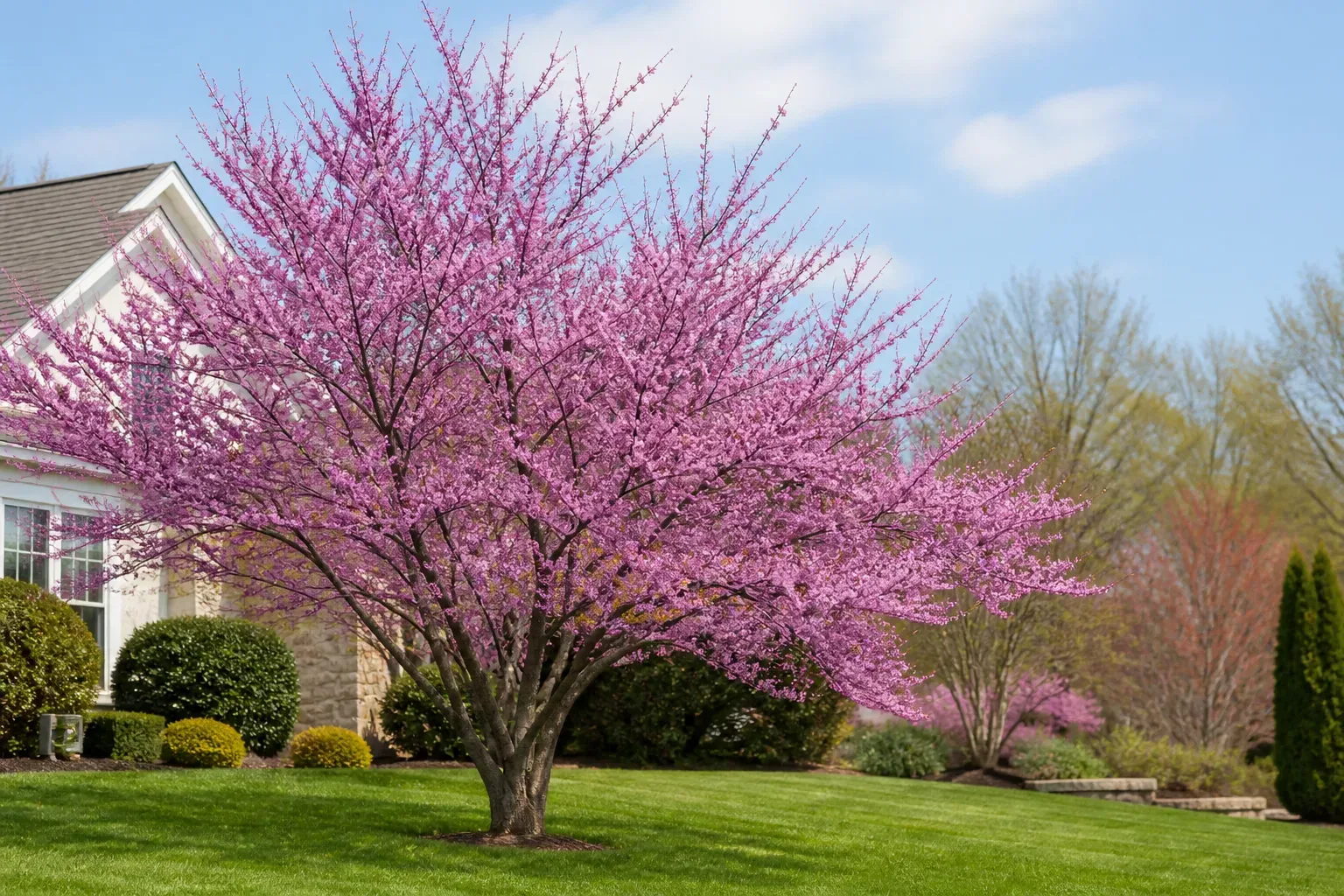
Redbuds are not one-size-fits-all spring trees. A standard Eastern redbud can spread 25 to 35 feet, while a grafted weeper may stay below 10 feet tall but trail across a broad bed; Texas redbuds handle hot, dry summers better than Eastern types but are less cold-hardy. Gold, burgundy, and variegated leaves also change the tree’s look long after flowers drop.
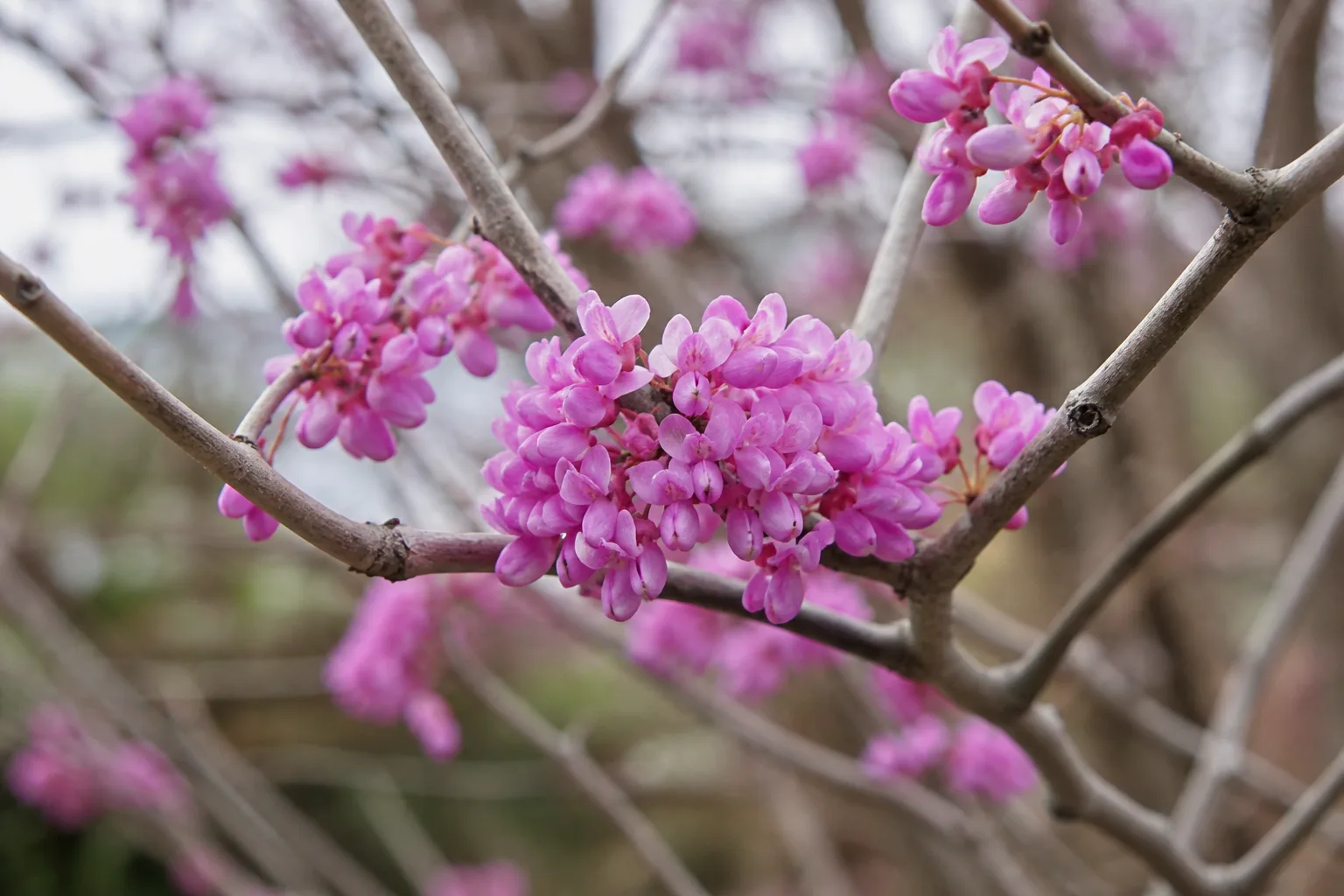
The names on nursery tags can make the choice harder. “Weeping redbud” describes a growth habit shared by several cultivars, “Lavender Twist” is a trade name for the cultivar ‘Covey,’ and a white-flowered form is not automatically a distinct species. Start with the space and climate you can offer, then pick the flower and foliage you want.
Start With the Site, Then Choose a Color
For a typical eastern or central U.S. yard, the straight species, Cercis canadensis, is the most adaptable starting point. It commonly reaches 20 to 30 feet high with a wider crown, blooms lavender-pink on bare branches in early spring, and accepts sun or partial shade. It is native across much of eastern North America, but performance still depends on the site: long drought, saturated soil, root disturbance, herbicide drift, and exposed wind can all cause trouble. NC State Extension’s species profile documents both its landscape range and those limits.
Do not choose by flower color alone. Ask how wide the tree gets, whether it is grafted, how much summer sun the foliage can handle, and whether your winter minimums fit the cultivar. For a dry-summer California yard, a native Western redbud can be a better match than a fashionable Eastern cultivar; for a compact courtyard in a cold climate, choose a cold-hardy selection with a clear label and a nursery able to confirm local performance.
The zone ranges below are broad planning guides compiled from extension, arboretum, and horticultural references. They are not a promise that a tree will thrive: USDA zones describe average annual extreme winter minimums, not summer heat, humidity, soil drainage, late frosts, or the sheltered microclimate beside a wall. Cultivar size also varies with climate, graft height, soil, and pruning; use the wider figure when planning clearances.
Compare 20 Redbuds at a Glance
| Redbud and botanical identity | Approx. mature size; USDA zones | Flowers and standout | Best fit and caveat |
|---|---|---|---|
| Eastern redbud — Cercis canadensis | 20–30 ft tall, 25–35 ft wide; 4–9 | Lavender-pink flowers; green heart-shaped leaves | Woodland edge or lawn specimen; avoid wet ground and prolonged drought. |
| ‘Forest Pansy’ — C. canadensis | 20–30 ft tall, 25–35 ft wide; 5–9 | Rosy-purple bloom; purple leaves, often greener in summer | Foliage accent in a sheltered site; Verticillium wilt is a specific concern. |
| ‘Oklahoma’ — C. canadensis subsp. texensis | 12–18 ft tall, 15–20 ft wide; about 6–9 | Royal-purple bloom; thick, glossy leaves | Hotter, drier central and southern gardens; still needs drainage and establishment water. |
| ‘Texas White’ — C. canadensis subsp. texensis | About 15–20 ft tall and wide; 6–9 | White flowers; glossy, thick foliage | Warm, relatively dry sites; lower cold tolerance than the Eastern species. |
| White Eastern redbud, f. alba | 15–25 ft tall and wide; roughly 4–9 | Pure white flowers; green foliage | A naturalistic white-flowering tree; seedlings vary and can cross with pink redbuds. |
| ‘Merlot’ — Cercis ‘Merlot’ | 9–12 ft tall, 10–15 ft wide; 6–9 | Pink-lavender bloom; glossy burgundy foliage | Compact choice for heat; canker and dieback remain possible. |
| ‘Carolina Sweetheart’ — C. canadensis ‘NCCC1’ | 20–30 ft tall, slightly wider; 4–9 | Pink flowers; purple leaves mottled with white, green, and pink | Foliage drama; give it moisture, and expect color to settle toward green in summer. |
| ‘Hearts of Gold’ — C. canadensis | 20–25 ft tall, 25–35 ft wide; about 5–9 | Pinkish-purple flowers; gold spring foliage | Sunny specimen or woodland edge; color greens more in shade and may scorch in heat. |
| ‘The Rising Sun’ — C. canadensis ‘JN2’ | 8–12 ft tall and wide; 5–9 | Pink-purple bloom; leaves flush apricot, yellow, then green | Small garden focal point; protect colored foliage from harsh afternoon sun. |
| Flame Thrower® — C. canadensis ‘NC2016-2’ | 15–20 ft tall, 10–15 ft wide; 5–9 | Light-purple bloom; leaves pass through purple, red, bronze, and green | Multi-season color; contrast eases in summer heat. |
| ‘Alley Cat’ — C. canadensis | 15–20 ft tall, about 12–20 ft wide; roughly 4/5–8 | Lavender flowers; white-and-green variegated leaves | Larger foliage specimen; hardiness estimates differ, so verify locally. |
| ‘Ace of Hearts’ — C. canadensis | About 10–15 ft tall and wide; 5–9 | Pink-lavender flowers; dense, rounded green crown | Restrained native selection for modest yards; compact does not mean shrub-sized. |
| Lavender Twist® — C. canadensis ‘Covey’ | Roughly 4–6 ft tall and 6–12 ft wide, depending on graft; zone 4–9 reported | Lavender-pink flowers; arching, weeping branches | Small focal point; reports differ on hardiness and spread, so verify locally. |
| ‘Ruby Falls’ — C. canadensis | Roughly 5–8 ft tall and 4–8 ft wide; 5–9 | Dark-rose flowers; weeping form with burgundy leaves | Compact accent; dimensions vary with graft height and training. |
| ‘Appalachian Red’ — C. canadensis | 15–25 ft tall and wide; 4–9 | Bright fuchsia-pink flowers, not true red | Use when bloom intensity is the priority; larger than its name may suggest. |
| ‘Traveller’ — C. canadensis subsp. texensis | About 6–8 ft tall, 12–14 ft wide; 6–9 | Rose-purple bloom; weeping habit and glossy leaves | Spreading accent for hot, dry-summer regions; reserve horizontal room. |
| ‘Don Egolf’ — C. chinensis | About 9–12 ft tall and wide; 6–9 | Deep pink-purple flowers; compact, upright form | Seedless, tidier Chinese redbud for a mild site; harder frost can damage the species. |
| Western redbud — C. occidentalis | About 12–20 ft tall and wide; 6–9 | Magenta-pink bloom; rounded leaves and red-purple pods | Dry-summer California and interior-West choice; flowering improves with winter chill. |
| European Judas tree — C. siliquastrum | About 20–30 ft tall, often wider; roughly 6–9 | Rosy-pink flowers on old wood and trunk | Mild, well-drained Mediterranean-style site; not a North American native. |
| Chain-flowered redbud — C. racemosa | About 20–25 ft tall and wide; generally 7–9 | Pale pink to lavender flowers in hanging chains | Collector’s tree for mild climates; uncommon in nurseries and not a cold-region pick. |
These are approximate landscape dimensions, not a ranking. Eastern redbud references differ on spread and longevity, while compact grafted cultivars can vary by several feet depending on graft height. If a narrow bed has a hard limit, get the seller’s actual graft-height information and choose based on eventual width, not the plant’s height in its pot.
The estimates combine extension, arboretum, and horticultural profiles. NC State Extension’s redbud and cultivar profiles, Clemson Cooperative Extension’s redbud guide, and Fine Gardening’s cultivar comparison cover the main Eastern selections; Morton Arboretum and Dawes Arboretum provide useful checks on compact and weeping forms. Where those references disagree, the table says so rather than treating a single nursery dimension as exact.
Eastern Redbud Cultivars: Form, Flowers, and Foliage
The dependable species and Texas selections
Eastern redbud is the benchmark for the genus: rounded or multi-stemmed, adaptable to full sun or dappled shade, and most floriferous when it gets good light without punishing afternoon heat. It often grows beneath taller trees in nature, which explains why a woodland edge can suit it better than an exposed parking strip. Yet a tree in deep shade may survive but flower less heavily. The Clemson Cooperative Extension redbud guide describes the early bloom, soil preference, and use in naturalized areas.
‘Forest Pansy’ extends the show with purple-red foliage, but the leaves can lose intensity as the season progresses, especially in hot weather. Its growth remains that of a regular Eastern redbud, so it is not a small-yard fix. NC State’s cultivar profile lists Verticillium wilt among its concerns; if that disease is common in your area or the planting site has a history of wilt, pick a different foliage effect rather than assuming dark leaves indicate toughness.
‘Oklahoma’ and ‘Texas White’ belong to the Texas redbud lineage, currently often treated as C. canadensis subsp. texensis. Their leathery, glossy leaves and better tolerance of heat or dry spells can help in the south-central United States, where an Eastern redbud may struggle through summer. But “more drought-tolerant” means more forgiving after establishment, not no-water: young trees still need deep watering, and all redbuds decline in poorly drained soil. Older nursery sources may call Texas redbud C. reniformis; the cultivar name and regional performance matter more than one synonym.
NC State Extension’s ‘Oklahoma’ profile lists a mature size of 12 to 18 feet tall and 15 to 20 feet wide. Clemson Extension’s redbud guide and NC State’s Texas redbud profile help distinguish ‘Texas White’ from the pink-flowered Eastern form.
The two white-flowered options are not interchangeable. White Eastern redbud, often sold as C. canadensis f. alba or var. alba, is a naturally occurring white form; seedlings can vary, and open pollination near pink trees can produce mixed offspring. ‘Texas White’ is a named selection of the Texas lineage, so it combines white flowers with thicker, glossy leaves and a warmer-region profile. Clemson’s cultivar notes distinguish the natural white form from ‘Texas White’; for a reliably white, more compact tree, compare ‘Royal White’ locally rather than relying on a seed-grown “alba” tag.
Purple, gold, and variegated foliage
‘Merlot’ is useful when color and scale both matter. It stays near 9 to 12 feet tall, with a somewhat wider, often low-branched crown, and its glossy wine-colored leaves hold their tone better than ‘Forest Pansy’ in heat. NC State records its parentage as a cross between ‘Texas White’ and ‘Forest Pansy’ and rates it as more heat- and drought-tolerant than many redbuds; keep that relative claim in perspective because the tree still needs establishment water and good drainage. NC State’s ‘Merlot’ profile is especially useful for this distinction.
‘Hearts of Gold’ and ‘The Rising Sun’ both bring gold to the spring garden, but the color sequence differs. ‘Hearts of Gold’ pushes gold leaves and has pink-purple flowers; full sun encourages stronger gold, while shade shifts foliage toward chartreuse, as NC State Extension’s profile describes. ‘The Rising Sun’ opens apricot-orange, moves through gold and yellow, then greens as leaves mature, with fresh growth continuing to add contrast; University of Arkansas Extension documents that seasonal progression. These effects are brightest in spring and can fade or scorch during high heat. Plant them where they receive morning sun and some relief from intense late-day sun in hot climates.
‘Flame Thrower’ is a larger, more upright selection with a different leaf sequence: purple new growth becomes red and bronze before maturing toward green. It was selected from a cross involving ‘The Rising Sun’; it is not a weeping tree, despite the slightly pendant tips some plants show. NC State Extension’s profile notes that the strongest variation appears early to mid-season and lessens as summer temperatures rise. Treat it as a seasonal foliage display rather than expecting constant flame-colored leaves.
For white-and-green leaves, ‘Alley Cat’ is a sturdier, larger specimen than compact marketing photos suggest, and its variegation is reported to hold better through summer than some older selections. The Dawes Arboretum record describes a 15- to 20-foot tree and notes that this selection’s leaves resist burning or fading better than other variegated redbuds. ‘Carolina Sweetheart’ begins with purple new leaves, then layers in white, green, and hot pink before settling mostly green, as NC State Extension’s cultivar profile describes. Both need room for a full tree crown; neither is miniature because its leaves are colorful. If you want variegation but have a small bed, consider a smaller alternative such as ‘Rising Sun’ or use a shrub instead of squeezing a medium tree into a foundation strip.
‘Ace of Hearts’ keeps a denser, rounded, more compact silhouette than the species, at roughly 10 to 15 feet tall and wide. Its benefit is a smaller footprint, not a special flower color or immunity from redbud diseases. Morton Arboretum rates it marginally hardy in zone 5, so confirm winter performance with a local nursery in cold sites. ‘Appalachian Red’ makes flowers the main event: saturated fuchsia-pink can look red at a distance, but it is not truly red. Both bloom before leaves emerge, creating a spring spectacle above green summer foliage; Fine Gardening’s cultivar profile gives its approximate size and bloom color.
Compact and cascading forms
“Weeping redbud” is a category, not one botanical variety. Lavender Twist® is C. canadensis ‘Covey’; ‘Ruby Falls’ is another eastern selection, while ‘Traveller’ is a weeping Texas redbud. They differ in size, leaf color, cold tolerance, and how wide they trail. The University of Utah’s arboretum profile identifies Lavender Twist as ‘Covey’; Fine Gardening’s cultivar comparison helps distinguish it from the Texas selection ‘Traveller’.
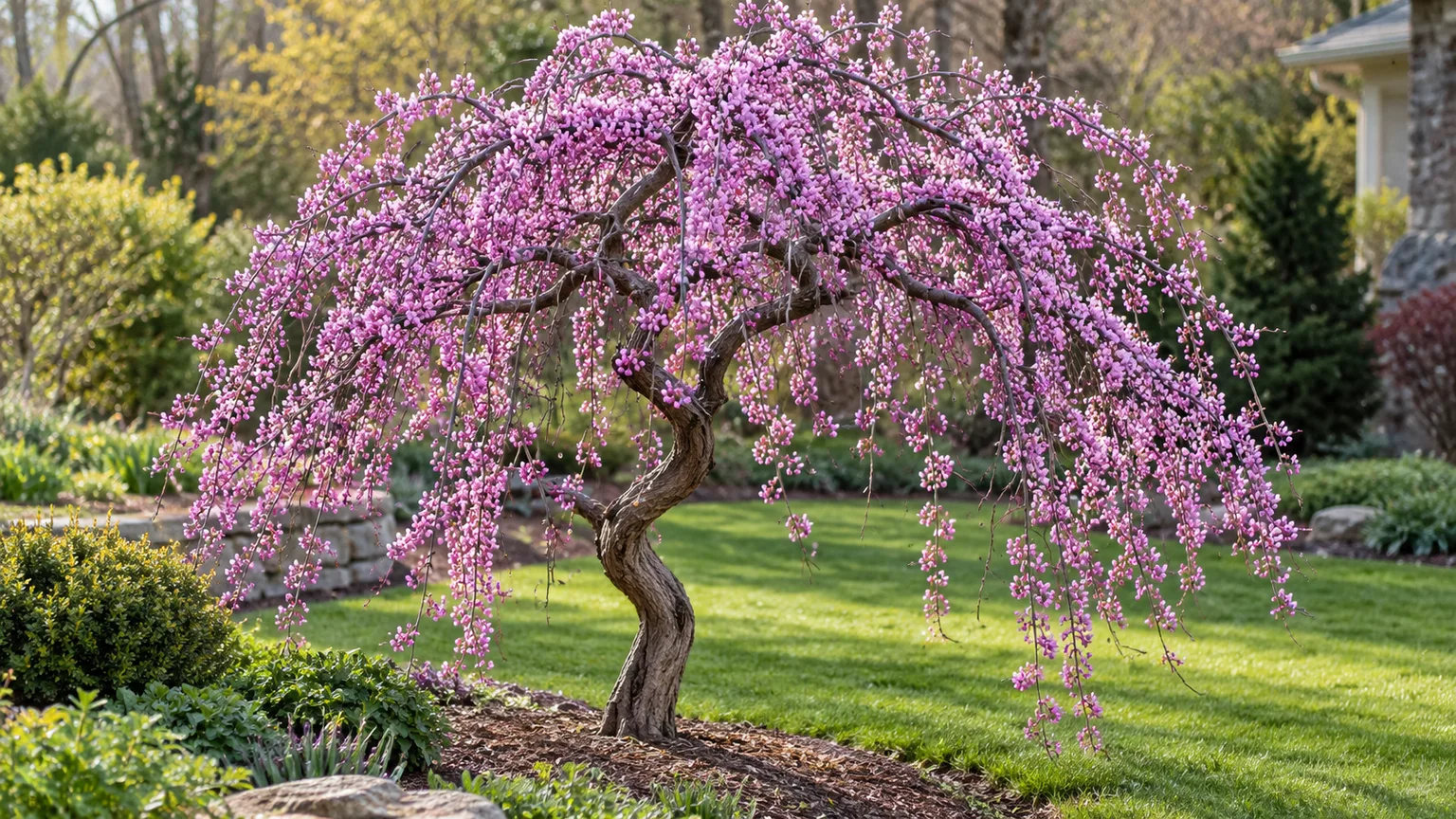
Lavender Twist creates a low umbrella of curved branches, so leave walking and mowing clearance around the canopy. Its final height depends partly on graft height and training: the trunk does not extend upward above the graft as a standard tree’s trunk does. Morton Arboretum reports a 4- to 5-foot height and 6- to 8-foot spread, while Dawes Arboretum notes a 12-foot spread and zone 4 hardiness; regional records vary. A seller may list a much shorter tree than its expected spread, which is why a narrow front bed can be the wrong place for a weeper.
‘Ruby Falls’ combines burgundy leaves with a compact weeping habit. References place mature dimensions differently, from a roughly 5-foot grafted specimen to a tree near 8 feet tall and wide; NC State Extension’s profile gives one measured range, while horticultural references often report a broader landscape footprint. Ask whether the nursery’s figure reflects the grafted plant’s actual crown or only trunk height. It can make a striking small-garden focal point when the branches have room to cascade.
‘Traveller’ has the glossy, thick foliage associated with Texas redbud and a wide, spreading weep. Its horizontal spread—often roughly twice its height—is what sets the planting distance. It can be a better regional fit than an Eastern weeper in a hot, dry-summer landscape, but it still needs drainage, irrigation during its first seasons, and protection from prolonged stress. Use it where a low canopy can extend over a retaining wall or open bed, not beside a narrow path.
Redbuds Beyond the Eastern Species
Chinese redbud ‘Don Egolf’
Chinese redbud (C. chinensis) tends to form a shrub-like, multi-stemmed plant and usually stays shorter than Eastern redbud in American gardens. ‘Don Egolf’ was selected at the U.S. National Arboretum as a compact, upright cultivar that flowers abundantly and produces little or no seed. Its smaller footprint and tidier fruiting make it useful where a Chinese redbud’s tendency to look loose or pod-laden would otherwise be a drawback. The U.S. National Arboretum’s cultivar sheet records a plant about 9 feet tall and 9.5 feet wide at 15 years.
The trade-off is winter hardiness. Chinese redbud can suffer dieback after a hard frost and appreciates protection from punishing afternoon sun in hot climates. Treat ‘Don Egolf’ as a mild-winter choice, roughly zones 6–9, and ask whether it has proven reliable in your area rather than assuming its small size makes it broadly adaptable. It is a reasonable specimen in a warm courtyard, but not an automatic substitute for native Eastern redbud in cold regions.
Western redbud for dry-summer gardens
Western redbud, C. occidentalis, is native to California and nearby interior West states and is one of the most practical redbuds for a dry-summer site in its climate range. It grows as a multi-stemmed shrub or small tree, commonly 12 to 20 feet tall and wide, with magenta flowers on bare branches and rounder leaves than Eastern redbud. After establishment, it uses less summer water than many ornamental trees if the soil drains well. UC Agriculture and Natural Resources’ regional guidance explains why it often outperforms Eastern redbud in California’s dry summers.
Western redbud’s regional fit is more important than its zone label. It needs winter chill for a reliable spring display, while hot-summer gardeners should not mistake drought adaptation for tolerance of reflected heat and compacted, waterlogged ground. It is a strong native choice in the foothills and Mediterranean-climate West, but not a replacement for every “Western” garden: check local elevation, rainfall, and nursery provenance.
European Judas tree for mild regions
The European Judas tree, C. siliquastrum, comes from southern Europe and western Asia. It carries rosy-pink flowers directly on older wood and sometimes the trunk, then develops broad heart-shaped leaves and long purple-brown pods. A mature tree can approach 20 to 30 feet, so it needs more space than a patio-sized cultivar. The Royal Horticultural Society describes a mature tree that can exceed 8 meters in spread, a useful reminder to plan for a broad crown.
This species suits mild regions with sun, well-drained soil, and relatively dry summers once established. It is often listed around zones 6–9, but winter exposure, humidity, and drainage influence success. The Royal Horticultural Society’s species profile describes its broad mature spread and drought resistance in the UK. “Judas tree” is sometimes used loosely for other redbuds; check the botanical name when comparing a European tree with American Eastern redbud.
Chain-flowered redbud as a collector’s choice
Chain-flowered redbud, C. racemosa, is unmistakable in bloom: pale pink to lavender flowers hang in elongated clusters, more like short wisteria chains than the tight clusters typical of most redbuds. NC State Extension describes racemes about 2 to 4 inches long with numerous flowers on a tree that can reach roughly 25 feet. The show is distinctive, but the bloom color is softer than the hot pink of many Eastern selections.
Availability and climate limit its usefulness. The species is not widely sold and NC State does not recommend it for North Carolina gardens; treat it as an uncommon plant for mild regions and collectors willing to confirm local hardiness. Do not choose it expecting a tougher or more vivid Eastern redbud. Its selling point is the floral form, not broad adaptability.
Match Redbud to Climate, Soil, and Space
Sun, heat, and hardiness
Most redbuds flower best in sun or bright partial shade, but their foliage can prefer afternoon protection where summers are hot. For a cool climate, the straight Eastern species and many of its cultivars offer the broadest winter range. For hot, dry conditions, look at Texas redbud selections such as ‘Oklahoma,’ ‘Texas White,’ ‘Merlot,’ and ‘Traveller’; for California dry-summer gardens, compare native Western redbud first. A warm-zone recommendation does not mean an Eastern redbud tolerates every subtropical site—humidity, soil, and heat load still matter.
Use the 2023 USDA Plant Hardiness Zone Map to check the minimum winter range for your address, then match it against an extension or arboretum description. If two sources disagree on a cultivar’s zones, choose the more conservative rating or ask a local extension office. A one-zone margin is sensible in exposed sites, frost pockets, or places where a late freeze can damage flower buds and young shoots.
Drainage, water, and transplanting
Redbuds tolerate many soil textures but do not reward a persistently soggy planting hole. Before planting, watch the site after heavy rain; if water stands or soil stays airless, choose another location or a different tree adapted to wet ground. Do not fill a clay hole with a pocket of rich potting mix—the abrupt change can hold water around roots and create a bathtub effect. Improve the larger planting area only where practical, and keep the root flare visible at soil level.
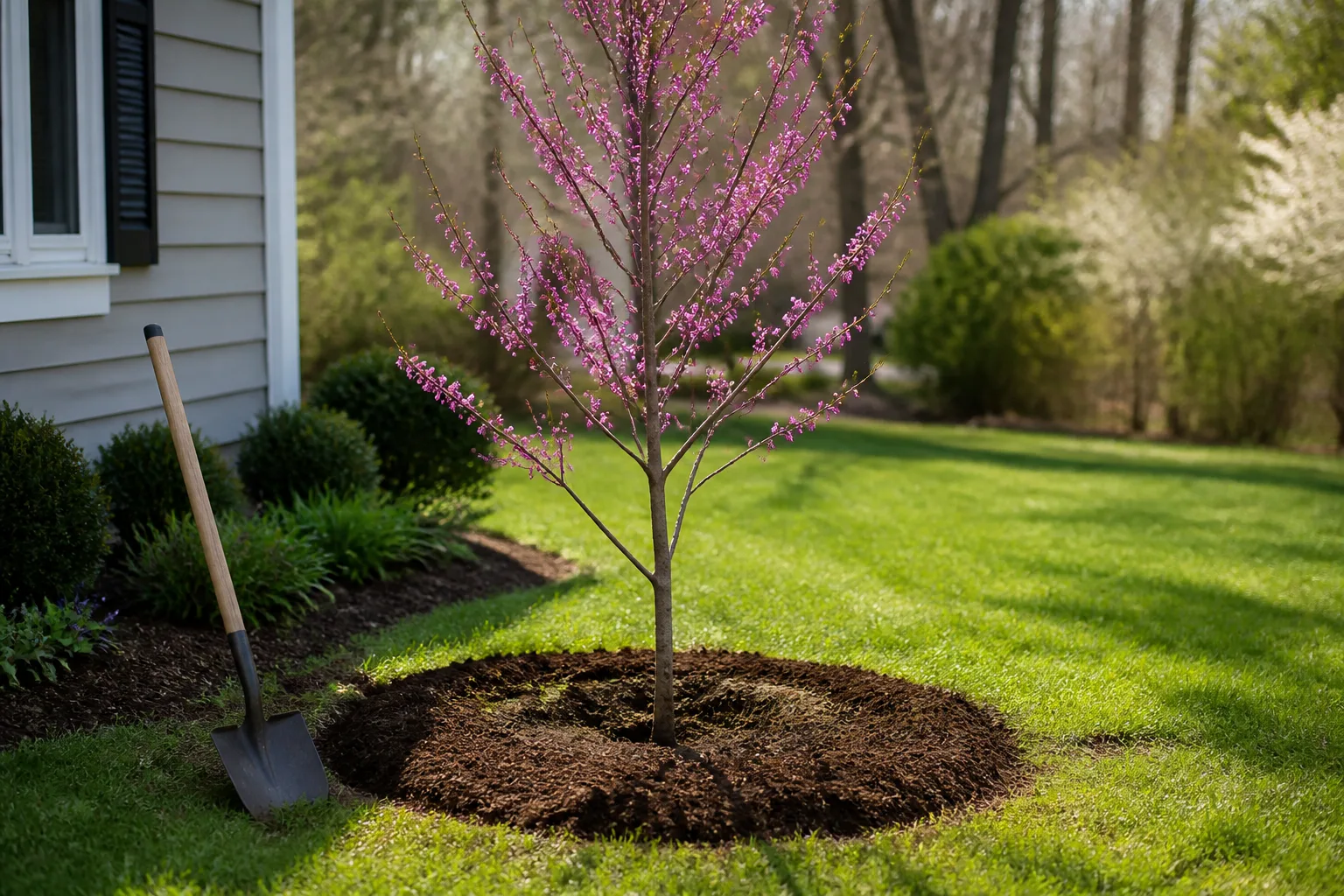
Plant a young tree where it can stay. Redbuds develop a substantial taproot and resent root disturbance, so moving an established specimen often sets it back. Water deeply during establishment, especially through hot, rainless weeks, then adjust irrigation to rainfall and soil. A thin mulch ring helps moderate soil moisture, but keep mulch several inches away from the trunk to avoid rot and rodent damage.
Plan for mature spread, not the planter’s label height. A standard eastern tree may need 25 feet or more across; a weeping selection can remain short yet spread 12 feet, and a compact upright may still be 10 to 12 feet wide. Measure from the trunk to walls, pavement, overhead lines, property edges, and mower paths. If branches would need repeated shortening to clear those features, the tree does not fit the site.
Disease and branch structure
Redbuds are not disease-proof. Canker and dieback can kill individual branches; leaf spots, powdery mildew, and Verticillium wilt occur; waterlogged roots invite decline. In a stressed tree, a problem that begins on one branch can progress through the crown. Extension profiles list canker, dieback, and other fungal issues for C. canadensis, but do not support calling named cultivars generally immune. Forest Pansy has the added Verticillium concern, so avoid it where susceptible trees have recently died of that soilborne disease.
Good planting decisions reduce risk more reliably than prophylactic sprays. Buy a healthy, correctly labeled tree; set it in well-drained soil; water it during establishment; and protect trunk and shallow roots from lawn equipment. Prune dead or crossing branches during suitable dry weather, and do not top a redbud to force a size the cultivar cannot naturally maintain. Redbuds can have weak wood and narrow branch unions, so a young tree’s structure deserves light, selective attention—not aggressive shaping.
Choose one feature to be the star
A redbud is easiest to place when one feature leads. Choose ‘Appalachian Red’ or the straight species for spring flowers, ‘Forest Pansy’ or ‘Merlot’ for burgundy foliage, ‘Rising Sun’ or ‘Hearts of Gold’ for gold, ‘Alley Cat’ or ‘Carolina Sweetheart’ for variegation, and ‘Ruby Falls’ or ‘Lavender Twist’ for a low, cascading outline. A second redbud with contrasting bloom time or foliage can work in a large garden, but two showy cultivars in a tiny bed can compete rather than complement.
For a small yard, ‘Ace of Hearts’ is a compact green-leaved choice, while ‘Ruby Falls’ gives a stronger sculptural look in less vertical space. For a hot-summer site, lean toward Texas selections and give new plantings a realistic irrigation plan. For a dry California garden, use Western redbud where local conditions suit it. At a woodland edge, the straight Eastern species often gives the best balance of native ecological value and seasonal color.
The best cultivar is the one that does not need rescue pruning, constant irrigation, or winter protection after planting. Read the botanical name, verify mature spread and local hardiness, inspect drainage, and ask whether the nursery’s measurements reflect the cultivar’s mature crown or a grafted plant’s initial height. If the seller cannot answer those questions, wait for a better-labeled tree.
Conclusion: Buy the Label That Fits the Site
Redbud varieties range from a 6-foot weeper to a broad, 30-foot Eastern tree, and their differences continue after bloom: glossy Texas leaves, purple or gold foliage, white flowers, or a cascading habit. Match botanical identity to climate, then use mature spread and disease notes to decide whether it belongs in your yard. A redbud planted once in the right place gives more reliable spring color than a dramatic cultivar planted where roots, branches, or foliage stay under constant stress.