15 Rose of Sharon Varieties for Your Landscape
Compare 15 Rose of Sharon varieties by mature size, flower color, foliage, seed set, and landscape use before choosing one for your yard.
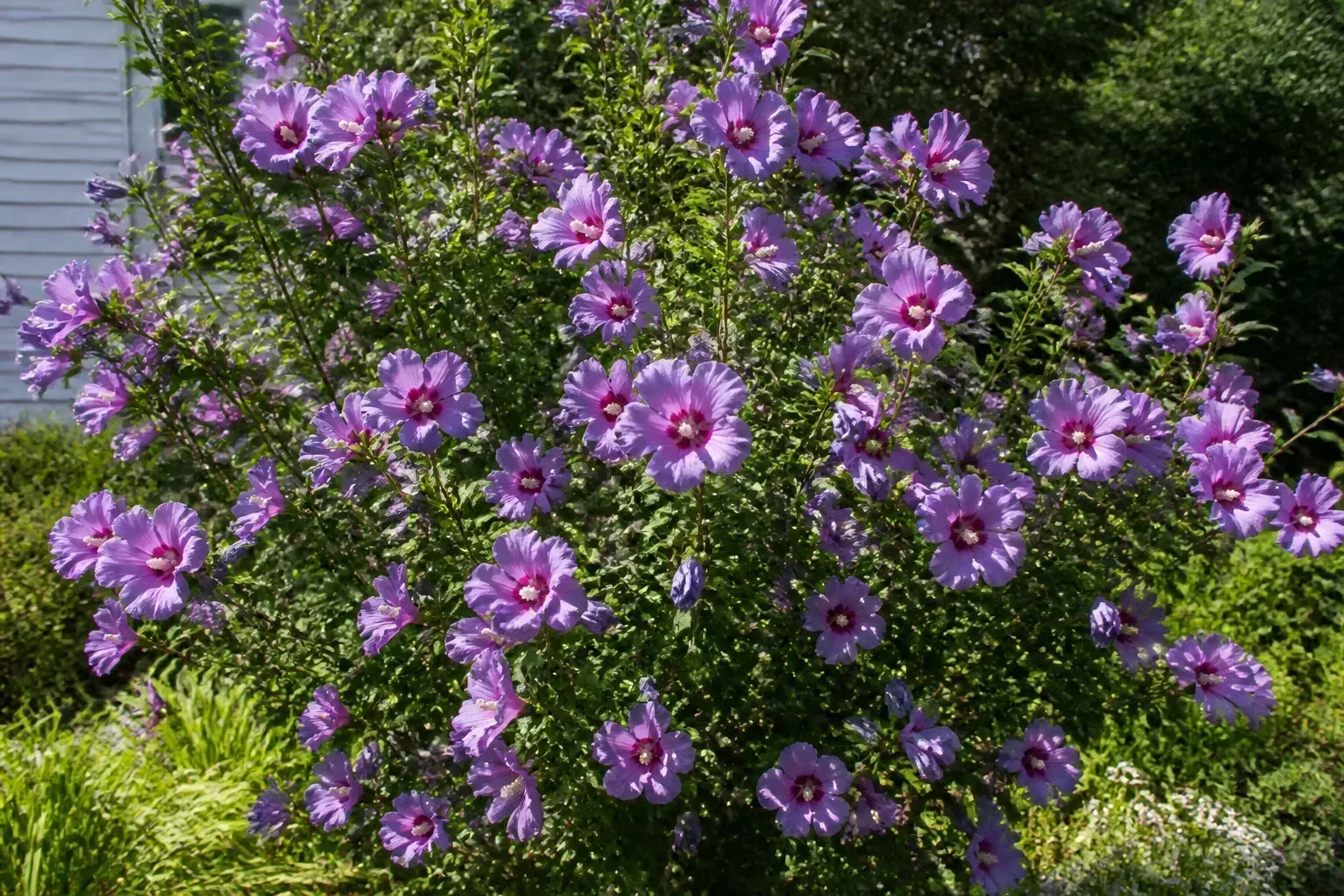
Rose of Sharon (Hibiscus syriacus) earns its place in a landscape when many spring and early-summer shrubs are finished. It leafs out late, then produces a succession of single or double hibiscus-like flowers from midsummer into early fall. The shrub is adaptable, but it is not automatically small: the species commonly reaches 8 to 12 feet tall and 6 to 10 feet wide, so the cultivar’s mature footprint matters more than the size of the pot you bring home. North Carolina State Extension describes the species as a large shrub or tree with that general footprint and a preference for moist, well-drained soil.
The best choice depends on the job. Lil Kim is the practical answer for a container or short border; Purple Pillar supplies height without the usual width; Sugar Tip and Sugar Tip Gold earn their space with foliage as well as flowers; and low-seed selections can make more sense where volunteers would be a nuisance. Use the comparison below to narrow the list before you shop, then confirm the cultivar name and current seed-set claim on the nursery tag.
How to Choose Among Rose of Sharon Varieties
Rose of Sharon is sometimes called shrub althea or Syrian hibiscus. It is a deciduous, multi-stemmed shrub in the mallow family, not the tender tropical hibiscus often sold for summer containers. The name Hibiscus syriacus covers a wide range of forms, from a 3-foot dwarf to a column that can exceed 10 feet, and from clean white singles to ruffled double flowers and variegated leaves.
Start with mature size and shape
Measure the space from the center of the planting hole to the nearest path, window, fence, or neighboring shrub. Use the listed mature width as the minimum planning number; do not assume annual pruning will let a naturally broad cultivar live permanently in a narrow bed. A large shrub can be trained into a small tree with a clear trunk, but that changes the silhouette, not the root-zone and canopy demands.
For a small garden, look first at Lil Kim, Sugar Tip Gold, Blueberry Smoothie, or Minerva. For a screen, look at the width as well as height: Purple Pillar is unusually narrow, while many 8- to 12-foot cultivars need a broad enough bed to look full rather than pinched. If you want a hedge, NC State suggests planting the species about 6 to 12 feet apart; use the lower end only for naturally narrower cultivars and a faster visual fill.
Decide how much seed control matters
Rose of Sharon can form persistent brown seed capsules, and regional behavior is not identical. The University of Connecticut Plant Database flags H. syriacus as having an invasive tendency in Connecticut, while NC State notes reports of invasiveness in some states, including Virginia and Kentucky. That does not mean every cultivar behaves the same way, and it does not make a “sterile” nursery label a universal legal or ecological guarantee.
If seedlings would be a problem, ask for a named low-seed or seedless selection and check your state or county extension guidance before planting. Treat “triploid,” “sterile,” and “few or no viable seeds” as useful cultivar information to verify, not as permission to skip local guidance. Even a desirable shrub should not be allowed to naturalize along unmanaged edges.
Match sun, soil, and climate before flower color
Full sun gives the heaviest flowering, although Rose of Sharon tolerates partial shade. Give it a warm, open position and soil that drains after rain but does not become bone-dry for long periods. The RHS profile for the species lists full sun and moist but well-drained soil, with a broad range of soil textures; the plant’s widely quoted USDA range of Zones 5–9 is a starting point, not a promise for every cultivar or exposed site.
Late leaf-out is normal, especially in cool springs. Do not replace a living shrub in May just because the stems look bare while nearby plants are green. On the other hand, winter-killed stems, repeated dieback, or a site that never warms enough for buds to mature are reasons to reassess the cultivar and placement.
15 Rose of Sharon Varieties at a Glance
The ranges below are useful for comparison, not a guarantee. Soil, climate, pruning, nursery production, and whether the plant is grown as a shrub or standard can change the final look. Illinois Extension confirms the core landscape traits—late-summer flowers, full sun to partial shade, moist well-drained soil, and the range of single and double cultivars.
| Variety | Approximate mature size | Standout feature | Seed and placement note |
|---|---|---|---|
| Blue Chiffon | 8–12 ft tall | Powder blue-violet semi-double flowers | Low-seed selection; broad shrub |
| Sugar Tip | 5–8 ft tall | Pink doubles and cream-edged foliage | Commonly sold as sterile; foliage-first value |
| Red Heart | 8–12 ft tall | White flowers with a deep red eye | Verify seed behavior; allow broad spacing |
| White Chiffon | 8–12 ft tall | Clean white single flowers | Low-seed selection; good moon-garden color |
| Aphrodite | 6–10 ft tall | Pink flowers with a red throat | Triploid, but seed production can vary |
| Blue Satin | 8–12 ft tall | Blue-violet flowers and red eye | Few or no viable seeds reported; full-sun shrub |
| Blueberry Smoothie | 4–8 ft tall | Double blue-purple flowers | Compact-to-medium choice; confirm final tag size |
| Lavender Chiffon | 8–12 ft tall | Soft lilac semi-double flowers | Low-seed selection; screen or specimen shrub |
| Lil Kim | 3–4 ft tall and wide | White flowers with magenta throat | Dwarf; container or short border |
| Lucy | 6–8 ft tall | Full double magenta flowers | Compact, rounded, and commonly sold as sterile |
| Minerva | 5–8 ft tall | Lavender-pink flowers with red eye | Watch local seed concerns; excellent contrast |
| Purple Pillar | 10–16 ft tall, 2–5 ft wide | Tall, columnar habit | Vertical accent; verify seed-set label |
| Orchid Satin | 8–12 ft tall | Lavender-pink flowers with dark center | Low-seed selection; upright form |
| Purple Satin | 8–12 ft tall | Rich purple single flowers | Low-seed selection; needs room to spread |
| Sugar Tip Gold | 4–5 ft tall | Purple doubles and gold-edged foliage | Compact foliage feature; check stock label |
The 15 Best Picks by Landscape Job
The descriptions below focus on what each plant does in a real planting, not just how the flower looks in a close-up. Cultivar names and trademark names can both appear on a tag, so record the botanical cultivar name when you buy. For a second set of cultivar comparisons, Gardeners’ Path’s Rose of Sharon guide is useful for matching flower form and mature habit; Garden.org’s cultivar listings provide additional examples of how the same plant is used by gardeners in different climates.
Compact plants for containers and small beds
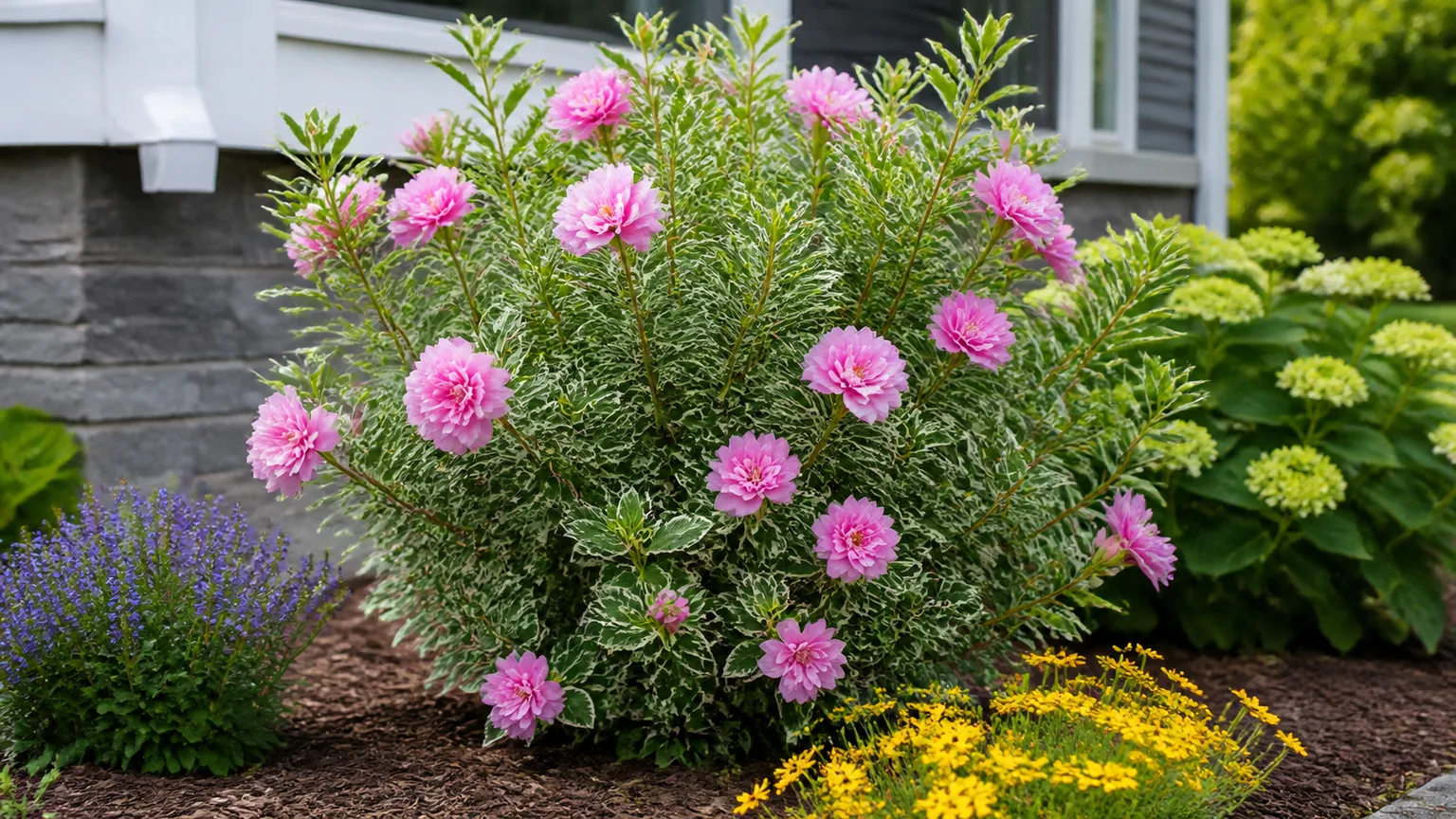
Lil Kim. At roughly 3 to 4 feet, Lil Kim is one of the safest picks when a normal Rose of Sharon would overwhelm the space. Its white flowers have a magenta throat and red veining, and the flowers can remain attractive for longer than the typical one-day bloom. Use it as a container specimen or at the front of a shrub border, but still give the pot reliable drainage and protect the root ball from severe winter cold in exposed containers.
Sugar Tip. Sugar Tip earns attention before it flowers because its blue-green leaves carry creamy-white variegation. The double pink flowers are a bonus, not the only reason to plant it. This is a good choice beside dark green shrubs or against a plain wall, but the light leaf margins can look washed out in deep shade and scorch in a hot, dry container.
Sugar Tip Gold. Choose Sugar Tip Gold when the foliage must carry the planting through spring and the flowering window. Its green leaves have bright gold edging and its double purple flowers create a high-contrast display. The roughly 4- to 5-foot habit suits a compact foundation bed better than a large privacy screen; keep the root zone evenly watered while the plant establishes so the variegated growth does not stall.
Blueberry Smoothie. This cultivar is a strong candidate for a small-to-medium border when double flowers are more important than a narrow silhouette. Its blue-purple blooms have a full, ruffled look, and the plant is commonly described as a compact selection. Nursery sizes vary, so use the tag’s final width rather than assuming every plant will stay at the smallest advertised number.
Minerva. Minerva combines a smaller, bushier habit with lavender-pink flowers and a bold red eye. It is large enough to anchor a border but less imposing than a full-size 10- to 12-foot cultivar. The color reads clearly from a distance, making it useful at the back of a perennial bed where a late-summer focal point is needed. Because seed behavior is reported inconsistently across sources and regions, check the local context before planting it near natural areas.
Tall or narrow plants for screening
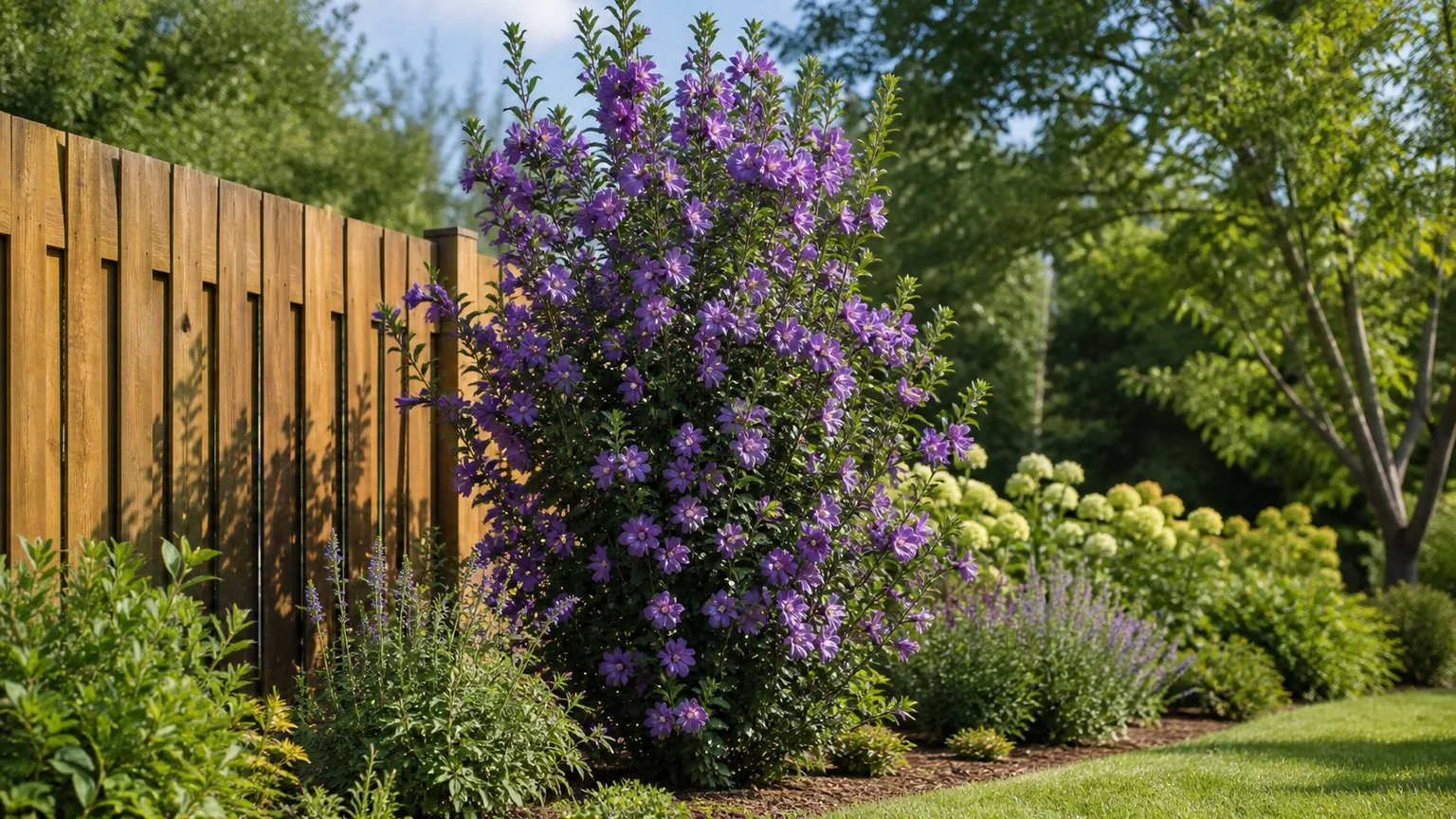
Purple Pillar. Purple Pillar is the outlier for vertical design: it can become very tall while remaining only a few feet wide. The semi-double purple flowers have a red throat and work well as a punctuation mark beside a fence, along a narrow side yard, or in a row of vertical accents. Do not plant it beneath low wires or directly against a window; narrow does not mean short, and a tall shrub still needs room for airflow and maintenance.
Blue Chiffon. Blue Chiffon gives a soft powder blue-violet effect with a frilly center that makes the flowers look fuller than a typical single. Its 8- to 12-foot height works as a late-season screen or large border shrub. The color is closer to blue-violet than a pure blue, especially in warm sunlight, so pair it with orange, yellow, or dark foliage if you want the cool tone to stand out.
Blue Satin. Blue Satin, also sold under the botanical cultivar name ‘Azurri Blue Satin,’ has intense blue-violet flowers with a dark magenta throat and yellow stamens. It is a good choice when flower color is the priority but volunteer seedlings are not welcome; sources commonly describe it as producing few or no viable seeds. Plant it where it can reach its full height and width, and do not let the low-seed trait substitute for checking local plant recommendations.
White Chiffon. White Chiffon is the cleanest choice for a white-flower garden, a pale foundation planting, or a moon-garden effect. Its single white blooms lack the strong colored eye seen on many Rose of Sharon types, so the shrub looks calmer from a distance. It is still a large cultivar, often reaching 8 to 12 feet, which makes it better for a rear border or screen than for a tight front walk.
Lavender Chiffon. Lavender Chiffon produces soft lilac-pink semi-double flowers with a darker eye and a rounded, upright habit. It makes a substantial shrub border or informal screen, especially where late-summer color needs to bridge the gap between annuals and fall perennials. The plant flowers on new growth, so a light spring shape-up is possible, but repeated hard shearing removes the very stems that will carry the season’s buds.
Orchid Satin. Orchid Satin is a tall, upright selection with lavender-pink flowers and a noticeable red center. Its value is consistency of outline: it can stand behind lower perennials without spreading as widely as a naturally broad shrub. Use it as a single accent or repeat it at generous intervals rather than crowding several plants into a hedge. Ask the nursery how the current stock is labeled for seed set, because cultivar availability and claims can change.
Flower contrast and foliage-first choices
Red Heart. Red Heart uses a simple palette—white petals and a deep red center—but the contrast reads strongly across a yard. It can reach roughly 8 to 12 feet and needs a broad location. This is the kind of established cultivar to choose when you want a familiar, high-visibility flower rather than variegated leaves or a double bloom. If seed control is a major priority, compare it with a named low-seed alternative before buying.
Aphrodite. Aphrodite has large pink flowers with a dark red throat and a full, rounded habit in the 6- to 10-foot range. It is a useful middle ground between a dwarf and a full-size screen. Aphrodite is often described as a triploid selection developed through National Arboretum breeding, but UConn notes that observations can still show ample seed production. That makes it a good example of why “triploid” should not be treated as an absolute no-seed guarantee.
Lucy. Lucy is a compact, full-bodied shrub with double rosy-magenta flowers that can resemble small peonies. At roughly 6 to 8 feet, it works as a flowering hedge or rounded anchor plant without the height of Purple Pillar. Give it full sun for the heaviest bloom; it tolerates some shade, but a dim position makes the shrub’s main feature less convincing.
Purple Satin. Purple Satin, also known by the cultivar name ‘Marina,’ produces rich purple single flowers with a deep red eye. Its color is more saturated than the softer lavender cultivars, and the upright vase-shaped habit makes it useful at the back of a mixed border. Allow 8 to 12 feet of height and generous width, then underplant the bare lower stems with perennials rather than trying to force the shrub into a tight formal hedge.
Planting, Spacing, and Pruning Rules That Prevent Regret
Rose of Sharon is forgiving after establishment, but “adaptable” is not the same as “indestructible.” It flowers on the current season’s growth, so the planting site, spring pruning, and summer moisture pattern all influence the display.
Give the shrub room and enough sun
Dig a hole no deeper than the root ball and several times wider, loosen circling roots, and set the top of the root ball level with or just above the surrounding soil. Water deeply after planting, keep a modest mulch ring over the root zone, and keep mulch away from the stems. During the first growing season, check the soil below the surface instead of watering by the calendar; the goal is steady moisture without a permanently saturated root zone.
Place full-size cultivars where their mature canopy can extend without blocking a walkway or pressing against siding. A spot with 6 or more hours of direct sun is the safest choice for heavy flowering. Part shade can keep the shrub alive, but it usually means fewer flowers and a looser, leggier form. The Purdue growing note also emphasizes moist, well-drained soil and explains that Rose of Sharon flowers on new growth.
Prune for the growth you want, not just a smaller number
Prune in late winter or early spring before strong new growth begins. Remove dead or winter-damaged stems first, then thin crossing branches and shorten selected shoots if you need a denser outline. A harder cut can produce fewer but larger flowers, while leaving more young stems generally gives a fuller succession of blooms.
Do not shear a large cultivar repeatedly into a small geometric ball. That creates a cycle of vigorous shoots, weak structure, and a plant that still wants to reach its genetic size. If you need a small plant, choose Lil Kim, Sugar Tip Gold, or another compact selection at the nursery rather than trying to make Purple Pillar behave like one.
Common Problems With Rose of Sharon Varieties
The most useful diagnosis begins with timing. A leafless shrub in late spring may simply be late to leaf out; a shrub that has leaves but drops unopened buds needs a different investigation.
Bud drop and weak flowering
If the shrub is leafy but produces few flowers, check light first, then winter injury, pruning timing, moisture swings, and fertilizer. Excess nitrogen can promote shoots at the expense of flowers, while drought followed by a heavy soak can stress buds. Purdue notes that heat, rain, wind, moisture or fertilizer stress, thrips, and Botrytis can all be involved in bud or blossom drop.
Individual flowers are short-lived, so a bloom that disappears overnight is not automatically a problem. Look for the next wave of buds and flowers along the new growth. If buds turn brown before opening, inspect closely for damage, improve airflow and watering consistency, and use a local extension diagnostic service before reaching for a broad pesticide.
Japanese beetles and other pests
Japanese beetles can skeletonize Rose of Sharon foliage quickly during their active season, while aphids, scale, spider mites, and thrips may appear in stressed or crowded plants. Start with the least disruptive response: inspect the undersides of leaves, remove visible beetles into soapy water, rinse small colonies of soft-bodied insects with a firm water spray, and improve plant vigor through correct light and moisture.
If damage is severe, identify the insect and follow the current label and local extension recommendations for the crop and site. Avoid spraying open flowers when pollinators are active, and do not assume an insecticide is justified just because a few leaves have holes. The shrub can tolerate some cosmetic feeding while it continues to grow.
Seedlings and unwanted spread
Persistent seed capsules and volunteer seedlings are the clearest reason to reconsider an established plant’s location. Remove capsules before they mature if you are allowed to keep the plant and want to reduce volunteers, pull young seedlings while the roots are small, and never dump pruned capsules or pulled plants along a naturalized edge.
For a new purchase, begin with a named selection described as producing few or no viable seeds, then verify the claim on the current tag. The distinction matters: UConn specifically notes that even a triploid cultivar can show variable seed production, and regional extension recommendations can change. A low-seed plant is a management advantage, not a substitute for local stewardship.
Conclusion
The right Rose of Sharon is the one whose mature size, seed behavior, and visual role fit your landscape. Pick Lil Kim or Sugar Tip Gold for a compact bed, Purple Pillar for height in a narrow footprint, Blue Chiffon or Blue Satin for blue-violet flowers, White Chiffon for clean white color, and Sugar Tip for foliage that earns its space before and after bloom.
Before buying, measure the planting area, check your local guidance on Hibiscus syriacus, and read the cultivar name rather than relying on a color label. Give the shrub full sun, well-drained soil, consistent establishment watering, and room to grow; those choices will do more for a long late-summer display than chasing the newest flower color.