How to Create a Secret Garden Right in Your Own Backyard
Plan a backyard secret garden with the right entrance, privacy screen, path, plants, seating, and lighting for your space, climate, budget, and upkeep.
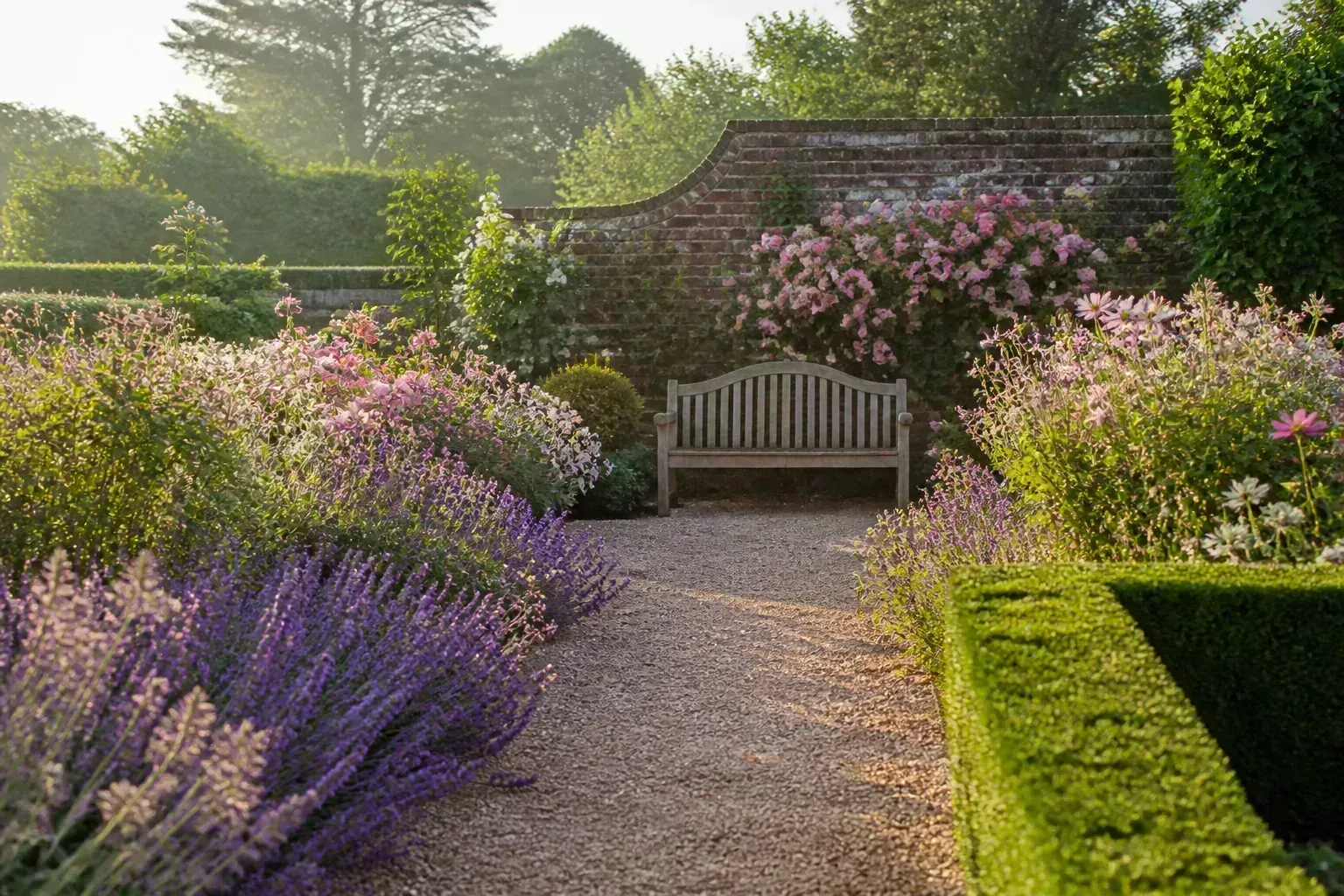
A secret garden is less about hiding the entire yard than about controlling what you see first. A gate, an offset screen, or a path that slips behind a planting bed can turn an ordinary corner into a place that feels discovered; a seat, a little shade, and plants that suit the site make it worth staying there.
That distinction keeps the project realistic. You do not need a stone wall, a maze, or acres of land: a small backyard can borrow a fence, tree canopy, or shady side yard, then add one partly concealed destination and a clear route to reach it.
Start with a feeling of discovery, not a locked gate
The best secret garden ideas create a brief pause between the everyday yard and the retreat. A trellis beside the patio, a narrow opening in a shrub border, or a freestanding gate that frames the entrance can hint at a second space without making the garden literally inaccessible. The view should open gradually: let a screen hide the chair from the kitchen window, then reveal it as someone walks around the bed.
Think in layers rather than decorations. One vertical element defines an edge, a path points toward a destination, and a focal detail gives the eye somewhere to land. A weathered door, curved arbor, old stone, or small sculpture can help, but an actual door is not required; in a tight lot, a pair of tall containers or an offset fence panel can suggest an entrance with less expense and less loss of light.
Use restraint with fairy-tale extras. A fragrant cluster or one unusual ornament reads as intentional; several statues, bright lights, and multiple fountains can crowd a small area. Choose one mood—woodland shade, a reading nook, or a leafy courtyard—and let the materials reinforce it.
Read the yard before you plan
Start with the place you already have, not a list of plants or décor. Observation can reveal that the best hidden space is under an existing tree, beside a garage wall, behind the patio, or at the far end of a narrow lawn. Building around existing shade and boundaries is simpler than manufacturing a secluded room from scratch.
Walk the yard at the time you expect to use it. Morning and afternoon sun can fall on opposite sides of a fence, a neighbor’s tree may cool one corner, and a wet patch after rain can rule out a seat or path that looked fine on a dry day. If possible, check the candidate space in more than one season: deciduous screening can disappear in winter, while a sunny nook can become exposed when a tree drops its leaves.
Map light, soil, sightlines, and traffic
Draw a quick yard map and mark the house, gates, windows, trees, utilities, downspouts, and existing paths. Note direct sun, damp patches, and whether soil is sandy, compacted, or heavy. A plant label cannot replace this check; University of Minnesota Extension advises matching plant needs to soil, drainage, water, sunlight, and exposure (UMN Extension).
Then inspect privacy from the seat, not just from the property line. Sit in the chair you intend to use and look toward upstairs windows, neighboring patios, a street, and the house’s own windows; mark only the angles that interrupt the retreat. This simple sightline check often reveals that a 4-foot-wide screen in one location will do more than a tall fence along an entire boundary.
In the United States, use the USDA Plant Hardiness Zone Map as a winter-survival guide, not a full description of the climate. Its zones are based on average annual extreme minimum temperature; they do not tell you whether a spot is hot, windy, waterlogged, shaded, or drought-prone, and the USDA notes that small yard microclimates may differ from the map. Outside the U.S., use your local climate guidance, then still check your own soil, light, water, and wind exposure (USDA map guidance).
Give the garden one destination
Choose the thing you want to do in the retreat before you decide what it should look like. A reading nook needs a comfortable chair, a stable place to set down a drink, and enough shade at the hour you read; a tiny tea table needs a level surface and a route wide enough to carry a tray. If the yard is too small for a separate room, make the existing patio feel tucked away with a screen and planting rather than squeezing a second seating set into the circulation path.
Put the destination slightly off the straight line from the house if space allows. A path that turns around a shrub or passes an arbor adds a sense of discovery; one small change of direction is enough. An elaborate maze steals room and adds edging work.
Treat the focal point as a visual cue, not an expensive centerpiece: a bench, distinctive foliage plant, contrasting pot, birdbath, or arbor opening. Stand at the entrance and see where your eye goes first. If it lands on a hose reel or utility box, redirect the view with planting before buying a statue.
Build privacy around the seat
Privacy works best when it is targeted at the moment of use. A shaded seat may need a backdrop behind it but open sides to keep a view of the rest of the yard; a bench near a fence may need a screen that blocks a neighbor’s second-story view without making a small garden dark. The Royal Horticultural Society recommends balancing shelter and privacy with the amount of light and outward view you want to preserve (RHS garden-screening guide).
Try a temporary test before installing a permanent fence. Move a large potted shrub, lean a freestanding screen in place, or hang a sheet of cardboard at the proposed height; sit at the intended seat and check the view from different angles. If the screen cuts off useful daylight or blocks a window, shift it closer to the chair, make it shorter, or choose slats that interrupt a direct sightline while admitting light and air.
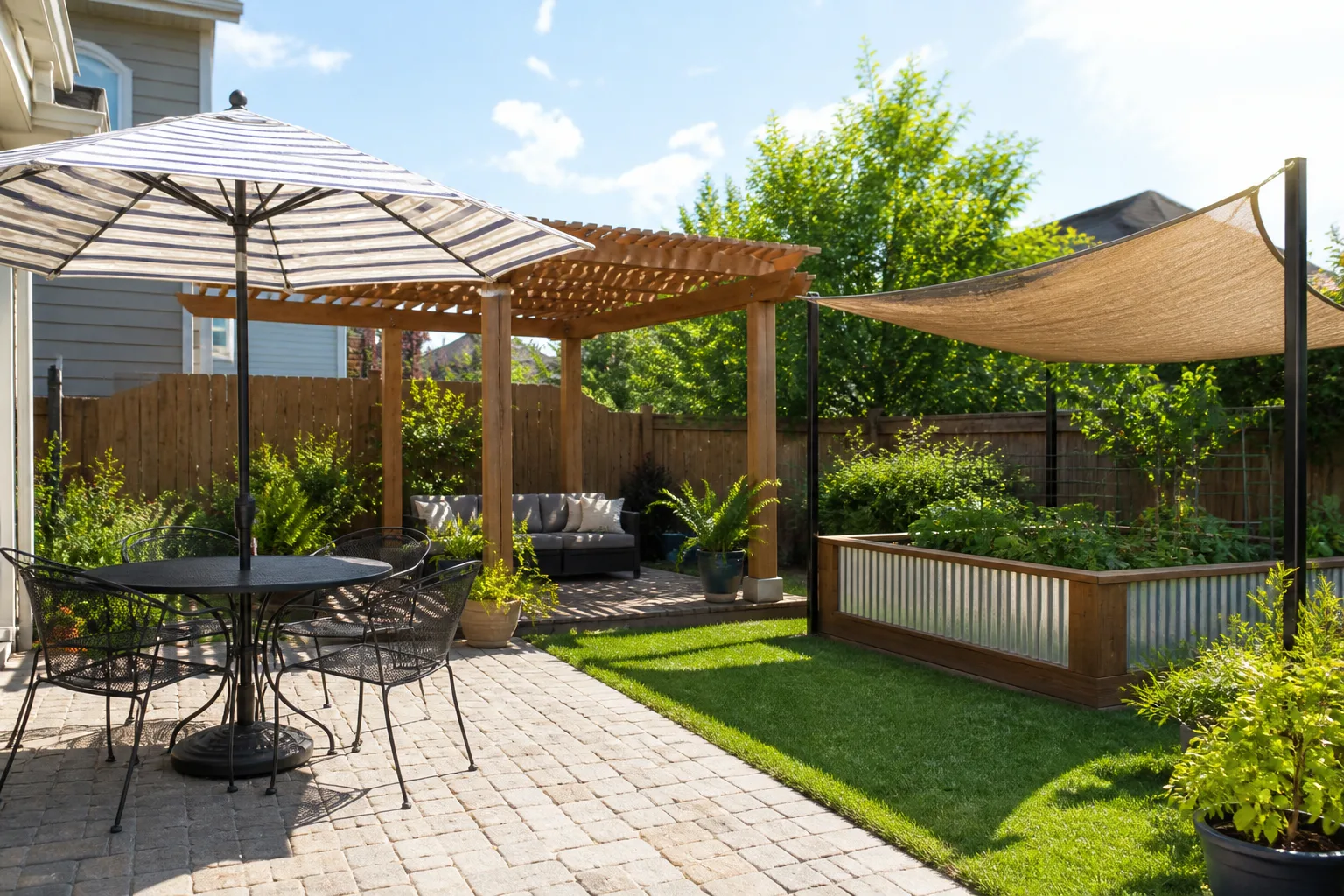
Match the screen to what you need to hide
A movable screen gives immediate, reversible privacy and can follow the sun or a changing seating arrangement, but it needs a stable base so wind cannot tip it. A trellis with a climber softens a fence and adds vertical planting, but the vine needs regular training and may not fill in for a season or more. A hedge offers a living backdrop, but it takes room at mature size, needs water while establishing, and may require repeated clipping; an evergreen screen also blocks winter light.
If the view is overhead, a low fence will not solve it. A pergola or an umbrella above the seat, a slender canopy tree, or a panel angled over the seating corner may be more effective. Conversely, for a ground-level view, a low wall, raised planter, or group of shrubs can break the line without creating a tall barrier across the whole yard. Designers at Fine Gardening describe this kind of layered, partial screening as a way to create separation while retaining glimpses into the garden (Fine Gardening on intimate garden design).
Before adding a permanent fence, tall wall, pergola, or tree, check local height limits, property boundaries, easements, and any neighborhood rules. The rules vary by place, and an attractive design can become a costly problem if it blocks a required sightline or crosses a shared boundary. If you plan to set posts, dig a pond, or plant large shrubs, request utility marking through your local 811 service in the U.S. and follow its waiting period before digging (Call Before You Dig).
Create a threshold and a comfortable route
An entrance can be as simple as the point where paving turns into a garden path. If a gate fits the plan, make sure it opens freely, latches reliably, and does not swing across the route. Reclaimed doors can look appealing in a photograph, but an exterior door is heavy and can warp or catch in weather; use a purpose-built gate or a decorative panel secured to posts instead of hanging a salvaged door where it could fall or obstruct access.
Let the path lead somewhere specific: a bench, a table, a tucked-away planter, or a view through an arbor. Short paths need not curve; in a compact yard, a few offset stepping areas can slow the view without wasting square footage. In a larger yard, a loop path can make the garden feel longer and let visitors return without retracing their steps.
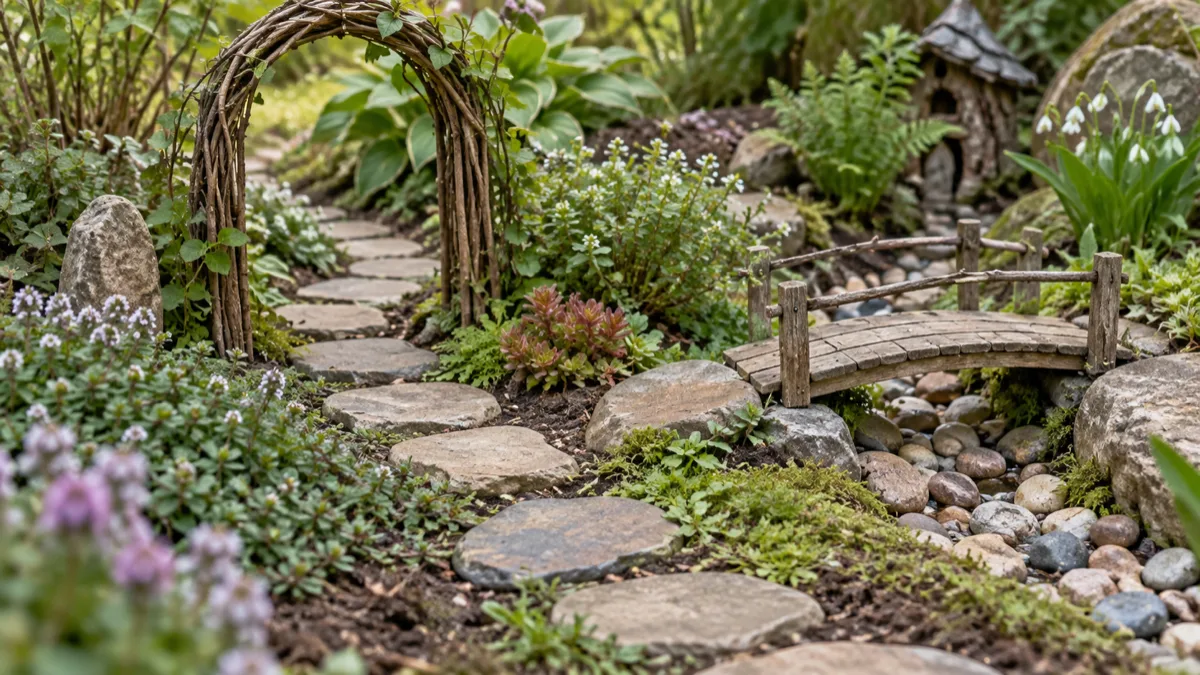
Choose path materials for real use
Design for the hardest task the route must handle. For wheelchairs, walkers, strollers, or carts, keep it firm after rain and clear of overhanging plants and furniture. Mississippi State Extension recommends at least 3 feet in accessible gardens; the U.S. Access Board uses 36 inches for specific outdoor recreation routes, with extra room for passing or turning. These are planning references, not blanket residential code, and width alone does not ensure accessibility (Mississippi State Extension, U.S. Access Board).
For easier movement, choose a compacted, stable surface such as properly installed pavers or firm aggregate, and plan a wider turning area at the destination rather than ending the path at a dead end. Rutgers Cooperative Extension notes that a level, well-draining path with a textured surface can help avoid slipperiness, while space for turns depends on the mobility devices in use (Rutgers Cooperative Extension guide to enabling gardens).
Pea gravel is easy to spread, but loose stones migrate into beds and are hard to push a wheeled chair through. Contain it with edging on a secondary spur; use a stable surface for the main approach. Stepping stones should sit level and close enough together for an ordinary stride, not float over mud or lawn.
Check drainage before paving: observe runoff after rain, avoid shedding water toward a house or neighbor, and plan for leaves or ice in your climate. Give plants enough mature-width clearance that the route stays passable without constant cutting back.
Pick plants for the conditions you have
The right plant thrives in that spot and at its mature size, not simply the one with the most storybook flowers. Measure the bed, note sun and shade, and check whether the soil drains quickly or stays moist. Locally appropriate native or adapted plants can reduce replacements and extra watering once established.
Use a small palette rather than collecting one of everything. Repeated plants, a few contrasting textures, and a seasonal accent usually look calmer than a different flower every few inches. In shade, use foliage and perennials that match soil moisture; at a hot, dry edge, choose locally suitable grasses or other drought-adapted plants instead of moisture lovers that need constant watering.
Hardiness matters, but so does heat: a perennial may survive winter yet struggle beside a hot wall, while a “sun” plant can flop under a dense canopy. Local extension services and botanical gardens can narrow choices by region; the RHS likewise recommends plants suited to their conditions (RHS sustainable planting combinations).
Treat climbing vines as permanent structures
Vines can cover a trellis quickly and create a leafy arch, yet fast growth has a cost: the support must be strong, stems need pruning, and some plants travel beyond the spot where they were planted. Avoid choosing a climber only because it blooms dramatically. Pennsylvania State University Extension warns that perennial vines can spread by underground stems, encroach on native areas, and become difficult to remove; it specifically flags introduced wisterias and other woody vines as plants that need careful consideration (Penn State Extension on perennial vines).
Trumpet vine can be valuable to hummingbirds and pollinators, but it can send up suckers and outgrow a small arbor. English ivy can climb trees and surfaces, spread into natural areas, and damage loose mortar or siding; North Carolina State Extension recommends considering alternatives in regions where it is invasive (NCSU Extension Plant Toolbox: English ivy). These examples are not a universal ban: local invasive status and climate vary, so check your state or country’s invasive-plant guidance before planting.
For a controllable vertical accent, use a container-grown annual vine or a locally appropriate non-invasive climber, attach it to a freestanding trellis, and leave access behind the support for pruning. Keep woody climbers away from gutters, roof edges, painted siding, and masonry unless the support and building detail are designed for them. If a plant is already known to be difficult to contain where you live, a flowering shrub, a trained fruit tree, or a tall perennial can provide height without the same spreading habit.
Layer plants for fragrance, color, and seasons
A secret garden should still look inviting after its first flush of blooms. Start with a backbone that holds shape—shrubs, evergreen forms, a small tree, or sturdy perennial clumps—then add bulbs and flowering plants that take turns rather than all peaking in one week. Foliage, seed heads, bark, and grasses carry the scene when flowers fade; a garden with winter structure often feels more finished than one that depends on a continuous summer flower show.
Fragrance can make a small space feel immersive, but place scented plants where people pass or sit rather than hiding them at the far boundary. Choose a few plants whose scent you enjoy and that tolerate your climate: some roses, lavender, herbs, or night-fragrant annuals may suit one site, while another garden will be better with aromatic foliage or no fragrance at all. If anyone in the household is sensitive to pollen or strong scents, prioritize texture and foliage instead.
Color can be quiet or vivid. Repeat two or three flower colors to create rhythm, then add one contrasting accent—such as yellow near purple or a bright bloom against dark foliage—rather than filling the whole border with competing colors. Plants such as ornamental alliums or tall flowering perennials can give a path a focal moment, but check mature height so stems do not flop across the route or block the seat.
Plan for seasonal succession before buying: an early bulb, late-spring perennial, summer bloomer, and fall seed head can extend interest beyond one flower window. Long bloom periods vary with rainfall, heat, deadheading, and region. In a dry season, choose adapted plants and place thirsty containers within hose reach.
Make a seat and focal point people will use
Seating turns a garden from a view into a destination. Choose a chair or bench for the footprint and the person who will use it. Metal can get hot in direct sun, while cushions need storage or weather-resistant fabric; leave room to move around the chair without stepping into a bed.
Place the seat where the screen is doing useful work, not necessarily at the very back of the yard. A backrest against a wall, a pair of planters near the chair, or a shrub placed just beyond the shoulder can create enclosure without closing off the front. Keep some open view toward the rest of the garden; a completely sealed corner can feel cramped, and it may be harder to see children, pets, or visitors across the yard.
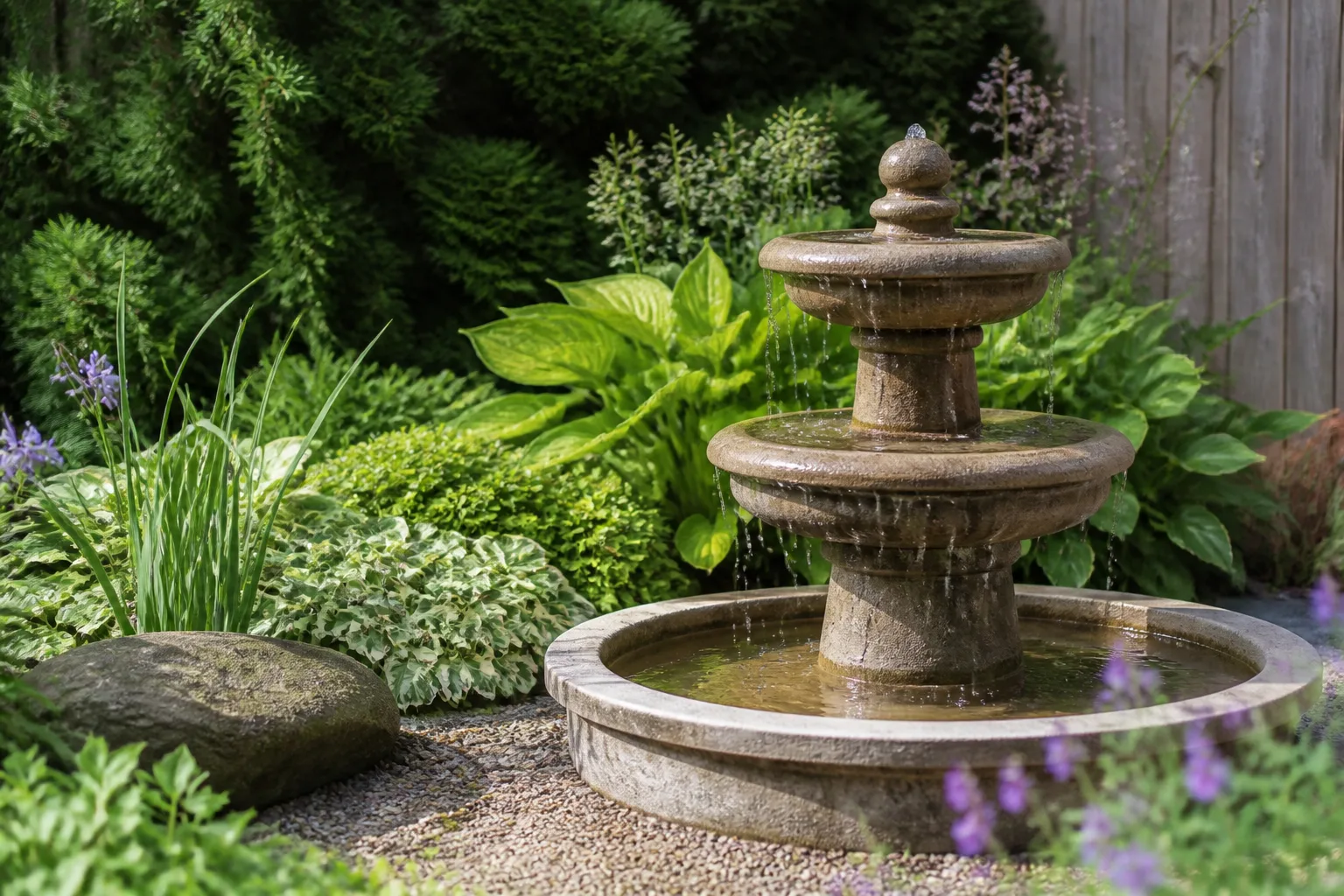
Pick one focal point that suits the scale: a birdbath, compact fountain, vintage chair, or sculptural pot can anchor a small nook, while a larger garden can support an arbor or garden room. Well-placed focal points can slow the eye, but leave enough space for the yard to function (Fine Gardening on small gardens).
Water features deserve a realistic maintenance check. A recirculating fountain can add sound, yet pumps need cleaning and water may evaporate quickly in heat; a shallow birdbath is simpler but needs regular scrubbing and refreshing. The CDC advises emptying and scrubbing items that hold water weekly to limit mosquito breeding (CDC mosquito-control guidance). If young children use the yard or you cannot maintain standing water, choose a dry focal feature instead.
Use lighting sparingly and safely
Plan the route first, then decide where light is actually needed. A low path light near a step, a shielded sconce at a gate, or one gentle light near the chair can make the garden usable after dusk without turning every shrub into a spotlight. Avoid shining bulbs into a neighbor’s window or directly into a visitor’s eyes; bright glare can make a path harder to see rather than easier.
DarkSky International and the Illuminating Engineering Society recommend using outdoor light only when needed, directing it where it is needed, keeping it no brighter than necessary, and using warmer-colored light where possible (Five Principles for Responsible Outdoor Lighting). Timers, motion sensors, or a switched fixture can keep lights from staying on all night. If the path needs consistent visibility, do not rely on decorative string lights as the only light source.
Use fixtures and cords rated for outdoor exposure and follow product instructions. The Consumer Product Safety Commission notes that outdoor extension cords need a jacketed cord and that improperly designed cords can pose shock or fire hazards (CPSC extension-cord guidance). Hire a qualified professional for permanent wiring; keep cords out of walking routes and puddles.

Keep the design safe and manageable
Make maintenance part of the design. Can you sweep behind the bench, prune the vine without climbing over the chair, and water containers without dragging a hose through a narrow gate? Leave working space between screens and plants and keep the path clear at its planned width.
Look for trip, fall, and pinch hazards before inviting people into the space. Level stepping stones, secure loose edging, anchor tall freestanding screens, keep gates from slamming in wind, and avoid overhanging branches at head height. If you have pets or children, check plant toxicity and thorn placement with a reliable local or veterinary source, and choose a shallow, stable feature instead of an open deep pond where a fall could be dangerous.
Budget for plants at their mature size. A row of small shrubs may look sparse the first season, so it is tempting to plant them too closely; that makes air circulation, pruning, and access harder later. Check the nursery label or local extension data for mature width and height, then plan for each plant to reach that space. If the border is narrow, use a few upright forms and ground-level planting rather than forcing a hedge that will eventually occupy the path.
Seasonal maintenance is part of privacy too. Deciduous shrubs can expose a seat in winter, annual vines disappear after frost, and perennials may need to be cut back or divided. If year-round screening is essential, combine evergreen structure with deciduous plants and a trellis; if winter privacy is not important, let seasonal change be part of the design rather than paying to hide every view all year.
Build the garden in stages
You can make a retreat without one large construction project. Find the seat and test its views, place a temporary screen, then mark the route with a garden hose. Live with the layout for a week or two, including after rain and at the hour you expect to use it, before buying pavers or planting shrubs.
Stage one: create the feeling cheaply. Reposition a chair, use containers you already own, add one weatherproof panel or trellis, and set a single focal object at the far end of a short path. Move the pieces until the entrance and sightline feel right. You can improve a fence with one climbing plant or repeated pots instead of covering its entire length.
Stage two: make the route and planting durable. Once the layout works, install the path surface, repair drainage issues, and plant a small number of shrubs and perennials that match the site. Add mulch, edging, and a hose-access plan before the beds fill in. In a shady nook, invest in foliage and texture; in a dry sunny nook, choose adapted plants rather than adding a fountain to mask a water problem.
Stage three: add permanent features only when they solve a real need. A fixed gate, pergola, masonry wall, or large fountain can be worthwhile when it improves privacy, shade, or access, but each brings construction, upkeep, and local-rule questions. Get utility lines marked before digging, check permit and boundary requirements, and bring in a landscape or building professional for retaining structures, electrical work, drainage, or heavy overhead elements.
Conclusion
The most successful secret garden in a backyard is the one that feels tucked away while still being comfortable to enter, sit in, and maintain. Start with one useful destination, hide only the views that interrupt it, then build a safe path and choose plants for the real conditions of your yard. A gate, arbor, fountain, or flowering vine can add character, but the quiet shift in perspective—a seat that is no longer on display, reached by a path that reveals it gradually—is what makes the space feel like a retreat.