Deadheading Hydrangeas in Summer: When to Cut
Learn when to deadhead hydrangeas in summer, where to make the cut, and why old-wood, new-wood, and reblooming shrubs need different timing.
The short answer: deadhead only after identifying the shrub
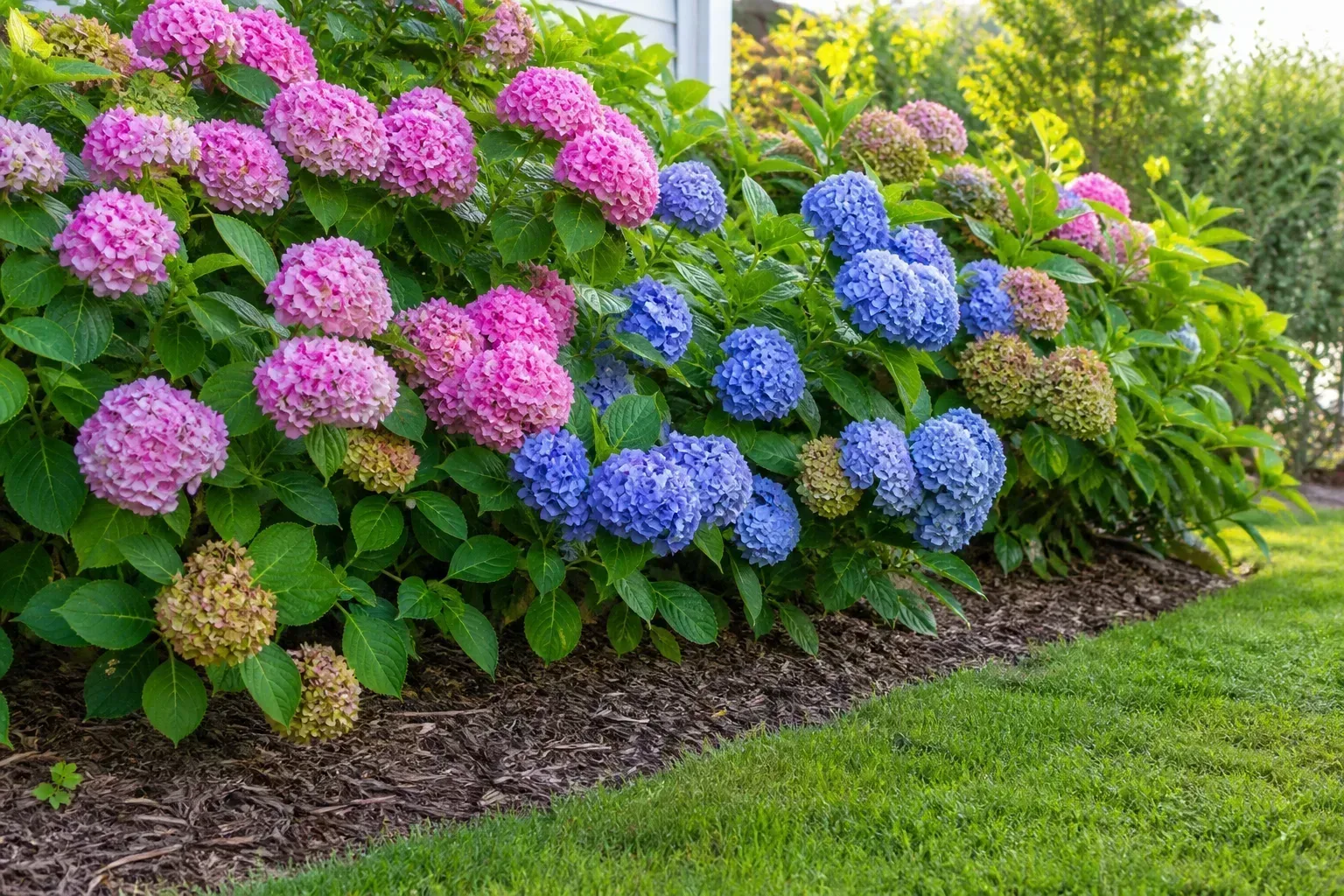
You can deadhead hydrangeas in summer, but you do not have to. The safe choice depends on whether your shrub flowers on old wood, new wood, or both. If you know it is a bigleaf, mountain, oakleaf, or climbing type that blooms on old wood, remove a faded head only soon after flowering and take as little stem as possible. If you cannot identify the plant and the season is already well advanced, leave the head in place rather than gamble with next year’s buds.
For panicle and smooth hydrangeas, deadheading is usually a cosmetic decision because they form next season’s flowers on new shoots after winter. They are more forgiving, yet summer is still not the time for a hard size-reduction prune. A faded bloom does not mean a whole branch needs attention.
The useful question is not “What month is it?” but “What kind of hydrangea is this, has its flower really finished, and where are the buds I need to preserve?” That check takes a minute and protects you from the classic disappointment of a healthy leafy shrub that produces few flowers next summer.
Deadheading is not the same as pruning
Deadheading removes a spent flower head and the shortest possible length of its stem. Pruning changes the plant’s framework by removing or shortening branches. Those two jobs can happen on the same day, but they should not use the same cut or the same goal.
That distinction matters most on old-wood hydrangeas. Their flower buds for next year form on stems that grew this season, so a branch-shortening cut in late summer can take buds with it. University of Georgia Cooperative Extension notes that bigleaf and oakleaf hydrangeas bloom on old wood and should be pruned immediately after flowering if pruning is needed at all (University of Georgia Cooperative Extension).
When you are simply tired of looking at a brown head, do not turn that cosmetic task into reshaping. Remove the head, reassess the silhouette, and save structural work for the species-appropriate dormant or post-bloom window. A light deadhead is reversible only in appearance; a deep cut can erase a year of flowers.
What a summer deadhead can and cannot change
Deadheading can make a shrub look cleaner, remove an unattractive flower head, and give you a clearer view of damaged or crowded stems. It may also be useful on a reblooming cultivar when done promptly after a flush. What it cannot reliably do is force every hydrangea to produce a new round of flowers.
Non-reblooming old-wood hydrangeas usually have one main flowering cycle. Removing the finished head will not change that biology. The benefit is tidy appearance, not a promise of more blooms. Better Homes & Gardens draws the same boundary: old-wood types do not need deadheading for health and do not rebloom merely because their faded flowers are removed (Better Homes & Gardens).
Treat dramatic claims about “redirecting all the plant’s energy” with care. A hydrangea’s next display depends on cultivar, light, water, roots, winter survival, and whether its buds remain intact. A careful flower-head cut can be useful; it is not a replacement for giving the plant the conditions it needs.
Tidiness is the reliable benefit
Choose deadheading when the flower head is brown, papery, rain-battered, or simply spoils the look of the shrub. You can also leave a fading head on the plant while it still has color you enjoy. Hydrangea flowers often age gradually, and that late-season green, rose, burgundy, or parchment phase can be more attractive than an immediate cleanup.
There is no penalty for leaving a healthy dried head for a few weeks while you decide. Gardening Know How describes missed deadheading as unlikely to harm a hydrangea in the short term; the plant can continue normal care the following season (Gardening Know How). That makes a conservative pause especially sensible when you do not know the cultivar.
Sterile and fertile florets change the seed question
Many showy hydrangea flower heads are mixtures of different florets. On lacecaps, the large colorful outer florets are usually sterile display florets, while the smaller center florets can be fertile. NC State Extension describes Hydrangea macrophylla flower clusters as having enlarged sterile flowers around the margin or throughout the cluster, and notes that the flowers are borne on the previous season’s growth (NC State Extension).
That means deadheading is not primarily a seed-control task for many garden hydrangeas. Removing a pollinated, fertile center can prevent that particular head from developing a capsule, but a mophead or lacecap’s ornamental value usually comes from the display florets rather than a large seed harvest. If you want to save seed from a species hydrangea, leave a selected, fully mature fertile head alone and do not assume seedlings will match the parent cultivar.
Identify the hydrangea before cutting
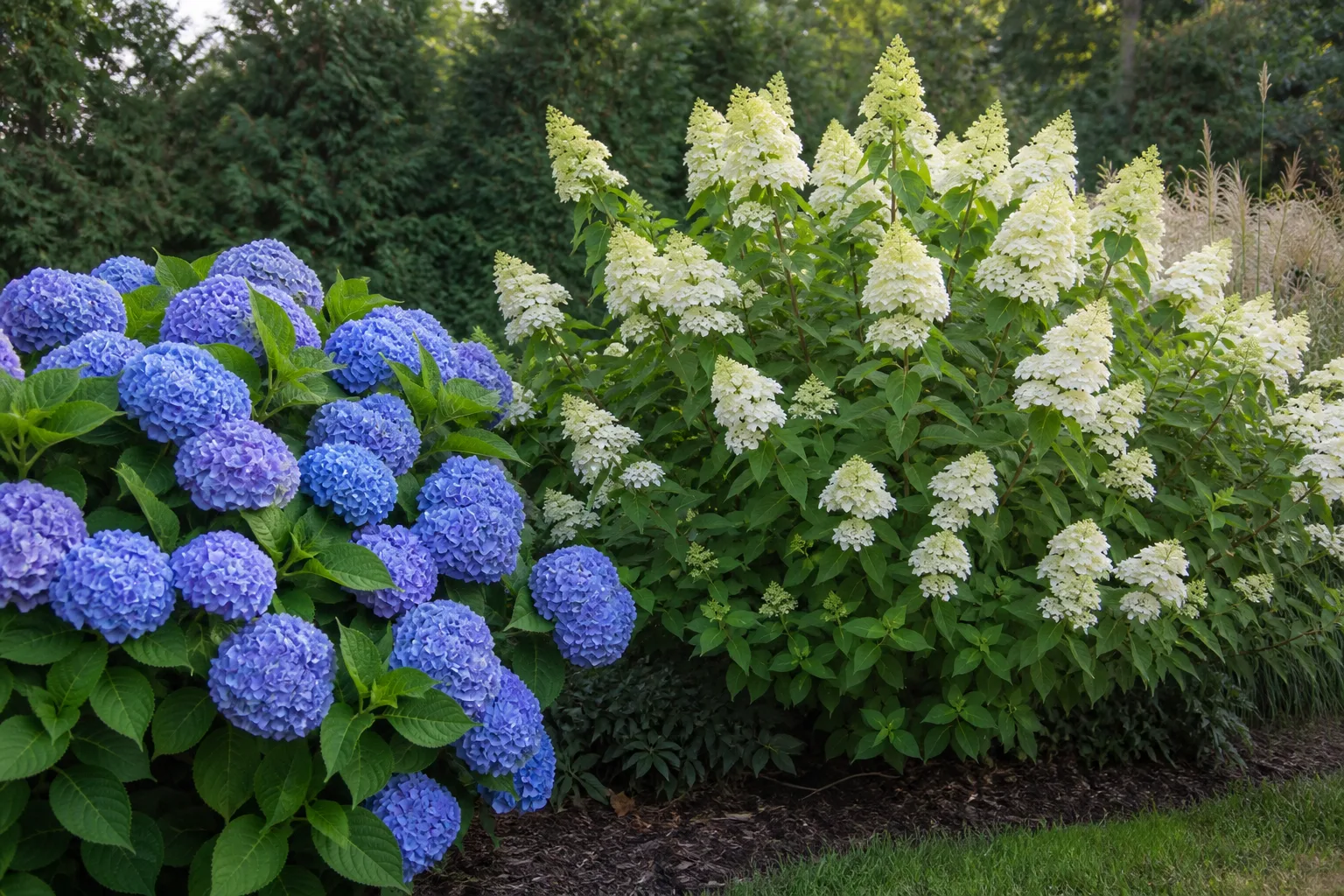
Look first at the leaves and flower shape, then check the original tag, plant label, order confirmation, or a reputable nursery listing for the cultivar. A round mophead or flat lacecap with broad leaves is often a bigleaf hydrangea. Oak-shaped leaves point to oakleaf. Long cone-shaped flowers generally indicate panicle, while large rounded white heads on a shrubbier plant often indicate smooth hydrangea.
This quick field guide gives a safer summer default:
| Hydrangea group | Typical clues | Where it flowers | Summer deadheading default |
|---|---|---|---|
| Bigleaf and mountain | Mophead or lacecap flowers; broad leaves | Mostly old wood, unless a rebloomer | Cut only promptly after bloom and only above healthy leaves |
| Oakleaf | Oak-shaped leaves; white cone flowers | Old wood | Cosmetic deadhead soon after bloom, or leave the heads |
| Climbing | Woody vine with flat white flower clusters | Old wood | Leave alone unless you know its post-bloom timing |
| Panicle | Long cone-shaped flower clusters | New wood | Optional light deadheading; save hard pruning for late winter |
| Smooth | Rounded white or green-white flower heads | New wood | Optional light deadheading; save structural pruning for late winter |
| Reblooming bigleaf or mountain | Label says reblooming or flowers recur | Old and new wood | Deadhead a finished flush promptly, but avoid deep late-season cuts |
Old-wood hydrangeas demand the earliest, lightest cut
Bigleaf, mountain, oakleaf, and climbing hydrangeas are the high-caution group. University of Georgia Cooperative Extension explains that bigleaf hydrangeas set the flower buds for the following year in late summer or early fall, and that oakleaf hydrangeas should be pruned immediately after flowering to avoid taking next year’s buds (University of Georgia Cooperative Extension).
For these plants, the safest summer deadhead is a small cut made shortly after a head has finished. Do not wait until you are doing a broader August yard cleanup, then cut each flower stem halfway down the branch. By then, you may be looking at new tip growth and developing buds that matter more than the faded head.
If the flowers have already dried and the shrub is moving toward fall, leaving them is often the lower-risk choice. The plant does not need a late haircut to prepare for winter. It needs healthy leaves, evenly moist soil, and undisturbed buds.
New-wood hydrangeas have more latitude, not a free pass
Panicle and smooth hydrangeas produce their flower buds on the new growth they will make after winter. This is why their principal pruning window is late winter or early spring, before fresh growth emerges. They tolerate more pruning than old-wood types, but that does not make a late-summer hard prune useful.
You may remove a spent panicle or smooth flower head during summer if it has turned brown or you dislike the look. Keep the cut shallow. Waiting until dormancy to remove the dried heads is also reasonable, especially if you enjoy their winter structure. Better Homes & Gardens notes that panicle flowers can be attractive into fall and that new-wood types can be tidied after leaf drop, before their new buds begin growth in late winter (Better Homes & Gardens).
New wood does not mean no consequences. Removing large amounts of leafy stem late in the season reduces the canopy that is helping the shrub store energy. Do not use an optional deadhead as an excuse to cut a panicle hydrangea down to size in August.
Rebloomers need a two-part strategy
Reblooming bigleaf and mountain hydrangeas can flower on both old and new wood. Their label may say reblooming, remontant, or identify a named series. NC State Extension lists several bigleaf cultivars as rebloomers, including members of the Endless Summer line (NC State Extension).
Promptly removing a finished early-summer flush may help a rebloomer move on to its next flowering cycle, but it is not guaranteed to create another display. The later the season, the more conservative you should become. A rebloomer still depends on old-wood buds for an early show next year, and late cuts can reduce that first flush even if new-wood flowers later compensate.
When the plant’s history is unclear, treat it as an old-wood hydrangea. That default may leave a few spent heads longer than you prefer, but it protects the harder-to-replace asset: the buds already forming on the stems.
Summer timing: use flower stage and season, not a rigid month
Summer deadheading is safest when a bloom has clearly finished and the shrub still has time to make and harden new growth before cold weather. That date varies by species, latitude, elevation, and the season’s weather. A calendar rule can be a useful reminder, but it is not a substitute for knowing whether the plant is an old-wood type.
For an old-wood hydrangea, act soon after the main bloom fades if you want the head removed. If summer is nearly over, skip the job. Gardening Know How similarly advises deadheading old-wood species in summer immediately after flowers fade, with special care not to remove the next season’s blooms (Gardening Know How).
For a new-wood type, either lightly deadhead during the growing season or leave the head for fall and winter interest. For a rebloomer, take spent heads early in the season, then stop making casual cuts once late summer arrives. The closer you are to your typical first frost, the less value there is in stimulating a response from the shrub.
How to deadhead a hydrangea without removing a bud
Use sharp bypass pruners, not hedge shears or dull scissors. Clean the blades before moving between shrubs, especially if any plant shows leaf spots, cankers, or dieback. The goal is one clean, deliberate cut instead of crushing the stem or repeatedly trimming downward until the plant looks “even.”
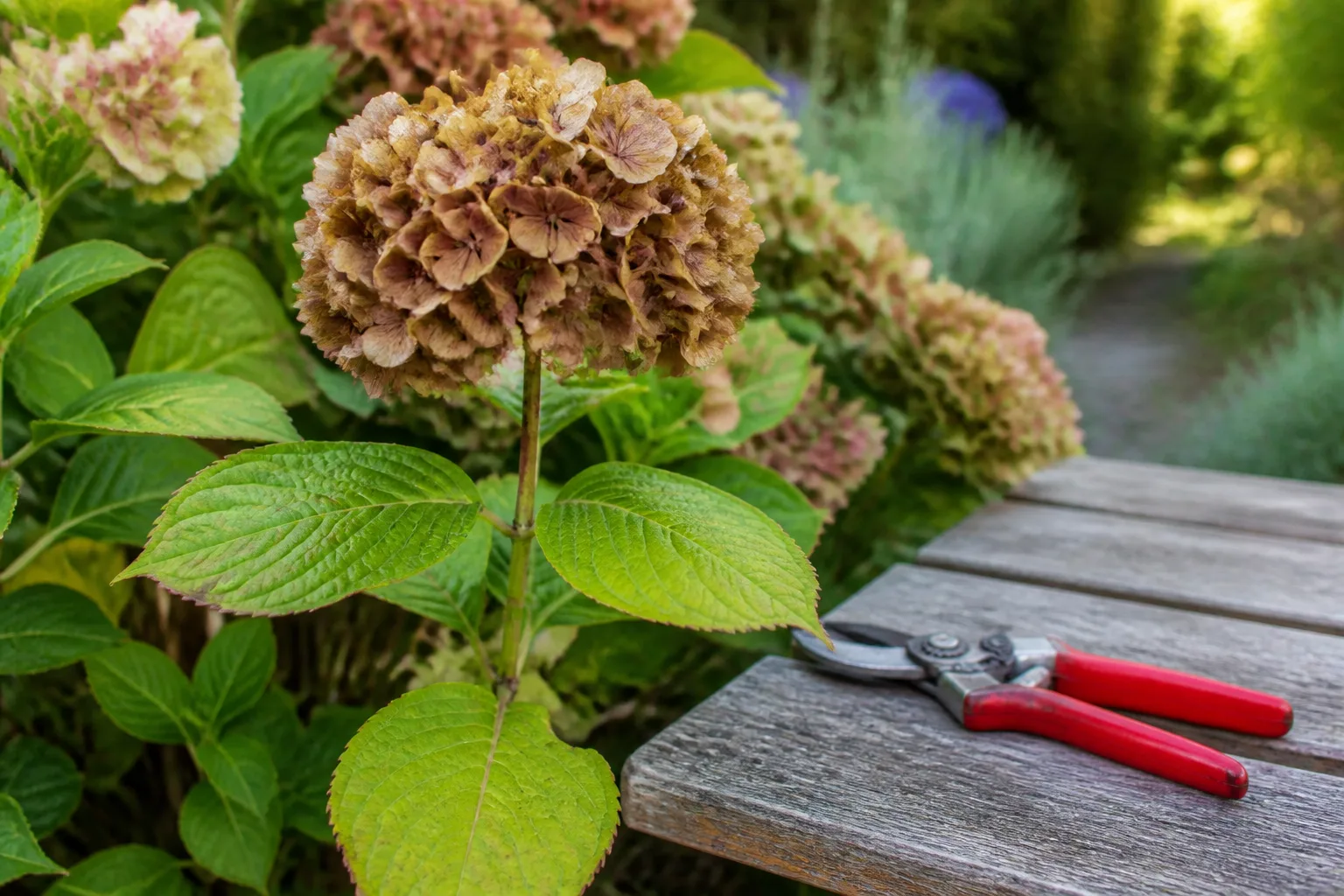
Work through this sequence:
- Confirm that the flower is spent rather than simply changing color.
- Follow the flower stem down from the head until you reach the first healthy pair of full-sized leaves.
- On an old-wood or unidentified hydrangea, stop there and cut just above that leaf pair, leaving the leaves and the rest of the branch intact.
- On a rebloomer, use the same shallow cut after a finished flush; do not remove live branch length to chase another bloom.
- On a panicle or smooth hydrangea, make the same tidy cut if desired, then leave the framework for late-winter pruning.
Make the smallest safe cut above healthy leaves
The leaf junction, or leaf axil, is where buds and new growth can develop. Cutting well below the first healthy leaves on an old-wood hydrangea is where a routine deadhead becomes risky. Better Homes & Gardens recommends snipping an old-wood flower head just above the first set of large leaves, rather than cutting deep into the stem where next year’s buds may be affected (Better Homes & Gardens).
Look before each cut because plant structure is not perfectly symmetrical. A small flower stem may sit above a pair of leaves and then a developing tip. If a bud or fresh side shoot is immediately below the faded head, preserve it. You are trying to remove a flower, not create a uniform row of clipped stems.
After cutting, step back. If you find yourself removing green branch tips to make the shrub round, stop. That is a pruning project, and the correct time depends on the species, not on whether one flower has gone brown.
When leaving faded hydrangea heads is the better choice
Leave the blooms if they still look good, if you want dried flowers for the winter garden, or if it is late enough that you are not comfortable identifying the plant’s bloom wood. This is particularly sensible for bigleaf and mountain hydrangeas in cold or exposed gardens, where dried heads can provide a small amount of protection around vulnerable upper buds.
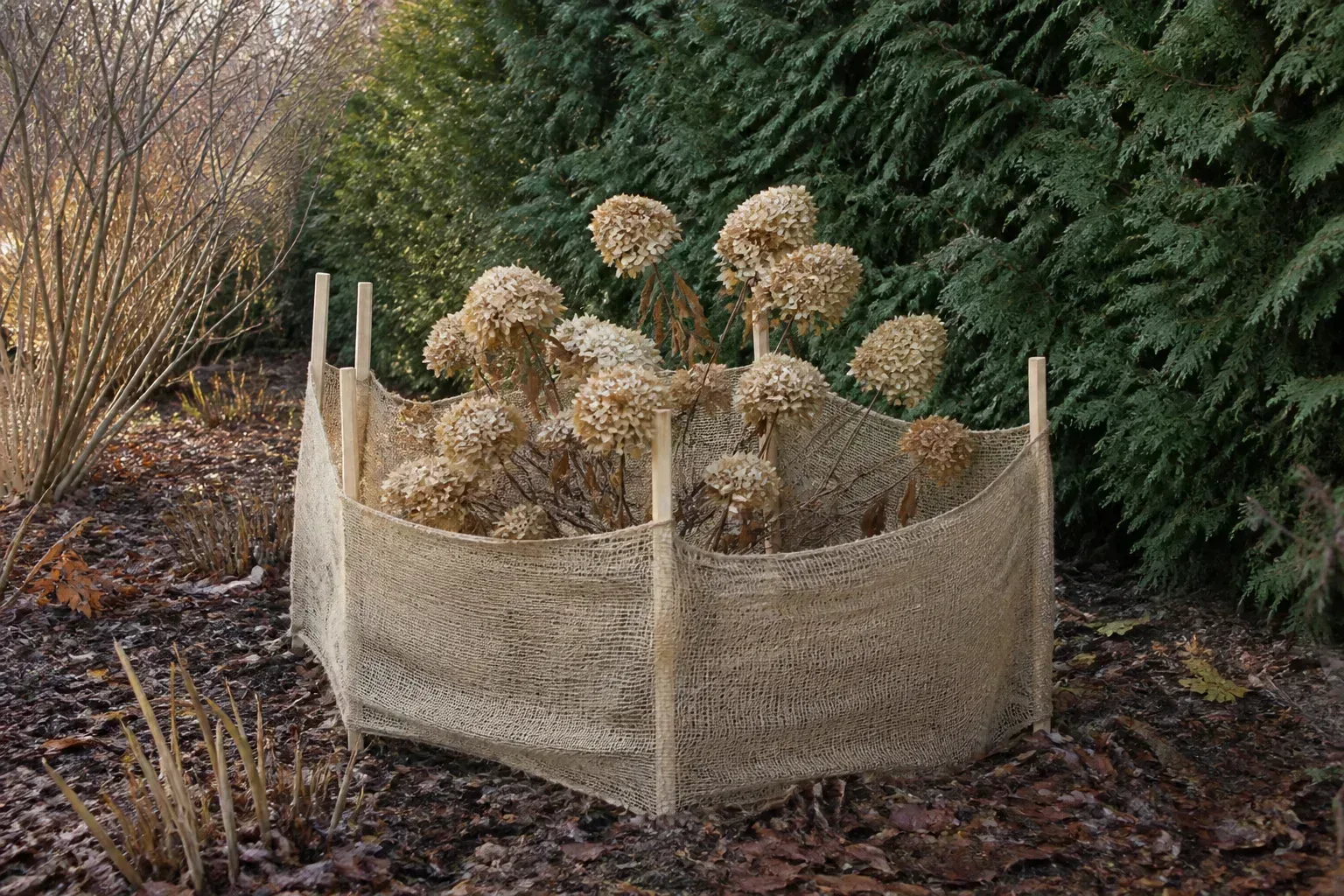
You may also leave a few heads intentionally for dried arrangements. Pick them only after they feel papery and have developed the color you want. On an old-wood shrub, take only the flower stem; never harvest long stems for an arrangement if it means removing next season’s buds.
Leaving flowers is not neglect. A winter silhouette can be attractive, and the dried structure may collect frost and snow in a way that makes the garden more interesting. Your spring cleanup can remove the old head back to the first strong healthy buds once the risk of the wrong late-summer cut has passed.
Heat, drought, and winter exposure change the decision
Do not deadhead a hydrangea that is visibly wilted from a heat wave simply because the flower head is drooping. First determine whether the soil is dry at root depth, water deeply if it needs moisture, and provide temporary protection from severe afternoon sun when appropriate. Removing a faded bloom will not correct heat stress, root problems, or poor site conditions.
Likewise, avoid a burst of late fertilizing after deadheading. A healthy shrub generally benefits more from steady moisture and mulch than from a late push of soft growth. In a cold or windy site, let old-wood stems finish the season without repeated cuts and plan winter protection after leaf drop if your cultivar is prone to bud loss.
If disease is present, remove only tissue that is clearly dead or infected and clean tools afterward. Widespread leaf spotting, sudden collapse, or failure to flower needs diagnosis. Do not solve a plant-health issue by stripping a stressed shrub of leaves and bloom stems.
Care after deadheading: support the shrub instead of stimulating it
Once the flower head is gone, shift attention from the pruners to the root zone. Hydrangeas do best with consistent soil moisture and good drainage, not a cycle of drought followed by saturation. Water slowly enough to moisten the root zone, then let the surface begin to dry before the next watering.
Maintain a moderate layer of organic mulch over the root area while keeping it away from the stems. Mulch helps moderate soil temperature and slows evaporation during hot weather. It is a more useful late-summer intervention than cutting healthy growth to make the shrub look neat.
Avoid heavy nitrogen fertilizer late in the season unless a local soil test or extension recommendation shows a genuine need. Rapid tender growth is not the goal as frost approaches. Let existing leaves photosynthesize, let buds mature, and make a note to assess size, dead wood, and structural pruning in the correct window next year.
A spent flower is not the cause of wilting or poor blooming
Deadheading cannot fix a hydrangea that is limp in midday heat, has scorched leaf margins, lacks flowers, or develops widespread spots. Those symptoms point to a care or health question: water availability, excessive sun, root stress, soil drainage, deer damage, winter-killed buds, or disease.
Start by checking the obvious physical conditions. Is the soil dry several inches down? Has the plant been exposed to hotter afternoon sun after nearby tree work? Are there broken stems, girdling ties, or wet soil that smells sour? A faded bloom may be present at the same time, but it is not usually the cause.
For a bigleaf or mountain hydrangea that leafs out well but does not flower, review the previous season’s cuts and the winter weather before adding more fertilizer. Lost old-wood buds are a common reason for leafy, bloom-poor shrubs. A panicle or smooth hydrangea that fails to flower needs a different review because it makes flowers on new growth.
Common summer mistakes that cost next year’s flowers
The costliest mistake is treating every hydrangea as if it followed the same pruning calendar. The second is cutting too far below the flower head because the branch looks awkward. Both mistakes are avoidable when you identify bloom wood and make the smallest cut that solves the cosmetic problem.
Watch for these additional traps:
- Deadheading late on an old-wood type: If you are unsure whether buds are already forming, leave the head.
- Shearing the whole shrub after bloom: Hedge trimming removes branch tips indiscriminately and can remove old-wood flower buds.
- Expecting a second bloom from a one-time bloomer: A tidy plant is a valid outcome; more flowers are not guaranteed.
- Removing every drying head before winter: A few dried heads can add winter texture and are often safer to remove in spring.
- Cutting during severe heat or drought: Stabilize water and shade conditions first, then make only essential cuts.
- Using dirty or dull tools: Clean, sharp bypass pruners reduce stem damage and lower the chance of moving disease between plants.
If you already cut an old-wood hydrangea too hard, do not keep pruning to “balance” it. Water normally, protect it through winter, and wait to see what buds remain next spring. A rebloomer may still produce some flowers on new wood, while a non-rebloomer may need a season to rebuild its display.
Conclusion
Deadheading hydrangeas in summer is optional, but the timing is not casual. Identify the shrub first, because old-wood bigleaf, mountain, oakleaf, and climbing types need a prompt, shallow cut after bloom or no cut at all. Panicle and smooth hydrangeas give you more flexibility, while rebloomers reward an early tidy-up but still deserve restraint later in the season.
When in doubt, cut only the spent head just above a healthy leaf pair—or leave it. That small pause protects next year’s buds, keeps a cosmetic job from becoming a pruning mistake, and gives the shrub the quiet end-of-season care it actually needs.



