30 Best Shrubs for Shade in Your Yard
Choose the right shade shrubs for your yard with 30 picks sorted by light, soil, mature size, flowers, privacy, wildlife value, and safety.
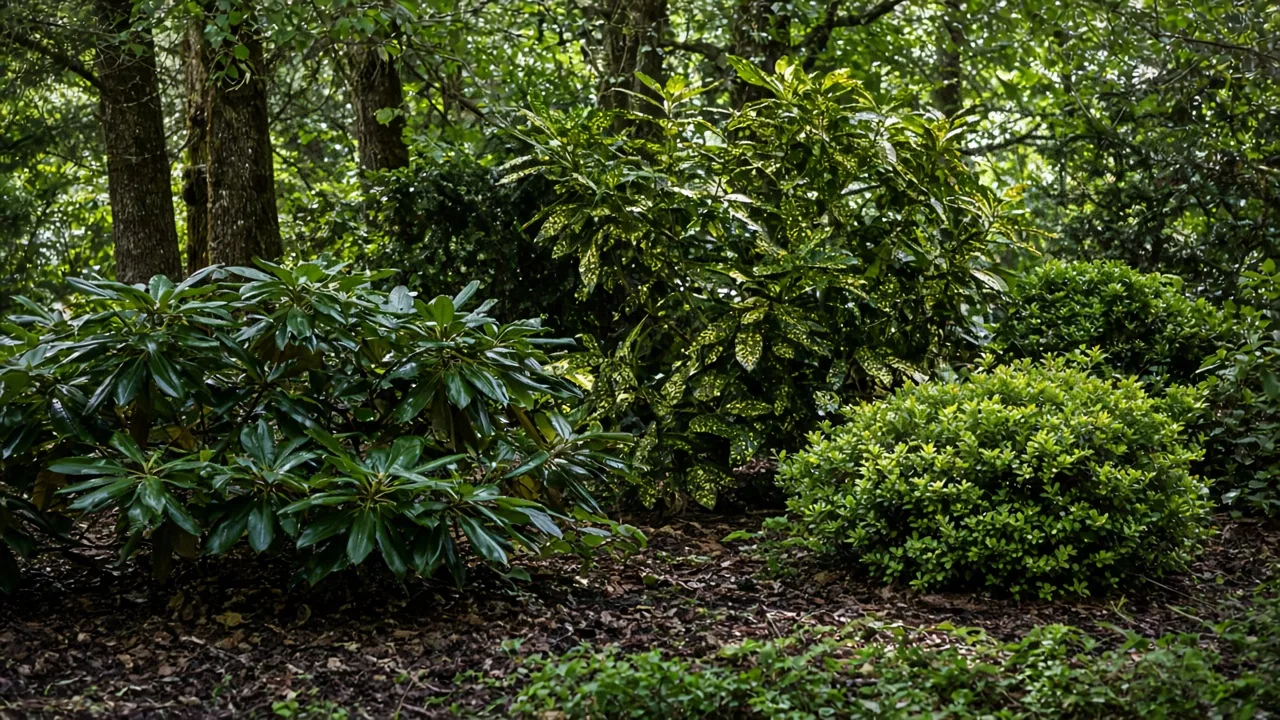
A shady yard is not a single growing condition. The strip beside a north-facing wall, the bright edge of a deciduous tree, and the dry soil beneath a mature evergreen may all look dark from the patio, but they ask very different things of a shrub.
The best choice is the one that matches the actual site and the job you need it to do. Some shrubs bring evergreen structure to deep shade; others need filtered light before they flower well. A few tolerate dry roots beneath trees, while woodland natives prefer cool, moisture-retentive soil. Use the guide below as a shortlist, then confirm the exact cultivar’s mature size and hardiness for your region.
Before You Choose: Shade Is a Site Condition, Not a Plant Label
“Shade-loving” does not mean “will flower in any dark corner.” A shrub can survive with little direct sun and still become open, thin, or flowerless when the light is too low. The RHS separates deeper shade from partial or dappled shade and also cautions that mature height and spread change with location, soil, and weather; that is a better way to think about this list than treating shade tolerance as a yes-or-no trait. RHS shade-shrub guidance
Measure the light you actually have
Watch the spot on a clear day in spring or summer. Deep shade receives little or no direct sun, often under a dense evergreen canopy or on the north side of a building. Dappled shade gets moving patches of light through leaves, while partial shade generally receives a few hours of direct sun, often in the morning.
The direction and timing matter. Two hours of morning sun can support more flowers than two hours of hot late-afternoon sun, and a deciduous tree may give you much more light in early spring than in July. If you are choosing a flowering shrub, record the brightest season as well as the darkest one; buds form according to the light the plant receives before bloom time.
Match soil, moisture, and mature size
Shade does not guarantee moist soil. Tree roots can intercept rainfall, dense buildings can block rain, and compacted soil can hold water after a storm. Dig a small test hole before buying: if the soil is cool and crumbly, you have a good starting point; if it is dusty, root-filled, or slow to drain, your shortlist needs to change.
Also measure the bed from the fence, path, and windows. A shrub sold in a one-gallon pot may eventually be 8 feet wide. Choose a compact cultivar when you need one, and plan for the mature width instead of promising yourself that constant pruning will solve a spacing problem. A practical guide from eGardenGo makes the same case for small gardens: compact shrubs can carry several seasons of interest without swallowing the space. eGardenGo’s small-garden shrub notes
Quick Picks by Garden Job
| If you need… | Start with… | The catch |
|---|---|---|
| A shrub for the darkest, sheltered corner | Japanese aucuba, yew, Japanese skimmia, coast leucothoe | Bloom and berry production may be limited by very low light |
| Spring flowers in filtered light | Evergreen azalea, rhododendron, mountain laurel, pieris | Most need acidic soil, steady moisture, and some sky light |
| A clipped hedge | Yew, boxwood, Japanese holly, inkberry holly | Use mature width and airflow; wet soil is a common failure point |
| Dry shade under established trees | Yew, boxwood, aucuba, Japanese holly | New shrubs still need deep watering during dry spells |
| Birds and seasonal fruit | Viburnum, serviceberry, spicebush, winterberry | Fruit may require the right pollinator and enough light |
| A small border shrub | Skimmia, dwarf fothergilla, daphne, dwarf tree peony | Slow growth and toxicity may matter more than flowers |
| A cold woodland garden | Mapleleaf viburnum, bunchberry, checkerberry, witch hazel | Heat, drought, and alkaline soil can be limiting |
30 Shrubs That Grow in Shade
These picks are grouped by what they contribute to a yard. The size notes are deliberately broad because species, cultivar, climate, pruning, and soil can shift the final result. Treat the notes as a buying filter, not a substitute for the nursery label or local extension advice.
Evergreen structure for deep or dappled shade
1. Japanese aucuba (Aucuba japonica) — Aucuba is one of the most useful foliage shrubs for deep shade, especially where you want broad, glossy leaves or yellow-flecked cultivars instead of flowers. It is happiest in partial to deep shade, moist but well-drained soil, and a sheltered position; young foliage can scorch or blacken in strong sun and wind. NC State lists a typical height of about 6 to 10 feet and notes its tolerance of varied soils, but it also flags the plant as poisonous, so keep fallen fruit and prunings away from children and pets. NC State Aucuba profile
2. Hybrid yew (Taxus × media) — Yew is a strong choice when the visual job is an evergreen hedge, foundation mass, or clipped screen. Cultivars vary from low mounds to tall columns, and the plant tolerates part shade and dry soil better than many broadleaf evergreens, provided drainage is good. NC State notes that yews can be severely pruned and shaped, but they dislike wet soil and are poisonous if eaten; do not use them beside a pet run or play area without a deliberate safety plan. NC State hybrid yew profile
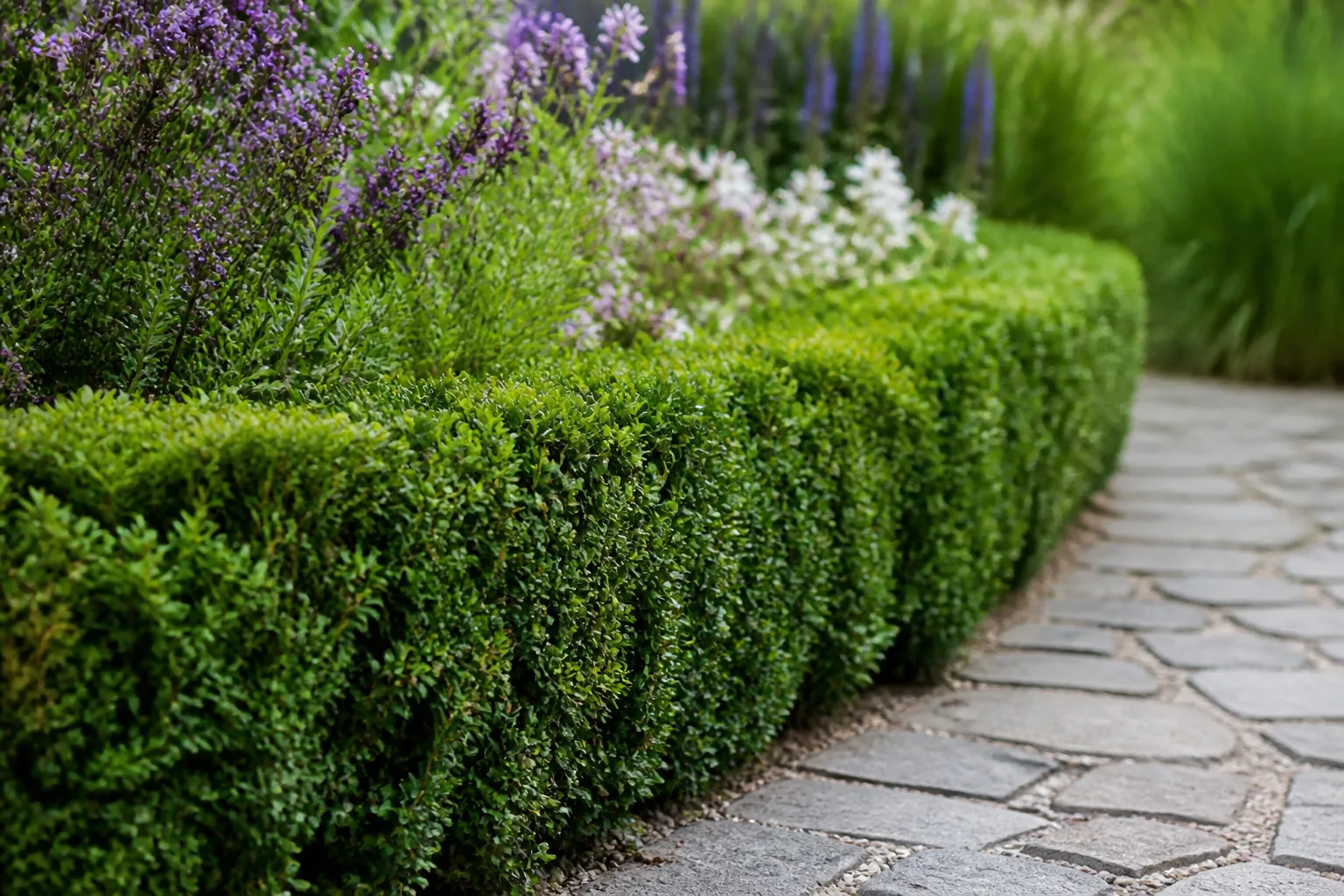
3. Boxwood (Buxus spp.) — Boxwood brings small leaves, dense branching, and a formal look to partial shade. It works well along paths and around woodland-style beds, but it is not a cure for a soggy foundation corner; choose a well-drained site with good air movement and avoid shearing so tightly that the outer foliage becomes a wall. Pick the cultivar by mature width and local disease performance, not simply by the word “boxwood” on the tag.
4. Japanese holly (Ilex crenata) — Japanese holly resembles boxwood in scale and can be clipped into a low hedge, but it usually appreciates more even moisture and protection from extreme heat or cold. The small leaves keep it visually tidy, while black berries may appear on female plants when a compatible pollinator is nearby. It is a good fit for a bright shade edge, not a root-packed, lightless pocket where every shrub becomes sparse.
5. Inkberry holly (Ilex glabra) — Inkberry is an evergreen North American native for acidic, moist, partly shaded soil and can replace a formal hedge with a softer, wildlife-friendly outline. The species can become leggy if crowded or left in very low light, so use compact cultivars where space is tight and give them room to branch. If berries are important, ask whether you need both sexes or a self-fruitful cultivar; “holly” does not automatically mean one plant will fruit heavily.
6. Japanese skimmia (Skimmia japonica) — Skimmia is a compact, rounded evergreen for cool shade, with fragrant spring flowers and bright fruit on female plants. Oregon State describes it as a small, dense shrub and confirms that it is dioecious, meaning male and female plants are separate; buy the pollination combination rather than guessing. It is also poisonous, so the red berries are ornamental, not a snack for a child or pet. Oregon State Skimmia profile
7. Japanese pieris (Pieris japonica) — Pieris earns a place in a sheltered acid-soil bed for its hanging flower clusters and colorful new growth. It prefers partial shade, moist well-drained soil, and protection from drying wind; in deep shade it may hold its foliage but flower less generously. NC State lists it as a poisonous shrub, so place it where browsing children, dogs, or cats cannot reach it. NC State Pieris profile
8. Coast leucothoe (Leucothoe axillaris) — Coast leucothoe has arching stems, evergreen leaves, and small flower clusters that make it useful at the front of a cool woodland border. Give it shade or partial shade, acidic soil, and reliable moisture without waterlogging; it is a better fit for a sheltered bed than for a hot, dry foundation. It stays smaller than many screening shrubs, but verify the local form because mature spread and winter performance vary.
Flowering shrubs for filtered light
Flowering shrubs generally need more light than foliage-first evergreens. “Tolerates shade” often means the leaves remain healthy; for a strong flower display, favor dappled light, morning sun, or a bright open sky above the bed.
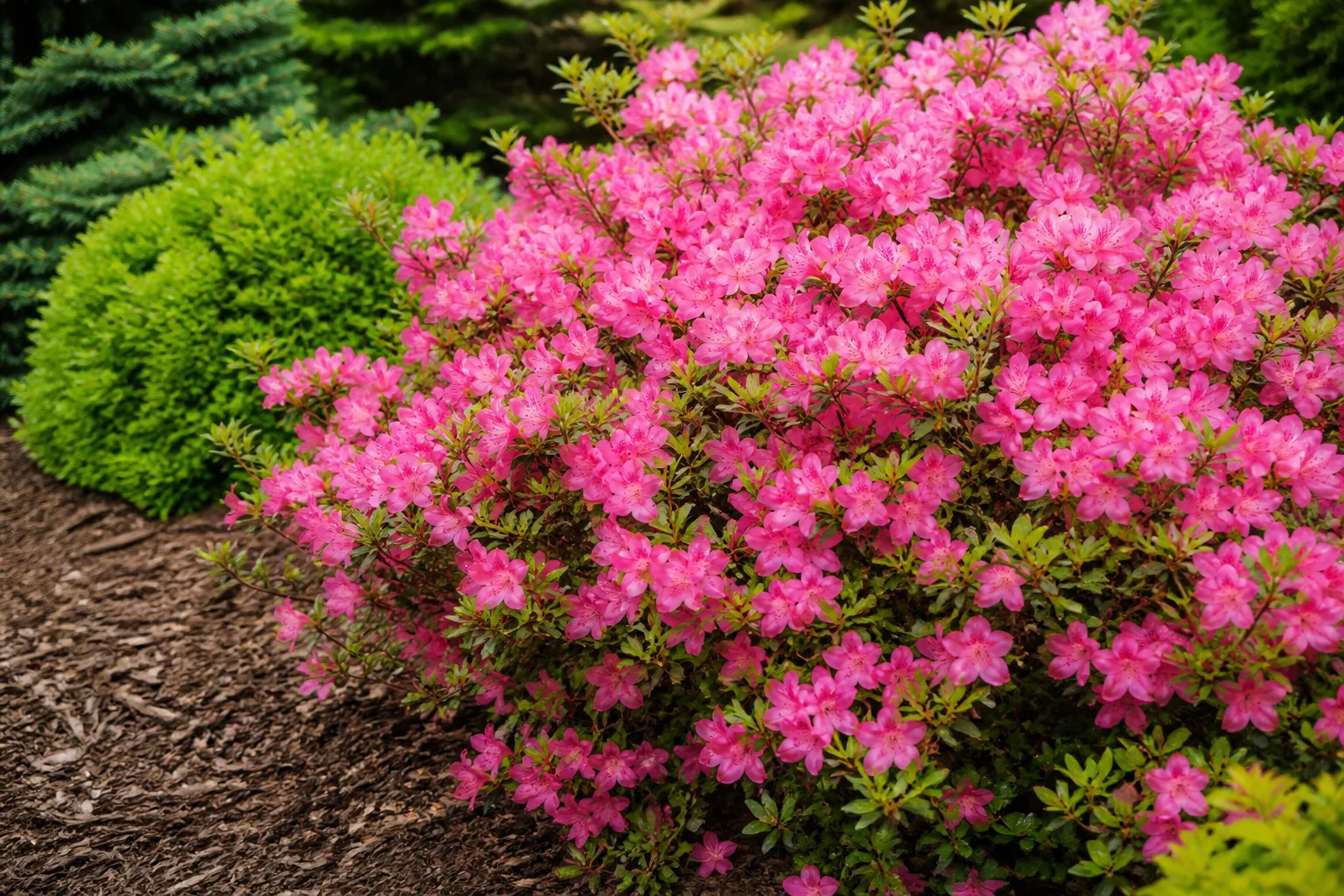
9. Evergreen azalea (Rhododendron hybrids) — Azaleas are compact spring bloomers for acidic, well-drained soil and bright woodland shade. Their shallow roots dislike both drought and standing water, so mulch the root zone lightly and water during dry weather instead of burying the stem in a heavy mulch mound. Cultivars range widely in mature height, flower color, and hardiness; choose the cultivar first, then design the bed around it.
10. Rhododendron (Rhododendron spp.) — Rhododendrons provide larger leaves and flower trusses than most azaleas and can anchor the back of a cool, dappled border. They prefer evenly moist, acidic soil and shelter from hot afternoon sun and drying wind, and a huge species range means that “rhododendron” is not a size prediction. If the site is dark, select a foliage-and-form cultivar rather than expecting a heavy bloom show.
11. Mountain laurel (Kalmia latifolia) — Mountain laurel is a broadleaf evergreen native to eastern North America, naturally associated with woodland conditions. Its folded buds and saucer-shaped flowers are strongest in filtered light, acidic soil, and steady moisture, while mature plants can become too large for a narrow foundation bed. All parts are toxic if eaten, so treat it as a look-but-do-not-touch choice around young children and animals.
12. Camellia (Camellia japonica and C. sasanqua) — Camellias bring glossy evergreen foliage and flowers from fall through spring, depending on the species and cultivar. They need bright shade or morning sun, acidic soil, consistent moisture, and protection from cold drying winds; dense full shade usually means fewer flowers. In warm climates they can be long-lived foundation shrubs, but a colder garden should select a hardy cultivar rather than assuming every camellia is interchangeable.
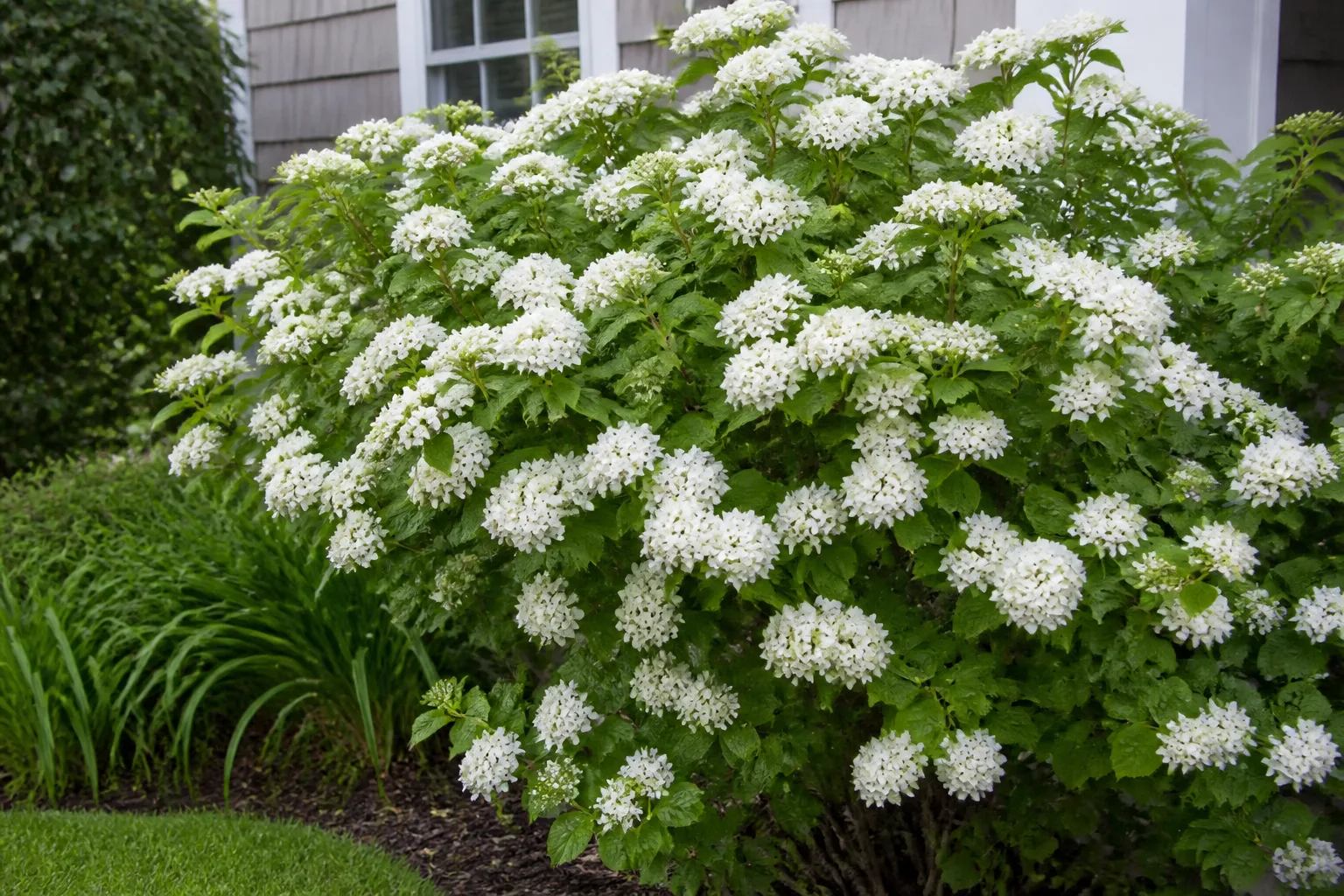
13. Oakleaf hydrangea (Hydrangea quercifolia) — Oakleaf hydrangea earns its space through more than summer flowers: oak-shaped leaves, peeling stems, and fall color give it several seasons of interest. It tolerates part shade, but flowering and sturdy stems are usually better with some morning sun or bright filtered light. Let it reach its mature width and prune after flowering only when needed; a permanently shaded, root-dry site can leave it smaller and less floriferous than the catalog photo.
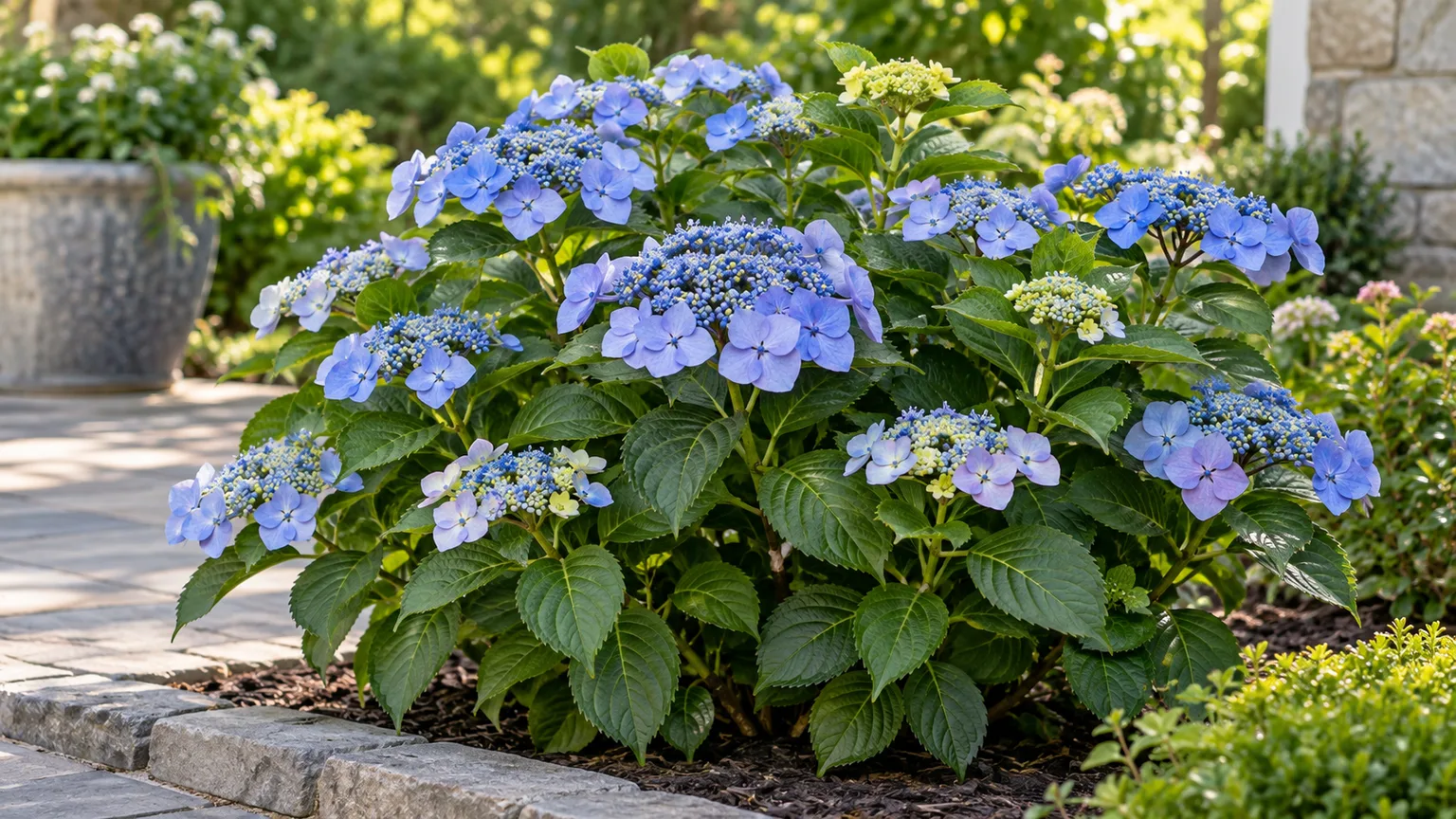
14. Bigleaf hydrangea (Hydrangea macrophylla) — Bigleaf hydrangea is best for morning sun and afternoon shade rather than true deep shade. It may grow leaves in a dark corner but set few buds, especially if the previous season’s flower wood is removed at the wrong time. Choose a reblooming cultivar if reliable flowers matter, and do not try to force blue flowers by changing soil pH unless the cultivar can actually respond to that chemistry.
15. Dwarf tree peony (Paeonia suffruticosa cultivars) — Tree peonies are woody subshrubs with large, dramatic flowers and handsome foliage. They appreciate dappled shade or gentle morning light, rich but well-drained soil, and a permanent location because moving or repeatedly disturbing the root system can set them back. In a very dark bed, enjoy the foliage and structure but expect fewer flowers than the same cultivar would produce in brighter filtered light.
16. Japanese kerria (Kerria japonica) — Kerria is one of the more forgiving deciduous shrubs for shade, with arching green stems and yellow spring flowers that can repeat in good conditions. It handles partial to full shade better than many flowering shrubs, but it can spread by suckering and become a tangled thicket if the old stems are never thinned. Use it where an informal screen or woodland edge is welcome, not in a narrow bed that demands a rigid outline.
17. Sweetshrub (Calycanthus floridus) — Sweetshrub is a deciduous native with fragrant, unusual flowers and aromatic foliage. It grows in partial shade and can handle a woodland-style setting, though more light usually means better flowering and denser form. Give it room for its eventual width and remove a few oldest stems when it becomes crowded rather than shearing the whole plant into a formal ball.
18. Common witch hazel (Hamamelis virginiana) — Witch hazel contributes fragrant yellow flowers in late fall or winter, when a shady yard can otherwise look empty. It is an upright shrub that may reach small-tree proportions if left alone, so it belongs at the back of a border or in a naturalized area rather than below a low window. It tolerates partial shade and rewards a gardener who values seasonal structure over a compact, constantly clipped silhouette.
19. Dwarf fothergilla (Fothergilla gardenii) — Fothergilla offers white bottlebrush flowers in spring, blue-green foliage in summer, and strong fall color. Dappled or partial shade preserves its form, while more sun usually increases bloom; acidic, evenly moist, well-drained soil keeps it happiest. The dwarf form is a smart choice for a small shade bed, but confirm the cultivar because full-size fothergillas can occupy much more room.
Native and wildlife-friendly shrubs
A shade garden can support more than decoration when flowers, fruit, and branching structure are chosen together. Fruit production is conditional: some plants need a pollinating partner, and heavy shade can reduce flowering even when the shrub remains healthy.
20. Arrowwood viburnum (Viburnum dentatum) — Arrowwood viburnum is a useful medium-to-large deciduous shrub for partial shade, with spring flower clusters, fall color, and blue fruit. It is better suited to an informal screen or mixed wildlife border than a tiny foundation bed, and mature width can rival height. A trusted landscape roundup from Country Living also highlights viburnum for wildlife and deer-resistant planting, but the exact species and cultivar still determine size and site fit. Country Living’s shrub selection guide
21. Mapleleaf viburnum (Viburnum acerifolium) — Mapleleaf viburnum is a smaller woodland understory shrub than many viburnums and is a good candidate for dappled or deeper shade. Its maple-shaped leaves turn warm colors in fall, followed by dark fruit that can feed birds. It may spread slowly by suckering, which is useful for naturalizing but inconvenient beside a paved path.
22. Serviceberry (Amelanchier spp.) — Serviceberries provide spring flowers, edible-looking but wildlife-valued fruit, and fall color, with forms ranging from multi-stemmed shrubs to small trees. They handle partial shade, but flowering and fruiting improve with more light and good air circulation; crowding a serviceberry into a damp corner can encourage foliar disease. Missouri Botanical Garden’s profile for alder-leaved serviceberry is a useful reminder that cultivar identity matters because mature size and habit vary widely. Missouri Botanical Garden serviceberry profile
23. Red buckeye (Aesculus pavia) — Red buckeye can be grown as a tall shrub or small understory tree and produces red tubular flowers that attract hummingbirds. It is a better choice for a spacious naturalized edge than for a small bed, and the seeds are poisonous to people and pets. Give it well-drained soil and enough room for a mature multi-stemmed shape rather than planning to keep a large plant permanently small with pruning.
24. Spicebush (Lindera benzoin) — Spicebush is a native deciduous shrub for moist woodland edges, with yellow spring flowers, aromatic leaves, and red fruit on female plants. It is valuable when you want a naturalistic screen that supports wildlife rather than a clipped hedge. Buy from a reputable native-plant nursery and confirm whether you need both a male and female plant for berries.
25. Northern bush honeysuckle (Diervilla lonicera) — Unlike invasive vining honeysuckles, bush honeysuckle is a low, suckering native shrub with tubular yellow flowers and good fall color. It tolerates partial shade and is useful for stabilizing a woodland edge or filling a rough, informal bed. Its spreading habit is an advantage when you want coverage, but it needs a boundary if you prefer a single tight clump.
26. Winterberry (Ilex verticillata) — Winterberry is a deciduous holly that drops its leaves but holds bright berries on bare stems in the cold season. It performs best in moist acidic soil and partial sun to partial shade, and fruiting requires compatible male and female plants with overlapping bloom times. Because it can become a sizeable shrub, use it at the back of a rain-fed or woodland border rather than in a dry foundation bed.
27. Coralberry (Symphoricarpos orbiculatus) — Coralberry is valued for its persistent berries and tough, informal character. It tolerates shade better than many berrying shrubs and can help fill a naturalized edge, but it may sucker and spread more than a small urban bed can accommodate. Cut out older stems at the base when needed instead of repeatedly shortening every branch to the same height.
Small, low-growing, and cold-climate options
The final three are low subshrubs rather than tall hedge plants. They are useful when the shade problem is at ground level, but they need the right climate and soil; a tiny plant is not automatically easier than a larger one.
28. Canadian bunchberry (Cornus canadensis) — Bunchberry is a low dogwood relative with white bracts and red fruit that works as a woodland groundcover in cool, moist shade. It is especially useful in cold regions where larger shrubs would overwhelm the space. Do not plant it in hot, dry, compacted soil and expect the same performance; its natural habitat is a clue to the conditions it needs.
29. Checkerberry or wintergreen (Gaultheria procumbens) — This evergreen, mint-scented subshrub stays low and forms a carpet in acidic, cool shade. Its small flowers and red berries add detail near stepping stones or under taller shrubs, but it is not a fast filler for hot or alkaline sites. Use it as a deliberate woodland accent, not as a substitute for fixing drainage or soil chemistry.
30. Carol Mackie daphne (Daphne × burkwoodii ‘Carol Mackie’) — This compact shrub is often chosen for cream-edged foliage as much as for its fragrant flowers. It prefers partial shade, sharply drained soil, and a position where it will not be disturbed; overwatering and root disturbance are more dangerous than a little neglect. Daphne berries and foliage are toxic and can irritate skin, so place it only where children and pets cannot browse it.
How to Plant Shade Shrubs Without Setting Them Back
Plant in spring or fall when the soil is workable and heat stress is lower. Dig a hole no deeper than the root ball and about twice as wide, loosen circling roots gently, and set the top of the root ball level with or slightly above the surrounding soil. Do not bury the trunk flare, and do not fill the hole with a rich pocket of compost that creates a sharp boundary between amended and native soil.
Planting under mature trees
Under a tree, dig between major roots instead of cutting through them. If the soil is shallow, use a smaller shrub or a cluster of plants that can share the available root zone rather than building a raised mound over the tree’s roots. A thin organic mulch layer can conserve moisture, but keep it several inches away from every trunk and shrub stem.
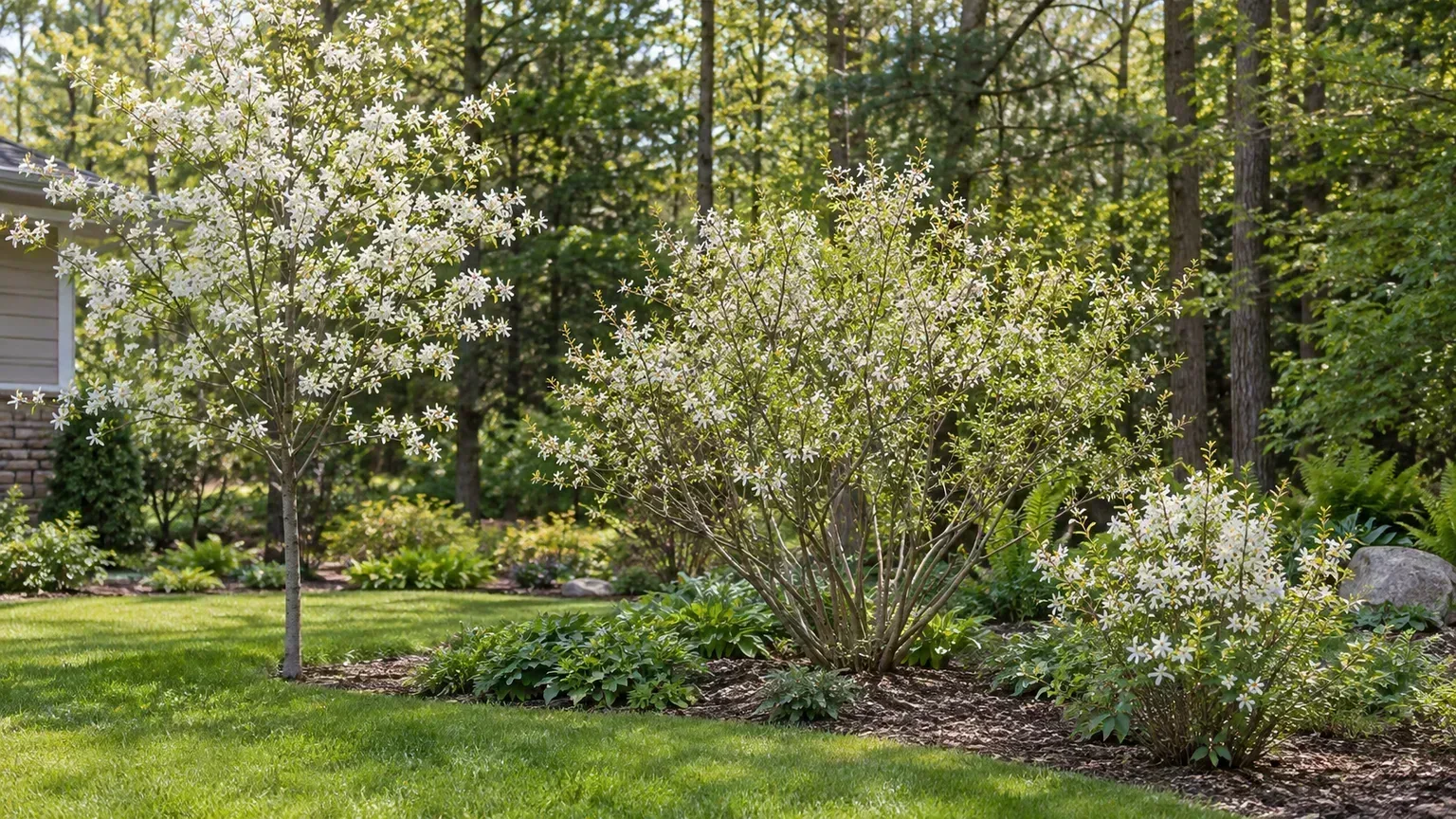
The first season is the hardest because a new shrub has a small root system while the tree already has an established one. Water slowly at the root ball, check the soil beneath the surface, and expect to irrigate during a dry spell even if the canopy looks lush. “Shade” protects leaves from heat but does not remove competition for water.
Watering, mulch, and first-year establishment
Water deeply enough to wet the full root ball, then let the surface begin to dry before watering again unless the plant specifically prefers consistently moist soil. The right interval depends on soil, weather, root competition, and pot size; a calendar reminder is less reliable than checking the soil.
Apply about 2 to 3 inches of shredded bark or leaf mulch over the root zone, leaving a clear gap around the stem. Avoid fertilizer at planting unless a soil test or local recommendation calls for it. A shrub that is establishing roots should not be pushed into soft, lanky growth when the site is already short on light.
Common Shade-Shrub Mistakes and What to Do Instead
The most common mistake is treating a list of shade-tolerant plants as a guarantee of equal performance. Before buying, ask three questions: will the shrub receive enough light for the feature I want, can the soil provide the moisture and drainage it needs, and will its mature size fit without yearly rescue pruning?
Other avoidable errors include planting a moisture-loving shrub in dry tree-root soil, putting an acid-lover into limed lawn soil, choosing a berrying holly without a pollinator, and placing a toxic plant beside a pet path. Invasive behavior is another local question: a plant that is manageable in one climate may escape in another, so check your extension service before planting a spreading shrub near natural areas.
When a shrub survives but does not bloom
First check light, then moisture, then pruning timing. Many flowering shrubs form next year’s buds on old wood, so a late-winter haircut can remove the display even when the leaves look excellent; others flower on new wood and can be pruned more freely.
If the plant is green but flowerless, do not begin with more fertilizer. Move the plant only if the root system can tolerate it, thin a competing canopy when that is safe and allowed, improve watering, or accept that the shrub is serving as a foliage plant in that location. A smaller flowering plant in the bright edge may be more satisfying than forcing a sun-loving shrub to perform in deep shade.
Toxicity, Invasiveness, and Household Safety
Several excellent shade shrubs are unsafe to eat. Yew, aucuba, pieris, mountain laurel, skimmia, red buckeye, and daphne should be treated as ornamental plants only; keep prunings, fallen berries, and seeds away from pets and children, and wear gloves when a plant’s sap or foliage is known to irritate skin.
Safety is not a reason to reject every shrub, but it is a reason to change placement. If a bed borders a play area, choose a non-toxic alternative where practical, ask a local extension service about the exact cultivar, and do not rely on a common name to identify a plant. The same discipline applies to invasiveness: verify local restrictions before choosing a fast-spreading shrub, especially beside woods, waterways, or unmanaged land.
Conclusion
The right shade shrub starts with a site observation, not a plant name. Measure the light, feel the soil, estimate the mature footprint, and decide whether you want evergreen structure, flowers, berries, privacy, or a low woodland layer.
For the darkest sheltered spots, begin with foliage-first choices such as aucuba, yew, skimmia, or leucothoe. For flowers, give azaleas, rhododendrons, camellias, hydrangeas, and mountain laurel as much filtered light and even moisture as the site allows. For wildlife, look to viburnum, serviceberry, spicebush, winterberry, and other regionally appropriate natives. A good match will need less correction later—and the shaded corner will look intentional rather than like a place where sunny plants went to fail.