6 Signs of Snakes in Your Garden and What They Mean
Learn how to read six signs of snakes in your garden, from shed skin and burrows to trails and eggs, and what to do safely next.

One shed skin is meaningful evidence. One round hole is not. The useful way to read signs of snakes in your garden is to separate direct evidence of a snake from clues that only show the yard has food, shelter, or an opening a snake could use.
That distinction keeps you from panicking over an old rodent burrow or taking unnecessary risks with a harmless native animal. It also helps you notice when several clues line up: a shed tucked beside a woodpile, a wavy trail through loose soil, and a sudden concentration of rodents or frogs are more persuasive together than any one clue by itself.
Montana Fish, Wildlife & Parks lists shed skins, droppings, crawl markings in loose soil, and visual observations as signs of snakes. Its guidance also explains why snakes turn up in gardens: they follow animal prey and need access to both cover and places to regulate their body temperature (Montana Fish, Wildlife & Parks’ guidance on living with snakes).
Read the clues as a pattern, not a verdict
Before you inspect anything, ask three questions: Is this direct evidence? Is there a reasonable alternative explanation? Does the location provide food or shelter? A long intact shed is direct evidence that a snake was there recently enough for the skin to remain, while a small hole may belong to a mouse, vole, crayfish, turtle, or other animal.
The location matters as much as the object. Snake signs are more plausible along a fence, under a deck, beside a rock or woodpile, near a compost area, or at the edge of tall vegetation than in the middle of a frequently mowed lawn. A single clue in a high-traffic, exposed spot may be old or unrelated; several clues around one protected edge deserve a more careful response.
Do not use the word “nest” too quickly. Most snakes do not build a nest the way birds do. They may use an existing cavity, burrow, log pile, rock crevice, or other refuge, and some species lay eggs while others give birth to live young. Think refuge or breeding site, not a tidy constructed nest.
| Clue | What it supports | Common alternative |
|---|---|---|
| Intact shed skin | A snake recently used the area | Old skin carried in by wind or attached to garden debris |
| Hole or cavity | Shelter is available | Rodent, crayfish, turtle, or drainage opening |
| Wavy soil mark | Something moved through loose soil | Hose drag, runoff, root, or another animal |
| Droppings | An animal has been feeding nearby | Lizard or other wildlife waste |
| Pet reaction | Something unusual is present | Rodent, frog, scent, or insect |
| Eggs | Possible reptile reproduction | Lizard, turtle, amphibian, bird, or debris |
That table is not a field guide and it is not a species-identification tool. Its purpose is to keep your response proportional: investigate strong clues from a distance, correct the habitat conditions you control, and ask for help when the risk or identification is uncertain.
1. A shed skin in a protected spot
A translucent, papery strip with a repeating scale pattern is the strongest garden clue short of seeing a snake. The skin may be curled into a loose tube, caught on a thorn or grass stem, or stretched along the edge of a board, fence, rock, or shaded planting bed. An intact shed can be surprisingly long even when the snake itself was small because it expands as it separates from the body.
Finding a shed proves that a snake occupied that immediate area at some point. It does not prove the snake is still there, that it was venomous, or that it has taken up permanent residence. Weather, foot traffic, mowing, and decomposition can leave a shed in place after the animal has moved on.
How to distinguish a shed from ordinary garden debris
Look for a continuous, lightweight skin rather than a random piece of plastic, bark, or dried leaf. The surface should show regularly repeated scales, and the head end may preserve a recognizable eye opening. Do not pick it up to examine it more closely; use your phone’s zoom from a safe distance, and keep children and pets away from the spot until you are satisfied that the area is clear.
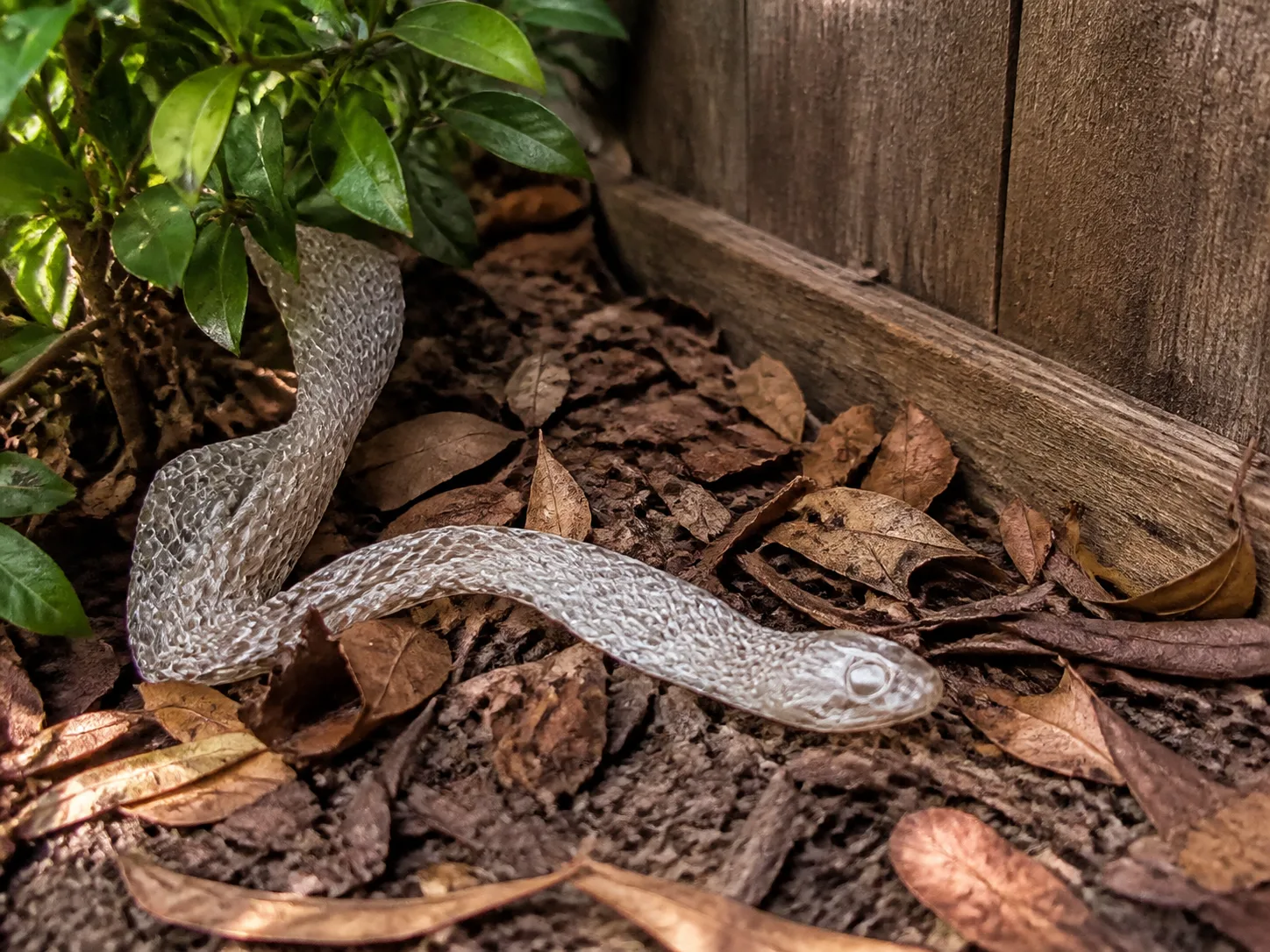
If you find a shed near a doorway or play area, use it as a reason to inspect the perimeter rather than as a reason to tear apart the garden. Check for dense cover, rodent activity, gaps under structures, and other clues. If the shed is accompanied by a recent sighting or repeated signs, ask your local cooperative extension office or wildlife agency which snakes are common in your region.
2. Rounded holes or abandoned burrows
Small, rounded openings in soil are often described as “snake holes,” but snakes usually do not excavate a fresh tunnel from scratch. They commonly reuse an abandoned rodent burrow, a cavity beneath a slab, a gap under a shed, a rock crevice, or another opening that already provides shelter.
That makes a hole a habitat clue rather than a snake identification clue. It tells you that a protected entrance may be available; it does not tell you which animal made it or which animal is using it now. A new mound of loose soil, gnaw marks, droppings, or repeated movement around the hole may point more strongly to a rodent problem than to a snake.
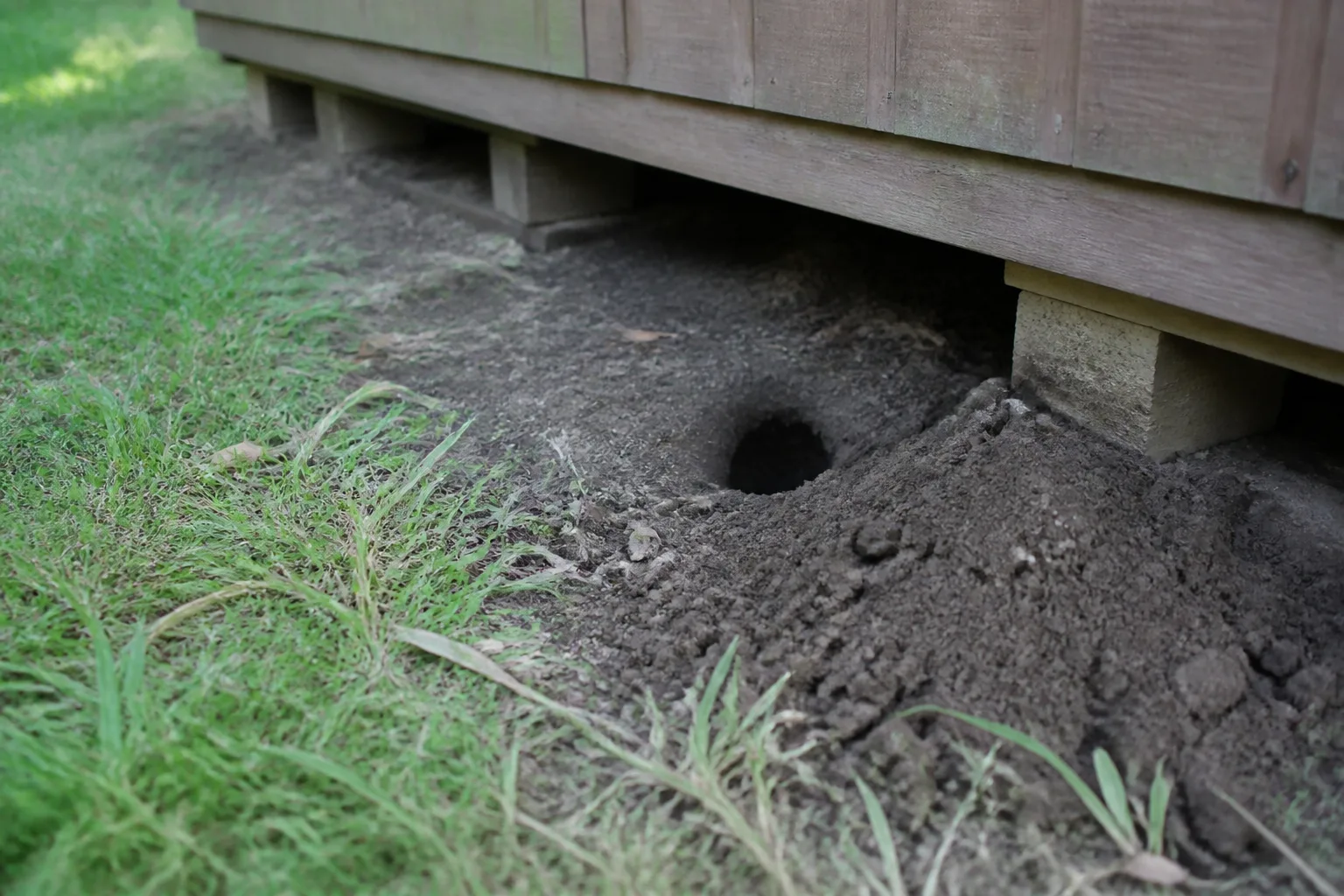
Why a hole does not prove snake activity
Do not insert a stick, hose, hand, or camera into a hole. The opening could contain a snake, a defensive mammal, a nest, or unstable soil. Fairfax County Park Authority notes that some snakes use log piles, rocky areas, and abandoned burrows for both cover and access to prey, and that a hole as small as a quarter inch can be enough for some small snakes to enter a building (Fairfax County’s snake-awareness guidance).
Instead, photograph the entrance from several feet away and note its position. If it is under a house, deck, shed, or porch, do not seal it until you know the space is empty; sealing wildlife inside creates a bigger problem and can lead to odor, damage, or an injured animal. A wildlife professional can check the opening and recommend exclusion that does not trap anything.
3. Smooth, winding trails through loose soil
A snake moving across loose, damp soil can leave a smooth, meandering line or a sequence of shallow curves. The mark may pass under foliage, along a wall, or from one refuge to another. It is easier to see after the soil has been lightly disturbed by weather and before rain, irrigation, or foot traffic erases the edges.
This sign is more useful when it connects two plausible hiding places. A wavy mark that begins at a burrow and disappears beneath a board is worth noting; a line in a busy path could be a hose drag, a root, runoff, a garden tool, or an animal other than a snake. Montana Fish, Wildlife & Parks specifically includes crawl markings in loose soil among the signs to watch for, but does not treat a track as proof by itself.
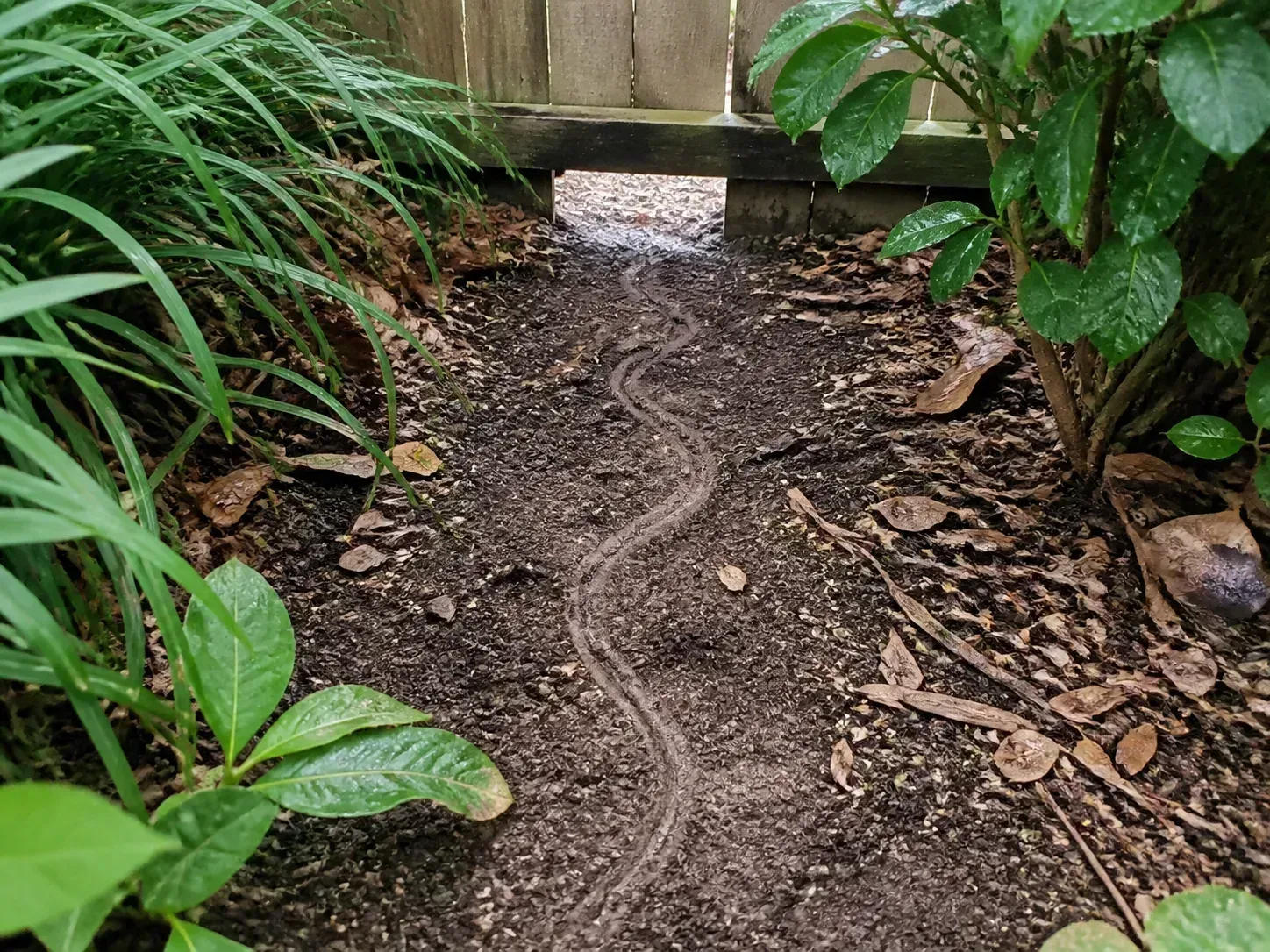
Avoid trying to follow a trail into thick vegetation. Record the direction, then inspect the surrounding area later from a clear path with boots and long pants. If the trail is paired with a shed or a visual sighting, keep people and pets out of that section until you can get local guidance.
4. Dark-and-white droppings near cover
Snake droppings are easy to miss and easy to misidentify. A snake’s waste can include a dark fecal portion and a pale, chalky urate portion, but lizards and other animals can leave superficially similar deposits. Fur, feathers, insect parts, or other prey remains may be present, yet those details still do not identify a species from a photograph alone.
The most useful interpretation is contextual: droppings tucked beneath cover, beside a suspected refuge, or near a known prey source add weight to other evidence. Droppings on their own are a weak clue. Montana Fish, Wildlife & Parks includes droppings among possible snake signs, while local wildlife agencies emphasize learning the species in your area rather than assuming every dark-and-white dropping came from a snake.
What droppings can and cannot tell you
Treat unknown droppings as potentially contaminated animal waste. Keep pets away, do not touch or sniff them, and avoid stirring dry material into the air. If you need a record, photograph it next to an ordinary object for scale and note whether it was found on soil, a flat surface, or inside a sheltered structure.
Droppings can tell you that an animal has been using the area. They cannot reliably tell you whether a snake is present today, whether it is dangerous, or whether the animal is feeding on garden pests. Use them as one piece of a pattern, not a reason to apply a repellent or disturb a hiding place.
5. A sudden change in pets or prey animals
Dogs may sniff, stare at, or bark toward a leaf pile, wood stack, deck edge, or dense border where they normally show little interest. Cats and other pets may avoid a familiar corner. You may also notice a change in the small wildlife around the garden: fewer visible mice, frogs, or lizards can mean a predator is using the area, although weather, food availability, predators, and seasonal behavior can cause the same shift.
These are indirect clues. A dog’s behavior can indicate an interesting scent, a mouse, a toad, or a harmless snake; it cannot identify the animal. Never send a pet into a hole or under a shed to investigate. Dogs are especially vulnerable because they put their noses close to cover and may corner a snake before a person sees it.
Fine Gardening describes snakes as part of a wider group of helpful garden wildlife because they can prey on insects and small animals. That does not mean every household should invite snakes into a play area, but it does mean that a change in prey activity is better understood as an ecosystem clue than as proof of an infestation (Fine Gardening’s overview of helpful garden wildlife).
6. Snake eggs or repeated nesting evidence
Confirmed snake eggs are a stronger sign of local reproduction than a single trail. They may be leathery, pale, and clustered in a protected, warm, humid location such as beneath rotting wood, compost, mulch, or another cavity. But an egg-like object can also be a lizard, turtle, amphibian, bird, or even a piece of fungus-covered garden debris, and not every snake species lays eggs.
The important point is not to solve the identification yourself by handling the clutch. Eggs can be damaged by turning or moving them, and the adult may be nearby even if it is hidden. Mark the location from a distance, keep people and pets away, and contact a local wildlife agency, extension office, or qualified wildlife professional if the site is near a home, play area, or work route.
Egg-like objects need caution
Do not dig through a pile to look for more. Do not spray, flood, burn, or relocate the material. If the eggs are inside a structure, pause any sealing or demolition work until a professional has assessed the area. Virginia’s wildlife agency recommends removing food and shelter when the goal is to discourage snakes, but it also recognizes that snakes are part of local wildlife and should be managed with informed, humane decisions (Virginia Department of Wildlife Resources guidance on living with snakes).
What a snake-friendly garden has in common
Snakes do not show up because a particular flower “calls” them. They stay where the conditions meet their needs: prey, cover, temperature, and sometimes water. A garden beside woods, fields, a creek, a rock wall, or an overgrown lot will naturally have more wildlife movement than a bare, sealed patio.
Food and shelter are the real drivers
Rodents, frogs, slugs, insects, and small reptiles can all be part of a snake’s food supply, depending on the species. Birdseed on the ground, unsecured feed, open trash, fallen fruit, and compost that attracts rodents can indirectly make a yard more interesting to snakes. Tall grass, thick mulch, brush piles, lumber, rock piles, dense ground cover, and gaps under buildings provide the cover that makes hunting and resting possible.
The practical rule is food plus shelter. Removing only the snake while leaving a rodent colony and a stack of boards in place does not solve the conditions that brought it there. The Virginia DWR recommends mowing regularly, reducing places where mice and rats can hide, removing brush and mulch piles near the home, and thinking about fallen birdseed as a rodent attractant.
You do not have to sterilize the whole property. Keep a tidy, visible buffer around doors, play areas, paths, and the foundation, then place logs, brush, compost, and dense habitat farther from those high-use zones if you want to support wildlife. That approach reduces surprise encounters while preserving some of the ecological value that snakes and other predators provide.
What to do when you find a snake
Stop, back away slowly, and give it a clear escape route. Do not corner it, throw objects, spray it, pin it, or ask a dog to chase it. The CDC’s NIOSH guidance for outdoor workers advises people not to touch or handle snakes, to avoid tall grass and leaf piles when possible, and to wear boots, long pants, and gloves when working around brush and debris.
If the snake is in a place where it can leave safely, the best response may be to keep everyone away and let it move on. New Jersey’s Department of Environmental Protection notes that snakes generally try to blend in or escape when threatened and recommends giving them space; species identification from a distance is safer than trying to determine whether a snake is venomous by getting closer (New Jersey DEP’s snake guidance).
For a suspected venomous snake, a snake inside a home, repeated sightings beside a doorway, or a snake that cannot retreat, call local animal control or a licensed nuisance-wildlife professional. Availability and relocation rules vary by city and state. Do not assume a general pest company is qualified to handle native reptiles; ask what training and local licensing the provider has.
When to call a wildlife professional
Ask for help when any of these apply:
- You cannot confidently identify the snake from a safe distance.
- The animal is near children, pets, a doorway, or a frequently used path.
- It is inside a building, trapped in a window well, or under a structure.
- You find eggs, repeated sheds, or several signs concentrated in one refuge.
- Someone has been bitten or may have been bitten.
If a bite occurs, seek emergency medical care immediately. Do not cut the wound, suck out venom, apply ice or a tourniquet, or try to capture the snake; if safe, take a photograph from a distance for identification. The CDC notes that venomous snakebites can cause lasting injury even when they are not fatal, so first aid myths are not worth testing.
Make the garden less inviting without harming wildlife
Start at the house, not in the middle of the garden. Walk the foundation, deck, shed, fence line, and compost area from a clear path. Look for gaps, spilled feed, unsecured trash, heavy cover, and places where rodents can move unseen.
Then make targeted changes:
- Reduce prey attractants. Store birdseed, pet food, and animal feed in sealed containers; clean up spills; secure trash; and harvest fallen fruit rather than letting it accumulate.
- Clear the house perimeter. Move woodpiles, boards, and dense brush away from doors, foundations, and play spaces. Wear boots and gloves, use tools to move material, and work slowly because a snake may already be underneath.
- Manage vegetation for visibility. Keep paths and the foundation edge short enough to see the ground. A wildlife-friendly meadow can remain elsewhere, but tall grass directly beside a doorway makes encounters harder to avoid.
- Seal buildings only after checking occupancy. Close gaps around pipes, doors, windows, foundations, and porches with a material appropriate for the structure. Fairfax County specifically warns that openings should be checked for snakes before they are sealed so an animal is not trapped inside.
- Address rodents with an integrated plan. Removing spilled seed and hiding places is safer for the whole food web than scattering improvised chemicals. If you need traps or professional rodent control, protect non-target wildlife and follow local guidance.
Snake-proof fencing can make sense around a small, high-priority area such as a poultry run or children’s play space, but it is not a casual weekend fix for every yard. Mesh size, buried depth, gates, vegetation, local species, and maintenance all affect performance; ask a local wildlife or extension professional for a design that fits your region.
There is no need to promise a snake-free landscape. The realistic goal is a yard where you can see where you are walking, buildings are closed to wildlife, food attractants are controlled, and native animals have room to pass without being cornered.
Conclusion: use multiple clues, then act safely
The best signs of snakes in your garden are not a random hole or a nervous dog viewed in isolation. A shed skin or a confirmed sighting is direct evidence; trails, droppings, eggs, burrows, and behavior become more meaningful when they cluster around the same sheltered edge and match the food and cover available there.
Photograph what you can from a distance, keep people and pets out of hidden spaces, and avoid reaching into any hole, pile, or cavity. Clean up the house perimeter, manage the prey that attracts wildlife, and preserve habitat farther from high-use areas when practical. If the species or situation is uncertain, local wildlife professionals are the safest route for both your household and the snake.



