Snake Plant Care: Light, Water, Soil & Problems
Grow a snake plant with the right light, dry-down watering rhythm, gritty soil, repotting cues, propagation methods, and symptom fixes.
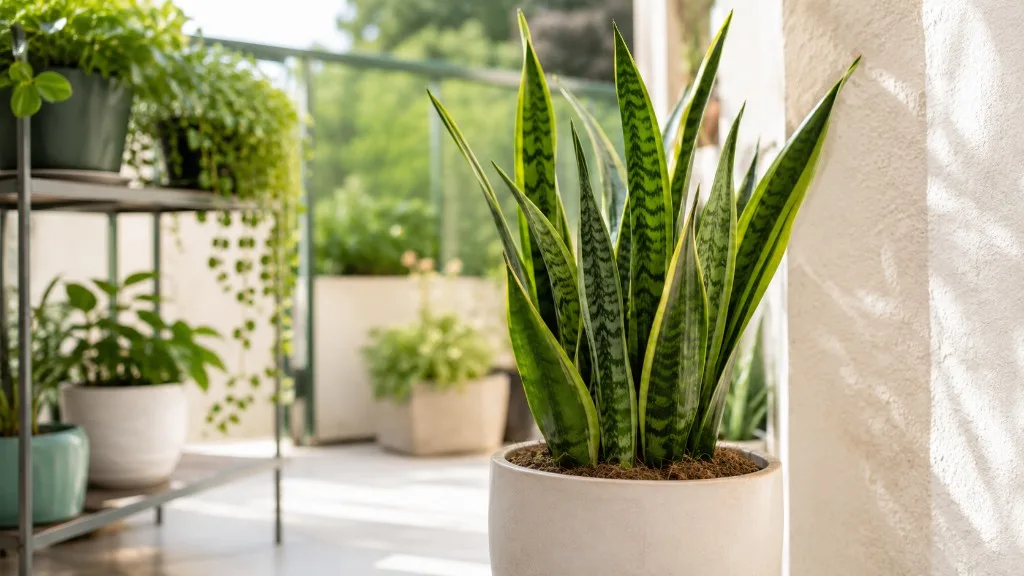
Snake plant care gets easier when you stop treating the plant like a thirsty tropical. The upright leaves are thick and water-storing, while underground rhizomes spread the clump and hold reserves. That combination lets a snake plant tolerate missed waterings, but it makes a pot that stays wet unusually dangerous.
The accepted name is Dracaena trifasciata, although plant tags still commonly say Sansevieria trifasciata or mother-in-law’s tongue. NC State Extension describes it as an erect, clumping evergreen perennial from central Africa with good drainage and careful watering requirements. (NC State Extension) For a healthy plant, make three decisions in order: give it enough light for the growth you want, use a mix that releases excess water, and wait for the root zone to dry before watering deeply.
What Makes a Snake Plant Different
A snake plant is a stemless, clumping plant whose leaves emerge from a crown and whose rhizomes travel horizontally below the mix. New pups appear at the ends of those rhizomes, which is why an established plant often gets wider before it gets dramatically taller. Standard forms commonly grow several feet indoors, while bird’s-nest types stay compact in a short rosette.
Its dry-country adaptations explain the most important care rule. Thick, leathery leaves can carry water through a dry spell, so the plant is not asking you to keep the mix evenly damp. It is asking for a complete drink followed by enough time for the pot to dry. Epic Gardening makes the same practical distinction: low light is tolerated, but brighter filtered light supports better color and growth, while soggy mix raises the risk of rot. (Epic Gardening)
The old and new botanical names refer to the same familiar houseplant for care purposes. You may also see names such as Saint George’s sword, viper’s bowstring hemp, or good-luck plant. Do not let a nursery label push you into a different watering routine; inspect the leaf shape, variegation, pot, and actual drying speed instead.
Snake Plant Care at a Glance
Use this table to set a starting point, then adjust for your room and pot. “Low maintenance” means fewer interventions, not that the plant can grow in darkness or sit in a cachepot full of runoff.
| Care factor | Practical starting point | What changes the decision |
|---|---|---|
| Light | Bright indirect light; a few hours of gentle direct sun can work | Window direction, season, curtains, and cultivar |
| Water | Soak when the mix is dry through the root zone; empty the saucer | Pot size, mix, terracotta, temperature, and light |
| Soil | Fast-draining cactus or succulent mix with plenty of air space | How quickly the mix dries and whether it has compacted |
| Pot | Drainage hole, sturdy base, usually only 1–2 inches wider than the root ball | Crowded pups, top-heaviness, cracked pot, or rot |
| Temperature | Normal indoor warmth; protect from cold glass and drafts | Winter windows, AC vents, patios, and transport |
| Humidity | Average indoor humidity is usually enough | Very dry air can increase mite pressure, but misting is not a cure |
| Fertilizer | Light feeding in spring and summer only | Growth rate, fresh potting mix, and plant health |
| Growth | Slow to moderate; winter pauses are normal | Light, warmth, cultivar, root space, and season |
| Pet safety | Toxic to cats and dogs if eaten | Pet access and chewing behavior |
Choose Light for the Growth You Want
Put a snake plant where it receives bright, filtered light for much of the day if you want new leaves, strong variegation, and a fuller clump. An east-facing window is an easy default. A few feet back from a bright south- or west-facing window, with a sheer curtain or some distance from the glass, also works well.
Low light is a survival setting, not a growth promise. A snake plant may stay green in a dim hallway or office, but it will usually grow slowly, use water more slowly, and show less contrast in variegated leaves. If the plant has not produced new growth for many months, move it closer to a bright window or add a grow light before adding fertilizer. Savvy Gardening similarly notes that low light can slow growth and soften color, while a sudden move into stronger light can scorch foliage. (Savvy Gardening)
Direct sun is not automatically forbidden. Gentle morning sun can be useful, but intense midday sun through glass can bleach, bronze, or crisp the window-facing side. Acclimate gradually over a few weeks: increase exposure in small steps, watch the hottest part of the day, and pull back if pale, papery patches appear. Damaged tissue will not turn green again, so the goal is to protect new growth while the plant replaces what it can.
Water by Soil Dryness, Not by Calendar
Water a snake plant thoroughly when the potting mix is dry throughout the root zone, then let excess water drain away. In a bright, warm room this might be every two to four weeks in the growing season; a cool, dim room or a large plastic pot may take much longer. In winter, it may be closer to every four to eight weeks, and NC State Extension notes that some plants need water only every one to two months during winter. (NC State Extension)
Do not turn those intervals into a schedule you obey without checking. A small plant in a porous terracotta pot can dry much sooner than a crowded plant in a deep plastic container. Light also changes the equation: less light means less growth and usually slower water use. The safest calendar is a reminder to test the mix, not an instruction to pour.
When it is time to water, take the inner pot to a sink or tray and drench the mix until water exits the drainage hole. Let it finish draining, then empty the saucer and any decorative cachepot. A shallow splash keeps the surface damp while the lower mix stays stale, and standing runoff removes the air roots need.
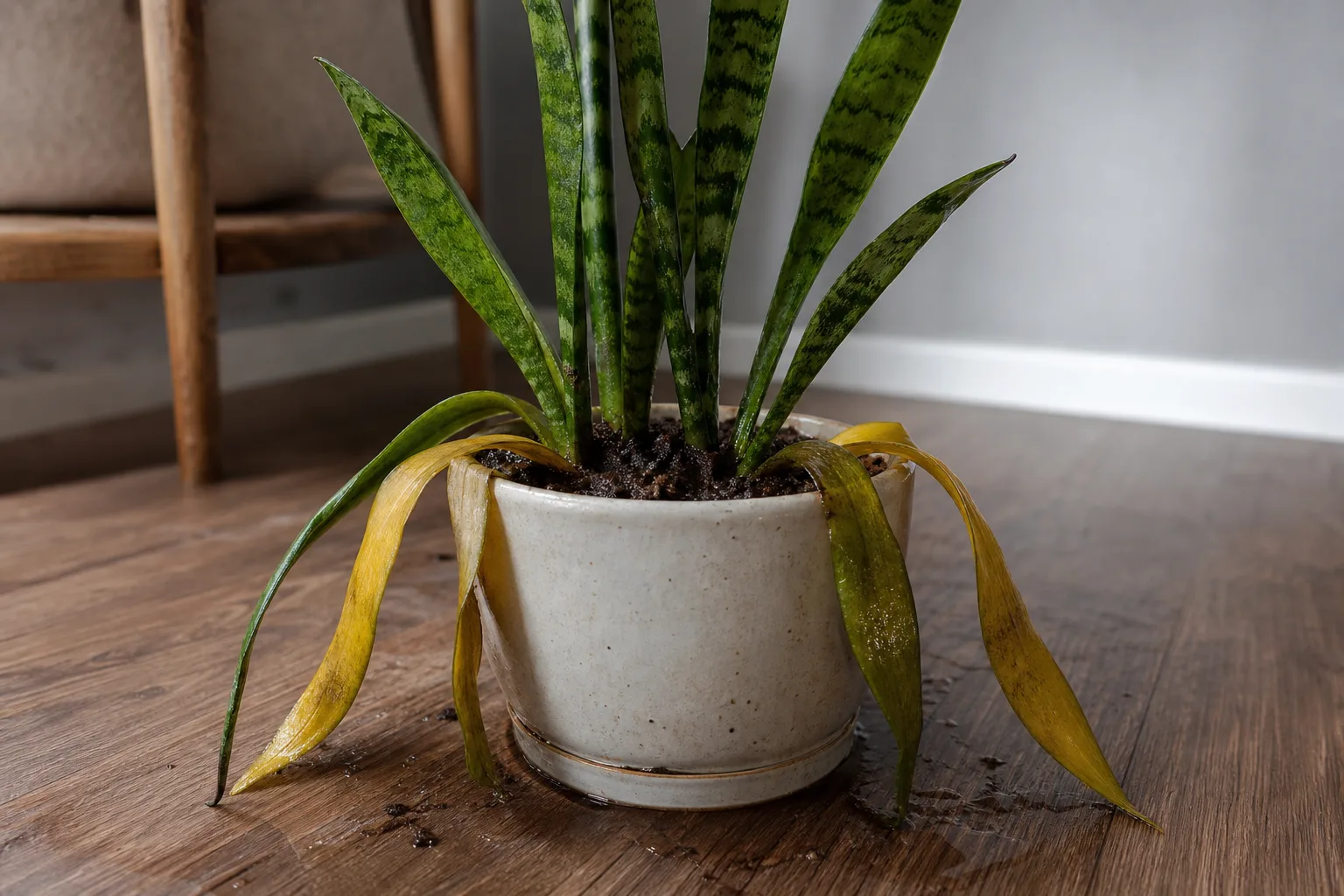
Overwatering is more than “too much water once.” It is a mismatch between water added and water released: a pot without a hole, a dense mix, low light, a cool room, or a saucer that never gets emptied. If the plant is soft at the base, the soil smells sour, or yellowing is spreading from the lower leaves, pause watering and inspect the roots rather than giving the plant another drink.
How to Check Moisture Before Watering
Use more than the surface. Push a clean finger or wooden skewer down into the pot, lift the inner pot to compare its weight with a recently watered pot, and check whether the lower mix feels cool or damp. If the skewer comes out with moist mix clinging to it, wait. On a large or very deep pot, a moisture meter can supplement those tests, but it should not replace looking at the roots when symptoms are severe.
If the mix is bone dry and pulling away from the pot, water slowly in two passes so it can absorb instead of running down a channel. If water immediately rushes around the sides and out the hole, the mix may have become hydrophobic or compacted; do not respond with daily watering. Rehydrate gradually once, then plan to refresh the mix if the problem repeats.
Build Fast-Draining Soil
Choose a commercial cactus or succulent mix, or a quality soilless potting mix amended with a coarse aeration component such as pumice, bark, or coarse perlite. The exact recipe matters less than the result: water should move through the pot, large pores should remain after watering, and the mix should not form a dense wet plug around the rhizomes.
Do not use garden soil by itself in a houseplant container. Field soil is heavy, compacts in a pot, and leaves less air around restricted roots. NC State’s container guidance explains that container media need both water-holding capacity and air-filled pore space, and it specifically warns that adding gravel to the bottom of a pot does not improve drainage; it can leave the mix above the gravel wetter. (NC State Extension container guidance)
If a bagged mix stays wet for more than a week or two in your growing conditions, changing the watering interval may not be enough. Check the pot, the hole, the root mass, and the mix texture. A gritty mix in a bright room can still stay wet in an oversized container, while a smaller terracotta pot may need more frequent checks. Soil is a system, not a label.
Manage Temperature, Humidity, and Airflow
Snake plants are comfortable in ordinary indoor temperatures, but they dislike cold shocks. Keep the foliage away from frosty glass, open doors in winter, and air-conditioning vents. Dark, water-soaked patches after a cold night are more consistent with cold injury than thirst; moving the plant into warmth and keeping the mix on the dry side gives firm tissue the best chance to recover.
Average household humidity is usually adequate. You do not need to mist a snake plant, and misting does not create a lasting humidity increase around the leaves. If the room is exceptionally dry, improve the room’s humidity with a humidifier or group plants, but keep air moving and do not compensate for dry air by watering wet soil.
Airflow matters because it shortens the time that water sits around the crown and soil surface. Give the plant space from a wall, avoid a sealed decorative cover, and keep leaves dry after cleaning. In a bathroom or kitchen, the combination of high humidity and low light is a stronger rot risk than humidity alone.
Fertilize Lightly During Active Growth
Snake plants are not heavy feeders. During spring and summer, apply a balanced houseplant fertilizer at half the label strength once every four to eight weeks, or feed only a few times across the season if the plant is slow-growing. Water first if the root ball is dry; fertilizer salts on dry roots can add stress.
Skip fertilizer in fall and winter when light and growth decline. Also skip it when the plant is freshly repotted, cold-stressed, infested, or showing mushy tissue. Brown tips can come from salt buildup or fertilizer excess, so more feeding is not a reliable response to pale leaves. If growth is stalled, check light and roots before nutrients.
Choose a Pot and Repot Without Adding Rot Risk
The best pot is the one that matches the root mass and lets you control drying. It must have a real drainage hole. Unglazed terracotta can help a chronic overwaterer because it loses moisture through the sides and provides a heavy base for tall foliage; plastic or glazed ceramic also work if you water less often and monitor the mix closely.
Move up only modestly, usually one pot size or about 1–2 inches wider than the root ball. An oversized pot surrounds a small root system with more wet mix than it can use, which increases the time the rhizomes stay oxygen-starved. A broad, stable pot is often better than a deep one for a spreading clump, especially when pups are developing.
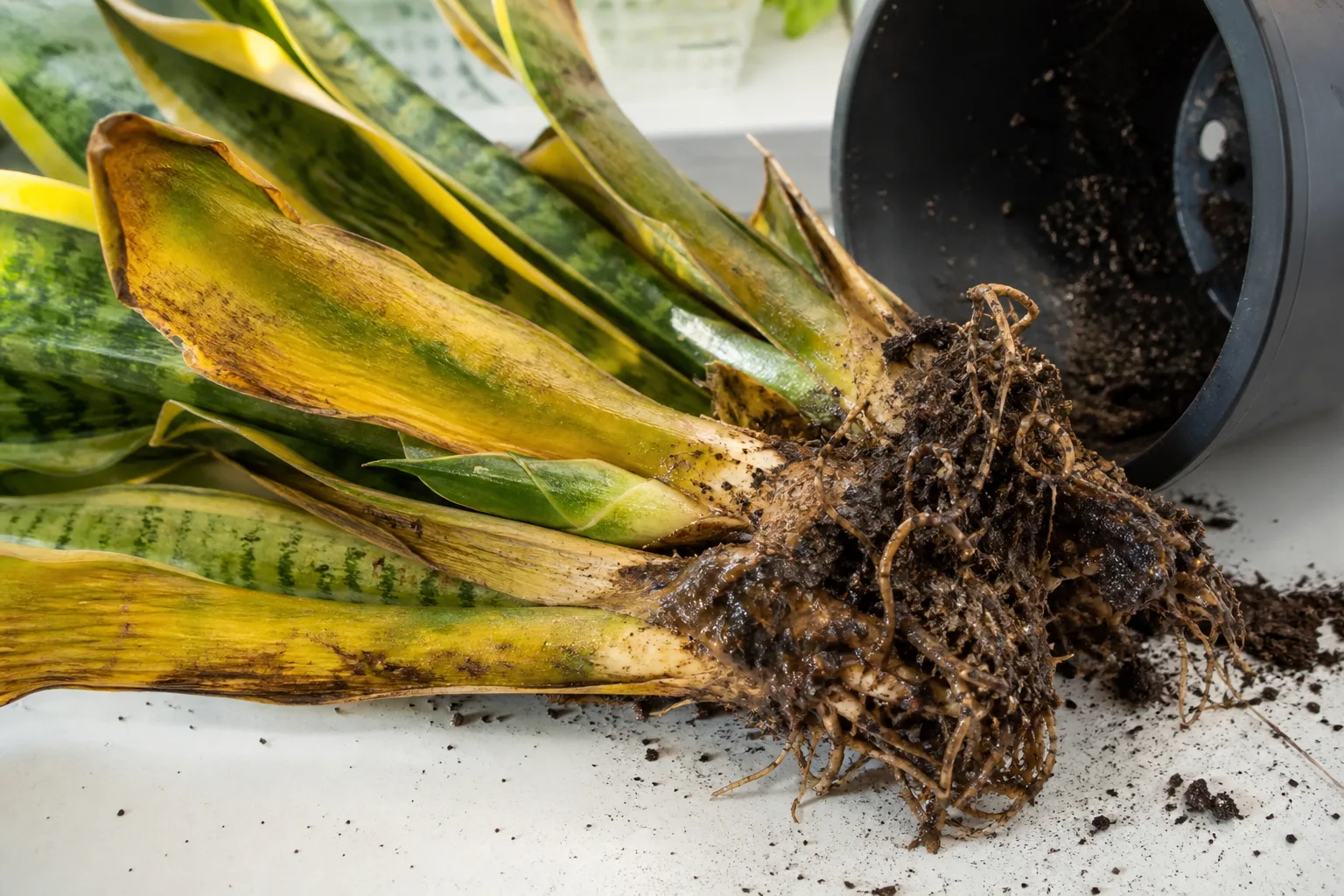
Repot in spring when possible, but do not delay if the plant is actively rotting, the pot has failed, or roots are forcing it apart. Slide the plant out without pulling on the leaves, brush away enough mix to see the rhizomes, and separate healthy firm tissue from dark, mushy tissue. Trim damaged roots with a clean blade, discard contaminated mix, and use a clean pot.
Set the plant at its old depth. Do not bury the crown to steady a floppy plant, and do not pack the mix hard around the leaf bases. After significant root surgery, let cuts dry in a warm, bright place for a day or two, then pot into dry or only barely damp mix and wait several days before a cautious watering.
When a Snake Plant Actually Needs Repotting
Repot because the root system or pot is limiting the plant, not because a calendar says the time has come. Look for a tight mass of pups, roots escaping from the hole, a cracked or bulging container, a plant that repeatedly tips over, or a mix that has compacted and stays wet. Slow growth by itself is weak evidence because low light and winter naturally slow this plant.
Being slightly root-bound is not an emergency. A snug pot can dry more predictably and support a fuller clump. If roots are healthy and the plant is stable, refresh the top layer or leave it alone. If the pot is much too large, down-potting into a container that matches the root mass may be safer than moving into an even larger decorative planter.
Propagate by Division or Leaf Cutting
Snake plants can be multiplied by separating pups, cutting rhizomes, or rooting leaf sections in water or soil. Choose a healthy parent plant and work during active growth when possible. Propagating a plant with rot or an active pest infestation spreads a problem and gives the cutting poor odds.
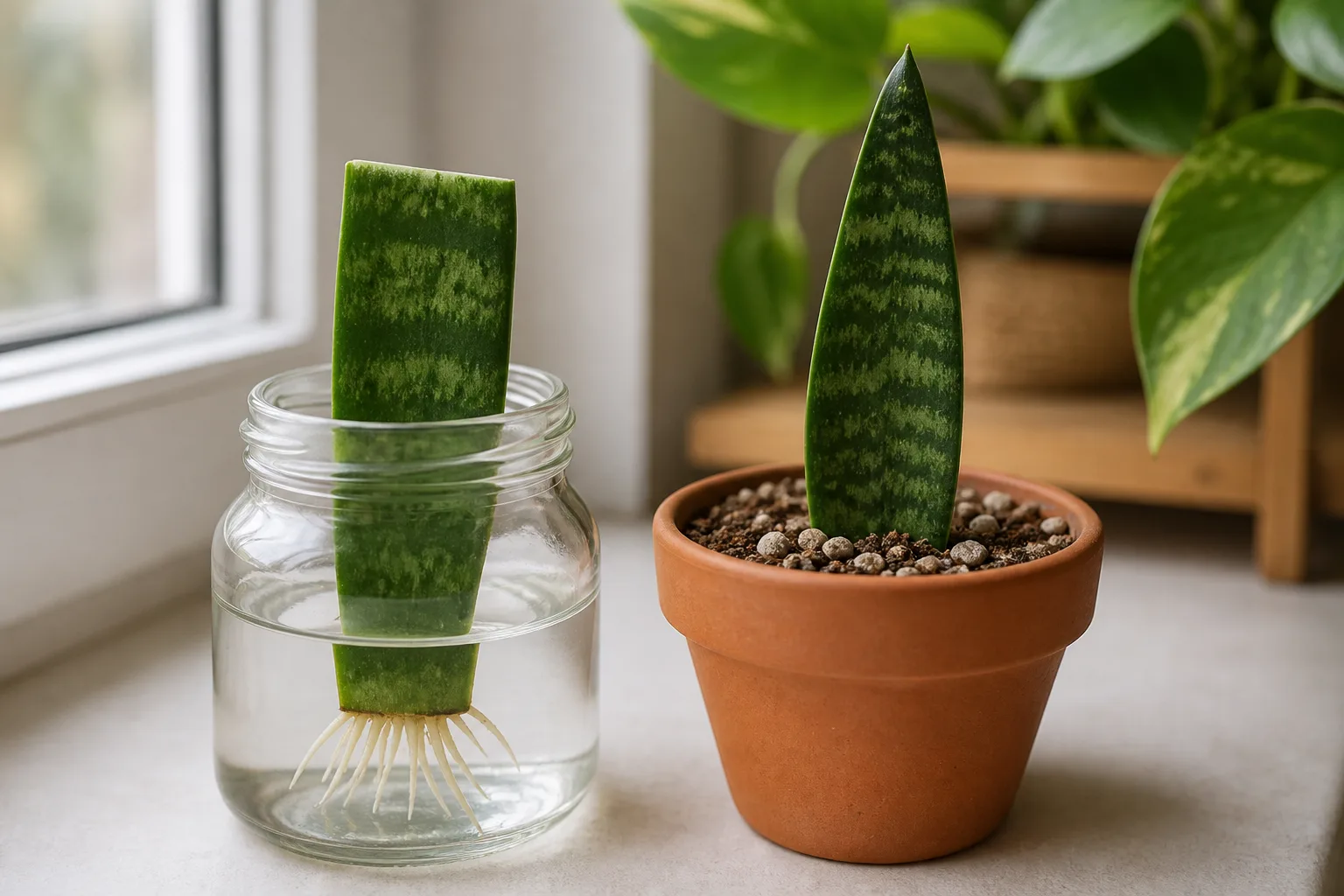
The choice is simple: use division when you want the fastest, most predictable new plant; use leaf cuttings when there are no usable pups or you want several experiments from one leaf. Water propagation is easy to observe but creates a transition into potting mix later. Soil propagation avoids that transition but hides the roots and must stay lightly, evenly—not constantly—moist.
Division Is the Fastest, Most Predictable Method
Unpot the crowded plant and brush away mix until you can see the rhizomes and roots. Separate a pup or clump only when it carries a piece of rhizome and, ideally, its own roots. A division with leaves but no viable base may sit for a long time or rot before it can reestablish.
Use a clean sharp knife to make the cut, let the cut surface dry for about a day if it is large, and pot the division in a small container of fast-draining mix. Keep the plant in bright indirect light, avoid deep shade while it roots, and do not compensate for root disturbance with frequent watering. Savvy Gardening’s division method likewise emphasizes rooted pups, spring or summer growth, clean tools, and restrained removal from the parent clump. (Savvy Gardening division guide)
Division is also the correct choice when you want to preserve a yellow-edged or patterned cultivar. The new plant already contains the parent’s growing tissue, so its foliage is much more likely to keep the cultivar’s traits.
Leaf Cuttings Are Slower but Flexible
Cut a firm, healthy leaf near its base and divide it into sections about 3–4 inches long. Mark the bottom of every section immediately; a piece planted upside down may fail. Let the cut ends callus in a dry, shaded spot for a few days.
For water propagation, place only the bottom portion in clean water and keep the rest of the leaf above the surface. Change the water weekly or whenever it becomes cloudy, provide bright indirect light, and move the cutting to gritty mix after roots form. For soil propagation, insert the bottom third into lightly damp mix and keep the pot warm, bright, and never saturated. Rooting and pup formation can take weeks to months, so do not tug on a cutting every day to check it.
The main trade-off is variegation. Leaf cuttings from yellow-margined cultivars often produce plain green plants because the cutting does not reliably recreate the patterned growing tissue. If keeping the cultivar matters, divide a pup that already shows the pattern. Epic Gardening and Savvy Gardening both describe leaf cuttings as workable but slower than division, with careful orientation and restrained moisture especially important. (Epic Gardening propagation guidance)
Choose a Snake Plant Variety
Standard green forms are the most forgiving choice for a dim room because they can remain attractive with less light, though they still need enough light to grow. ‘Laurentii’ has yellow margins and needs a brighter position to keep strong contrast. ‘Moonshine’ has silvery leaves that can look washed out in deep shade, while ‘Hahnii’ types form a compact rosette suited to a shelf or desk.
Other common cultivars include ‘Bantel’s Sensation’ with narrow white striping, ‘Black Gold’ with dark leaves and gold edges, and ‘Twisted Sister’ with arching, twisted foliage. The cultivar changes the silhouette and light sensitivity more than it changes the basic care: all need a drainage hole, a fast-drying mix, and a watering decision based on soil rather than a fixed date.
Snake plant leaves do not branch from a cut tip. If a leaf is damaged, yellowing beyond recovery, or collapsing at the base, remove the entire leaf as close to the soil line as possible with a clean blade. Cutting only the brown tip leaves a blunt scar and does not make the leaf resume growth.
Remove dead leaves and loose soil from the crown, then wipe dust from both sides of firm leaves with a barely damp cloth. Avoid oils, heavy leaf-shine products, and repeated wetting of the crown. Pruning is for hygiene, shape, and removal of compromised tissue; it will not create new growth in a plant that lacks usable light or healthy roots.
Troubleshoot Yellow, Brown, Wrinkled, or Drooping Leaves
Read the pattern before changing care. One old lower leaf turning yellow while the rest of the plant stays firm can be normal aging. Several yellow leaves with soft bases, wet mix, or a sour smell point to a water-and-root problem. Pale leaves throughout a dim plant point more toward insufficient light, while bleached patches on the window side after a move point toward sun stress.
Brown tips on firm leaves can follow a long dry spell, salt buildup, fertilizer excess, very dry air, or a damaged root system. Check moisture and the pot before assuming humidity is the sole cause. Flush accumulated salts only through a pot with a functioning drainage hole, then allow the mix to dry again; do not keep watering a plant whose roots are already wet.
Wrinkled leaves with bone-dry mix usually need one thorough watering, followed by a better drying check. Wrinkled leaves in wet mix are more worrying: the roots may be damaged and unable to move water into the leaves. Drooping or flopping can also follow low light, a crowded clump, a weakened crown, or an oversized pot. The first step is always to inspect the mix and the leaf base, not to add both water and fertilizer.
If the lower leaves are translucent, mushy, or detaching from the crown, unpot the plant. Firm roots and rhizomes can be repotted; black or mushy tissue needs to be removed before fresh dry mix goes in. A plant with extensive crown rot may not be recoverable as a whole, but a firm, clean leaf section can sometimes be treated as a separate propagation attempt.
Manage Pests Before They Spread
Inspect new plants before placing them beside your collection and isolate them for about two weeks when practical. Mealybugs look like white cottony clusters in leaf bases; scale looks like hard bumps; spider mites can leave fine webbing and stippled foliage; thrips can distort new growth. Fungus gnats are a moisture clue as much as an insect problem, because their larvae thrive when the surface stays wet.
Start with containment and confirmation. Move the affected plant away from others, check leaf undersides and the crown, and remove visible pests with a cotton swab or a gentle rinse that does not leave the soil waterlogged. Repeat inspections because one cleaning rarely catches eggs or hidden insects. If you use a labeled insecticidal product, follow that product’s directions, test a small area first, and keep treated foliage away from pets and children.
Do not treat every brown mark as a pest, and do not use repeated sprays on a plant that is actually sunburned or rotting. The correct order is diagnosis, isolation, a low-risk physical cleanup, then a labeled treatment if needed. A healthy, well-lit plant in a fast-draining mix is easier to monitor and recover than one already stressed by wet roots.
Keep Snake Plants Away From Pets
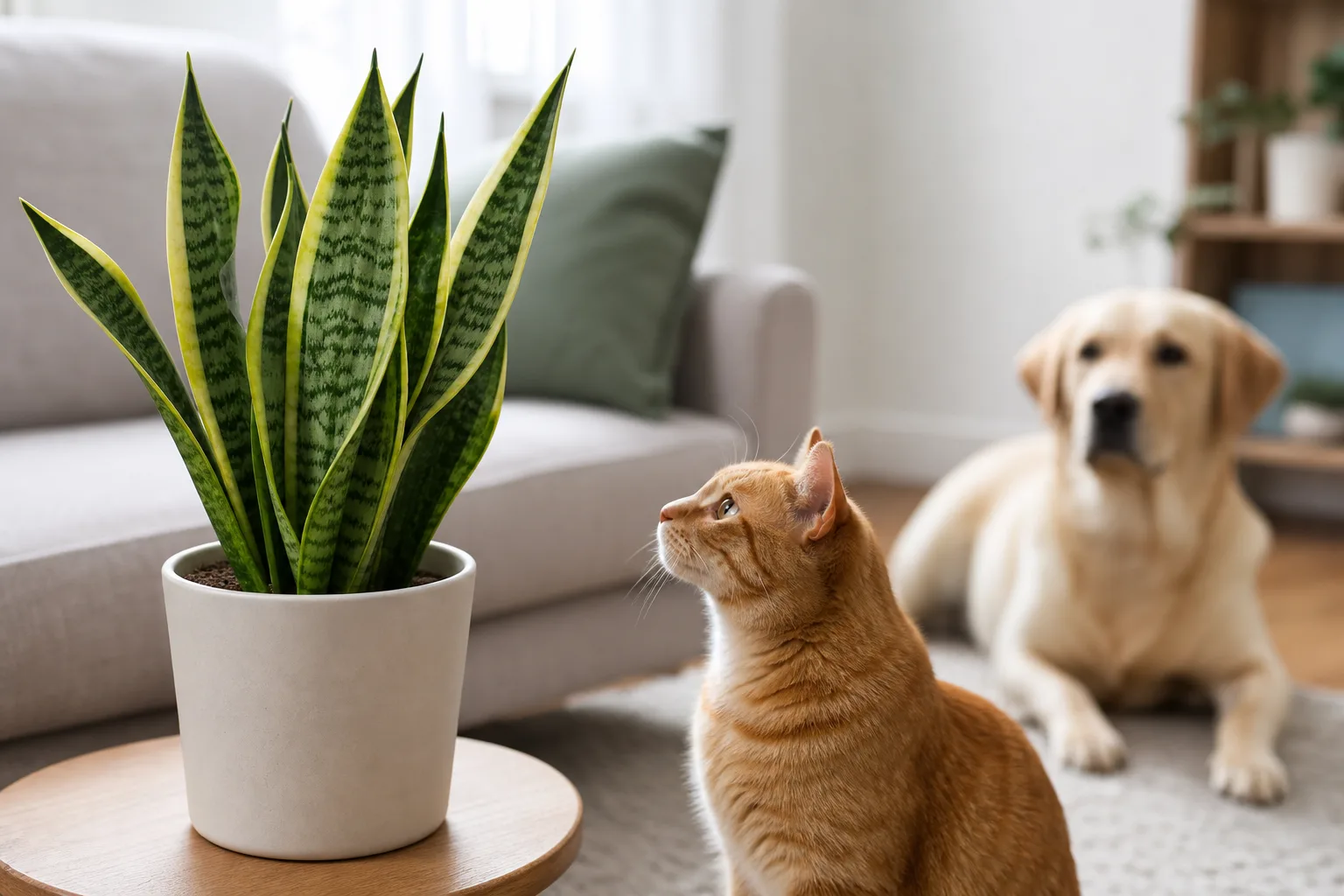
The ASPCA lists snake plant under its older scientific name, Sansevieria trifasciata, as toxic to dogs and cats. The toxic principles are saponins, and reported clinical signs include nausea, vomiting, and diarrhea. (ASPCA Animal Poison Control) NC State Extension also identifies saponins and lists the leaves, stems, roots, flowers, fruit, and sap among the plant parts of concern. (NC State Extension)
This is an ingestion risk, so placement is the practical control. Use a stable high shelf only if the pet cannot climb to it, or keep the plant in a closed room. A floor pot is a poor choice for a puppy or cat that chews foliage. If you suspect ingestion, remove access to the plant, note what was eaten if you can do so safely, and contact your veterinarian or ASPCA Poison Control at (888) 426-4435. Do not induce vomiting unless a veterinary professional tells you to.
Set Realistic Expectations About Blooms and Air Quality
Snake plants can produce fragrant, pale flowers on a stalk, but indoor blooming is uncommon and not a useful measure of whether your care is correct. Bright enough light, maturity, and a slightly snug root system may coincide with flowering, but stressing the plant with drought or root restriction is not a reliable bloom strategy. Grow it for dependable foliage first.
You may also see claims that a snake plant will purify a bedroom. NASA’s technical report describes foliage plants and root systems removing trace pollutants under controlled conditions in tightly sealed environments. (NASA Technical Reports Server) That research does not mean one decorative pot replaces ventilation, source control, or a properly sized air cleaner in a normal home, where air is constantly exchanged and pollutants are not added in the same controlled way.
Conclusion
The reliable formula for snake plant care is simple but not careless: give the plant bright indirect light when you want growth, use fast-draining mix in a pot with a drainage hole, and water deeply only after the root zone has dried. Keep the pot snug rather than oversized, repot when roots or the container show a real need, and choose division when you want a new plant that keeps a variegated cultivar’s pattern.
When a snake plant looks wrong, inspect before reacting. Wet soil plus soft yellow bases calls for a root check, not more water; dry soil plus wrinkles calls for one thorough drink, not daily sips; pale growth may need light, while bleached patches need less direct sun. The plant is forgiving of neglect, but it is not forgiving of a permanently wet crown. Keep it warm, give it room to drain, and place it where pets cannot chew it, and this slow-growing houseplant can stay handsome with very little fuss.