How to Grow and Care for an American Sycamore Tree
Learn how to grow an American sycamore: plan for its wide crown and roots, water a young tree, prune safely, and recognize spring anthracnose symptoms.
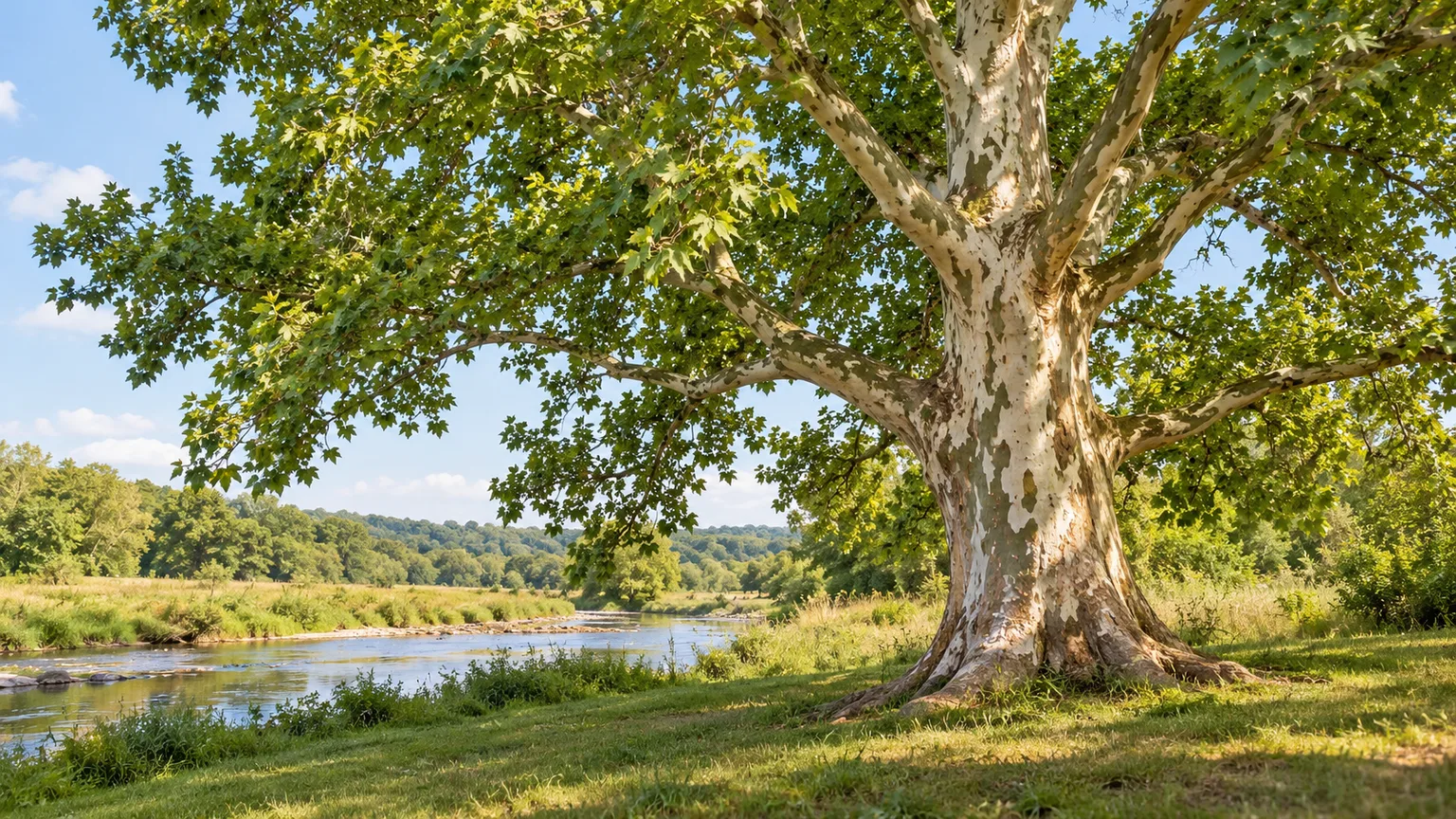
An American sycamore (Platanus occidentalis) is a fast-growing shade tree for a genuinely large site. It can reach 75 to 100 feet tall and spread about as wide, with a trunk that may become enormous; the mottled bark, broad leaves, and dangling seed balls make it easy to recognize, but those same traits bring space and cleanup demands. Decide whether you can accommodate the mature tree before buying a sapling.
Once established in the right place, a sycamore is adaptable and does not need a complicated feeding routine. The most useful care is early: plant it at the right depth, keep its root ball moist while it establishes, maintain a broad mulch ring without burying the trunk, and leave major pruning to a trained professional.
The short answer: start with site fit
The American sycamore is a good candidate for open ground, a large park-like lawn, or a broad native planting where a wide canopy and natural litter are welcome. It is a poor match for a small yard bordered by a house, driveway, sidewalk, septic field, or overhead wires. Its size is not something regular pruning can safely solve.
Before planting, check four things: room for a crown that may spread 75 to 100 feet, full sun for steady growth, soil that stays moist but does not remain waterlogged, and tolerance for falling leaves, twigs, bark flakes, and fruit balls. If one of those conditions is missing, choose a smaller shade tree that fits the site instead of planning to contain a sycamore later.
Identify the American sycamore
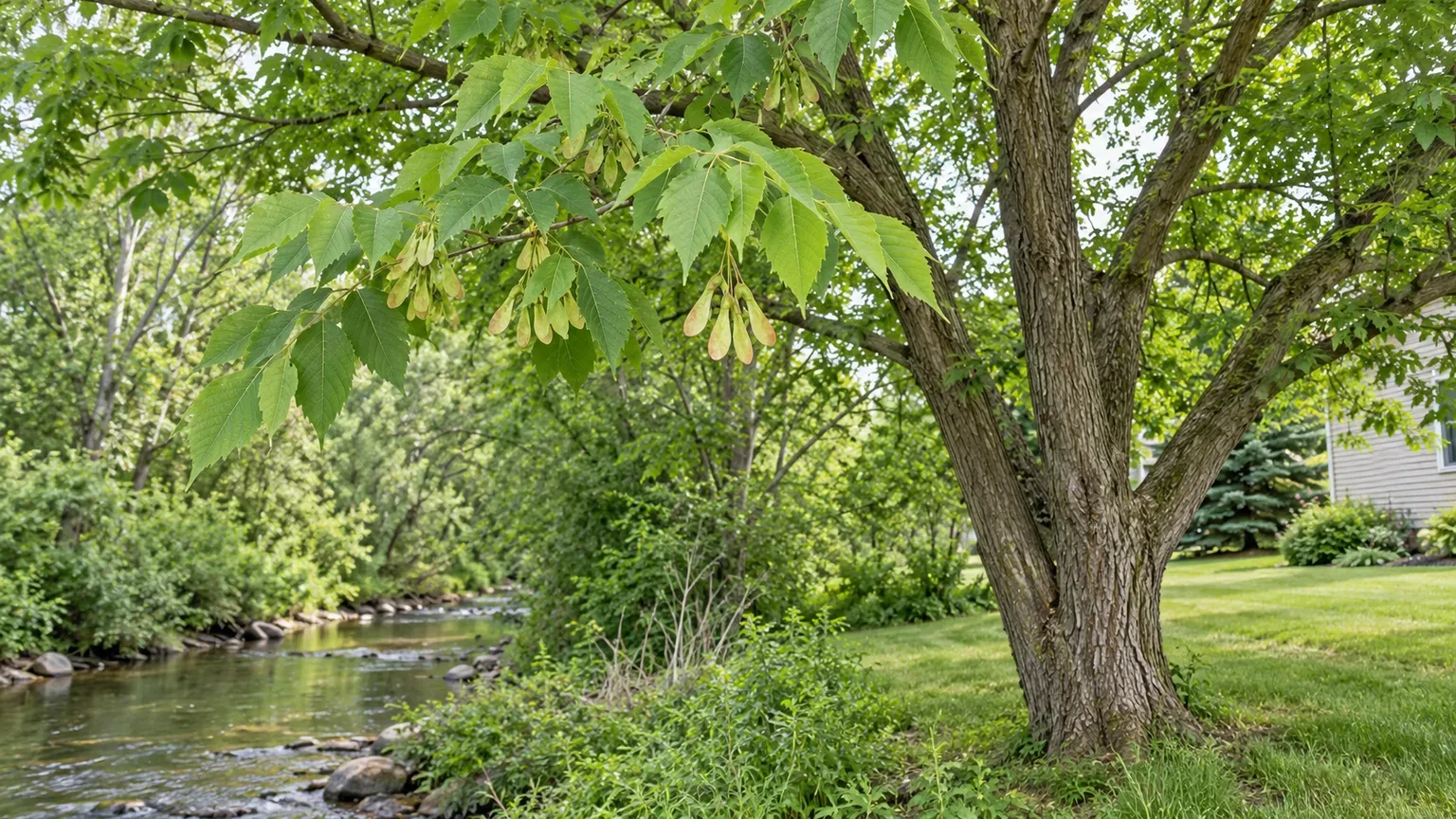
American sycamore is native to southeastern Canada and much of the central and eastern United States. A mature tree has a broad, irregular crown; leaves are large and palm-shaped, commonly with three to five coarse-toothed lobes.
The bark on older lower trunks can be gray and scaly, while the upper trunk sheds patches to reveal pale cream, greenish, or white inner bark. That peeling is a normal feature, not a sign that the trunk is dying.
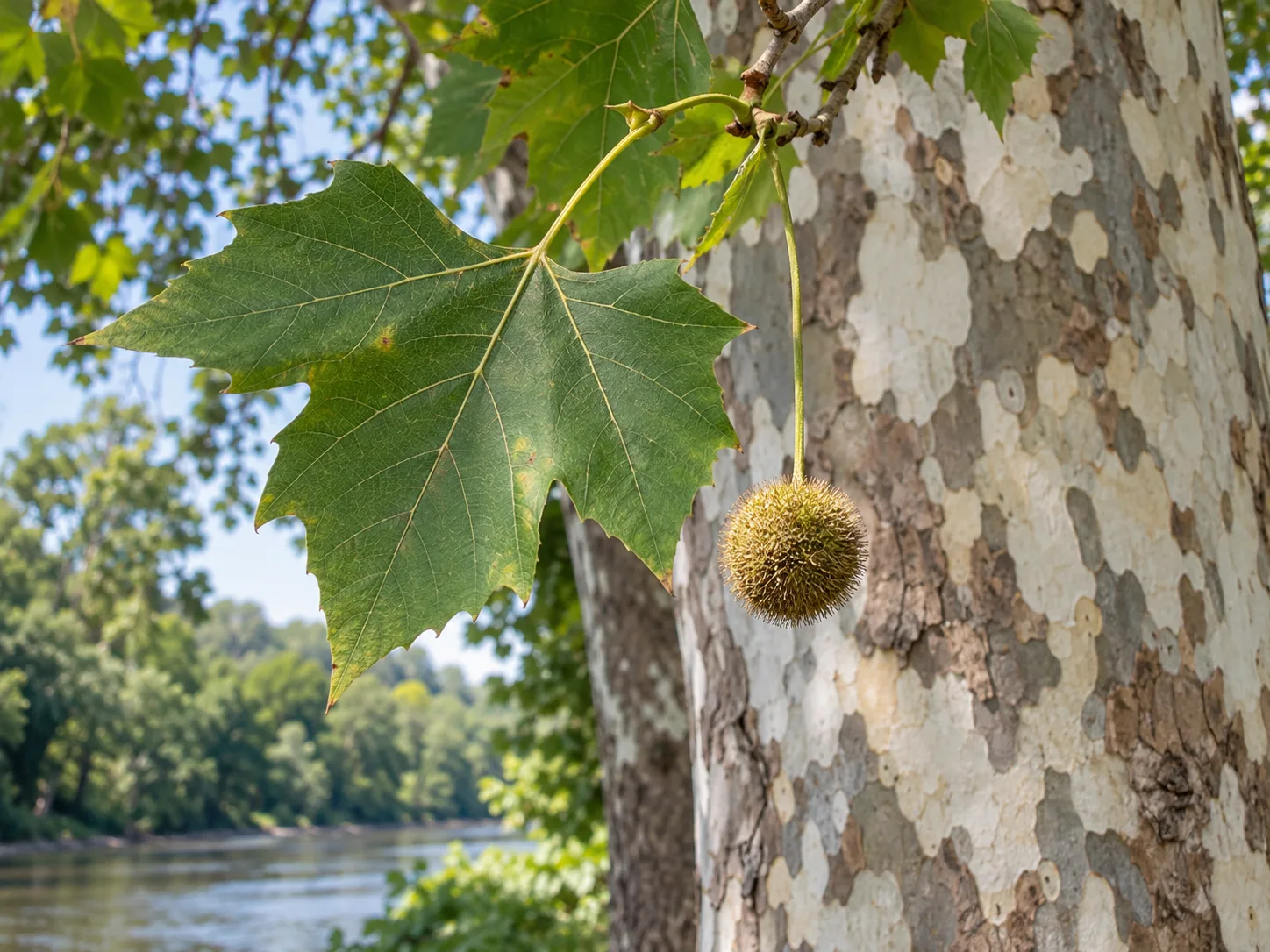
Round, fuzzy fruit heads hang from long stems and can persist into winter before breaking apart and falling. Each head carries many seeds, and the tiny hairs on dry heads or new foliage may bother people who are sensitive to airborne plant fibers; handle dry debris gently and use gloves if it irritates your skin. North Carolina State Extension’s American sycamore profile is a useful reference for its field marks, range, mature dimensions, and common landscape cautions.
Plan for the mature crown and root zone
Do not use the nursery pot’s modest size as a guide to eventual clearance. The crown can shade a large area, and broad surface roots may become more visible as the tree matures. Roots do not seek sound pipes as a target, but they can exploit existing leaks and can conflict with pavement or compacted, restricted rooting zones.
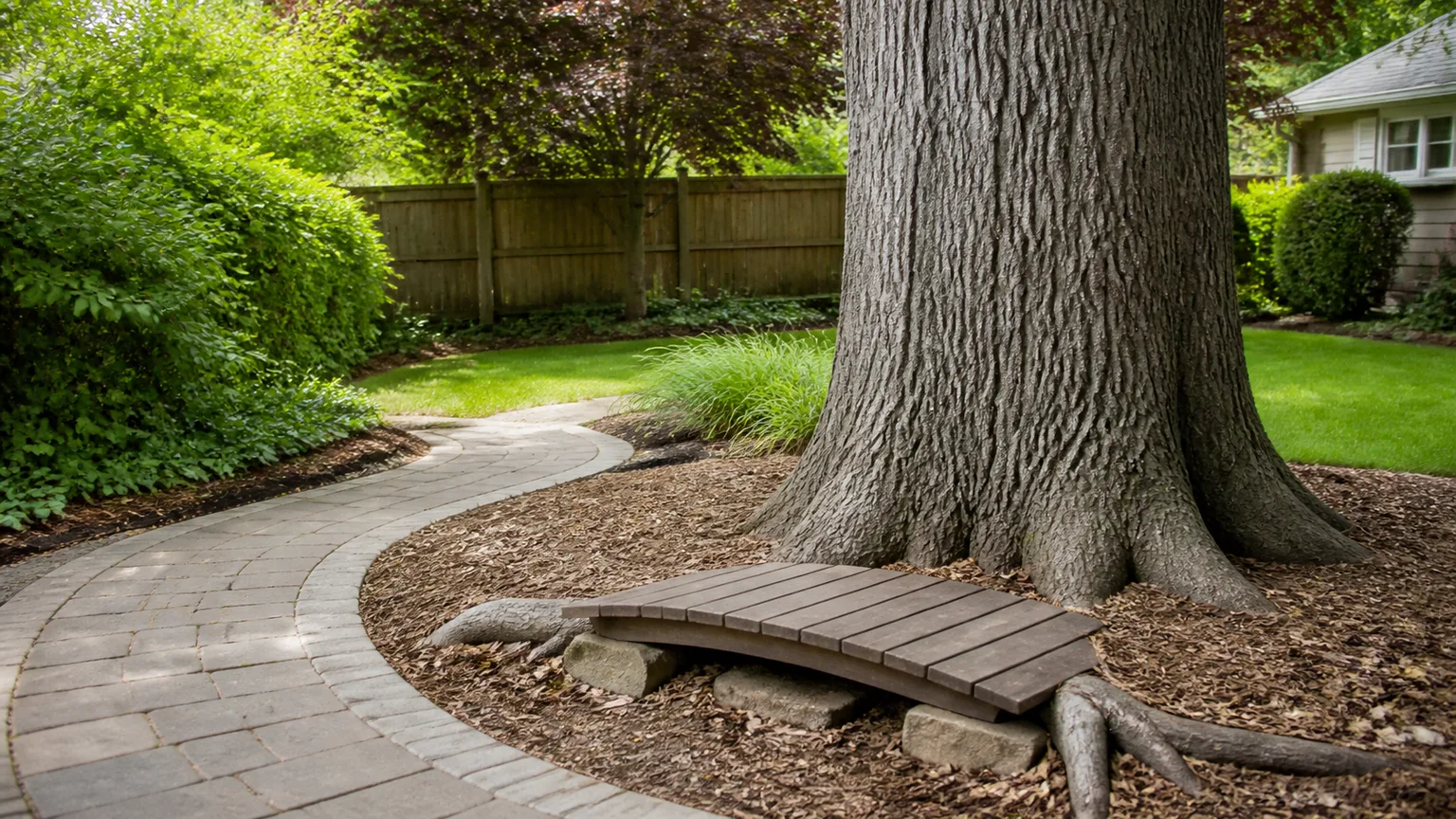
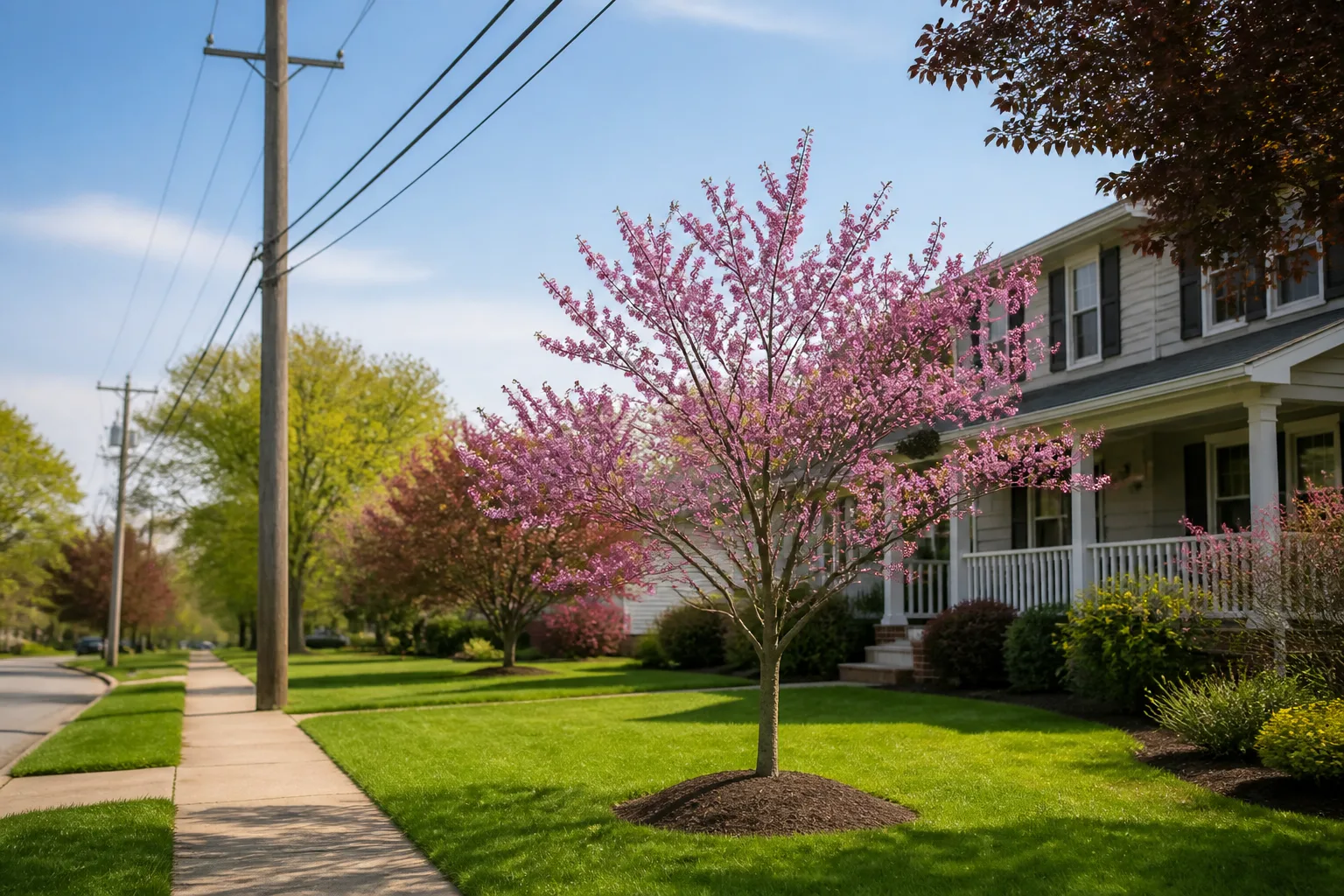
Walk the planting area and look up as well as down. Keep the tree well away from overhead utilities and give the trunk and future crown room from buildings, pavement, retaining walls, and buried services; the right setback depends on the actual site and local requirements, so use the utility-location service before digging and ask a local arborist or municipality if clearances are uncertain. The tree’s ability to tolerate urban conditions does not mean it is a good fit for every urban lot.
Give it sun and moist soil
Choose a spot with full sun when possible. American sycamore tolerates a range of soil textures and pH, and it can handle moist locations better than many landscape trees, but it grows best when roots have moisture and oxygen rather than sitting in permanently saturated soil. A stream edge or rain-garden margin may suit it if the planting area is large and water drains between wet periods.
The native range includes regions with cold winters, and horticultural references commonly place the species in USDA Zones 4 through 9. Zone is only a first screen: local heat, drought, exposure, soil, and provenance also affect establishment. For a tree intended to live for decades, a locally adapted nursery specimen and a site that matches its moisture preference matter more than trying to correct a poor site with fertilizer.
Plant with the root flare visible
Plant in spring or fall when the ground is workable and the young tree can establish without summer heat or frozen soil. For a container-grown tree, check that the root ball is not packed with circling roots; if it is badly deformed, ask the nursery for a better specimen rather than burying the problem. The trunk should widen where the first structural roots emerge, and that root flare belongs at or slightly above the finished soil line.
Dig a hole about twice as wide as the root ball, but no deeper than the root ball at its root flare. Loosen the sides so new roots can move into surrounding soil, set the tree straight, remove the container and any synthetic materials, and position the first roots so they point outward rather than wrapping around the trunk. Gardenia’s American sycamore growing guide gives similar width-and-depth planting proportions, while the University of Maryland Extension’s root-flare guidance explains why burying the flare can keep the lower trunk wet and hide girdling roots that later restrict water movement.
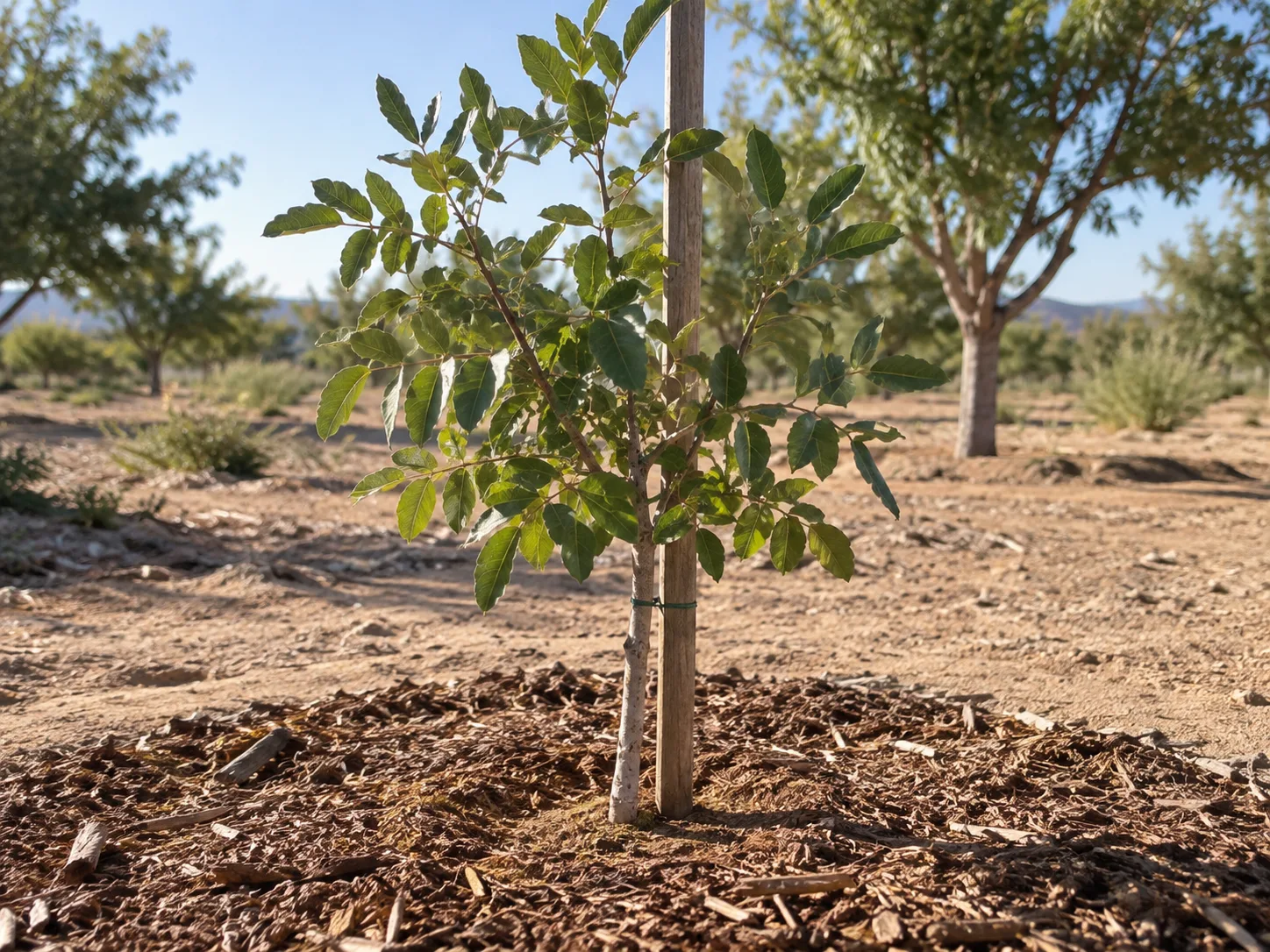
Backfill with the soil removed from the hole, breaking large clods by hand, then water slowly so soil settles around the roots. Do not pile amended soil, compost, or fertilizer under the root ball; a sudden boundary between rich backfill and native soil can discourage roots from expanding outward. If the tree needs a stake in a windy site, keep it flexible and temporary, and remove it once the tree stands securely on its own.
Water by checking the root ball
During the first growing season, check moisture inside the original root ball and just beyond it. Nursery mix can dry at a different rate from surrounding soil, so damp ground nearby does not prove the new tree’s roots have water. When the root ball begins to dry, water slowly over the root zone until moisture reaches the depth of the roots; avoid a quick surface sprinkle that wets only the mulch.
As roots spread, widen the watered area instead of pouring all the water against the trunk. Frequency changes with rainfall, temperature, wind, soil texture, and the size of the original tree, so a weekly calendar cannot replace a moisture check. Gardening Know How’s American sycamore care article likewise emphasizes deep watering for young trees and extra water during extended dry spells.
After establishment, the species has some drought tolerance, but that does not make it drought-proof. If a dry period lasts and the soil is dry several inches down, give the root zone a slow, deep soak rather than frequent shallow sprinkling. Waterlogged soil, a sunken root flare, and drought can all cause canopy stress, so look at the soil and planting depth before assuming a leaf symptom is a watering problem.
Mulch lightly and fertilize for a reason
Spread organic mulch broadly over the root zone to slow evaporation and reduce competition from turf. Keep the layer about 2 to 4 inches deep and leave a bare buffer around the trunk so the root flare and bark stay visible. Mulch should look like a wide, shallow donut, not a mound against the trunk; University of Maryland Extension describes how over-mulching can hide the flare and encourage roots to circle the stem.
A healthy sycamore in suitable soil generally does not need routine fertilizer just because it is young or growing quickly. Pale foliage or slow growth can have several causes, including drought, poor drainage, root damage, or compacted soil, so do not treat symptoms with a high-nitrogen product before checking the site. Use a soil test or local Extension recommendation to identify a real nutrient deficiency, then follow the product label and avoid feeding a drought-stressed tree.
Prune for structure, not size control
A young tree benefits from occasional structural attention while its branches are small: preserve one well-positioned central leader, remove dead or rubbing branches, and correct defects before they become large cuts. Do not strip the lower crown simply to make a sapling look like a mature shade tree; temporary lower branches add trunk growth, and pruning should remove only what the developing structure needs.
What you can handle from the ground
Use clean, sharp hand pruners or a pruning saw for small reachable branches, cutting just outside the branch collar rather than flush with the trunk. Remove a broken or dead branch promptly if you can do so safely from the ground, and avoid topping, stubbing, or cutting back every vigorous shoot. These cuts create weak regrowth or large wounds without controlling the tree’s ultimate height and spread.
When a certified arborist should take over
Call a qualified arborist for large limbs, work near power lines, a high canopy, cracks, hanging branches, or a tree whose structure has changed after a storm. Ladders and chainsaws are a poor combination for homeowners, and topping a sycamore can leave it with weakly attached shoots. If anthracnose has killed twigs, Penn State Extension advises dormant-season pruning of dead material; its sycamore disease guide describes cutting below cankers and disposing of diseased branches rather than leaving them in the canopy.
Expect roots, seed balls, and seasonal litter
Sycamore care includes cleanup. Large leaves fall in autumn, bark flakes and small twigs can shed at other times, and the spherical fruit heads drop after hanging through winter. In a low-traffic woodland edge, that litter can remain as part of the natural setting; over a walkway, patio, or pool, it may become a recurring chore.
Surface roots are not automatically a sign of poor health. Avoid repeatedly mowing over them, adding soil to bury them, or cutting large roots to reclaim lawn; major root cuts can destabilize or injure a mature tree. If roots lift a sidewalk or interfere with a drain, get an arborist’s assessment before altering them, and consider whether the tree’s size is compatible with the hardscape over the long term.
Read spring leaf problems accurately
Sycamore leaf symptoms can look dramatic, especially after a cool, wet spring, but a bare-looking branch does not identify the cause by itself. Look at timing, which leaves are affected, and whether the problem is widespread or concentrated on one branch. Those clues help distinguish a seasonal fungal disease from drought, root injury, or a more serious vascular problem.
Recognize anthracnose
Sycamore anthracnose is most conspicuous during cool, wet spring weather, when emerging leaves may turn brown, crinkle, or develop dead areas along veins and margins. The disease can also blight young shoots and cause early leaf drop; Penn State Extension documents these symptoms and notes that affected trees can push new foliage after the early-season loss. A healthy mature tree may recover its canopy, so a single spring episode is not by itself a reason to apply fungicide.
Rake or remove heavily infected fallen twigs and leaves when practical, and prune clearly dead twigs during dormancy rather than shearing healthy growth in summer. Do not expect sanitation alone to prevent every recurrence, because weather and susceptibility affect infection. If repeated defoliation, branch dieback, or a declining crown continues, have an arborist or Extension diagnostician identify the problem before considering treatment; Virginia Cooperative Extension notes that some London plane cultivars show better anthracnose resistance than American sycamore, but those are different trees, not guaranteed fixes for a sycamore already in place.
Check other causes of browning
Brown margins that begin on older leaves later in summer can have causes beyond spring anthracnose, including drought stress and bacterial leaf scorch. Penn State Extension describes bacterial leaf scorch as beginning on older foliage, often on only a few inner or lower branches, and expanding over time; that pattern calls for a closer diagnosis rather than repeated fungicide applications.
Check soil moisture, trunk flare, recent construction, mower injury, and whether symptoms follow one branch or the whole crown. A tree with small leaves, delayed spring growth, progressive dieback, or large cankers deserves professional assessment, particularly if the trunk or major limbs are near people or buildings. Avoid pruning suspect branches or moving tools between trees until you understand the issue; some canker diseases can spread on contaminated equipment.
Monitor pests without spraying by default
American sycamores can host lace bugs, scales, borers, leaf beetles, caterpillars, and mites. A few insects or stippled leaves do not necessarily threaten a large established tree, and broad-spectrum sprays can remove beneficial insects while missing pests sheltered on leaf undersides or in bark. Inspect the affected foliage, look for insects or cast skins, and note whether damage is local or progressing through the crown.
Keep the tree’s root zone healthy and avoid mechanical damage, then ask a local Extension office or arborist to identify a serious or persistent infestation. Treatment depends on the pest, its life stage, and the tree’s value; a product that is safe for a small ornamental shrub may be impractical or unsafe to apply to a tall sycamore. Never spray a mature canopy from a ladder or apply a pesticide without checking its label and the site restrictions.
Grow a sycamore from seed
American sycamore is commonly propagated from seed, while a named cultivar needs vegetative propagation to retain its traits. The fuzzy fruit heads contain many seeds and can self-sow where soil is exposed. For a small batch, separate achenes from a mature fruit head with gloves, sow them about a quarter-inch deep in moist seed-starting mix, and keep the container bright and evenly damp rather than saturated; Gardenia notes that overwintered seeds planted in spring can germinate promptly, though seedling vigor and timing vary.
For most homeowners, buying a healthy nursery tree is more predictable than raising one from a seed ball. A seedling may take years to become a substantial shade tree, and it will not necessarily match a selected cultivar’s growth or appearance. Choose the species only after settling the site question, because propagation does not make the mature tree smaller.
Let a hardy tree rest through winter
An established American sycamore is cold-hardy across much of its range and does not need a winter wrapping routine. The tree’s pale, patchwork upper trunk becomes more visible after leaf fall, while seed balls remain on the branches. Do not peel bark, tie branches tightly, or pile mulch around the trunk to prepare for cold weather.
For a newly planted tree, keep watering during dry autumn weather until the soil freezes, protect the trunk from mower and string-trimmer injury, and check that stakes or ties are not cutting into the bark. If snow or ice breaks a major limb, leave work above shoulder height to an arborist. Healthy structure and a visible root flare matter more than winter fertilizer or a protective mulch mound.
Sort out sycamore, London plane, and sycamore maple
The name “sycamore” refers to different trees in different regions. In North America it usually means American sycamore, Platanus occidentalis; the sycamore maple is Acer pseudoplatanus, a maple, while London plane is the hybrid Platanus × acerifolia. Their leaves and mottled bark can look similar, so check the botanical name on a nursery label before choosing a tree.
That distinction matters when reading about cultivar resistance. Virginia Tech’s landscape tree recommendations describe London plane cultivars such as ‘Bloodgood,’ ‘Columbia,’ and ‘Liberty’ as more resistant to anthracnose than American sycamore. If a disease-resistant urban shade tree is the main goal, ask a local arborist or nursery which tree performs well in your region, and weigh its eventual size and litter along with disease resistance.
The American sycamore cultivar ‘Howard’ is listed by North Carolina State Extension, but a cultivar name does not change the species’ need for generous space. Gardenia’s American sycamore profile summarizes its large spread, wildlife use, and landscape character; use such descriptions as a starting point and verify local performance with regional Extension guidance.
Conclusion
Grow an American sycamore where its 75- to 100-foot canopy, expansive roots, and steady litter are welcome. Give it full sun, moist but aerated soil, a visible root flare, steady water while it establishes, and enough unpaved ground to support the mature tree.
After planting, keep care simple: inspect the root zone, mulch broadly without touching the trunk, prune only for sound structure, and watch for spring anthracnose without treating every brown leaf as a crisis. If the site is tight, utility lines cross the crown, or roots and cleanup would conflict with daily use, choose a smaller tree before planting.