12 Best Concrete Crack Fillers for Driveways and Walls
Find the best concrete crack filler for driveways, walls, foundations, hairline cracks, leaks, and wide gaps—plus prep steps and repair limits.
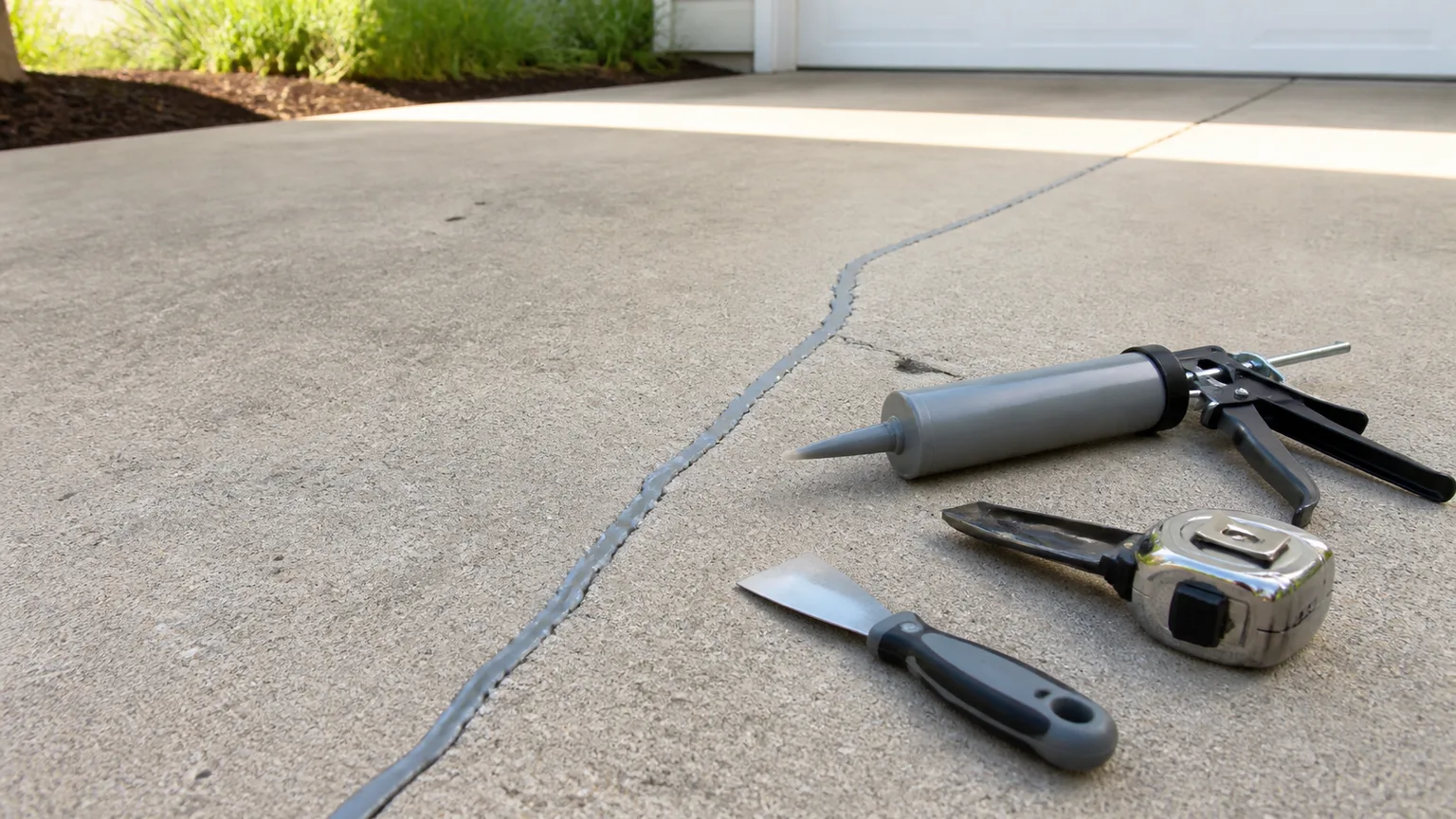
A concrete crack filler is only “best” when it matches the crack in front of you. A thin, stable line in a garage floor needs a different material from a deep hole in a step, a moving driveway joint, or a foundation wall that is admitting water.
The shortlist below covers those jobs without pretending one tube can solve every concrete problem. Measure the crack and identify the surface before using the comparison table. If concrete has shifted, is sinking, or is part of a potentially compromised foundation, arrange an inspection.
Start With the Crack, Not the Product Label
The most useful product categories are based on what the repair has to do. Flexible polyurethane or latex sealants are suited to cracks that open and close slightly. Self-leveling sealants spread across flat horizontal surfaces. Acrylic patches and epoxy compounds fill wider voids or damaged edges, while hydraulic cement is designed for fast-setting patches and some active water leaks.
A concrete crack may be a moving joint, settlement gap, surface shrinkage crack, or symptom of water pressure or structural movement. Filling the opening without dealing with the cause can make the repair look finished while the same crack returns beside it.
Match Width and Depth Before You Shop
Measure the widest point of the crack with a ruler or a simple crack-width card. Do not judge by the narrowest section, and do not assume a hairline crack is shallow; some cracks widen below the surface. Record the approximate depth too, because a product rated for a wide surface opening may still require backer material or multiple lifts in a deep void.
As a starting point, use a liquid or hairline filler for cracks up to about 1/8 inch, a caulk or flexible sealant for many cracks from 1/8 to 1/2 inch, and a patching compound for larger gaps, spalls, and broken corners. Those are selection ranges, not universal permissions. The package’s maximum width, depth, and layer thickness control the actual repair.
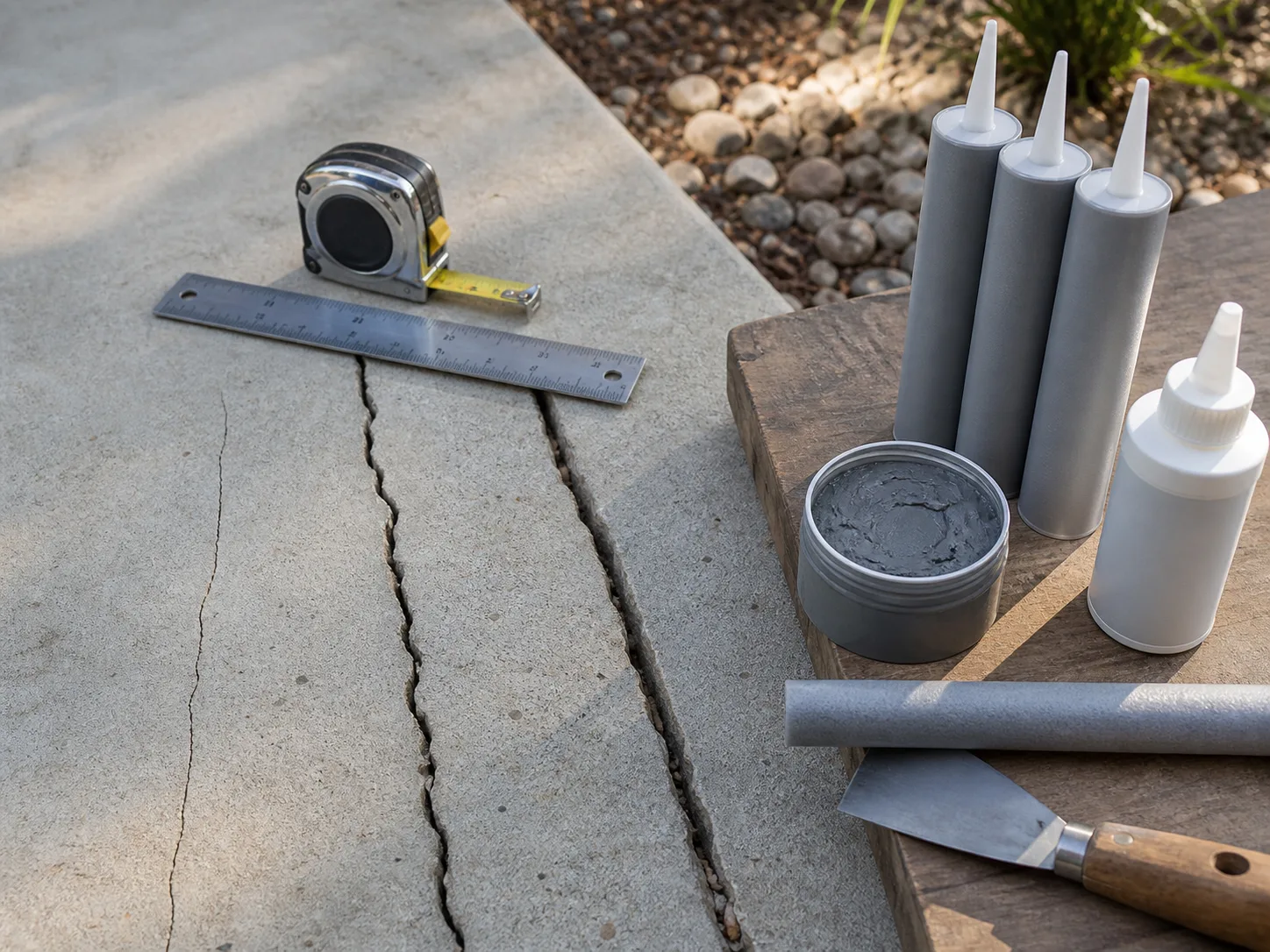
Depth changes the job. A deep crack should not automatically be packed solid with expensive sealant. If the product allows it, use a compatible closed-cell backer rod or clean, dry sand to reduce the depth and give the sealant a stable shape. Keep the filler itself within the manufacturer’s maximum lift or bead thickness; thick material can skin over while the center remains soft.
Match the Filler to the Surface and Its Movement
Look at the repair from the side. A self-leveling product is meant to flow across a flat horizontal surface such as a slab, driveway, garage floor, walkway, or patio. It can run off a slope and will slump on a wall. A non-sag sealant, acrylic patch, or trowel-grade compound is better when the crack is vertical or overhead, provided the label allows that orientation.
Next, decide whether the concrete moves. Driveways and exterior slabs expand and contract with temperature, and a crack affected by settlement or freeze-thaw movement needs some ability to stretch. A rigid patch can be strong in a stable void but may pull away or fracture when the two sides shift. Flexible products tolerate limited movement; they cannot stabilize a sinking slab or bridge an actively widening structural crack.
Moisture is a separate question from movement. Some formulations tolerate damp concrete after flowing water has stopped, while others require a clean, dry surface. A waterproof label also does not mean the product is suitable for continuous submersion, a swimming-pool shell, or a leaking foundation. Treat those conditions as product-specific and read the current technical sheet before application; for example, compare the limits in Sika’s self-leveling sealant instructions with the instructions for the product you actually buy.
Know When a Filler Is the Wrong Repair
Concrete fillers repair a gap; they do not correct poor drainage, soil settlement, frost heave, tree-root pressure, a failed footing, or a slab that is moving independently on each side of the crack. They are most appropriate when the surrounding concrete is sound, the crack is within the product’s size range, and the movement is limited enough for the formulation to accommodate.
Do not use a shopping-list recommendation as a structural diagnosis. A crack in a decorative patio may be a manageable water-sealing job, while a similar-looking crack in a foundation wall may need a professional assessment before any injection or patching. Persistent moisture also deserves attention to grading, gutters, downspouts, and drainage rather than a thicker bead of sealant.
Red Flags on Foundations, Walls, and Slabs
Call a qualified concrete or foundation professional when the crack is rapidly widening, has visible vertical displacement, makes one side of a slab higher than the other, or keeps reopening after a careful repair. Diagonal or stair-step cracks in masonry, cracks that continue through a foundation wall, large areas of spalling, and water that returns under pressure are also poor candidates for a casual filler repair.
The same applies when doors or windows near a foundation bind, floors slope, walls bow, or a crack appears alongside significant settlement. If a crack is part of a load-bearing wall, column, beam, footing, or structural slab, the material choice is secondary to finding out why it formed. A foundation kit may stop a leak in a suitable nonstructural crack; it should not be used to hide movement that needs engineering or building repair.
The 12 Best Concrete Crack Fillers at a Glance
| Pick | Best use | Material or behavior | Surface and application | Main limitation |
|---|---|---|---|---|
| Sika Sikaflex Pro Select Self-Leveling Sealant | Overall flat-slab repair | Flexible polyurethane, self-leveling | Horizontal; caulk gun | Runs on slopes and is slow to fully cure |
| DAP Liquid Cement Crack Filler | Fast small-crack filling | Flowable latex-based filler | Flat horizontal surfaces; squeeze bottle | Not for walls; thickens in cold conditions |
| Sika Sikacryl Pro Select Ready-Mix Concrete Patch | Wide cracks and spalling | Ready-mix acrylic patch | Horizontal or vertical; trowel | Not intended for vehicle-traffic surfaces |
| Rust-Oleum Concrete Patch & Repair | Durable stable voids | Two-part epoxy compound | Many concrete surfaces; trowel or putty knife | Requires mixing and has limited working time |
| Latex-Ite Pli-Stix Driveway Crack & Joint Filler | Driveway cracks | Heat-melted thermoplastic rubber | Dry horizontal pavement; heat tool | Black finish and open-flame or heat-tool risk |
| RadonSeal Concrete Foundation Crack Repair Kit | Suitable basement-wall water paths | Polyurethane injection system | Foundation or basement wall; injection ports | Complex and inappropriate for structural diagnosis |
| Sika Sikaflex Crack Flex Sealant | Flexible horizontal sealing | Textured polyurethane | Horizontal; caulk gun | Not for vertical cracks |
| DAP Concrete Siliconized Filler & Sealant | Small indoor or outdoor gaps | Flexible siliconized sealant | Horizontal or vertical; caulk gun | Long full-cure time; not continuous submersion |
| Quikrete Self-Leveling Sealant | Traffic-rated flat cracks | Flexible polyurethane, self-leveling | Horizontal; caulk gun | Slumps on slopes and needs extended cure |
| DRYLOK Fast Plug Hydraulic Cement | Fast water-stop patching | Quick-setting hydraulic cement | Horizontal or vertical; mix and trowel | Too fast for leisurely work and poor for thin moving cracks |
| Sashco Slab Concrete Crack Repair Sealant | Wide moving slab cracks | Highly flexible latex sealant | Horizontal; caulk gun | Needs tooling and a long cure |
| Bluestar Flexible Concrete Hairline Crack Filler | Very thin cracks | Flowable flexible filler | Dry horizontal surface; squeeze bottle | Limited width and no vertical application |
The 12 Picks, With the Right Use Case for Each
These are use-case recommendations, not a claim that one brand is superior in every climate or on every slab. Product packaging, technical sheets, and local conditions can change, so confirm the current width, depth, temperature, moisture, traffic, and cure requirements before opening the container.
1. Sika Sikaflex Pro Select Self-Leveling Sealant — best overall for a flat outdoor slab. This polyurethane sealant is a strong fit when you want a flexible, self-leveling bead in a horizontal crack on a driveway, walkway, patio, or garage floor. It is especially useful when a repair needs to tolerate weather and modest thermal movement, and its flow means you can finish the surface without extensive tooling.
The trade-off is that it is runny while being applied. Keep it on a truly flat surface, go slowly, and use compatible backer material in a deep crack rather than filling a deep void with one heavy pour. Treat the full cure window—not the dry-to-touch time—as the point when the surface can take traffic.
2. DAP Liquid Cement Crack Filler — best for small flat cracks without a caulk gun. The squeeze bottle makes this flowable latex-based filler approachable for a homeowner repairing narrow cracks in a driveway, walkway, step tread, or basement floor. It can settle into fine openings without a separate applicator, but the tip must be trimmed carefully so the bead does not flood the surface.
This is a horizontal-surface product. It can thicken in cold conditions, and a small crack still needs cleaning before the liquid goes in. Warm the container only as the label permits; do not improvise heat or apply it to a damp surface when the instructions call for dry concrete.
3. Sika Sikacryl Pro Select Ready-Mix Concrete Patch — best for wide cracks, chips, and spalling outside vehicle lanes. A ready-mixed acrylic patch is more appropriate than a watery sealer when concrete has a broad gap, flaked edge, shallow hole, or damaged masonry area. Its textured finish can blend better than a smooth caulk on stairs, walls, stoops, and protected exterior surfaces.
Apply it in thin layers when the void exceeds the stated thickness. The patch is convenient because it needs no mixing, but convenience does not make it a driveway repair; vehicle traffic and repeated flexing can exceed its intended use. Let each layer cure as directed before adding another.
4. Rust-Oleum Concrete Patch & Repair — best for a durable, stable repair that justifies two-part mixing. Epoxy is useful for a sound, relatively stable crack or small hole where adhesion and hardness matter more than high flexibility. This type of compound can be troweled or knifed into concrete, then sanded or painted after its full cure if the finish matters.
The hard part is the clock. Mix the base and activator in the stated ratio, prepare all tools first, and use only what you can place within the working time. Epoxy is not a structural cure for a moving slab, and a two-part product is a poor choice when you cannot control the temperature, cleanliness, or mixing accuracy.
5. Latex-Ite Pli-Stix Driveway Crack & Joint Filler — best for a dry driveway when a heat-melted rope fits the repair. This thermoplastic rubber filler is pressed into a narrow driveway crack and melted so it forms a flexible, watertight seal. It can be attractive for long, repetitive horizontal cracks where a cartridge would be slow and a quick return to traffic matters.
It is black, so the repair will remain visible on gray concrete. The heat step also changes the safety profile: clear away dry grass, leaves, solvents, wood, and other combustibles; use the tool exactly as directed; and avoid a torch when the setting or your experience makes it unsafe. Do not use this approach on a wet, dirty, vertical, or structurally moving crack.
6. RadonSeal Concrete Foundation Crack Repair Kit — best for a suitable basement-wall crack when you can follow an injection process. A polyurethane injection kit uses ports and sealant to fill a crack through the wall rather than simply laying a bead across the face. That makes it a specialized option for some nonstructural foundation or basement-wall water paths where keeping moisture out is the central goal.
Foundation work deserves a higher bar than patio repair. Inspect for displacement, recurring movement, wall bowing, and drainage problems first. If those conditions are present, use the kit only after a qualified professional confirms that injection is appropriate. Follow the kit’s port spacing, mixing, injection, and cure instructions; the process is more involved than squeezing out caulk.
7. Sika Sikaflex Crack Flex Sealant — best for a textured flexible seal on a horizontal surface. This polyurethane sealant suits horizontal concrete cracks that need a bead capable of handling modest expansion, contraction, and traffic. Its textured gray finish can visually disappear into rough concrete better than a glossy sealant, and it can be tooled if the application leaves a high spot.
It is not a self-leveling wall repair. Plan the bead height, clean the crack thoroughly, and give it the full cure time before walking or driving over it. Choose it when the crack is within the stated width range and the surrounding slab is stable enough that a flexible seal can do its job.
8. DAP Concrete Siliconized Filler & Sealant — best for small gaps where adhesion and flexibility matter on more than one orientation. A siliconized filler can be useful around concrete-to-masonry or concrete-to-stucco transitions as well as in small cracks on walls, foundations, walkways, and floors. The flexible seal helps keep incidental rain and humidity out while allowing a little movement between adjoining materials.
Do not confuse “waterproof” with “made for submerged use.” This type of sealant may dry relatively quickly at the surface but need much longer to cure through, especially in a deep bead or cool, humid conditions. Tool it neatly while workable and keep water away for the period on the label.
9. Quikrete Self-Leveling Sealant — best for a wide, traffic-exposed crack on a flat horizontal surface. A self-leveling polyurethane is a practical choice when you need the material to spread into a pavement crack and settle without a long tooling session. It belongs on flat driveways, garage floors, patios, walkways, and stoops when the crack width and depth fit the product range.
The convenience has a strict boundary: it is not a wall filler and will not behave well on a slope. Deep cracks may need more than one application, with the specified wait between layers. Check the product’s current technical data—such as Quikrete’s sealant data sheet—before setting a reopening time for foot or vehicle traffic.
10. DRYLOK Fast Plug Hydraulic Cement — best when a quick-setting patch must hold back water. Hydraulic cement is designed for a fast set after mixing and can be useful for holes, larger cracks, and some active leaks in concrete or masonry. It can be applied on vertical or horizontal surfaces, making it a better orientation match than a self-leveling sealant when water is coming through a wall.
Fast set is both its advantage and its trap. Mix only a small amount, use the specified water ratio, and have the trowel ready before adding water. It is not a good hairline filler, and its rigid nature makes it a weak choice for a crack that repeatedly opens and closes. A water-stop patch also does not solve the outside drainage or pressure that is driving the leak.
11. Sashco Slab Concrete Crack Repair Sealant — best for larger moving cracks on horizontal slabs. This flexible, sanded sealant is intended for cracks that are too wide for a thin liquid filler and exposed to the expansion, contraction, and traffic that challenge rigid patches. It can stretch substantially when the surrounding concrete moves, making it a useful category to consider for exterior slabs in areas with broad temperature swings.
It is not self-leveling, so plan to smooth the surface with a putty knife and avoid leaving a raised ridge where tires or shoes will catch it. A wide crack still needs a sound edge and may need backer material. Let the repair cure fully; “dry to the touch” is not the same as ready for a driveway’s repeated load.
12. Bluestar Flexible Concrete Hairline Crack Filler — best for very thin cracks in a dry flat surface. A narrow squeeze-bottle tip and flowable consistency make this type of filler useful when the opening is too fine for a thick caulk to penetrate cleanly. It is a sensible match for hairline cracks on horizontal concrete where the surrounding slab is stable and the repair goal is to limit moisture entry.
The narrow range is the reason to choose it and the reason to reject it. Do not stretch a hairline product across a 1/4-inch gap, a wall crack, a slope, or a deep void. Remove dust from the opening, apply sparingly, and allow the stated cure time to pass before traffic or painting.
How to Repair a Concrete Crack So It Stays Filled
Good preparation often matters more than choosing between two similar sealants. A filler cannot bond to powder, loose flakes, oil, standing water, or a moving edge, and it cannot be expected to fill a deep cavity without the support the instructions call for.
The Six-Step Application Sequence
- Inspect and measure. Photograph the crack, measure its widest point and depth, and check for displacement, water pressure, spalling, or signs that it is still growing. Reject the DIY repair if the surrounding concrete is unstable or the crack falls outside the product’s limits.
- Choose a weather window. Follow the label for temperature, rain, dampness, and surface condition. Stop active water before applying a product that is not designed for leaks, and do not trap wet concrete under a material that needs a dry bond.
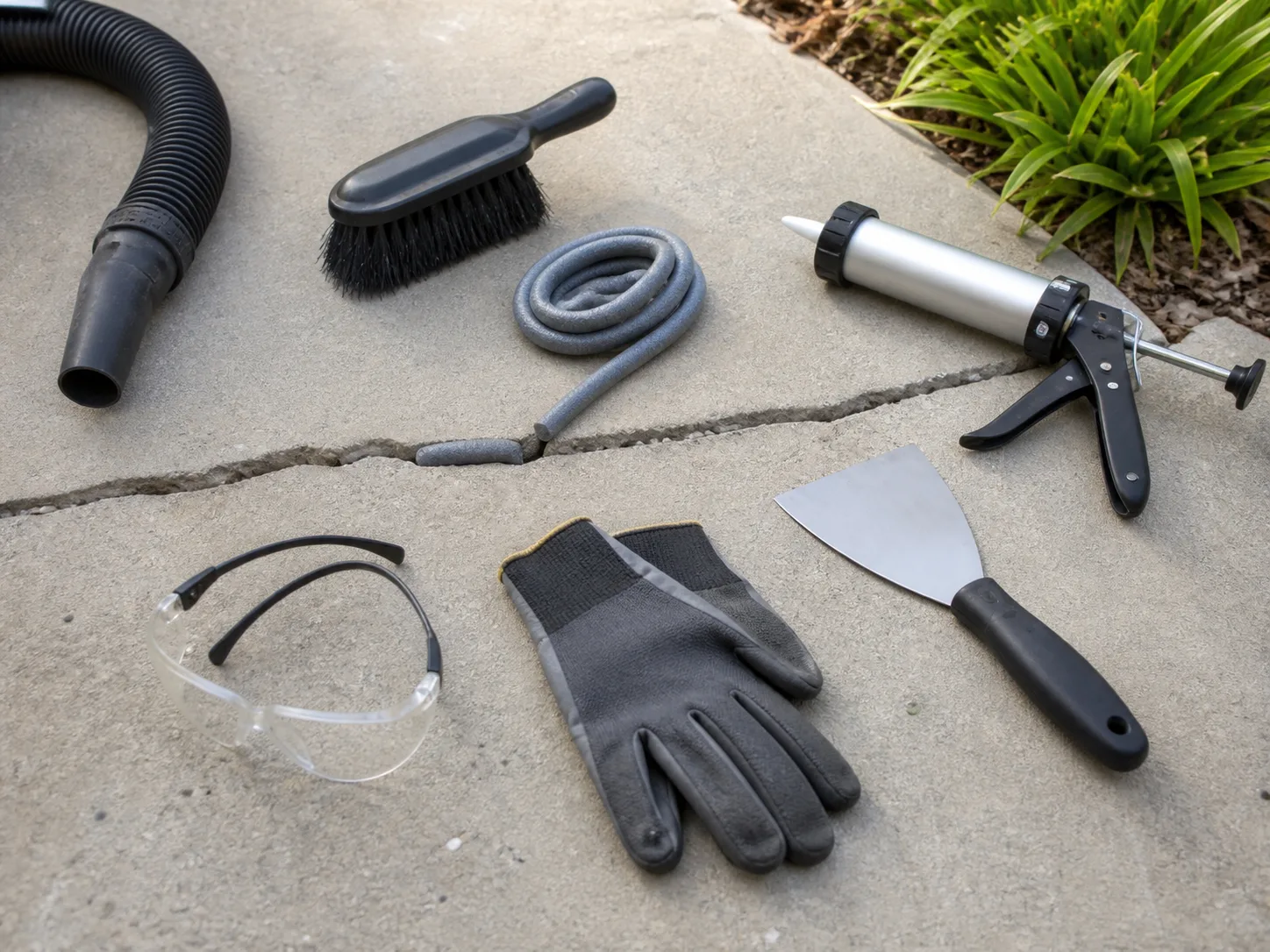
- Open and clean the repair area only as directed. Remove loose fragments and dust with a stiff brush, vacuum, or blower. If grinding or cutting is required, control dust and wear the protective equipment specified for the work; OSHA’s silica guidance for construction explains why concrete dust should not be treated as harmless.
- Stabilize deep or wide voids. Install compatible backer rod or use the permitted sand method when the label calls for it. The goal is to avoid wasting filler in an unnecessarily deep cavity and to give a flexible bead the right shape, not to bury debris in the crack.
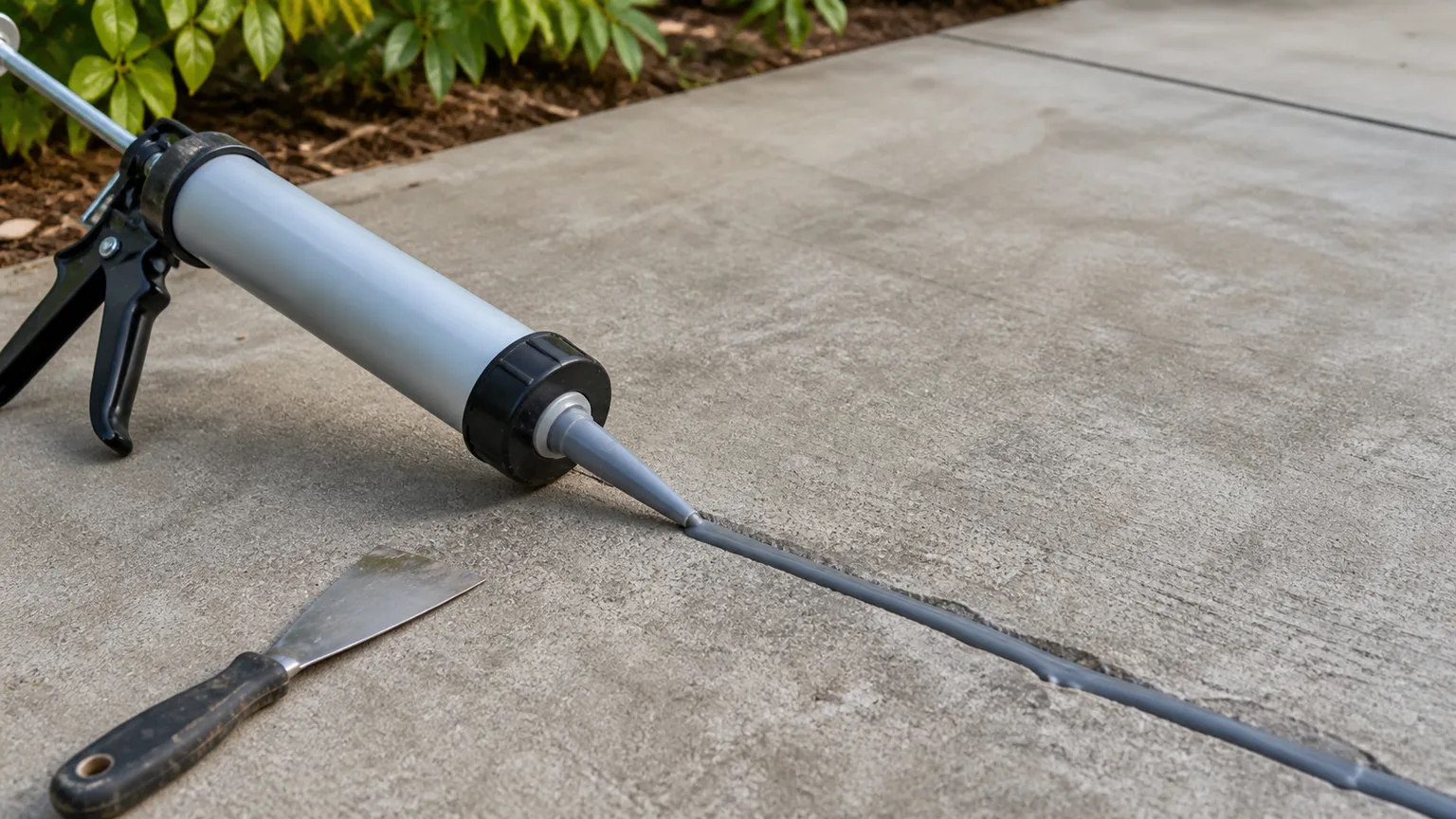
- Apply at the correct thickness. Use a steady bead for caulk, small batches for epoxy or hydraulic cement, and thin lifts for a patch compound. Keep self-leveling sealant on flat ground and protect vertical work from sagging. Tool or feather the edges only while the product is workable.
- Protect the repair through full cure. Keep rain, wash water, foot traffic, tires, chemicals, and temperature extremes away for the manufacturer’s stated period. A product that has skinned over can still be soft underneath, so use the full cure window when the surface will carry a vehicle or furniture.
For dust-producing work, avoid dry sweeping. Use the dust-control method appropriate to the tool and product, keep bystanders away, and clean the work area without sending fine particles into the air. Wear eye protection and gloves as appropriate, and follow the product’s safety data sheet for skin contact, ventilation, and disposal.
Common Application Mistakes
The most common failure is buying by the word “waterproof” instead of by the crack’s behavior. A waterproof rigid patch can split when a driveway moves, while a flexible sealant can stretch successfully but look poor or fail when packed into a hole deeper than its permitted thickness.
Another mistake is applying too much material at once. A thick bead can slump, skin over, trap moisture, or cure unevenly. Deep work usually lasts longer when it is stabilized and built in the specified lifts, even if that means a second visit.
Do not seal a dirty crack, paint before full cure, drive over a repair because it feels dry, or use a self-leveling product on a wall. Avoid pressure-washing immediately before application unless the product instructions specifically accommodate the moisture and drying time. Do not treat a recurring crack by repeatedly adding another surface layer; find the cause.
When to Use a Backer Rod or Sand
Backer material is useful when a crack is deeper than the sealant should fill or when a wide opening needs a controlled sealant profile. A closed-cell foam backer rod is a common option for joints and deep cracks, but it must fit snugly without being forced so deep that the filler loses contact with the sides. Some products allow clean, dry sand instead; others do not.
Never use backer rod as a substitute for repairing missing concrete, a collapsed edge, or a structural void. If the crack has a broken lip, an undermined slab, or a large cavity beneath it, a surface seal will not provide the support the concrete has lost.
Product-Specific Limits Still Matter
The words “concrete crack filler” cover materials with very different chemistry and behavior. Polyurethane and flexible latex are usually chosen when limited movement is expected. Epoxy offers a hard, adhesive repair for a stable area. Acrylic patch is better for texture, corners, and broader surface loss. Hydraulic cement sets quickly and handles some water-stop situations, but it does not become a flexible joint.
Even within one category, the limits vary. One self-leveling sealant may accept a wider crack than another; one product may tolerate damp concrete while its neighbor requires a dry surface. A product can be paintable after cure but unsuitable for vehicle traffic, or waterproof after cure but unsuitable for permanent submersion.
Read the Label After You Buy
Before cutting the tip or opening the lid, confirm six items: permitted surface orientation, maximum width, maximum depth or layer thickness, temperature range, surface moisture, and return-to-service time. Then check the cleanup method, ventilation needs, compatibility with paint or coatings, and whether the product is intended for concrete, masonry, asphalt, or a combination.
Save the packaging or technical data sheet with a photo of the repair. It makes it easier to identify the material later, wait for the proper cure, and choose a compatible coating.
What to Do After the Repair
Watch the crack through the next wet period and temperature change. A good repair should remain bonded at the edges, without a new open line beside it, a soft center, or water tracking around the patch. If the concrete moves, the filler may fail again even when the application was correct; that is information about the underlying slab, not necessarily proof that a different color or brand will solve it.
Keep water away from the repair by maintaining gutters, downspouts, surface grading, and drainage. Avoid harsh impacts at the edge, remove standing water when practical, and inspect before winter in freeze-thaw climates. If a driveway or walkway has become uneven, repair the trip hazard and the supporting base rather than repeatedly filling the visible seam.
Conclusion
For most flat, weather-exposed cracks in sound concrete, a flexible self-leveling polyurethane such as Sika Sikaflex Pro Select is a sensible starting category. DAP Liquid Cement Crack Filler is easier for small horizontal cracks, an acrylic patch handles wider surface damage, epoxy suits a stable durable void, and hydraulic cement is reserved for fast-setting water-stop work. A moving slab, a foundation warning sign, or a crack that keeps reopening changes the problem entirely.
Measure first, match the product to the surface and movement, prepare the opening carefully, and obey the full cure time. The best concrete crack filler is the one that fits the repair—and the best repair is the one that does not hide a problem the filler cannot fix.