How to Attract Luna Moths to Your Garden
Plant the right host trees and make your yard safer for luna moths. Get regional timing, identification tips, lighting advice, and a no-harm sighting plan.
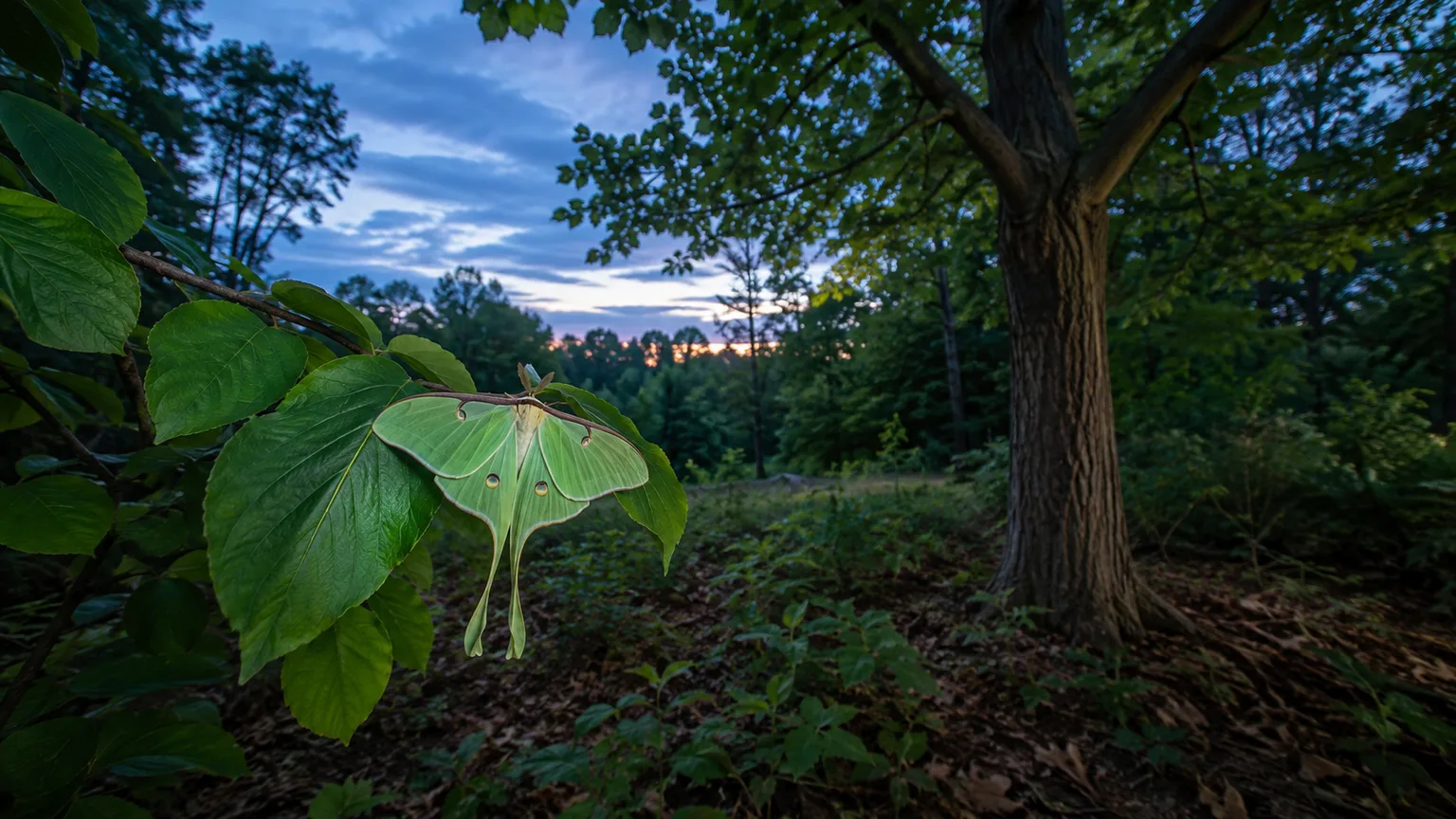
If you want luna moths in your garden, start by planting for the caterpillar, not the adult moth. The adult Actias luna lives briefly, does not feed from flowers, and spends its available energy on finding a mate. Its young need fresh leaves from suitable hardwood trees, and that single fact changes the entire garden plan.
The most reliable approach is to grow or preserve a locally appropriate host tree, leave a little undisturbed habitat beneath it, reduce unnecessary insecticide use, and keep nighttime lighting restrained. Those steps can make your yard more useful to luna moths, but they cannot guarantee a sighting: the species must occur in your region, and adults must be flying when conditions are right.
Start with the Luna Moth’s Real Food Source
Luna moths are often grouped mentally with butterflies, so gardeners naturally reach for nectar plants. That works for many butterflies and for some adult moths, but it is the wrong first move for luna moths. Adult luna moths have vestigial mouthparts and do not take in food; the caterpillar is the feeding stage.
The caterpillars eat foliage from a range of deciduous trees and shrubs. Frequently documented hosts include hickories, walnuts, sweetgum, persimmon, birch, red maple, white oak, willow, sumac, and black cherry. The exact mix varies by region, so a native host tree that already thrives in your local soil and climate is a better bet than an exotic tree chosen from a generic list.
This is also why flowers are supporting habitat rather than a luna moth “feeder.” Fragrant, pale, evening-opening flowers can help other moths and night-active insects, and they make a garden more biologically diverse. They do not replace host foliage for luna moth eggs and larvae.
Understand the Four-Part Life Cycle
Supporting luna moths means keeping four different needs in mind: egg, larva, pupa, and adult. A tidy yard that supplies only one of those stages may produce an attractive moth sighting while still failing to provide a place for the next generation.
Eggs and leaf-feeding caterpillars
After mating, a female places eggs on the leaves of a host plant, often singly or in small groups. The eggs hatch after roughly one to two weeks, although temperature and local conditions affect the timing. Newly hatched larvae begin feeding immediately, which is why a host tree is more valuable than a flower border for this species.
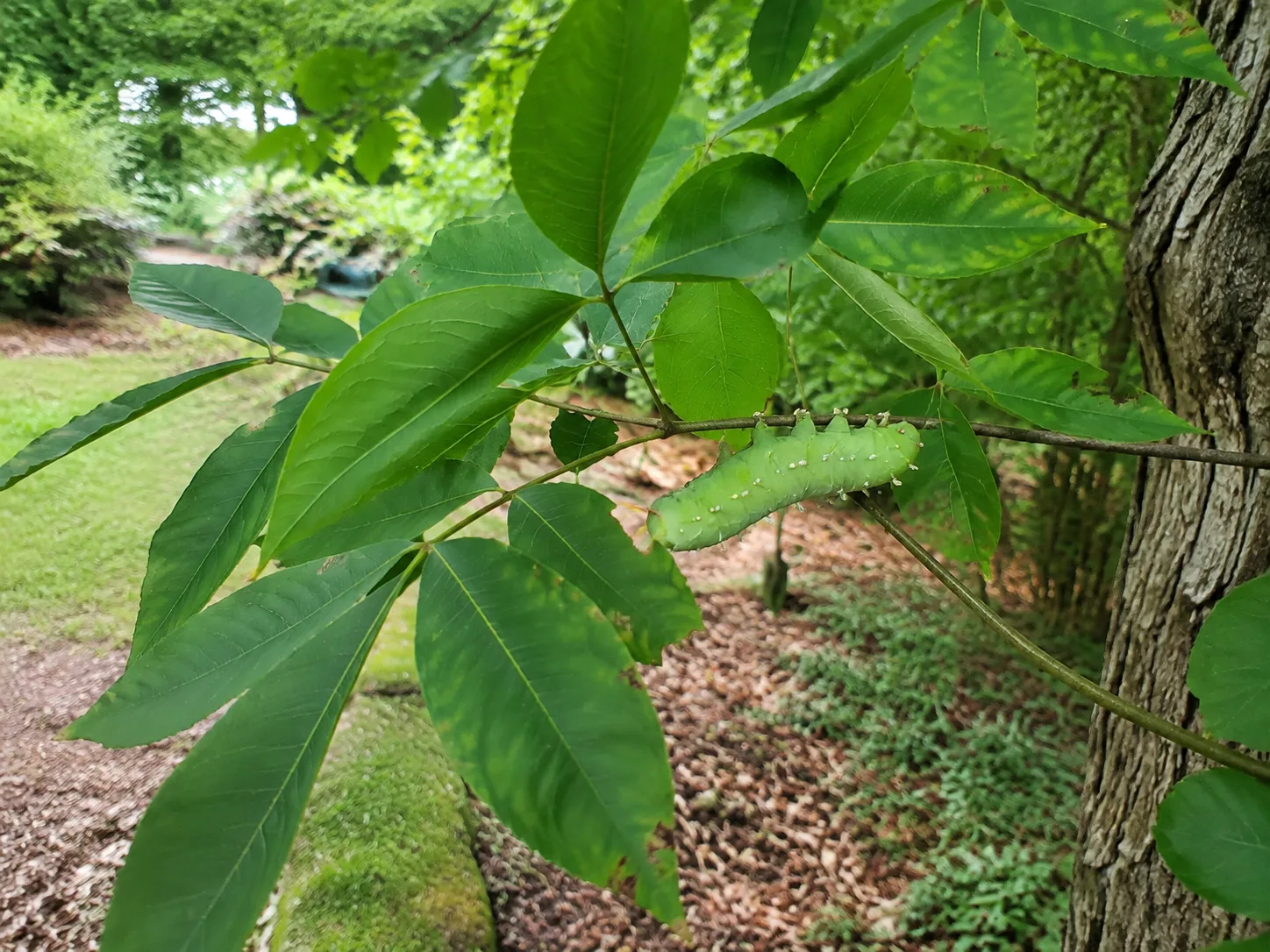
The caterpillar passes through several growth stages called instars. It becomes large enough to notice—often around 2 to 3 inches at full size—and may be green with yellow lines and rows of colored spots. A few chewed leaves are not evidence that the tree is failing. On an established hardwood, scattered feeding is usually a normal wildlife cost of having a living garden.
The University of Florida’s species profile and the Chesapeake Bay Program’s field guide both describe the larval dependence on tree foliage and the adult’s lack of feeding (University of Florida Featured Creatures profile; Chesapeake Bay Program luna moth field guide). Those distinctions are worth keeping visible when a caterpillar is mistaken for a plant pest.
Cocoons, emergence, and the short adult stage
When a mature caterpillar finishes feeding, it leaves the foliage and forms a silk cocoon among leaves or nearby vegetation. The pupa may develop for several weeks, or it may remain dormant through an unfavorable season depending on temperature and latitude. The cocoon is not necessarily hanging conspicuously from a branch; it can be easy to miss in leaf litter.
The adult usually emerges with soft, folded wings. It needs time to pump fluid into those wings and allow them to harden before it can fly. Adults are nocturnal and live for less than about ten days, with many surviving roughly a week. Males search for females, while females release pheromones that males detect with their large, feathery antennae.
That compressed adult schedule explains two common surprises: you may see a luna moth resting near a light in the morning, and you may never see the moth even when caterpillars are using a tree. Most of its life is spent as an inconspicuous egg, caterpillar, or cocoon.
Identify a Luna Moth Before You Change the Garden
An adult luna moth is hard to confuse with a common house moth. Look for broad, pale green wings, a dark or purplish outer band, four eyespots, and long tails extending from the hindwings. The wingspan is commonly in the 3- to 4.5-inch range, though size and color can vary with geography and generation.
The caterpillar is a different-looking animal. It is generally green, plump, and marked with yellow lines or small colored spots. It does not make a web nest like some caterpillar pests. If you find one, note the tree species and take a photograph from a respectful distance rather than moving it to a “better” plant.
The Chesapeake Bay field guide notes that the tail and eyespot pattern help confuse predators, while caterpillars can rear the front of the body and make clicking sounds as a defense. Identification matters because a gardener who recognizes the animal is less likely to apply a broad caterpillar spray to a species that rarely causes meaningful defoliation.
Check Range and Flight Timing Before You Plant
Luna moths are native to much of eastern North America and southern Canada, with a range that reaches from the northeastern United States south through Florida and west into parts of the central and southern United States. The distribution is broad, but it is not universal. If you garden well outside the normal range of Actias luna, a host tree cannot create a population where the species does not naturally occur.
Flight timing follows latitude and warmth. Northern populations commonly have one generation and are most likely to be seen from late spring into summer. In warmer southern areas, two or more generations may occur, extending the possible flight window. Look on warm nights after dark, then check tree trunks, porch walls, and nearby vegetation around dawn when newly active or recently active adults may be resting.
Local records are more useful than a national calendar. Ask a nearby nature center, county extension office, native-plant society, or community science group when recent sightings occur. NatureServe’s Actias luna record is a useful starting point for understanding the species as a regional wild animal rather than a guaranteed garden visitor (NatureServe Explorer: Actias luna).
Choose Luna Moth Host Trees for Your Site

The best host tree is not simply the one with the longest list of documented associations. It is a tree that is native or well established in your region, has enough room to mature, and can remain unsprayed for the years it takes to become useful habitat.
Common host choices include hickory, black walnut, sweetgum, persimmon, paper or river birch, red maple, white oak, willow, sumac, black cherry, and pecan in regions where pecan is appropriate. A mature tree that is already on your property is often the most valuable choice of all. Before removing a volunteer tree, inspect it for caterpillar use and consider whether its size, roots, and location can be managed safely.
Match the tree to your yard, not just the moth
A host tree is a long-term landscape decision, not a seasonal decoration. Check mature height and spread, root behavior, storm exposure, moisture needs, fall litter, fruit or nut drop, and whether the species is invasive or poorly adapted in your area. Black walnut, for example, can be a substantial tree with messy fruit and chemical effects on some nearby plants; it is not a sensible choice for every small border.
If you have room for only one new tree, choose the strongest local native host recommended by a regional nursery or extension service. If you have no room for a tree, preserve existing hardwoods nearby, add locally native shrubs that support other moths, and concentrate on pesticide and lighting decisions. Do not plant a 60-foot tree under utility lines just to chase a sighting.
If your site already has hickory, walnut, sweetgum, or another likely host, you can strengthen the habitat without adding another tree. Water young trees during establishment, mulch without piling it against the trunk, and avoid pruning for cosmetic reasons during the active season when caterpillars may be present. For a closer look at one important host group, see our guide to identifying and choosing hickory trees.
Layer host trees with a woodland edge
Luna moths fit best in a layered landscape: canopy trees above, smaller trees or shrubs below, and a patch of leaf litter or groundcover beneath. A perfectly open lawn with one isolated ornamental tree may supply leaves, but it offers less shelter and continuity than a woodland edge or a connected group of hardwoods.
You do not need to turn the entire property wild. Keep a mowed path or crisp edge for access, then allow one corner behind a bed, shed, or fence to retain natural structure. Avoid removing every volunteer shrub and fallen branch. The goal is a safe transition between garden and habitat, not an unmanaged thicket beside a walkway.
Preserve the Ground Habitat Under Host Trees

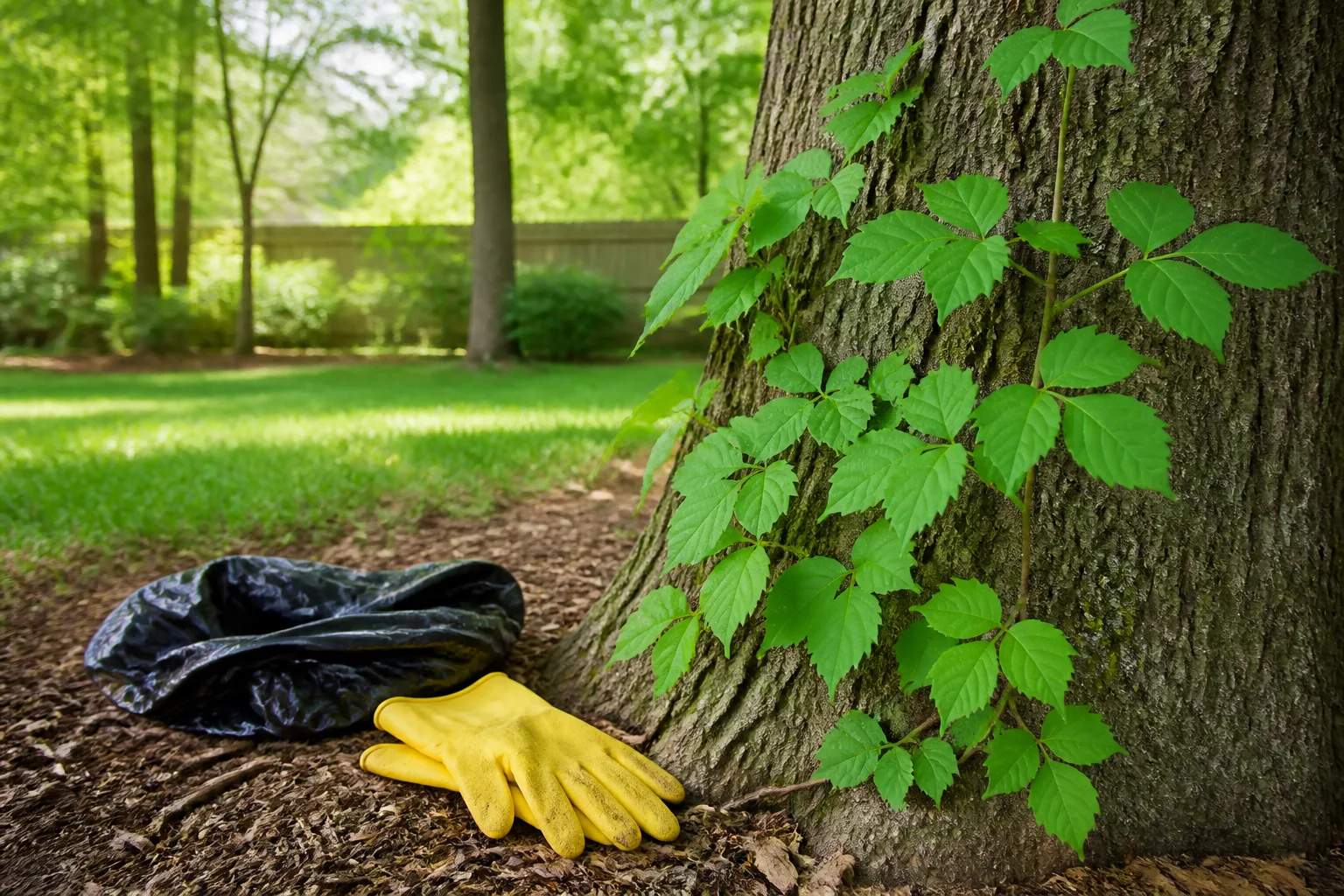
“Leave the leaves” is especially relevant when a caterpillar may leave the tree to pupate. Keep a layer of intact leaves beneath or near host trees, particularly through the season when larvae finish feeding. A leaf blower used to clear every bed edge can remove cocoons, shelter, and the microclimate that protects developing insects.
You can still maintain a usable garden. Rake leaves off paths, drains, steps, and turf where they create a hazard, then move them under trees or to a designated wildlife corner. Avoid shredding the whole layer immediately beneath a host tree. If you compost leaves, keep at least one quiet patch in place until the local moth season has passed.
Ground habitat also protects more than luna moths. It supports beetles, native bees, spiders, and other organisms that feed birds and help decompose organic matter. The practical trade-off is simple: maintain high-traffic areas neatly, but do not demand a sterile surface from every square foot of the property.
Use Pesticides Only When the Trade-Off Is Clear
Spraying a host tree for a few chewed leaves defeats the purpose of planting it. Luna moth caterpillars eat treated foliage, so broad-spectrum insecticides and caterpillar products can kill the larvae you want to support. This includes products marketed as “natural”; a product’s origin does not make it harmless to non-target caterpillars.
Start with identification and thresholds. If damage is light and the tree is established, leave it alone. If a serious tree-health problem requires treatment, identify the pest, confirm the product and timing with a local extension professional, and explain that the tree is wildlife habitat. Do not spray a whole canopy on a routine calendar simply because insects are present.
Protect host trees from drift as well as direct application. Keep lawn and ornamental sprays away from the canopy, avoid windy conditions, and never assume that a spot treatment is isolated if droplets can move. The Gardener’s Eden’s practical luna moth guidance likewise emphasizes protecting host trees and avoiding unnecessary insecticides and herbicides (The Gardener’s Eden: Moonlight Flight in the Garden).
Make Outdoor Lighting Less Disruptive
Luna moths and other nocturnal insects may gather around porch, garage, or security lights, which makes a light seem like an effective attractant. It can help you see an adult temporarily, but leaving bright lights on all night is poor habitat design. Artificial light can pull insects away from normal movement and mating behavior, expose them to predators, and keep them circling when their short adult life is already limited.
Use the least light that safely does the job. Turn off decorative lights when you are not outside, use motion sensors for security fixtures, shield bulbs so light points downward, and keep fixtures away from the host-tree canopy when possible. Warm, low-intensity lighting may reduce insect attraction compared with bright blue-rich light, but darkness is the clearest solution when safety allows.
There is a useful distinction here: a dim porch light can help you spot a moth that has already arrived, while a bright all-night floodlight can make the surrounding habitat less suitable. The goal is not to lure every adult into a trap of illumination; it is to let the moth move, mate, rest, and leave.
Add Night-Blooming Plants for the Wider Moth Community

Flowers are not a food source for adult luna moths, but they can broaden the value of a moth-friendly garden. Many other moths do feed as adults and are drawn to pale, fragrant flowers that open or release scent after dusk. Native plants that match your soil and region are the priority; do not buy an invasive vine simply because it is fragrant at night.
Use evening flowers as one layer around the host habitat. Moonflower, native honeysuckle, evening primrose, white phlox, buttonbush, garden phlox, and other locally suitable plants may serve nocturnal visitors, but their exact value depends on region and the moth species present. A diverse planting also supports daytime pollinators, so the bed does more than target one spectacular insect.
If you are building a broader pollinator garden, combine habitat with safe drinking access for insects. Our guide to recycled-dish water stations for pollinators covers shallow, stone-filled designs that reduce drowning risk. Keep water stations shallow and refreshed; they are not required for luna moths, but they can make the wider garden more welcoming.
Watch for Luna Moths Without Harming Them
Observe from the edge first. A flashlight with a dim or red setting, a camera held back from the insect, and a quiet check of host trees at dusk or dawn are usually enough. Never pin, glue, net, or restrain a wild adult for a photograph, and do not touch the wings: the scales are delicate and the insect has very little time to reproduce.
If you find an adult on a wall or porch
Leave it where it is unless it is in immediate danger from a door, foot traffic, a pet, or a vehicle. If it is resting on a movable object, you can place that object in a shaded, sheltered spot near vegetation, but avoid picking up the moth by its wings. A newly emerged moth may be unable to fly until its wings have expanded and hardened.
If an adult is inside a garage or house, open an exterior door or window near the insect and turn off interior lights. Give it a route out rather than chasing it with a broom. An adult on a porch in the morning is not evidence that it needs food, sugar water, or a flower bouquet.
If you find a caterpillar or cocoon
Do not relocate a caterpillar unless it is in immediate danger from mowing, a planned spray, or a failing branch. Record the host tree, take a quick photograph, and leave it to feed. A cocoon should be treated as a protected wild stage; do not bring it indoors, cut it from a branch, or collect it for release.
If you must prune or treat a host tree, postpone nonessential work until the local flight and larval season is over. When work cannot wait, inspect the branches and ground first, mark the wildlife area, and ask a local extension office for species- and season-specific advice. The safest intervention is usually the one that changes the habitat least.
Know What Luna Moths Do Not Need
You do not need a nectar feeder, a sugar solution, a commercial “moth attractant,” or a collection of purchased cocoons. Releasing captive-reared insects can spread disease or introduce animals that are poorly matched to the local population. A garden cannot force a wild luna moth to appear, and a light trap may attract many other insects without helping reproduction.
You also do not need to eliminate every predator. Birds, bats, owls, wasps, beetles, and parasitoids are part of the food web that luna moths navigate. Removing predators or spraying broadly to protect a single caterpillar usually creates more ecological damage than the original feeding.
The most useful “attraction” is quiet continuity: a host tree that remains healthy, a patch of leaf litter that is not repeatedly cleared, and nights that are dark enough for insects to behave naturally. The Gardener’s Eden and Hyannis Country Garden both emphasize habitat, host plants, and reduced light and chemical disturbance as the practical foundation for supporting moths (Hyannis Country Garden moth habitat guidance).
Decide Whether Caterpillar Feeding Is a Problem
Look at the tree before you look at the caterpillar. A mature, vigorous hardwood can usually tolerate scattered feeding, especially when leaves remain on most branches and new growth is strong. One or two large caterpillars are not a population explosion, and removing them may do more harm than accepting a few holes.
Intervene only when there is a genuine plant-health or safety reason: a young tree is being heavily defoliated, a branch is failing, or a confirmed pest outbreak requires professional management. Even then, separate the problem from the luna moth. Identify which insect is causing the damage, check whether the tree can recover, and use the narrowest effective response.
For gardeners who want to help but worry about a messy yard, design the habitat visibly. Edge the wildlife patch, mow a simple path, prune dead wood when safe, and place a small sign or garden marker outside the habitat if you share the property with family. A defined wild corner is easier to protect than an invisible rule that says every leaf everywhere must remain untouched.
Conclusion: Build Habitat and Let the Moth Arrive Naturally
To attract luna moths, plant or preserve the trees their caterpillars can eat: hickory, walnut, sweetgum, persimmon, birch, maple, oak, willow, sumac, black cherry, or another regionally suitable host. Then protect the conditions around those trees by leaving some leaf litter, avoiding unnecessary sprays, limiting bright nighttime lighting, and allowing a layered woodland edge to develop.
If you have a small yard, your best contribution may be preserving an existing tree and coordinating with nearby habitat rather than planting a tree that will outgrow the site. If luna moths are outside your local range, make a native moth garden for the species that do occur there. Either way, the right goal is not a guaranteed photo; it is a garden that gives a wild insect a better chance to complete its life cycle.