Ginger Zee and Practical Green Living Tips
Explore Ginger Zee’s greener-living context with practical steps for buying less, cutting food waste, composting responsibly, reducing plastic, and saving home energy.

“Live greener” can sound like a request to replace everything in your home at once. A more useful starting point is to choose one repeated routine—what you buy, what you throw away, or how you heat and cool your space—and make the lower-waste option the easier one.
Ginger Zee is ABC News’ chief meteorologist and chief climate correspondent. ABC’s official biography describes her reporting on weather disasters and climate stories, while ABC’s 2024 Earth Week announcement says she led a series about climate challenges and solutions. That announcement documents coverage of sustainable grocery shopping, reducing plastic, minimizing food waste, fast-fashion waste, and upcycling. It does not establish the details of Zee’s private shopping, composting, or thermostat habits, so the practical advice below is general guidance rather than a list of personal routines attributed to her. (ABC News biography; ABC’s Earth Week announcement)
What ABC’s Earth Week coverage documents
ABC presented its Earth Week series as a look at both climate challenges and solutions being tested by individuals, communities, industry, and government. Its schedule described Good Morning America coverage of sustainable grocery choices, less plastic, less food waste, and ways to save money; a separate Nightline report was to examine clothing waste and upcycling. Those are documented editorial themes, not proof that one person’s habits can solve a systemic problem.
That distinction matters because celebrity profiles can blur the line between what someone said publicly, what a show covered, and what a reader should do at home. Here, Zee provides the public climate-reporting context. The actions that follow are evaluated on their practical merits, including where they are inconvenient, where local services matter, and when a supposedly green swap is not an improvement.
There is also no need to treat a household choice as a substitute for cleaner infrastructure, effective public policy, or company-level changes. Individual routines are most useful when they reduce waste that would otherwise occur, make better options normal in a family or workplace, and help people ask for services that make low-waste choices accessible.
Pick one high-friction routine first
Start by noticing what repeatedly creates waste or uses energy in your own week. It might be produce that spoils before you cook it, a stream of single-use drink cups during a commute, unopened clothing purchases, or heating an empty home. Pick a pattern you can observe, rather than a broad goal such as “be sustainable.”
For seven days, keep a short note: what was discarded, what was purchased impulsively, or when the heating or cooling ran in an empty room. The aim is not to record every wrapper or kilowatt-hour. You are looking for a recurring point where a small change could prevent the same waste next week.
Then ask three questions: Does this happen often? Can I change it without buying a pile of new equipment? What would make the new choice easier on a busy day? If the answer depends on a costly device, a long detour, or a routine you cannot maintain, choose a different starting point. A greener habit that survives an ordinary Tuesday is more useful than an ambitious plan abandoned after Earth Day.
Buy less by adding a pause to checkout
Buying less can start with a short “no new” experiment. For a week or a month, pause before purchasing nonessential items and first ask whether you already own something that does the job, can repair the item, borrow it, rent it, or find it secondhand. A time-limited experiment is easier to evaluate than a permanent rule, and it reveals which purchases are driven by genuine need and which are triggered by convenience or marketing.
Before buying, try a simple sequence: write down the need; check the cupboard, closet, or tool drawer; set a waiting period for nonurgent purchases; then look for a repair, loan, rental, or used option. Unsubscribe from promotional messages if they repeatedly prompt purchases, and remove stored payment details if one-click checkout makes it hard to pause. These changes reduce friction in the moment when a purchase is most likely.
Secondhand is not automatically the right choice for every item. Fit, hygiene, safety, durability, accessibility, and time all matter; some equipment should meet current safety standards, and some work clothing or household necessities need to be available promptly. If a used item requires an expensive repair or will be replaced quickly, buying a durable new version may be the more practical decision. The goal is to avoid unnecessary churn, not to make people feel guilty for meeting a real need.
A no-buy challenge helps reduce waste only if it changes what you eventually bring home. If you simply postpone purchases and make them all at the end of the month, the experiment may teach you what triggers impulse spending, but it has not reduced the total number of items. Use it to build a lasting pause—save the list, wait, and return only for needs that still make sense.
Make reuse work with boundaries
Reusable bags help only if you remember them and use them repeatedly. Keep a few where the trip begins: by the door, folded in a work tote, or secured in the car if you drive. A small repeatable set usually works better than accumulating dozens of promotional totes that take up space and eventually become another disposal problem.
Make the system resilient to forgetting. If you arrive without a bag, you can carry a small purchase by hand, reuse a clean bag you already have, or accept a store bag and use it again for another appropriate task. The useful habit is not perfection; it is making the default trip produce fewer disposable bags over time. Clean reusable bags according to their material and use, particularly if they have carried raw meat or unwashed produce.
Refillable or concentrated household products may also reduce packaging, but compare the real routine rather than the label. Does a refill pouch or tablet fit a product you already use? Can you follow the manufacturer’s dilution directions, and will you actually replenish it? Avoid buying a new branded dispenser if a clean, compatible container you already own will work. For cleaning products, follow label directions and never mix products unless the label explicitly instructs you to do so.
Reduce disposable packaging with a shopping system
A grocery routine can reduce packaging and food waste at the same time. Before shopping, check what is already in the refrigerator and pantry, plan a few meals around the most perishable ingredients, and bring containers or bags only if the store accepts them and you are prepared to use them. Buying unbagged produce is useful when it fits your household, but avoiding a thin produce bag is not a win if the produce then spoils unused.
Choose the package that gives you a realistic quantity and protects the food. A larger package is not automatically better if you cannot use it before quality declines; individually portioned food may be useful for someone with limited storage, mobility, or cooking time. Likewise, a local refill station is worthwhile only if it carries what you need and does not require an extra trip that makes the routine harder to sustain.
Separate the choice you control from the system you do not. If a product is only sold in packaging your local program will not accept, you can consider another brand, ask the retailer about alternatives, or focus on reducing the quantity you buy. Recycling instructions differ by location and material, so check your municipality’s current guidance rather than assuming the chasing-arrow symbol means an item belongs in curbside recycling.
Prevent food waste before composting
Composting is useful for unavoidable scraps, but preventing edible food from being wasted should come first. A compost bin does not recover the water, energy, labor, transport, or money that went into food that was never eaten. Make “use what we have” the first response, and send only the remaining suitable scraps to a compost system.
Use a simple weekly food routine
At the start of the week, look at the perishables and put the ones that need attention where they are easy to see. Plan one flexible meal—soup, pasta, fried rice, a grain bowl, or another familiar dish—that can absorb vegetables or cooked ingredients nearing the end of their useful life. Keep a freezer container for ingredients you will use later, label it with the contents and date, and freeze portions while they are still in good condition rather than waiting until they are questionable.
Store ingredients where they stay usable for your household. That may mean keeping salad greens visible, separating delicate herbs from produce that speeds their deterioration, or buying a smaller quantity of a food that often goes unused. “Buy only what you need” sounds simple, but the practical version is to match package size, shopping frequency, freezer space, and cooking schedule to the people eating at home.
Use date labels thoughtfully and follow food-safety advice for storage and leftovers; a compost plan is not a substitute for safe handling. If you are unsure whether food is safe, do not taste it to find out. The aim is to prevent avoidable spoilage while keeping health decisions separate from waste reduction.
Compost scraps with a setup you will maintain
If scraps remain after meal planning, choose a compost route based on where you live and what your household can maintain. A backyard bin can turn suitable food scraps and yard material into a soil amendment; a worm bin fits a smaller space but requires attention to moisture and feeding; a municipal or community service may be simplest where it accepts kitchen organics. No single method is right for every home.
Before buying a bin, check local rules. Curbside collection and drop-off programs may accept a wider range of food than a backyard pile, while backyard systems can attract animals if unsuitable ingredients are added or scraps are left exposed. Ask the local program what it accepts, where to take material, and whether it requires a particular liner or container. Never assume “compostable” packaging belongs in a home pile; many products need commercial processing or are not accepted by the local operator.
For a basic backyard pile, commonly composted kitchen materials include fruit and vegetable scraps, coffee grounds and filters, and eggshells, alongside leaves, shredded paper, and other suitable browns. The list is not universal: the EPA advises checking local composting or recycling guidance for materials such as dairy, fats, meat, and fish, which can attract pests or cause odor in a simple home pile.
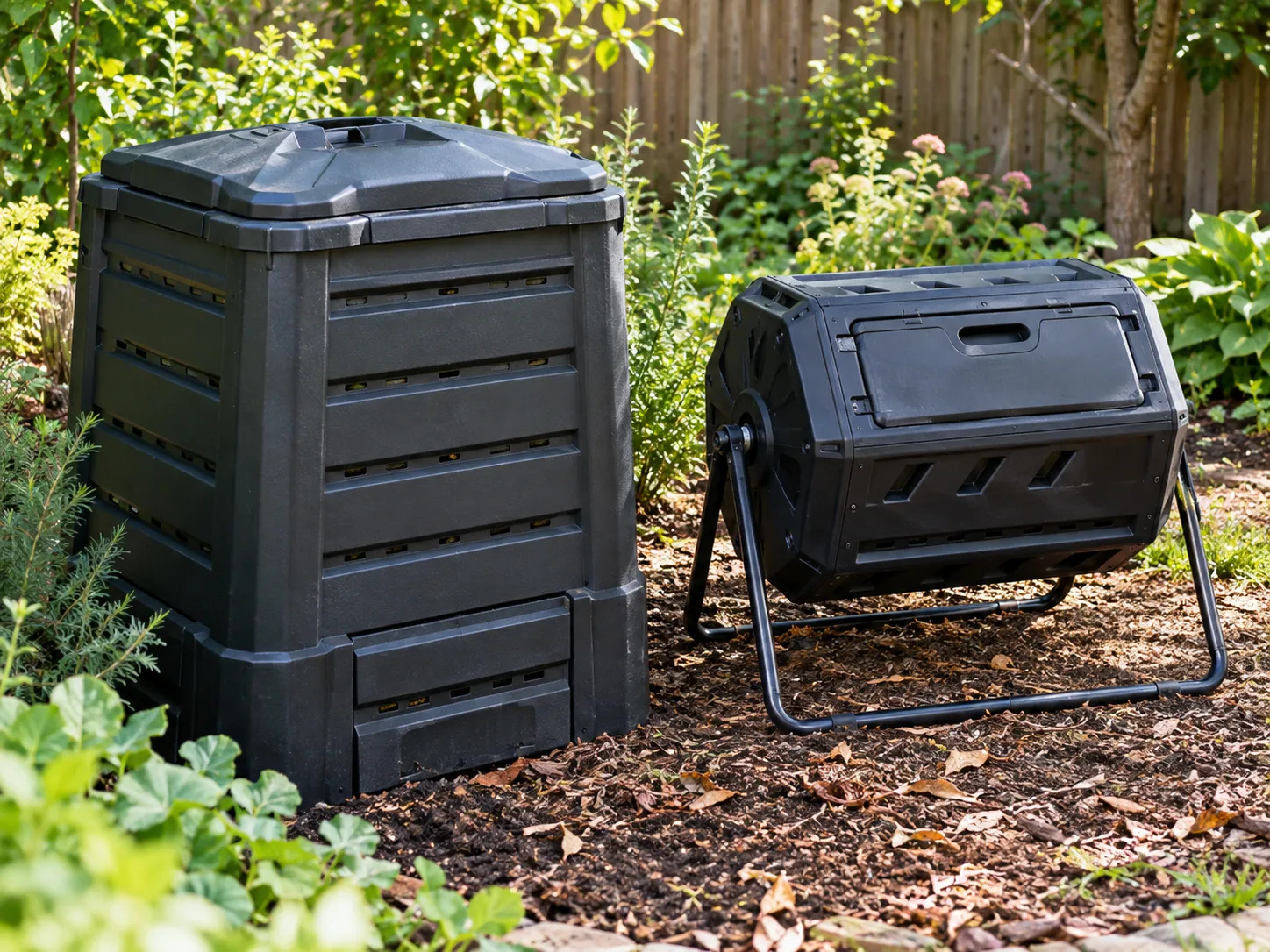
A covered bin or tumbler can keep food scraps contained while they break down.
The EPA’s home-composting guidance describes balancing nitrogen-rich “greens,” such as fruit and vegetable scraps and coffee grounds, with carbon-rich “browns,” such as dry leaves and shredded paper, while keeping the pile moist and aerated. The Royal Horticultural Society also notes that compost bins can be scaled to the size of a garden and the amount of material available. Better Homes & Gardens distinguishes passive cold composting from faster, more actively managed hot piles; the quicker method asks for more turning and attention. Follow the instructions for your system and local program; general backyard advice does not override an operator’s accepted-material list. (EPA home composting guide; Royal Horticultural Society composting guide; Better Homes & Gardens composting guide)
Choose backyard, worm bin, or local collection
Choose a backyard bin if you have a suitable outdoor spot, a reliable supply of dry leaves or other browns, and a use for finished compost. It is convenient for a household that gardens, but it is not a set-and-forget trash can: the pile needs enough dry material, some air, and protection from animals. If you rent, have a small yard, or do not want to manage a pile, ask whether your city, farmer’s market, school, garden, or community garden accepts food scraps.
A worm bin is an option for apartments and small households, but it has its own care needs. It is not simply a sealed bucket: bedding, appropriate feeding, drainage or moisture control, and a location away from harsh heat and cold all matter. Start with a modest amount of the food the system accepts, then add more only as the worms process it. A neighbor’s successful setup may not transfer exactly to a different climate or indoor space.
Collection programs offer convenience but have boundaries. Some accept meat, dairy, cooked food, or certified compostable products; others do not. If the list is unclear, call the operator instead of guessing. Contamination can make a whole collection load harder to process, so sorting according to local instructions is part of the action, not a minor detail.
Keep a backyard pile balanced and low-odor
A sour or rotten smell usually means the pile is too wet, compacted, or dominated by food scraps. Add dry browns such as leaves or torn uncoated cardboard, mix the material to restore airflow, and bury fresh scraps under the drier outer layer. If the pile is dry and barely breaking down, add water gradually and mix it rather than soaking the whole bin at once.
Fruit flies gather around exposed scraps, so cover new additions with browns, keep the lid closed, and clean the kitchen collection container regularly. Rodents are more likely when meat, dairy, oily food, or cooked leftovers are added to a simple backyard pile or when scraps remain uncovered; follow the EPA and local program’s list rather than assuming every organic item belongs there. If pests persist, pause food additions and correct the bin setup before trying another additive or buying a new product.
Finished compost should look dark and crumbly, with much of the original material no longer recognizable. It can take months or longer depending on temperature, particle size, moisture, and how often the pile is turned; do not rush unfinished scraps directly around plants. If you have no garden use, a community collection route may be a better fit than producing a pile of material with nowhere to go.
Cut home energy with practical settings
Heating and cooling are large household energy uses, but the right adjustment depends on the climate, equipment, building, schedule, and people in the home. A small setpoint change may be comfortable for one household and disruptive for another. Rather than promise a fixed saving from one degree, start with a schedule that avoids heating or cooling an empty home when doing so is safe for your equipment and occupants.
The U.S. Department of Energy advises that a programmable thermostat can reset temperatures while people are asleep or away, so a home does not have to remain at the same setpoint all day. Use your equipment manual and a schedule that fits your routine. If your system is a heat pump, radiant system, or other equipment with specific operating needs, check the manufacturer’s guidance before making large setbacks. (U.S. Department of Energy thermostat guidance)

Efficient lighting is one small part of a broader home-energy plan.
Adjust the thermostat without sacrificing safety
Try one modest schedule change for a week and notice comfort, sleep, condensation, and whether the system behaves normally. A thermostat setback is not suitable if it risks frozen pipes, unsafe indoor temperatures, medical needs, or damage to a building. Older adults, infants, people with health conditions, and residents of poorly insulated homes may need a different comfort plan than a generic energy-saving chart suggests.
If changing a setpoint causes a heat pump to run constantly or the home to recover slowly, do not assume a more extreme adjustment is better. Setback strategies vary with equipment and weather, and some systems work best with smaller changes. When the schedule is confusing, ask the HVAC installer or utility energy adviser to help configure it; the aim is efficient operation that remains safe and livable.
Other energy steps may be more durable than fiddling with the thermostat: use efficient lighting when a bulb needs replacement, close gaps where outside air leaks, maintain filters according to the system instructions, and use shades or ventilation in ways that suit local weather. Larger insulation or equipment upgrades can cost money and may require professional assessment, so distinguish low-cost habits from capital improvements rather than implying everyone can do both immediately.
Know which greener swaps are not worth buying
A “green” label does not tell you whether a purchase will reduce waste in your specific home. A new set of reusable containers is of little value if you already have containers and rarely use the new ones. A refill concentrate may be convenient for one household and unsuitable for another that cannot safely store or measure it. The first greener purchase is often the one you do not need to make.
Use a replacement rule: keep using a functional product; repair it when repair is safe and proportionate; replace it when it no longer does the job; and choose a durable alternative that fits your routine. For disposable items you repeatedly use, a reusable version can help when it is genuinely reused and cleaned. If the reusable requires special care, frequent replacement, or an extra trip, the advantage becomes less obvious.
Also notice rebound purchases. Someone trying a no-buy month might still order extra storage bins, organizers, or “eco” accessories to support the challenge. A person avoiding plastic packaging might buy more food than they can use. A household reducing laundry products should not mix DIY chemicals or change a cleaner’s dilution by guesswork. Keep the action focused on avoiding a recurring waste stream, not assembling a perfect-looking kit.

Repairing a useful garment can extend its life when the fix is practical.
Clothing is a good example of why flexibility matters. Buy fewer impulse pieces, care for what you own, mend small damage if you can, trade or borrow occasion wear, and consider secondhand when size and condition work. But a no-new-clothes rule should not prevent replacing a worn-out work uniform, weatherproof layer, or safety item. A habit is a tool for changing the default, not a moral test.
Turn a personal habit into a shared norm
The household member who remembers the bags, sorts the food scraps, and resets the thermostat can easily become the only person doing the work. A better system puts cues where everyone sees them: a bag by the keys, an “eat first” shelf in the refrigerator, a small labeled compost container, or a thermostat schedule that follows the household’s actual routine. Visible cues make habits less dependent on one person’s memory.
Share the decision, not just the task. Agree which food scraps go in the collection bin, who takes them outside, how often the indoor container is washed, and what happens when the bin is full. At work or in an apartment building, ask management for clear recycling and food-scrap instructions, reusable serving items, or an accessible drop-off point. A service that is easy to use helps a whole group participate.
This is also where personal action meets collective change. ABC described its Earth Week coverage as spanning individual, community, industry, and government solutions. A household can make a useful routine visible, but it can also support local compost collection, safer walking and transit routes, repair options, and packaging policies that give residents practical choices. (ABC’s Earth Week announcement)
Measure progress without green guilt
Choose a measure that tells you whether the routine changed. You might count how many grocery trips used your existing bags, how many planned meals used ingredients already on hand, how many clothing purchases you delayed, or whether the thermostat followed the sleep-and-away schedule. A simple tally for a month is usually enough to reveal whether the change is taking hold.
Avoid turning a small count into a claim about exact emissions saved unless you have a method and reliable inputs for that calculation. Household energy and waste effects depend on the item, local disposal system, product lifespan, weather, and what alternative you would otherwise have used. The honest result may be “we threw away less produce this month,” not “we reduced our footprint by a precise amount.”
If an experiment fails, diagnose the friction. Maybe bags are not stored near the exit, the compost container is inconvenient to clean, or the thermostat setting is uncomfortable. Move the cue, choose a simpler method, or test a different habit. The next useful action is to make a change easier to repeat, not to blame yourself for a routine that was poorly designed.
You also do not need to adopt every tip. A renter may not control insulation; a person without a car may have limited access to a drop-off site; someone working multiple shifts may need food that is quick and individually packaged. Focus on the decisions available to you and support improvements that reduce the burden for others. A sustainable routine is one that works within real constraints and can be shared without shame.
Conclusion
ABC’s Earth Week coverage connected Ginger Zee’s climate-reporting role with stories about solutions, sustainable grocery choices, plastic reduction, food waste, and clothing waste. That is useful context for a practical guide, but it is not evidence about every private habit in Zee’s home. The strongest advice here is therefore grounded in what readers can test: buy only what serves a real need, make reuse convenient, prevent edible food from being wasted, choose a compost system that fits local rules, and adjust home energy settings only when it remains safe and comfortable.
Start with one repeated source of waste or energy use, change the setup around it, and check after a week whether the new routine actually worked. Keep what is easy to maintain, modify what creates friction, and leave room for community and policy solutions alongside household choices. Living greener does not require a flawless home; it means making useful improvements that fit the people and place involved.