Tarantula Hawk Wasp: ID, Sting, and Safe Removal
Tarantula hawks are solitary spider wasps, not colony-building yellow jackets. Learn their field marks, sting first aid, safe removal, and prevention.
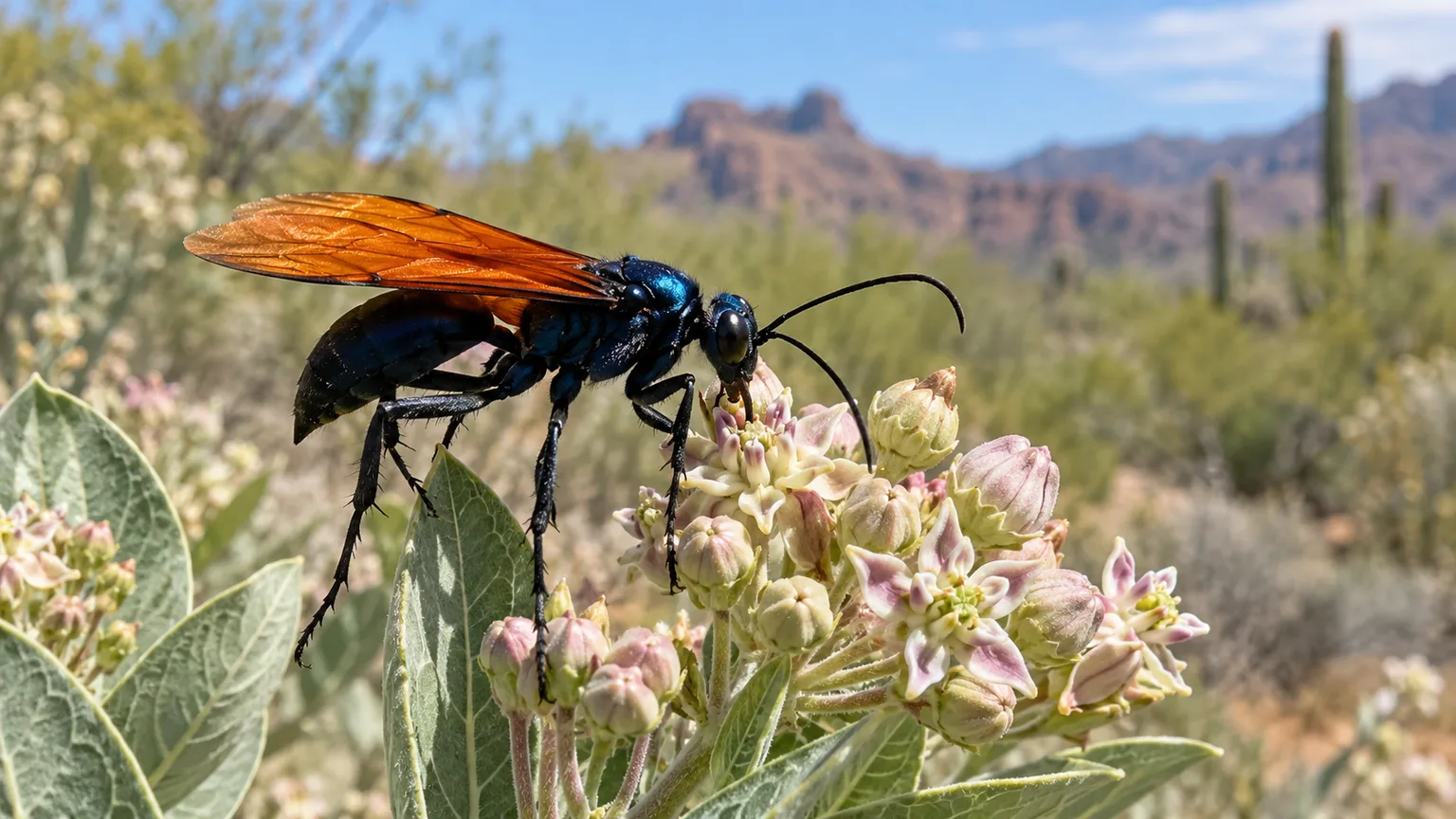
A tarantula hawk is a large, solitary spider wasp with a metallic dark body and often bright orange wings. It can deliver an exceptionally painful sting, but it is not a colony-building wasp that patrols a nest or hunts people; adults mostly visit flowers, and females search for tarantulas as food for their larvae. If one crosses your yard, give it room and leave it alone. If it enters the house, keep people and pets away while you provide a safe route outside or call a pest professional rather than swatting or spraying it.
The word “removal” needs context here. One tarantula hawk in the garden usually calls for no pest treatment, while a wasp repeatedly trapped indoors or an encounter where someone has a serious sting allergy deserves a more careful plan. Correct identification changes the response, because standard advice for a social wasp colony—bait traps, nest destruction, or insecticide—does not automatically apply to a solitary tarantula hawk.
What Is a Tarantula Hawk?
“Tarantula hawk” is the common name for large spider wasps in the family Pompilidae. The familiar species belong to the genus Pepsis, and related tarantula-hawk species are also placed in Hemipepsis. They are wasps, not birds of prey, and they are not a type of tarantula.
The name refers to the female’s unusual hunting strategy. She locates a tarantula, stings and paralyzes it, then uses the spider as living food for a developing larva. The adult wasp itself feeds on nectar; it is the young that develop on the spider. The National Park Service’s natural-history account describes this life cycle and the species’ striking appearance.
That life cycle is dramatic, but it does not mean a wasp is trying to attack a person. A tarantula hawk’s powerful sting helps it subdue spider prey and defend itself if grabbed or trapped. For people, the useful distinction is between a painful insect that should not be handled and a social wasp colony that may defend a shared nest.
How to Identify a Tarantula Hawk Wasp
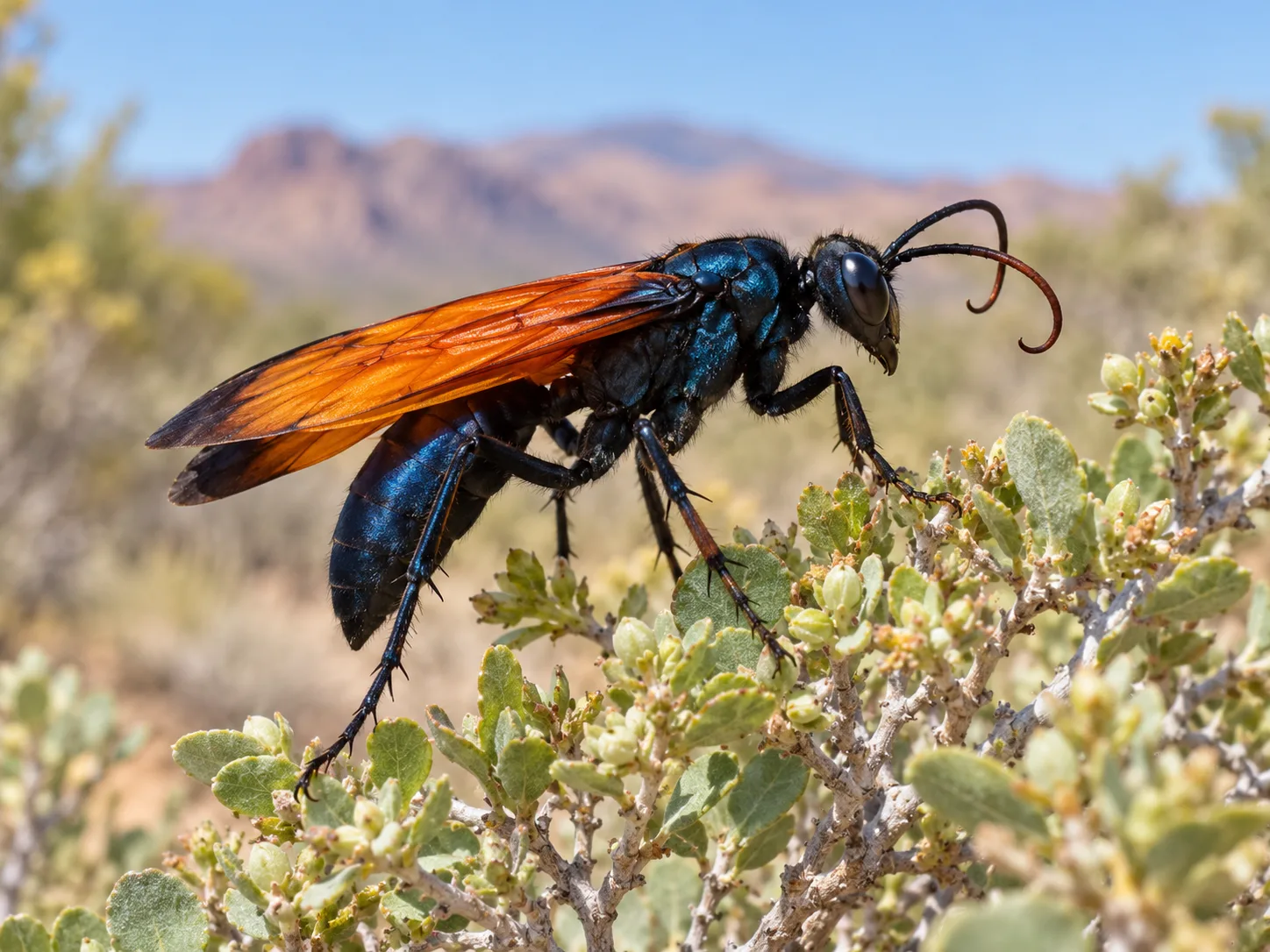
Look for a large, long-legged wasp with a robust, dark blue-black or black body. Many have vivid orange or rust-colored wings, sometimes edged in black; other species or individuals can have darker wings. A metallic sheen, a substantial silhouette, and long legs make the insect stand out from the more familiar yellow-and-black wasps around homes.
Size varies by species and region, so it is better to use several clues than a single measurement. The Grand Canyon’s National Park Service identification page describes Pepsis thisbe as reaching roughly two inches, with a dark iridescent body, bright wings, and long legs. Other tarantula hawks can be larger, while lighting and distance can make color look different than it does in a close photograph.
Female and Male Tarantula Hawks: The Antennae Clue
A close look can help distinguish the sexes: females tend to have curled antennae, while males have straighter antennae. Males do not have a stinger; females do. The University of Texas at El Paso’s insect museum reference describes these identifying features and the wasp’s hooked leg claws.
Do not approach closely just to check antennae or sex. At a safe distance, treat a large dark wasp with orange wings as a possible tarantula hawk and avoid touching it. A clear photo taken with zoom can help a local university extension office or insect-identification service, but no photo is worth risking a sting.
Where Tarantula Hawks Live—and When You’ll See Them
In the United States, tarantula hawks are most associated with warm southern and southwestern areas where their spider prey occurs. Related species range through Central and South America, and some live in tropical environments. The Natural History Museum notes the broad range; the National Park Service discusses local species in Southwest habitats. A sighting outside a desert landscape is not impossible, but exact species and range depend on location.
They are usually seen during the day, especially in warm months when adults are active and flowers provide nectar. Activity can ease during extreme midday heat, and seasonal timing varies with climate and species. Seeing one near flowering plants is not evidence that a nest is in the house: it may simply be feeding before flying on.
A single wasp near a porch or window may also be a temporary visitor, particularly if it is seeking shade or an exit. Repeatedly finding insects indoors is a reason to inspect screens and gaps, but first confirm that the insects are actually tarantula hawks rather than another wasp entering through the same opening.
What Tarantula Hawks Do and Why They Visit Flowers
Adult tarantula hawks are nectar feeders. They may visit milkweed, mesquite, soapberry, and other flowering plants; the flowers provide energy for the adult wasp. Their presence around a garden can therefore be brief and tied to blooming plants rather than to a nest or food waste.
A female hunts tarantulas to provision offspring, not to feed herself. After paralyzing a spider, she places an egg on or near it in a burrow. The developing larva uses the immobilized spider as food. That specialized relationship explains both the common name and why an adult flying from flower to flower is not necessarily a sign of a household pest problem.
A Solitary Wasp, Not a Colony
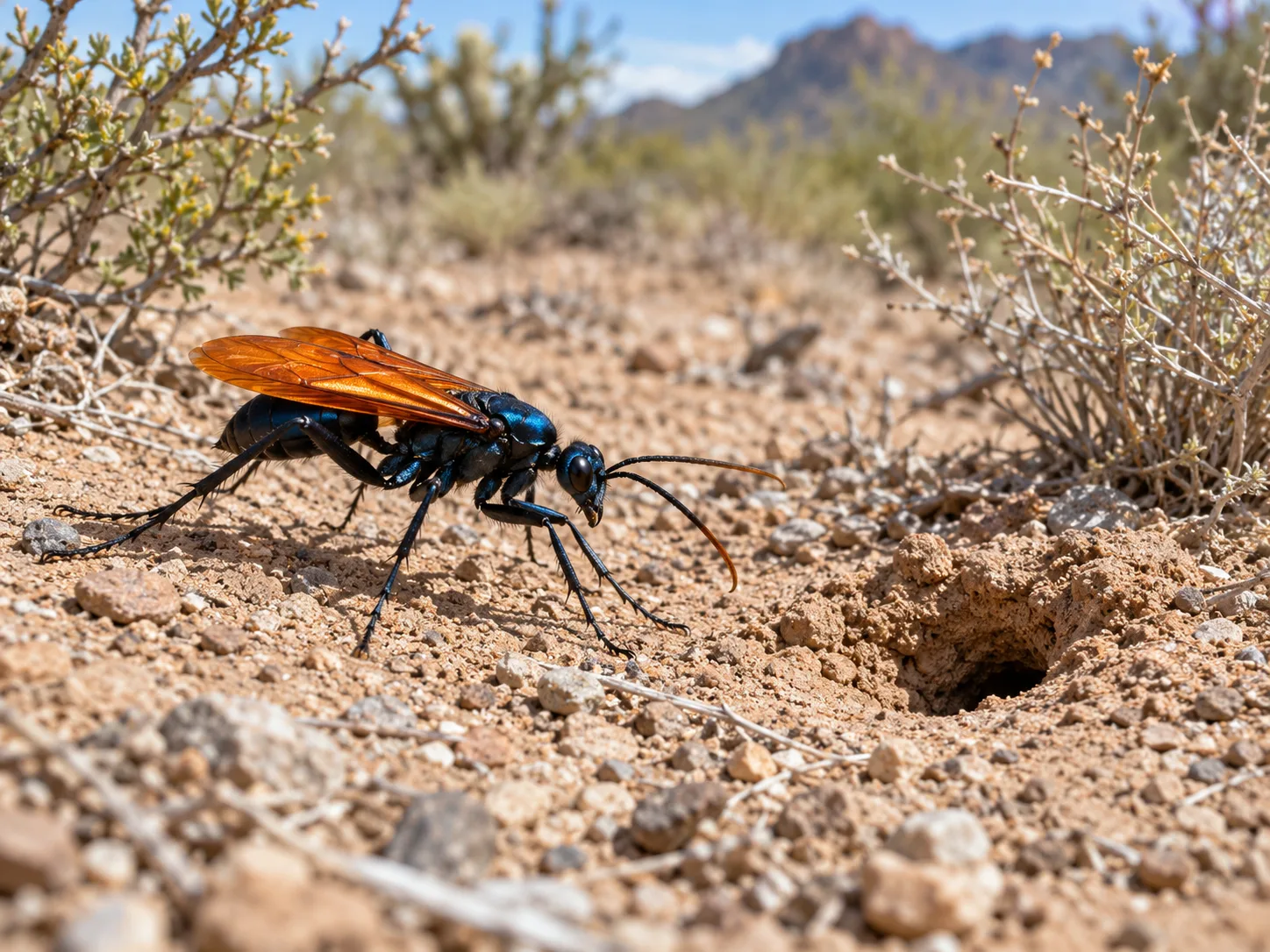
Tarantula hawks lead solitary lives; each female works independently rather than defending a large shared colony. A hole in the soil is not enough to identify a tarantula-hawk nest. It could belong to another insect or animal, and a female may use a tarantula’s burrow as part of the life cycle rather than create a visible paper nest like social wasps do.
This distinction makes “how to destroy the nest” a poor first question. Do not pour anything into an unidentified hole, block it, dig into it, or place a trap beside it. Those actions can injure wildlife, expose you to a defensive insect, contaminate soil, or affect beneficial insects without addressing an actual hazard. The broader UConn Extension overview of solitary wasps is useful context: solitary wasps have different nesting habits and risks from social colonies, though it covers several wasp groups rather than tarantula hawks specifically.
Are Tarantula Hawks Dangerous to People?
They can sting, and a sting can be intensely painful. That is a reason to keep your distance, not a reason to assume the wasp is actively hunting people. Tarantula hawks do not swarm around people in the way a disturbed social colony can, and adults commonly spend their time feeding or searching for spider prey.
The risk increases when the wasp is stepped on, grabbed, pinned against clothing, or trapped inside a space with someone trying to swat it. Walk in shoes where you know these wasps occur, look before kneeling or reaching into ground cover, and avoid handling any large wasp. If a person has a known severe allergy to insect stings, plan to avoid close contact and follow their clinician’s existing emergency plan.
What a Tarantula Hawk Sting Feels Like
The sting has a reputation for severe, sharp pain. The Natural History Museum places Pepsis among the highest-ranked insects on Justin Schmidt’s pain index, a subjective scale based on sting experience. That ranking describes pain, not how much venom entered a person, how long every reaction lasts, or whether someone is having an allergic emergency.
Pain can be fierce at first and may fade over minutes, though local redness, swelling, or tenderness can last longer. Individuals react differently, and no article can predict a particular person’s response. A very painful local sting is not automatically anaphylaxis, but breathing difficulty, swelling of the mouth or face, faintness, or a rapidly spreading body-wide reaction is an emergency.
What to Do if a Tarantula Hawk Stings You
Move away from the wasp first so you are not stung again. Wash the area gently with soap and water, then apply a wrapped cold pack for about 10 minutes at a time, with breaks between applications. MedlinePlus recommends washing stings and using a wrapped ice pack in intervals; follow the page’s advice for general first aid and contact a clinician if you are unsure or symptoms are severe.
Do not cut, suck, burn, or tightly bind the sting site. A wasp sting is not treated by trying to draw out venom, and the tarantula hawk’s long stinger is not a reason to dig into your skin. If an object appears embedded, avoid probing and get medical advice.
Call emergency services immediately for trouble breathing, throat tightness, swelling of the tongue or face, fainting, confusion, or other signs of anaphylaxis. If the person has prescribed epinephrine, help them use it as directed in their emergency plan and do not wait to see whether symptoms pass. MedlinePlus lists these warning signs and first-aid steps; emergency symptoms need urgent care even if the insect’s identity is uncertain.
For a painful but limited local reaction, use only pain relief that is normally safe for you and follow its label. Seek medical advice if the symptoms are worsening, the sting is in the mouth or throat, there are multiple stings, or the person has a relevant medical condition. If possible, note what the insect looked like from a safe distance; do not try to capture it for identification.
How to Tell a Tarantula Hawk From Other Wasps
A large black wasp is not automatically a tarantula hawk. Compare size, color, flight, and setting, but use the table as a screening aid rather than a definitive identification; local species vary and photos taken at a distance can hide the details.
| Insect | Common clues | What the clue means for your response |
|---|---|---|
| Tarantula hawk | Large, dark metallic body; often orange wings; long legs; most associated with warm southern and southwestern habitats | Give one individual room; do not look for or treat a social colony based on one sighting |
| Cicada killer | Large solitary ground-nesting wasp, often with pale bands on the abdomen; females hunt cicadas | A busy-looking patch of lawn can still be individual nesting activity; do not handle or block a burrow |
| Paper wasp | Slender body and a hanging papery nest with open cells | Nest location and repeated traffic matter; keep people clear and get professional advice if it is near a doorway |
| Yellowjacket | Often smaller with yellow-and-black markings; workers may repeatedly visit food or defend a colony | Repeated activity or a nest close to people deserves a different assessment from one solitary wasp |
If the insect is not clearly identifiable, do not select a pesticide or treatment based on a guess. Photograph it from a safe distance, note where and when you saw it, and ask a local extension service or licensed pest professional to identify it. Correct identification is especially important when a supposed “ground nest” could be a solitary wasp’s burrow or a different animal’s opening.
Tarantula Hawk in the House? Safe First Steps
Keep children and pets out of the room and do not swat at the wasp. A swat can pin it against a surface or drive it into clothing, increasing the chance of a defensive sting. If you can do so without approaching it, close interior doors to limit where it can fly and open an exterior door or window with a screen-free route out.
Then give it time and space to leave. Do not try to catch it in a jar with your hands near the insect, vacuum it, or spray the room. If the wasp is on a curtain or near a person with a serious allergy, or if you cannot create an exit without getting close, leave the room and contact a pest professional who can safely remove or identify it.
One insect indoors does not establish that tarantula hawks are nesting in the walls. Check whether a screen is torn, a door is left open, or a gap around a window allows insects through. If the same kind of wasp continues to appear, record dates and locations and ask for an inspection rather than treating the entire house.
Should You Remove a Tarantula Hawk?
Usually, no. If one is outside and not interfering with a high-traffic path, the safest and simplest choice is to let it move on. A tarantula hawk is solitary, so a single sighting does not imply the kind of colony that a wasp spray or bait trap is designed to control.
If it repeatedly appears in a place people must use, first reduce accidental contact: keep children and pets away from the area, reroute foot traffic, and avoid trimming or digging near the wasp. You do not need to remove flowering plants simply because an adult visits them. If you cannot avoid the area or someone at home has a serious sting allergy, get a professional assessment focused on identification and the least disruptive effective option.
That is also why a bottle trap or broad repellent is a poor default. A nectar-feeding wasp may investigate flowers, but there is no colony of workers for a sugar bait to reduce; a trap can catch other insects and still leave the encounter problem unchanged. Products intended for social wasps target a different situation and should not be chosen solely because the insect is large. If there is no confirmed repeat activity or unsafe location, do not purchase a pesticide just to make one visitor disappear.
Avoid DIY nest destruction, powders, gasoline, or improvised soda traps. A hole is not proof of a tarantula-hawk nest, and the wrong treatment can expose the user or nearby pets to chemicals while harming non-target insects. Even when a pest professional recommends treatment, ask what species and target they confirmed, why treatment is needed, and how it will protect people, pets, and other wildlife.
How to Prevent Encounters Around Your Home
You cannot reliably keep every native wasp out of an outdoor garden, and the goal should be fewer accidental contacts rather than eliminating all wasps. Focus on places where people walk, sit, or reach without looking. Keep doors and screens in good repair so an outdoor insect has less opportunity to enter the home.
Yard Habits That Reduce Accidental Contact
Wear shoes in areas where tarantula hawks are common, especially near dry ground and flowering beds. Look before kneeling, weeding, picking up yard debris, or reaching into a plant. If you see a wasp on a flower or moving over soil, pause and give it a clear route away rather than waving your hands or trying to scare it.
Teach children not to touch or chase large insects and help them keep a few feet of space from any wasp. Move play and seating areas away from a recurring flight path if needed, but do not dig up a suspected burrow just to investigate it. If a ground opening appears in a high-use spot, mark the area from a distance and ask a local expert to identify it before deciding what to do.
Exclusion Steps if One Gets Indoors
Repair damaged window screens, fit door sweeps where there is a visible gap, and seal small openings around doors or windows. These measures are general insect exclusion; they prevent accidental entry but do not remove an outdoor tarantula hawk or identify a soil burrow.
If insects repeatedly enter through a particular area, inspect that route and consider a professional inspection. Avoid sealing a hole in a wall or foundation if you do not know what uses it, and do not block an opening that could serve ventilation or drainage. Targeted exclusion is safer than spraying rooms or the surrounding yard without confirming the source.
When to Call a Pest Professional
Call a licensed pest professional when you cannot safely get a wasp out of an occupied room, when several similar insects repeatedly enter the house, or when suspected nesting activity is close to a doorway, play area, or other unavoidable route. Contacting a professional is also reasonable when someone in the household has a serious sting allergy and you need help reducing exposure. Ask the technician to identify the insect rather than treating every large wasp as the same pest.
A useful inspection should answer three questions: What species is present? Is there a real nest or entry route, or was there a single visitor? What is the least disruptive way to reduce the specific risk? Be cautious of anyone recommending that you handle the wasp, pour a liquid into an unidentified hole, or treat a broad area without explaining the target and precautions.
For a single wasp outside, a professional visit is rarely necessary. The decision changes when the insect is inside and inaccessible, sightings keep recurring, or the location makes accidental contact hard to avoid. A clear description, photo taken from a distance, date, and exact location can help the professional arrive prepared without asking you to collect a specimen.
Conclusion
Tarantula hawks are impressive but solitary spider wasps: adults feed at flowers, and females hunt tarantulas to provision their young. Their sting can be extremely painful, so do not handle, swat, or step near one; the risk of a serious medical reaction depends on the person, not on a pain-index ranking.
For a lone wasp outdoors, create space and let it go. For one indoors, isolate the room and offer an exit if you can do so safely; call a professional when it cannot be moved without close contact or the sightings keep recurring. Sting first aid should stay simple, and breathing problems or face and throat swelling call for emergency care. Correct identification is the best first step toward a proportionate, safer response.



