Tillandsia Ionantha Care: Light, Water, and Bloom
Get Tillandsia ionantha care right: choose bright filtered light, adjust weekly soaking to your room, prevent trapped water, and grow healthy pups after bloom.
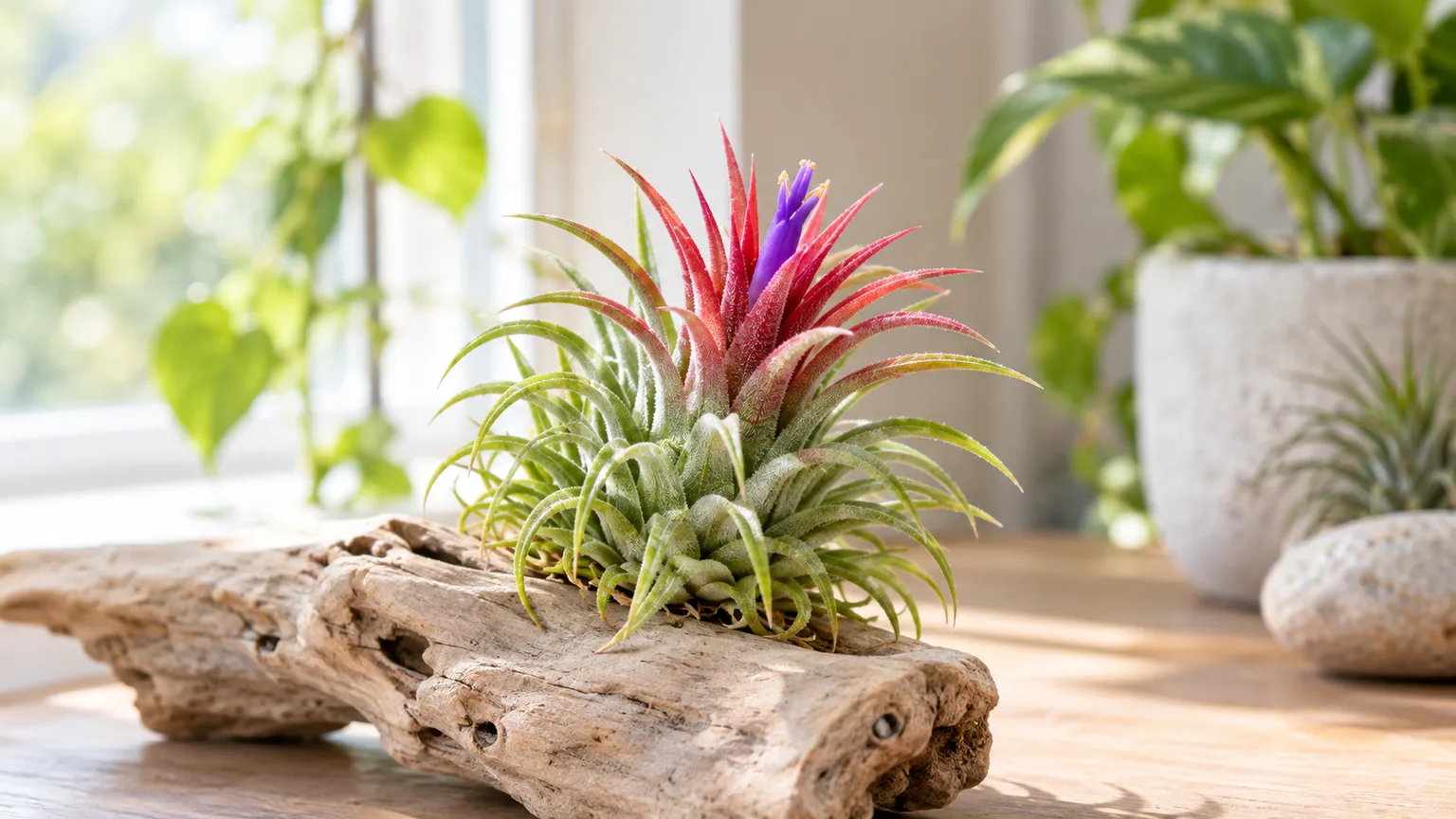
A sky plant is still a plant with a real watering routine. Tillandsia ionantha can live without potting soil, but it cannot live on humidity alone: it needs bright light, a thorough drink, and enough moving air to dry before moisture gets trapped in its tight center. Once those three jobs are planned together, care becomes easier than the word “air plant” suggests.
The main adjustment is to water according to the room, not simply the date on a calendar. A warm, bright shelf with dry indoor air can dry an ionantha much faster than a cool, humid room; a closed glass vessel can stay wet long after the leaves look dry. Start with the routine below, then use the plant’s texture and the time it takes to dry to refine it.
Sky plant care at a glance
| Need | A practical starting point |
|---|---|
| Light | Bright, filtered light; protect from hot afternoon sun behind glass |
| Water | Remove from its display and soak about once a week to start; adjust to how quickly it dries |
| Drying | Shake out water and leave the plant inverted or on its side in open air until fully dry |
| Display | Use a mount or open holder; avoid soil and sealed terrariums |
| Temperature | Keep warm and frost-free; do not soak a cold plant that will stay wet |
| Feeding | Optional, very dilute air-plant or bromeliad fertilizer during active growth |
| Growth cycle | A rosette flowers once, then produces offsets that can become a clump or new plants |
This table is a baseline rather than a promise that every home needs the same frequency. If your plant is mounted where it dries in under an hour, increase hydration or move it away from hot, drying air; if it remains damp for much of the day, improve airflow and lengthen the interval.
Why ionantha grows without soil
Tillandsia ionantha is a small evergreen bromeliad native to Mexico and Central America. In nature it grows as an epiphyte on other plants or sometimes as a lithophyte on rock; it does not parasitize its host. The roots that form on a cultivated plant mostly help it grip a branch, cork, or other support rather than anchor it in potting mix. NC State Extension describes the species as a small epiphytic perennial and notes that its roots function as holdfasts.
Instead of taking up most of its water through soil roots, an air plant absorbs moisture and nutrients through specialized leaf scales called trichomes. Those tiny scales can give the foliage a silvery or frosted cast, especially when dry. They do not make the plant self-watering: rainfall and fog in nature still supply actual moisture, so a houseplant needs deliberate watering. The Royal Horticultural Society’s air-plant guide explains both the role of trichomes and why ventilation matters after watering.
Ionantha has narrow, curved leaves arranged in a compact rosette. As it approaches flowering, the inner leaves often flush red or pink, and a short flower stalk bears violet-blue flowers; the RHS species profile describes the color change and bloom. Commercial forms vary: NC State lists names such as ‘Druid,’ ‘Fuego,’ ‘Guatemala,’ ‘Mexican,’ ‘Rubra,’ and ‘Scaposa.’ Labels can be inconsistent, so judge a plant by its actual leaf texture and drying speed rather than assuming every named form needs a dramatically different routine.
Give it bright, filtered light
Place an ionantha where it receives strong daylight without baking in intense afternoon sun. An east-facing window is often an easy starting point; a south- or west-facing window can work if a sheer curtain, a little distance from the glass, or a nearby bright shelf softens the hottest rays. In a dim room, move it closer to a window or use a full-spectrum grow light on a steady daytime schedule rather than trying to compensate with extra water.
A few hours of mild morning sun may be tolerated after the plant has adjusted, but sudden direct sun through hot glass can bleach or scorch the leaves. Increase exposure gradually over a week or two and check the surface facing the window. The aim is bright light that supports compact growth and flowering, not maximum sun at any cost: too much light combined with heat can dry a small rosette faster than its watering routine can replace moisture.
Color is not a simple light meter. Red inner leaves can be the plant’s normal pre-bloom display, and some forms color more strongly than others; look for a flower stalk or an overall firm, healthy rosette before concluding that a red plant is stressed. Pale, elongated new leaves point more toward insufficient light, while bleached patches on the window-facing side suggest excess sun.
Water thoroughly, then dry completely
Most indoor ionanthas do better with a full soak than with a few quick sprays. A useful starting routine is one soak each week, with the interval shortened during hot, bright, dry periods and lengthened when a cool, humid room keeps the plant wet for longer. The Associated Press gardening column describes a weekly 30- to 60-minute soak as a general starting point; specialist grower Air Plant City also recommends soaking, while emphasizing that species and room conditions change the schedule.
Advice differs across references because the growing conditions differ. For example, RHS guidance for air plants under its cultivation conditions gives a more frequent spring-to-autumn immersion schedule, while home-care guides often begin around weekly. Treat the schedule as an experiment: keep the light and display stable for a few weeks, note whether the leaves stay open and firm, and adjust one variable at a time. Do not mist every day as a substitute for soaking; a fine spray can refresh the surface but may not wet the whole plant enough to rehydrate it.
A dependable soak-and-dry routine
- Remove the plant from its shell, glass globe, or mount if that object cannot drain freely. Use a clean bowl of room-temperature water deep enough to submerge the rosette.
- Soak for about 20 to 30 minutes as a starting point. If the foliage has become tightly curled or feels unusually dry and papery, a longer soak of up to about an hour can help; prolonged storage underwater is not appropriate.
- Lift the plant and gently shake it, then turn it upside down over a towel or drying rack. Let water drain from the center instead of putting the wet plant straight back into a vessel.
- Leave it in bright, indirect light with good air movement until the leaves and crown are dry. Several hours may be needed in a cool room; the plant should not sit wet overnight or stay damp inside a display.
- Return it to its normal position only when dry. If the rosette remains wet for most of a day, fix the display or airflow before increasing the watering frequency.
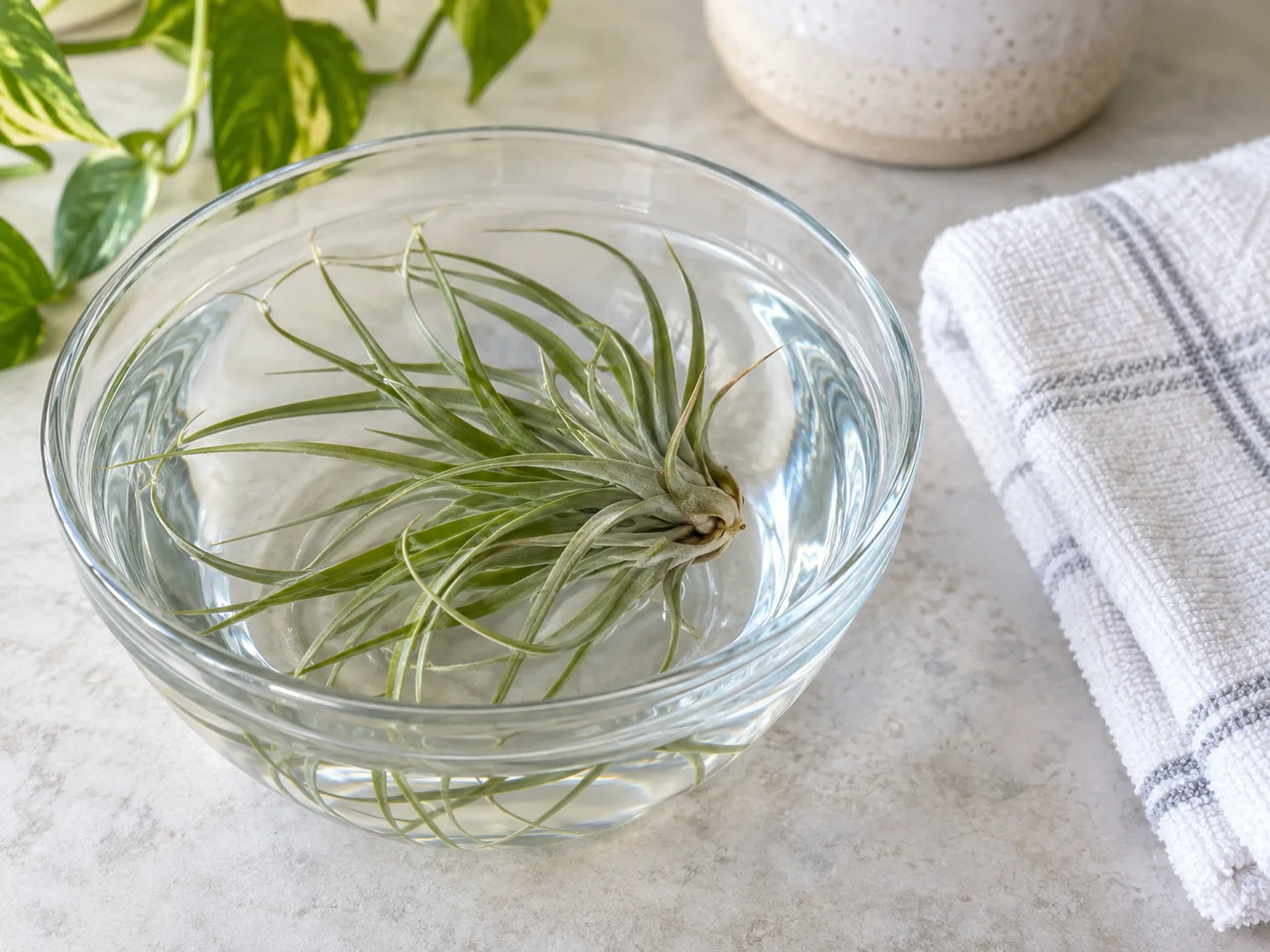
A plant mounted to wood can be watered under a gentle stream or soaked with its mount if the mount dries quickly. If the support stays wet, water the rosette separately or rinse it carefully, then angle it so the center drains. Water sitting at the base of leaves is a bigger risk than the number of minutes the plant spent submerged.
Choose water for your local conditions
Rainwater is a good option when it is clean and easy to collect, but you do not have to buy special water just because the plant is an air plant. Clean tap water may work where the supply is not heavily mineralized. If you see a persistent chalky film on the leaves or live in a hard-water area, try rainwater or a low-mineral source; the RHS warns that bicarbonates from hard tap water can accumulate on trichomes. Avoid artificially softened water, which can add sodium. Distilled or reverse-osmosis water has few dissolved minerals, so do not use it indefinitely without a suitable dilute fertilizer. Air Plant City notes that clean tap water can be workable, while RHS places more emphasis on avoiding hard water: the useful decision is whether your water leaves deposits, not whether it comes from a tap.
If a water source is questionable, test it on one plant and look for residue over several weeks. Flush the leaves occasionally with clean water if a mineral film is forming, then shake the rosette well and dry it fully. Avoid adding ice, sugary drinks, or homemade fertilizer mixtures; a small, measured amount of suitable plant food is more predictable.
Balance humidity with airflow
Ionantha appreciates humid air, but room humidity cannot replace watering, and humidity without air movement can keep the crown damp. Heated rooms and air conditioning often lower humidity, so a plant that thrived on a shaded bathroom shelf in summer may need more frequent soaking in a dry winter living room. Do not chase a single humidity percentage: how quickly the plant dries after a soak is a more useful household observation than an inexpensive sensor’s isolated reading.
If your home is very dry, group the air plant near other plants or run a room humidifier nearby, while leaving space for air to circulate around the rosette. Avoid aiming a fan directly at the leaves; a gentle movement of room air is enough. A steamy bathroom helps only if it also has adequate light and ventilation. A dark bathroom with stagnant, wet air is not a better location than a bright shelf in a drier room.
Choose a display that drains and breathes
A sky plant can sit on a dry shelf, rest in a shallow open bowl, or attach to cork, driftwood, or a ceramic holder. Because its roots are holdfasts, it does not need a pot full of soil. Give the base some support without packing moss or decorative filler tightly around the center, where water could collect and where new pups may emerge.
Glass globes can look attractive but are the most common display trap. A globe with a narrow opening or a sealed lid slows drying; if you use one, remove the plant for watering and drying, and return it only when completely dry. An open terrarium with generous airflow is safer than a closed bottle garden. Do not leave the rosette sitting in a dish of water or press it into wet moss. For a mounted display, use a loose tie or a small amount of plant-safe adhesive on a non-growing contact point, keeping the crown free and the plant removable for care.
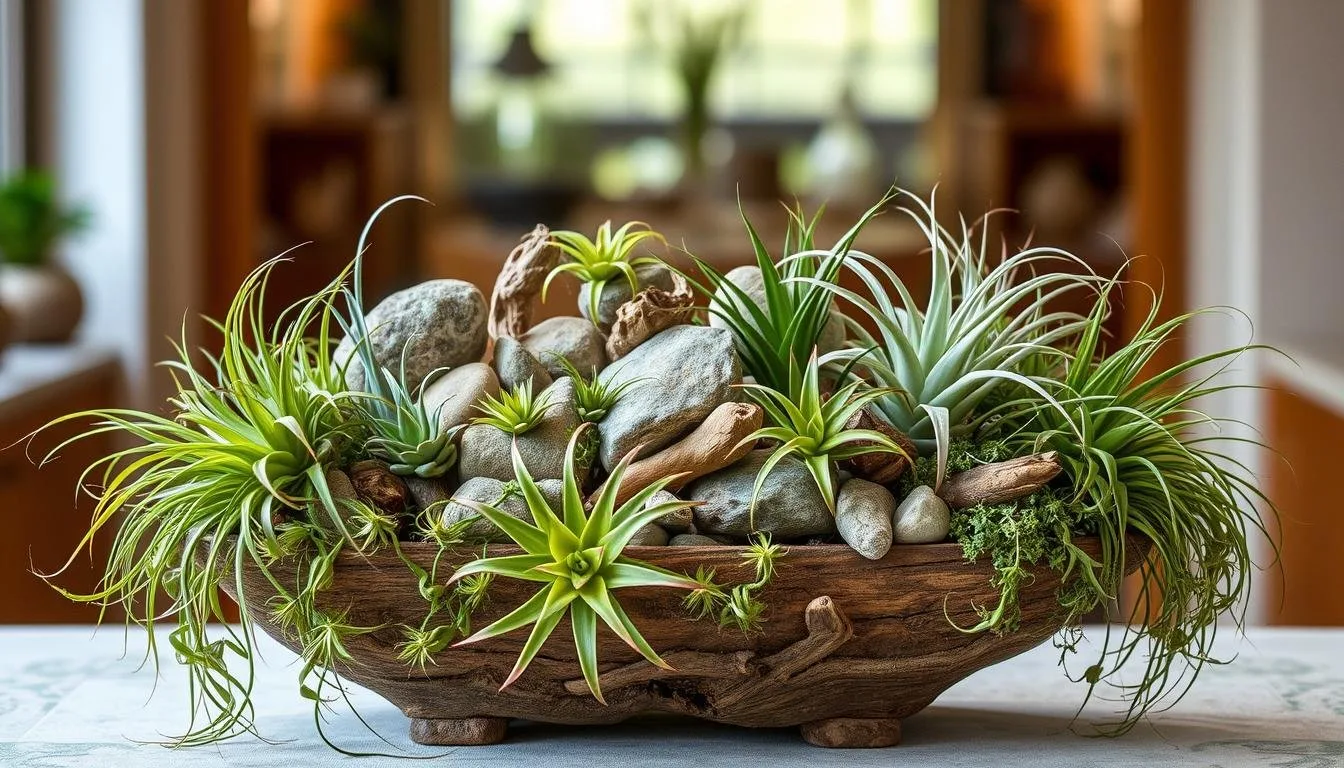
Plan the display around watering before you attach or arrange the plant. If the only way to soak it is to dismantle a fragile arrangement, the setup will make routine care easy to skip; choose a removable cradle or mount the plant where you can reach it. Displays should make the plant visible and stable while leaving the leaves open to light and air.
Keep the plant warm and adjust with the seasons
Grow ionantha indoors in a comfortable, warm room and protect it from frost, cold drafts, and chilly window glass. It can spend warm months outdoors in a shaded or dappled position with good airflow, but introduce it to brighter conditions gradually and bring it back inside before cold nights. A sheltered tree branch or covered porch can mimic the air movement of an epiphytic growing site without exposing the plant to harsh midday sun.
Watering changes with both season and placement. A plant outdoors in breezy heat can dry in a few hours and need more frequent soaking; one in a cool room in winter may stay damp much longer. RHS advises avoiding watering when temperatures are below about 12°C (54°F), because a cold plant may remain wet too long. That is a practical watering caution, not a guarantee of a universal survival threshold. If your home is cold, water earlier in the day and give the plant a warm, airy place to dry.
Feed lightly, if needed
Fertilizer is optional for a healthy plant receiving regular clean water and good light. If growth is slow or you want to support a mature plant during active growth, choose a liquid fertilizer intended for air plants or bromeliads and dilute it more than the label’s standard houseplant rate. NC State Extension recommends dilute liquid fertilizer during the growing season; conservative feeding is safer than a strong dose because Tillandsia leaves are directly exposed to the solution.
Apply a small amount with a watering session no more than about once a month in spring and summer, then rinse or follow with a plain-water soak if residue appears. Do not put fertilizer into a tray and leave the plant soaking, and do not feed a dry, stressed, or rotting plant. Too much fertilizer can leave mineral residue or damage leaf tissue; a weak plant needs the cause of stress corrected first, not a stronger feeding schedule.
Understand the red blush, flowers, and life cycle
The inner leaves often turn pink or red as a mature ionantha prepares to bloom. This color change is part of the plant’s appeal, not automatically a sign of drought or sunburn. In the typical form, a short central bloom produces violet-blue flowers among colored bracts; varieties can differ, and some selections such as ‘Druid’ are sold for pale or white flowers. The NC State species profile describes the red pre-bloom leaves and cultivar variation.
A rosette flowers once in its life. After flowering, it can produce offsets at the base while the original rosette gradually declines; it does not usually collapse the day the flower fades. Keep watering the whole clump as normal and remove the spent flower stalk with clean scissors once it has dried or become untidy. Fertilizer cannot force a young plant to bloom on demand, and a calendar date is not a reliable prediction because maturity, light, and growing conditions all matter.
If a red plant remains firm and has a visible flower spike, continue normal care rather than trying to reverse its color. If it is red but also brittle, bleached, or collapsing at the base, investigate sun exposure or rot. Treat color as one clue among several rather than a diagnosis on its own.
Propagate pups without rushing them
Offsets, often called pups, form around the mother rosette after or around flowering. Let each pup grow until it is at least about one-third the size of the parent before separating it; the RHS propagation guidance and NC State profile use this approximate size as a practical cue. A larger pup is easier to handle and has more leaf area to hydrate independently.
To separate one, hold the parent steady and gently rotate or pull the pup sideways at its base. If it resists, stop and wait several weeks rather than tearing leaves or the growing point. Once free, water and dry it using the same routine as an adult, and keep it in bright filtered light while it establishes. It does not need soil or a special rooting hormone.
You can also leave pups attached to form a clump. Clumps often look fuller and support themselves more easily on a mount, but the center can become crowded; space the rosettes so water drains and air reaches the inner leaves. Remove a mother plant only after it has completely dried and died, leaving healthy pups attached if they are still growing.
Trim only what is dead or damaged
Routine pruning is unnecessary. If an outer leaf has dried completely, ease it away only when it releases readily; check underneath first because pups may be hidden at the base. Brown tips can be trimmed with clean scissors for appearance, following the leaf’s natural angle, but the damaged portion will not turn green again.
Do not cut into the crown or remove firm green leaves to make the plant look smaller. The center is the growing point, and damage there can prevent new growth. Roots can be left alone: they are useful anchors even though the plant does not feed through them like a typical potted houseplant.
Troubleshoot changes in the leaves and crown
Read the location and texture of a symptom before changing care. Dry-looking outer tips, pale leaves, and a soft dark center point to different problems; extra soaking is not the right first move for every brown mark. Check when the plant was last watered, how long it stayed wet, which side faces the window, and whether any residue remains on the leaves.
Leaves curl, wrinkle, or feel papery
A gradual, tight inward curl with a dry or papery feel usually suggests dehydration, especially if the leaves have lost their normal thickness. Give the plant a thorough soak, shake out excess water, and let it dry in open air; then shorten the interval slightly or move it away from heating vents and hot afternoon sun. If the leaf shape is only mildly curved and the rosette remains firm, that may be its natural form rather than a crisis.
Do not respond to dry leaves by keeping the plant constantly wet. First check that the water reaches the whole rosette and that the plant is not mounted in a way that blocks soaking. If it quickly dries in a warm, bright spot, add a midweek rinse or soak and observe whether new leaves stay more open; old damaged tips will not recover.
The center is soft, brown, or black
A soft or dark crown, especially when leaves pull away with little resistance, is a warning for rot rather than thirst. Remove the plant from any closed vessel, stop misting, and let it drain in a warm, airy place; advanced rot often destroys the growing point and may not be reversible. If healthy pups are present, keep them separate from a rotting mother when they can be removed without force.
Look for the conditions that allowed water to sit: the plant went back into glass while wet, its center was not shaken out, or it stayed cold after watering. Correct those conditions before the next soak. A few dry outer leaves alone are not proof of rot; the crown’s firmness and the ease with which leaves detach are more useful clues.
Tips or patches turn brown, pale, or bleached
Crisp tips can follow dry air, infrequent watering, or mineral deposits, so compare the water routine with the surface of the leaf. White crust or repeated tip damage after tap-water use is a reason to trial rainwater or another low-mineral source and to rinse the plant clean. Brown patches concentrated on the side facing a window suggest sun scorch; move it back or filter the light, then acclimate slowly if you increase exposure again.
Pale, stretched new leaves more often indicate too little light. Move the plant closer to a bright window over several days, not from deep shade straight into full afternoon sun. A pink or red center with firm leaves is different from bleaching: if the color sits mainly in the inner leaves and a flower spike is emerging, it may simply be preparing to bloom.
Check for pests before treating
Ionantha is not usually a pest-prone houseplant, but mealybugs or scale can hide where lower leaves overlap or where the plant touches its mount. The RHS species profile lists mealybugs among possible pests, while NC State reports few routine pest or disease problems. Inspect the crown, leaf bases, and nearby plants when you see cottony spots, small bumps, sticky residue, or unexplained decline.
Isolate an affected plant and remove visible insects with a soft brush or damp cotton swab, taking care not to leave the rosette wet. Avoid spraying household oils or random pesticide mixtures onto the silvery leaves; their coating is part of how the plant absorbs moisture. If the infestation persists, use only a product labeled for the plant and pest, test a small area first, and follow its directions. Improve display cleanliness and check new plants before placing them beside the collection.
Conclusion
A healthy Tillandsia ionantha needs a simple rhythm: bright filtered light, a complete soak often enough to keep the leaves firm, and a full dry with air moving around the rosette. Soil is unnecessary, but water, drainage, and a breathable display are not. Start with a weekly soak, adapt to the room’s heat and humidity, and use the plant’s texture and crown condition to guide the next change.
The red blush and violet flowers are part of its life cycle, and pups give you a way to keep the plant’s growth going after its first bloom. Choose a display you can remove and dry easily, avoid strong fertilizer or sealed wet glass, and let offsets grow before separating them. These small decisions make a sky plant both a long-lived display and a manageable houseplant.



