11 Trees With Helicopter Seeds (Samara Fruit)
Compare 11 trees with helicopter seeds by samara shape, mature size, site needs, invasive risk, and the clues that separate look-alikes.
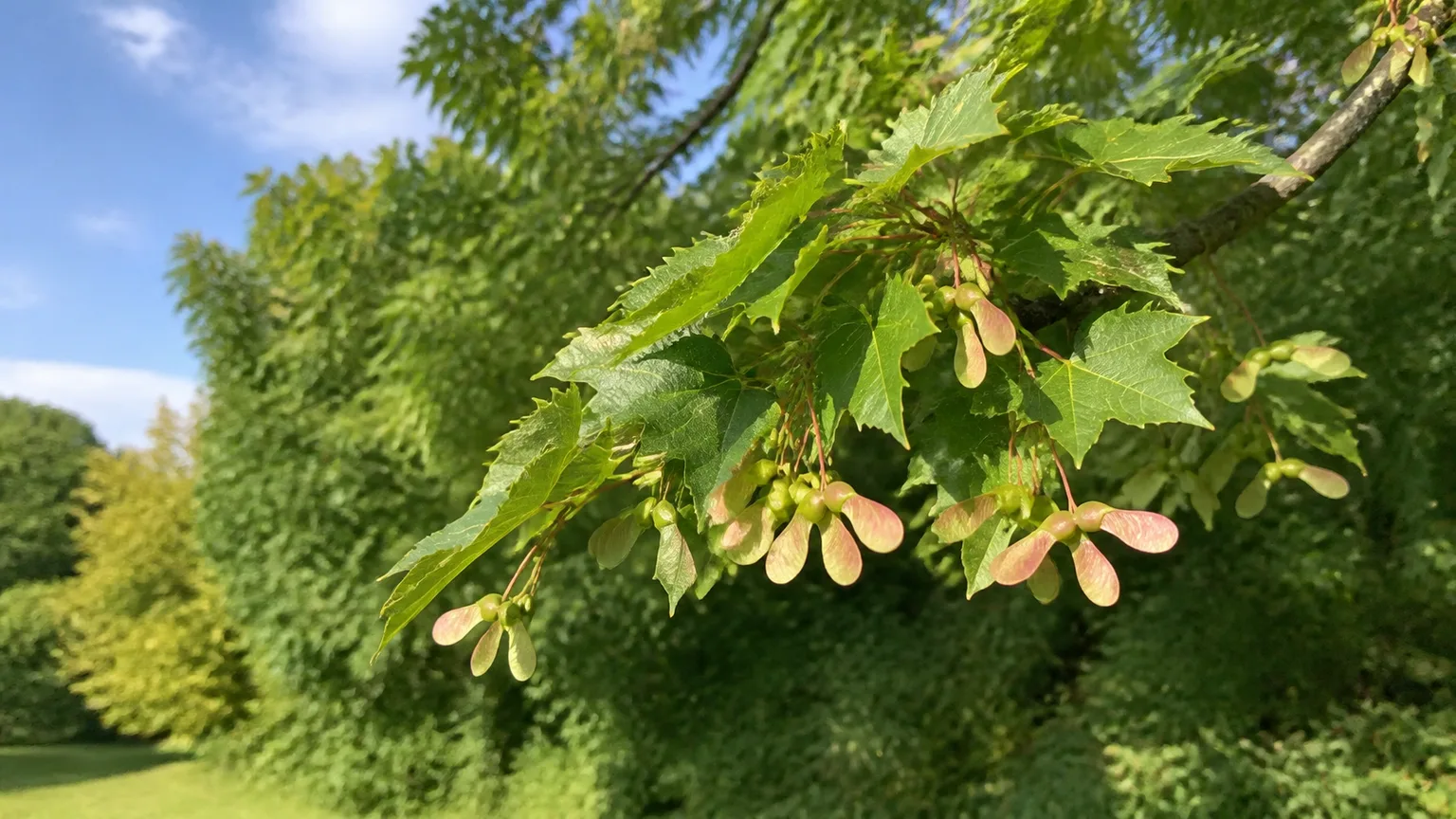
If a papery seed whirls down from a tree, “helicopter seed” is the friendly name you are likely to hear. The botanical term is samara: a dry fruit with a wing that helps carry the seed on wind. Maples make the familiar paired spinners, but ash, elm, hoptree, tuliptree, and tipu tree make very different samaras too.
The shape can narrow down what you are looking at, but it is not enough for a certain identification by itself. Use the wing together with the leaves, bark, twig arrangement, fruiting season, and the tree’s location. That matters when a volunteer might be a desirable native tree—or an invasive species that should not be allowed to mature.
What “helicopter seed” means
A samara is a fruit, not merely a naked seed. The fruit wall grows into a thin, papery, fibrous wing around or beside the seed. As the fruit drops, the wing increases drag and can make the samara autorotate, slowing its fall and giving moving air more time to carry it away from the parent tree. The USDA Forest Service account for sugar maple records that its large papery wings can carry samaras at least 100 meters in suitable wind.
That design spreads risk. A tree does not need every seed to land in a perfect spot; it needs enough seeds to reach open, moist, or otherwise favorable ground. Red maple samaras can ripen and disperse in spring, while other species release them in summer, fall, or even after they hang through winter. The season is therefore one of the best clues after the fruit shape.
The common nickname is a little misleading in two ways. First, not every samara spins dramatically; ash keys and many elm fruits flutter or glide rather than twirl like a maple. Second, “helicopter tree” does not name one family or one kind of landscape plant. It describes a dispersal feature shared by trees and shrubs with very different sizes, root behavior, and ecological effects.
How to identify a samara-bearing tree
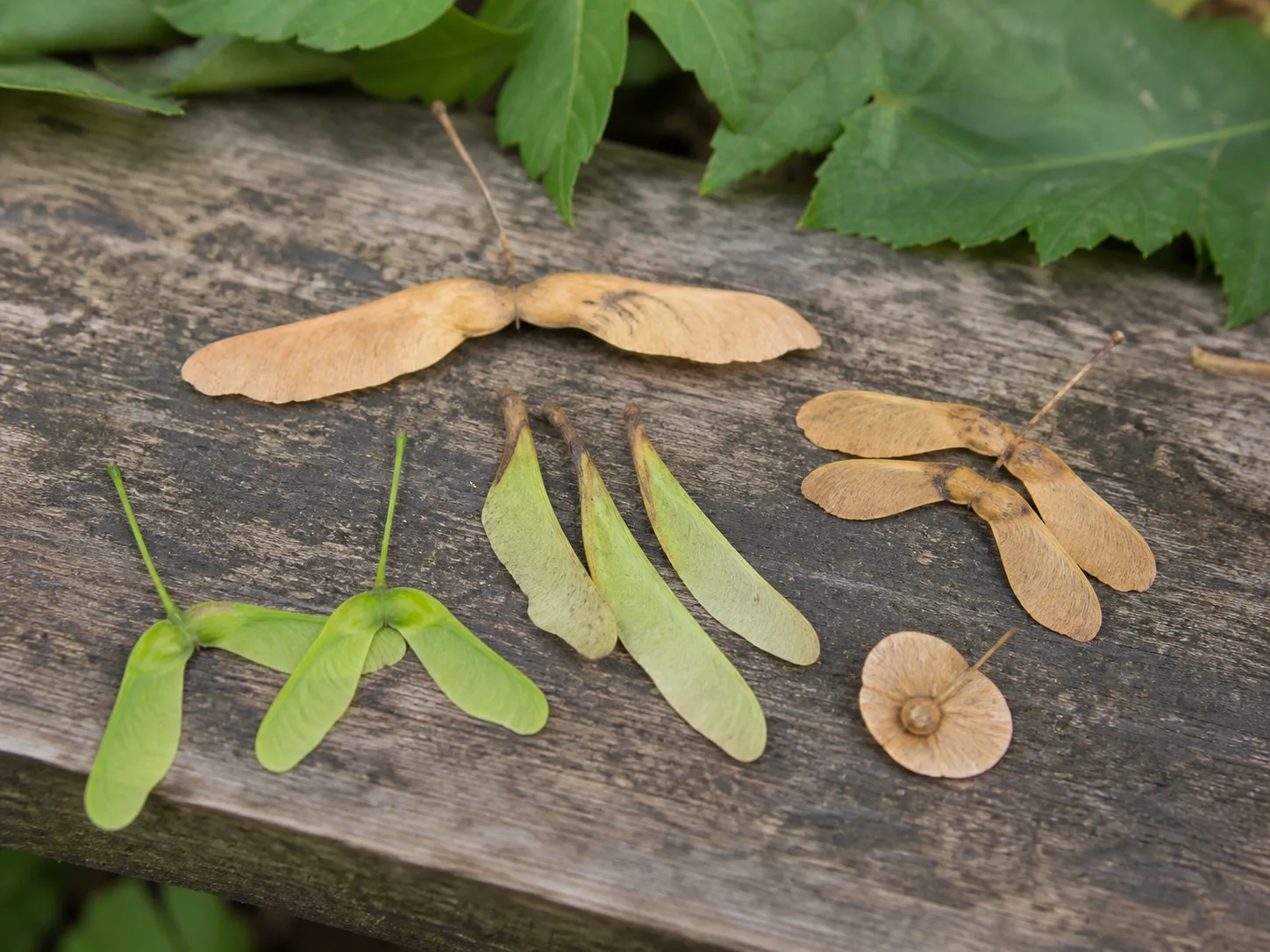
Start with the fruit in your hand, then look up at the tree that produced it. Note whether the wings are paired or single, whether the seed sits at the center or one end, whether the fruit is round or elongated, and whether it hangs in a loose cluster, a chain, or a tight cone. A quick photograph of the fruit beside a ruler is more useful than a close-up with no scale.
Next, record three tree clues: leaf arrangement, leaf shape, and bark or twig details. Maples usually have opposite leaves and palmately lobed blades. Ashes have opposite, pinnately compound leaves. Elms usually have alternate, single, asymmetrical leaves. Tree-of-heaven also has compound leaves, which is why its smooth leaflet margins, foul odor when crushed, and distinctive twigs matter.
Paired maples versus single-winged ash keys
Maple fruits are usually two samaras joined at the seed end. They form a V, U, or nearly straight pair depending on species. Red maple tends to show a narrower V, silver maple opens much wider, and Norway maple’s wings can lie almost flat. Japanese maple samaras are smaller and often arch upward, but cultivar variation is substantial.
Ash fruits are single-winged samaras, commonly called keys. The seed cavity is long and narrow, and the wing extends from one end like a paddle. Green ash keys often hang in dense, drooping clusters. The USU Forestry identification guide describes green ash fruit as a paddle-shaped samara, while UF/IFAS describes the fruit as an oblanceolate to spatulate winged samara.
Elm, hoptree, tuliptree, and tipu clues
Winged elm fruits are small, flat, and often hairy around the margin, with one seed in the middle. Common hoptree produces a much rounder, wafer-like samara; NC State Extension’s plant profile notes that each circular fruit can contain two or three seeds. Those two fruits do not look like maple helicopters once you compare them side by side.
Tuliptree makes a cone-like aggregate of many narrow samaras that breaks apart as it matures. Tipu tree, a warm-climate South American legume, makes a larger, leathery, one-sided winged fruit with the seed-bearing portion near the base. The Kew Plants of the World Online profile confirms the species identity and its South American range; in the United States it is a landscape tree mainly for frost-free or nearly frost-free climates.
Quick comparison of the 11 trees
| Tree | Samara shape | Typical landscape scale | Best first clue | Main caution |
|---|---|---|---|---|
| Red maple | Paired, narrow V | Large shade tree | Red flowers, lobed leaves | Shallow roots and surface-root competition |
| Silver maple | Paired, wide angle | Large, fast tree | Silvery leaf undersides | Weak wood and surface roots |
| Norway maple | Paired, nearly flat | Large shade tree | Flat samara wings, dense shade | Invasive in parts of North America |
| Japanese maple | Small paired arch | Small tree | Fine or deeply cut leaves | Cultivar size and sun tolerance vary |
| Winged elm | Small single, hairy-edged | Medium to large tree | Corky wing ridges and fuzzy fruit | Dutch elm disease and site size |
| Common hoptree | Round, wafer-like | Small tree or shrub | Three-part leaves | Can smell unpleasant when bruised |
| Tree-of-heaven | Long, twisted single wing | Large, fast tree | Smooth leaflets and foul odor | Invasive; resprouts after cutting |
| Tuliptree | Cone of many samaras | Very large tree | Tulip-shaped leaves | Outgrows small yards quickly |
| Tipu tree | Large, leathery wing | Medium to large tree | Warm-climate compound foliage | Frost, roots, and mature size |
| Green ash | Narrow, single paddle | Large tree | Opposite compound leaves | Emerald ash borer and seed litter |
| Velvet ash | Small, single paddle | Medium to large tree | Southwestern ash habit | Ash pests, water, and heat fit |
The size descriptions are planning categories, not guarantees. Cultivar, climate, irrigation, soil depth, and pruning can change growth, so check the botanical name and mature dimensions before planting. A tree that is “fast-growing” in a reference may be much slower on a dry, compacted site—and much larger than expected in deep, irrigated soil.
1. Red maple (Acer rubrum)
Red maple is one of the most recognizable native trees with helicopter seeds. Its paired samaras often appear red, pink, or yellow, and their wings form a narrow V before turning tan or brown. They commonly ripen in spring, sometimes before the canopy is fully leafed out. NC State Extension describes the fruit as a paired, V-shaped samara and places the species across eastern North America.
The tree earns its name from more than the fruit: young twigs, spring flowers, and fall foliage can all show red. It is adaptable to full sun or partial shade and tolerates more soil variation than many maples, but the practical trade-off is a shallow, spreading root system. Do not tuck it into a narrow strip beside paving and expect turf or perennials to thrive beneath it.
Choose red maple when you have room for a large native shade tree and want seasonal color plus wildlife value. If you are collecting samaras for propagation, gather fresh, plump fruits soon after they mature rather than saving dry brown wings for months; red maple seed can germinate without the long cold treatment required by some other maples.
2. Silver maple (Acer saccharinum)
Silver maple produces paired samaras with wings that spread at a wide angle, sometimes nearly straight across. The fruit develops in spring or early summer, often in conspicuous clusters. Its deeply lobed leaves have silvery undersides, a useful clue when the seeds are scattered far from the canopy. NC State Extension lists silver maple as a fast-growing tree that tolerates moist soil and occasional flooding.
That wet-soil tolerance is why it appears along streams and low sites, but it is not a free pass for planting beside a house. Silver maple has relatively weak wood, can shed branches in storms, and forms surface roots that interfere with lawns and hardscape. Its quick growth can look like a bargain when a new yard needs shade, yet the mature maintenance burden is usually much greater than the seedling suggests.
If a silver maple is already established in a spacious, suitable place, clean up samaras as needed and monitor branch structure. If you are choosing a new tree for a small yard, compare mature width, wood strength, and root space before being persuaded by fast growth.
3. Norway maple (Acer platanoides)
Norway maple makes paired samaras whose wings commonly lie nearly flat, around a straight line. That geometry is one of the quickest ways to separate it from a sugar maple, whose samara pair usually forms a more pronounced horseshoe. UConn Extension explains the flat 180-degree wings and the species’ ability to germinate in shade.
The identification matters because Norway maple is invasive in parts of North America. It tolerates shade, compaction, drought, and urban pollution, which are excellent survival traits for the tree but also help seedlings move into woodlands and suppress native understory plants. The University of Maryland Extension’s Norway maple profile also notes the distinctive flattened samaras and vigorous roots.
Do not plant Norway maple simply because a mature tree looks like a dependable shade tree. Check your state or province’s invasive-plant guidance first. If you are removing a volunteer, verify the identification using leaves, bark, and samara angle; native maples can be valuable trees, and a mistaken removal is an avoidable loss.
4. Japanese maple (Acer palmatum)
Japanese maple is the small, ornamental member of this group. Its paired samaras are usually smaller than those of street-size maples, and their wings curve upward into an arch as they mature. The leaves may be broad-lobed, finely dissected, green, red, purple, or variegated, depending on the cultivar. NC State Extension records the fruit as a two-part samara with incurved wings.
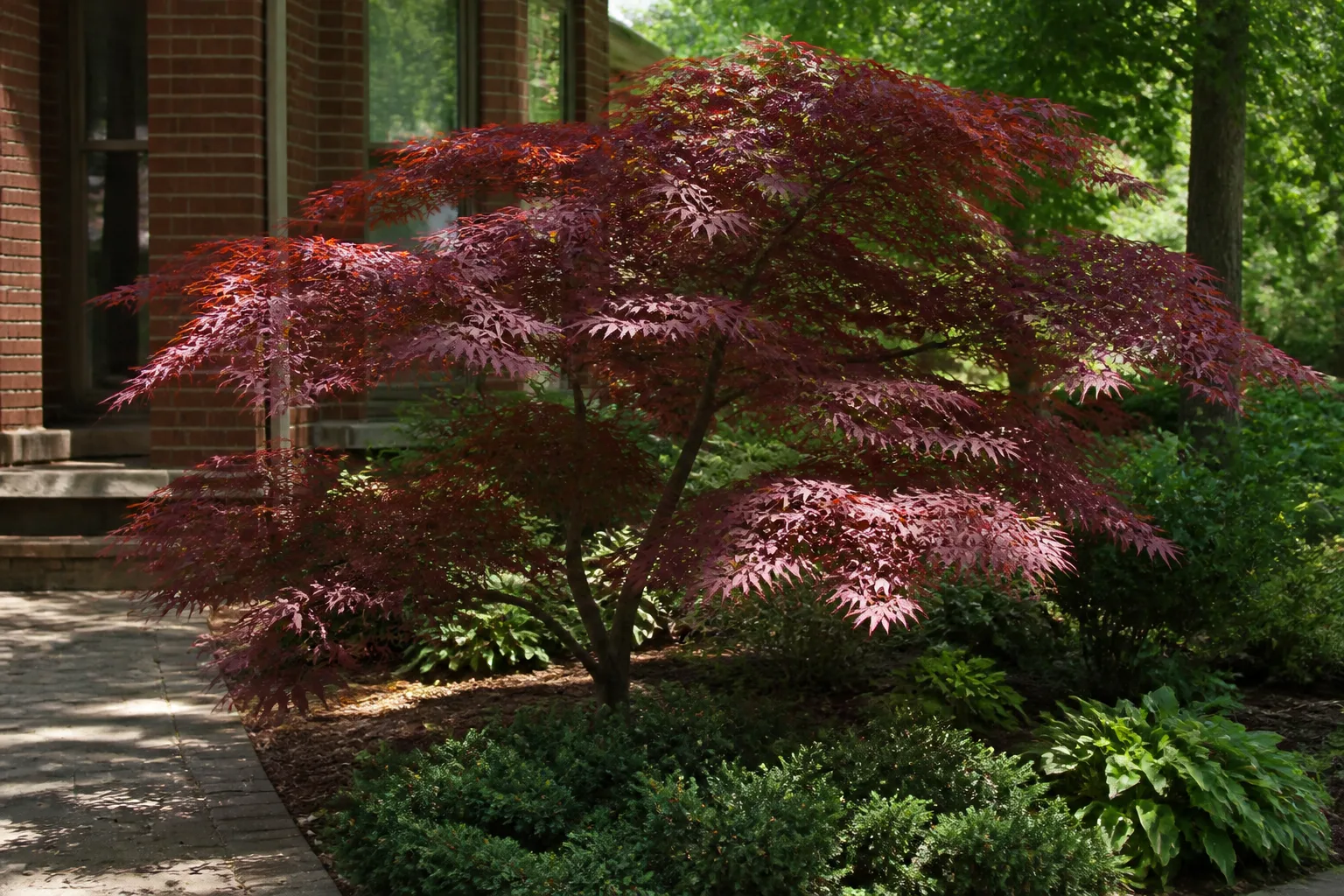
Japanese maple is often a better fit for a courtyard, woodland edge, or small lawn than the large maples in this list, but “Japanese maple” is not one uniform size. A compact laceleaf cultivar and an upright green-leaf cultivar can differ dramatically in mature height, width, sun tolerance, and wind sensitivity. Protect finely cut leaves from harsh afternoon heat where summers are hot, keep the root zone evenly moist while the tree establishes, and avoid burying the trunk flare under mulch.
Seedlings from a named cultivar may not look like the parent. If the leaf color or shape is the reason you bought the tree, buy a grafted plant rather than relying on a dropped samara to reproduce it exactly.
5. Winged elm (Ulmus alata)
Winged elm produces small, flat samaras with a solitary seed and a noticeably hairy margin. The fruits ripen early, often in spring, and may give the branches a reddish or greenish cast before the leaves fully expand. The USDA Forest Service account for winged elm describes the fruit as a flat, hairy-edged samara and notes that both wind and water can disperse it.
The tree gets its common name from corky ridges or “wings” that develop along some young branches. Leaves are small, alternate, and asymmetrical at the base, unlike the opposite, palmately lobed leaves of maple. In an open site, winged elm often develops an attractive rounded crown; in a forest, it can grow taller and straighter.
It is a regional native, not a universal recommendation. Confirm that the species suits your climate and space, and inspect nursery stock for local disease guidance. A seedling growing beneath a mature elm is easy to overlook until the root system and canopy begin competing with structures or other trees.
6. Common hoptree (Ptelea trifoliata)
Common hoptree is a small tree or large shrub with a samara unlike the classic helicopter. Its fruit is round and wafer-like, with a papery wing around the edge; it may hang in clusters from summer into winter. The three-part leaves and the circular fruits are the best combination of clues. The species is native across much of eastern and central North America, though its exact status and performance are regional.
Its name comes from the historical use of the dried fruits as a hop substitute, not from a resemblance to a hop vine. The plant can handle full sun to partial shade and a range of well-drained soils. Bruised leaves and stems may smell strong, so plant it where that trait will not surprise people brushing past it.
Common hoptree is worth considering when you want a native small tree, screen, or wildlife-friendly shrub with winter fruit interest. Give it room to branch naturally rather than forcing it into a tight foundation hedge. NC State’s profile is especially useful for confirming the circular samara and three-part foliage.
7. Tree-of-heaven (Ailanthus altissima)
Tree-of-heaven makes long, twisted samaras with a single seed set inside a narrow wing. The fruits often turn reddish brown and remain in hanging clusters into winter, so a leafless tree can still advertise its identity from a distance. The leaves are very large and pinnately compound, with many smooth-edged leaflets; crushed foliage and twigs have a strong, unpleasant odor.
This is the species on the list that deserves the clearest “do not plant” warning. Penn State Extension identifies tree-of-heaven as an invasive tree and noxious weed, documenting both wind-dispersed samaras and extensive root suckering. A female tree can produce very large seed crops, and a cut or injured tree may respond with vigorous sprouts, so simply cutting the trunk is not a complete control plan.
Do not confuse it with native walnut, hickory, sumac, or ash just because the leaves are compound. Compare leaflet margins, smell, bark, twigs, and fruit, and use local extension guidance before taking control action. If a large tree is involved, a certified arborist or local invasive-plant professional can help you choose a method that addresses the root system and protects nearby desirable plants.
8. Tuliptree (Liriodendron tulipifera)
Tuliptree, also called yellow-poplar, does not make a handful of loose maple-style helicopters. Instead, it produces a cone-like aggregate made of many narrow samaras. As the aggregate matures, the samaras separate and fall, often persisting on the tree or ground into late fall and winter. NC State Extension describes the fruit as a two- to three-inch aggregate of samaras.
Look for the tree’s distinctive four-lobed, tulip-shaped leaves and large, upright form. It is one of the largest native trees in eastern North America, grows quickly in good conditions, and can produce attractive yellow fall color and tulip-like flowers once mature. The same vigor makes it a poor choice for a small yard, beneath utility lines, or close to a foundation.
If you have a large property and want a tall native canopy tree, tuliptree can be impressive. Plant it with its eventual height and branch spread in mind, not the dimensions of the container specimen. Its samaras are a useful identification clue, but the leaf shape is usually more diagnostic when the fruit has already dispersed.
9. Tipu tree (Tipuana tipu)
Tipu tree is the warm-climate outlier in this group. Native to Bolivia, southern Brazil, and northern Argentina, it is grown as a broad-canopied flowering tree in subtropical and frost-free landscapes. After its yellow flowers, it produces a large, leathery, winged legume that looks samara-like and can spin as it falls. The fruit is much larger and less delicate than a maple samara.
The National Garden of Athens’ plant profile describes the fruit as a winged legume of the samara type, while Kew’s taxonomic profile confirms its South American native range. In a suitable climate, tipu tree can become a large shade tree with a spreading canopy; in a cold climate, winter damage or outright failure makes it the wrong choice.
Before planting one, check frost exposure, mature width, root behavior, irrigation, and local street-tree recommendations. It is not a substitute for a hardy native maple in a temperate garden. If you found a large winged fruit in a warm city, the seed’s size and leathery texture, plus the tree’s pinnate leaves and yellow flowers, can point toward tipu tree.
10. Green ash (Fraxinus pennsylvanica)
Green ash makes narrow, paddle-shaped samaras in dangling clusters. The wing is shorter than the seed-bearing body, and fruits change from green to tan as they mature, commonly in late summer and fall. The tree’s leaves are opposite and pinnately compound, usually with five to nine leaflets. Female trees produce fruit; male cultivars are sometimes selected where seed litter is undesirable.
Green ash is a broadly adaptable native tree that tolerates wet soil, drought after establishment, urban conditions, and some salt. That flexibility led to extensive planting, but it also means many mature trees now face serious pest pressure. UF/IFAS notes the species’ fast growth, large mature size, annual seed set, and susceptibility to breakage. University of Minnesota Extension and state forestry programs can provide the most relevant current emerald ash borer guidance for your location.
Do not choose green ash only because it can survive a difficult site. If you already have one, watch for canopy thinning, bark splits, epicormic shoots, D-shaped exit holes, or unusual dieback, and ask an arborist to assess it. The samaras are valuable identification clues, but they also explain why a female tree can create a carpet of seedlings in open ground.
11. Velvet ash (Fraxinus velutina)
Velvet ash is a southwestern ash with small, flat, single-winged samaras. It is adapted to warmer, often drier regions than green ash and is associated with riparian corridors and desert Southwest landscapes. The leaflets and twigs may have a velvety texture, but ash identification is difficult when fruit, leaves, and bark are viewed separately.
The species can grow into a substantial tree where water is available, so its drought reputation should not be read as permission to plant it in a narrow, irrigated courtyard. Site conditions, local provenance, summer heat, and winter cold all matter. In the Southwest, use regional tree-selection lists and water-use guidance rather than copying a planting recommendation from a cooler climate.
Velvet ash is also part of the wider emerald ash borer conversation. The USDA Forest Service’s ash research resources treat ash seed collection and management at the genus level, while extension programs track local pest conditions. If you are trying to identify a volunteer, photograph the samara cluster, opposite leaf arrangement, bark, and twig buds together before deciding what to keep.
How to choose one without creating a future problem
The most attractive samara is not automatically the best tree for your site. Start with a simple filter: native status, mature size, root space, moisture, storm exposure, and maintenance. A small yard may suit Japanese maple or common hoptree; a large open property may accommodate red maple or tuliptree; a wet naturalized edge may support a locally native species that would be a poor street tree. Norway maple and tree-of-heaven require an additional invasive-status check before you let seedlings establish.
Use the botanical name when buying. Common names overlap, cultivars differ, and nursery tags sometimes use “maple,” “ash,” or “pussy willow” loosely. Ask how tall and wide the exact selection becomes, whether it is male or female when fruiting matters, and how the species performs in your local soil rather than in an idealized hardiness-zone description.
Seed propagation is possible, but it is not equally easy for all 11 trees. Red maple can germinate soon after ripening. Many temperate maples need moist cold stratification; Iowa State University Extension lists about 40 to 90 days for sugar maple and 90 to 120 days for Norway maple. A seedling grown from a hybrid or named cultivar may not reproduce the parent’s traits, and a tree grown from seed can take years to reveal its final form.
A safe way to manage volunteers and collect seed
If samaras are covering a lawn or filling flowerpots, identify the parent tree before you decide whether the seedlings are weeds. Pull young seedlings while the soil is moist, before the root becomes established. For larger volunteers, do not mow or cut an invasive tree repeatedly and assume it is gone; tree-of-heaven in particular can respond with root and stump sprouts. Follow your local extension service’s control guidance and hire an arborist for trees near buildings or utilities.
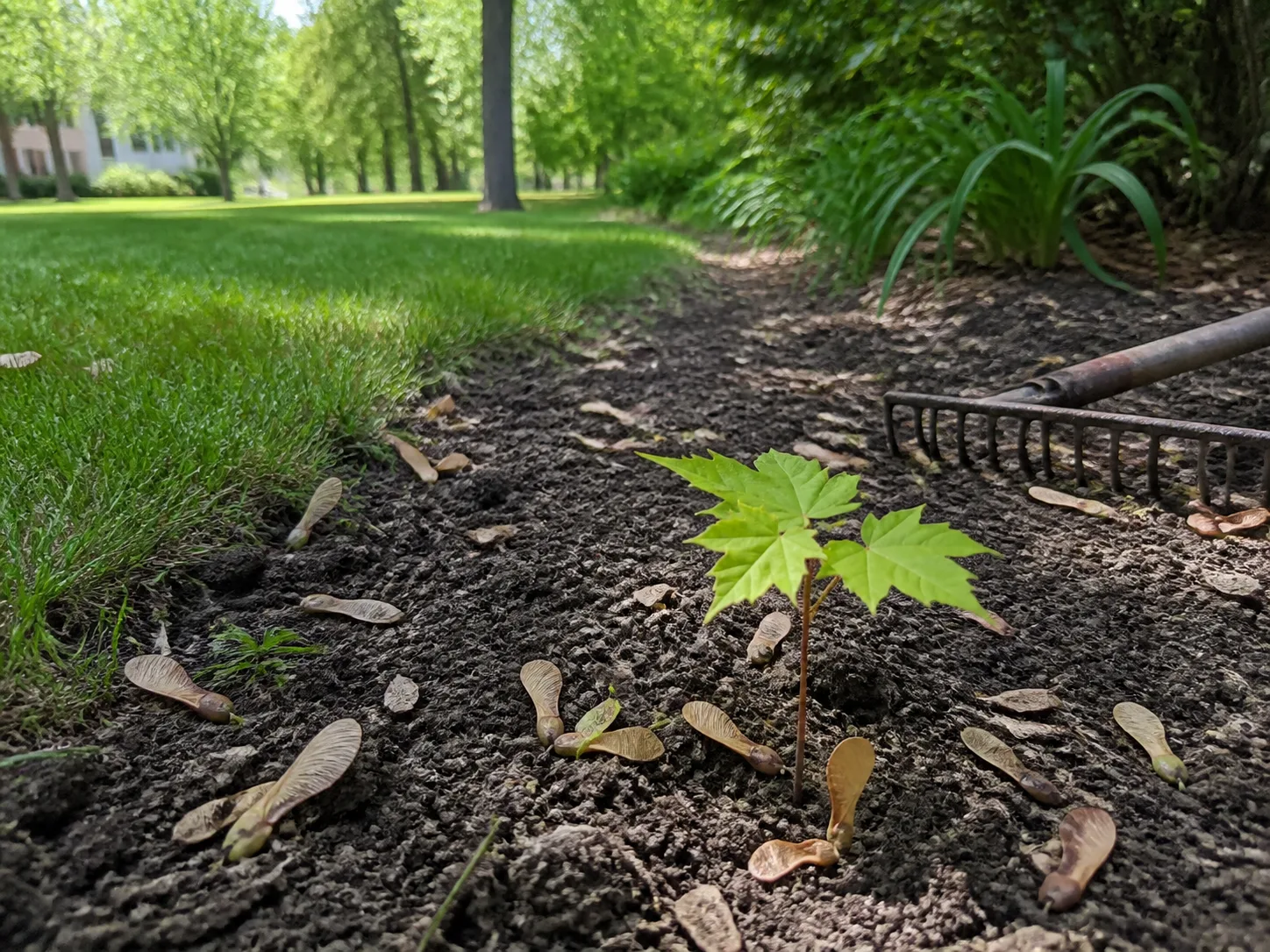
To collect samaras for a small propagation experiment, choose a healthy, correctly identified tree, gather mature but not moldy fruits, label the species and collection date, and keep the seeds moist if the species requires immediate sowing or cold stratification. Sow more than one seed because empty or nonviable samaras are common. Never scatter an unfamiliar species near a natural area, and never move seed across regions without checking plant-health and invasive-species rules.
Do not eat a winged fruit just because someone calls it a helicopter seed. Some maples have documented traditional or culinary uses, but the common nickname covers many unrelated plants, and a seed found on the ground may be misidentified, dirty, moldy, or treated with landscape chemicals. For identification, propagation, wildlife observation, or a small nature craft, there is no benefit to tasting it.
Conclusion
Helicopter seed is a charming name for a real botanical strategy: the samara, a winged fruit built for wind dispersal. Paired maple samaras are the familiar version, but single-winged ash keys, hairy elm fruits, round hoptree wafers, tuliptree cones, twisted tree-of-heaven wings, and large tipu fruits show how varied the form can be.
When you find one, photograph the fruit with the leaves and bark, note the season and habitat, and confirm the botanical name before planting or removing anything. That small identification habit helps you keep a valuable native tree, avoid an invasive one, and choose a samara-producing tree that will still fit your landscape when the seedling becomes mature.



