19 Best Climbing Perennial Vines for Gardens
Choose from 19 climbing perennial vines for arbors, trellises, and fences, with support, pruning, hardiness, spread, and safety trade-offs.
A climbing vine can turn a bare fence into a flowering screen, soften a pergola, or make a narrow side yard feel layered instead of boxed in. But “perennial” does not mean every vine on this list will survive every winter, and “climbing” does not mean a plant can grip every support you give it.
The most reliable choice starts with three measurements: your coldest winter conditions, the sun at the planting spot, and the mature weight and spread your structure can carry. Use the profiles below as a shortlist, then check the plant’s label or a local extension profile for the exact cultivar you plan to buy.
Choose based on site, support, and climate
Identify how the vine climbs
Vines reach light in different ways, and the difference determines whether a thin wire, a lattice, or a load-bearing arbor will work. The RHS guide to climbers and wall shrubs groups the main strategies as twining stems, tendrils, stem roots, and sticky pads.
- Twining stems wrap around a narrow post, wire, or branch. Star jasmine, honeysuckle, mandevilla, and chocolate vine belong here.
- Tendrils curl around slender supports. Passionflower, hardy kiwi, cup-and-saucer vine, and many clematis use this kind of reach, although young plants often need guidance.
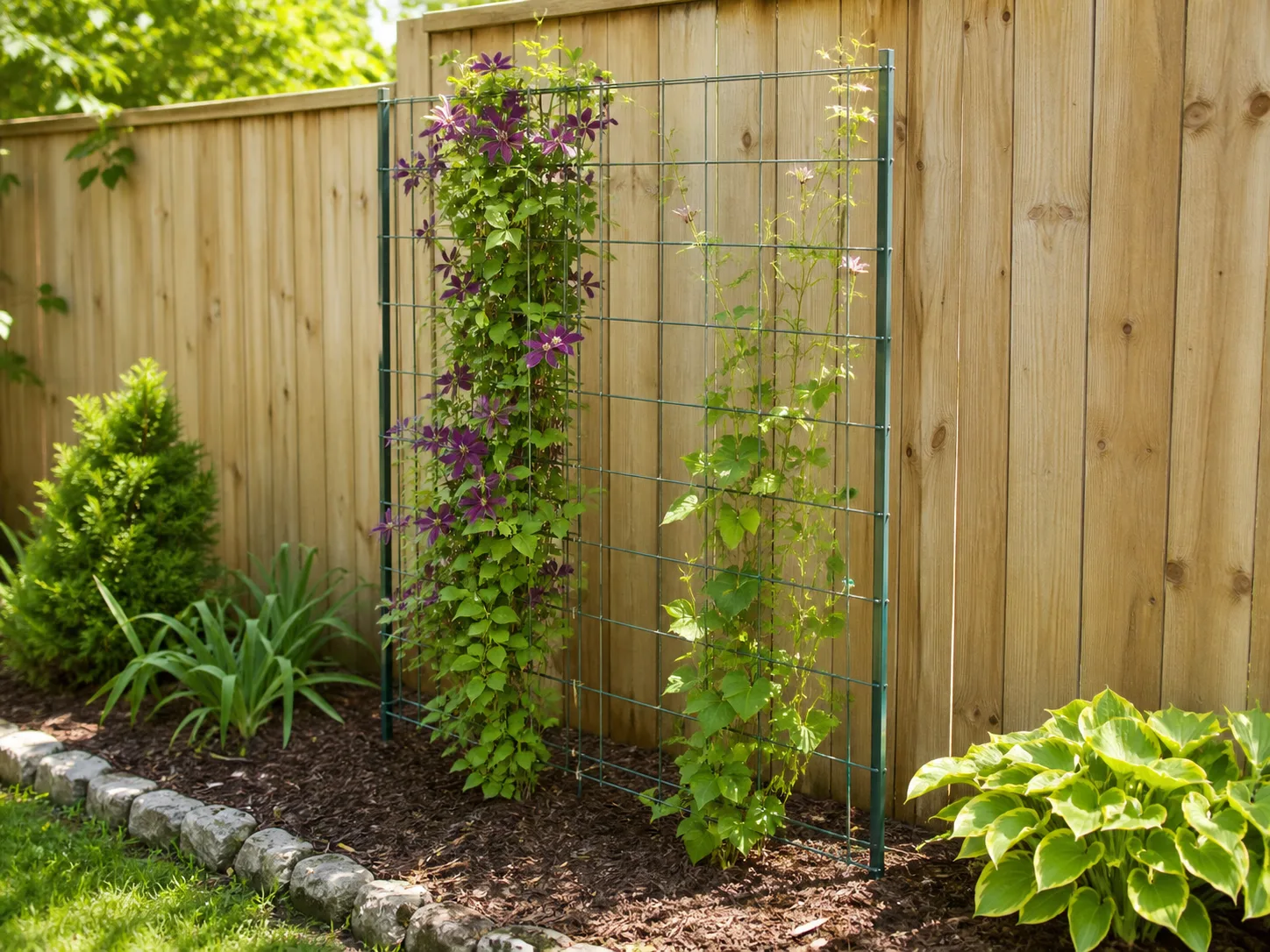
- Leaf-stem climbers use flexible leaf stalks to hook onto a trellis. Many clematis need a small-diameter grid rather than a thick, smooth post.
- Aerial rootlets or adhesive structures cling to rough surfaces or masonry. Climbing hydrangea and trumpet vine can attach this way, but their mature weight makes a separate support safer near buildings.
- Long canes that need tying are not self-climbers. Climbing roses have to be trained and secured; they will not wind around an arbor on their own.
This is why a beautiful plant can fail on an otherwise attractive trellis. If the openings are too wide for a clematis leaf stalk, the vine dangles. If a rose has nowhere to tie its canes, it makes a thicket at the base. If a heavy trumpet vine is placed on a light decorative grid, the support becomes the weak link.
Size the structure for mature weight
Read the mature height and spread as a structural specification, not as a decorative footnote. A young vine in a one-gallon pot may look harmless, but years of woody stems, wet foliage, flowers, and wind can add a great deal of leverage. Put the support in place before planting, anchor it independently of a weak fence panel, and leave access for pruning.
The practical rule is simple: light vine, light support; vigorous woody vine, engineered support. Fine Gardening’s examples of lashed poles, hoops, and trellises show how simple materials can work, but they also show why the dimensions must be enlarged when a plant starts pulling the structure over. For an arbor or pergola, inspect the posts, fasteners, and footings—not just the decorative top.
Avoid planting directly against a wall and expecting rainfall to reach the root ball. The RHS recommends planting climbers about 18 inches from a wall, angling the plant toward its support; that small gap avoids the dry rain-shadow soil beside foundations and gives roots room to establish. In a windy site, the gap also lets you tie the first stems without trapping them against hot masonry.
Start with the job you want the vine to do
Best for shade or woodland edges
For a shady wall or north-facing fence, start with climbing hydrangea rather than forcing a sun-loving tropical vine to survive on weak light. Clematis can work in partial shade if its leaves get enough light and its roots stay cool and evenly moist, while chocolate vine tolerates a broad range of light but may become invasive in some regions.
Shade is not the same as dry. The area beneath eaves or beside a wall can receive little rainfall even when the garden around it is wet. Improve the soil, water newly planted vines during their first season, and choose a plant whose hardiness and moisture needs match the actual microclimate.
Best for privacy, fragrance, or pollinators
For quick privacy, choose a vine that is vigorous enough for the space but not so aggressive that it will escape the bed. Gardening Know How’s fast-vine guide makes the same useful distinction: speed helps cover a fence, but most vines still need a structure and some hand training. Passionflower, trumpet vine, coral or Cape honeysuckle, star jasmine, and climbing roses can all make a strong vertical display, but they differ sharply in winter behavior and maintenance.
Fragrance narrows the field further: star jasmine, chocolate vine, moonflower, snail vine, and some honeysuckles are the sensory standouts. For wildlife, look at the whole plant rather than just the flower color. Clematis and passionflower can support pollinators, trumpet vine supplies nectar and serves as a host for a native sphinx moth, and coral honeysuckle provides tubular flowers for hummingbirds. A locally native vine is not automatically small or tidy, so ecological value still has to be balanced against spread and support load.
19 climbing perennial vines worth considering
Clematis
Clematis (Clematis spp.) is the most versatile starting point for a flowering trellis because the genus includes compact herbaceous types, large-flowered hybrids, and vigorous species with very different bloom times. Most prefer sun on the foliage with afternoon shade in hot climates, deep, consistently moist but well-drained soil, and a cool root zone under mulch. Roughly speaking, many garden types fit zones 4–9, but the exact range belongs to the cultivar.
The crucial detail is the pruning group. NC State Extension explains the three practical types: Type 1 blooms on old wood and is pruned after flowering; Type 2 flowers on old and new wood and gets light shaping; Type 3 blooms on new wood and can be cut hard in late winter. If you prune by calendar date without knowing the group, you can remove the stems that carry the next display.
Choose clematis for a narrow trellis, fence panel, or mixed planting where you want flowers without a massive woody framework. Give young stems a fine-grid support and handle them gently. Skip a large, fast species if you want a no-maintenance vine or if you cannot reach the top for seasonal training.
Climbing hydrangea, chocolate vine, and hardy kiwi
Climbing hydrangea (Hydrangea anomala subsp. petiolaris) is the shade specialist of this list. It makes white lacecap-like flower clusters, develops handsome peeling bark, and can eventually cover a wall or large tree. It is slow to establish, then substantial—often reaching 30 feet or more—so use a durable support and give it room. It is best in zones 5–9 with rich, moist soil; afternoon sun is possible where roots do not dry out.
Chocolate vine (Akebia quinata) earns its place for semi-evergreen foliage and small brown-purple flowers with a spicy scent. Its twining habit suits an arbor or fence, and it can tolerate more shade than many flowering vines. The catch is regional: it has escaped cultivation in parts of the United States. Check your state or county invasive-plant list before planting, and remove fruit or seedlings if local guidance identifies it as a risk.
Hardy kiwi (Actinidia arguta or A. kolomikta) is primarily a foliage and fruit vine rather than a flower-border showstopper. It is exceptionally vigorous, with large leaves and a twining habit that needs a heavy-duty trellis or pergola. In most cases, fruiting requires compatible male and female plants, although some named cultivars are self-fertile. Choose it for a productive, long-term structure—not a lightweight obelisk you plan to move next year.
Purple passionflower and trumpet vine
Purple passionflower or maypop (Passiflora incarnata) combines a genuinely unusual flower with edible-looking fruit and strong wildlife value. The vine uses tendrils, likes sun to light shade and evenly moist, well-drained soil, and can die back in colder climates before returning from the crown. NC State’s profile identifies it as a perennial woody vine native to the central and eastern United States and notes its pollinator and host-plant value.
Give passionflower a trellis with slender wires and expect to guide new growth. It can spread beyond the original planting by underground growth, so decide whether you want a contained specimen or a naturalized patch. If you grow it for fruit, confirm the plant’s identity and local food-safety guidance before eating anything; ornamental passion vines are not interchangeable with every edible passionfruit species.
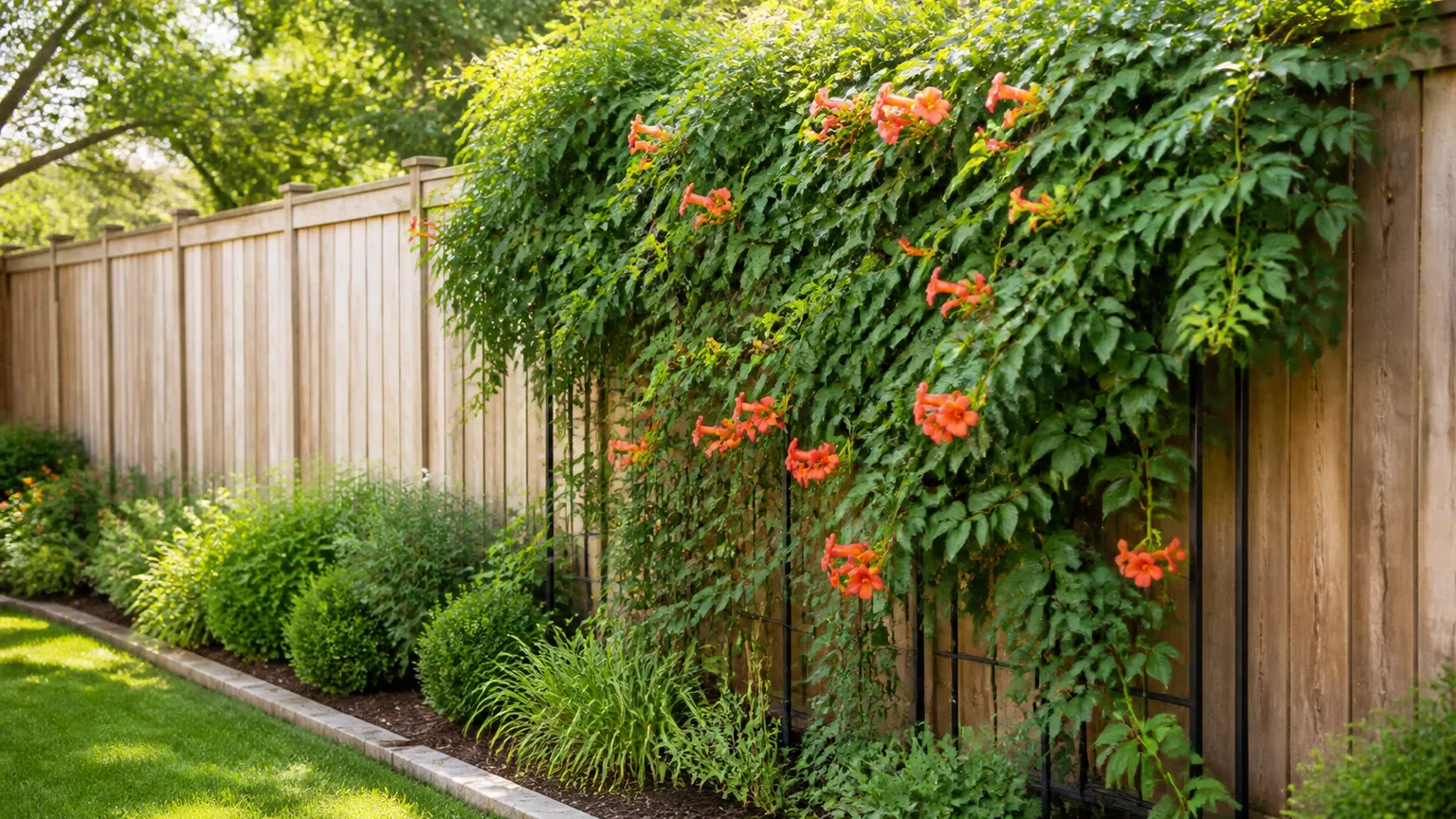
Trumpet vine (Campsis radicans) is one of the strongest hummingbird magnets here—and one of the easiest to regret in a small bed. It climbs by aerial rootlets, flowers on new wood, and tolerates average soil in sun to partial shade. Its mature canopy is heavy, and NC State Extension warns that species plants sucker from underground runners and self-seed freely.
Plant trumpet vine only where mowing, hard edging, or regular removal of suckers is realistic. It belongs on a stout arbor, masonry-independent trellis, or naturalized boundary, not beside delicate shrubs or under roof eaves. Prune in early spring to keep the framework manageable, and wear gloves if the foliage irritates your skin.
Climbing roses and star jasmine
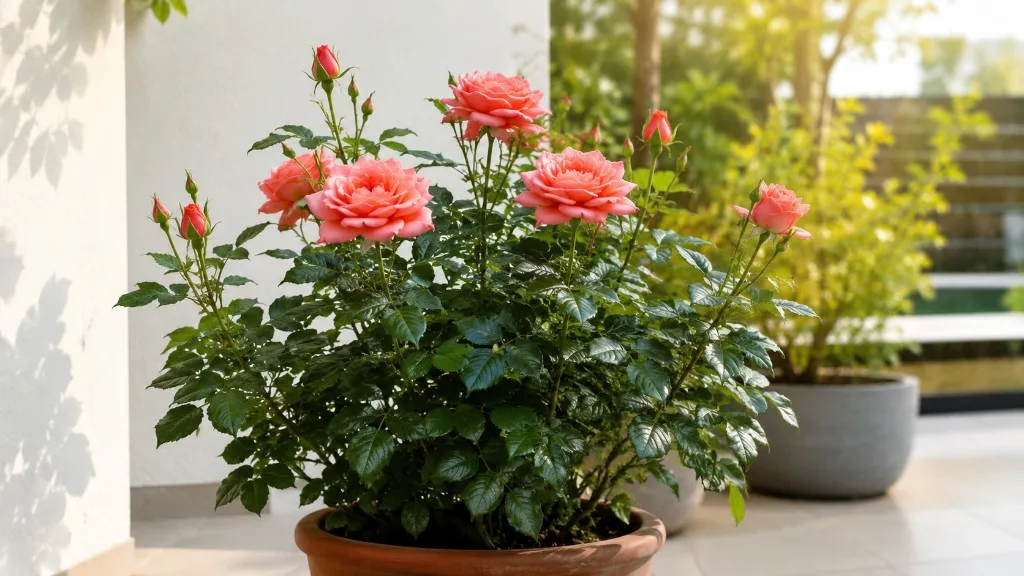
Climbing roses (Rosa spp.) are shrubs with long canes, not self-clinging vines. They reward a sturdy trellis, wires, or arbor where you can tie canes loosely and bend them outward or horizontally. That training creates more flowering laterals than simply sending every cane straight up. Full sun, fertile but well-drained soil, and dependable watering produce the best show; zone range and repeat bloom depend on the cultivar.
Do not prune a new climbing rose as if it were a compact hybrid tea. First let its main canes establish enough length to cover the support, removing only broken, diseased, or badly placed growth. Later, follow the cultivar’s guidance for once-blooming ramblers versus repeat-blooming climbers. Choose roses for a visible entry, fence, or arbor where you are willing to tie, deadhead, and manage thorns.
Star jasmine (Trachelospermum jasminoides) is an evergreen, twining vine for warm climates, usually zones 8–10. Its glossy foliage and intensely fragrant white flowers make it a natural for patios, gates, and sheltered walls. It can be grown in a large container in colder places, but that changes the job from perennial landscape cover to seasonal overwintering.
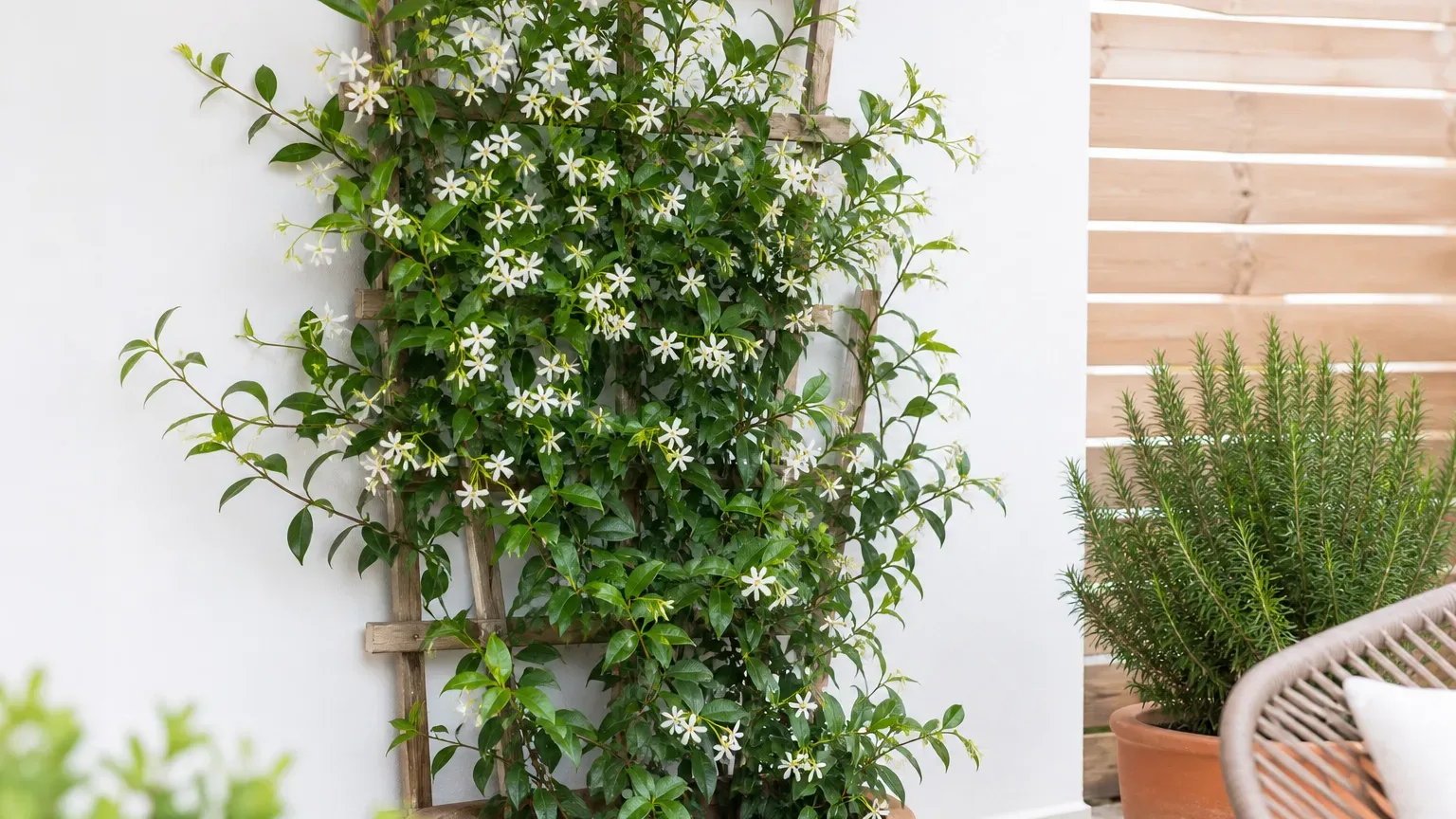
Use a wire grid or narrow trellis and tie the first stems until they begin to twine. Provide sun for heavier bloom, some afternoon protection in very hot areas, and excellent drainage. Star jasmine is a good choice when you want year-round foliage in a mild climate; it is a poor choice for an exposed cold site or a gardener unwilling to protect a container before frost.
Mandevilla, bougainvillea, and moonflower
These three are often marketed as perennial flowering vines, but in much of North America they are warm-season container plants. Treat their hardiness as a climate decision, not a promise that the roots will return after a freeze.
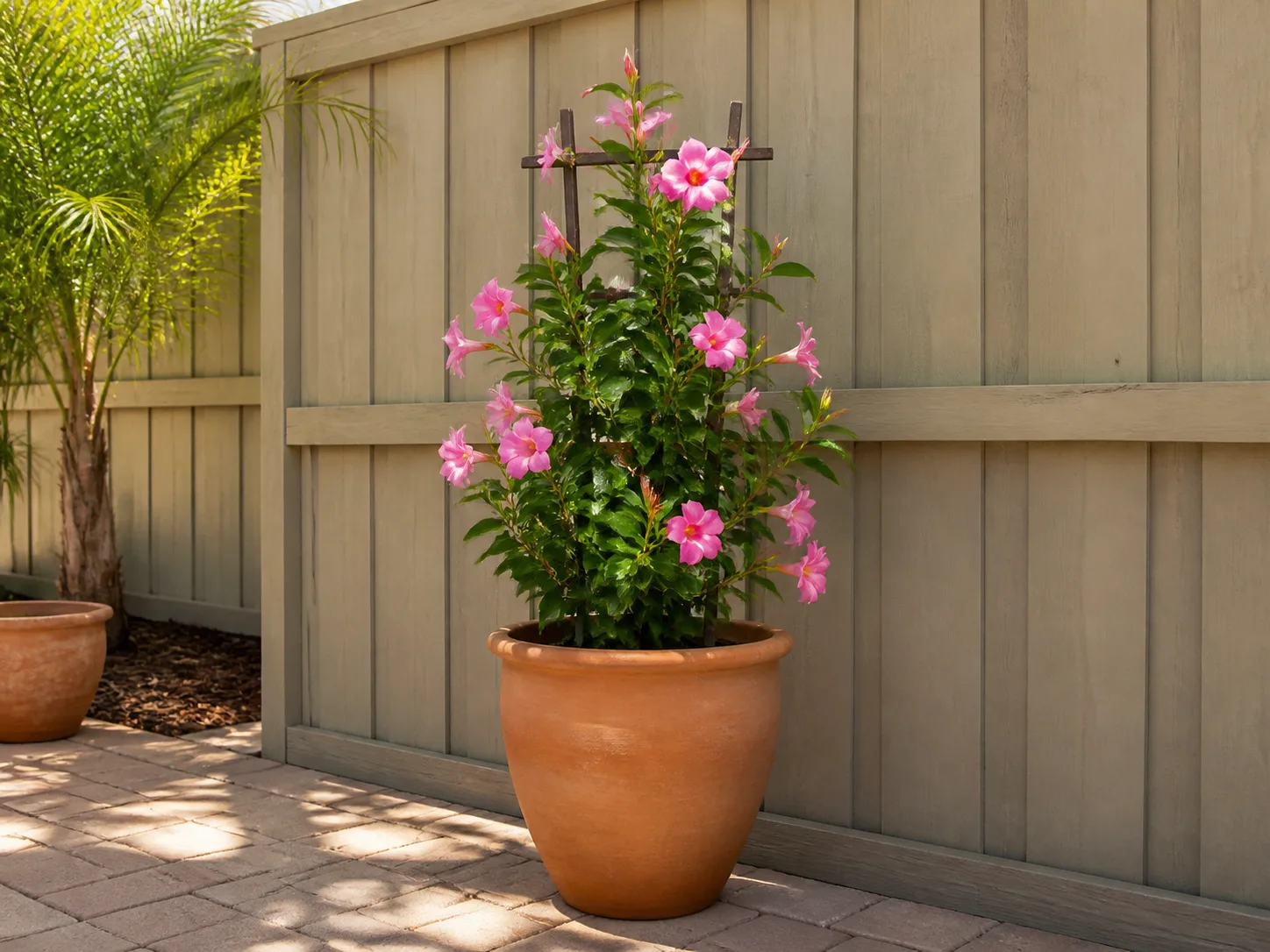
Mandevilla (Mandevilla spp.) produces glossy foliage and large trumpet-shaped flowers in pink, red, or white. It likes warmth, sun, steady moisture, and a support that is easy to move with the container. In zones 10–11 it can be a landscape perennial; elsewhere, grow it on a trellis in a large pot and bring it to a bright, frost-free place before temperatures fall.
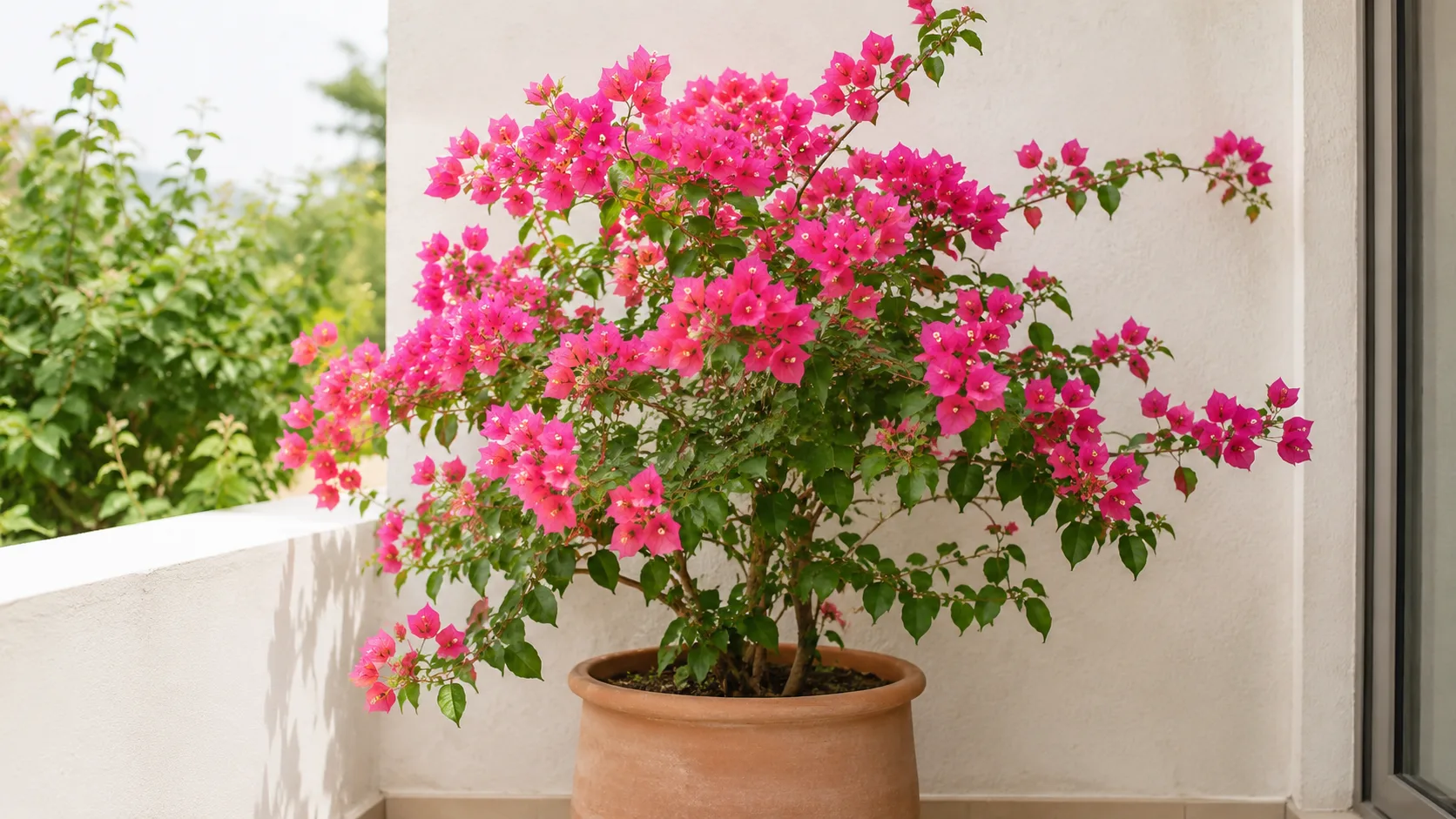
Bougainvillea (Bougainvillea spp.) is the sun-and-heat specialist, with thorny woody stems and colorful bracts surrounding its small true flowers. Give it full sun, fast drainage, and restrained feeding; overly rich, wet soil encourages leafy growth rather than the display people want. It can become a large landscape plant in zones 9–11, but container training keeps its size and winter move manageable.
Moonflower (Ipomoea alba) opens its large white flowers in the evening and releases fragrance after dark. It is a tender perennial in very warm zones, but commonly grown as a fast annual elsewhere from seed or young plants. Give it a sunny trellis, regular moisture while it is actively growing, and enough room for long twining stems. Because it is vigorous and frost-sensitive, it is best for a seasonal screen rather than a permanent arbor planting in a cold climate.
Cape honeysuckle, Japanese honeysuckle, and black-eyed Susan vine
Cape honeysuckle (Tecoma capensis) can be trained as either a shrub or a vine, with orange to red tubular flowers that suit warm pollinator gardens. It is evergreen or semi-evergreen in mild climates, generally zones 9–11, and responds well to pruning after flowering. Use it on a fence or trellis in sun to partial shade, but leave enough room for lateral spread. It is a useful tropical-subtropical screen where winter freezes are rare.
Japanese honeysuckle (Lonicera japonica) is included here as a warning, not a default recommendation. It is fragrant and vigorous, but NC State Extension classifies it as highly invasive in the United States and documents its rhizomes, runners, and bird-dispersed seeds. Do not plant it where local authorities or extension guidance list it as invasive, and do not assume a fast privacy screen is worth the ecological cleanup.
For a native alternative in much of the eastern United States, consider coral honeysuckle (Lonicera sempervirens). It twines around an arbor or trellis, flowers on new growth, and supplies tubular blooms for hummingbirds. NC State describes it as a native vine that reaches roughly 10–20 feet and performs best in sun with well-drained soil. It is still a vigorous plant, so give it a support it can occupy for years.
Black-eyed Susan vine (Thunbergia alata) stays smaller than the honeysuckles and is excellent for a container obelisk, balcony trellis, or temporary summer screen. Its orange, yellow, pink, or white flowers have dark centers, and its slender stems twine rather than forming a heavy woody framework. It is perennial in zones 10–11 and usually grown as an annual or overwintered container plant elsewhere. Use a narrow support and consistent moisture; a thick arbor post gives its delicate stems little to grab.
Cup-and-saucer, bleeding heart, and snail vine
Cup-and-saucer vine (Cobaea scandens) is a dramatic, fast-growing tender vine with large cup-shaped flowers and broad foliage. It uses tendrils, so it needs a mesh or wire support rather than a smooth post. In zones 9–11 it can be perennial; in colder areas it is generally a seasonal screen or container project. Give it sun, moisture, and a strong structure—its speed can hide how much plant it is building.
Bleeding heart vine (Clerodendrum thomsoniae) has white flowers with red calyces and a tropical, evergreen habit. It prefers warmth, humidity, partial shade, and consistently moist but well-drained soil. Grow it outdoors year-round only in zones 10–12, or use a container and a small trellis that can be moved indoors. It is a good choice for a sheltered patio display, not an exposed temperate-climate pergola.
Snail vine or corkscrew vine (Cochliasanthus caracalla) is prized for fragrant flowers that twist into shell-like forms. It is a vigorous twiner for zones 9–12, enjoys sun to partial shade and rich, moist soil, and needs a sturdy support plus light pruning to keep the stems from becoming a tangled mass. In frost-prone regions, treat it as a tender container vine and expect the winter move to be part of the routine.
Sweet potato and snapdragon vines
Sweet potato vine (Ipomoea batatas) is primarily a foliage vine, not a long-lived flowering climber. Chartreuse, bronze, purple, or variegated cultivars spill from containers and can scramble up a low trellis, but they are not the best choice for covering a tall arbor. In zones 9–11 they may persist as perennials; elsewhere, frost ends the display. Choose it when the goal is fast color and soft foliage, and pinch it regularly to keep it from swallowing neighboring plants.
Snapdragon vine (Asarina scandens, often listed under Maurandya scandens) is a light, graceful climber with small tubular flowers in pink, purple, blue, or white. It is best on slender wire, a small obelisk, or a hanging basket rather than a heavy fence. In zones 9–10 it can behave as a perennial, while cooler gardeners usually grow it as an annual. Give it sun to partial shade, average moisture, and a support with narrow openings that its fine stems can actually use.
Planting and training for a full, stable display
Prune without losing next year’s flowers
Pruning a vine is not just a size-control chore; it is a way of deciding where next season’s flowering wood will sit. Start by identifying whether the plant blooms on old wood, new wood, or both. Clematis makes this rule obvious, but the same logic applies to climbing roses, honeysuckle, trumpet vine, and jasmine.
Plant in spring or autumn when conditions are mild, except for tender plants that need a long warm season or a frost-free start. Set the root ball so the plant is stable, angle the stems toward the support, and tie with soft material that will not girdle growing shoots. Water deeply through the first growing season, especially in the dry strip beside a wall. Mulch the root zone without piling it against the stem.
The first training pass should spread stems across the structure rather than sending one central shoot straight upward. Tie long canes or twining stems at several points, check them after wind, and remove crossing growth before it hardens. A vine that is evenly distributed early is easier to prune and flowers more evenly later.
Contain vigorous vines and protect tender ones in winter
Containment begins before planting. Avoid Japanese honeysuckle where it is invasive, keep trumpet vine away from beds you cannot inspect, and give chocolate vine the same regional scrutiny. Remove suckers while they are small, collect unwanted seed pods, and do not let stems bridge into trees, gutters, rooflines, or neighboring shrubs.
For a tender vine, a large container is not a compromise—it is a management tool. The RHS guidance on climbers notes that tender types can be moved to frost-free protection, while newly planted hardy climbers need reliable watering during their first growing season. Use a pot with drainage, a support that travels with it, and a winter location that still provides adequate light.
Do one final inspection before winter: loosen ties that have tightened, remove diseased foliage, check anchor points, and decide whether the vine should be cut back or carried indoors. Do not wrap a wet, tender vine tightly against a wall and call it winter protection; cold, trapped moisture, and poor airflow can create a different problem.
Conclusion
The best climbing perennial vine is the one that matches the site and the structure—not the one with the longest catalog description. Clematis is a flexible choice for flowers, climbing hydrangea handles shade, star jasmine and coral honeysuckle bring fragrance or wildlife value in suitable climates, and tropical vines can make excellent container displays when winter protection is part of the plan.
Measure the support, check the mature size, identify how the vine climbs, and look up the local invasive-plant guidance before you buy. That short decision sequence will keep a beautiful vine from becoming a structural, pruning, or ecological problem later.



