Should You Cut an Orchid Stem After Flowers Die?
Should you cut an orchid stem after flowers die? Learn when to cut brown spikes, when to prune above a green node, and how to support the next bloom.
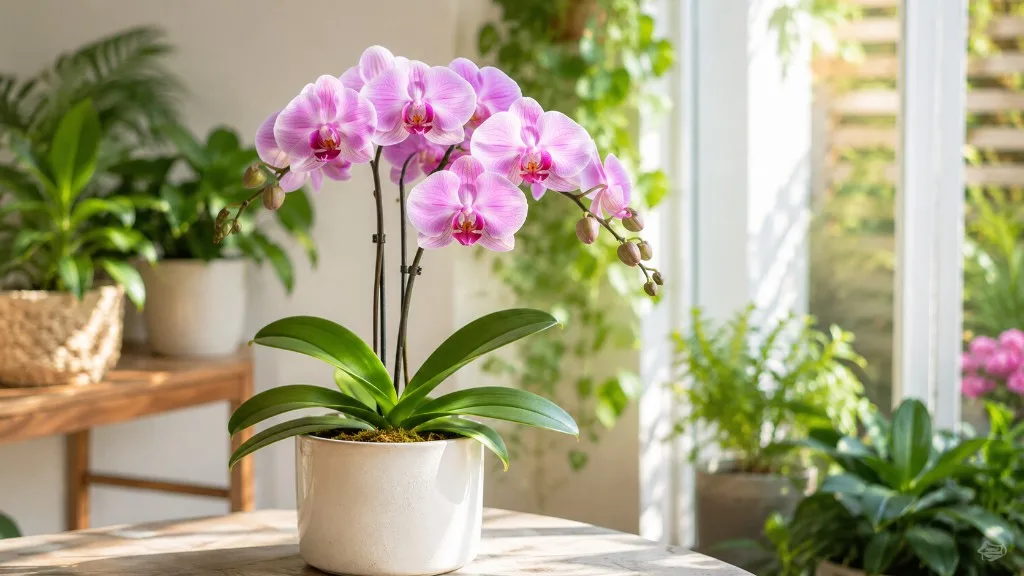
When the last orchid flower falls, the right question is not simply “cut or don’t cut?” First look at the flower spike. A completely brown, yellow, dry, or mushy spike is finished and can be removed. A firm green spike may still contain an unused node that can produce a side branch, especially on a common moth orchid (Phalaenopsis).
That second option is not automatically the best option. A node cut may extend the display with a smaller flush of flowers, while a full cut gives the plant a cleaner recovery period before its next normal bloom. The American Orchid Society makes the same important distinction: spike pruning depends on the orchid genus, the unused nodes, and the plant’s strength—not on the fact that the flowers have faded alone. (American Orchid Society)
The short answer: let the spike decide
Use this quick rule before you pick up scissors:
| What you see | Best first choice | Why |
|---|---|---|
| The spike is brown, yellow, dry, or soft | Cut it back to the base | It is no longer a useful flowering structure, and damaged tissue should not remain attached. |
| The spike is green and the plant is firm, leafy, and well-rooted | Cut just above one viable, unused node, or cut to the base for recovery | The node may branch, but the plant will spend energy trying to flower again. |
| The spike is green but the leaves are limp, the roots are failing, or the plant is newly stressed | Cut the whole spike to the base | Recovery is a better investment than asking a weak plant to carry another bloom. |
This rule is mainly for the Phalaenopsis orchids sold as houseplants. If the label names a different orchid, pause before copying the moth-orchid method. Some orchids flower once from a spike, while others can flower repeatedly from an older spike or from a different structure entirely.
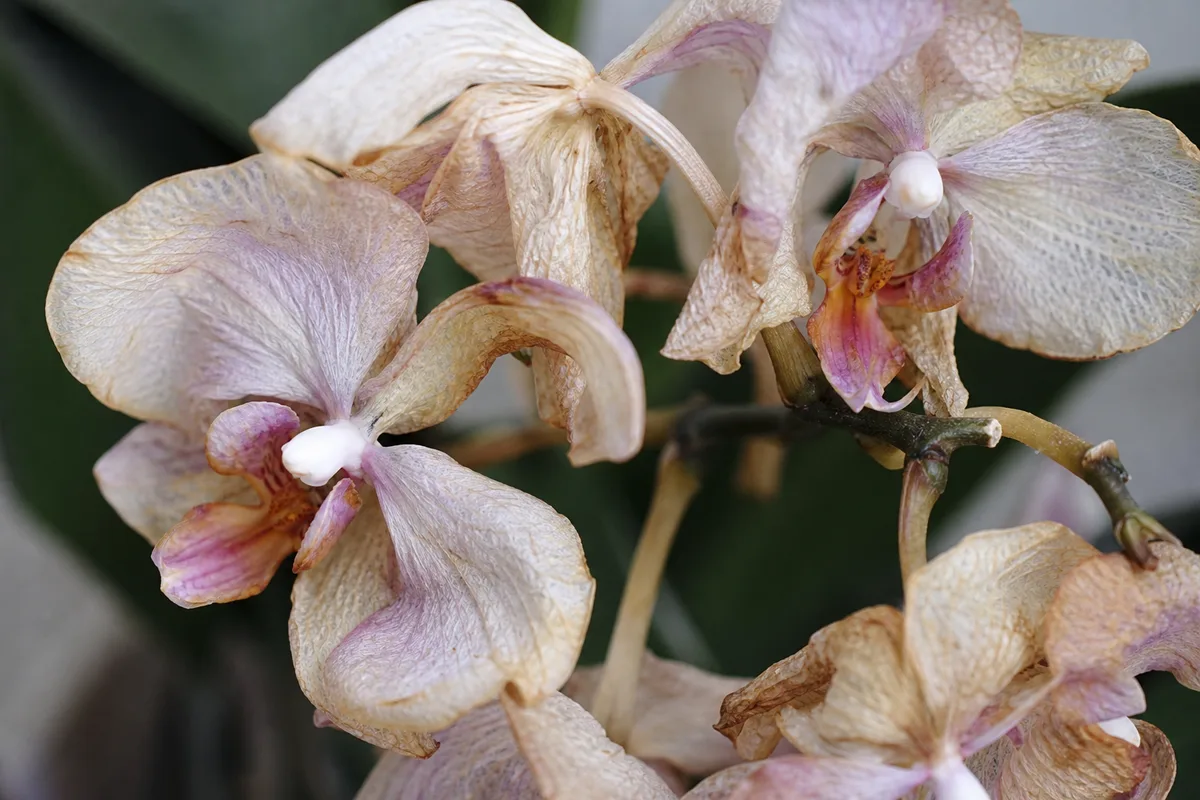
First, identify what you are cutting
Orchid owners often call a flower spike a stem, but the distinction matters because cutting a root or the plant’s crown can set it back far more than removing an old flower stalk. A spike carries buds and flowers; a root absorbs water and anchors the plant. Look closely before making a cut.
Flower spike versus root
On a typical monopodial moth orchid, a flower spike emerges from the central line between the leaves or from the side of the main stem. It is usually relatively thin, has small joints or bumps along its length, and may be staked upright. A root tends to emerge from the sides of the plant, has a rounded tip, and may point out of the pot or arch through the air.
The color check is useful but not perfect. A dry root can look pale and a new spike can be green, yet roots generally have a smooth, cylindrical tip while a spike develops a flatter, pointed end. If you are unsure, leave the structure alone for a few days and watch where new growth comes from rather than cutting by guesswork.
Those small joints on a spike are nodes. Each node is covered by a little bract, which looks like a shallow triangular flap. A plump node whose bract still lies close to the spike may be unused; a node that has already produced a branch or flower is less likely to produce another growth point.
Choose the cut by color, nodes, and plant strength
Once you know you are looking at a flower spike, decide whether preserving it helps the plant or merely keeps an exhausted piece of stem in place. The best cut is the one that matches the plant’s condition, not the one that promises the most flowers on paper.
Brown, yellow, dry, or mushy spike
Remove a spike that has turned fully brown or yellow and feels dry. A spike that is soft, blackening, or mushy is a more urgent cleanup because damaged tissue can stay wet against healthy plant parts. Cut back to firm, healthy tissue; if the entire spike is affected, remove it at the base.
Do not confuse a brown spike with a dead orchid. The spike can finish its job while the crown, leaves, and roots remain alive and capable of producing a new spike later. The plant may look bare for a while because it is between displays, not because it has died.
You can also remove individual flowers that remain attached after they have shriveled. Use clean fingers for a loose flower or sterile scissors for a stubborn one, and avoid pulling on the spike. The goal is to remove spent tissue without tearing the living stem.
Green spike with unused nodes
A firm green spike gives a healthy Phalaenopsis a choice. If the plant has several firm leaves, a stable crown, and roots that are not brown and collapsing, you can shorten the spike above an unused node. The node may activate a side branch, although the result is never guaranteed and the new flowers are often fewer or smaller than the first flush.
You will see different recommendations for the first, second, or third node because the best target depends on the spike and the cultivar. A useful home rule is to choose the lowest plump, unused node that still sits below the faded flower section, then cut about 1/2 inch (1 centimeter) above it. The American Orchid Society specifically recommends cutting above the second unused node for a strong chance at a secondary branch, while NC State Extension describes cutting just above the first node below the faded flowers. (NC State Extension)
Treat those instructions as options, not competing laws. If the lower nodes look flat, dry, or already used, a node cut is unlikely to do much. If the spike has a healthy node but the whole plant is struggling, a base cut is usually kinder. The node provides an opportunity; the leaves and roots provide the energy.
Green spike on a weak or damaged plant
Cut a green spike to the base when the plant is trying to survive a separate problem. Warning signs include limp or badly wrinkled leaves, a crown that is soft or dark, many hollow roots, a pot that stays wet for too long, or a plant that has recently been repotted after root loss. A flower branch is a luxury when the root system cannot reliably supply water.
This is also the better choice for a small division, a recently rescued orchid, or a plant that has been moved through a major change in light or temperature. Removing the spike does not guarantee recovery, but it stops the plant from spending more resources on a low-probability flower flush. Fix the root-zone problem, stabilize the light, and let new leaves and firm roots tell you the plant is rebuilding.
Cut the spike safely
The cut itself takes seconds; preparation prevents the avoidable problems. Use a sharp pair of fine scissors or snips that can make one clean cut rather than crushing the spike. Wipe the blades with isopropyl alcohol before cutting, and clean them again before moving to another orchid.
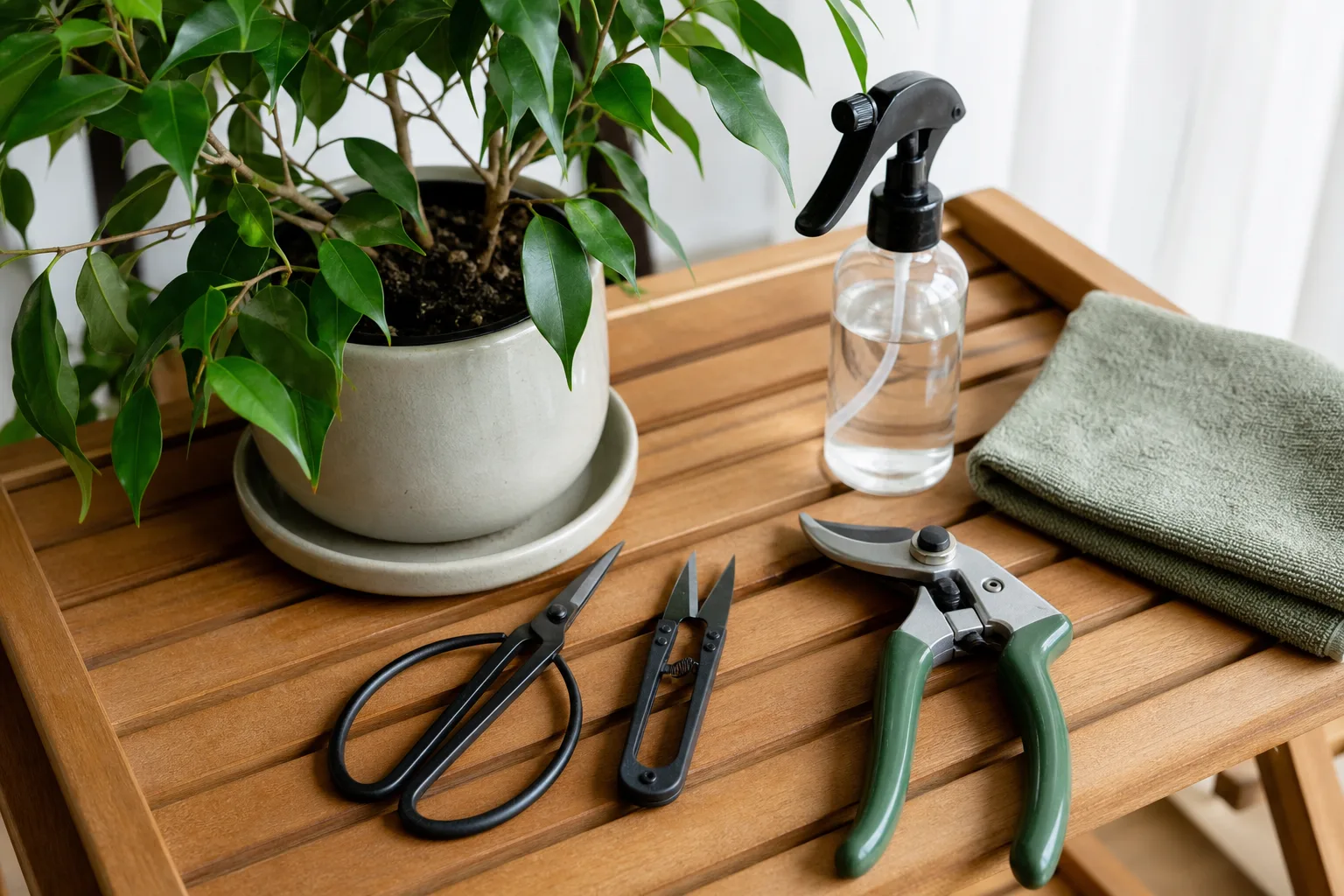
Work on a clean surface with the orchid supported so you do not pull the crown or twist the plant in its pot. Keep the cut surface dry and do not splash water into the crown afterward. For routine post-bloom pruning, the clean cut and good drainage matter more than coating every cut with a product.
Make a clean base cut
Use a base cut when the spike is fully dead, when there are no viable nodes, when the spike has disease or soft tissue, or when the plant needs recovery. Follow the spike to the point where it emerges from the plant, then cut cleanly while leaving a short stub rather than gouging the crown. If the spike joins a pseudobulb or cane on a sympodial orchid, do not use this instruction without identifying the plant first.
Afterward, discard the cut material and check the plant for other problems. A hollow decorative cachepot, sour-smelling medium, or a cluster of mushy roots will not be solved by a perfect spike cut. If those issues are present, address the root zone during the plant’s recovery rather than immediately starting a bloom-pushing routine.
Do not turn post-bloom cleanup into a general haircut. Healthy leaves are the plant’s energy-producing panels, and healthy aerial roots are functional roots—not untidy stems. Remove a leaf only when it is fully dead or clearly diseased, and remove a root only when it is soft, hollow, or rotting. Never cut into the crown, the firm stem between the leaves, or a green pseudobulb simply to make the plant look neater.
Make a careful node cut
For a vigorous Phalaenopsis with a green spike, find the unused node you selected and cut about 1/2 inch above it. Keep the cut on the portion of the spike above the node, so the node remains attached to the plant. Avoid cutting directly through the bump or so close that the remaining tissue splits.
Remove only the spent upper section. Leave lower green sections and other unspent nodes intact, but do not assume every bump will flower. A node that has already supported a branch, a dried bract, or a previous bloom has already spent much of its growth potential.
The plant may send a side branch, a keiki, or nothing visible for months. That uncertainty is why a node cut should be viewed as a low-risk experiment for a strong plant—not as a required step for every orchid after flowering.
The first few days after either type of cut should be uneventful. The cut end may darken slightly as it dries, but it should not become wet, spreading, or foul-smelling. If the tissue softens, move the orchid away from mist, standing water, and stagnant air, and cut back to firm tissue with a newly cleaned tool. Repeatedly touching the cut or sealing it under a wet decorative cover creates more risk than leaving it open and dry.
Not every orchid uses a flower spike the same way
The grocery-store orchid is usually a Phalaenopsis, which is why the node-cut method is so widely repeated. It is not a universal orchid-pruning rule. The American Orchid Society notes that some Psychopsis orchids and some Dendrobiums can flower repeatedly from the same spike, so a green spike may need to stay in place until it is clearly finished. It also notes that many other genera flower only once from a spike and later dry it back to the point where it joins the plant. (American Orchid Society)
Sympodial orchids such as many Cattleyas, Oncidiums, and Paphiopedilums grow from a rhizome and pseudobulbs rather than from one upright crown. Their flower spikes may arise from or near a pseudobulb, and cutting below the leaves can damage the structure that stores energy for the next growth cycle. For an unknown orchid, identify the genus or ask an orchid society before pruning beyond a clearly dead spike.
A useful fallback is simple: remove obviously dead or diseased material, but leave a green, unfamiliar spike alone until you know how that orchid blooms. Saving a living spike for a few more days costs little; cutting it at the wrong point can remove next season’s flowering structure.
Post-cut care that supports the next bloom
Pruning does not create the energy required for flowering. It only decides where the plant can direct growth next. After the cut, return to steady care and judge progress by roots, leaves, and new growth rather than by checking the spike every morning.
Light and watering are the foundation
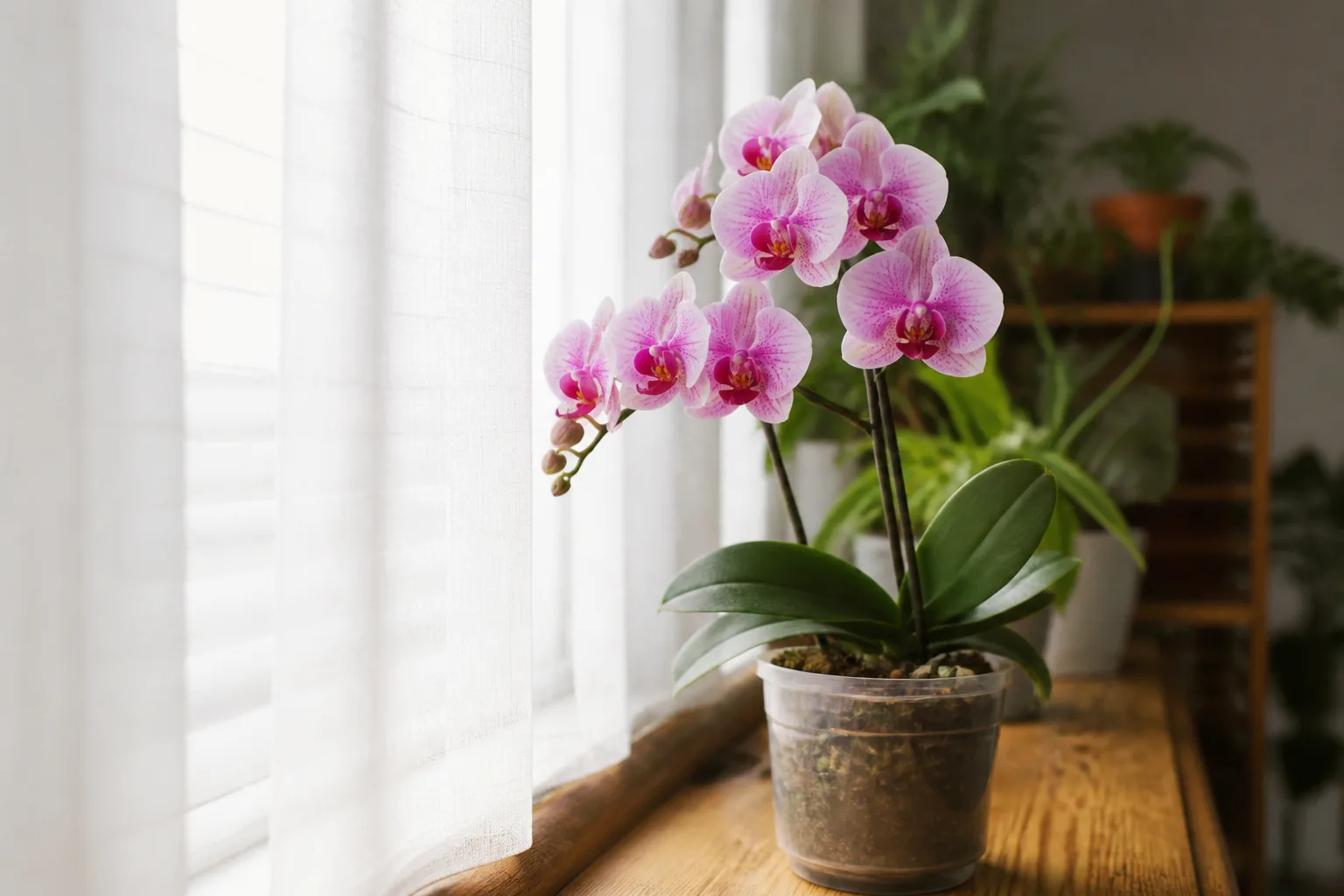
Give a typical Phalaenopsis bright, filtered light. An east-facing window is a useful starting point; a bright west or south window may work farther from the glass or behind a sheer curtain. Very dark green leaves and a long wait without new growth can point to insufficient light, while bleached or scorched patches suggest the plant is too close to intense sun.
Water by the root zone, not by the calendar. NC State Extension describes moth orchids as warm, humid plants that prefer a bark-based medium with excellent drainage; mature plants may need roughly weekly watering, but the mix should dry somewhat and the pot should drain completely. (NC State Extension) Epic Gardening’s recent moth-orchid guidance similarly recommends checking root color, condensation, and medium dryness instead of watering every week automatically. (Epic Gardening)
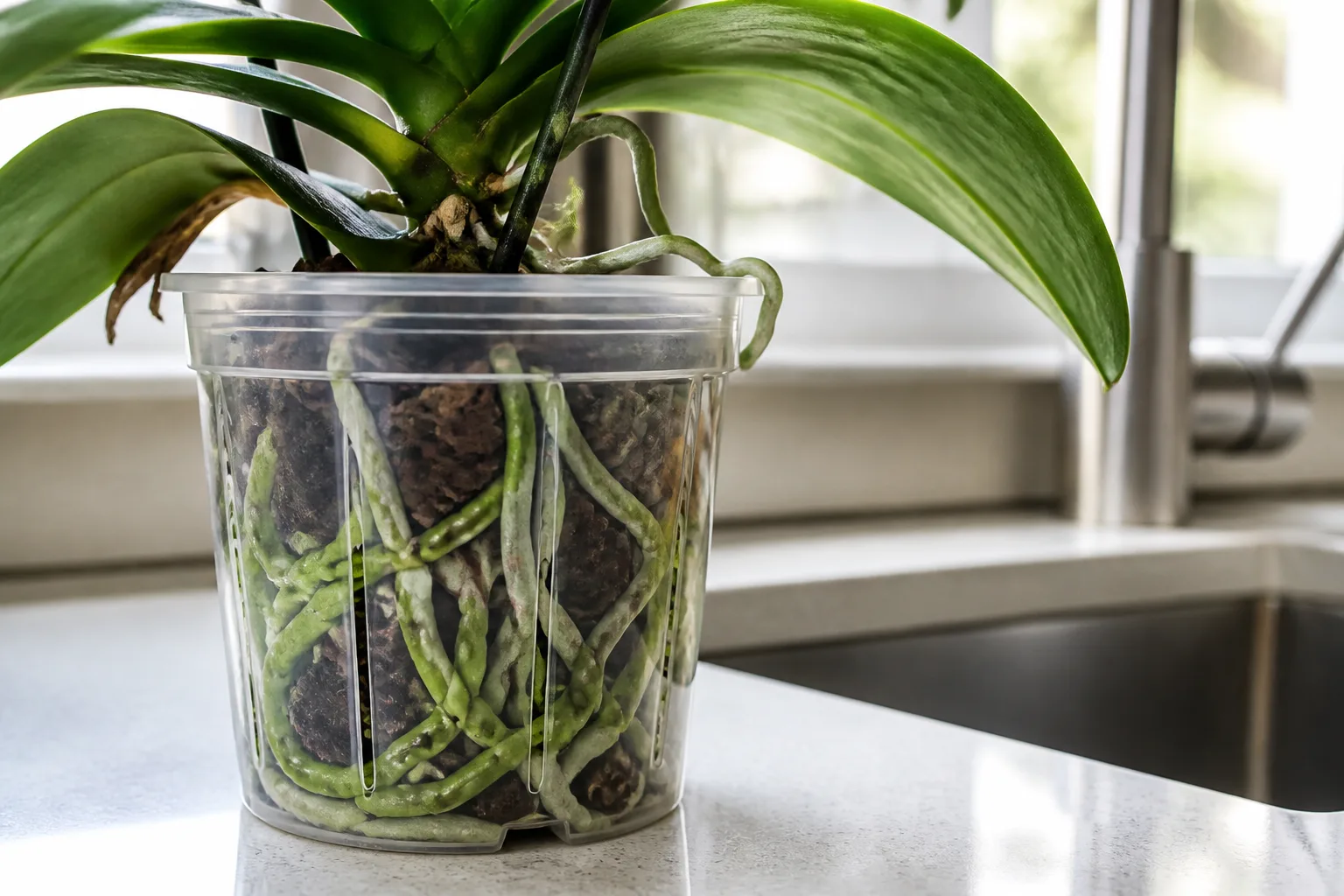
When the roots look silvery and the bark is nearly dry, take the inner pot to a sink, soak the medium thoroughly with room-temperature water, and let it drain before returning it to the decorative pot. Green, plump roots or visible condensation mean the plant may still have enough moisture. Never leave the pot sitting in runoff, and keep water out of the crown where it can collect and encourage rot.
A simple post-cut check-in keeps the recovery period from becoming guesswork:
- On pruning day: remove the cut spike, empty any water from the cachepot, and return the plant to the same stable light. Do not immediately move it to a darker room just because it is no longer flowering.
- At the next watering: inspect the roots and bark before adding water. A newly cut orchid does not need extra water, and overwatering cannot make a node activate.
- Over the next several weeks: watch for a new leaf, root tips, a swelling node, or a new spike emerging between the leaves. These are stronger recovery signals than a dormant spike changing every day.
- If the pot stays wet: improve drainage or investigate the medium and roots instead of increasing the watering interval by habit. A cut spike cannot compensate for a suffocating root zone.
This sequence also explains why a healthy orchid can seem to do nothing after pruning. The plant may be rebuilding roots or storing energy before it commits to flowering. A stable, gradually improving plant is on a better path than one that produces a quick side branch while its leaves are losing firmness.
Feed lightly and repot only when needed
A post-bloom orchid does not need a high-phosphorus “bloom booster” to compensate for weak conditions. If the plant is actively growing, use a water-soluble orchid fertilizer diluted according to its label and flush the medium with plain water regularly to limit salt buildup. Gardening Know How recommends feeding during active growth, then reducing or pausing fertilizer after flowering until new leaves appear. (Gardening Know How)
Repot after flowering when the bark has broken down, the pot stays wet, the roots are crowded by decomposed material, or the plant has root rot. Do not repot a stable orchid simply because the flowers fell. Moth orchids prefer a snug, well-drained container; a much larger pot can hold wet mix around a small root system and make the next recovery harder.
If you do repot, use orchid bark or another open orchid medium, trim only roots that are soft, hollow, or black, and keep firm aerial roots above the mix when possible. Give the plant a short settling period, then resume moisture checks based on the new pot and medium rather than the old watering routine.
If the next bloom does not appear
No new flowers after a node cut does not prove that you pruned incorrectly. The node may remain dormant, the cultivar may flower on a different seasonal schedule, or the plant may be using its energy to grow leaves and roots. A healthy Phalaenopsis commonly blooms on a yearly rhythm, but individual hybrids and home conditions change the timing.
Troubleshoot in the order the plant is telling you
Start with light. A plant that survives in a dim room may not have enough energy to initiate a new spike. Move it gradually toward brighter filtered light rather than placing shade-grown leaves against hot midday glass.
Next inspect roots and moisture. Firm green or silvery roots and a medium that dries between thorough waterings are encouraging. Brown, hollow, or mushy roots, a heavy wet pot, and wrinkled leaves together point to a root-zone problem; watering more will not fix roots that cannot function.
Then look at temperature and seasonal cues. NC State notes that large-flowered Phalaenopsis types may need a cool nighttime period of about 55°F for roughly a week in autumn to initiate a spike, while modern dwarf hybrids may not need that same cue. (NC State Extension) Do not put an orchid against freezing glass or expose it to abrupt drafts. A modest, safe day-to-night change is different from cold damage.
Finally, check whether you are asking the cut to do work that only time can do. A base cut, node cut, brighter window, or fertilizer change cannot make a stressed orchid flower on demand. Look for a new leaf, firm roots, a swelling node, or a new spike nub between the leaves; those are better progress signals than an empty calendar.
If buds form and then fall, think beyond pruning. Sudden temperature changes, a heater or air-conditioner draft, a sharp change in light, dry roots, wet roots, and moving the plant repeatedly can all interrupt a developing display. Stabilize one variable at a time. Moving an orchid from a dim shelf to direct midday sun while also repotting and increasing fertilizer makes it impossible to tell which change helped or caused the setback.
Likewise, do not keep cutting a spike shorter every time nothing happens. A node that stays dormant is information: the cultivar may prefer a new basal spike, the node may already be spent, or the plant may not yet have enough stored energy. Make one sensible cut, improve the growing conditions, and wait for the plant to show its next move.
Conclusion: prune for the plant you have
Cut a brown, yellow, dry, or mushy orchid spike to the base. On a strong Phalaenopsis, a green spike with a genuinely unused node can be shortened just above that node for a chance at a side branch. On a weak or root-damaged plant, remove the whole spike and spend the next cycle rebuilding roots, leaves, light, and drainage.
The safest orchid aftercare is observant rather than fussy: identify the structure before cutting, sterilize the tool, keep water out of the crown, let the bark dry enough between thorough waterings, and give the plant bright filtered light. A clean cut can make reblooming more likely, but the plant’s stored energy and growing conditions decide whether the next flower arrives.