13 Ash Tree Species: Identification, Size, and EAB Risk
Compare 13 ash tree species by size, habitat, leaf and bark clues, and emerald ash borer risk before planting or identifying a tree.
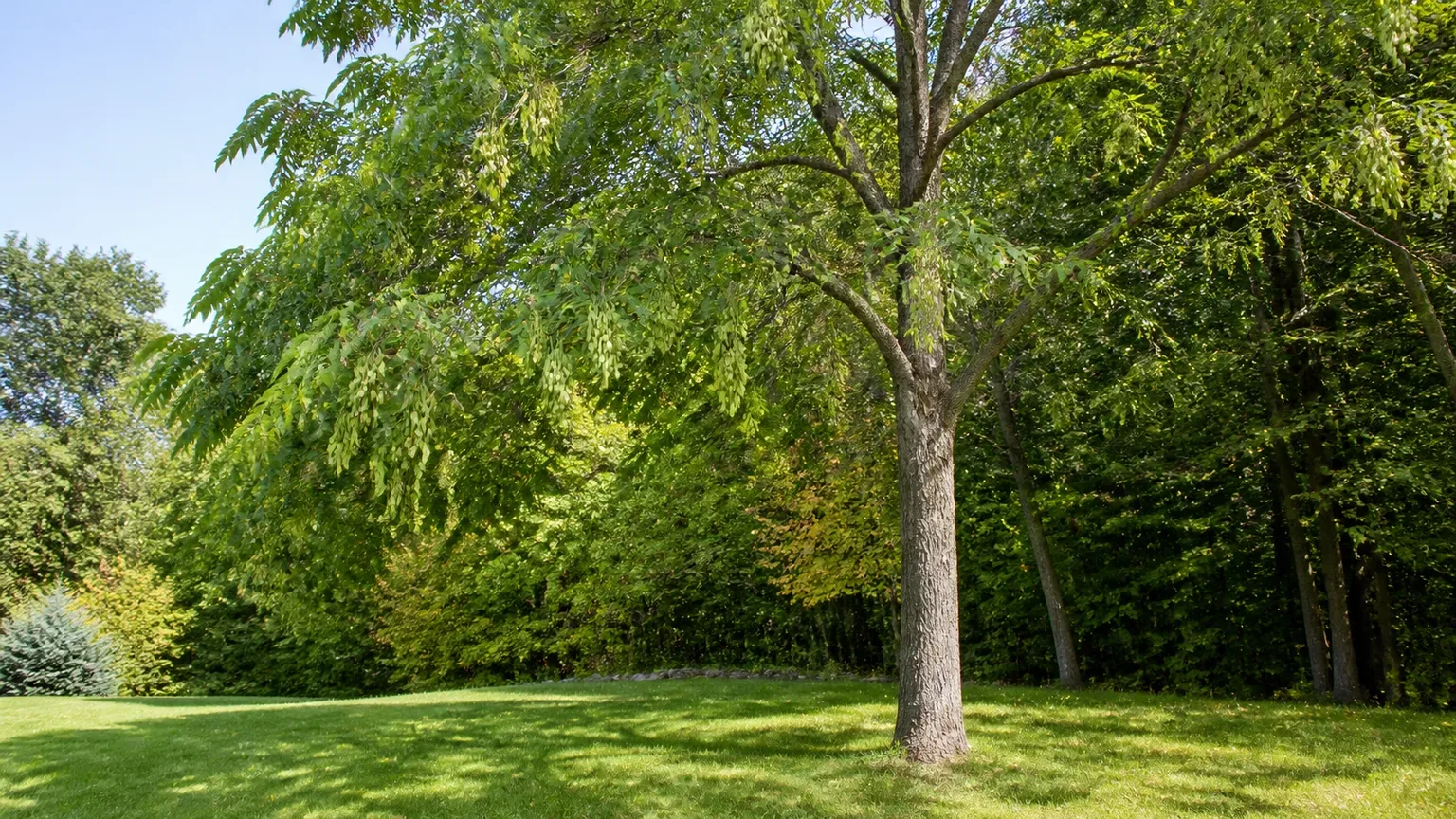
Ash trees are members of the genus Fraxinus, a group of deciduous trees and shrubs in the olive family. They are recognizable by a useful combination of opposite branching, pinnately compound leaves, and winged fruits called samaras—but identifying the exact species takes more than spotting a “helicopter seed.”
The 13 species below range from a 12-foot desert shrub to an 80-foot shade tree, and from bogs and swamps to dry limestone hills. That diversity matters because the best ash for a wetland restoration project is a poor fit for a compact lawn, while a species that looks promising on paper may be a risky investment where emerald ash borer is established.
Ash trees at a glance: what belongs to Fraxinus
The Fraxinus genus contains true ash trees and small trees native across North America, Europe, Africa, and Asia. Their leaves are usually divided into several leaflets along one central stalk, their flowers are small and often petal-free, and female flowers develop into flat, winged fruits. The North Carolina Extension Gardener Plant Toolbox is a useful starting point for comparing the genus and its species profiles.
Ash is not the same as mountain ash. “Mountain ash” is a common name for Sorbus species, which belong to the rose family and have a different fruit and leaf structure; the First Nature ash identification guide explains the distinction in the context of European ash.
The practical consequence is that a name such as “water ash,” “red ash,” or “Arizona ash” may be a regional common name rather than a separate species. Record the botanical name from a plant tag, herbarium label, or extension key before making a planting or treatment decision.
How to identify an ash tree before you name the species
Start with the whole twig, then move to the leaf and fruit. A single detached leaflet can resemble hickory, walnut, or even some compound-leaved ornamentals; the arrangement of the leaves on the branch is usually more helpful.
Opposite branches and compound leaves
On a typical ash, leaves and side branches emerge in pairs directly across from each other. The leaf is pinnately compound: several leaflets attach along a central rachis, with one terminal leaflet at the tip. Leaflet number varies by species, often from three to 13, so counting alone is not a reliable identification.
Ash leaflets are commonly oval to lance-shaped, with edges that may be smooth, toothed, or finely serrated. White ash often shows a paler underside, blue ash has usually seven to 11 leaflets and distinctive four-angled young twigs, and black ash has dark buds and a wet-soil habitat that help separate it from the more adaptable green ash. The NC State profile for blue ash documents the square young shoots, alkaline-soil tolerance, and relative—not absolute—reduction in EAB impact.
To separate ash from hickory or walnut, inspect a living twig rather than a fallen leaf. Hickory and walnut normally have alternate leaves and branches, and they produce nuts; an ash has opposite branching and a samara instead.
Samaras, bark, and winter buds
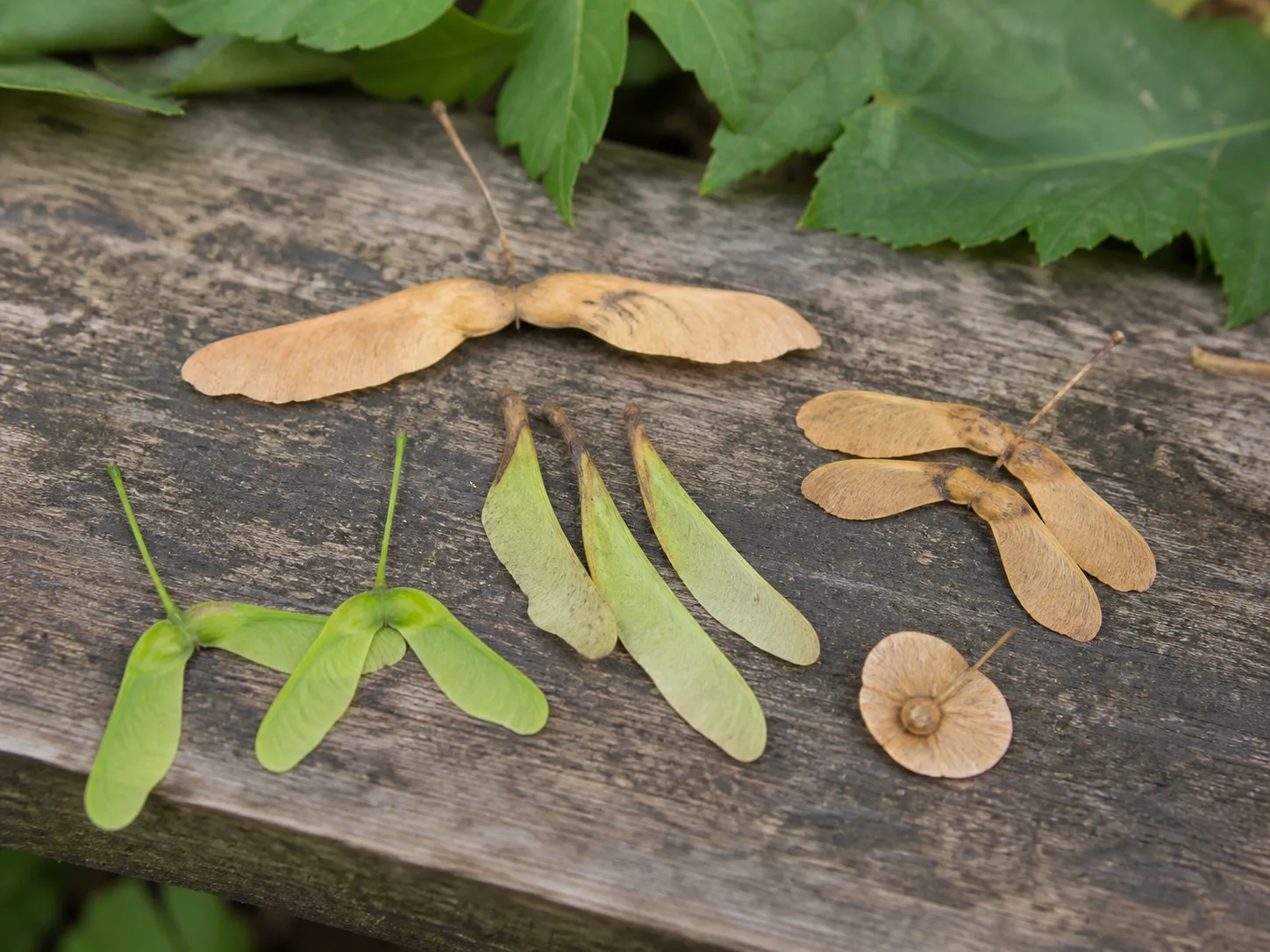
Ash fruits are flat, papery samaras that usually have one elongated wing attached to a seed body. They hang in clusters and can persist after the leaves drop. Maple samaras are often paired like a two-bladed propeller, so the fruit can be a useful clue—but wind, age, and overlapping foliage make fruit alone a weak basis for naming the tree.
Bark changes as a tree ages. Mature white and green ash commonly develop gray bark with diamond-shaped ridges, while younger trunks can be much smoother. Winter buds are especially useful: black ash is known for nearly black buds, while European ash has conspicuously dark buds too. If the tree has no leaves, combine bud color, twig arrangement, bark texture, crown shape, and habitat rather than relying on a single feature.
The EAB decision changes which species make sense
Emerald ash borer, Agrilus planipennis, is an invasive beetle whose larvae feed beneath ash bark and destroy the tissues that move water and nutrients. It attacks true ash trees in the genus Fraxinus, and the City of Toronto’s current overview notes that all true ash species are at risk, even though some individual trees may show more tolerance under lower pest pressure.
This changes the planting question. If EAB is present locally, a new ash is rarely the sensible default for a home lawn or street-side canopy. A species with comparatively lower observed damage—such as blue ash or Manchurian ash—should not be described as immune, and a “seedless” male selection is still an ash that can face the beetle.
Ash can still have legitimate conservation, ecological, and historic uses. A land manager restoring a wetland, preserving genetic diversity, or caring for a high-value mature tree may make a different decision from a homeowner choosing a new shade tree. In either case, check local extension guidance and diversify the planting rather than establishing a monoculture of one ash species.
13 ash tree species, grouped by habitat and use
Use the comparison below to narrow the list, not to replace a local plant profile. Height and spread vary with soil, climate, cultivar, and whether a source measures a wild tree or a landscape specimen; use the nursery tag and a local plant database for the final siting decision.
| Species | Approximate mature size | Best first site clue | Main caution |
|---|---|---|---|
| Black ash | 50–65 ft tall and wide | Peat, muck, bogs, and flood-prone ground | Extremely vulnerable to EAB |
| Green ash | 50–70 ft tall, 35–50 ft wide | Adaptable moist soil; occasional flooding | Highly vulnerable to EAB |
| White ash | 60–80 ft tall and wide | Moist, well-drained soil; pale leaf undersides | Highly vulnerable to EAB |
| Blue ash | 50–70 ft tall and wide | Full sun, dry or limestone/alkaline soil | Less affected is not immune |
| California ash | 20–25 ft tall | Dry western sites; two-petal flowers | Regional EAB status can change |
| Carolina ash | 30–60 ft tall | Southeastern swamps and wet woods | Wetland specialist; at-risk genus |
| European ash | 60–80 ft or more | Large, sunny, sheltered site; dark buds | Disease and EAB pressures |
| Gregg’s ash | 11–15 ft tall | Desert climate and small-space form | Verify local hardiness and pest advice |
| Manna ash | 40–50 ft tall and wide | Full sun and fragrant spring flowers | EAB threat remains |
| Narrow-leaf ash | 50–80 ft tall | Slender leaflets and urban tolerance | ‘Raywood’ is not pest-proof |
| Pumpkin ash | 60–80 ft tall, broad spread | Saturated wetland soil and swollen trunk base | Very large and highly EAB-susceptible |
| Velvet ash | 20–40 ft tall and wide | Southwestern dry or alkaline soil | Uncertain EAB susceptibility |
| Manchurian ash | 40–50 ft tall | Cold climate and yellow fall color | Relative resistance is conditional |
Wet-soil specialists
Black ash (Fraxinus nigra) — Usually 50–65 feet tall and broad, black ash is native to bogs, peat, muck, streams, and seasonally flooded ground in eastern Canada and the northeastern United States. Its dark buds, open crown, and flexible wood are distinctive, but the species has been devastated across much of its range by EAB and is not a sensible new street-tree choice in an infested region. NC State Extension lists its wet-soil habitat, size, and severe pest concern.
Green ash (Fraxinus pennsylvanica) — This 50–70-foot tree is one of the most adaptable ashes, tolerating moist clay or loam, occasional flooding, drought once established, moderate salt, and alkaline soil. Its 5–9 leaflets, short leaflet stalks, diamond-ridged bark, and abundant single-winged samaras are useful ID clues, but its adaptability also made it a common landscape tree—and a very vulnerable EAB host. NC State’s green ash profile now advises against planting new green ash.
Carolina ash (Fraxinus caroliniana) — A southeastern wetland ash associated with swamps, floodplains, and wet woods, this species can reach roughly 30–60 feet. It is a better match for a wet naturalistic site than for a dry suburban bed, and its shade tolerance is useful where many full-sun trees struggle. Its EAB susceptibility is not a promise of safety; treat it as an at-risk Fraxinus and follow regional monitoring advice.
Pumpkin ash (Fraxinus profunda) — Named for the swollen base that can develop in saturated soil, pumpkin ash is a large eastern North American tree, often 60–80 feet tall with a broad spread. It belongs in the “specialist wetland tree” category, not a small rain-garden shopping list, and the Missouri Botanical Garden profile warns against new planting because of its high EAB susceptibility.
Dry-site, urban, and smaller ashes
Blue ash (Fraxinus quadrangulata) — A 50–70-foot Midwestern tree, blue ash tolerates dry conditions, limestone-derived or alkaline soils, and some moisture as long as the site is not permanently flooded. Young twigs with four ridges are its signature clue. It has generally been less affected than many North American ashes, but NC State Extension still records EAB as a problem and notes that blue ash can be slower to establish.
California ash (Fraxinus dipetala) — Also called two-petal ash, this shrub or small tree usually stays around 20–25 feet and comes from dry parts of California, Arizona, Utah, and Nevada. Three to nine leaflets with rounded tips and fragrant white flowers with two petals make it visually unlike the big eastern shade ashes. It is a better drought-adapted candidate for a suitable western site, but EAB risk in the West is a moving regional question, not a reason to skip monitoring.
Gregg’s ash (Fraxinus greggii) — A small desert ash, usually about 11–15 feet tall, Gregg’s ash can be trained as a small tree or kept as a large shrub. Its small leaves and thin gray branches suit containers or limited spaces better than the broad canopy of white or green ash, while its native desert climate makes drainage and heat more important than rich, constantly wet soil. In a new planting, verify local availability and pest guidance because its EAB response is less established than that of common North American landscape ashes.
Velvet ash (Fraxinus velutina) — Native to the southwestern United States, velvet ash is commonly 20–40 feet tall and wide, with shoots that have a velvety texture. It can tolerate drought after establishment and alkaline soil, but fast growth is not a free benefit: a poorly sited tree can become weak, thirsty, or too large for the space. Its susceptibility to EAB remains uncertain in many regions, so do not sell it as a resistant replacement.
Large shade and ornamental ashes
White ash (Fraxinus americana) — Often 60–80 feet tall and broad, white ash develops a rounded crown and diamond-ridged gray bark. Its leaves commonly have seven leaflets with whitish undersides, and it has strong historic value as a timber tree used for tool handles and sports equipment. The Missouri Botanical Garden describes its moist, well-drained soil preference, moderate drought tolerance, fall foliage, and high EAB risk; new planting is generally difficult to justify where the pest is established.
European ash (Fraxinus excelsior) — A large, wide-crowned European tree that may reach 60–80 feet or more, European ash is easiest to recognize in winter by its dark buds and in summer by its broad compound leaves. It prefers a sunny, sheltered site and is not automatically a low-risk substitute for native ashes: European populations also face serious pest and disease pressures, and relative EAB resistance is not the same as immunity. TreeHelp’s extension-attributed profile is useful for its size and cultivar context.
Manna ash (Fraxinus ornus) — Also called flowering ash, this 40–50-foot southern European and western Asian species is valued for fragrant white flower panicles in late spring, smooth gray bark, and yellow-to-purple fall color. It prefers full sun and moist, well-drained soil but has some drought tolerance after establishment. Gardenia’s horticultural profile gives a useful landscape description while still noting that EAB threatens the species.
Narrow-leaf ash (Fraxinus angustifolia) — This medium-to-large ash has slender leaflets and a reputation for coping with urban conditions, dry soil, and alkaline conditions when well established. The cultivar ‘Raywood’ is especially known for purple or claret fall color. Give it real canopy room—often 50–80 feet—and check the local pest picture before planting; a showy cultivar does not change the genus-level EAB risk.
Manchurian ash (Fraxinus mandshurica) — Native to eastern Asia and generally 40–50 feet tall, Manchurian ash has large compound leaves and attractive yellow fall color. It is often discussed as less vulnerable or less preferred by EAB than several North American ashes, which makes it interesting for research and breeding, but field performance depends on beetle pressure, tree health, and local climate. Treat “more resistant” as a reason to investigate—not as a guarantee.
Match an ash to your site, not just your hardiness zone
Hardiness zone tells you whether winter temperatures may be survivable; it does not tell you whether the root zone will stay wet, whether the canopy will clear a roof, or whether the tree will become a safety liability. Use zone as the first filter, then match habitat and mature dimensions.
Full sun, moisture, and soil
Most ashes grow best in full sun, often defined as six or more hours of direct light. The exceptions are matters of tolerance rather than a license to plant in deep shade: black ash and Carolina ash can handle more shade because their native habitats are wet woods, while Gregg’s ash may tolerate some shade in hot desert conditions.
Group the soil by drainage before you choose a species. Black, Carolina, green, and pumpkin ash can handle wet ground to different degrees; blue, California, Gregg’s, velvet, and manna ash make more sense where drainage is good and drought timing is predictable. Do not “fix” a permanently saturated site by putting a dry-site ash in a large planting hole—the roots still experience the surrounding wet soil.
Mature size, fruit, and maintenance
Measure the planting area from the future trunk, not from the nursery pot. A white, green, black, pumpkin, or European ash can eventually need a canopy footprint wider than a typical front yard, and limbs over roofs, sidewalks, driveways, and power lines turn routine pruning into a recurring expense.
Female trees produce samaras, which can be valuable wildlife food but also create litter and volunteer seedlings. Male cultivars reduce fruit mess, not EAB risk, and sex expression can be more complicated in ash than a nursery label suggests. Select a seedless form only when it solves a genuine maintenance issue, never as a pest-management strategy.
How to plant and care for an ash tree
If you have decided an ash is appropriate for a conservation, restoration, or low-risk local site, plant in fall or early spring when the soil is workable and the tree is not under summer heat stress. Choose a healthy, locally adapted nursery tree, inspect the trunk for wounds and circling roots, and keep the root flare at soil level rather than burying it.
Dig a broad hole no deeper than the root ball and at least two to three times as wide. Backfill with the native soil you removed, loosen only soil that is compacted, and apply a thin mulch layer over the root zone while keeping mulch away from the trunk. A deep mulch volcano encourages moisture and decay where the trunk should remain dry.
Establishment watering and pruning
Water slowly and deeply through the first growing season, adjusting for rain, soil texture, and heat rather than following a fixed daily schedule. The goal is evenly moist soil around the developing roots, not a permanently saturated planting hole; a newly planted tree in sand may need more frequent irrigation than one in clay, but both need oxygen around the roots.
Once established, many ash species tolerate short dry periods, but drought tolerance is not the same as zero-water performance. During a prolonged drought or heat wave, water the root zone deeply and check the tree for early stress before leaves scorch or branches die back.
Prune only dead, broken, crossing, or structurally dangerous branches unless a qualified arborist has a specific training objective. Avoid topping, large flush cuts, and casual bark wounding: those practices reduce structural strength and can make an already pest-prone tree harder to manage.
Emerald ash borer: signs, timing, and next steps
Check an ash at least once a year, especially where local detections are increasing. EAB larvae feed under the bark, so the first visible canopy symptoms may appear after internal damage is already significant; Utah State University Extension explains why the insect is difficult to manage and why trees with more than about 50 percent crown dieback have a poor chance of recovery.
How to separate EAB from look-alike damage
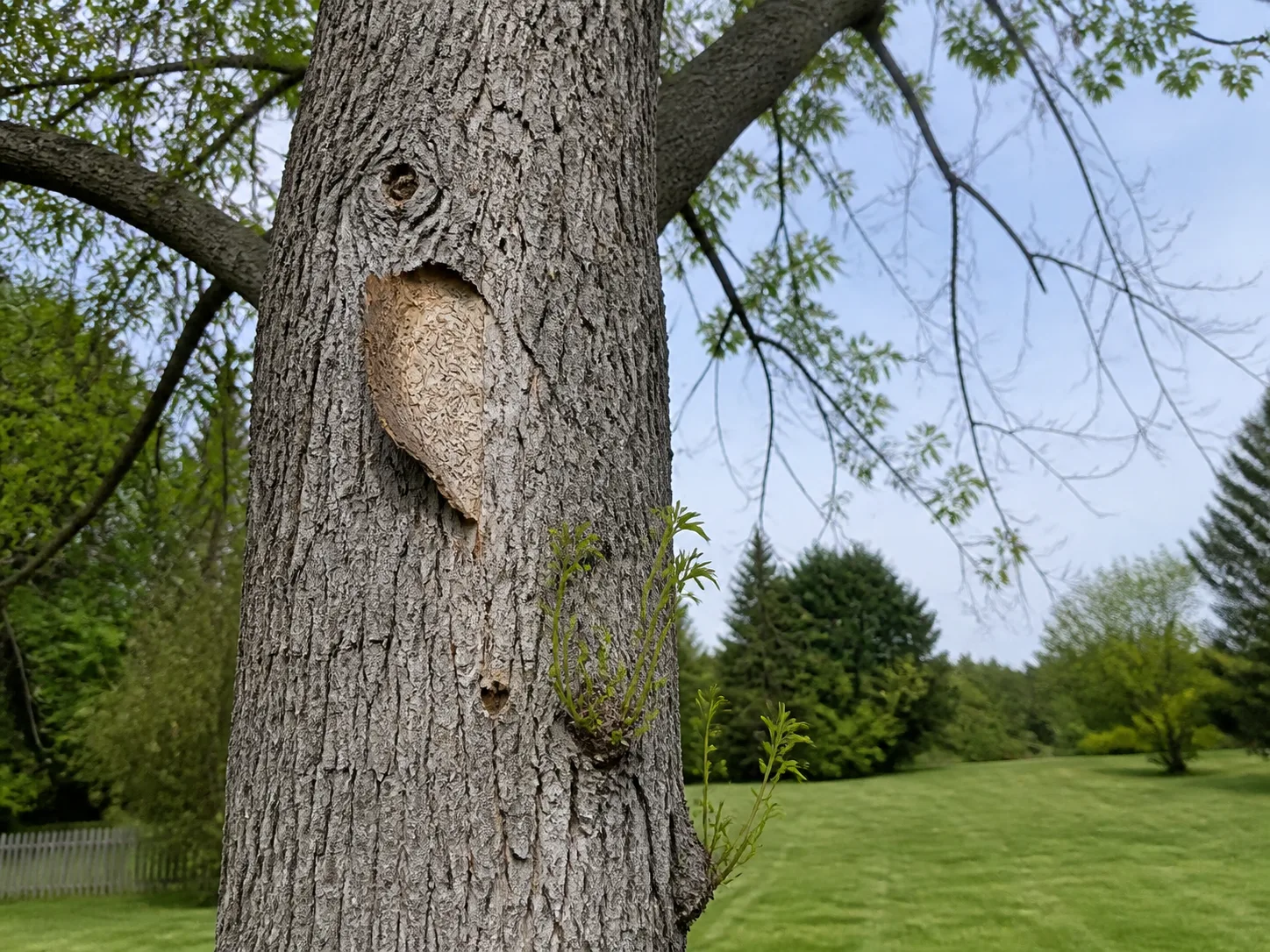
The strongest warning signs are a combination of symptoms, not one hole in the bark:
- D-shaped exit holes: adult beetles leave small, distinct D-shaped openings as they emerge.
- S-shaped galleries: peeling a small loose piece of bark may reveal winding larval tunnels in the cambial zone; do not strip healthy bark as a routine inspection.
- Thinning upper crown: dead branches often begin high in the canopy, followed by more general dieback.
- Epicormic shoots: clusters of new shoots from the trunk or major limbs can signal stress.
- Woodpecker activity and bark flecking: birds may pull bark while feeding, but these clues are not diagnostic on their own.
Drought, root damage, ash bark beetles, cankers, ash yellows, and storm injury can produce overlapping symptoms. If the tree has high value or sits near people, vehicles, or structures, have an arborist inspect it instead of drilling, stripping bark, or applying a pesticide based on a photograph.
When treatment is worth discussing
Treatment works best as protection for a healthy or lightly infested, structurally valuable tree before canopy loss becomes extensive. Purdue Extension emphasizes that treated trees need continued treatment and that moving firewood spreads EAB; the City of Toronto’s integrated pest management program shows why timing and professional application matter.
Ask three questions before spending money on treatment: Is EAB confirmed or likely in this area? Is the tree healthy enough to respond? And is the tree valuable enough to justify repeat applications and monitoring? A large healthy white ash near a home may meet that test; a severely declining tree with major dieback, poor structure, or a hazardous lean may be a removal decision instead.
Do not choose a soil drench, trunk injection, rate, or schedule from a generic internet list. Product labels, tree size, timing, applicator licensing, and local regulations matter, and systemic insecticides are not a universal rescue for trees with advanced canopy loss.
Other ash pests and diseases
Ash may also host ash bark beetles, lilac ash borer, scales, aphids, leaf miners, fall webworms, ash sawflies, and ash leaf curl aphids. Common disease problems include leaf spots, rust, anthracnose, cankers, powdery mildew, ash yellows, and general decline; a correct diagnosis matters because pruning, watering, sanitation, and treatment are not interchangeable fixes.
Start with the simplest site checks: Is the root flare buried? Has soil stayed saturated? Was the tree wounded by a mower or string trimmer? Did drought, construction, salt, or a late freeze precede the symptoms? Correcting a site stress can prevent a minor pest from becoming a tree-wide decline, while spraying an unknown insect may waste money and harm beneficial organisms.
Conclusion: choose with both habitat and pest risk in mind
The best way to identify an ash is to combine opposite branching, pinnately compound leaves, samaras, buds, bark, and habitat. The best way to choose one is to add mature size, drainage, fruiting, structural maintenance, and local EAB status to that identification.
Black, Carolina, and pumpkin ash belong to wet-site conversations; blue, California, Gregg’s, and velvet ash cover smaller or drier niches; white, green, European, manna, narrow-leaf, and Manchurian ash offer larger or ornamental forms with very different trade-offs. In an EAB-affected region, preserving a healthy existing tree may justify expert monitoring, but planting a new ash should be a deliberate ecological or landscape decision—not an automatic choice for shade.



