20 Types of Watermelon for Every Garden
Compare 20 types of watermelon by size, color, days to maturity, seed status, and space. Find the right variety for a short season or small garden.
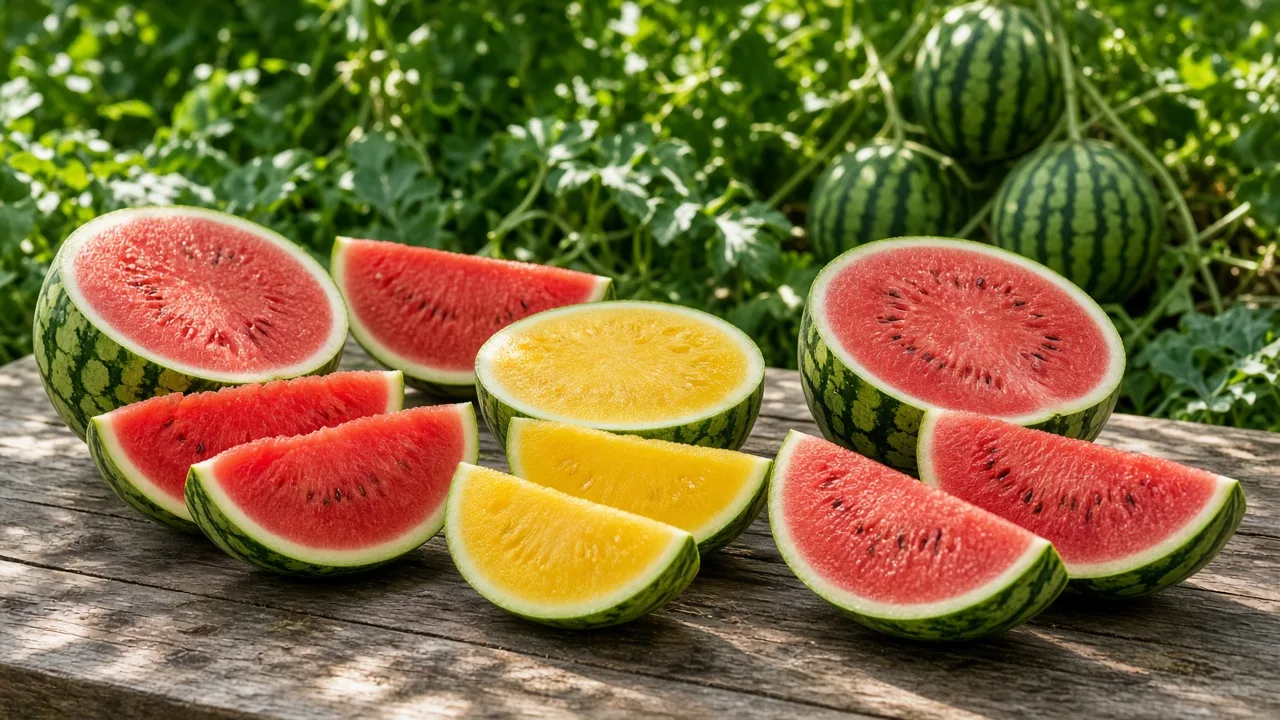
The best watermelon for your garden is not automatically the biggest, sweetest, or most unusual one. It is the variety that can finish before frost, fit the space you actually have, and match how your household wants to eat it.
Watermelons range from compact icebox fruit that can fit in a refrigerator to sprawling picnic and giant types that need a long, hot season. They also come with red, pink, yellow, orange, or cream flesh, plus a choice between seeded varieties and seedless triploids. Use the guide below to choose by growing conditions first, then by the fun details.
Pick the Right Watermelon Before You Buy Seeds
Count Heat and Frost-Free Days, Not Just Hardiness Zone
Watermelon is a frost-sensitive annual, so a USDA hardiness zone is a poor shortcut for choosing a cultivar. Your useful number is the stretch of reliably warm weather between planting and the first autumn cold, with enough sun for the fruit to build sugars. A seed packet’s “days to maturity” is an estimate, and catalogs may count from sowing, transplanting, or another point in the crop cycle.
As a starting point, early icebox and personal types often mature in about 70 to 80 days, while many picnic melons need 80 to 95 days and giants can push beyond 100. A short-season gardener should not choose a 95-day melon for a 75-day window and hope fertilizer will make up the difference. BHG’s watermelon guide uses the same useful distinction between early-season fruit at roughly 70–75 days and main-season fruit at roughly 80–90 days.
Epic Gardening’s melon overview likewise places many melons in an 80- to 100-day range while noting that dwarf types can mature earlier. That spread is why a packet’s number should be matched to your own frost-free window, not compared as though every supplier measured from the same date.
Warm soil matters at the beginning as much as warm air matters at the end. Direct-sow when the soil is genuinely warm—around 65–70°F is a practical threshold—and use black plastic or a temporary row cover if your spring is slow. If you start indoors, sow only a few weeks before planting and use biodegradable pots; an overgrown watermelon transplant with tangled roots can lose more time than it gains.
Match Fruit Size to Real Garden Space
Fruit size and vine size are related, but they are not the same thing. A small watermelon may still grow on a vine that travels several feet, and a “bush” label usually means reduced vine length, not a tiny plant that can be tucked between herbs.
For a small in-ground plot, choose an icebox or personal type and let the vine run over a path, mulch, or unused lawn edge. For a raised bed, plan the vine’s exit route before planting so it does not smother neighboring crops. A full-size picnic type deserves open ground, a broad bed edge, or a trellis strong enough to carry the fruit in fabric slings.
Containers are possible, but they are not a loophole around watermelon’s appetite for root space, moisture, and sun. Pick a genuinely compact cultivar, use a large container with excellent drainage, and expect more frequent watering than in-ground plants. A pot that is merely “big enough for a tomato” is not a fair test of the variety.
Decide Whether Seeded or Seedless Fits Your Plan
Gardening Know How’s seedless-watermelon explanation notes that triploid seeds can also be less reliable at germination and need warmer soil than ordinary seeded types.
Seeded watermelons are the simplest place to start: the seeds usually germinate more readily, the plants produce their own pollen, and you can save mature seed from an open-pollinated variety. Seedless types are convenient at the table, but they require a second planning decision because they are triploid plants with sterile pollen.
That does not make seedless plants genetically modified or impossible for a home gardener. It does mean you need a compatible seeded watermelon nearby to provide pollen, and the two plants need overlapping flowers. If you have room for only one plant, choose a seeded variety. If you want seedless fruit, buy a recommended pollenizer at the same time instead of treating it as an afterthought.
Compare the 20 Watermelon Types at a Glance
Gardener’s Path’s variety comparison and Harvest to Table’s short-season guide are useful cross-checks because they show how cultivar size and maturity vary across seed catalogs and climates.
The figures below are practical ranges, not promises. Weather, transplant timing, soil fertility, disease pressure, and the seed company’s counting method can move the harvest date. Use the packet for the final maturity estimate and treat the fruit’s field cues as the deciding evidence.
| Variety | Fruit and flesh | Approx. days | Best fit | Important trade-off |
|---|---|---|---|---|
| Allsweet | 25–30 lb, oblong, red | 90 | Long, hot season | Needs room to run |
| Belmont | 6–10 lb, round, red, seedless | 90 | Seedless icebox harvest | Needs a seeded pollenizer |
| Black Diamond | 30–50 lb, round, red | 90 | Large heirloom fruit | Long vines and heavy fruit |
| Bush Sugar Baby | Up to about 12 lb, red | 75 | Small gardens | “Bush” still needs sun and food |
| Carolina Cross | 50–200 lb, oblong, red | 95 | Giant-fruit projects | Not a realistic short-season choice |
| Charleston Grey | 20–40 lb, oblong, red | 85 | Classic picnic melon | Fruit is too large for most pots |
| Congo | 35–50+ lb, striped, red | 90 | Crowds and long seasons | Needs considerable space |
| Cream of Saskatchewan | 8–12 lb, cream flesh | 80 | Cool-season novelty | Thin rind bruises easily |
| Crimson Sweet | 15–35 lb, striped, red | 85 | Dependable classic | Needs a broad growing area |
| Dixie Queen | About 40 lb, red | 80 | Warm gardens | Large fruit and vigorous vines |
| Jubilee | 26–38 lb, striped, red | 95 | Heat and humidity | Long maturity window |
| Moon & Stars | 25–30 lb, spotted rind, red | 100 | Heirloom display | One of the longest waits here |
| New Queen | 5–6 lb, orange flesh | 80 | Early color and smaller fruit | Seeds can be less common to find |
| Orangeglo | 20–30 lb, orange flesh | 90 | Large orange-fleshed fruit | Needs a long warm run |
| Sangria | 20–23 lb, striped, red | 87 | High-flavor picnic use | Too large for tight plots |
| Secretariat | 16–20 lb, red, seedless | 80 | Earlier seedless fruit | Requires a seeded pollenizer |
| Sweet Siberian | 5–10 lb, apricot flesh | 80–85 | Shorter seasons | Not a single-serving mini |
| Tiger Doll | 8–9 lb, red | 72 | Very short seasons | Still a vigorous vine |
| Top Gun | 20–24 lb, striped, red | 83 | Uniform picnic fruit | Needs more space than icebox types |
| Yellow Petite | 6–10 lb, yellow flesh | 70 | Earliest novelty harvest | Flesh is softer than many red types |
20 Watermelon Types to Grow
The most useful way to read this list is to choose one variety for your growing constraint and one for your curiosity. If the season is marginal, let the early choice carry the harvest; then trial a colorful or heirloom type only if you can afford a later failure.
Early and Compact Choices
Bush Sugar Baby is a strong small-garden candidate when you want familiar red flesh without committing to a full picnic melon. Its shorter vines and roughly 75- to 80-day window make it more manageable than large heirlooms, but “bush” does not mean it can tolerate shade or a cramped root zone. Give it the sunniest edge of the bed and train the vine away from vegetables you still need to reach.
Cream of Saskatchewan earns its place for both flavor and climate flexibility. The 8- to 12-pound fruit has pale cream flesh and a thin, striped rind, and it can finish in roughly 80 days. That thin rind is a handling warning: place fruit on clean mulch or a board and avoid dragging it when checking the underside.
New Queen is a good choice when you want orange flesh in a relatively small icebox package. Its 5- to 6-pound fruit and approximately 80-day maturity window are friendlier to short summers than a giant orange-fleshed type. Treat its catalog timing as a window, not a guarantee, and prioritize warm soil at planting.
Sweet Siberian produces 5- to 10-pound melons with apricot-colored flesh in about 80 to 85 days. It is a useful middle ground for a cool garden that wants something more distinctive than red flesh but still needs a reasonable finish date. The fruit is personal-to-icebox sized rather than truly tiny, so the vines still need room to spread.
Tiger Doll is one of the fastest options in this group, often listed at about 72 days. Its 8- to 9-pound fruit has a light rind with thin dark striping and crisp red flesh, a size that is easier to finish and refrigerate than a 30-pound picnic melon. It is an especially sensible trial for a gardener whose summer is hot but short.
Yellow Petite is the early novelty pick. The 6- to 10-pound fruit has sweet yellow flesh and can be listed around 70 days, making it appealing for short seasons and small households. Do not choose it solely because the number is low; it still needs full sun, warm soil, regular moisture, and a healthy vine to reach good flavor.
Classic Red-Fleshed Picnic Types
Allsweet is a traditional oblong picnic watermelon for gardeners with a long, hot season and enough space for a vigorous vine. Its striped rind and bright red flesh are familiar, and the usual maturity estimate is around 90 days. Choose it for the combination of classic appearance and useful disease resistance, not for a small plot.
Charleston Grey is an old-fashioned choice with a gray-green rind, firm red flesh, and a thick exterior that handles transport better than thin-rinded types. At roughly 20 to 40 pounds and around 85 days, it fits a large garden better than a raised bed crowded with other crops. Its mature size also makes it a sensible candidate for rind pickles or a gathering where one melon needs to serve many people.
Crimson Sweet remains a practical benchmark because it combines a recognizable striped fruit, dark red flesh, moderate maturity at about 85 days, and resistance to some common diseases. It is still a large plant, so do not confuse “reliable” with “compact.” For a first full-size watermelon, it is often more forgiving than a giant showpiece because the fruit can finish within a broader range of seasons.
Dixie Queen is a warm-climate picnic type that can produce a large, pale-rinded fruit in roughly 80 days. The shorter maturity estimate is useful, but the melon can still weigh around 40 pounds, so vine and harvest logistics matter. Grow it when you want a southern-style family melon and have an open bed rather than a balcony container.
Jubilee produces long, striped melons with sweet, firm red flesh and a mature size commonly in the 26- to 38-pound range. It likes heat and humidity, but its approximately 95-day window makes it a poor bet for a cool, frost-prone garden. Look for an improved seed line if fusarium wilt or anthracnose has been a recurring issue locally, while remembering that resistance lowers risk rather than eliminating it.
Sangria is a high-yielding picnic type with dark green and lighter green striping, bright red flesh, and an estimated 87-day maturity. It suits gardeners who want a crowd-sized melon without waiting quite as long as they would for Moon & Stars or Jubilee. Expect vigorous vines and plan where the fruit will rest before the first female flowers open.
Top Gun produces uniform 20- to 24-pound fruit on vigorous plants in roughly 83 days. Its fairly predictable shape can be useful if you want several melons that mature within a similar window for a party or preserving project. It is still a full-size watermelon, so a neat row on the seed packet does not translate to a neat little plant in the garden.
Colorful and Heirloom Standouts
Moon & Stars is the conversation piece: dark green rind marked with yellow “moons” and “stars,” sometimes echoed in the leaves, over red flesh. The fruit often reaches 25 to 30 pounds and may need around 100 days. Choose it when the garden experience includes watching an heirloom develop, not when every fruit must be guaranteed before an early frost.
Orangeglo brings deep orange flesh to a large, striped 20- to 30-pound fruit. The vines can yield heavily under favorable conditions, but the approximately 90-day maturity means it needs a real summer rather than a brief warm spell. Its color is most rewarding when the melon is allowed to finish fully on the vine, because an early-picked novelty is still an under-ripe watermelon.
Black Diamond is a large, round heirloom often listed in the 30- to 50-pound range, with a thick dark green rind and crisp red flesh. It is a good choice for a hot, spacious garden where the challenge is producing a substantial fruit, not conserving square footage. Support the fruit on clean mulch and avoid excessive handling; a heavy melon can damage its own stem if the vine is moved repeatedly.
Large, Long-Season, and Giant Types
Carolina Cross is for the grower who wants a fair-project watermelon and is willing to build the season around it. Under exceptional conditions, fruit can reach far beyond 100 pounds, but that possibility comes with a roughly 95- to 100-day maturity window, a huge vine footprint, steady fertility, and careful watering. In an ordinary home garden, think of it as a long-season experiment rather than a dependable dinner crop.
Congo is another crowd-scale heirloom, often producing striped fruit around 35 to 50 pounds or more. Its 90-day timing is shorter than Carolina Cross, but the plant still needs open ground and strong, healthy foliage through fruit enlargement. Choose it for generous slices and historical character, not because a short maturity number makes it small-space friendly.
Seedless Choices for Home Gardens
Belmont produces round, 6- to 10-pound seedless fruit on vigorous plants. It is a useful icebox-size seedless choice when you want a manageable melon, but it cannot be planted as a lone specimen and expected to set fruit reliably. Pair it with the compatible seeded pollenizer named by your seed supplier and make sure their flowers overlap.
Secretariat offers an earlier seedless option with oval, 16- to 20-pound fruit and a maturity estimate around 80 days. The larger size makes it more of a family picnic melon than an individual icebox fruit, while the seedless trait adds the same pollination requirement as Belmont. If this is your first triploid crop, buy a transplant or start extra seed in warm conditions because seedless packets can be less forgiving at germination.
Seedless watermelons are called triploids because their plants carry three sets of chromosomes and do not make useful pollen. The Watermelon Board explains that the seed is produced through a cross involving diploid and tetraploid parents; that is breeding, not genetic modification. In the garden, the practical fact is simpler: a seeded diploid plant must supply pollen to the seedless plant’s female flowers.
Set Up the Bed Around the Variety
Start Seeds in Warm Soil and Protect Young Roots
Give any variety full sun, fertile well-drained soil, and a way to keep moisture steady without leaving the roots saturated. A soil test is more useful than a generic fertilizer schedule; watermelon generally performs well in rich soil around pH 6.0 to 6.5, and BHG recommends checking the soil before adding amendments.
Direct sowing is usually kindest to the roots. Plant when soil is warm, keep the seedbed evenly moist, and thin seedlings rather than allowing a crowded clump to compete. In a cool climate, start seeds indoors only two or three weeks before the last frost window in a soilless mix, then transplant gently before roots circle the pot. RHS growing guidance emphasizes warm germination, shelter, and a smooth transition because tender melon plants can stall after a sudden temperature drop.
Water deeply at the root zone and keep the soil consistently moist during vine growth, flowering, and fruit enlargement. Mulch after the soil has warmed to slow evaporation and reduce soil splash, but keep wet mulch from touching the crown. Once fruit is near full size and the plant is healthy, avoid swinging from drought to a flood; those abrupt changes are more likely to produce cracking and watery texture than a calm, consistent taper.
Plan Seedless Pollination Before Planting
Watermelon flowers are separate male and female flowers on the same plant. The female flower has a small swelling behind it; a bee or careful hand pollinator must move pollen from an open male flower to that stigma for a fruit to develop.
This is essential for seedless fruit. Plant the seeded pollenizer close enough that bees do not have to cross a large empty space, and follow the seed company’s recommended pairing or layout. Gardening Know How recommends a practical home-garden pattern of one seeded plant for about two seedless plants, while commercial arrangements vary; the important point is not to copy a field ratio blindly but to keep pollen available beside the triploids.
The University of Delaware’s research on triploid watermelon found that poor pollen supply can delay fruit set and increase hollow heart, with risk rising as seedless fruit grows farther from a pollenizer. In one study, incidence rose sharply past about six feet from a pollenizer crown, and the authors also found that the response differed by variety. That does not mean every backyard melon six feet away will fail, but it is a strong reason to plant the pollenizer within the same small growing area, protect bees during bloom, and hand-pollinate if cool or rainy weather keeps them inactive.
The University of Delaware’s research on triploid watermelon found that poor pollen supply can delay fruit set and increase hollow heart, with risk rising as seedless fruit grows farther from a pollenizer. In one study, incidence rose sharply past about six feet from a pollenizer crown, and the authors also found that the response differed by variety. That does not mean every backyard melon six feet away will fail, but it is a strong reason to plant the pollenizer within the same small growing area, protect bees during bloom, and hand-pollinate if cool or rainy weather keeps them inactive.
To hand-pollinate, use a freshly opened male flower in the morning. Touch its pollen-bearing anthers to the center of an open female flower, or use a small clean brush. Do not remove row covers and then spray insecticides over the blooms; RHS notes that melons depend on insect pollination, especially when grown under cover.
Avoid the Failures That Make Good Varieties Disappointing
The first failure is choosing by novelty alone. A yellow or orange interior is interesting, but the color cannot rescue a variety that runs out of warm days. The same is true of a giant: a 150-pound possibility is irrelevant if the vine is still flowering when your nights turn cold.
The second failure is treating “days to maturity” as a harvest appointment. The number shifts with soil warmth, cloud cover, transplant shock, drought, disease, and whether the catalog counted from seed or transplant. Start checking the plant early, but do not cut a fruit just because the printed number has arrived.
The third is expecting disease resistance to mean immunity. ‘Crimson Sweet,’ ‘Allsweet,’ ‘Charleston Grey,’ and several improved lines are described as having resistance to fusarium wilt or anthracnose, but resistance can vary by seed line and local pathogen pressure. Rotate cucurbits when possible, keep foliage from staying wet overnight, remove badly diseased material, and choose a resistant cultivar as one layer of prevention rather than a guarantee.
The fourth is feeding a lush vine instead of growing a balanced plant. Too much nitrogen can create impressive leaves while fruit set and fruit quality lag. Start with tested soil, feed lightly when the plant is actively growing, and avoid applying a high-nitrogen lawn product near the watermelon bed.
The fifth is allowing repeated drought followed by heavy irrigation. Watermelon needs moisture, especially while fruit is swelling, but saturated soil suffocates roots and erratic irrigation can split fruit. A soaker hose or drip line, mulch after warming, and a finger or trowel check several inches below the surface are more dependable than watering by the calendar.
Finally, do not confuse a green mini-fruit with a failed variety too quickly. Poor pollination, cold weather, a damaged vine, or a late-set flower can cause an early abortion. If the plant has male flowers but few female flowers, the issue may be heat, light, nutrition, or plant age; if it has many tiny fruits that yellow and drop, look first at pollination and moisture consistency.
Harvest by Field Cues, Not by Calendar Alone
Watermelon does not become sweeter after it is cut, so harvest timing deserves as much attention as seed selection. The calendar narrows the window, but the individual fruit tells you whether it has actually finished.
Start with the tendril closest to the fruit stem. It should be brown, dry, and crisp rather than green and flexible. Then check the ground spot where the melon rests: creamy yellow or buttery yellow is a stronger maturity clue than white or pale green. Look for a rind that has shifted from glossy to a more muted finish, and compare the fruit’s size and shape with the variety description.
Weight helps as a supporting clue because a ripe watermelon should feel dense for its size. A heavy fruit is not automatically sweet, though; late overwatering can make a melon heavy and watery. The familiar thump can help rule out an obviously immature fruit, but sound varies with rind thickness, shape, temperature, and internal defects, so do not let a hollow note override a green tendril and white ground spot.
Harvest with a clean knife or pruners and leave a short stem stub. Cut rather than twisting the fruit from the vine, and support large melons with both hands while checking them. If one fruit is ready and another is not, harvest only the ready fruit; pollination dates and ripening can differ by more than a week on the same plant.
Conclusion
Choose watermelon in this order: first the warm days your garden can provide, then the space your vines can occupy, then the fruit size and color you want to eat. Tiger Doll, Yellow Petite, Bush Sugar Baby, Cream of Saskatchewan, New Queen, and Sweet Siberian are sensible starting points for shorter seasons; Crimson Sweet, Charleston Grey, Allsweet, Sangria, and Top Gun suit gardeners with room for classic picnic fruit; Moon & Stars, Orangeglo, and the giant types reward patience and a longer summer.
If you choose Belmont or Secretariat, put their seeded pollenizer on the shopping list before planting. Give every selection warm soil, full sun, steady moisture, room to run, and enough time on the vine. The variety sets the potential, but the garden’s heat, roots, pollinators, and harvest judgment decide whether that potential reaches the cutting board.



