15 Types of Monstera: How to Choose the Right One
Identify Monstera by juvenile leaves, fenestrations, shingling, variegation, and support needs—and avoid mislabeled look-alikes.
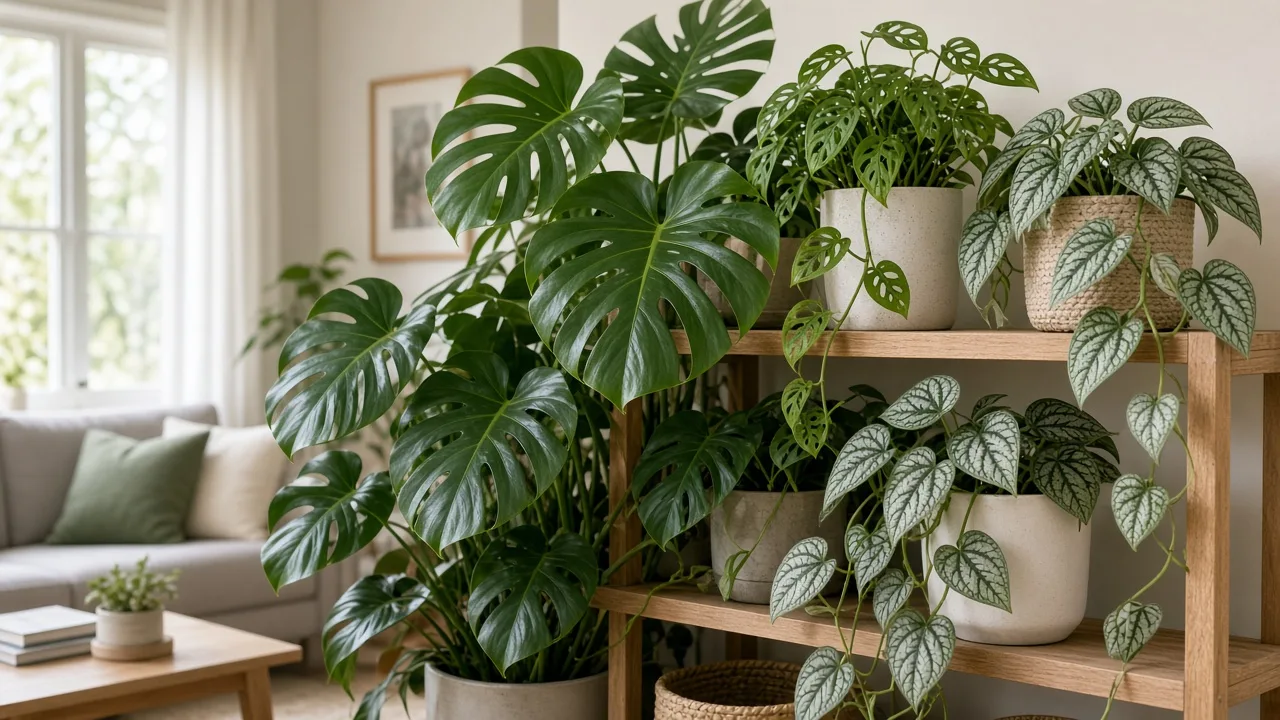
If you want a Monstera but do not know which one to choose, start with the job you want the plant to do. A ceiling-filling floor plant, a compact hanging vine, a silver-leaved climber, and a collector specimen may all be sold as “Monstera,” but they do not create the same workload or need the same kind of support.
The most important identification clue is not always the number of holes in a leaf. It may be the plant’s growth habit, whether the leaves lie flat against a support, how thick the leaf feels, or whether the name describes a cultivar rather than a species. Use this guide to compare 15 widely discussed Monstera types, then read the buying and care sections before you spend collector-level money on a plant that is still too young to identify confidently.
What Counts as a Monstera Type—and How to Identify One
The genus Monstera contains dozens of tropical aroid species, but only a small selection is routinely grown as a houseplant. Within that selection, nursery labels mix three different categories: a species such as Monstera deliciosa, a cultivar such as ‘Thai Constellation’, and a trade name such as “Monstera Peru.” A fourth category consists of look-alikes from other genera that are sold with “Monstera” in their common name.
That distinction matters because a cultivar does not have a separate wild species identity. ‘Thai Constellation’ and ‘Albo Variegata’ are variegated forms of M. deliciosa, not two unrelated Monsteras. Likewise, “mini Monstera” is a useful shopping nickname, but the plant behind it is usually Rhaphidophora tetrasperma, not a Monstera at all. Plantura’s species overview makes the same practical distinction between true species and the plants sold under familiar houseplant nicknames.
Some names are also unsettled in everyday trade. “Monstera Peru” and Monstera karstenianum are often used together by sellers, while plants sold as M. obliqua may be misidentified; Thursd’s trade-focused comparison is useful for seeing why those labels create confusion. When the label is uncertain, describe the plant by its visible traits and ask for the mother plant, node, and mature-leaf history rather than treating a dramatic name as proof.
Look at the whole plant, not just the prettiest leaf in the listing. A reliable first pass uses five clues:
- Leaf architecture: Are the openings holes enclosed within the blade, or are they splits that reach the edge? Are leaves thick and quilted, papery, silver, or feather-like?
- Growth habit: Does the vine climb, trail, or press its leaves flat against a support? A shingling plant needs a different setup from a basket plant.
- Maturity: Juvenile leaves may be smaller and entire, while mature leaves can become larger and fenestrated. A small solid leaf does not automatically mean the plant is a non-fenestrating type.
- Stem and nodes: On a cutting, confirm there is a viable node. A leaf without a node can stay green for a while but cannot produce a new vine.
- Variegation pattern: Cream or white sectoring, yellow marbling, and silver juvenile foliage are different traits. Ask whether the pattern is stable for that cultivar or simply a one-off sport.
If the seller cannot show more than one leaf, treat the identification as provisional. The Royal Horticultural Society’s growing guide notes that common Swiss cheese plants may take years to produce their characteristic holes, so a juvenile plant often tells you less than its listing suggests.
1. Monstera deliciosa
Monstera deliciosa is the classic choice for a large, architectural houseplant. Mature leaves combine deep splits with internal holes, and an established vine can become a substantial floor plant; Penn State Extension describes indoor plants reaching roughly 6 to 8 feet when conditions and support are adequate.
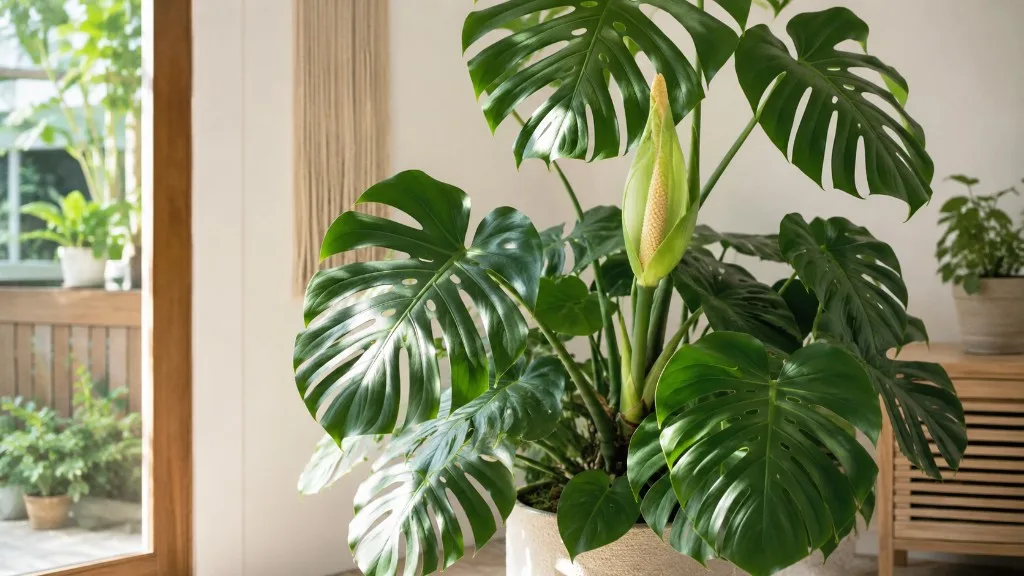
The practical catch is scale. A small nursery plant may look manageable for a year, then begin sending long stems and heavy leaves toward the brightest window. Give it bright, filtered light, a stable pot, and a sturdy moss pole, trellis, or board before it becomes impossible to train. Young leaves can be heart-shaped and solid, so do not judge the plant’s eventual leaf form from its first few leaves.
Choose M. deliciosa if you want the easiest mainstream Monstera and have room for a vertical statement plant. It is less suitable for a narrow shelf, a dark corner, or a home where a top-heavy pot would be easy to knock over.
2. Monstera adansonii
Monstera adansonii is the better fit when you want the Swiss-cheese effect without the broad, room-dominating leaves of M. deliciosa. Its leaves are smaller and usually filled with oval holes, and its flexible stems can climb a support or trail from a hanging pot.
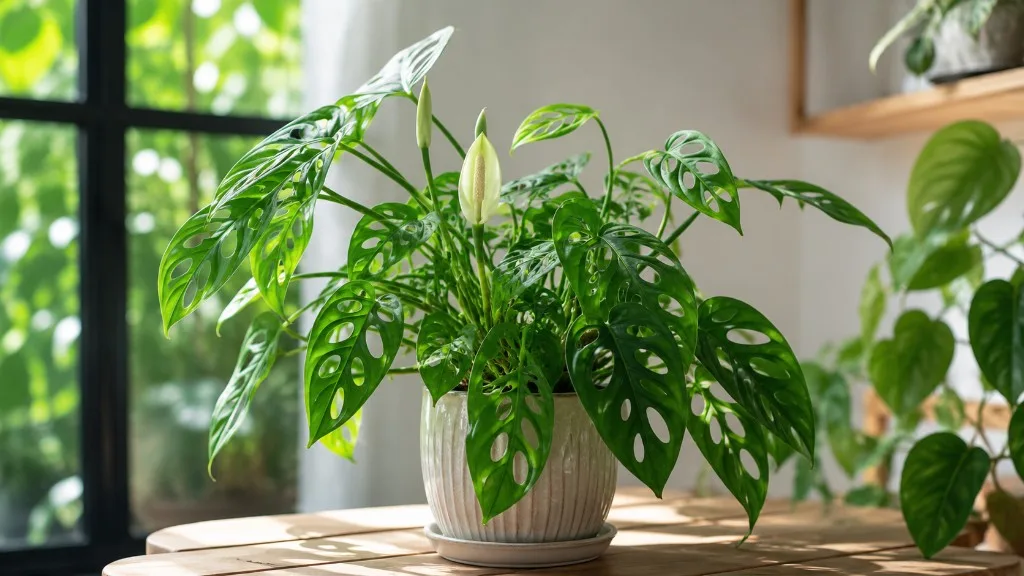
The plant is vigorous, but “small” does not mean self-contained. A happy specimen can produce long vines, and the leaves become more attractive when the plant receives enough light to keep new growth compact. It also dislikes being left cold or chronically wet, so use an airy mix and let the upper layer dry before watering deeply.
This is one of the strongest beginner choices for an apartment, especially if you prefer a hanging or narrow vertical display. Variegated forms exist, but their slower growth and higher light demand make a plain green plant the more forgiving starting point.
3. Monstera siltepecana
The silver Monstera earns its place through color rather than oversized fenestration. Juvenile leaves are narrow and silvery-green with darker veins, creating a metallic effect that looks good even before the plant matures. Penn State Extension notes that an upright support can encourage the leaves to become larger, greener, and more fenestrated.
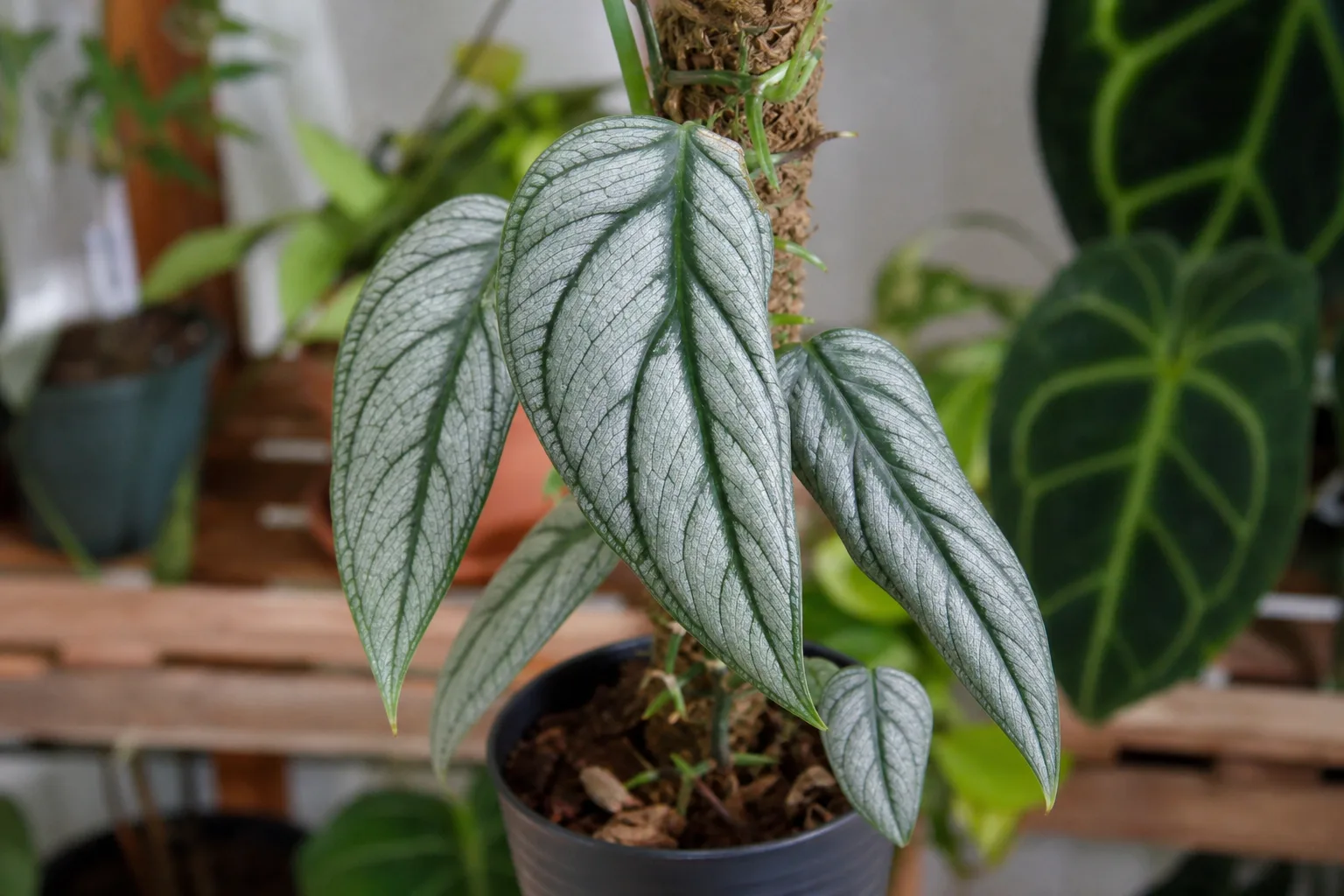
That makes M. siltepecana a useful example of why “no holes yet” is not a complete diagnosis. A trailing specimen may stay in a juvenile-looking phase longer, while a climbing plant in brighter usable light can change its leaf shape over time. Even then, maturity is gradual; do not move it into harsh direct sun to force a faster transformation.
Choose it for a small collection or a vertical display where silver foliage is the main attraction. It is a better visual choice than M. deliciosa when you want texture and contrast without immediately committing to a giant pot.
4. Monstera dubia
Monstera dubia is the shingling Monstera. Juvenile leaves are small, heart-shaped, and held tightly against a board, bark slab, or moss-covered support, creating a layered pattern rather than a hanging cascade. That flat growth is the plant’s signature, not a sign that it is stuck or unhealthy.
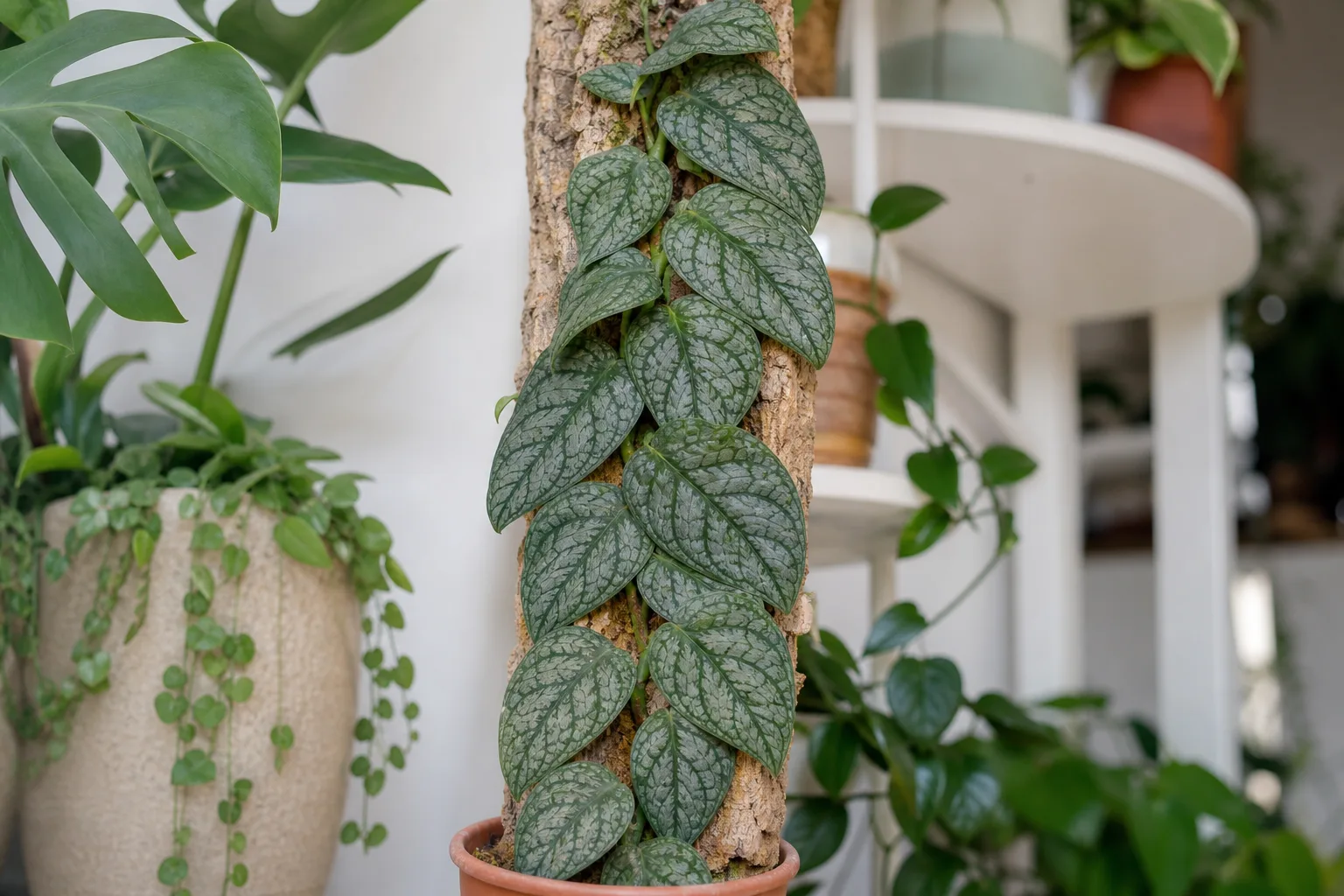
The support should be broad and stable enough for the plant to keep contact as it grows. A thin round pole may work temporarily, but a flat plank or wide moss board makes the shingling habit easier to see and train. Mature plants can change dramatically, so leave space for a larger climbing phase instead of designing only for the juvenile pot.
Buy M. dubia when the unusual growth habit matters more to you than immediate large leaves. It rewards a grower who enjoys training; it is a poor match for someone who wants a plant that can simply trail over a shelf.
5. Monstera karstenianum ‘Peru’
The plant sold as “Monstera Peru” is known for thick, dark green leaves with a puckered, quilted texture. It is often grown as a compact trailer or trained upward, but it is not the type to buy for dramatic fenestrations; the foliage is prized for its ridges and gloss instead.
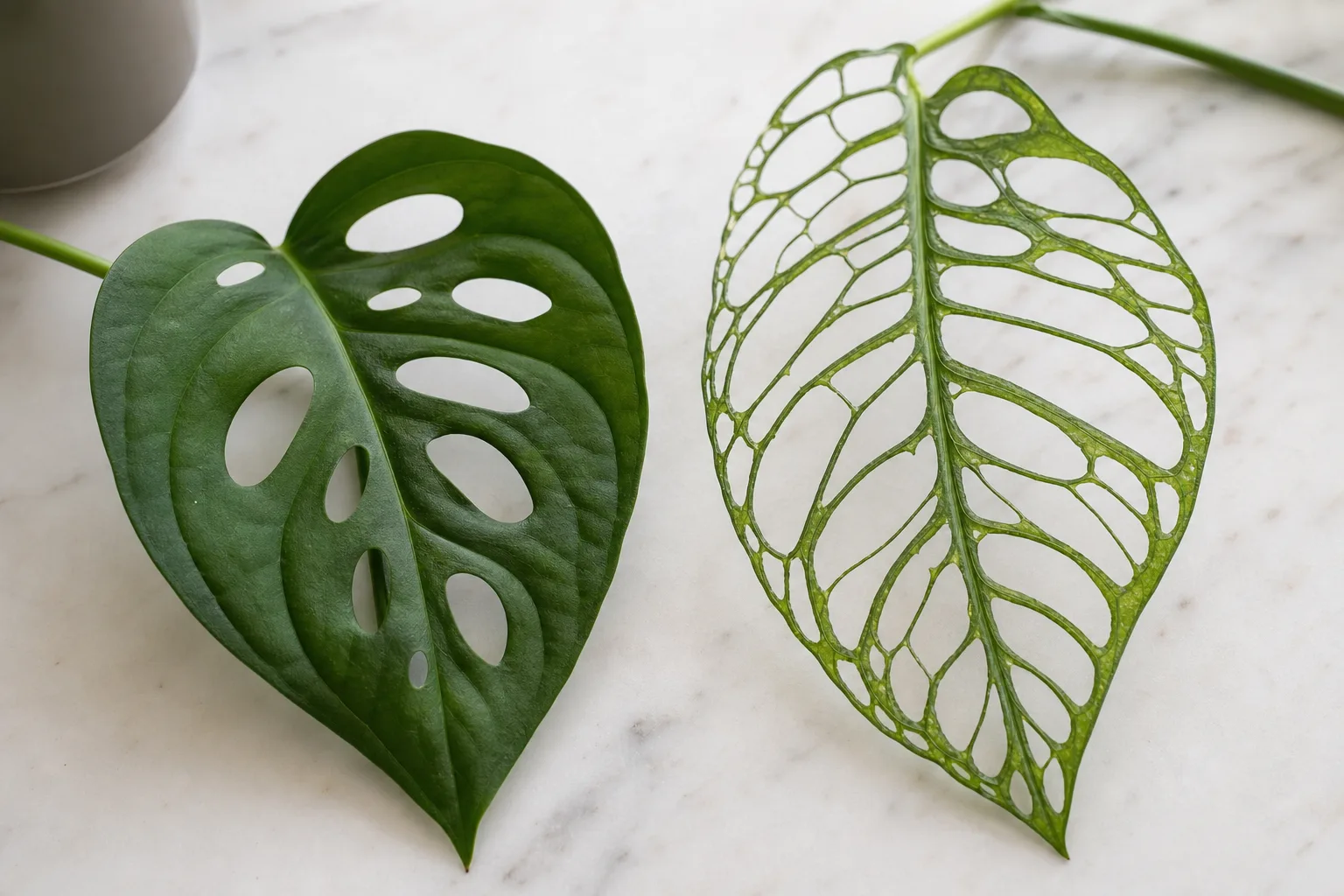
The name deserves a careful note. Commercial listings commonly pair “Peru” with Monstera karstenianum, yet trade naming is inconsistent, and a seller may use the name for a similar textured plant. Compare the actual leaf surface, ask for a photo of the mother plant, and do not assume every “Peru” listing is a taxonomically verified specimen.
This is a good choice for a grower who wants a tactile, dark-leaved plant in a smaller footprint. Its thick foliage can look excellent in a hanging basket, but its compact size should not be confused with low light tolerance or permission to keep the roots constantly wet.
6. Monstera standleyana
Monstera standleyana is a climbing species with elongated leaves that may carry cream, yellow, or white speckles, stripes, or irregular patches. It is sometimes sold as the “five holes plant,” but indoor specimens do not reliably develop the large fenestrations people expect from M. deliciosa. The variegation and narrow leaf shape are the stronger identification clues.
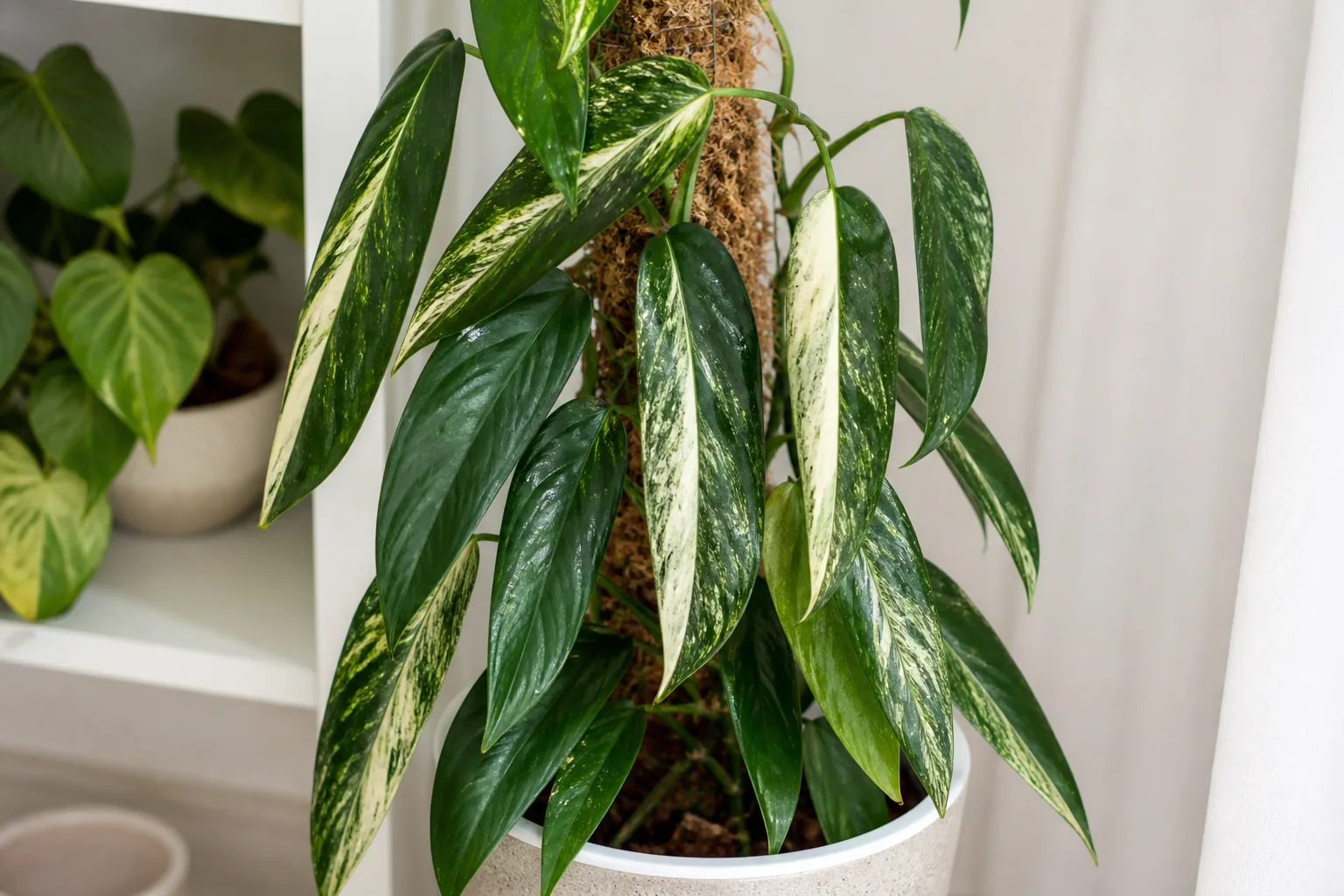
Treat the variegation as a care variable. Pale tissue contributes less chlorophyll, so a highly variegated plant has less green surface available for photosynthesis and can grow more slowly than a fully green one. Give it bright indirect light, protect it from hot glass, and expect the pattern to vary from leaf to leaf.
Choose M. standleyana for a more restrained, patterned climber. It is a better purchase than a giant variegated deliciosa if you want visible color but have limited floor space.
7. Monstera acuminata
Monstera acuminata is a smaller, pointed-leaved species that can suit a shelf, terrarium-style display, or compact climbing setup. It may develop holes or splits as it grows, but the plant’s scale and tapered leaf shape are more useful identifiers than a promise of dramatic adult fenestration.
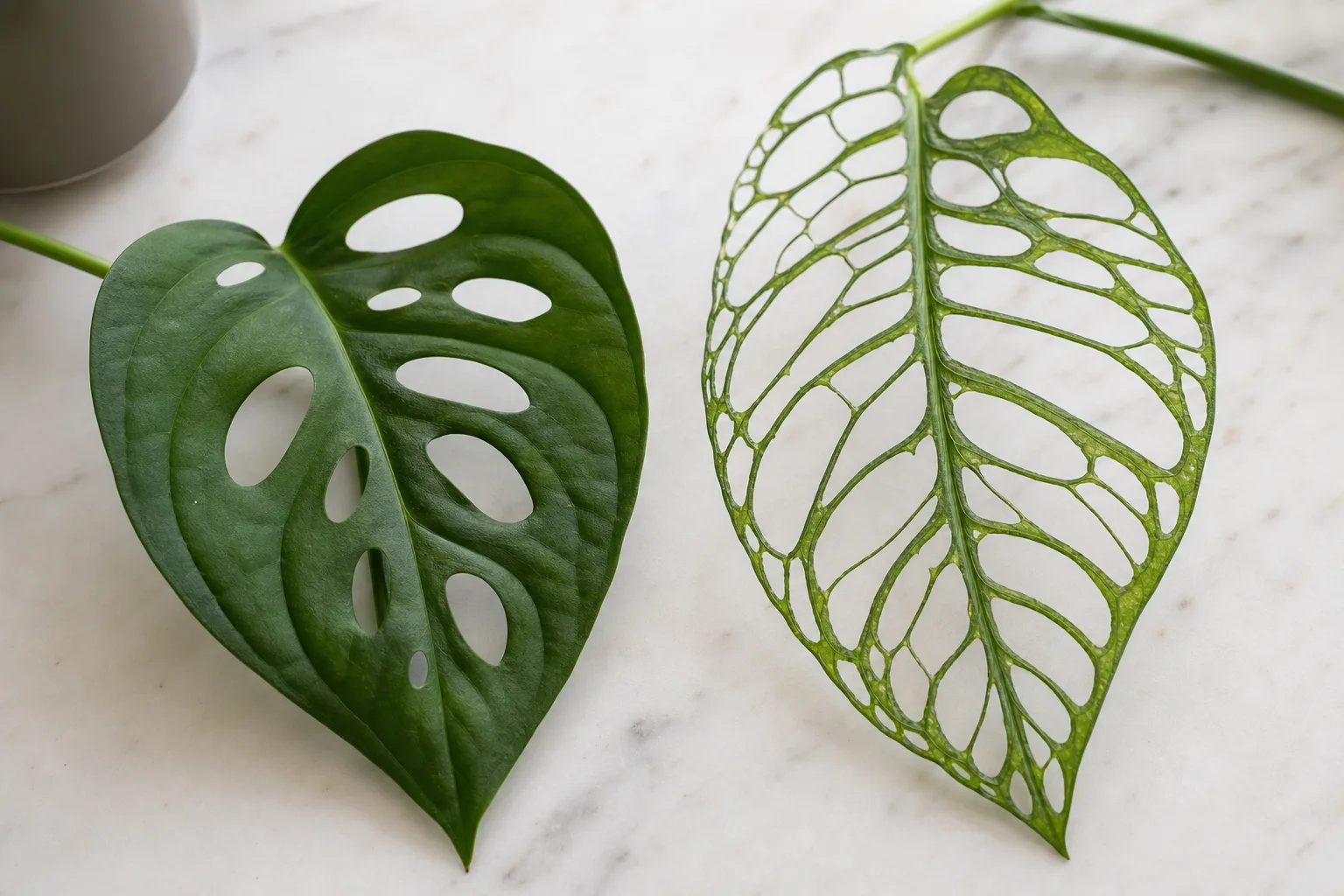
Its small size can tempt growers to place it in a dim spot. Resist that shortcut: compact does not mean shade-loving. Give it steady bright indirect light, warmth, and an airy root zone, then let the plant establish before repeatedly moving it around the room.
This is a good option when you want a true Monstera without the immediate footprint of M. deliciosa. It is less suitable for a cold windowsill or a grower who changes its location every few weeks.
8. Monstera pinnatipartita
Monstera pinnatipartita is valued for the transition in its foliage. Juvenile leaves begin relatively simple, then mature leaves become large, glossy, and deeply divided in a feather-like pattern. That change gives the plant a more sculptural look than the regular oval holes of M. adansonii.
It is a climber, so a support is not an optional decoration if you want the mature form. A plant left sprawling may remain smaller-leaved and more difficult to position, while a well-supported vine can present its leaves toward the light. Keep the support secure before the stems become heavy.
Choose it if you enjoy watching a plant develop rather than buying an instant finished specimen. Its eventual size and support needs make it better for a plant stand or floor display than a narrow desktop.
9. Monstera lechleriana
Monstera lechleriana is a vigorous, larger-leaved relative that can be confused with other holey Monsteras when young. As the foliage matures, openings tend to develop toward the center of the blade, and the plant benefits from room to climb and spread.
The key decision is whether you can accommodate speed and mass. Fast growth sounds attractive, but it also means more frequent tying, a heavier support, and a larger turning radius near a window. Do not plant a vigorous climber in a decorative pot that is too light to counterbalance the vine.
This type suits an experienced grower who wants a dramatic climbing plant and has the patience to manage structure. For a first Monstera, M. deliciosa is usually easier to find and identify, while M. lechleriana is more of a deliberate collection choice.
10. Monstera subpinnata
Monstera subpinnata is a standout for fern-like, feathered foliage. Instead of the broad, split leaves most people picture, it can develop narrow divisions that give the plant an airy silhouette. In trade, its mature appearance is the reason to grow it; a juvenile plant may not show that full effect.
Provide a vertical structure and enough room for the divided leaves to spread without being crushed against a wall. Bright indirect light helps maintain strong growth, but the plant still needs protection from sudden hot sun through glass. Water when the mix is beginning to dry rather than following a fixed calendar.
It is a rewarding choice for a collector who wants shape, not just holes. If you are buying a small cutting, ask for a photo of the parent plant because a juvenile leaf will not reliably preview the final form.
11. Monstera obliqua
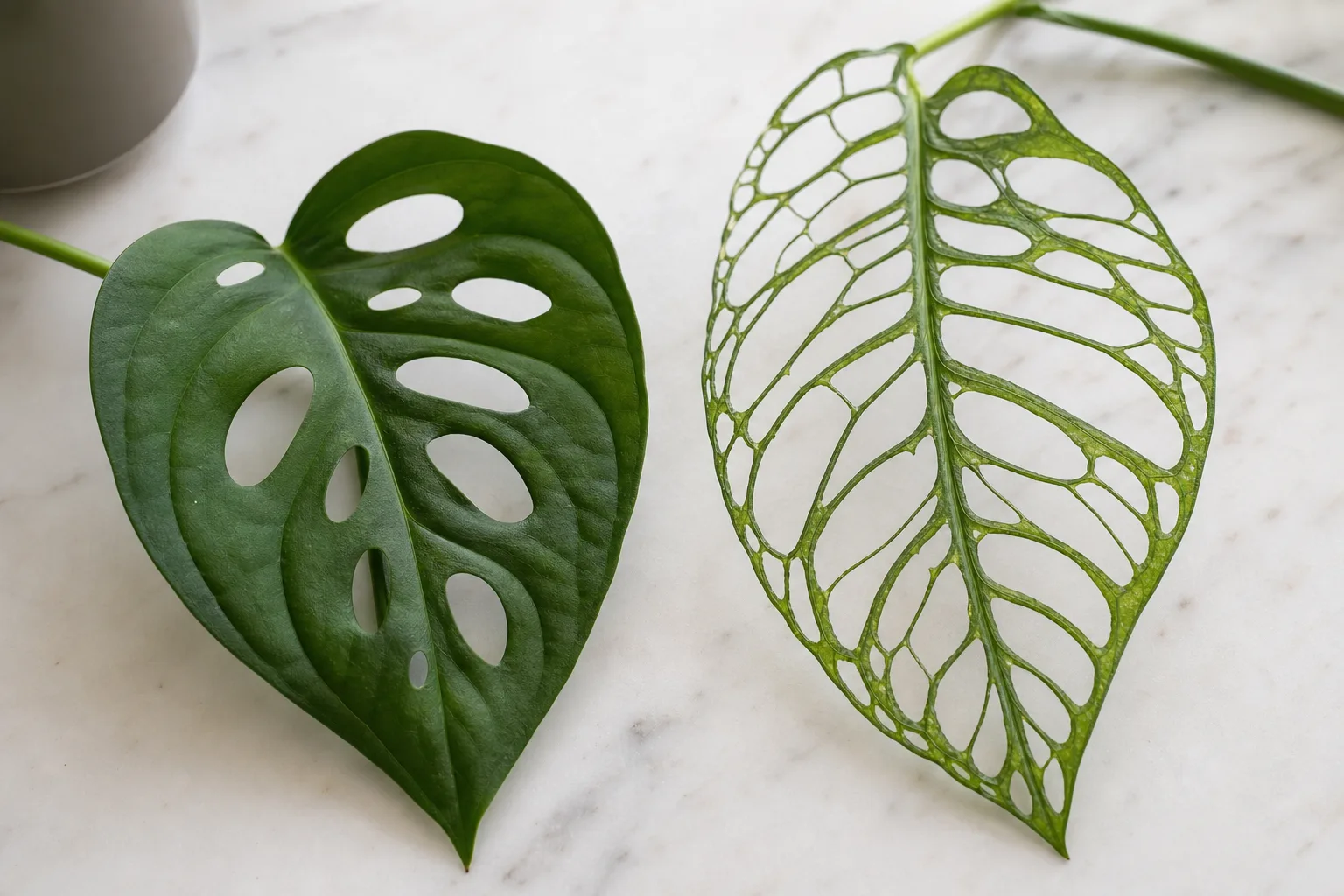
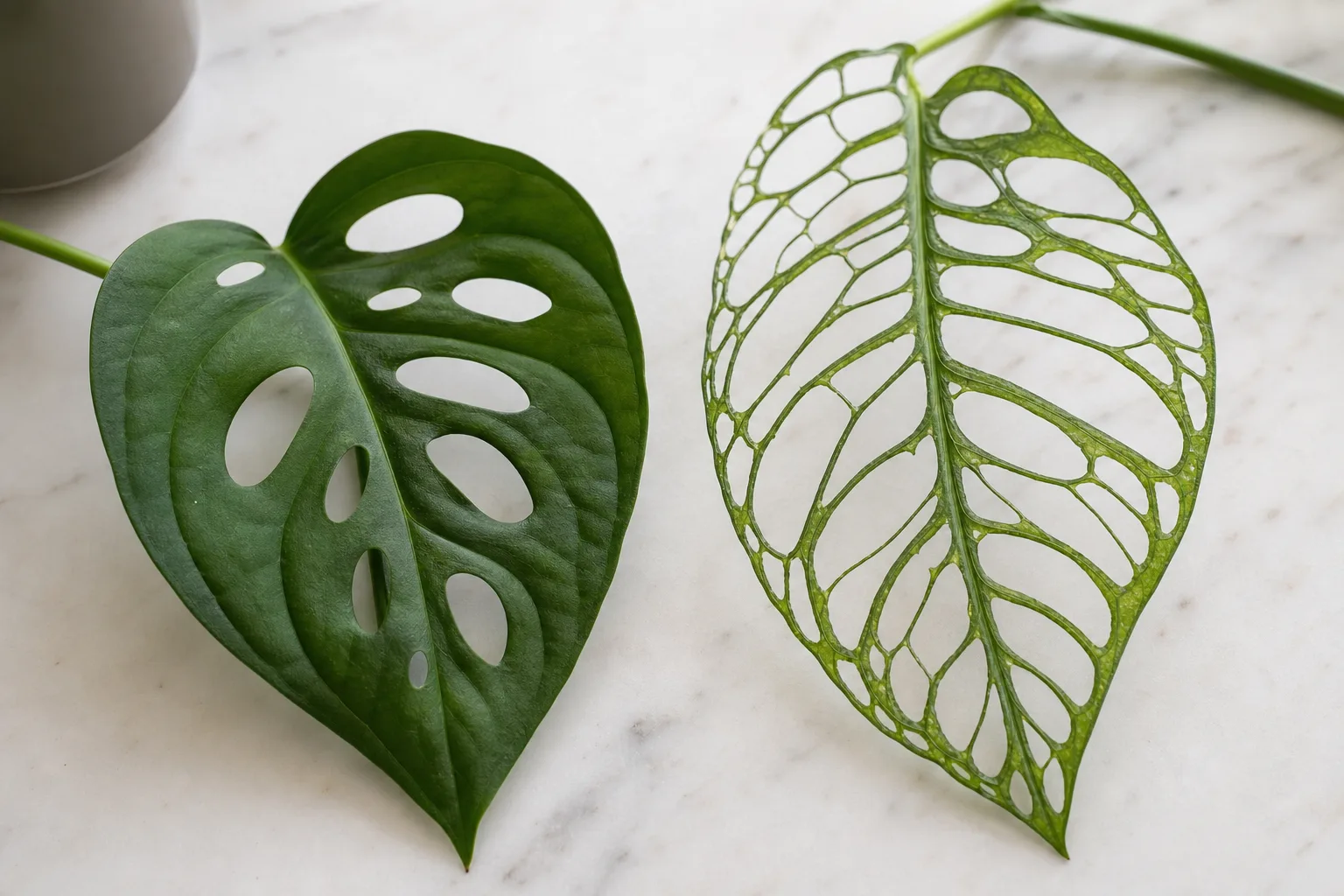
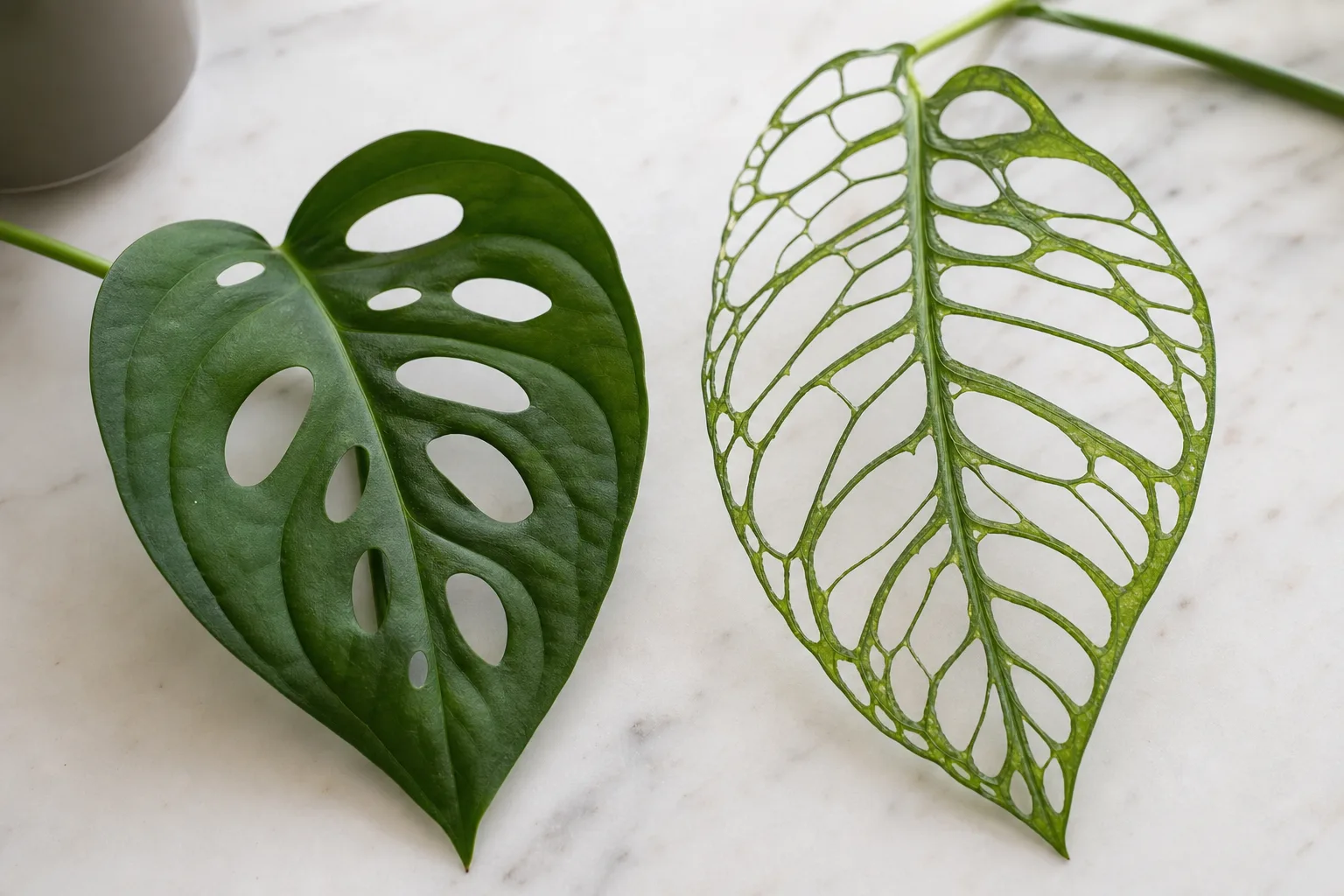
True Monstera obliqua is the name behind many identification disputes. It is associated with exceptionally thin leaves and a very high proportion of fenestration, but that delicate appearance is also why the plant is uncommon, expensive, and difficult to verify. A listing that uses the name without provenance deserves skepticism.
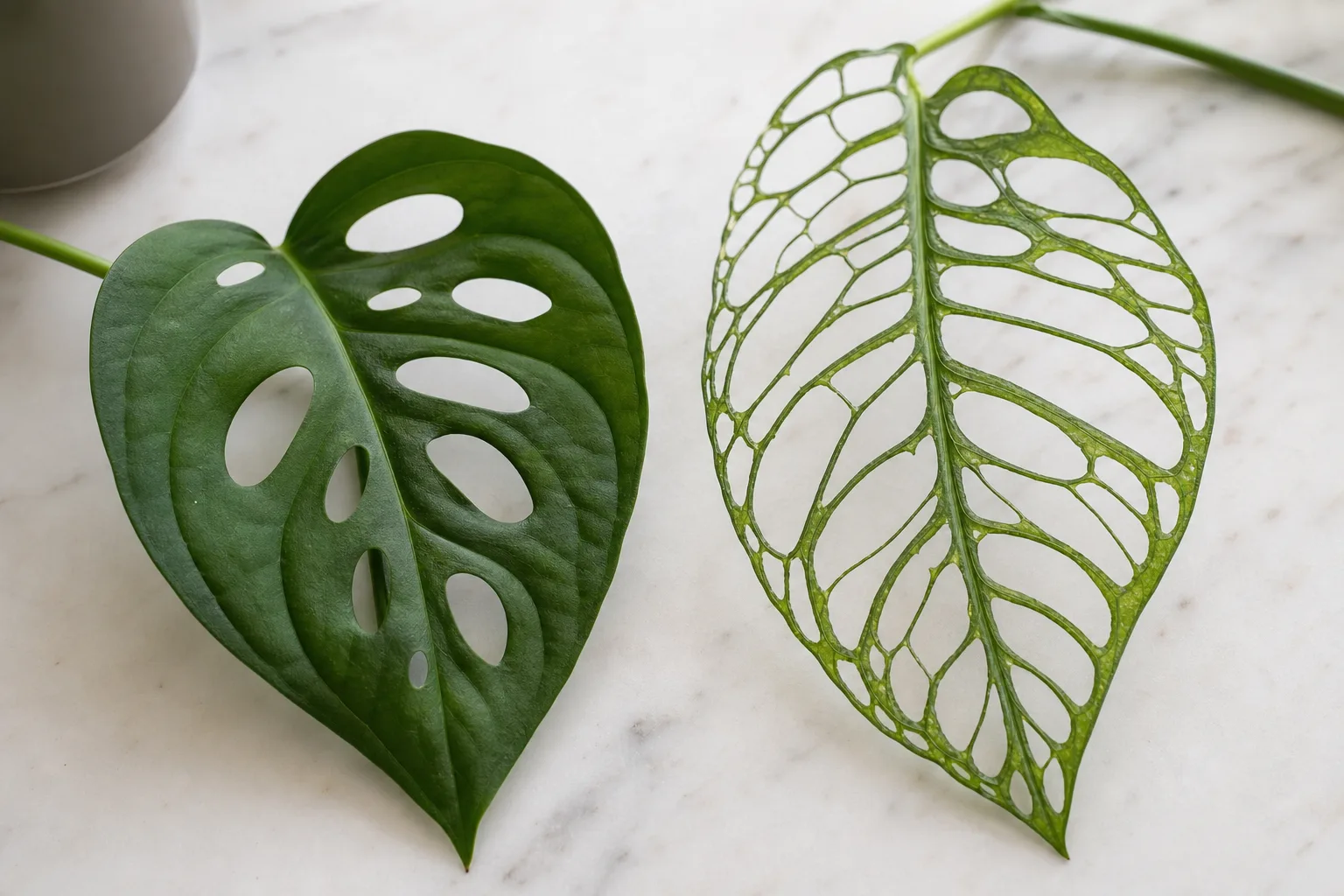
Do not use “the leaf has lots of holes” as the entire test. Compare leaf thickness, the amount of green tissue between openings, the plant’s growth history, and the seller’s evidence of the mother plant. A sturdy, thick-leaved plant sold as obliqua may be another species or a trade form such as “Obliqua Peru.”
Choose this only if you are comfortable with uncertainty, careful acclimation, and the possibility that the label is wrong. For the same visual mood with a more realistic path to success, a well-grown M. adansonii or M. esqueleto is often the more sensible purchase.
12. Monstera esqueleto
Monstera esqueleto is prized for elongated leaves with large, skeletal openings. It is frequently discussed alongside plants once sold under other names, so a seller’s naming history matters. The plant is visually dramatic, but it still needs the basics: bright indirect light, a stable climbing support, an open root mix, and time to mature.
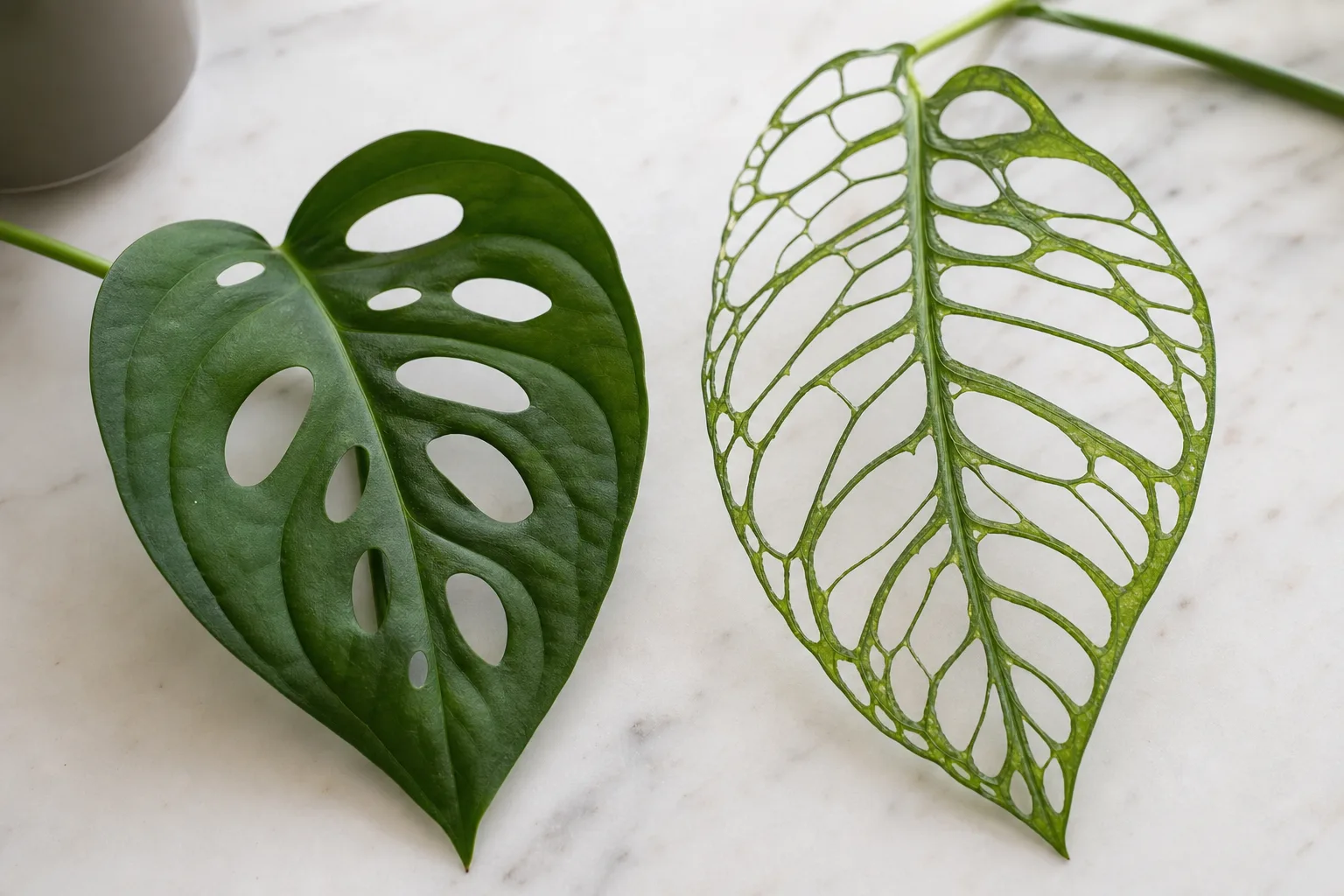
Unlike the paper-thin impression associated with true M. obliqua, an esqueleto-type plant is generally chosen for its large, strongly perforated leaves and more substantial presence. Even so, photographs can exaggerate the effect when they show only a mature leaf; ask to see the whole plant and the newest growth.
Grow it when you want a collector form with a clear visual payoff and have enough room for a climber. A small plant can look modest for a long time before its leaves develop the skeletal pattern that justified the purchase.
13. Monstera deliciosa ‘Thai Constellation’
‘Thai Constellation’ is a variegated cultivar of Monstera deliciosa, not a separate species. Its creamy speckles and marbling are usually more distributed across the blade than the large white sectors of an Albo, although individual leaves can vary. Penn State Extension’s Monstera houseplant guidance also identifies ‘Thai Constellation’ and ‘Albo Variegata’ as variegated forms of M. deliciosa.
The pale tissue has little or no chlorophyll, so the plant may grow more slowly than a green deliciosa and needs good usable light to support the green portions. More light does not mean several hours of harsh afternoon sun; use bright indirect light or a properly positioned grow light and acclimate slowly.
Choose it if you want a patterned statement plant and can accept slower growth, higher cost, and occasional leaves with more or less variegation than expected. It is often a better first variegated Monstera than an extremely white cutting because it tends to offer a more balanced amount of green tissue.
14. Monstera deliciosa ‘Albo Variegata’
‘Albo Variegata’ is another variegated M. deliciosa, recognized for irregular white or cream sectors, streaks, and blocks. The pattern is often striking but can be unstable across a vine: one leaf may be generously marked while the next is mostly green or nearly white.
When buying a cutting, inspect the node, not only the leaf. A leaf with beautiful white space is not enough if the node cannot produce a new shoot with green tissue. The safest cutting has a healthy node and enough green on the stem or expected growth point to power new leaves.
This cultivar suits collectors who enjoy watching variation unfold and are willing to pay for a verified cutting. It is a poor choice if you want predictable, fast growth or do not have a bright, stable location.
15. Monstera deliciosa ‘Aurea Variegata’
‘Aurea Variegata’ is the yellow-variegated counterpart many collectors seek. Its markings can read as yellow patches, streaks, or marbling, and the exact appearance depends on the clone and the leaf’s age. Like other variegated forms, it should be treated as a cultivar of M. deliciosa, not as a separate species.
The color is most useful when paired with growth information. A seller who shows only one saturated leaf but cannot show the node, newest leaf, or parent plant is asking you to buy a photograph rather than a plant. Look for a rooted specimen with active green growth, clear shipping conditions, and a return policy before paying a premium.
Choose ‘Aurea’ for warm yellow patterning and a slower collector project. If you want the most forgiving, affordable entry into the genus, a green M. deliciosa or M. adansonii remains the better decision.
The Look-Alikes Often Sold as “Mini Monstera”
The most common look-alike is Rhaphidophora tetrasperma, often sold as “mini Monstera.” It belongs to the same broad aroid family and has fenestrated leaves, but it is a different genus. Its compact habit and quick growth make it a useful alternative, not a rare Monstera.
Other plants can be mislabeled in the same way. Epipremnum pinnatum ‘Cebu Blue’ can develop splits as it matures, and Philodendron bipinnatifidum has deeply divided leaves, but neither should be identified by a Monstera tag alone. Check the botanical name, leaf arrangement, growth habit, and whether the seller’s photos match the named plant.
This is not merely a taxonomy argument. A look-alike may need a different amount of space, climb differently, or behave differently when propagated. If the plant is being sold as a “rare Monstera,” ask for the scientific name and a photo of the mother plant before treating the price as justified.
Baseline Care That Works for Most Monstera Types
Most Monsteras share a useful baseline, but the word bright does more work than the word tropical. Put the plant near bright filtered light or a strong grow light, not in a dim corner and not pressed against hot midday glass. Penn State Extension and RHS both link healthy growth to bright indirect or filtered light, warmth, and a free-draining root zone; low light can produce leggier growth and fewer mature fenestrations.
Water thoroughly when the upper part of the mix has begun to dry, then let excess water drain completely. RHS advises allowing the compost to become almost dry and avoiding a pot that sits directly in water, while Penn State gives a practical top 1 to 2 inches as a drying checkpoint. The correct interval changes with pot size, season, light, and humidity, so use soil feel and pot weight rather than a weekly reminder.
Use an airy mix that holds some moisture but still leaves oxygen around the roots. Bark, coarse perlite, coco coir, or another open component can improve a dense commercial mix, but no ingredient rescues a pot with no drainage hole. Repot only when the root ball or plant size justifies it, and move up modestly rather than placing a small root system in a huge wet container.
Support is part of Monstera care, not a styling afterthought. In the wild, M. deliciosa climbs with aerial roots and changes from juvenile, close-fitting leaves to larger adult foliage; the National Tropical Botanical Garden’s plant database documents that climbing life cycle. Indoors, tie the stem loosely to a moss pole, trellis, board, or stake, keeping petioles free to orient toward the light.
Humidity helps, but it cannot compensate for cold, darkness, or waterlogged soil. Keep most types warm and away from drafts and direct heat, use a humidifier when the room is genuinely dry, and leave room for airflow between leaves. Misting may wet the surface briefly, but it is not a substitute for stable room humidity or good root care.
Finally, plan around safety. Penn State describes Monstera as toxic if eaten because of calcium oxalate crystals, and the ASPCA entry for Monstera deliciosa lists dogs, cats, and horses as at risk with mouth irritation, swelling, drooling, vomiting, and difficulty swallowing. Keep plants and fallen leaves away from pets and children, wear gloves if the sap irritates your skin, and treat the rare possibility of ripe fruit outdoors as a separate botanical event—not as permission to chew houseplant leaves.
Conclusion
The best Monstera is the one whose mature habit fits your room, not the one with the most dramatic name. Choose M. deliciosa for a forgiving large climber, M. adansonii for a smaller holey vine, M. siltepecana or M. dubia for unusual juvenile foliage, and a variegated cultivar only when you understand its slower, less predictable growth.
When a listing seems too rare or too cheap, slow down and inspect the evidence: botanical name, mature photos, node, parent plant, growth habit, and seller history. A healthy, correctly labeled plant with enough light and a real support will give you far more satisfaction than an expensive leaf that never tells you what it is.



