Monstera Peru Care Guide: Trade Name, Texture & Support
Philodendron opacum
Grow Monstera Peru indoors with clear taxonomy caveats, puckered leaf ID, board or moss pole support, watering, humidity, soil, and pet-safety guidance.
Monstera Peru Care Guide: Trade Name, Texture, Shingling & Support
Start with wateringThe most common care mistake for Monstera PeruWatering guide →Monstera Peru care essentials
Light
Water
Every 7–12 days — allow top 3–5 cm to dry. Water thoroughly until drainage from holes, empty the saucer, and reduce in winter. Check the pot, not the calendar.
Soil
Standard potting mix + 20–25 % perlite + 10–15 % orchid bark. Well-draining chunky aroid mix. pH 5.5–7.0.
Humidity
Temperature
Fertilizer
A balanced liquid houseplant fertilizer at half label strength once monthly in active growth is enough for most homes. Do not feed a stressed, dry, newly repotted, or winter-stalled plant; fertilizer cannot fix weak light, damaged roots, or a mix that stays wet too long.
About Monstera Peru
Monstera Peru is native to Southeastern Nicaragua to Ecuador. Monstera Peru has a upright growth habit and part of the Araceae family. It is also known as Monstera karstenianum, Philodendron opacum, Green Galaxy Monstera, Monstera sp. Peru, and Karstenianum Monstera.
| Detail | Information |
|---|---|
| Also known as | Monstera karstenianum, Philodendron opacum, Green Galaxy Monstera, Monstera sp. Peru, Karstenianum Monstera |
| Native region | Southeastern Nicaragua to Ecuador |
| Growth habit | Upright |
| Scientific name | Philodendron opacum |
| Family | Araceae |
Monstera Peru Care Guide: Trade Name, Texture, Shingling & Support
What Monstera Peru Is
Monstera Peru is the trade name for a compact climbing aroid grown for thick, glossy, puckered leaves. The plant is sold under labels such as Monstera Peru, Monstera sp. Peru, Green Galaxy Monstera, and Monstera karstenianum. Those names are useful at a nursery bench, but they are not the same as accepted botanical taxonomy.
The important correction is this: Kew Plants of the World Online lists Monstera karstenianum as a synonym of Philodendron opacum, not as an accepted Monstera species. Kew’s accepted record for Philodendron opacum places it in Araceae, gives a native range from southeastern Nicaragua to Ecuador, and describes it as a climbing epiphyte of wet tropical habitat.
For care, that means two things. First, keep using the trade name “Monstera Peru” if that is how your plant is labeled or how you found this page. Second, do not assume every Monstera deliciosa instruction applies perfectly. This plant behaves more like a small, textured, climbing aroid: it wants filtered light, oxygen around the roots, warm rooms, moderate to high humidity, and a surface its nodes can climb.
Quick Care Summary
| Care factor | Best target for the plant sold as Monstera Peru |
|---|---|
| Light | Bright indirect light; steady medium indirect light is acceptable but slower |
| Water | Water when the top 3-5 cm (1-2 inches) of mix is dry |
| Soil | Chunky aroid mix with potting base, perlite, and orchid bark |
| Humidity | Aim for 50% or higher when possible |
| Temperature | Warm indoor rooms; avoid cold drafts and winter glass |
| Support | Board, cork plank, moss pole, coir pole, or trellis |
| Pet safety | Treat as toxic because aroid calcium oxalates irritate mouths and throats |
Botanical Identity, Trade Names, and Why It Matters
Houseplant labels lag behind taxonomy. A plant can remain widely sold under an old or informal trade name even after botanical databases treat that name differently. Monstera Peru is a good example: growers and collectors still use “Monstera Peru” because it identifies the plant in commerce, while Kew treats Monstera karstenianum as a synonym under Philodendron opacum.
This matters most for trust and buying decisions, not because your plant needs a radically different shelf. If a seller claims “rare true Monstera karstenianum species,” ask what they mean. A clear listing should acknowledge that the plant is commonly sold as Monstera Peru while accepted taxonomy points to Philodendron opacum. Avoid paying a premium for labels that pretend the name question is settled in the opposite direction.
It also affects pet-safety wording. Clemson Extension groups philodendrons, pothos, and monsteras as closely confused aroids in the arum family, and notes that these plants share calcium oxalate toxicity concerns across the group Clemson Cooperative Extension. The safest household advice is to treat the plant sold as Monstera Peru as an inaccessible aroid, whether the tag says Monstera or Philodendron.
How to Identify Monstera Peru
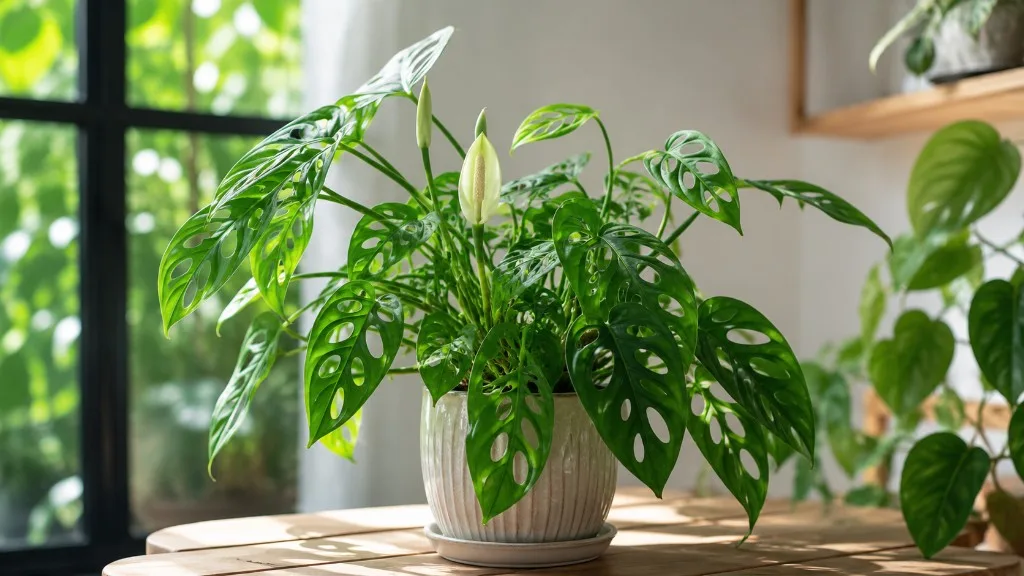
Look for thick, dark green, puckered leaves with a quilted or bullate surface. The texture is the point. The leaves should feel firmer than Monstera adansonii and more corrugated than a smooth juvenile deliciosa.
The plant does not make Swiss-cheese holes. Better conditions can make new leaves larger, darker, and more rigid, but they will not turn into fenestrated deliciosa leaves. If the plant you bought begins producing thin leaves with oval holes, you may have a different Monstera. If it has heavily patterned green-on-green or creamy marbled leaves and a different growth rhythm, compare it carefully with Epipremnum lookalikes before accepting a premium “Peru” label.
Helpful ID checks:
- Leaf surface: raised, puckered, almost reptilian texture.
- Leaf outline: entire blade with no splits or holes.
- Stem habit: climbing or trailing vine with nodes and aerial-root points.
- Best display: close vertical support, not a huge floor-plant silhouette.
- Label caution: “karstenianum” is a trade clue, not accepted-name proof.
Monstera Peru vs Deliciosa, Adansonii, and Lookalikes
| Plant | What separates it from Monstera Peru |
|---|---|
| Monstera deliciosa | Much larger; mature leaves develop splits and holes; usually grown as a floor plant |
| Monstera adansonii | Thinner leaves with oval holes; faster, softer vine habit |
| Monstera dubia | True shingle plant with flatter juvenile leaves pressed tightly to support |
| Monstera siltepecana | Often silvered juvenile foliage; can fenestrate at maturity |
| Epipremnum lookalikes | May share puckered or patterned foliage, but labeling and taxonomy differ |
Do not identify by one old leaf alone. Nursery conditions, shipping stress, and low light can flatten texture or stretch internodes. Judge the plant by several leaves, the newest growth, node spacing, seller label, and whether the vine stiffens and embosses once it climbs in better light.
Native Range and Growth Habit
Because accepted taxonomy points to Philodendron opacum, use Kew’s range cautiously rather than inventing a Peru-only origin. Kew lists the accepted species as native from southeastern Nicaragua to Ecuador, not simply Peru, and describes it as a climbing epiphyte in wet tropical biome.
That climbing habit explains the indoor care pattern. The plant wants moisture and air at the roots, but not stale wet potting mix. It wants bright filtered light, but not harsh direct sun pressed against glass. It wants a trunk-like surface or pole because the vine is built to move upward toward better light, not sprawl forever in a dim shelf corner.
Light for Compact, Textured Growth
Give Monstera Peru bright indirect light if you want strong texture and short internodes. Penn State Extension recommends placing Monstera near a sunny window with bright light but not direct sun, warning that low light makes plants get leggy. For Monstera Peru, leggy growth usually means longer gaps between leaves, paler foliage, and weaker puckering on new growth.
Good indoor placements include:
- East window with morning sun filtered by distance or glass.
- South or west window behind a sheer curtain.
- Bright room within a few feet of the window, not across a dark room.
- Full-spectrum grow light when natural light is weak.
Light drops sharply as plants move away from windows; University of Minnesota Extension notes that indoor plant light intensity changes with placement and distance from the source lighting for indoor plants. If new leaves are small and the vine reaches sideways, fix light before increasing water or fertilizer.
Watering Without Rot
Water when the top 3-5 cm (1-2 inches) of mix is dry, then soak thoroughly and empty the saucer. Penn State gives the same top 1-2 inch dry-down rule for Monstera houseplants and warns that overwatering can result in root rot.
Do not let the thick leaves fool you. Older leaves can stay firm while roots are already struggling in a wet, airless pot. Use a finger check, wooden skewer, or pot-weight check before watering. Missouri Botanical Garden explains that waterlogged soil deprives roots of oxygen, roots die back, and damaged roots become vulnerable to root rot organisms overwatering.
In many homes, a small supported plant may need water about every 7-12 days during active growth and less often in winter. Treat that as a checkpoint, not a rule. A bright, warm, root-filled pot dries faster than a recently repotted plant in medium light. If you change placement, pot size, or soil, relearn the dry-down rhythm for two weeks.
For a deeper watering routine, use the Monstera Peru watering guide.
Humidity and Temperature
Monstera Peru is more forgiving than many thin-leaved collector aroids, but it still grows better with stable humidity. Penn State recommends humidity preferably above 50% for Monstera houseplants humidity guidance, and NC State describes Monstera as preferring high humidity indoors NC State Extension.
Low humidity does not always kill the plant. It more often shows up as brown tips, stuck new leaves, dusty corrugations, and slower unfurling. A small humidifier near the plant works better than occasional misting. Grouping tropical plants helps a little. Pebble trays help only marginally unless the room is already close to target.
Keep the plant in normal warm indoor temperatures. Wisconsin Horticulture notes that Monstera plants do not grow below 50°F (10°C) and frost kills them Wisconsin Horticulture Extension. Avoid cold window glass, heat vents, AC blasts, and drafty winter doors.
Soil and Pot Choice
Use a chunky aroid mix that drains quickly but does not dry into a hard brick. A practical LeafyPixels mix is standard potting mix amended with 20-25% perlite and 10-15% orchid bark. The goal is air around the roots, not a desert mix.
Penn State recommends a well-draining soilless mix rich in organic matter for Monstera and notes that bark or perlite can amend purchased blends potting mix guidance. That is exactly the direction Monstera Peru needs: moisture retention from the base mix, drainage from perlite, and structure from bark.
Drainage holes are mandatory. A decorative cachepot is fine only if you remove the inner pot to water, drain fully, and return it to an empty outer pot. Oversized containers are risky because extra wet mix sits around a small root system. If you need a recipe by pot size or support style, use the Monstera Peru soil guide.
Boards, Moss Poles, and Trellises
Support changes the plant’s shape. A trailing Monstera Peru can look attractive from a shelf, but unsupported vines usually keep smaller leaves and longer internodes. A board, cork plank, moss pole, coir pole, or trellis lets nodes stay close to a vertical surface and encourages more compact growth.
Wisconsin Horticulture recommends support for Monstera stems and describes moss-covered supports that aerial roots can attach to, including watering the support so roots can use it support guidance. For the plant sold as Monstera Peru, choose the support based on the display you want:
- Flat board or cork plank: best for juvenile shingling-style displays.
- Moss pole: best for upright climbing and larger leaves.
- Coir pole: lower-maintenance vertical support, less root engagement than moist moss.
- Trellis: useful for shaping vines, but less natural for tight node attachment.
Tie stems loosely. Keep nodes facing the support. Do not strap petioles tightly or bury stems under wet moss where they can rot.
Fertilizer, Repotting, and Propagation Basics
Feed lightly during active growth only after light, water, and soil are stable. A balanced liquid houseplant fertilizer at half label strength about monthly in spring and summer is enough for most plants. Skip fertilizer after repotting, during winter slowdown, or while the plant is recovering from pests, drought, or root damage.
Repot when roots circle the pot, the mix compacts, water runs straight through, or the plant dries within a day despite thorough watering. Move up one pot size. Install support during repotting so you do not damage roots later. The full Monstera Peru repotting guide covers timing, pot size, and recovery.
Propagate by stem cuttings with at least one node. University of Minnesota Extension explains Monstera propagation from stem cuttings and node/aerial-root sections stem cuttings. For this plant, water or moist sphagnum can work; pot into a small container once roots are long enough to anchor in chunky mix. For step-by-step cutting placement, use the Monstera Peru propagation guide.
Common Problems and First Checks
Most Monstera Peru problems come from the same four variables: moisture, light, humidity, and pests. Check them in that order before making several changes at once.
| Symptom | First likely checks |
|---|---|
| Yellow lower leaves | Wet mix, low light, normal old-leaf loss, recent move |
| Brown tips | Dry air, inconsistent watering, salt buildup, root stress |
| Leggy vines | Not enough light, no support, too much distance from window |
| Stuck new leaves | Low humidity, dry spells, cold drafts, root stress |
| Mushy stem base | Overwatering, dense mix, oversized pot, standing water |
Puckered leaves trap dust. Wipe them gently with a damp cloth so the texture stays clean and so pests are easier to see. Wisconsin Horticulture notes that Monstera may be affected indoors by aphids, mealybugs, scale insects, or spider mites and recommends periodic dust removal pest and dust notes.
Buying Checklist and Mislabeling Red Flags
Choose a plant with firm textured leaves, clean undersides, active tip growth, and soil that smells fresh. Avoid a pot with sour wet mix, widespread yellow leaves, sticky residue, webbing, collapsed stems, or a vine that looks newly tied to a support to hide weak growth.
Label checks matter more on this plant than on ordinary pothos. A good seller may still use “Monstera Peru” because that is the trade name, but they should not claim that Monstera karstenianum is an accepted Monstera species when Kew lists it as a synonym under Philodendron opacum. If the listing is expensive because of variegation, ask for current photos of the exact plant, stable variegated growth, and rooted-node evidence.
First 30 Days at Home
Do less than you think. Quarantine the plant, inspect leaves and nodes, learn how fast the pot dries in your room, and keep it in bright indirect light. Do not repot on day one unless the mix is sour, pests are obvious, or the roots are failing.
Expect a short pause after shipping or store conditions. One older yellow leaf is not automatically a crisis. Multiple yellow leaves on wet mix, a soft stem base, or wilting in damp soil is different: check roots and soil structure before adding water. Once new growth resumes, add support or repot into the correct mix if needed.
Pet and Child Safety
Treat Monstera Peru as unsafe for chewing pets and small children. UF/IFAS notes that Monstera species contain needle-like insoluble calcium oxalate crystals that can irritate the mouth, throat, eyes, and digestive tract UF/IFAS poisonous houseplants. Clemson gives similar calcium oxalate warnings for philodendrons and notes burning, irritation, drooling, vomiting, and difficulty swallowing if eaten.
The ASPCA lists Swiss cheese plant as toxic to dogs and cats due to insoluble calcium oxalates and advises calling ASPCA Poison Control or a local veterinarian if ingestion is suspected ASPCA toxicity record. Keep this plant on inaccessible shelves, in closed rooms, or out of pet households entirely if your animal chews foliage.
Wear gloves if sap irritates your skin during pruning, repotting, or propagation. Bag trimmings instead of leaving them where pets can mouth them.
When to use this page vs other Monstera Peru guides
Use this overview when you need whole-plant identity, buying, setup, support, and safety context. Use the deeper topic pages when one care variable needs a specific fix.
- Monstera Peru watering explains dry-down checks, seasonal intervals, and overwatering rescue.
- Monstera Peru light helps you choose a window or grow light for compact textured growth.
- Monstera Peru soil gives mix ratios for nursery pots, board mounts, and moss-pole plants.
- Monstera Peru fertilizer covers feeding without salt stress.
- Monstera Peru repotting covers pot size, support installation, and post-repot recovery.
- Monstera Peru propagation covers node cuttings, water rooting, moss, and pot-up timing.
- Monstera Peru pruning covers shortening leggy vines and using trims for cuttings.
Related Monstera Peru guides
- Monstera Peru watering - use when yellowing, wet mix, or dry-down timing is the main issue.
- Monstera Peru light - use when leaves are small, flat-textured, scorched, or stretched.
- Monstera Peru soil - use when the pot stays wet, smells sour, or drains poorly.
- Monstera Peru propagation - use when you want to root a node cutting or fill a support.
- Monstera Peru repotting - use when roots are crowded or support must be installed.
- Monstera Peru fertilizer - use when growth is stable but slow during the growing season.
- Monstera Peru pruning - use when vines are bare, long, or damaged.
Conclusion
Monstera Peru is best understood as a trade-name plant: sold as Monstera Peru or Monstera karstenianum, but treated by Kew taxonomy as Philodendron opacum. That correction does not make the plant harder to grow. It makes the advice more honest.
Give it bright indirect light, water only after the top 3-5 cm of mix dries, use a chunky aroid substrate, keep humidity steady when possible, and provide a board or pole if you want compact textured growth. Buy with label caution, keep it away from pets and children, and judge success by the next new leaf: firm, darker, closer-spaced, and more embossed than the last.
How to care for Monstera Peru?
When should you water Monstera Peru?
Every 7–12 days — allow top 3–5 cm to dry. Water thoroughly until drainage from holes, empty the saucer, and reduce in winter. Check the pot, not the calendar.
- Check top 2 inches - Check the pot, not the calendar.
- Drain excess water - Water thoroughly until drainage from holes, empty the saucer, and reduce in winter.
What soil works best for Monstera Peru?
Standard potting mix + 20–25 % perlite + 10–15 % orchid bark. Well-draining chunky aroid mix. pH 5.5–7.0.
- Well-draining mix - Well-draining chunky aroid mix.
Grower notes for Monstera Peru
Peru identity — trade name vs botany
Monstera Peru is the houseplant trade name most growers use for the puckered-leaf aroid sold as Monstera karstenianum, Green Galaxy Monstera, or Monstera sp. Peru. Current Kew and World Flora Online records treat Monstera karstenianum as a synonym of Philodendron opacum, so this page uses the familiar trade name while noting the botanical caveat. It is not a juvenile Monstera deliciosa; buy it for rigid, quilted foliage, not split-leaf fenestrations.
What makes Peru different from common Monsteras
Peru stays more compact than deliciosa and reads more architectural than adansonii because the leaf surface is thick, dark, and corrugated. The no-hole look is normal for this trade plant; maturity shows up as stronger stems, larger textured leaves, and shorter internodes when it is trained upward. Treat claims about exact species behavior cautiously because most authoritative care references are Monstera-genus or aroid guidance rather than Peru-specific trials.
What matters most with Monstera Peru
Judge the whole plant: new growth texture, root-zone moisture, light at the leaf surface, and how fast the pot dries after watering. The care checkpoint is bright indirect light for deepest embossing, or steady medium indirect light if that is all your room offers. Pair that with chunky aroid mix and water only when the top 3–5 cm dries. Change one variable at a time — do not repot, relocate, and fertilize in the same weekend.
Best placement and shingling support
Peru belongs where bright filtered light reaches the canopy for most of the day — east windows, or south/west behind sheer curtains — not in a dim corner because the texture looks dramatic there. For juvenile shingling, mount stems loosely against a cork board or moss plank so nodes stay close to the support and aerial roots can attach. A moss pole, plank, coir pole, or trellis is more than decoration: support keeps vines from stretching into sparse trailers. Humidity target: 50–70%. Temperature comfort zone: 18–27°C (65–80°F).
Before you buy this plant
Choose Monstera Peru with firm, glossy puckered leaves, clean undersides, and soil that does not smell sour or feel compacted. Be cautious if you see widespread yellowing on wet mix, sticky residue, collapsed stems, or a pot that stays heavy in poor light. Verify the label says Peru, karstenianum, Philodendron opacum, or Green Galaxy, and inspect the actual leaf texture rather than trusting one trade name. Cosmetic old-leaf damage is less worrying than weak roots or active pests.
First month after bringing it home
Do not repot Monstera Peru on day one unless the mix is clearly failing or pests are obvious. Quarantine it, learn how fast the pot dries in your light, and keep care boring while it acclimates. Watch for brown tips on new growth (low humidity or drought), yellow lower leaves on heavy wet mix (overwatering), and leggy vines with flat-looking embossing (insufficient light). Install a moss pole or board once the vine is stable so juvenile shingling or mature climbing habit can develop rather than a sparse trailer.
Is it pet safe?
Monstera Peru is treated as toxic to cats and dogs; contact a veterinarian or ASPCA Poison Control if ingestion is suspected.
Contains insoluble calcium oxalate crystals and other irritants. Ingestion causes oral irritation, intense burning, swelling, drooling, vomiting, and difficulty swallowing in pets.
Watering Monstera Peru
Every 7–12 days — allow top 3–5 cm to dry. Water thoroughly until drainage from holes, empty the saucer, and reduce in winter. Check the pot, not the calendar.
Soil & potting for Monstera Peru
Standard potting mix + 20–25 % perlite + 10–15 % orchid bark. Well-draining chunky aroid mix. pH 5.5–7.0.
Humidity & temperature for Monstera Peru
Fertilizer & pruning for Monstera Peru
Use a balanced liquid houseplant fertilizer at half label strength once monthly in active growth is enough for most homes. Do not feed a stressed, dry, newly repotted, or winter-stalled plant; fertilizer cannot fix weak light, damaged roots, or a mix that stays wet too long. for Monstera Peru.
| Detail | Information |
|---|---|
| Fertilizer type | A balanced liquid houseplant fertilizer at half label strength once monthly in active growth is enough for most homes. Do not feed a stressed, dry, newly repotted, or winter-stalled plant; fertilizer cannot fix weak light, damaged roots, or a mix that stays wet too long. |
Common problems on Monstera Peru
Yellow Leaves
MediumLikely cause: Common on this plant type; confirm with recent watering, light, and root checks.
Quick fix: Inspect the plant and correct the most likely care stressor before stacking treatments.
Full fix guide →Brown Tips
MediumLikely cause: Common on this plant type; confirm with recent watering, light, and root checks.
Quick fix: Inspect the plant and correct the most likely care stressor before stacking treatments.
Full fix guide →Root Rot
MediumLikely cause: Common on this plant type; confirm with recent watering, light, and root checks.
Quick fix: Inspect the plant and correct the most likely care stressor before stacking treatments.
Full fix guide →Overwatering
MediumLikely cause: Common on this plant type; confirm with recent watering, light, and root checks.
Quick fix: Inspect the plant and correct the most likely care stressor before stacking treatments.
Full fix guide →Underwatering
MediumLikely cause: Common on this plant type; confirm with recent watering, light, and root checks.
Quick fix: Inspect the plant and correct the most likely care stressor before stacking treatments.
Full fix guide →Spider Mites
MediumLikely cause: Common on this plant type; confirm with recent watering, light, and root checks.
Quick fix: Inspect the plant and correct the most likely care stressor before stacking treatments.
Full fix guide →Mealybugs
MediumLikely cause: Common on this plant type; confirm with recent watering, light, and root checks.
Quick fix: Inspect the plant and correct the most likely care stressor before stacking treatments.
Full fix guide →Aphids
MediumLikely cause: Common on this plant type; confirm with recent watering, light, and root checks.
Quick fix: Inspect the plant and correct the most likely care stressor before stacking treatments.
Full fix guide →Leggy Growth
MediumLikely cause: Common on this plant type; confirm with recent watering, light, and root checks.
Quick fix: Inspect the plant and correct the most likely care stressor before stacking treatments.
Full fix guide →Slow Growth
MediumLikely cause: Common on this plant type; confirm with recent watering, light, and root checks.
Quick fix: Inspect the plant and correct the most likely care stressor before stacking treatments.
Full fix guide →Wilting
MediumLikely cause: Common on this plant type; confirm with recent watering, light, and root checks.
Quick fix: Inspect the plant and correct the most likely care stressor before stacking treatments.
Full fix guide →Drooping Leaves
MediumLikely cause: Common on this plant type; confirm with recent watering, light, and root checks.
Quick fix: Inspect the plant and correct the most likely care stressor before stacking treatments.
Full fix guide →Low Humidity
MediumLikely cause: Common on this plant type; confirm with recent watering, light, and root checks.
Quick fix: Inspect the plant and correct the most likely care stressor before stacking treatments.
Full fix guide →Not Enough Light
MediumLikely cause: Common on this plant type; confirm with recent watering, light, and root checks.
Quick fix: Inspect the plant and correct the most likely care stressor before stacking treatments.
Full fix guide →Fungus Gnats
MediumLikely cause: Common on this plant type; confirm with recent watering, light, and root checks.
Quick fix: Inspect the plant and correct the most likely care stressor before stacking treatments.
Full fix guide →Mold on Soil
MediumLikely cause: Common on this plant type; confirm with recent watering, light, and root checks.
Quick fix: Inspect the plant and correct the most likely care stressor before stacking treatments.
Full fix guide →