Monstera Peru Not Getting Enough Light? Signs and Fixes
Quick answer
If several new Monstera Peru leaves are getting smaller while the vine develops longer bare spaces between nodes, move its growing tip one step closer to a bright, filtered window. Keep sustained direct sun off the leaves, then judge the next one or two hardened leaves rather than expecting old growth to change.
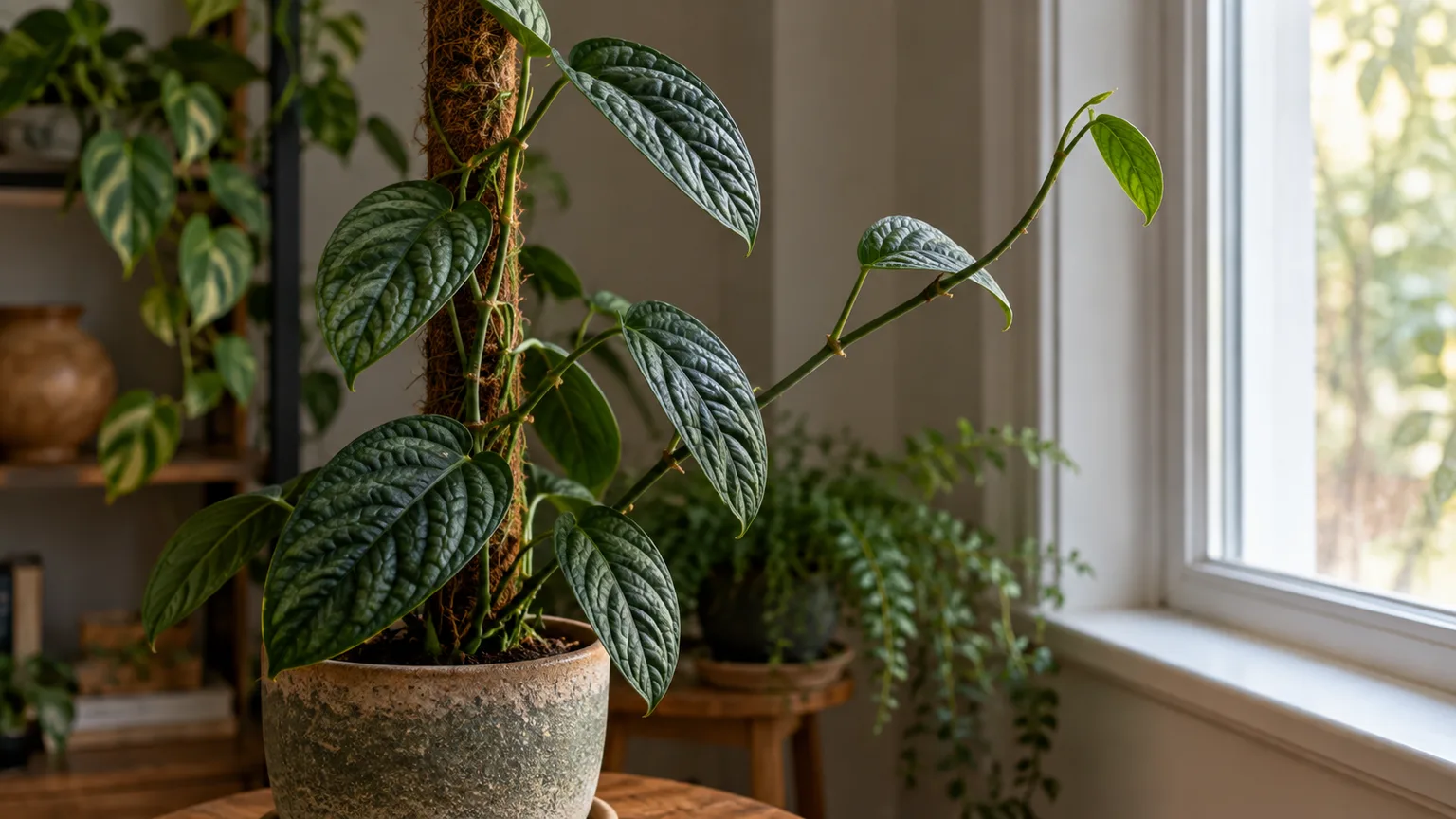
Not Enough Light on Monstera Peru: Causes, Checks & Fixes
This guide covers not enough light on Monstera Peru. See also the general Not Enough Light guide, watering, and light pages for this plant.
Not Enough Light on Monstera Peru: Causes, Checks & Fixes
Quick answer
If several new leaves on your Monstera Peru are becoming smaller while the stem develops longer bare gaps between them, move the growing tip one step closer to a bright, filtered window. Keep a sustained sunbeam off the foliage. This is a safer first correction than putting a plant from a dark shelf straight into intense afternoon sun; Penn State Extension’s general Monstera guidance likewise favors bright light without direct sun.
Low light usually changes the vine gradually. It can show up as longer distances between nodes, a new leaf that is smaller than the last one, and a tip that angles toward the brightest opening in the room. One quiet week or one small leaf does not prove a light problem: Peru’s growth can pause after a move, during darker months, or while a new leaf is still unfolding. For the broad symptom pattern shared across plants, see the not-enough-light guide; this page focuses on the growth clues of the climbing Peru trade plant.
Judge the response on new growth. Existing leaves and long stem sections will not reshape after you move the pot. A useful comparison is the next one or two leaves after the new position has stayed consistent, with watering adjusted to the slower or faster dry-down that comes with the new light.
What low light looks like on Monstera Peru
On the puckered-leaf plant sold as Monstera Peru, low light is usually a pattern in the newest growth rather than a sudden mark on an old leaf. The vine may put out smaller leaves, stretch farther between leaf attachment points, and lean toward a window. The thick older leaves can remain dark and firm for a long time, so a healthy-looking lower stem does not rule out a dim growing tip.
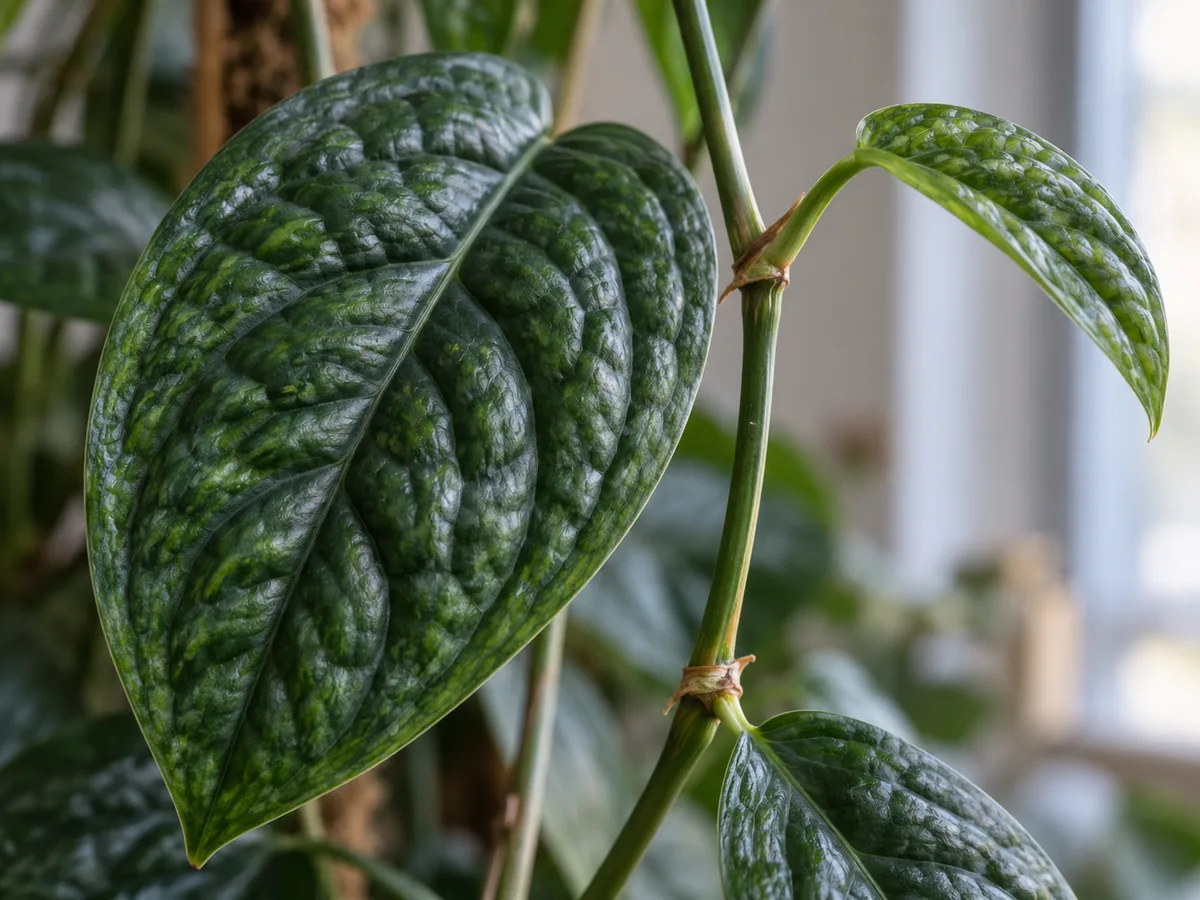
Compare the newest fully opened leaf with the older puckered foliage; the long stem space is more useful than the leaf’s normal lack of holes.
The most useful clue is repetition. If two or more successive leaves are smaller and their nodes sit farther apart than the older section of the same vine, then check light at the active tip. A single small leaf can reflect the plant’s age, a recent cutting, root disturbance, or ordinary variation. Wait until a leaf has unfolded and firmed before judging its final size and texture.
Peru is sold for thick, deeply puckered leaves, not for the holes and splits associated with mature Monstera deliciosa. A solid leaf is normal for this trade plant and is not a symptom of insufficient light. The Spruce’s general Monstera care guidance describes bright indirect light and notes that excessive shade can make Monstera leggy; that is useful genus-level context, not a measured light trial on Monstera Peru.
Read the Peru’s nodes, not missing leaf splits
A node is the point on the stem where a leaf and often an aerial root attach; the internode is the stem length between nodes. When low light is affecting a climbing vine, the internodes on the newest section can become noticeably longer than those on the older section. The leaf blade may also be smaller, but compare leaves that have finished unfolding and are close in age.
Do not use a long petiole as the measurement. The petiole is the stalk from stem to leaf blade, and it can angle or lengthen as a leaf reaches for a better position. For a fair comparison, follow the main stem and compare the distances from one leaf-bearing node to the next. A ruler or a quick phone photo beside the stem can make a subtle change easier to see over several weeks.
This check is especially useful if your plant is trained against a board or pole. The vine can look full where older leaves sit while the active tip has climbed above the useful light. Look at the uppermost two or three nodes, not only at the foliage closest to the pot.
A compact Peru is not supposed to fenestrate
Do not move a Peru into stronger sun because you are waiting for holes to appear. Fenestrations are not the right progress measure for this plant’s familiar trade form. Better light is more likely to show up as steady new leaves and a more compact spacing between their nodes; it will not turn an old solid leaf into a split one.
Leaf texture is also a slow signal. A newly opened Peru leaf can look smoother or softer before it hardens, so compare it after it has matured rather than during the unfurling stage. If the leaf stays smaller and the stem has stretched across several nodes, then the placement deserves attention. If the leaves retain their usual size and the internodes remain short, slow growth by itself may be seasonal rather than a light diagnosis.
Why the climbing tip can be dimmer than the pot
The spot beside the planter is not always the spot where the plant is growing. Monstera Peru climbs, so its newest tip may sit higher than the window’s brightest area or behind the edge of a curtain, shelf, or support. A board-mounted plant can also have one face toward the glass and another in the room’s shadow. Measure where the active leaf receives light, not where the pot is convenient to water.
Distance and obstruction matter as much as the name of the window. A north-facing window with open sky can be brighter than a south-facing window blocked by a balcony, tree, or deep overhang. Sheer curtains, tinted glass, neighboring buildings, and the plant’s own leaves also reduce light at the tip. Window orientation is a starting clue; the conditions at the leaf are the actual growing environment.
A climbing plant can appear leggy for two reasons at once: the vine may be trailing without support, and its tip may be reaching from a dim spot. Support gives the stem a surface to climb; it does not replace light. If the plant has been kept in a hanging basket far inside the room, move the growing tip closer to the window before deciding that pruning alone will make it compact.
Season changes can make a once-suitable shelf too dim. In winter, days are shorter and the sun’s path shifts; a location that gave bright indirect light in summer may offer much less at the vine tip. Recheck the placement when the newest growth begins to lengthen, especially if the plant did well in the same place during a brighter season.
Check light at leaf height
Human vision adjusts to a room, so a space that feels bright to you may still be dim for a growing tip. UF/IFAS Gardening Solutions explains this adaptation and gives broad indoor foot-candle bands for low, medium, and high light. Those bands help describe an indoor location, but they are not a Monstera Peru-specific threshold; use a reading as a comparison between locations, not as a guarantee that a leaf will grow a certain size.
If you have a light meter, measure beside the newest leaf, with the sensor facing the direction the leaf faces. Take readings at more than one time of day if the light changes across the room. A phone app can help you compare one shelf with another, but its sensor and case may not provide a calibrated horticultural reading. Consistency is more useful than treating one number as exact.
Without a meter, check the shadow cast by your hand at the plant’s leaf surface on a bright day. A barely visible shadow points to a dimmer location; a soft, readable shadow suggests more useful indirect light; a sharp, dark-edged shadow means a direct beam is reaching the spot. Repeat the check at the vine tip, because a shadow beside the pot can give a different answer.
Also note whether direct sun reaches the plant and for how long. A bright indirect spot can be close to a window while the sun’s beam stays off the leaves. If the plant sits where a beam crosses the same puckered surface for hours, the concern changes from low light to scorch risk. That distinction matters before you make the first move.
Confirm the cause before changing care
Use the whole growth pattern to decide whether light is the likely limiting factor:
- Compare recent nodes. Look at several newest internodes against the older part of the same vine. Repeatedly longer spacing plus smaller new blades is more persuasive than a single slow leaf.
- Check the growing point. Notice which way the tip faces and whether a pole, board, shelf, curtain, or neighboring plant shades it. If the pot is bright but the tip is not, reposition the vine or its support.
- Compare two possible locations. Measure or shadow-check at the current tip and at the brighter filtered location you are considering. Avoid choosing a spot solely by window direction.
- Inspect the root zone. Feel the upper 3–5 cm of mix, lift the pot to estimate its weight, and confirm that water drains freely. If the mix stays wet and heavy for an unusually long time, light may be contributing to slow dry-down, but dense soil or poor drainage may also be involved.
- Look for a different symptom pattern. Sudden pale, dry patches on the window-facing leaves point away from low light. Fine stippling, webbing, sticky residue, or a fast decline also needs a pest or root-zone check rather than a light-only fix.
A strong low-light diagnosis has three parts: a dim reading or weak shadow at the active tip, a repeated change in the newest internodes or leaves, and no clearer explanation such as a wet root zone or sun scorch. If only one part fits, change one condition and observe the next growth rather than treating several possible causes at once.
| What you see | More likely explanation | What to check next |
|---|---|---|
| Smaller newest leaves, longer internodes, and a tip leaning toward a dim room | Low light is likely | Compare light at the active tip with a brighter filtered position |
| Pale, dry, or crispy patches only on the window-facing surface after a move | Too much direct sun or heat | Check when the beam reaches the leaf and filter or move it back |
| Lower leaves yellow while the pot remains heavy and wet | Root-zone or watering stress may be contributing | Check drainage, mix, and watering before increasing light alone |
| A long vine with firm leaves but no support | Trailing growth may be part of the shape | Add a stable climbing surface and still assess light at the tip |
| No new leaf yet, but compact old growth remains healthy | Seasonal pause or slow establishment is possible | Review the Monstera Peru slow-growth guide before changing fertilizer |
First fix: move the growing tip into brighter filtered light
Choose one brighter position where the active tip receives a broad wash of daylight but no prolonged direct beam. An east window is often a practical starting point; a south or west window can work when a sheer curtain or some distance from the glass softens the sun. Keep the change to filtered brightness rather than moving from shade straight into hot midday sun; the exact Peru-specific light threshold has not been established in a direct trial.
If the current spot is a dark corner, make the move in stages over several days rather than setting the plant on a hot windowsill immediately. Keep the same pot and mix while you observe it, and do not add fertilizer to compensate for a dim position. The goal is to give the growing point a better light environment without introducing a sudden sun or heat stress at the same time.
Give the support and the vine the same consideration as the pot. If the pole leans away from the window, rotate or reposition it so the newest leaves face the brighter side. With a board-mounted plant, check the whole front surface for a light stripe or a shaded upper section. A small adjustment to the support can improve exposure without disturbing roots.
Make the location brighter, but do not use harsh sun as a shortcut. Watch the leaf surface during the brightest part of the day. If it becomes warm or develops a pale patch, filter the light or move the plant back.
Use a grow light when the window cannot reach the tip
A grow light can supplement a room where the brightest safe window still leaves the vine’s top growth dim. UF/IFAS describes LED and fluorescent fixtures as practical artificial-light options for indoor plants. Choose a fixture with a clear coverage area and follow its distance guidance for foliage rather than copying a number from another lamp, since output varies by design and intensity.
Aim the fixture at the active tip and the upper leaves, not just the pot or lower stem. A timer helps keep lighting consistent from day to day. Give the plant a normal dark period overnight; leaving a lamp on around the clock is not a substitute for a bright daytime window. After changing the setup, watch for gradual improvement in new leaves and for any bleaching, upward curling, or warmth that could signal excessive intensity.
Do not decide that a grow light has failed after a few days. Monstera Peru needs time to produce another leaf, and an old stretched section will remain stretched. If the tip grows slowly during the darker season, maintain the improved placement and reassess when active growth resumes instead of continually moving the fixture.
Keep support aligned with the new growth
Monstera Peru’s climbing habit makes support placement part of the light plan. A pole or board helps hold the stem in a defined direction, but the uppermost node should not disappear behind the support or extend into a darker part of the room. If the vine is allowed to trail over a shelf, the top may still be several feet from the window even when the pot is close.
After the light change, guide new growth toward the brighter side and attach the stem loosely so it can keep expanding. Do not force a stiff, mature stem flat against a board; a sudden bend can crack it. If only one side of the plant receives useful light, turn the support gradually so the growing tip and leaves receive a more even exposure.
Support does not erase an already long internode. It can make the next section easier to direct and can keep the plant from making a sparse arc across the room. If you want a compact display, judge success by the new nodes and leaves that form after the tip receives better light, not by the old vine’s shape.
Recheck watering when the light changes
A Monstera Peru in dimmer light can use water more slowly than one in a brighter, warmer place. Clemson Cooperative Extension notes that watering frequency shifts with location, pot, mix, weather, plant size, and growth stage, and that low-light conditions can lengthen dry-down. After moving the plant, do not keep the old calendar schedule automatically.
Use the pot rather than a fixed number of days. Check the top 3–5 cm of mix and lift the container before watering; the Peru profile uses that dry-down range as a practical checkpoint. Water thoroughly when the mix has reached the appropriate dry point, allow excess water to drain, and empty the saucer. If the pot remains heavy and the mix feels wet, wait and look at the Monstera Peru watering guide for the plant’s full dry-down routine.
If the mix stays wet despite a brighter location, inspect its structure and drainage. A fine, compact mix can hold water around the roots, so light alone may not resolve the slow-drying pot. Use the Monstera Peru soil guide to compare the current mix with a chunkier aroid blend before deciding that the plant needs a larger container.
When yellowing accompanies wet mix, soft roots, sour odor, or a collapsing stem base, treat the root zone as the priority. Low light may have contributed to the slow dry-down, but it does not explain every yellow leaf. The Monstera Peru overwatering guide and root-rot guide cover those patterns. For genus-level light guidance, the Monstera Peru light guide is the place to compare window placement and measured brightness.
Too much light can look like the opposite problem
Low light usually shows first in the vine’s shape and pace: stretched internodes, smaller new leaves, and a tip reaching toward an opening. Excess light is more likely to mark the leaf that faces the beam with pale, dry, or scorched tissue. NC State Extension warns against direct sunlight for indoor Monstera. Treat a new surface patch after moving to a sunny window as a reason to soften the exposure, not to move farther into the sun.
A newly exposed leaf may be more vulnerable than an older leaf that formed under the old placement. Acclimate a Peru gradually if you move it from deep shade to a bright window. If a direct beam reaches it for part of the day, use a curtain or shift it back until the light is bright but filtered. Do not confuse a naturally textured, glossy surface with bleaching; look for a new change in color or dryness.
Other lookalikes need their own check. If the stem spacing remains compact but the plant simply has not produced a leaf, compare the season, recent repotting, and root condition before diagnosing low light. If leaves have fine yellow stippling, webbing, or sticky deposits, inspect both sides for pests. If only old lower foliage yellows and the pot stays wet, investigate watering and drainage. The Monstera Peru yellow-leaves guide helps sort those patterns.
What can recover, and when
A move to brighter filtered light cannot shrink existing internodes or make an old leaf larger. Those are records of how the vine grew in the past. They can remain healthy and useful as foliage even if the plant’s overall outline is sparse. If an old leaf is not diseased or mostly dead, there is no need to remove it just because the stem section below it is long.
Look for progress in the next growth point. After the plant has had a stable brighter position through a new growth cycle, compare the next leaves with the most recent ones formed in low light. A firm leaf of similar or larger size, with a shorter node gap, is a better sign than a sudden burst of old-leaf color. The timeline can range from weeks to months depending on season, warmth, root health, and how quickly the plant grows; there is no reliable fixed date for a new Peru leaf.
If the plant does not improve, review the light reading at the tip first. Then check whether the pot still dries slowly, whether the plant is warm enough for active growth, and whether pests or root problems are present. If the plant is stable but not actively growing in winter, maintain the suitable light and wait for the next active period rather than repeatedly relocating it.
A very sparse vine can be pruned later if you prefer a shorter outline, but pruning is a styling choice, not the first treatment for low light. Let the parent plant settle in the better position first. If you decide to restart part of the vine, use the Monstera Peru propagation guide so any cutting retains a viable node; The Spruce’s Monstera stem-cutting guidance likewise includes a node on the cutting, since a leaf blade by itself cannot replace a stem section. Keep a cutting under the same bright, filtered conditions while it roots.
Prevent the same stretch on the next section of vine
Place the plant where the growing tip—not just the pot—gets dependable bright, filtered light. When the vine grows upward, check its upper leaves again because they can move into a darker or more exposed band of the room. If the plant climbs along a board or pole, align that support with the window so the newest nodes do not sit in the support’s shadow.
Recheck the spot after seasonal changes and after moving furniture or adding a curtain. A simple note of the date, leaf size, internode length, and a light-meter reading or shadow description can make a gradual decline visible before the vine becomes very sparse. Do not rely on how bright the room looks at night or on a reading taken at the empty windowsill.
Keep watering tied to the mix’s dry-down rather than maintaining a fixed weekly routine. If you move the plant into brighter conditions, it may use water faster; if you move it away from the window for display, it may use less. Check the pot for a few cycles after a light change. Stable light, an airy root zone, and a support that keeps the tip in the bright zone make a better prevention plan than extra feeding.
When to use this page vs other Monstera Peru guides
Use this guide when the main clue is repeated smaller new leaves, longer internodes, or a tip reaching toward a brighter window. The Monstera Peru overview explains the trade-name identity and the plant’s broader growth habits. For the whole per-plant symptom index, use the Monstera Peru problems hub.
Choose a sibling guide when another pattern leads the diagnosis. Use leggy growth when the vine is sparse and you want to assess support, spacing, and pruning; use slow growth when a compact plant has stopped producing leaves. If the pot stays wet, move to watering or soil; if leaves yellow or roots soften, follow the yellow leaves or root rot diagnosis instead.
Related Monstera Peru guides
- Monstera Peru overview — use for the plant’s identity, growth habit, and broad care context.
- Monstera Peru light guide — use for window placement, light measurement, and grow-light setup.
- Monstera Peru watering guide — use when the pot dries unusually slowly or quickly after a move.
- Monstera Peru soil guide — use when drainage or mix structure may be extending dry-down.
- Monstera Peru leggy growth guide — use when you need to decide whether support or pruning is also needed.
- Monstera Peru slow growth guide — use when leaf production is slow but the vine remains compact.
- Monstera Peru problems hub — use to compare other recurring symptoms on this plant.
Related tool
Use the Plant Light Requirements Tool to compare the light at the vine’s growing tip with the plant’s recommended indoor range.