Monstera Peru Overwatering: Signs, Root Checks & Recovery
Quick answer
If Monstera Peru's pot stays heavy and the mix is wet below the surface, pause watering and empty any standing runoff. Resume only when the top 3–5 cm has dried and the pot feels lighter; inspect roots if stems soften or the mix smells sour.
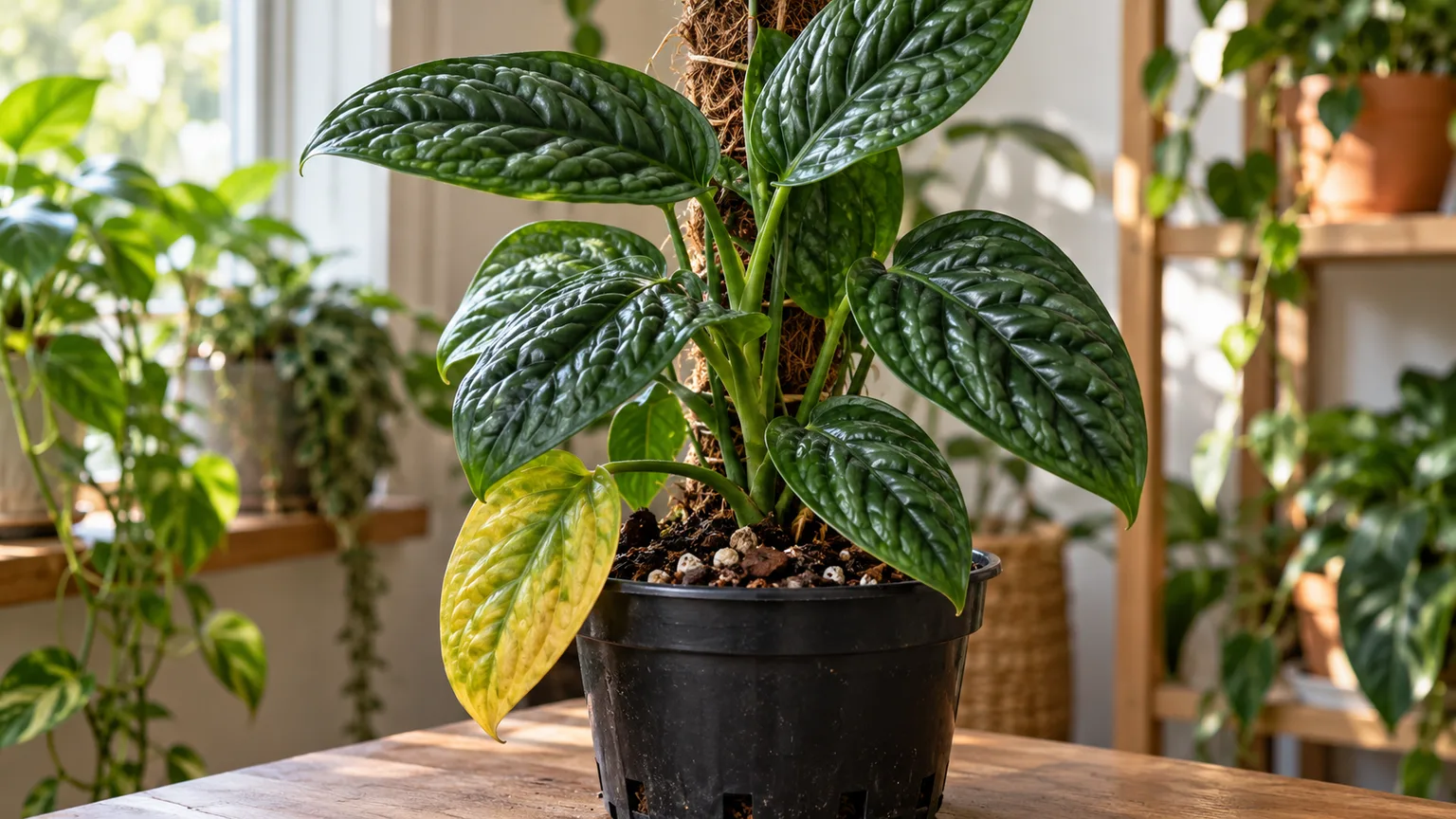
Overwatering on Monstera Peru: Causes, Checks & Fixes
This guide covers overwatering on Monstera Peru. See also the general Overwatering guide, watering, and light pages for this plant.
Overwatering on Monstera Peru: Causes, Checks & Fixes
A Monstera Peru can look glossy and firm while the lower part of its pot is still wet. When yellowing begins, the useful question is not simply whether you watered recently; it is whether the root ball is staying saturated long enough to lose air. The plant sold under this trade name has thick, puckered leaves and is commonly grown as a compact climber, so the visible leaf surface is a less reliable guide than the pot and roots. For the broad mechanics of chronic wet soil, see the general overwatering guide; this page focuses on how to confirm the problem on Monstera Peru. Start with the Monstera Peru overview if you need to identify the plant or review its normal setup.
What overwatering looks like on Monstera Peru
The pattern that raises concern is a combination: the pot remains heavy well after watering, mix is damp below the surface, and one or more older leaves turn yellow or lose firmness while growth slows. The leaves may droop even though the root zone is wet. Missouri Botanical Garden also lists yellowing and slowed growth among waterlogging symptoms, though neither one alone identifies the cause (waterlogging symptoms). A single yellow leaf can also reflect age, a recent move, or another stress.
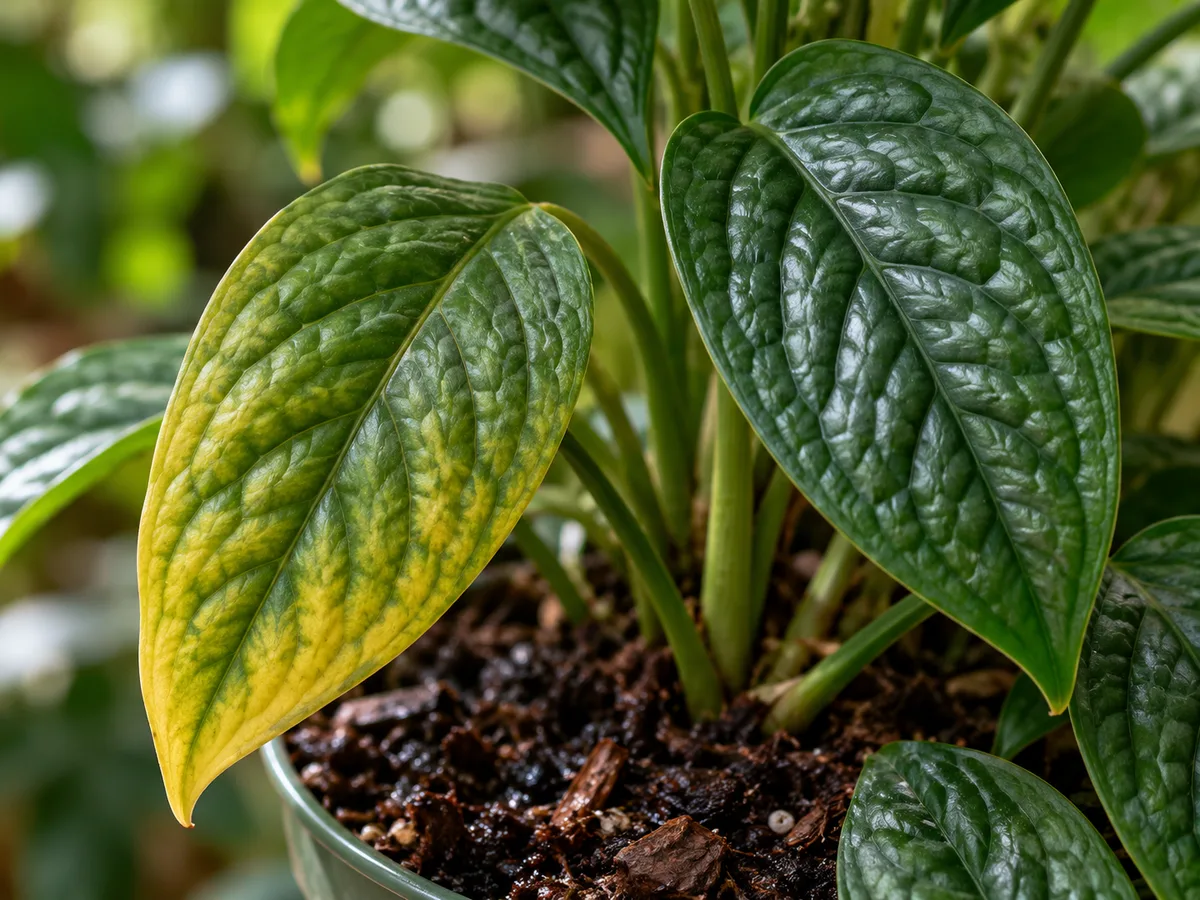
A yellowing older leaf is a reason to check the pot; damp mix and root condition help confirm whether excess water is involved.
The thick, embossed leaves are part of Monstera Peru’s normal appearance. Their raised texture is not itself a symptom, and a yellow lower leaf cannot tell you whether the cause is wet soil, dry soil, low light, or ordinary aging. Penn State Extension advises letting the top 1 to 2 inches of Monstera soil dry between waterings and notes that overwatering can lead to root rot; use that as genus-level guidance, then read your Peru’s actual pot rather than copying a calendar. Penn State Extension’s Monstera guidance supports the dry-down principle.
Why Monstera Peru can stay wet below a dry surface
Overwatering is a root-zone condition, not a count of how many times you used the watering can. A thorough soak followed by a proper dry-down is different from frequent small pours that keep the center of the pot damp. Dense peat-heavy mix, an oversized container, blocked drainage holes, a full cachepot, or a cool dim location can all lengthen the time the mix stays wet. A plant may therefore be overwatered even when you think you have been watering “carefully.”
Roots need air as well as moisture. Missouri Botanical Garden explains that waterlogged soil limits oxygen available to roots; damaged roots decline and may decay, which reduces the plant’s ability to take up water and nutrients. Yellowing, weak growth, and root or crown decay can follow, but those symptoms still need to be matched to the root-zone evidence. Missouri Botanical Garden’s overwatering guidance describes that chain.
Monstera Peru is often kept in a small nursery pot, a shallow board-mounted container, or a deeper pot around a moss pole. Those setups do not dry at the same rate. A small shallow pot can dry quickly at the exposed front while the mix tucked behind a board remains cool and damp. A moss pole may also be moist when the inner pot is already wet. Treat the pot and its drainage holes as the main measurement; the support is a separate surface to assess.
Light changes that dry-down. A Peru moved from a bright window to a dim shelf may use water more slowly, while a plant in brighter filtered light may dry sooner. If the pot began staying wet after a seasonal move, correct the light placement gradually and recheck its moisture instead of keeping the old watering rhythm. The Monstera Peru light guide explains placement; the watering guide covers its normal dry-down checks.
One label used for Monstera Peru is Monstera karstenianum. Kew currently treats that name as a synonym of Philodendron opacum, so references using “Monstera” may describe other species and should be used as care comparisons rather than proof of a Peru-specific trial. Kew’s taxonomic record supports the naming caveat. The practical advice below combines that uncertainty with general Monstera extension guidance and the LeafyPixels care profile for this plant.
Check the root zone before changing the plant
Use four checks in order. They help separate excess water from a symptom that only looks similar.
-
Reconstruct the last two or three waterings. Note the date, whether you soaked the entire root ball or added a small top-up, and whether water drained freely. Record any recent changes in pot, mix, light, heater or air-conditioning exposure, and season. A sudden slow dry-down after a move is a clue that the old interval no longer fits.
-
Test below the surface. Touch the mix 3–5 cm down near the edge of the pot. If it is still cool and wet, wait; the dry-looking surface is not enough. For a deeper pot, insert a clean wooden skewer closer to the center and lower root zone, then pull it out. A damp or soil-coated skewer means moisture remains. Do not push through a dense root mass or repeatedly poke the same spot.
-
Compare pot weight and drainage. Lift the nursery pot if it is manageable, or compare its heft with how it feels after a full soak and drain. A heavy pot plus a damp mid-depth check is stronger evidence than leaf color alone. Make sure drainage holes are open and that the inner pot is not standing in water inside a decorative cachepot. Clemson’s indoor watering guidance likewise recommends checking soil below the surface and accounting for pot and growing conditions rather than watering by date. Clemson Cooperative Extension’s indoor watering guide explains these checks.
-
Smell and inspect only if the other signs justify it. A sour or rotten smell from the drainage area, a soft stem base, or rapid decline across several leaves makes root inspection reasonable. A damp surface, a few fungus gnats, or one yellow leaf alone does not prove root rot. Missouri Botanical Garden recommends checking below the surface because the top can dry before the lower root zone and notes that sour or rotten soil odor can accompany prolonged oxygen loss.
For a shallow Peru grown against a board, check moisture at the pot’s drainage edge and behind the mount rather than trusting the exposed face. For a moss-pole plant, do not confuse a damp pole with a wet root ball. The RHS gives similar dry-the-top-few-centimetres advice for Monstera dubia, a different shingling Monstera; use it as an adjacent example, not as a measured Monstera Peru rule. RHS Monstera dubia care notes recommend keeping the compost moist without waterlogging and checking the surface.
When to inspect roots for root rot
Overwatering means the root zone remains too wet for too long; root rot is damage to roots that have started to decay. The two are related, but not interchangeable. A heavy pot with wet mix tells you to stop adding water and investigate drainage. It does not, by itself, prove that the roots are rotten. Use the Monstera Peru root rot guide when you have soft or decaying roots and need the more specific salvage steps.
If you do slide the plant from its pot, look at several roots rather than judging one stained root. Healthy roots are usually firm and pale, although some plants have naturally darker roots, so color alone is not a diagnosis. Black or brown roots that are mushy, crumble when touched, or smell unpleasant are more consistent with decay; Better Homes & Gardens’ root-rot guide describes those signs. A firm stem base and some firm roots are encouraging signs. If the roots are mostly firm, return the plant to the same pot and focus on dry-down rather than cutting healthy roots.
Consider root inspection when the pot has stayed wet through a long period, the plant continues declining despite a pause in watering, or the base of a stem has softened. If the plant is otherwise stable and the root ball is only damp, let it drain and dry first. Roots are hidden, and Epic Gardening’s root-rot guidance notes that routine digging to inspect them is not practical or recommended. Disturbing a stressed root system can add another setback, so unpotting should answer a real question or correct a failed container, not serve as a routine response to yellowing.
Lookalikes: overwatering, underwatering, light, and leaf aging
| What you find | More consistent with | Next check |
|---|---|---|
| Heavy pot, wet mix several centimeters down, yellowing lower leaf or slow decline | Overwatering or poor drainage | Pause watering; check drain holes and roots if decline continues |
| Very light pot, dry mix at depth, limp leaves | Underwatering | Water thoroughly once the root ball is actually dry |
| Mix stays wet after moving the plant to a dimmer place | Low light slowing dry-down may contribute | Review the light placement before changing watering again |
| One oldest leaf yellows while the rest of the plant and roots stay firm | Normal aging or a separate isolated stress is possible | Track whether a second leaf changes and inspect the root zone |
| Curled or drooping leaves, but soil and pot weight are unknown | Not enough evidence to call it overwatering | Check the mix first; both overwatering and underwatering can curl Monstera leaves |
Leaf curling is especially easy to overread. A Monstera may curl in response to either very wet roots or a dry root ball, so use the pot check to separate the two rather than watering to “test” the plant. Tom’s Guide’s Monstera leaf-curl article describes both watering extremes as possible causes of curling. Monstera leaf-curl diagnosis is a practical comparison, not a diagnostic test for Peru by itself.
A pest problem is more plausible when you find visible insects, fine webbing, or sticky residue on leaves; inspect the undersides and the newest growth. If you find those signs, use the Monstera Peru spider-mite guide or the relevant pest guide instead of treating wet soil as the whole explanation. If the main change is drooping with dry mix, compare the underwatering guide and drooping-leaves guide.
First fix for mild overwatering: stop the next saturation
If the root ball is damp but the stem base and roots are still firm, the first fix is simple: do not water again yet, and remove any standing runoff from the saucer or cachepot. Keep the plant in a stable, bright-indirect location with normal room warmth while the mix dries. Do not move it into direct sun or set it beside a heater to force evaporation; that can add leaf stress without correcting dense soil or trapped water.
Recheck the root zone rather than waiting a set number of days. When the top 3–5 cm is dry and the pot is clearly lighter, water evenly across the surface until excess drains, then empty the saucer. A few small sips can leave some roots dry while keeping the lower mix wet, so the goal is a complete soak followed by an appropriate dry-down. The interval depends on pot size, mix, light, temperature, and plant activity; it may be shorter in warm bright weather and longer in a cool, dim room.
If the pot has no drainage hole, the outer container holds water, or a dense mix remains saturated long after the room conditions have changed, fix that underlying setup. Move the plant into a pot with drainage and a loose, well-draining aroid mix sized close to the root ball. Do not use a dramatically larger pot: unused wet mix around a small root system takes longer to dry. The Monstera Peru soil guide covers mix structure and pot choice.
If roots are rotting, rescue the plant in stages
When roots are mushy or decaying and the plant is continuing to decline, remove it from the pot so you can see how much healthy tissue remains. Work over a washable surface, ease away loose wet mix, and avoid tugging on firm roots. With clean, sharp scissors, trim only roots that are clearly soft or dead; this is the basic cleanup step in BHG’s root-rot treatment guidance. Keep any firm root and stem tissue. The aim is to remove failed material and put the living root system into fresh, airy mix, not to make the root ball bare.
Choose a clean pot with drainage that fits the remaining roots without leaving a large ring of unused media. Set the crown at its previous height and support the vine so it does not rock while new roots establish. Do not add fertilizer, root stimulant, fungicide, or several home treatments at once. A damaged root system has less capacity to use fertilizer, and extra products make it harder to see whether the new drainage setup is working.
After repotting, water just enough to settle the mix and let excess drain away. Then wait until the top few centimeters dry and the pot lightens before watering again. Keep conditions steady; avoid relocating, pruning healthy stems, and changing the support in the same week unless a soft stem base makes removal necessary. If the lower stem has collapsed but an upper segment remains firm with a viable node, a clean stem cutting may preserve a backup, though it is a separate propagation step and not the first treatment for an otherwise salvageable root ball.
A Peru with a firm crown and some healthy roots can often resume growth, but it may take time to replace damaged roots. If every root and the stem base are soft, there is no firm node to preserve, and decay continues through the vine, the plant may not be recoverable. Do not keep escalating treatments to force a recovery; take a healthy cutting only if a firm node remains, and discard fully decayed material.
Board-mounted Peru and moss poles need separate checks
A climbing or shingling Monstera Peru can have more than one damp surface around it. On a board, the back of the root ball may stay moist against the support while the exposed face looks dry. Check near the drainage opening and at a safe mid-depth point before deciding to water. If the planter is shallow, compare its weight and the skewer result because a finger test near the rim can miss the small pocket holding most of the roots.
On a moss-pole setup, the pole and the pot are different water reservoirs. The pole may be dry while the soil is still wet, or the pole can be damp because it was recently watered even though the pot needs a check. Do not pour more water down the pole as a response to yellowing. First check the inner pot. If you are actively training aerial roots, moisten the support only when the root ball is not saturated and the support itself has dried; do not keep pole moss constantly wet.
This distinction is useful for Peru because the support often sits close to the plant’s short stem and small root zone. Water trapped where the vine meets the substrate can keep the stem base wet. Avoid packing fresh sphagnum tightly around the crown as a quick fix. Keep the base visible enough to inspect, and leave air space around the stem. If the board or pole is permanently damp, reduce that moisture source while the pot recovers.
Recovery: read new Peru growth, not the old yellow leaf
If a leaf has fully yellowed, do not use its color as your recovery signal. Wait until it is mostly yellow or failing, then remove it with clean scissors if it is easy to reach; do not strip firm green leaves just to make the plant look tidy. Recovery is better judged by whether new yellowing stops, the stem remains firm, and the pot begins moving through a predictable wet-to-dry cycle again.
Watch the next leaf as it emerges and hardens. Monstera Peru’s leaves have a strong quilted surface when healthy, so compare new growth with the plant’s own unaffected leaves rather than expecting fenestrations or the shape of a Monstera deliciosa leaf. A new leaf that opens normally and stays firm is a more useful sign than an old damaged leaf becoming cosmetically perfect. If a new leaf stalls while the pot remains wet, revisit root health and light instead of adding fertilizer.
After root work, keep watering decisions tied to moisture checks, avoid repeated unpotting, and do not fertilize until the plant is stable and producing growth. If new leaves remain smaller or the vine keeps weakening, the issue may include light, root damage, or support stress. Recheck the light placement before changing another variable.
Mistakes that keep Monstera Peru’s root zone wet
- Watering every week automatically. A weekly reminder can prompt a check, but it cannot account for season, pot depth, mix, or window changes. Test before pouring.
- Giving small top-ups. Repeated sips may not wet the whole root ball evenly and can leave part of the pot continually damp. When it is due, soak thoroughly and allow free drainage.
- Diagnosing from a single yellow leaf. One older leaf can age naturally. Check whether the pot is wet and heavy and whether more than one part of the plant is declining.
- Repotting every time leaves yellow. If the mix drains and the roots are firm, repotting adds root disturbance without fixing a confirmed cause.
- Fertilizing a wet, declining plant. Fertilizer will not restore oxygen to a saturated root zone. Wait for a stable root system and active growth.
- Keeping the cachepot or board reservoir full. Drainage water left around the inner pot defeats the benefit of drainage holes. Empty it after every soak.
- Trying to dry the plant with harsh heat or sun. A hot window or heating vent changes leaf temperature quickly while a dense center can remain wet. Keep light bright but filtered and let the pot dry naturally.
Prevent another overwatering cycle
Set the plant up so water can leave the pot and you can read the mix. Use an inner container with several open drainage holes, and let it drain completely before returning it to a decorative cachepot. Use a chunky, airy aroid mix that holds some moisture without collapsing into a dense block. Choose a pot only modestly larger than the living root system; an oversized pot can stay wet around roots that are not yet occupying the mix.
Learn the pot’s dry-down in its current spot. After a thorough watering, lift the pot and remember its weight. Check the top 3–5 cm and lift it again before the next watering. Once both signals point to a drier root zone, water thoroughly, then discard runoff. In winter or after moving the plant into lower light, expect the pot to take longer to lighten and extend the time between waterings based on checks. In brighter, warmer conditions it may dry faster; do not assume the interval is fixed.
If your Peru grows against a board, check behind the support and near the drain hole. If it climbs a moss pole, track pole moisture separately from pot moisture. Recheck after repotting or changing light, since either can change dry-down. For a simple starting estimate after you know your setup, use the watering calculator for Monstera Peru, then confirm the result with your pot rather than treating it as a schedule.
Severity note: This problem is marked medium for Monstera Peru in the plant-problem data. It is a triage label, not a prediction of damage or a substitute for the moisture and root checks above.
When to use this page vs other Monstera Peru guides
Use this page when the mix remains wet below the surface, the pot stays heavy, or symptoms appeared after frequent watering, poor drainage, a pot change, or a move to dimmer conditions. Use the yellow-leaves guide when the main question is why a leaf changed color but the pot is drying normally. Use underwatering when the mix is dry and pot is light, and drooping leaves when the plant sags but the moisture pattern is unclear. A soft or decaying root system belongs with root rot.
Related Monstera Peru guides
- Monstera Peru overview — plant identity and full care context.
- Monstera Peru problems hub — choose a symptom guide when more than one issue may be involved.
- Monstera Peru watering — normal dry-down checks and when to water.
- Monstera Peru soil — drainage, mix texture, and pot fit.
- Monstera Peru light — placement when a pot dries slowly after a move.
Related tool
Use the Watering Calculator for a starting interval, then verify the root-zone moisture and pot weight before watering.