Root Rot on Monstera Peru: How to Check and Treat It
Quick answer
If Monstera Peru is declining while its mix stays wet, first slide the plant from its pot and inspect the root ball. Root rot is confirmed by damaged, soft roots—not by one yellow leaf or a drooping vine alone.
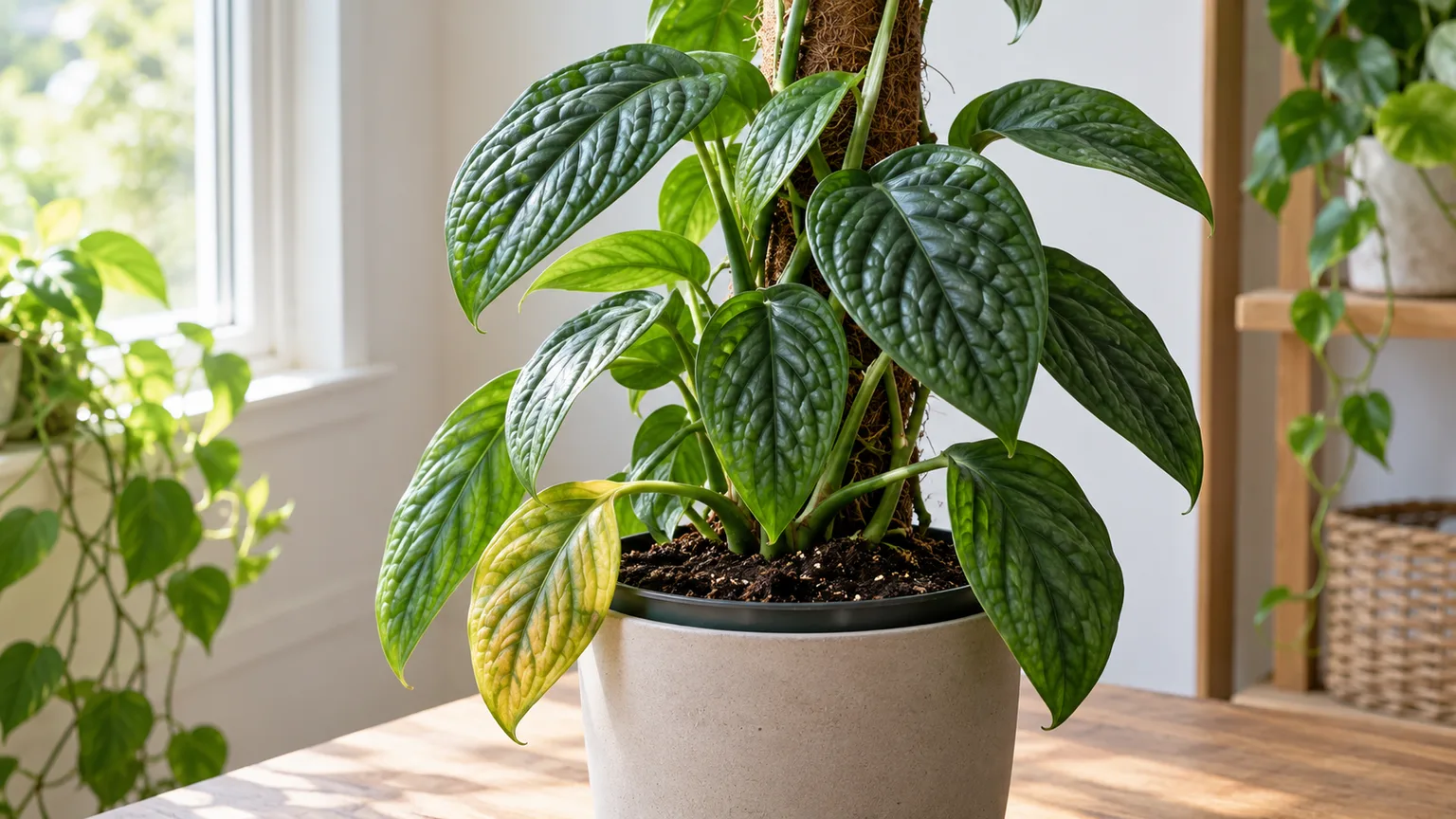
Root Rot on Monstera Peru: Causes, Checks & Fixes
This guide covers root rot on Monstera Peru. See also the general Root Rot guide, watering, and light pages for this plant.
Root Rot on Monstera Peru: Causes, Checks & Fixes
Quick answer
If your Monstera Peru is declining while its potting mix remains wet, the first action is to slide the plant from its pot and inspect the root ball. Do this when wet soil is paired with ongoing decline, a sour odor, or a soft stem base; a single yellow older leaf is not enough reason to disturb a healthy root system. Root rot is a root-zone diagnosis, not a leaf-color diagnosis.
A healthy-looking top can hide damaged roots, while a drooping vine can also result from a dry root ball, cold, or a recent move. Confirm the roots and the watering history before choosing a treatment. For the broader mechanics of wet, oxygen-poor media, see the general root rot guide; the steps here focus on Monstera Peru’s compact climbing habit, thick leaves, potting mix, and stem nodes.
What root rot looks like on Monstera Peru
Root trouble often appears first as a mismatch: the pot stays heavy and damp, yet the leaves lose firmness or older leaves begin to yellow. That mismatch deserves attention because roots stressed in wet mix may no longer supply the canopy normally, a pattern covered in Penn State’s indoor-plant disease guidance. It still does not prove that the roots are rotting; check the root ball before making that call. General houseplant root-rot guidance describes the importance of inspecting roots and correcting drainage.
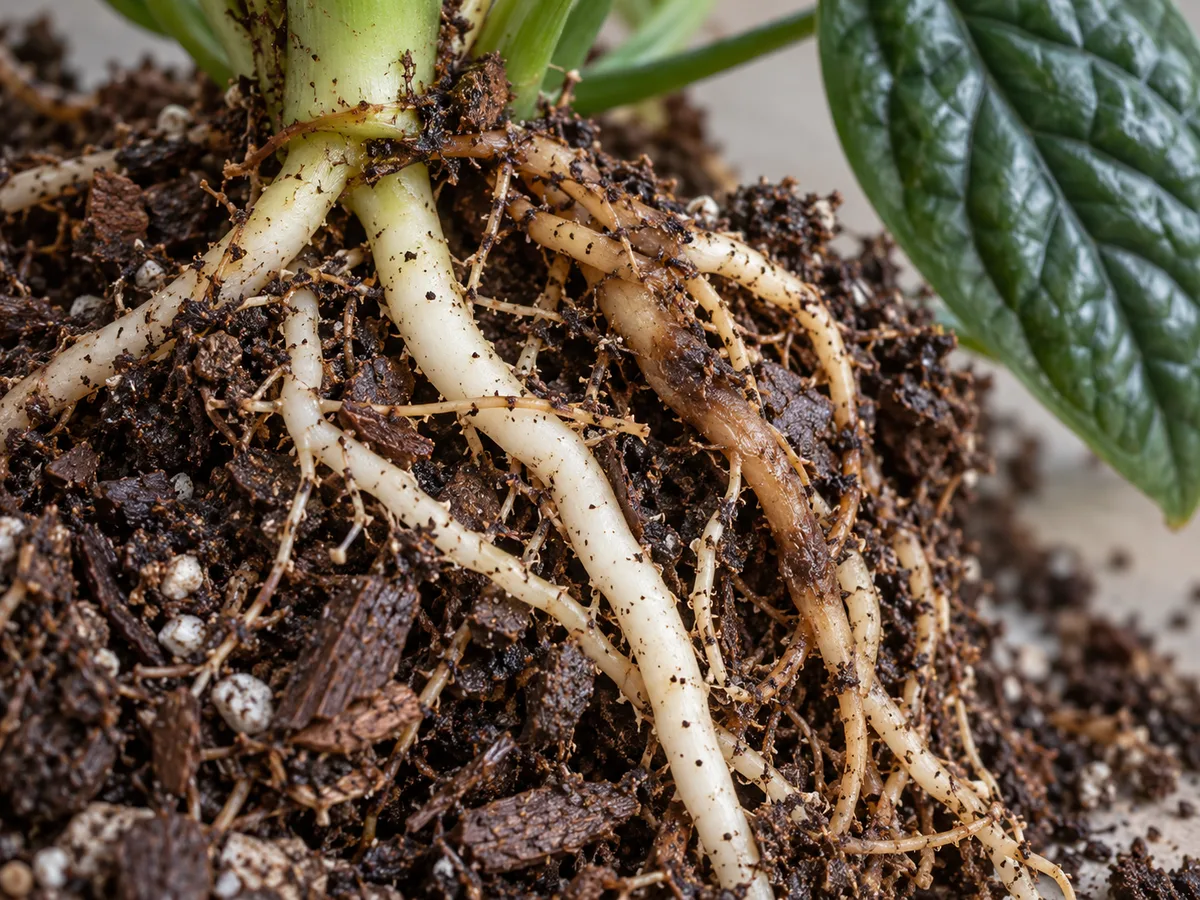
Root appearance supports a diagnosis, but compare several roots and the whole potting mix; color by itself is not a Peru-specific test.
On an unpacked root ball, keep the distinction practical: live roots feel firm and resilient; rotted tissue may be darkened, soft, hollow, or lose its outer layer when gently touched. Root color varies with age and the mix that clings to it, so do not remove every tan root automatically. UC ANR’s Phytophthora guidance is written for landscape and woody or crop hosts, not Monstera Peru; its illustration contrasts a pale healthy feeder root with a black killed one, and the article emphasizes that symptoms vary by host and pathogen. Use that contrast as general context, not a species-specific threshold or a way to identify a pathogen.
Above the soil, look for a pattern rather than a single blemish: several leaves drooping or yellowing while the mix remains wet, slow drying compared with the plant’s usual pattern, or softening at the stem base. Leaf texture and puckering are normal features of this trade plant; they do not diagnose root damage. If only one old lower leaf is changing and the rest of the plant remains firm while the pot dries normally, monitor before unpotting.
Separate root rot from lookalikes
| What you notice | What it may mean | Next check |
|---|---|---|
| Drooping leaves with a dry, light pot | The plant may be short of water rather than rotting. Compare the mix depth and recent watering before intervening. See the underwatering guide. | Check whether the upper 3–5 cm has dried and whether the root ball is dry farther down. |
| Drooping or yellowing leaves with a heavy, persistently wet pot | Root stress is plausible, but only damaged roots confirm rot. | Inspect the root ball if decline persists; do not add another watering just because the leaves droop. |
| One yellow older leaf with otherwise firm growth | Normal leaf turnover or another care change may explain one leaf; it is not enough to diagnose rot. The yellow-leaves guide covers the wider differential. | Compare the newest leaf, stem firmness, and pot dry-down over several days. |
| Growth only on the soil surface | That surface sign alone does not confirm root damage. Use the mold-on-soil guide for that separate visual issue. | Check below the surface and inspect roots if the pot stays wet and the plant declines. |
| Soft, dark roots plus a wet mix | This is stronger evidence of root rot, especially if multiple sections of the root ball are affected. | Remove decayed tissue and correct the wet-root-zone conditions. |
The symptom-only wilting guide helps when the root ball is not persistently wet or no root damage is visible. The overwatering guide is the better next read when the concern is a repeated watering routine but the roots still feel firm. Those pages address related problems; they do not replace root inspection when the root ball itself is soft and decayed.
Why a climbing Monstera Peru can stay too wet
Monstera Peru is grown for its thick, deeply quilted leaves and climbing stems. In a bright room, an actively growing vine can use water differently from a plant moved into low light, kept cool, or slowed during winter. A weekly habit that once matched a warm, bright spot can leave the same pot wet for too long after a seasonal or placement change. Monstera guidance from Penn State Extension treats light and watering as linked care conditions; it is genus-level guidance, so use it with the Peru-specific dry-down checks in this guide rather than as a fixed schedule.
Pot size and mix matter as much as the number of waterings. A large volume of fine, compacted mix can remain wet in the center even when the surface looks dry. A blocked drainage hole or a nursery pot left in standing water can keep the lowest roots saturated. UC ANR’s Phytophthora article is about landscape plants, but its general point is relevant as context: prolonged soil saturation raises root and crown rot risk, while good drainage and water management help lower it. It does not establish that a particular Monstera Peru has Phytophthora or any other specific pathogen.
The climbing habit creates one misleading cue. If you train the vine against a moss pole or plank, the support may be damp while the potting mix is dry, or dry while the root ball is still wet. Do not water the pot just because the support feels dry. Check the mix at the root zone and compare the pot’s weight; the aerial roots attached to a support are not a substitute for checking the roots inside the container.
Confirm the cause before cutting roots
Start with the pot, not the leaves. Lift the nursery pot out of any cachepot and empty standing water. Note whether the pot feels unusually heavy and whether water can escape through open drainage holes. A slow drain, persistently wet mix, or a sour odor raises concern, but odor alone cannot tell you which organism is involved.
If the plant is declining and the root ball remains wet, support the vine near its base and ease the plant out without pulling on its leaves or support. Remove loose mix gently so you can see more than the outside surface. Compare several root sections from top, center, and bottom. Firm roots that resist a light squeeze are different from soft tissue that collapses or slips away. Avoid stripping every root clean just to make the ball look tidy; the goal is to identify the damaged portion and preserve living roots.
Inspect the stem base and the lowest nodes as well. A firm stem with some healthy roots gives the plant a reasonable recovery path. A soft, darkened stem base means the damage may extend beyond the roots, so preserving a healthy cutting becomes more important. Do not infer a pathogen from a root’s color or a smell. UC ANR notes that root and crown symptoms can differ by pathogen, host, moisture, and temperature; its landscape Phytophthora guidance should not be used to name a disease on a houseplant.
Then reconstruct the last few weeks of care: watering dates, whether the pot dried between them, drainage, any recent repotting, a move to a dimmer window, cooler nights, or a much larger cover pot. This history helps explain why the mix stayed wet. Monstera Peru’s watering guide gives the plant-specific top-layer check; the soil guide explains the airy mix that helps the root zone drain. Use both to compare the current setup with the plant’s normal conditions.
First fix: inspect and remove confirmed rot
If you see soft, decayed roots in a persistently wet root ball, the first fix is to unpot the plant and remove the damaged root zone before the rot progresses. Do not water again to “perk up” a wilted plant that is already sitting in wet mix. If you have not seen damaged roots, finish the checks above before cutting or repotting.
Once rot is confirmed, work in a clean area. Set aside firm, living roots and cut away only tissue that is soft or clearly dead, using clean scissors or pruners. Make each cut back to firm tissue; wipe the blades between cuts if they contact decayed roots. Do not cut off every root that is cream, tan, or soil-stained. The aim is to preserve as much functional root mass as possible, not to make the root ball uniformly pale.
Discard the old saturated mix rather than packing it tightly around the trimmed roots again. Choose a clean pot with unobstructed drainage that is sized for the remaining root ball; a pot that is much wider can leave more wet substrate around fewer roots. Refill with fresh, airy aroid mix. The current Monstera Peru care recommendation is a standard potting mix amended with about 20–25% perlite and 10–15% orchid bark; keep the mix open rather than compressing it around the roots. The species-specific repotting guide covers container and handling choices.
After repotting, water once to settle the mix, let excess drain fully, and empty the saucer. Then wait until the upper 3–5 cm dries before watering again, adjusting for pot size, room temperature, light, and season. Clemson’s indoor watering guidance recommends judging indoor plants by their actual moisture needs rather than treating a calendar as the watering signal. Avoid a fungicide, peroxide soak, fertilizer, or extra watering unless a qualified source and an identified problem call for it; a product cannot correct a pot that remains saturated.
Save the vine when the root ball is badly damaged
Monstera Peru’s climbing stems give you a backup option that a damaged root ball does not: a healthy stem node can be used as a cutting. Consider that route if very few firm roots remain, the stem base is becoming soft, or the plant continues to decline after the root-zone correction. A cutting is a backup, not a guarantee of recovery.
Choose a section of firm, unaffected vine that includes at least one node; a leaf alone cannot replace a node. Use clean pruners and keep the cutting away from decayed material. If the plant still has a firm crown and a useful set of roots, do not cut it merely because one root is brown. Keep the rooted plant as the main recovery attempt and take a backup only when the decline makes that sensible. Penn State’s Monstera propagation guidance is genus-level context for stem cuttings, not a promise that every Monstera Peru cutting will root.
Do not use a soft or blackened section as propagation material. If the entire stem base is mushy and no firm node remains, the plant may not be salvageable. Dispose of the collapsed tissue and used mix, clean the pot before reusing it, and correct the watering and drainage setup before bringing another plant into that container.
Recovery: follow roots and new growth, not old leaves
A yellowed or badly wilted leaf may stay damaged even after the remaining roots recover. Do not judge success by waiting for old tissue to turn green again. The useful signals are that the stem base stays firm, the mix dries at a more predictable pace, the plant stops losing leaves, and new roots or a healthy leaf eventually appear.
Use a simple log rather than adding several changes at once: note the repotting date, when the mix is dry 3–5 cm down, pot weight after watering, and any fresh yellowing or softening. In the first days after treatment, focus on whether decline has stopped; later, look for new roots or a firm new leaf. Recovery timing varies with how much root mass remains, light, temperature, and the plant’s growth rate, so there is no reliable Peru-specific deadline for a new leaf.
Keep the plant in stable bright indirect light while it regains roots. If it was in a dark corner, move it gradually to a brighter filtered position; do not place it straight into harsh direct sun to force growth. The Monstera Peru light guide can help you choose a steadier spot. Hold fertilizer while the roots are freshly pruned and the plant is still declining; feeding is not a treatment for decayed roots. Resume ordinary care only after the plant shows stable growth and the root zone is drying normally.
Recheck the root ball only if wet mix and decline continue, or the stem base softens. Repeatedly unpotting a plant whose leaves are slow to recover can break the roots that remain. If symptoms stop spreading and the stem stays firm, let the roots establish in the fresh mix before making another change.
Prevent a second episode in this Peru pot
Use a drainage hole and a pot that fits the remaining root mass. If you move the plant into a much larger container after pruning roots, the unused wet mix can dry slowly. A clean pot with working holes and a loose aroid mix gives you a clearer dry-down pattern. The current recommended soil blend for Monstera Peru is standard potting mix with perlite and orchid bark; see the Monstera Peru soil guide for the full mix and handling details.
Check moisture before each watering. The current care baseline is to let the top 3–5 cm dry, water thoroughly, allow drainage, and empty the saucer; the 7–12 day interval is only a starting observation range. A small pot near a bright window can dry faster than a larger pot in a cool room. In winter or low light, reduce watering as growth slows instead of keeping the warm-season schedule. Clemson Extension’s indoor watering guidance supports checking the soil and the container conditions rather than watering every plant on the same day.
Keep light steady enough that the vine is not using much less water than your routine assumes. Monstera Peru prefers bright filtered light for compact, well-textured growth; avoid compensating for a dim position by watering on a fixed weekly cycle. The care overview brings together light, watering, and support choices so you can check the full setup when one variable changes.
If you use a moss pole, plank, or coir support, treat its moisture separately from the potting mix. The support can be kept suitable for climbing without leaving the container saturated; check the roots and mix at the base of the vine rather than watering because the pole feels dry. If you repot or change the support, observe how the pot dries for a few weeks before returning to an old schedule.
When to use this page vs other Monstera Peru guides
Use this page when wet mix and root inspection point to damaged roots. If the roots are firm but the pot stays wet because watering is too frequent, start with the overwatering guide. If the root ball is dry and light, use the underwatering guide. If the visible issue is a single yellow leaf or a drooping stem without root evidence, the yellow-leaf and wilting guides cover those symptoms more broadly.
For the full list of this plant’s problem pages, open the Monstera Peru problems hub. That hub is the route when you are still deciding which symptom best matches what you see; this guide is the route once the roots themselves need inspection and recovery.
Related Monstera Peru guides
The Monstera Peru overview is the starting point for its general care pattern. Use the watering guide for the top-layer dry-down routine, the soil guide for a faster-draining mix, and the repotting guide for container changes. Return to this page when the root ball is soft or decayed; use the sibling symptom guides when the roots remain firm and the issue is limited to leaves, surface mold, or watering behavior.
Related tool
Use the Root Rot Risk Checker to compare recent watering, drainage, and light changes before making a correction.