Underwatering on Monstera Peru: Causes, Checks & Fixes
Quick answer
Water Monstera Peru only after the top 3–5 cm of mix has dried and the root ball is also becoming light. If the mix is dry deeper down, give one slow, thorough watering until it drains; if it remains damp, do not add water just because the leaves droop.
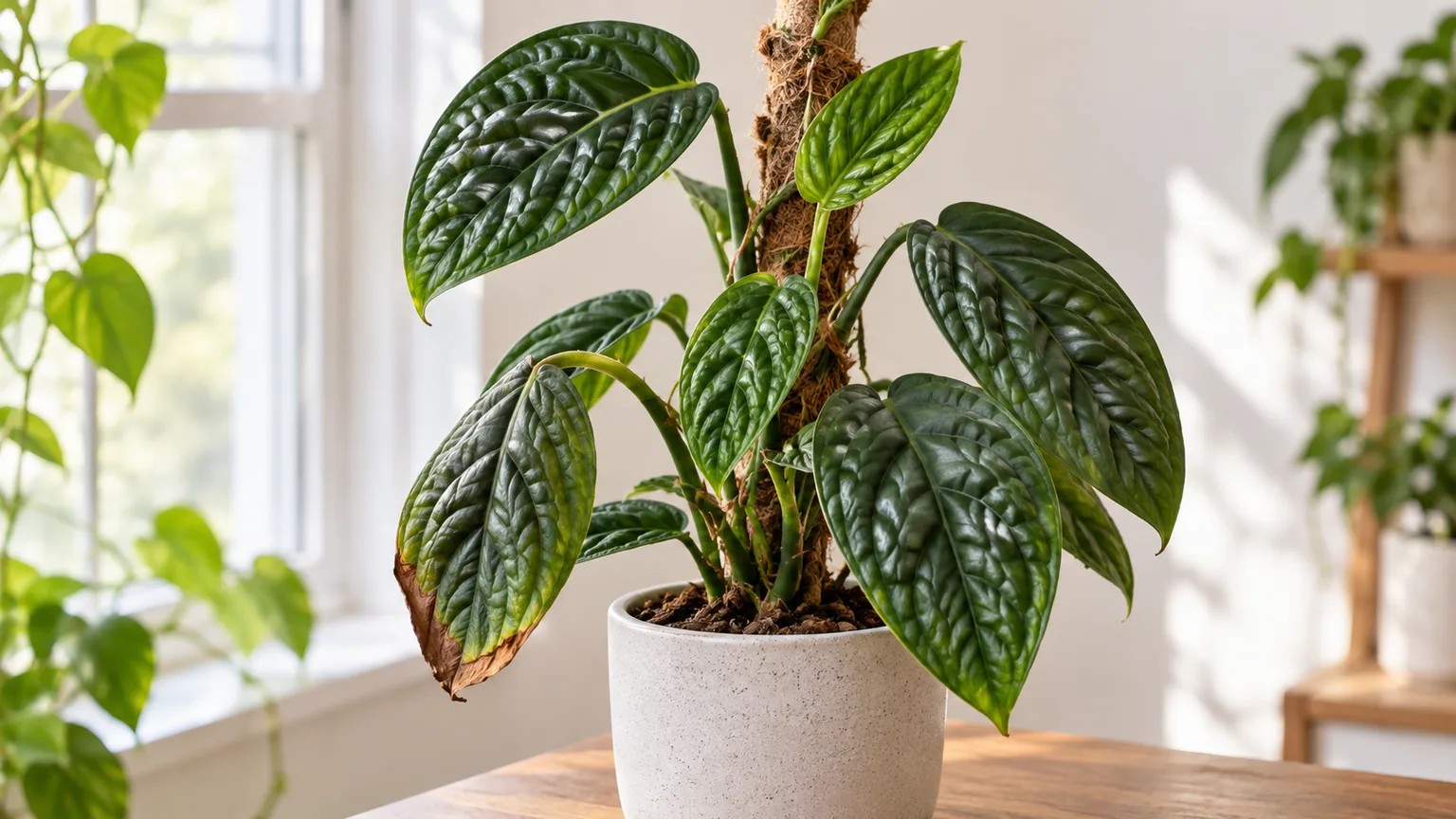
Underwatering on Monstera Peru: Causes, Checks & Fixes
This guide covers underwatering on Monstera Peru. See also the general Underwatering guide, watering, and light pages for this plant.
Underwatering on Monstera Peru: Causes, Checks & Fixes
Underwatering is plausible when Monstera Peru’s pot is light and the mix is dry below the surface, not simply when its leaves droop. First check the root ball at depth. If it is dry through the active root zone, give one slow, thorough watering and let the pot drain fully. If the middle of the mix is still damp, hold off: thirst and injured roots can produce similar limp leaves.
For the general mechanics of too little water, see our underwatering guide. This page focuses on the compact, thick-leaved plant sold as Monstera Peru: how its puckered foliage can mislead, where a board or moss support complicates checks, and how to restore moisture without keeping the smaller root zone wet afterward.
What underwatering looks like on Monstera Peru
The foliage sold under the Peru name is valued for thick, dark, deeply puckered leaves. The raised surface is normal; it is not itself a drought wrinkle. Look for a change from that individual plant’s usual appearance: one or more leaves becoming less firm, a petiole relaxing downward, and a margin or tip turning dry and brittle while the root ball is actually dry. The combination matters. A single brown edge can persist after an earlier dry spell, low humidity, or a different stress, so it cannot tell you whether to water today.
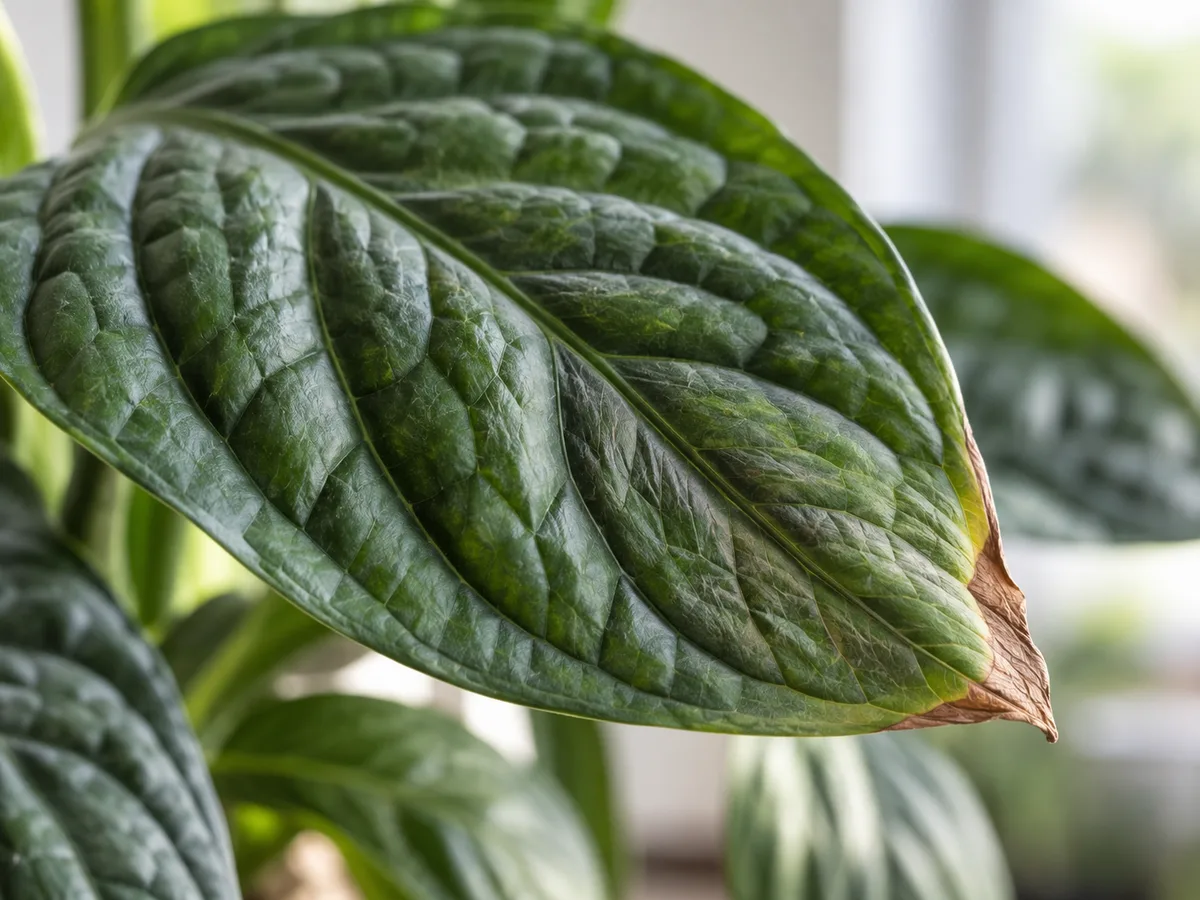
On Monstera Peru, use dry mix and pot weight to confirm thirst; a crisp leaf edge is a clue, not a diagnosis by itself.
Underwatering tends to develop as a dry-down pattern rather than a single dramatic mark. The pot becomes lighter over several days, the top dries first, and the deeper mix eventually loses moisture as well. If you missed a watering and the leaves look softer at the same time, compare the pot with its weight just after a full soak. That history is more useful than comparing your Peru with a photograph of a different plant.
The thick, embossed leaves can make visual diagnosis feel counterintuitive. Their natural ridges catch light and cast small shadows even when the plant is healthy. Do not mistake those folds for shriveling, and do not expect a thirsty leaf to develop holes: lack of fenestrations is normal for the familiar Peru trade plant. Use texture as a supporting observation; use the mix and pot as the evidence that decides whether to water.
Why a Monstera Peru can be hard to read
Thick leaves make the surface a late clue
A change in leaf firmness is worth noticing, but it is not a moisture meter. The visual signal may be subtle on a leathery leaf, and a leaf that has already developed a dry edge may stay scarred after the root zone is corrected. That makes repeated leaf squeezing or waiting for a severe collapse a poor routine. Check the root-zone conditions before a leaf looks badly damaged.
The genus-level Monstera guidance from Penn State recommends watering thoroughly and letting the top 1 to 2 inches of soil dry before the next watering; that is a broad Monstera reference, not a published trial for the Peru trade plant. The Monstera Peru watering guide translates that principle to this plant’s smaller indoor pots by using a 3–5 cm surface dry-down plus a deeper check and pot weight. Keep those as checkpoints, not a schedule that overrides what the mix is doing. Penn State Extension’s Monstera guidance supports the genus-level dry-down and thorough-watering baseline.
A climbing vine can hide a small root zone
Monstera Peru is often displayed upright against a plank, board, or moss pole. A tall support can make the plant look substantial even when the pot holding its roots is small. Do not use the length of the vine, the height of the support, or a dry-looking pole as evidence that the pot itself needs water. The roots in the container and any roots attached to the support are separate places to observe.
For a board-mounted plant, inspect the mix at more than one point if you can do so without tearing roots away from the mount. The exposed edge may feel dry while the back of a shallow pot stays damp against a board or cachepot. For a moss-pole plant, note whether the support is wet, but assess the pot independently. This is a practical check for Peru’s common display setups, not a claim that a pole replaces watering the root ball.
Penn State describes Monstera as a climbing vine with aerial roots and lists boards, moss supports, and trellises as options for the genus. That context explains why the support may influence where you look, but the pot still gets its own moisture check. Penn State’s support notes are genus-level guidance; they do not prescribe a separate watering interval for a Peru board or pole.
Room conditions can change the dry-down
A watering interval that worked in a bright, warm room can become too frequent after the plant is moved to a cooler, dimmer corner. A small nursery pot, a porous container, an airy mix, and warm light can dry at different rates from a larger plastic pot in lower light. Clemson Extension lists plant type, growth stage, location, pot, mix, and weather as factors that change watering frequency. Its indoor watering guide supports adjusting the check interval to those conditions instead of relying on a fixed day count.
For Monstera Peru, compare the current pot with the pattern you observed after the last full watering. If you moved it, repotted it, changed the support, or entered a darker season, restart the observation rather than assuming the old interval still applies. If the light itself has changed, review the placement; a change in light can change how quickly the pot uses water, but it does not prove drought by itself.
Confirm the root ball before changing the schedule
Use two checks before watering: one that samples moisture below the surface and another that tells you whether the pot has lost water overall. If possible, compare the result with what the pot feels like shortly after a complete watering. Clemson recommends checking the mix by touch and notes that potting mix loses weight as it dries; pot weight and touch checks are more useful together than a calendar reminder alone.
- Feel below the top crust. Push a finger about one joint into the mix near the edge, away from the main stem. If that layer is dry but the deeper pot still feels cool or damp, wait and check again. In this plant’s published care plan, the top 3–5 cm is the first dry-down checkpoint, not permission to water when the rest of a large pot remains wet.
- Use a clean wooden skewer for a deeper sample. Slide it partway toward the bottom without forcing it through roots. If it comes out cool, darkened, or with mix clinging to it, the center still has moisture. A dry surface alone can be misleading because the surface dries before soil near the roots; the Missouri Botanical Garden recommends probing below the surface to assess the root zone. Its soil-probe advice supports checking depth rather than judging from top color.
- Lift the pot. A Peru in a small nursery pot should feel clearly lighter after the mix dries than it did after watering. A decorative cover pot can hide runoff and add misleading weight, so lift the inner pot if it is safe to do so. If there is no baseline, note the weight after this watering and use it as a comparison next time. Clemson describes a definite loss of pot weight as mixes dry; the useful signal is the change in your own pot, not a universal number.
- Check drainage and standing water. Confirm that the inner pot has open drainage holes and that no saucer or cachepot is holding old runoff. If water cannot leave the container, symptoms may resemble drought even though the bottom remains saturated.
- Read the pattern, not one leaf. Dry mix through the root zone, a lightweight pot, and a recent long gap in watering make underwatering more likely. A heavy pot with damp mix and persistent wilt points away from thirst. Clemson notes that root injury from overwatering can also prevent water uptake and cause wilting, so droop alone is not a reliable water signal.
The pot’s surface can be dry while the lower root zone is not. The Missouri Botanical Garden notes that surface dryness does not reliably show moisture deeper down and that sour or rotten odor can indicate soil that has remained without oxygen. A sour smell is a reason to investigate the root environment, not a reason to pour in more water. The Botanical Garden’s root-zone checks help distinguish a dry top from a dry root ball.
When to inspect roots
Do not unpot a firm Monstera Peru just because one leaf droops. Root inspection is more useful when the pot stays heavy, the mix smells sour, several leaves decline while the soil is damp, or the stem base is becoming soft. If inspection is warranted, ease the root ball out carefully and look for a clear contrast: firm roots are intact, while severely damaged roots may be dark, soft, and unpleasant-smelling. The Missouri Botanical Garden describes oxygen deprivation and decaying roots in waterlogged soil; Better Homes & Gardens also identifies soft, discolored roots as a root-rot concern and explains removal of affected tissue. BHG’s root-rot guide supports that conditional inspection, not routine unpotting after a missed drink.
First fix: rewet a confirmed dry root ball evenly
If the mix is dry well below the surface and the pot is light, water slowly across the entire soil surface until water runs from the drainage holes. Pause briefly and apply a second small pour if the first one races down the sides without wetting the center. Let the pot drain completely, then empty the saucer or cachepot. This single thorough rehydration is the first fix; it restores the root ball without leaving the pot sitting in runoff.
Do not try to make up for a long dry spell with a series of little sips every few hours. Small additions can wet only part of the root ball and leave you unsure what is happening below. The goal is even moisture through the mix followed by normal drainage, not waterlogging. Once the plant has been watered, wait for the next genuine dry-down check before repeating the soak.
If the mix has become difficult to rewet
Peat-heavy mix that has dried completely may resist water or shrink from the pot wall. If the first watering runs around the root ball instead of soaking in, wait about half an hour and water again. As another option, stand the nursery pot in a shallow basin until the surface of the mix becomes moist, then remove it and let all excess water drain away. Clemson Extension recommends a second watering after half an hour or a temporary sink or bucket soak when very dry mix is hard to rewet; it also cautions that completely dried peat may not hold water as well afterward. Clemson’s rewetting method supports using this as a recovery technique rather than a permanent routine.
If the water still bypasses the mix, or the center stays dry after repeated attempts, the potting medium may be compacted or broken down. Do not keep the container submerged indefinitely. Once the plant is stable, review the Monstera Peru soil guide and consider repotting into a more open mix only if the current medium is actually failing. The repotting guide can help you decide whether the plant needs that intervention; it is not the first response to an ordinary missed watering.
What to do after the first soak
After watering, keep the plant in its existing suitable location and observe the next day rather than changing light, fertilizer, support, and pot all at once. A limp but otherwise firm leaf may take time to regain its usual posture. Do not use a crisp old edge as your recovery test; watch whether decline stops and the next leaf develops normally. Leave partly green leaves in place while the plant stabilizes unless they are broken or diseased.
If the stem remains firm and the pot drains normally, give the plant a few days to respond, then use the same depth and weight checks. Avoid another soak if the root ball is still wet. Conversely, if the mix dries unusually fast despite thorough watering, check whether the pot is root-bound, the container is porous, or the support installation has changed the way you can reach the soil. Repeatedly adding water without checking those conditions can turn a single dry spell into alternating drought and saturation.
Hold fertilizer until the plant is back on a stable watering rhythm and new growth is progressing. Fertilizer does not replace water, and a stressed root system should not be asked to process an unnecessary feeding while you are still diagnosing moisture. Also avoid pruning healthy stems or removing every marked leaf in the same session. Retain the healthy climbing vine and its nodes unless a section is dead or damaged beyond use.
How recovery shows up on this climbing aroid
The first useful sign is that decline stops: the pot rehydrates evenly, the stem stays firm, and the leaves do not continue to lose rigidity. Do not expect a crisp edge or brown patch to turn green again. That old tissue can remain a record of the drought even after the active problem is corrected. Judge the plant by stability and the next leaf, not by whether every older leaf returns to showroom condition.
A new leaf is a particularly useful checkpoint on Monstera Peru because the textured blade develops while attached to a growing vine. Note whether the new leaf opens without severe distortion, remains firm as it hardens, and is similar in size and texture to recent leaves grown under comparable conditions. One small or imperfect leaf after a stressful period does not prove that watering failed; environmental changes and root damage can also interrupt growth.
Do not promise a fixed recovery deadline. A small plant with healthy roots may resume growth sooner than a mature vine recovering in winter or after losing roots. The general potted-plant recovery information in BHG notes that signs of fresh growth can follow correction of root rot, while plants that fail to improve may be unsalvageable; that is a broad range, not a Monstera Peru timetable. BHG’s recovery notes are relevant only when root damage is part of the problem.
Lookalikes: when a droopy Peru is not thirsty
| Pattern | What to check | More useful next step |
|---|---|---|
| Limp leaves, very light pot, dry mix through the root zone | Whether water wets the center or runs down the sides | Rehydrate once and drain; then restart the dry-down check |
| Limp leaves, heavy pot, damp mix or sour smell | Drainage, root firmness, and how long the pot has stayed wet | Do not water again; investigate root stress and compare with Monstera Peru overwatering or root rot |
| Droop without clearly dry soil | Whether the plant was moved, chilled, heated, or disturbed | Read the Monstera Peru wilting guide before treating droop as thirst |
| Brown margins but a normally weighted pot | Room dryness, recent sun exposure, and whether only old leaves are affected | Compare with Monstera Peru brown tips before shortening the watering interval |
| New growth is small or spaced far apart, but leaves remain firm | Light at the growing tip and the vine’s support | Review the light guide; low light can slow water use, so a former schedule may now be too frequent |
Underwatering and overwatering can both lead to poor root health and wilt. The difference is not just leaf posture: combine how the plant looks with what the soil and pot are telling you. Clemson’s comparison of overlapping watering symptoms is a useful reminder to check root-zone moisture before choosing a treatment.
Use the global underwatering guide for shared mechanics, and use the plant-specific sibling pages above when the pattern points to a competing cause. This page is best when dryness is confirmed, not when a single leaf has an unexplained mark.
Keep Peru’s support separate from its root-zone diagnosis
An aerial root reaching a moss pole or plank is part of the climbing display; it does not show whether the potting mix is wet enough. If you routinely moisten a moss support, record that separately from watering the pot. A damp pole can coexist with a dry pot, and a wet pot can sit behind a dry-looking board. Check the pot before adding water to either location.
When the plant is mounted close to a board, avoid pulling the vine forward just to inspect every root. Use an accessible edge of the mix or a skewer inserted gently in the pot. If you can’t safely sample the center, make the next watering more deliberate and note how long it takes the pot to lighten. Use the support to keep the vine steady, not as a reason to repot a healthy plant in the middle of a drought response.
The care profile for this trade plant emphasizes a chunky mix, drainage, and a top 3–5 cm dry-down. Those are the species-specific defaults used here; the exact interval changes with the room and container. If your Peru repeatedly swings from bone dry to wet for many days, the Monstera Peru watering guide and soil guide give the longer-term setup context.
Prevent the next dry spell without watering by calendar
Choose one repeatable check that suits your pot. For a small nursery container, a finger at the top 3–5 cm plus a lift is often enough. For a deeper pot, add a skewer so you do not confuse a dry crust with a dry center. Keep the same method for a few watering cycles; changing between finger tests, meters, and surface color every day makes it hard to learn your plant’s actual rhythm.
A simple log can include the date of a thorough watering, the pot’s approximate weight immediately afterward, the day the top layer becomes dry, and whether the support or room changed. Do not turn the notes into a rigid interval. Their purpose is to tell you whether a future gap is unusual and how the plant behaves in that specific light, pot, and mix.
Make seasonal adjustments by checking more often when warmth and stronger light speed drying, and less often when growth slows and the pot stays damp. Clemson’s watering guidance lists light, temperature, container, and mix among the variables that affect water use, while Penn State’s Monstera care advice gives a dry-down trigger rather than a fixed weekly date. Together they support a check-first routine, not automatic watering every seven or ten days.
Use a pot with open drainage and a mix that drains yet does not dry instantly in your home. A plant in a shallow board mount may need more frequent observation than a deeper pot, but that is a reason to check, not to water on a preset schedule. If a cachepot catches runoff, empty it after watering so the inner pot is not left standing in water. If the pot dries unusually quickly, check the root ball and mix structure before compensating with repeated small drinks.
Keep the plant in stable, bright indirect light and avoid a sudden move to harsh direct sun while it is recovering. Better light may increase water use, but direct heat can add a second stress and make it harder to interpret the response. The Monstera Peru overview gives the full baseline for support, light, and soil; the Monstera Peru problems hub helps route a symptom that persists after the watering pattern is corrected.
When to seek a more serious root check
A single dry-down and one crisp older leaf usually call for measurement, not emergency surgery. Escalate your inspection if several leaves decline in quick succession, the stem at the soil line becomes soft, the pot stays heavy for much longer than usual, or there is a sour odor. Those signs do not prove root rot, but they do make a simple underwatering explanation less convincing.
If a root inspection confirms extensive soft, decaying tissue, remove only the clearly damaged material with clean scissors and use a clean pot with drainage and fresh, airy medium. Do not keep trimming healthy roots in search of a perfect white root ball. If most roots and the stem base have collapsed, the plant may not be salvageable; a firm node cutting can sometimes preserve a vine section, but only if it includes healthy tissue. Better Homes & Gardens describes trimming affected roots and improving drainage as general root-rot rescue measures; for a Peru, treat them as conditional salvage steps after inspection, not as the response to a dry pot.
If the plant remains wilted after a confirmed, even rehydration, stop repeating the watering treatment. Recheck whether the mix is wet at depth, whether the pot drains, and whether the roots or stem base are compromised; the wilting guide below is the better next read for a plant that stays limp despite corrected moisture.
When to use this page vs other Monstera Peru guides
Use this guide when you can confirm that the mix is dry through the root zone and want to rehydrate without overcorrecting. Use the Monstera Peru watering guide for the ongoing rhythm, seasonal dry-down, and board or moss-pole setup. If the soil stays wet while the plant droops, use overwatering or root rot. If dryness is not clear, the wilting guide helps separate competing causes.
Related Monstera Peru guides
- Monstera Peru overview — plant identity and the full care baseline.
- Monstera Peru watering — how to check the pot and adjust watering through the year.
- Monstera Peru soil — mix and drainage choices when the root ball dries unevenly or stays wet.
- Monstera Peru light — placement when a room change alters dry-down speed.
- Monstera Peru problems hub — route to related symptoms when drought is not confirmed.
Related tool
Use the Plant Watering Calculator to keep a record of the conditions that affect the next moisture check. Treat its result as a reminder to inspect, not an automatic instruction to water.