Monstera Peru Light Needs: Bright Indirect & Best Window
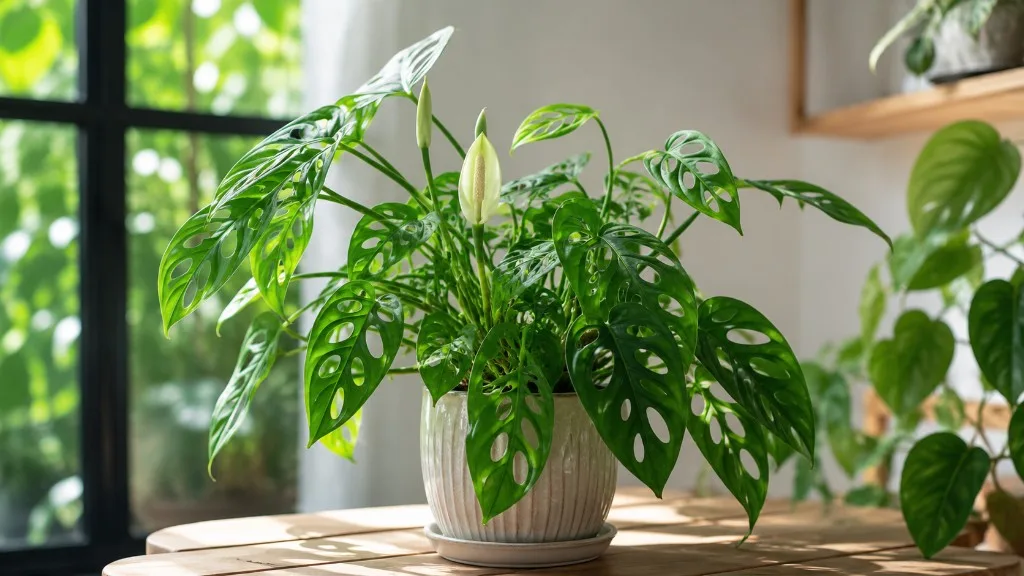
Monstera Peru Light Needs: Bright Indirect, Best Window & Signs
Monstera Peru Light Needs: Bright Indirect, Best Window & Signs
Monstera Peru is a trade name, so light advice needs one caveat before the window talk starts. The puckered-leaf plant sold as Monstera Peru, Monstera karstenianum, Green Galaxy Monstera, or Monstera sp. Peru is treated by Kew as a synonym of Philodendron opacum under the name Monstera karstenianum. That does not make the care label useless; it means this guide uses the houseplant trade name readers know while grounding identity in the accepted botanical record. For the full identity note, start with the Monstera Peru overview.
Light is the care variable that decides whether Monstera Peru looks tight, dark, and sculptural or slowly becomes a thin vine with shallow texture. Aim for bright indirect light when you can, accept steady medium indirect light as maintenance, and avoid unfiltered hot sun on the corrugated leaves. This page focuses on placement, measuring brightness, grow lights, and warning signs; if your main issue is wet soil after a move, use the Monstera Peru watering guide alongside it.
Quick answer: bright indirect light, not a dark corner
Monstera Peru grows best where the newest leaves receive bright light without direct midday or afternoon sun sitting on the foliage. Penn State Extension gives the genus-level Monstera rule clearly: place Monstera near a sunny window where it gets bright light but not direct sun, and expect legginess in lower light. Peru follows that rule, but the goal is not fenestration. The goal is short internodes, firm leaves, stronger puckering, and steady attachment to a support.
The most reliable indoor placements are an east window, a very bright north window, or a south/west window softened by sheer curtains or distance from the glass. A shelf three metres from a window may look bright to a human, but it often reads as survival light to the plant. If you want compact, board-hugging growth rather than a long trailer, put the growing tip in the brightest safe zone and train it upward.
Taxonomy note: why this page says Monstera Peru
The accepted botanical name matters because many online pages repeat the trade name as if it were settled species taxonomy. Kew lists Philodendron opacum as the accepted species and describes it as an Araceae climbing epiphyte native from southeastern Nicaragua to Ecuador in wet tropical biome. Kew also lists Monstera karstenianum as a heterotypic synonym of that accepted name.
For care, the practical takeaway is narrower: this plant is a compact climbing aroid with thick, puckered leaves, not a juvenile Monstera deliciosa waiting to split. Authoritative care sources rarely test the trade plant sold as Peru directly, so this guide separates source-backed genus or taxonomy facts from Monstera Peru-specific grower interpretation. The trade-name plant still needs the same broad aroid logic: filtered tropical brightness, support, warm rooms, and a root zone that is not kept wet in low light.
What good light looks like on new growth
Good light on Monstera Peru shows up as new leaves that are firm, dark green, and visibly puckered once hardened. On a supported plant, new nodes stay closer together and the vine is easier to keep against a board, plank, or pole. If the newest leaf is much smaller than the previous one, flatter in texture, or separated by a long stretch of bare stem, the plant is probably below its display-quality light level.
Do not judge the spot by one old leaf that still looks attractive. Thick leaves can coast for months while the growth point quietly weakens. After moving the plant, watch the next one or two leaves and compare internode length, leaf width, and rigidity. If light improves but the pot stays wet too long, check the Monstera Peru soil guide because dense mix can hide behind what looks like a light problem.
Why light controls texture, internodes, and shingling
Many Monstera care pages talk about light as a trigger for holes and splits. Peru is different: the display feature is the embossed leaf surface and the tight climbing habit. Better light gives the plant more energy to build thicker, more rigid leaves and shorter spaces between nodes. Low light does not erase the texture from old leaves, but it makes new growth look smaller, flatter, and more stretched.
The shingling logic comes from broader Monstera biology. Wisconsin Horticulture Extension explains that juvenile Monstera seedlings can grow closely overlapped against trunks in a shingle plants stage before changing as they mature. Peru is sold for a similar compact, board-friendly look, so even light across the mount matters. A board with one hot sun stripe and one dark side creates uneven growth: the lit side can scorch while the shaded side stretches.
Foot-candle targets and the no-meter shadow test
Light meters are not mandatory, but they prevent a common mistake: calling every pleasant room “bright indirect.” UF/IFAS Gardening Solutions notes that human eyes adapt so well that we are poor judges of indoor brightness, then defines indoor bands as 25-100 foot-candles for low light, 100-500 foot-candles for medium light, 500-1000 foot-candles for high light, and over 1000 foot-candles for direct sunlight at midday in its foot-candle guidelines. For Monstera Peru, a practical target is the upper medium to lower high range at the growing tip, with direct sun filtered before it lands on leaves.
If you do not have a meter, use a shadow check at leaf height on a bright day. A barely visible shadow usually means low light for Peru. A soft shadow with readable edges is the useful bright-indirect zone. A sharp, dark shadow means the plant is receiving direct sun or near-direct intensity; filter it before the same beam sits on puckered foliage for hours.
| Reading at leaf height | What it means for Monstera Peru | Best action |
|---|---|---|
| Under 100 ftc | Too dim for attractive new growth | Move closer to a window or add a grow light |
| 100-500 ftc | Maintenance to moderate growth | Use the upper end for better texture |
| 500-1000 ftc | Best display range when sun is filtered | Watch for heat on west/south exposures |
| Over 1000 ftc | Direct-sun risk indoors | Filter, move back, or shorten exposure |
Best window placement by orientation
Window direction gives you a starting guess, not a guarantee. Overhangs, trees, tinted glass, curtains, season, and distance from the glass can change the actual light more than the compass direction. Measure or shadow-test where the top leaves sit, especially on poles and boards where the growing tip may be higher than the pot.
| Window | Best setup | Watch for |
|---|---|---|
| East | On the sill or within 30 cm of glass | Usually safest; still acclimate new purchases |
| North | Very close to unobstructed glass in a bright room | Winter slowdown and long internodes |
| West | 1-1.5 m back or behind sheer curtains | Afternoon scorch and warm leaves |
| South | Filtered with sheer curtains or set back | Strongest growth potential, highest burn risk |
East windows
East windows are the easiest recommendation for most homes. Morning sun is gentler, and the plant gets useful brightness before the room heats up. Board-mounted Peru often performs well here because the leaves can face the window without being cooked by afternoon rays.
Place the pot on the sill or within about 30 cm of the glass if temperatures stay stable. If the newest leaves lean hard toward the pane, rotate the pot slightly or shift the board so the leaf faces receive a broader wash of light. Do not move a newly shipped plant straight into direct morning beams; give it several days of bright shade first.
North windows
North windows work only when they are bright and unobstructed. They can maintain a compact Peru in summer, but winter often turns them into slow-growth spots. If new internodes lengthen beyond the older pattern, do not compensate with fertilizer; move the plant brighter or add a grow light.
North windows are better for stable maintenance than for rebuilding a sparse vine. If your plant is already leggy, use north light only with supplemental lighting over the growing tip. A board or pole helps, but support cannot replace missing photons.
West and south windows
West and south exposures can produce excellent texture when filtered. They can also scorch Peru quickly because the same direct beam may hit corrugated leaf pockets for several hours. NC State Extension’s Monstera guidance recommends moderate brightness but not direct sunlight, which is the right safety rule for these windows.
Use a sheer curtain, place the plant back from the glass, or angle the support so leaves receive reflected brightness instead of a direct stripe. Touch leaves during the brightest part of the day. If they feel warm, the light is too intense for that position even if the plant has not burned yet.
Board, plank, moss pole, and trailing placement
Display style changes how light hits the foliage. A board or plank holds leaves flatter, so one directional light source can create a bright side and a shaded side. A moss pole lets leaves spiral and catch light from more angles, but the top of the pole can end up above the brightest part of the window if the pot sits too low. A trailing shelf plant often keeps the top leaves bright while older lower leaves are shaded by the vine itself.
Penn State Extension notes that indoor Monstera still needs sturdy support and can use moss sticks, trellises, bamboo stakes, or sphagnum-covered boards for its aerial-root attachment. For Peru, put the support where the growth point receives light first. If the display is sparse, take cuttings only after the parent plant is in better light; the Monstera Peru propagation guide works best when cuttings come from firm, well-lit stems.
Grow lights for dark rooms and winter
Use a grow light when the best window cannot keep new internodes short. UF/IFAS says plants can grow entirely under artificial light if the source is appropriate and identifies fluorescent and LED lights as better long-term options than hot, inefficient incandescent bulbs for houseplants under artificial lighting. For Monstera Peru, choose a broad-spectrum LED or fluorescent fixture and aim it at the top leaves, not just the pot.
Start with the fixture about 30 to 60 cm above the upper foliage and run it on a consistent 12-14 hour timer. If leaves stay small after three to four weeks and show no bleaching, move the light slightly closer. If leaves bleach, curl upward, feel warm, or develop dry tan patches, raise the light or shorten the photoperiod. Do not run a grow light all night; a consistent dark period keeps growth rhythms normal.
Low light vs too much light: symptom table
Light problems often look like watering problems, so diagnose by pattern. Low light usually changes new growth first: longer gaps, smaller leaves, weaker texture, and slow dry-down. Excess light usually damages the exposed surface first: pale patches, crisp spots, heat curl, and sudden bleaching on the window-facing side.
| Symptom | Likely light cause | First action |
|---|---|---|
| Long internodes and small new leaves | Too little light at the growing tip | Move one step brighter or add a grow light |
| Wet pot for 14+ days | Low light slowing water use | Delay watering and improve light before repotting |
| Pale tan patches on window-facing leaves | Direct sun or lamp too close | Filter light, move back, or raise fixture |
| Curling during afternoon only | Heat/light stress | Check leaf temperature and shift from west/south beams |
| One shaded side sparse on a board | Uneven light across the mount | Rotate or re-angle the support |
If you recently moved the plant from dim light into a much brighter spot, expect one older leaf to yellow during adjustment. That is not a reason to return it to darkness. It is a reason to slow the transition, check moisture, and judge the next leaf instead of the oldest one.
How light changes watering
Light and watering are linked tightly on Monstera Peru. Clemson Cooperative Extension notes that watering frequency changes with location, pot, soil mix, weather, plant size, and growth stage, and specifically says a plant in a warm, dry, sunny location needs more frequent watering than one in a cool low-light environment. That is why a Peru moved from a dim shelf to an east window may dry faster within one or two cycles.
Do not keep the same watering schedule after a light change. Lift the pot, test the top 3-5 cm of mix, and watch how fast the support dries. If the plant moved brighter, it may need water sooner; if it moved dimmer for decor, it may need much less. The safest reset is to re-learn the pot for two weeks before changing fertilizer, repotting, or pruning. For feeding timing after light improves, use the Monstera Peru fertilizer guide rather than feeding a stressed plant immediately.
Peru vs deliciosa vs adansonii light needs
Monstera Peru is more compact than Monstera deliciosa and thicker-leaved than Monstera adansonii, but it is not a true low-light plant. RHS notes that the biggest, most perforated Monstera leaves come from mature plants in good light and high humidity, while Penn State and NC State both caution against direct sun for indoor Monstera. Peru does not need light to create holes; it needs enough light to maintain texture and tight growth.
Use this comparison as a care decision, not a hard species trial. Deliciosa usually needs more space and strong bright indirect light to size up. Adansonii stretches quickly when light drops. Peru can look acceptable in upper medium light, but its best form still comes from bright filtered exposure and support.
| Plant | Main display goal | Light mistake you will notice first |
|---|---|---|
| Monstera Peru | Puckered texture and compact support growth | Long internodes, flatter new leaves |
| Monstera deliciosa | Large leaves and mature fenestrations | Small juvenile leaves, no splits |
| Monstera adansonii | Thin vining leaves with holes | Sparse, weak vines and smaller leaves |
Seasonal moves and acclimation
Winter and summer can reverse your assumptions. A south window may be safer in summer with trees leafed out, then become a direct-beam scorch risk in winter when the sun angle drops. A north window may be acceptable in June and too dim by December. Recheck the plant at leaf height after seasonal changes rather than trusting the same label year-round.
Acclimate gradually when the change is large. Move from dim to bright filtered light over one to two weeks, especially with a newly purchased plant, a recently rooted cutting, or a plant recovering from wet soil. Delay Monstera Peru repotting until the plant has produced stable new growth in the new light; stacking relocation, root disturbance, and fertilizer in the same week slows recovery.
When to use this page vs other Monstera Peru guides
Use this page when the question is where the plant should sit: window direction, grow-light distance, scorch risk, low-light stretch, or support orientation. Use the Monstera Peru overview for identity, toxicity, growth habit, and the taxonomy caveat in full. Use watering when the pot stays wet or dries too fast after a light move, soil when dense mix keeps roots wet in a dim room, propagation when a leggy vine needs restarting, fertilizer when growth is stable but slow, and repotting only after light and watering are settled.
Conclusion
Monstera Peru light care is about building texture, short internodes, and useful support growth under bright filtered conditions. Give the growing tip bright indirect light, use upper medium light only as maintenance, filter hot south and west sun, and add a grow light when the room cannot support new leaves. The most honest test is simple: measure or shadow-check the leaf surface, wait for the next one or two leaves, then adjust by what the new growth shows.
Related Monstera Peru guides
- Monstera Peru overview — identity, taxonomy, growth habit, toxicity, and overall care.
- Monstera Peru watering — dry-down checks after light changes.
- Monstera Peru soil — chunky mix for low-light and bright-window placements.
- Monstera Peru propagation — restarting leggy vines after placement improves.
- Monstera Peru fertilizer — feeding only after light and watering are stable.
- Monstera Peru repotting — timing root work around seasonal light changes.