Monstera Peru Fertilizer: When, How, and Mistakes to Avoid
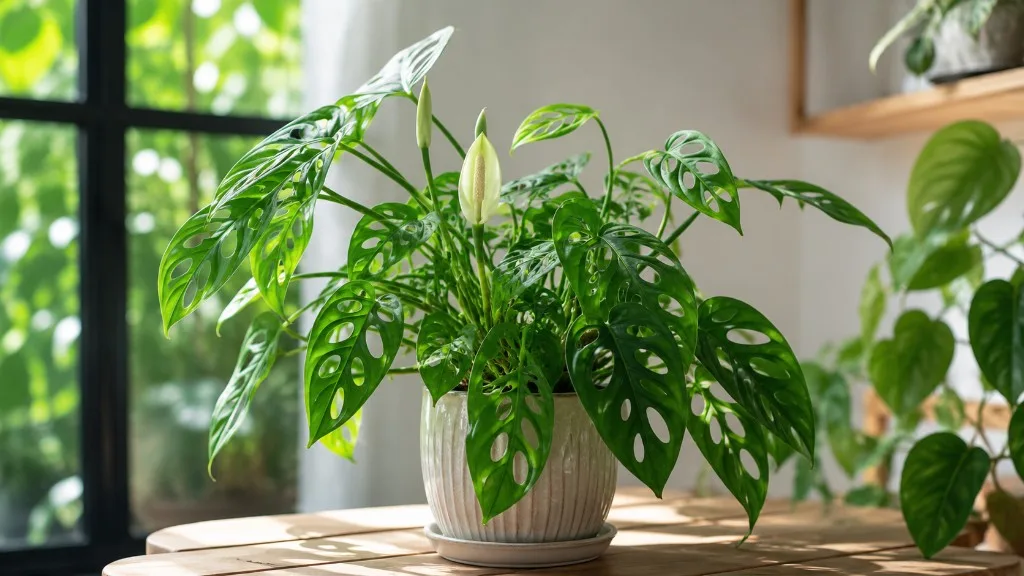
Monstera Peru Fertilizer: When, How, and Mistakes to Avoid
Monstera Peru Fertilizer: When, How, and Mistakes to Avoid
Monstera Peru is the trade name most growers use for the thick, deeply puckered aroid sold as Monstera karstenianum, Green Galaxy Monstera, or Monstera sp. Peru. Current Kew taxonomy treats Monstera karstenianum as a synonym, while the LeafyPixels plant-detail hub tracks the accepted-name caveat under Philodendron opacum. That matters for fertilizer because there are no strong Peru-specific feeding trials; the safest advice comes from Monstera and houseplant fertilizer sources, then gets adapted to Peru’s slower, smaller indoor habit.
Fertilizer supports embossed leaf expansion and vine strength on boards and moss poles, but only after light, watering, and soil are already in range. Use this page to decide when to feed, how much to dilute, how board mounts differ from moss poles, and what to check first when brown tips appear after feeding.
Quick Answer — Light Feeding in Active Growth Only
During active growth — roughly mid-spring through early fall — apply a balanced liquid houseplant fertilizer at half the label strength every four to six weeks to already-moist soil. Pause in winter, after repotting, and during any stress period when roots cannot safely absorb salts. Moss-pole climbers in bright indirect light often sit at four to five weeks; board-mounted juveniles in shallow pots may need every six to eight weeks. Fertilizer cannot fix low light, wet compacted mix, or a pot three sizes too large.
LeafyPixels Field Notes: Board Mounts, Moss Poles, and Salt Risk
These observations come from comparing compact Peru plants in 12-15 cm nursery pots, a shallow board-mount setup, and standard moss-pole containers under bright filtered indoor light. They are not controlled fertilizer trials. They explain how LeafyPixels adapts extension guidance for the smaller trade plant sold as Peru.
| Setup observed | What changed feeding most | Practical outcome |
|---|---|---|
| Board-mounted juvenile, shallow pot | Low soil volume and slower vine extension | Half-strength feed every 6-8 weeks was safer than monthly feeding; salt crust showed early on the rim |
| Moss-pole climber, brighter window | Faster stem extension and larger new leaves | Half-strength feed every 4-5 weeks during peak growth supported steady leaves without full-dose feeding |
| Shelf plant in medium light | Slow dry-down and fewer new leaves | Four or five light feeds per year was enough; extra fertilizer did not improve embossing |
The source-backed rule is simple: fertilize houseplants during active growth, use a suitable houseplant fertilizer, apply to moist potting soil, and stop if salts accumulate. The Peru-specific intervals above are interpretation from growth rate, pot volume, and salt symptoms, so treat them as starting points.
Why Fertilizer Matters for a Slow, Thick-Leaved Climber
Fertilizer replaces nutrients used during growth and nutrients leached from container mix. UConn’s houseplant fertilizer guide notes that houseplants rely on growers to supply nutrients through fertilizer and that underfed plants can show slow growth, weak stems, and pale leaves. Peru is not a heavy feeder like outdoor vegetables, but it is also not a lean-soil succulent. Without occasional light feeding, a Peru in the same soilless mix for two years may push smaller, paler embossed leaves despite correct watering.
Think of fertilizer as maintenance for active growth, not a shortcut to deeper puckering. Leaf texture tracks bright indirect light, humidity, and climbing support — not a high-nitrogen spike. If new leaves stay small and flat despite good feeding, check light and root health before escalating fertilizer. Overfeeding on a plant that is not growing burns roots and salts the mix faster than underfeeding ever slows a healthy Peru.
Thick Leaves Change Nutrient Timing
Peru’s leathery, corrugated leaves make it less visibly wilt-prone than thin-leaved Monstera adansonii in the same room. LeafyPixels treats that as a practical dry-down clue, not as a lab-measured transpiration claim. Slower visible growth often pairs with slower nutrient draw, which is why copying deliciosa’s aggressive feeding schedule on a compact Peru in a 12 cm pot is a common path to brown tips and white salt crust. Clemson Cooperative Extension notes that houseplants should be fertilized only during active growth — for Peru indoors, that window is often narrower and less intense than for a floor deliciosa on a moss pole in peak summer.
Quick-Reference Feeding Card
| Setting | LeafyPixels home default | Penn State genus schedule |
|---|---|---|
| Spring–summer active growth | Balanced liquid at half strength, every 4–6 weeks | Every 2 weeks with balanced houseplant fertilizer |
| Fall taper | Last half-strength feed when growth slows; pause by late fall | Growth naturally slows |
| Winter | No fertilizer for typical indoor setups | Monthly balanced fertilizer |
| Application rule | Moist soil only — never dry roots | Water thoroughly; let top dry between waterings |
| Salt management | Flush with plain water once mid-season if feeding monthly | Not specified |
| Skip feeding when | Dry soil, stress, pests, or 0–6 weeks after repot | Same practical exclusions apply |
Half-strength dilution example: If the label says 1 teaspoon per gallon for houseplants, mix ½ teaspoon per gallon. Water normally the day before, then pour the solution until a little drains and empty the saucer.
When to Fertilize Monstera Peru
Feed when Peru is actively producing new embossed leaves and extending stems, and stop when growth slows sharply. Indoors in temperate climates, that window usually runs April through September, depending on room temperature, latitude, and whether the plant sits in bright or medium indirect light. UConn describes March through October as the usual active-growth period for many houseplants and recommends no winter fertilizer when reduced light and temperature make plants inactive. Never feed dry soil, a newly repotted plant (wait four to six weeks until new growth stabilizes), or any plant recovering from root rot until you have fixed the underlying care issue.
Fresh bagged potting mix often includes a starter fertilizer charge that lasts weeks to months. A new Peru may look fine without supplemental feeding at first — then growth slows when that charge depletes, especially in a small pot you water frequently. Resume light feeding only after you see firm new leaves unfurling, not on a fixed calendar the day you bring the plant home.
Spring and Summer Active Growth Window
Start feeding when you see fresh growth: new leaves with firm puckered texture, aerial roots attaching to a moss pole or board, and the pot drying on a normal rhythm between waterings. Wisconsin Horticulture Extension recommends fertilizing regularly from spring until fall while Monstera is in active growth. During peak summer, half-strength balanced liquid every four to six weeks suits most Peru setups in average home light. A moss-pole climber in bright east or south-filtered light may sit at the four-week end — still at half strength, not full label dose.
Penn State Extension advises fertilizing every two weeks through the growing season and monthly through winter for Monstera houseplants. That is genus-level guidance, not a Peru-specific trial. For Peru, treat Penn State’s biweekly interval as an upper ceiling for only the fastest-growing moss-pole specimens with steady new leaves and no salt crust — not the default for every Peru on a shelf.
Winter Pause and Grow-Light Exception
Most temperate indoor Peru plants slow sharply November through February: short days, cooler rooms, and reduced water use mean unused fertilizer becomes soluble salt in the mix. Iowa State Extension emphasizes matching fertilizer to active plant growth — dormant or static plants do not benefit from feeding and accumulate salts instead.
Grow-light exception: If supplemental LEDs keep continuous new embossed leaves appearing through winter, optional half-strength feed every six to eight weeks is reasonable — but watch for white crust on the soil surface and flush if it appears.
Seasonal Feeding Calendar
| Month | Growth phase | Feeding guidance |
|---|---|---|
| March–April | Waking up, new shoots | Start half-strength liquid when active growth is visible |
| May–August | Peak leaf and vine production | Every 4–6 weeks default; bright moss-pole plants may feed every 4 weeks at half strength |
| September | Slowing slightly | Reduce to every 6–8 weeks or taper off |
| October | Wind-down | Final light feed if still growing, then pause |
| November–February | Low growth indoors | No fertilizer for typical setups |
| Grow-light winter exception | Continuous new leaves under 10–12 hr supplemental light | Optional half-strength feed every 6–8 weeks; watch for salt crust |
Best Fertilizer Type and N-P-K for Monstera Peru
The best Monstera Peru fertilizer for most homes is a complete water-soluble balanced or foliage-weighted houseplant formula with micronutrients on the label. UConn explains that nitrogen supports leafy growth, phosphorus supports flowering and root growth, and potassium supports stem strength and stress tolerance. A formula slightly higher in nitrogen — such as 9-3-6 or 24-8-16 — can suit leaf-texture goals better than a high-phosphorus bloom booster, because Peru is grown for foliage and excess product adds salt without matching metabolism.
Avoid shopping by the word “Monstera” on the bottle unless you trust the brand’s dosing. Standard 10-10-10 or 20-20-20 at half strength remains practical; UConn lists balanced examples such as 20-20-20 and 10-8-7 as adequate for many houseplants. RHS recommends feeding Swiss cheese plants with balanced liquid fertilizer during the growing season — the same product class works for Peru at the conservative intervals above, not necessarily at maximum label frequency.
Skip slow-release pellets in small pots unless you also skip liquid feed for two to three months — stacking both concentrates salts unpredictably in shallow board-mount containers.
Balanced Liquid Formulas and Dilution Math
Worked example for an 8-inch pot: Label recommends 1 teaspoon (5 ml) per gallon of water for indoor plants. For half strength, use ½ teaspoon per gallon — roughly 2.5 ml per 3.8 liters. If your watering can holds 2 gallons, that is 1 teaspoon total for the full batch, not 1 teaspoon per gallon twice. Stir, then apply to moist soil after a normal watering cycle so roots are hydrated before encountering dissolved salts; UConn specifically warns to apply fertilizer to already-moist potting soil to avoid root damage.
How to Apply Fertilizer Step by Step
- Check soil moisture — top 2–3 cm should be moist from a recent watering, not soggy and not bone dry.
- Mix at half label strength in a watering can; use a measuring spoon for consistency.
- Pour slowly across the soil surface, avoiding concentrated pour directly on the stem base.
- Water until a small amount drains from the bottom; discard saucer runoff.
- Mark the date and watch the next one to two new leaves for tip burn or healthy embossed growth.
- Flush with plain water mid-season if you feed monthly — run water through the pot equal to at least the pot volume, twice, as University of Maryland Extension recommends for leaching excess salts.
Never foliar-feed as a routine on Peru — corrugated leaf pockets trap fertilizer droplets and invite spotting. Do not pour solution into leaf axils or onto moss poles as a substitute for soil feeding unless you are following a deliberate, dilute pole-moistening routine tied to watering.
Board Mount vs Moss Pole: Feeding Nuances
Shallow board-mount pots hold less soil volume, so salts concentrate faster even when growth looks modest. Feed every six to eight weeks at half strength during peak summer, or switch to quarter strength monthly only if new shingling leaves keep appearing and no crust forms. Flush monthly during active season because rim crust appears early in small volumes.
Moss-pole climbers in deeper pots with bright light use nutrients faster — every four to five weeks at half strength is a typical peak-season rhythm when aerial roots attach and embossed leaves enlarge steadily.
Trailing shelf plants in medium light often need only four to five feeds per year total. Match feeding to observed growth rate — new embossed leaves every few weeks means the plant can use food; months without new leaves means pause regardless of calendar.
Frequency Decision Table by Light and Pot Size
| Scenario | Suggested interval (half strength) | Notes |
|---|---|---|
| Juvenile board mount, moderate light, shallow pot | Every 6–8 weeks spring–summer | Small volume salts quickly; lean is safer |
| Moss-pole climber, bright indirect light | Every 4–5 weeks | Faster stem and leaf area |
| Standard pot, 15–18 cm, medium light | Every 5–6 weeks spring–summer | Default Peru setup |
| Dim corner, slow or no new leaves | Do not feed until light improves | Fertilizer will not replace photons |
| Fresh repot (0–6 weeks) | Pause | Repot stress plus starter charge in new mix |
| Hard tap water + frequent feeding | Extend interval; flush more often | Mineral load stacks with fertilizer salts |
Signs You Are Feeding Correctly vs Signs of Trouble
Healthy feeding signals: new embossed leaves unfurl at stable or increasing size when light and support are adequate; petioles stay rigid; foliage stays deep green; soil surface stays free of heavy white crust; the plant produces steady but not explosive growth through summer without sudden leaf drop after feeding.
Over-fertilizing signals: University of Maryland Extension describes browning or dieback of leaf tips and margins, reduced growth, lower leaf yellowing, wilting despite moist soil, and white crust on the potting media surface. UConn adds that overfertilization can brown roots and leaf tips, distort leaves, and leave white crust on pot rims. On Peru, brown tips are easily confused with low humidity — check for salt crust and whether tips appeared within one to two weeks of feeding before blaming moisture alone. Peru’s thick leaves can delay obvious wilt; inspect the soil rim monthly.
Under-fertilizing signals: persistent pale new growth despite good light, proper watering, and healthy roots in old, exhausted mix — but rule out light and water first, because those cause pale stretch far more often than true nutrient deficiency indoors.
Brown Tips After Feeding: Fertilizer Problem or Care Problem?
Use this table before adding more fertilizer or flushing unnecessarily. Brown tips are a symptom, not a diagnosis.
| What you see | More likely cause | First action |
|---|---|---|
| Brown tips appear 1-2 weeks after feeding, plus white crust or a bitter-looking rim | Fertilizer salt buildup | Stop feeding, flush, and pause 4-6 weeks |
| Brown tips with a very light pot and dry mix | Underwatering or dry-air stress | Rehydrate thoroughly, then stabilize the watering rhythm |
| Yellowing lower leaves, wet heavy pot, sour smell | Root stress from wet or compacted mix | Check soil drainage before feeding again |
| Small pale leaves with long internodes and no salt crust | Not enough light, not fertilizer shortage | Move toward brighter indirect light and wait for the next leaf |
| Tips burn right after repotting or a pot-size jump | Repot stress plus fresh mix or fertilizer charge | Pause fertilizer and follow the repotting recovery timeline |
Over-Fertilizing and Salt Flush Recovery
Stop all fertilizer immediately if you see tip burn, crust, or leaf drop after feeding. Flush the pot with plain room-temperature water until it runs freely from the drainage hole, wait thirty minutes, and repeat until you have passed at least one full pot volume of water through the mix twice. University of Maryland Extension notes that large pots with excessive salts can be leached this way; UConn also recommends leaching with copious water or repotting into fresh medium when excessive fertilizer salts are severe. Smaller pots with heavy crust may need the top inch of mix replaced after flushing. Pause feeding for four to six weeks and resume at half strength only when the next new leaf opens without immediate tip necrosis. Burned leaf tissue will not heal — judge recovery by clean new growth, not old damaged blades.
How Feeding Connects to Light, Water, and Soil
Fertilizer only works when the rest of the system is in range. Peru in bright indirect light photosynthesizes more and uses nutrients faster. In dim light, the same feed sits unused and becomes salt. In soggy soil with poor drainage, roots absorb water slowly while salts concentrate — a common path to root stress compounded by feeding. Pair feeding with active growth, a chunky well-draining mix, and the dry-down rhythm from the watering guide — tune frequency to the whole routine, not a calendar isolated from how fast your pot actually dries.
Hard tap water adds calcium and magnesium that accumulate over time. If you feed every four to six weeks and use hard water, a mid-season flush matters more than switching to a specialty “Monstera” product. NC State Extension lists good drainage and high organic matter as cultural requirements for Monstera — Peru shares that root-zone logic even though it never develops split leaves.
Peru vs Deliciosa vs Adansonii Feeding Differences
All three are Monstera aroids, but indoor feeding is not interchangeable.
| Factor | Monstera Peru | Monstera deliciosa | Monstera adansonii |
|---|---|---|---|
| Growth rate | Slow to moderate | Fast when supported | Fast vine length |
| Typical pot size | Small to medium | Large floor pots | Small hanging pots |
| Leaf nutrient demand | Moderate — thick tissue | High — large leaf area | Moderate — thin leaves, fast metabolism |
| Safe default interval | Every 4–6 weeks half strength | Every 4–6 weeks; biweekly possible in bright light | Every 4–6 weeks; leaner in tiny pots |
| Salt risk in small pots | High on board mounts | Lower in large volume | High in shallow baskets |
Deliciosa’s large leaf surface and Penn State’s biweekly growing-season guidance fit vigorous floor specimens better than compact shelf plants. Adansonii’s thin leaves often show tip stress quickly but also grows fast enough to use light feeds in bright conditions. Peru sits between them on growth speed but closer to adansonii on pot volume — which is why conservative feeding wins.
Common Monstera Peru Fertilizer Mistakes
Feeding dry soil concentrates salts at the root zone and burns fine roots — always water normally first, or feed the day after a thorough soak when the mix is evenly moist.
Copying deliciosa biweekly feeding on a slow board-mount Peru — pot volume and growth rate do not support that salt load.
Chasing deeper puckering with nitrogen — texture tracks light, humidity, and age; fertilizer supports existing growth, it does not emboss juvenile leaves on demand.
Winter feeding on a static plant because Penn State mentions monthly winter fertilizer — most temperate indoor Peru are not in active growth December through February unless under strong supplemental light.
Ignoring salt crust until multiple leaves tip-burn — white rim on the soil surface is an early warning; flush and pause before permanent root damage.
Feeding immediately after repot — fresh mix plus liquid feed stacks with repot stress; wait for stable new growth.
Stacking slow-release granules and monthly liquid in a shallow board pot — salts accumulate silently until several embossed leaves crisp at once.
Pet and Handling Safety
Monstera Peru is treated as a toxic aroid because Monstera relatives contain needle-like insoluble calcium oxalate crystals in sap and tissue. UF/IFAS EP639 notes that all Monstera species and plant parts are toxic to dogs, cats, and humans, causing mouth and throat irritation if chewed, and ASPCA lists Swiss cheese plant toxicity under insoluble calcium oxalates. Concentrated fertilizer solution and crusty salty soil are also unsafe if ingested — keep bottles, runoff saucers, and flush water out of reach. Wear gloves if sap irritates skin when pruning or handling cut stems. Contact your vet or poison control if a pet consumes plant tissue or fertilizer runoff.
Conclusion
The plant sold as Monstera Peru responds best to light, consistent nutrition during active growth — not heavy doses on a fixed calendar. Start with half-strength balanced liquid every four to six weeks spring through early fall, apply only to moist soil, flush salts mid-season if you feed regularly, and pause through winter unless grow lights keep new embossed leaves coming. Feed moss-pole climbers in bright light slightly more often than board-mounted juveniles in shallow pots, and remember that embossed leaves need good culture more than heavy doses. Fix light, water, and soil before chasing fertilizer — and when in doubt, skip a month rather than double the dose. Peru tolerates a slower feed far better than it tolerates burned roots.
When to use this page vs other Monstera Peru guides
Use this fertilizer page when you are choosing a feeding schedule, diagnosing brown tips after feeding, or deciding whether to resume fertilizer after repotting. For how often to water, see Monstera Peru watering. For window placement and grow lights, see Monstera Peru light. For mix choice and drainage, see Monstera Peru soil. For when to unpot and refresh mix, see Monstera Peru repotting. For species identity, toxicity, and year-round defaults, start with the Monstera Peru overview.
Related Monstera Peru guides
- Monstera Peru overview — species identity, toxicity, and care defaults
- Monstera Peru watering — dry-down checks tied to nutrient uptake
- Monstera Peru light — how brightness changes growth rate and feeding need
- Monstera Peru soil — mix structure and salt buildup prevention
- Monstera Peru repotting — when to pause fertilizer after fresh mix
- Monstera Peru propagation — do not feed unrooted cuttings