Monstera Peru Yellow Leaves: Causes and First Checks
Quick answer
If a Monstera Peru leaf turns yellow, check where it is on the vine and how damp the root ball is before watering or feeding. One aging lower leaf beside firm new growth can be normal; several yellow leaves on a heavy pot point first toward a wet root zone. Pause the next watering until a mid-pot skewer and pot weight show whether the mix is still moist.
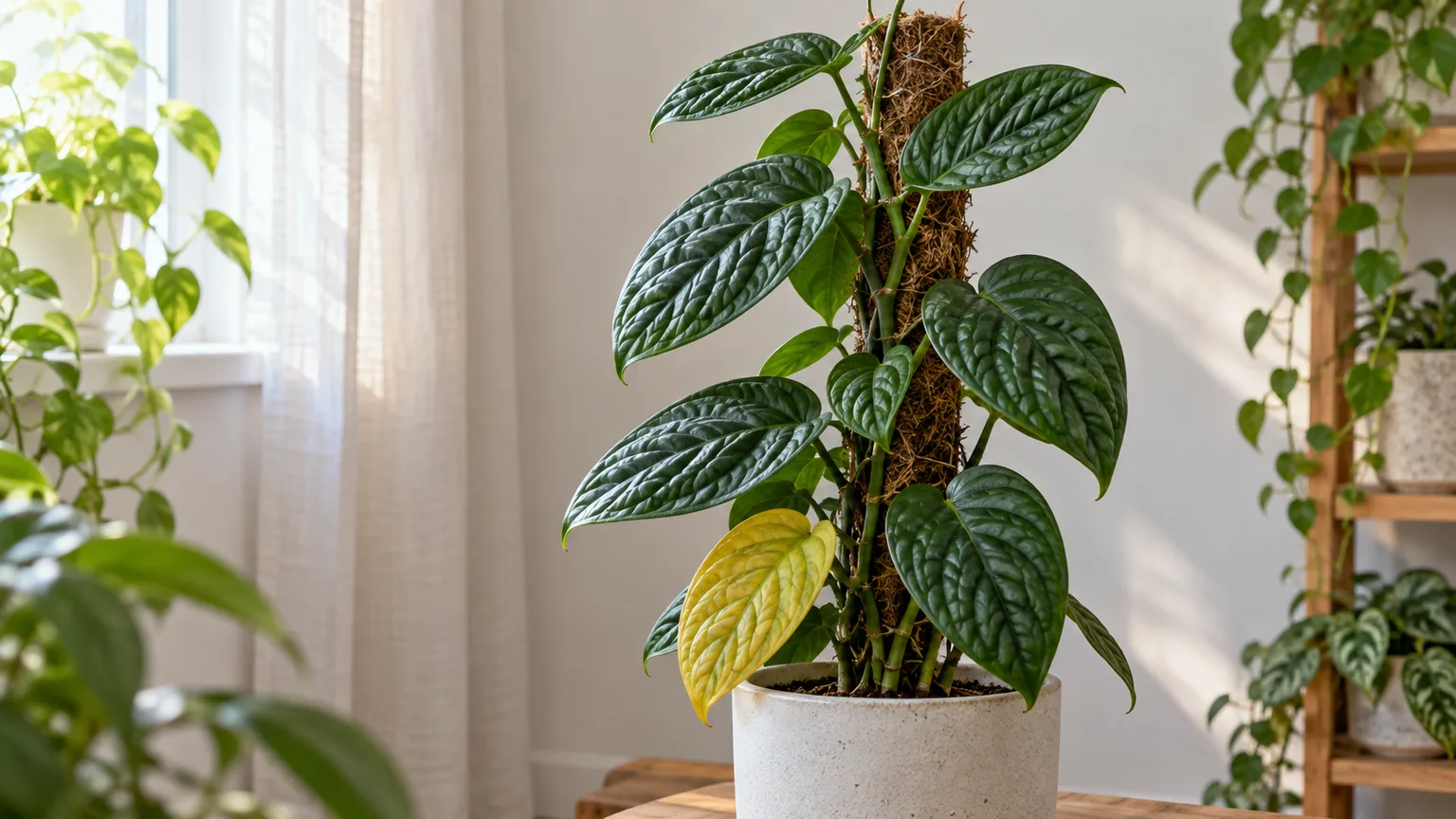
Yellow Leaves on Monstera Peru: Causes, Checks & Fixes
This guide covers yellow leaves on Monstera Peru. See also the general Yellow Leaves guide, watering, and light pages for this plant.
Yellow Leaves on Monstera Peru: Causes, Checks & Fixes
Quick answer
When a Monstera Peru leaf turns yellow, first check its position on the vine and the moisture deeper in the pot. One oldest lower leaf changing slowly while the climbing tip keeps making firm, puckered leaves can be ordinary aging. Several yellow leaves, a stalled tip, or a yellow leaf paired with a pot that stays heavy makes a root-zone problem more likely. Do not respond to yellow by automatically adding water or fertilizer.
Lift the pot, compare its weight with how it feels just after watering, and push a clean wooden skewer into the mix near the middle of the root ball. If the skewer comes out cool or damp, wait before watering and reassess the mix and light. If it comes out clean and the pot is light through most of its depth, water thoroughly and let it drain. This check is more useful for this compact climber than a calendar, since a board-mounted nursery pot and a deeper moss-pole pot dry at different rates.
For the broad symptom mechanics, use the general yellow-leaves guide; this page narrows the checks to the thick, quilted leaves, climbing nodes, and small root zone of Monstera Peru.
What yellow leaves look like on Monstera Peru
The plant sold as Monstera Peru has dark, thick leaves with a deeply puckered surface. A normally green leaf can lose its rich color gradually and become pale green or yellow; the change may be easiest to see across the broad raised folds, where natural ridges and shadows can otherwise look like discoloration. A uniformly yellow older leaf is different from isolated tan patches, crisp margins, or a pale area only on the window-facing side. Note whether the whole blade is changing or whether the color shift follows one edge, vein, or patch.
Look at the entire vine before diagnosing one leaf. Record whether yellowing starts at the base, appears on several leaves at once, or shows up in the newest leaf near the growing tip. Check whether new growth is still firm and unfolding, whether the stem at each affected node feels solid, and whether a fresh yellow leaf follows a recent move, watering change, or repotting. The extension references cited here discuss Monstera or Monstera deliciosa generally; none is a direct care trial of the plant sold as Peru, so treat their advice as comparison points rather than fixed species rules.
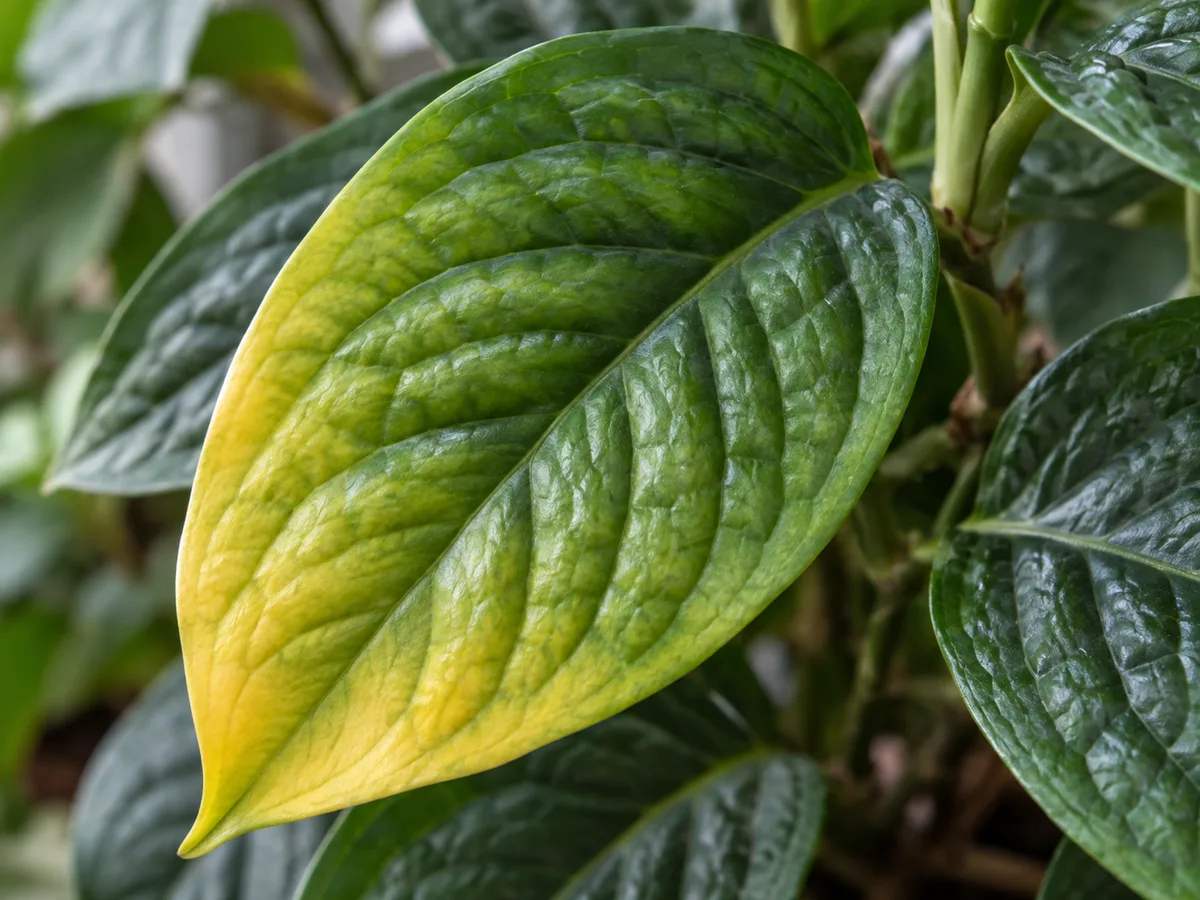
A yellowing lower leaf is a clue, not a diagnosis: compare its position and texture with the rest of the climbing stem.
Why this puckered-leaf climber can yellow
Yellow color by itself does not identify the cause. On Monstera Peru, root-zone moisture is a high-priority check because its small pot or shallow mount may stay damp longer than the exposed surface suggests, especially in dim light or a dense mix. Penn State advises letting the top one to two inches dry between waterings and warns that overwatering can lead to root rot in Monstera houseplants (Penn State Extension’s Monstera guidance). NC State Extension’s Monstera profile describes indirect light and drying part of the mix before another soak. These are Monstera-level guideposts, not an exact watering formula for Peru.
Light can contribute in two opposite ways. A dim corner can slow growth and slow the pot’s dry-down, leaving a grower watering on the old schedule even as the plant uses less water. A sudden beam of hot direct sun may instead bleach or scorch exposed tissue; that damage tends to follow the exposed side rather than appear as several uniformly yellow lower leaves. A change in placement is especially relevant if the vine is trained vertically, because its tip may sit much closer to a window or grow light than the pot.
Pests, a recent root disturbance, or ordinary aging are other possibilities, but look for confirming evidence. Inspect the undersides and corrugations of leaves, petiole joints, and stem nodes for visible insects, fine webbing, or sticky residue. A single old leaf near the bottom can age while the plant grows; the RHS describes how older shaded leaves break down chlorophyll as part of general plant aging, and Bloomscape’s Monstera yellowing guide likewise treats isolated older lower leaves beside new growth as a different pattern from broad decline.
Read yellowing from the lower nodes to the Peru growing tip
The location of the affected leaf helps narrow the next check. Peru is often trained to climb on a plank or pole, so read the vine from its oldest lower nodes up to the active tip instead of treating every leaf as an interchangeable rosette. The following patterns are clues; confirm them against pot moisture, recent care, and the condition of new growth.
| Pattern on the vine | What it suggests | What to check next |
|---|---|---|
| One oldest lower leaf yellows gradually; the tip remains firm and active | Possible normal aging, especially if no other leaves are changing | Watch the next leaf and check that the root ball is not staying wet |
| Several lower leaves yellow while the pot stays heavy | Excess moisture, slow dry-down, or root trouble moves higher on the list | Check drainage holes, mix depth, pot size, and the last watering |
| A leaf yellows after the pot has become very light and dry | Drought stress or uneven wetting is possible | Test the center and back of the root ball, not just the exposed surface |
| New leaves are smaller, paler, or the internodes lengthen as older leaves fade | The growing tip may be short of usable light or the roots may be impaired | Check leaf-height light and whether the pot dries normally |
| Pale, dry patches face a window or lamp | Direct light or heat may be damaging exposed tissue | Check leaf temperature and the direction of the light beam |
| Yellowing comes with visible insects, fine webbing, or sticky marks | Pest activity needs confirmation | Inspect leaf undersides, folded growth, petiole joints, and nodes |
This routing prevents a common mistake: treating a drooping or yellow leaf as proof of thirst. If yellowing accompanies soft growth or the mix is wet at depth, consult the plant-specific overwatering guide; if the mix is dry through most of the pot, compare the signs in underwatering on Monstera Peru. Use the Monstera Peru problems hub when symptoms overlap and you need to choose between separate problem pages.
Check the root zone without unpotting first
Start with the container. Lift it, check whether it has open drainage holes, and remove any standing water from an outer pot or saucer. Push a skewer into the middle of the mix rather than stopping at the dry-looking surface. On a moss board, test the potting mix behind the stem as well as the exposed front; on a deeper pole pot, check more than one depth. The outer edge of either setup can feel dry while the center remains damp.
The potting mix should eventually release excess water rather than remain saturated. UF/IFAS notes that Monstera does not tolerate excessively wet soil, and its landscape guidance links too much water applied too often with root rot. That source discusses Monstera in Florida landscape conditions rather than indoor Peru, so use the point narrowly: persistent wetness is a reason to investigate drainage and watering, not proof that every yellow leaf is root rot. The Monstera Peru soil guide explains the site’s loose, chunky mix target.
Unpot only when the moisture pattern and visible decline justify it: for example, the mix remains wet for an unusually long period, the base of the vine softens, or several leaves worsen despite withholding another soak. Slide the root ball out gently and look for roots that still feel firm versus roots that are soft and breaking down. A sour smell or a mushy stem base adds concern. If roots and stem are firm and the pot drains freely, return the plant without disturbing the root ball and continue the lower-stress checks first.
Make one correction that matches what you confirmed
If the root ball is still damp
Do not add water to treat yellow color. Wait until the mix reaches its usual dry-down point, then reassess how quickly the pot loses weight. Check whether the pot sits inside a cachepot holding runoff, whether the holes are blocked, and whether a dense or oversized mix-and-pot combination is keeping the center wet. A move to brighter filtered light can help normalize the plant’s conditions, but do not move it directly into several hours of harsh sun.
If the stem base is firm and the pot is drying, do not immediately repot just because one leaf is yellow. If the base is soft or the roots are breaking down, remove only damaged roots with a clean blade and use fresh, airy mix in a pot with working drainage. Keep the support stable while the plant settles; avoid twisting the climbing stem or burying its nodes deeper in wet mix. For clear root decay and progressive decline, follow the more detailed Monstera Peru root-rot guide.
Excess moisture does not have to look like a puddle. Wisconsin Horticulture Extension reports that Monstera leaves may “sweat” when the growing medium is too moist and recommends reducing watering to help prevent root rot. Its article concerns M. deliciosa, so this is a general Monstera clue, not a diagnostic test for Peru. On a Peru vine, use it as another reason to check the pot before adding water.
If the root ball is dry through most of the pot
Water the mix evenly until water drains from the bottom, then empty the saucer and cachepot. If water runs around a shrunken root ball without wetting it, apply water in two slow passes a few minutes apart rather than leaving the pot submerged for hours. Confirm the center is damp afterward. Then wait for the next dry-down instead of repeating a small splash each day.
Do not judge success by whether the yellow leaf darkens. A badly yellowed blade may remain yellow even after the plant has enough water. The better signs are that the stem stays firm, no additional leaves yellow, and the next new leaf unfolds without shriveling or stalling.
If light or heat fits the pattern
When the newest growth is long and undersized, or the pot remains damp in a dark spot, move the growing tip toward bright filtered light in a gradual step. Check where the upper leaves sit, not just the planter. Use a sheer curtain or move the plant back if a direct beam leaves the foliage hot or pale. The Monstera Peru light guide covers placement and seasonal adjustment; its advice is aimed at the trade plant’s compact, puckered display growth.
Avoid changing location, potting mix, and watering routine all on the same day. Make the light change, then continue checking the mix as the new position changes dry-down. If lower leaves keep yellowing while the tip lengthens, compare the pattern with not enough light on Monstera Peru rather than increasing fertilizer to force growth.
If insects are present
First isolate the plant from nearby houseplants and inspect the full vine, especially the underside of each puckered leaf and the protected joints where a leaf stalk meets the stem. Remove visible insects with a damp cloth or rinse foliage where the pot can drain safely. Reinspect after several days; one pass may miss insects tucked into folds. Use a pesticide or soap only when you have identified an active pest, and follow its label on a small test area because the leaf folds may hold moisture and residues.
Monstera guidance lists common indoor pests such as spider mites, mealybugs, aphids, and scale, but that list does not confirm that yellowing is caused by pests. If you see fine webbing or stippled damage, use the Monstera Peru spider-mites guide to confirm the pest before choosing treatment. Do not spray a plant solely because one old leaf has turned yellow.
Keep Peru’s climbing support from confusing the diagnosis
The vertical support changes what a quick inspection reveals. On a board-mounted plant, the leaf surface and upper stems can look dry while mix pressed against the mount stays damp. On a moss pole, moisture in the support and moisture in the inner pot are separate things: a dry pole does not prove the root ball needs water, and a wet pole does not prove the pot is still wet. Test the potting mix itself before changing the watering schedule.
Check where yellowing sits relative to the nodes. A leaf that is aging at the oldest node while the next leaves are firm is a different picture from a yellowing tip or a stem that has become soft near the soil line. Avoid pulling aerial roots free from the support just to inspect them. They help anchor the vine, while the potting-root zone is the place to assess first for moisture-related decline.
Do not mistake Peru’s normal puckered texture for a symptom: the deep ridges are part of its appearance. Look for a change from the plant’s own baseline: fading across the blade, a new yellow band, a change in firmness, or several leaves changing at once. A photograph taken in similar light every week can help distinguish a color shift from shadows between the raised folds.
Recovery: what can improve and what cannot
Once the cause is corrected, judge progress by the part of the plant still growing. A yellow leaf will often stay yellow or eventually dry and detach; it is not a reliable recovery gauge. Healthy signs are that the growing tip remains firm, the next leaf unfurls normally, existing yellowing stops spreading, and the pot begins to dry between waterings at a repeatable pace.
Do not remove every yellowing leaf immediately. Leave a leaf that is partly green and still firm while you correct the cause; the plant can continue using its remaining healthy tissue. Once it is fully yellow, dry, or loose, remove it with clean scissors at the petiole base without cutting into the stem or node. Removing a few damaged leaves does not fix wet roots, poor light, or pests, so do not use pruning as the main treatment.
After root disturbance, the climbing tip may pause while the plant re-establishes. Keep conditions steady and avoid fertilizer until the root zone is functioning and fresh growth resumes. Recovery speed varies with season, light, temperature, remaining roots, and how much of the vine is affected; a Peru in winter or a very dim room may not show a new leaf quickly. If the yellowing continues to climb the vine, the stem softens, or the root ball remains wet, reassess rather than waiting on a calendar.
Mistakes that make Monstera Peru yellowing harder to read
- Watering because the leaf is yellow. Yellowing does not tell you whether the pot is dry. Check the center and pot weight first.
- Adding fertilizer before checking roots. Fertilizer cannot correct a wet mix, root injury, or low light. Do not treat a single yellow blade as a nutrient diagnosis.
- Repotting every plant with one yellow leaf. Repotting disturbs roots. Reserve it for a failing mix, blocked drainage, or evidence of root decline.
- Moving a dim plant into direct afternoon sun. Increase light gradually and filter direct beams while the leaves acclimate.
- Removing the green leaves and tip. Peru needs healthy foliage and an intact growing point to continue its climbing growth; trim only tissue that is fully spent or diseased.
- Changing several conditions together. If watering, light, mix, and fertilizer all change at once, it becomes difficult to identify which correction helped.
Prevent yellow leaves without keeping a fixed schedule
Place the growing tip where it receives bright filtered light. Check the plant again when seasons change, because a winter window may provide less usable light or a different direct-sun path than it did in summer. If the vine is trained up a plank or pole, make sure the upper leaves do not sit in a hotter beam than the lower leaves.
Use a container with open drainage and a mix that lets excess water pass through. Keep the pot size close to the root ball instead of moving it into a much larger container simply to make the support more stable. Learn how the full pot feels just after watering, then check it every few days until you know its dry-down pace. The site Monstera Peru watering guide describes the finger, skewer, and pot-weight checks; treat its interval examples as observations, not a schedule every plant must follow.
Inspect the leaves and nodes when you water. Look for gradual color change on the oldest leaves, fresh growth at the tip, pests along the puckered folds, and any soft or wet area around the stem base. Wipe dust gently with a damp cloth rather than leaving standing water pooled in the ridges. A quick look at the undersides is also a chance to catch pests before multiple leaves are affected.
Keep notes when yellowing first appears: which leaf and node changed, whether the mix was damp or dry, recent watering, where the plant sat, and whether new growth was active. This short record prevents repeated emergency changes based on color alone. If the same leaf continues to yellow but the rest of the vine remains stable, treat it differently from a pattern that spreads to new nodes.
When to use this page vs other Monstera Peru guides
Use this guide when the main question is why one or more leaves have lost color. If the pot is wet and heavy, continue with overwatering or root rot based on the root and stem evidence. If the plant is limp in dry mix, use underwatering. If only the newest growth is stretched or small, use the low-light guide; if you have found insects, follow the matching pest page.
Related Monstera Peru guides
- Monstera Peru overview — use for plant identity, trade-name context, and the full care picture.
- Monstera Peru problems hub — use when yellowing appears alongside another symptom and you need to route the diagnosis.
- Monstera Peru watering — use for dry-down checks and watering after the pot’s light or support changes.
- Monstera Peru soil — use when the mix stays wet or drains poorly.
- Monstera Peru light — use when the vine is stretching, pale, or exposed to direct sun.
Related tool
Use the Plant Problem Diagnosis Tool with Monstera Peru selected to compare the leaf pattern and recent care checks before making another change.