Monstera Peru Drooping Leaves: What to Check First
Quick answer
First check the Monstera Peru's potting mix 3–5 cm below the surface and compare the pot's weight. A dry, light root ball points to thirst; a wet, heavy one can mean stressed roots, so do not add water until you know which pattern fits.
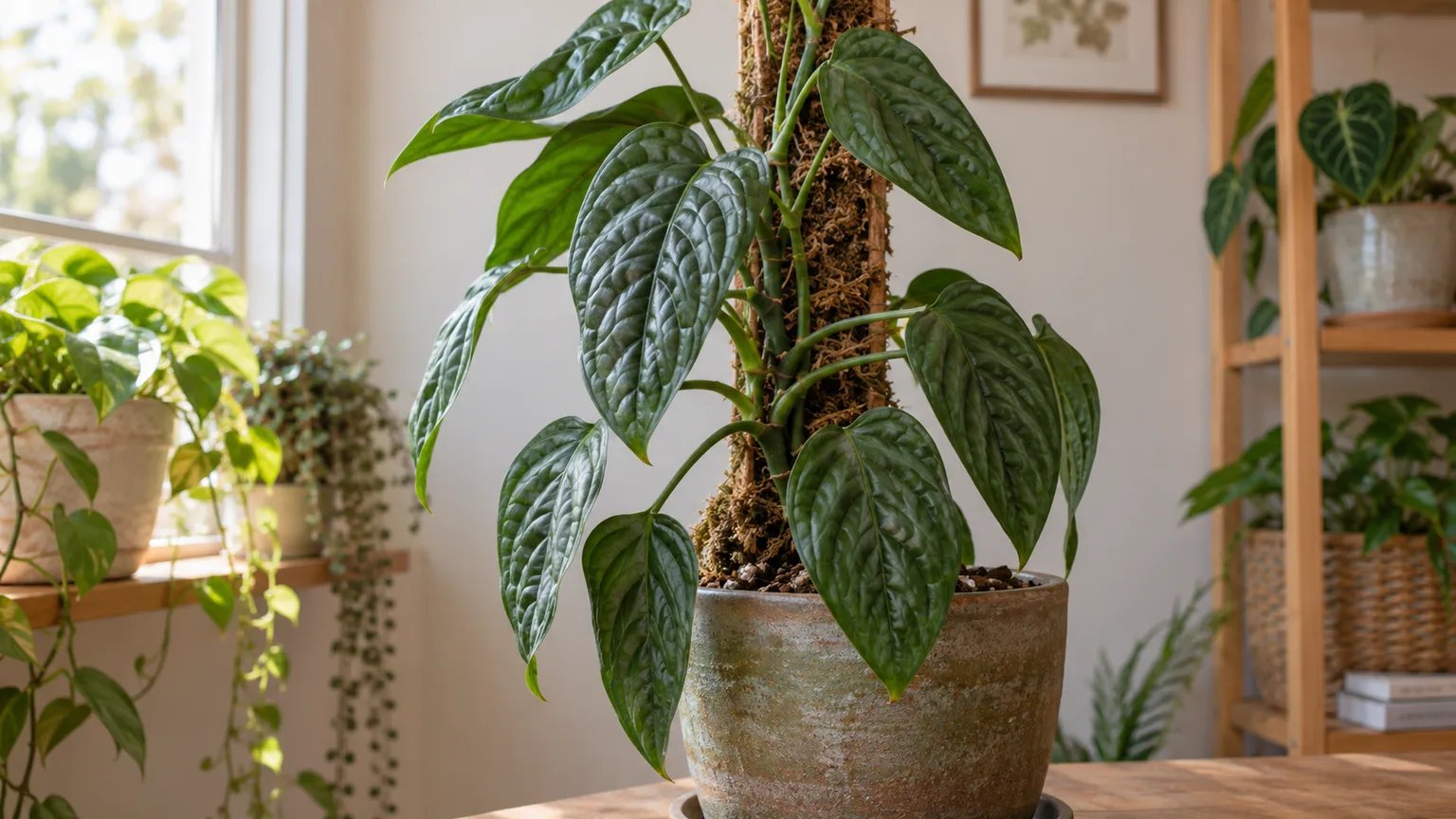
Drooping Leaves on Monstera Peru: Causes, Checks & Fixes
This guide covers drooping leaves on Monstera Peru. See also the general Drooping Leaves guide, watering, and light pages for this plant.
Drooping Leaves on Monstera Peru: Causes, Checks & Fixes
Quick answer
First check the potting mix about 3–5 cm below the surface and lift the pot before you water. If the root ball is dry and the pot feels light, water thoroughly and let excess drain; if the mix is wet and the pot is heavy, pause watering and look for slow drainage or root damage. Drooping leaves alone cannot tell you which of those opposite fixes is right.
Monstera Peru is the familiar trade name for a compact climbing aroid with thick, puckered leaves, as shown in Brittany Goldwyn’s Peru care guide. Its root ball should dry in a steady pattern: the top layer dries first, but the center should not stay cold and saturated for days. For the plant’s broader placement and support needs, start with the Monstera Peru overview. For general symptom mechanics across houseplants, see the drooping leaves guide; the checks below apply that wider diagnosis to this vine and its potting mix.
What drooping leaves look like on Monstera Peru
A true droop is a change from the plant’s usual shape: leaf stalks soften or angle down, several leaves hang lower at once, and the newest growth may fail to hold its normal position. A single leaf pointing toward a window, or a long vine leaning away from its support, is weaker evidence. Monstera Peru’s thick, deeply veined leaves have visual weight, so a trailing stem can look low without the whole plant being dehydrated.
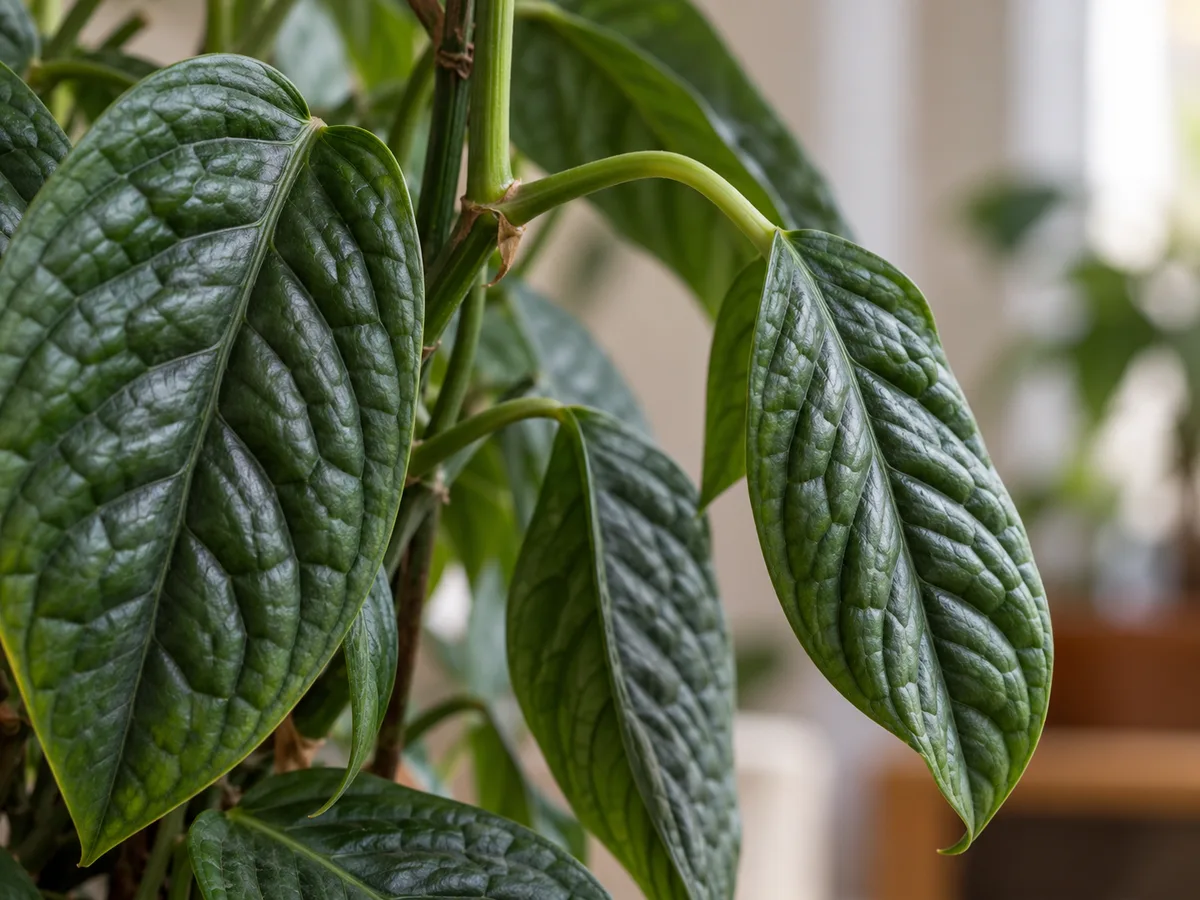
The puckered leaves can hang from either a thirsty root ball or stressed roots in wet mix; check the pot before changing care.
Look at the whole vine rather than judging one blade. If the leaves are still firm, the stem at each node feels solid, and the plant has recently been allowed to trail, support or orientation may explain the shape. If several petioles feel limp and the newest leaf is also losing firmness, treat it as a plant-wide water or environmental problem. In this guide, “drooping” means a new loss of firmness, not simply the naturally pendant outline of an unsupported climbing stem.
Read the root zone before watering
Monstera Peru can droop when its roots cannot supply enough water to the leaves, whether the mix is too dry or has stayed wet long enough to injure roots. Clemson Extension notes that underwatering and overwatering can produce similar wilt because damaged roots may not take up water; it cautions that watering a plant with root injury can make the problem worse (Clemson Extension’s indoor-plant watering guidance). That is why the first action is a moisture check, not a watering can.
Check the pot in this order:
- Push a finger or an untreated wooden skewer into the mix about 3–5 cm, away from the stem. The surface can look dry while the center is still damp, especially in a deep nursery pot.
- Lift the pot and compare its weight with how it feels after a full watering has drained. A clear change in weight is useful when bark and perlite make the surface look dry quickly.
- Check the drainage holes and saucer. The pot should be able to drain freely, and its base should not sit in runoff.
- Note the smell and texture at the holes. Fresh, earthy mix is different from sour-smelling, persistently wet mix; do not unpot solely because one leaf hangs low.
For Monstera Peru, the care starting point is to let the upper 3–5 cm dry before watering, then water through and allow the pot to drain. A named horticulture writer’s Monstera Peru care guide also stresses checking the top couple of inches and using soil that drains well. The exact interval changes with pot size, mix, season, and the light reaching the leaves, so the plant’s watering guide is a better reference than a fixed seven- or ten-day reminder.
| Pattern | What it suggests | What to do next |
|---|---|---|
| Limp leaves, dry mix below the surface, light pot | The root ball may be too dry | Water evenly once and let it drain |
| Limp leaves, wet mix, and a heavy pot | Roots may be oxygen-starved or damaged | Stop adding water and inspect drainage; check roots if decline continues |
| Droop began after a move, cold night, or hot window | Temperature or light shock is possible | Return to stable bright indirect light and observe before changing watering |
| One trailing section leans, but leaves and stems stay firm | Vine position or weak support may be contributing | Check how the stem is attached before treating it as wilt |
Why a dry Monstera Peru root ball can cause drooping
A Peru in a small pot, a warm bright spot, or a loose bark-heavy mix may dry sooner than the same plant in a larger plastic pot under weaker winter light. The top can become dry before the center of the root ball, so test below the surface instead of watering whenever the bark on top looks pale. If the skewer comes out nearly clean and the pot feels much lighter, thirst is a reasonable diagnosis; a dry outer layer by itself is not.
Very dry peat-based nursery mix can also pull away from the pot or let water run down the sides without wetting the center. Water slowly across the surface, pause, and repeat so the root ball absorbs moisture rather than sending the first pour straight through. If water still channels past an extremely dry core, a short bottom soak can help rewet it; then lift the pot out and let it drain completely. Bloomscape’s Monstera troubleshooting page describes limp, drooping leaves after the mix dries through and recommends rewetting the full root ball rather than giving a small splash (Bloomscape’s drooping-Monstera guidance).
Once the pot is evenly moist, do not water again until the upper layer has dried to the Peru’s normal checkpoint. A rescue watering should restore moisture, not turn the mix into a reservoir. If the plant perks up but the same pot becomes bone-dry again unusually quickly, check whether roots fill most of the container or whether water is bypassing the center. The Monstera Peru soil guide explains the role of a chunky, airy blend; changing the blend is a later fix for repeated dry-down problems, not the first move during a single afternoon of droop.
When wet mix points to root stress
A wet, heavy pot changes the diagnosis. Roots need both water and air around them; in saturated mix, uptake can fall even though the plant is surrounded by water. In a Monstera Peru, this pattern is more plausible when the pot lacks drainage, the mix is dense, runoff remains in a cachepot, or the plant receives less light than before. Clemson Extension explains that waterlogged roots can rot and that root injury can make foliage wilt despite wet soil (Clemson’s root-and-wilting explanation).
Do not water a wet Peru to “push” water through the soil. Empty collected runoff, keep the plant in steady bright indirect light, and allow the mix to dry toward its normal range. Look for a cluster of warning signs before disturbing the root ball: a pot that remains heavy for many days, soft stem tissue near the soil line, or progressive yellowing alongside droop. A single yellow lower leaf or one tired petiole does not prove rot.
If those warning signs cluster, slide the plant from its pot and inspect the roots. Root appearance varies by host and pathogen, so color alone is not a diagnosis, but a UC ANR root-rot guide contrasts healthy pale feeder roots with darkened infected roots. On your Peru, check whether suspect sections are also soft or coming apart; trim only tissue that is clearly mushy, using clean snips, and move the plant into fresh, airy mix in a pot with open drainage. Keep the new pot close to the size of the remaining root system; excess unused soil holds moisture around the roots for longer. If you have confirmed soft, dark roots, the plant-specific Monstera Peru root-rot guide covers that more focused rescue.
A very large moss pole or support can confuse the moisture check: the pole may feel damp while the potting mix is dry, or the pot can remain wet while the pole surface dries. Test the container’s mix separately. If your plant is trained to a pole, avoid saturating the pole and pot repeatedly just because one surface feels dry; use the Peru’s pot and root ball as the watering gauge.
Light, heat, and cold can change the pattern
Monstera Peru grows best with bright indirect light. A sudden move into strong midday sun against hot glass can increase stress on leaves, while a cold window or air-conditioning draft can make a tropical climbing aroid lose firmness without a recent watering change. Penn State Extension recommends bright light without direct sun for Monstera houseplants and warns against cold drafts (Penn State Extension’s Monstera guidance); Brittany Goldwyn’s Peru-specific care notes likewise favor bright, indirect light and caution against sudden temperature swings (Monstera Peru light and temperature notes).
Think about what changed in the day or two before the droop: a plant moved beside a radiator, a sunbeam reaching through glass, an open window on a cold night, or a new grow light placed very close to the leaves. If the soil is still moderately moist and the pot is not abnormally heavy, correct the placement first. Return the plant to a stable bright spot with filtered light; do not move it repeatedly from shade to sun while trying to find a fast cure. Use the Monstera Peru light guide to choose a lasting position.
Low light usually changes the pace of the problem rather than making a single dramatic droop by itself. In a dim corner, the mix dries more slowly and the vine may stretch toward the nearest window. Continuing the old summer watering rhythm in winter can then leave the root ball wet for too long. Reduce watering only after checking the actual mix, and improve light gradually so the leaves acclimate rather than receiving a sudden blast of direct sun.
Separate a trailing vine from a wilted vine
Monstera Peru is grown as a climbing or trailing plant. An unsupported stem may arc out from the pot, and leaves on the outer part of a vine can sit lower than foliage held against a board or pole. That silhouette alone is not the same as collapsed turgor. Compare the current shape with the plant’s own recent posture: are the leaf blades still thick and firm, are the nodes solid, and is new growth continuing to open?
If the stem is firm but the whole vine is leaning, give it a stable support and tie the stem loosely at a node. Do not pull petioles upright or bind leaf stalks tightly; they need to move as the plant grows. Support can correct a mechanical lean, but it cannot repair roots that are too dry or damaged by wet mix. The plant’s overview explains how climbing support fits this growth habit.
A new leaf that is still unfurling may also hang lower for a short time than mature leaves. Do not force it open, bend its petiole, or mistake a single developing leaf for a whole-plant watering emergency. Wait for that leaf to open while checking the rest of the vine and the pot. If the older leaves are firm and the mix is in its normal dry-down range, leave the plant stable instead of changing several conditions at once.
Choose one first correction, then reassess
After checking the root ball, choose the response that matches the evidence. Do one correction first so the plant’s reaction remains readable.
- Dry through the root zone: water slowly until runoff appears, then let the pot drain fully. If the mix repels water, rewet it in two passes or use a brief bottom soak; do not leave the pot standing in water.
- Wet and heavy, but no root warning signs: pause watering and keep the pot draining in bright indirect light. Recheck the mix rather than scheduling the next watering by date.
- Wet with sour odor, soft roots, or stem-base decline: inspect the root system and replace failing mix only if the plant shows those combined signs. This is when repotting is justified; routine droop alone is not a reason to disturb a healthy root ball.
- Moisture appears normal, but the droop followed a heat or cold change: move the plant away from the extreme and hold it in one stable, filtered-light location.
- Leaves and nodes are firm but the stem is hanging: improve support without changing water or soil.
Avoid adding fertilizer, pruning healthy leaves, raising humidity, and repotting all at once. Those actions make it harder to tell whether the original problem was drought, waterlogged roots, or a sudden location change. Hold fertilizer while the plant is actively declining; it will not repair a damaged root system. Remove a leaf only when it is mostly dead or has collapsed, and keep the cut away from the vine’s node if the stem is still healthy.
If root loss is extensive but one section of vine is still firm, Monstera Peru may be salvageable from a node-bearing cutting. Take a healthy section only after confirming which tissue is sound, and root it separately in a clean, airy medium. Brittany Goldwyn’s Peru guide describes stem cuttings with several visible nodes as a propagation route (Monstera Peru cutting guidance); treat this as a backup when the original root system is failing, not as a routine response to a few drooping leaves.
What recovery looks like
A thirsty plant with intact roots may regain some firmness after the root ball is thoroughly rewetted and allowed to drain. If the leaves remain slack, do not keep watering in search of a faster response; reassess whether the center actually became moist and whether the plant was recently exposed to heat or cold. Root damage takes longer to resolve because the plant must stabilize and replace roots before it can support the foliage consistently.
An old leaf that has creased, yellowed, or dried at the edge may not return to its former shape. Track recovery by the whole plant: the decline stops, stems stay firm, the mix returns to a predictable dry-down, and any new leaf opens without immediately hanging limp. A small number of old leaves can be lost even after the cause is corrected. If several leaves collapse in sequence, or the stem base becomes soft, return to the wet-root checks rather than waiting for a new leaf to judge the problem.
For a recently repotted Peru, avoid another repot unless the mix is failing or roots are clearly rotting. Keep the plant in steady light and check the mix before watering while it stabilizes. The Monstera Peru repotting guide can help you decide whether the pot or mix needs a planned change after the plant has stabilized.
Avoid the fixes that can deepen the droop
The most costly mistake is assuming every limp leaf means thirst. That response can prolong root injury if the pot is already wet. The opposite mistake is withholding water from a genuinely dry root ball because the plant was watered “recently”; a warm room, small pot, or active climbing vine can change how quickly the mix dries. Read the actual pot, not your calendar.
Do not use misting as a substitute for correcting root moisture. A spray on the leaf surface does not wet a dry center or restore roots in soggy mix. Do not move the plant to full sun to “dry the soil faster,” either; the leaves can overheat while the root problem remains. Avoid packing fresh soil tightly around roots or choosing a much larger container during an emergency. The goal is an even, airy root zone and one stable environment, not a collection of quick fixes.
Do not prune a still-green drooping leaf simply because it looks untidy. If the root system is sound, that leaf may partly recover; if it does not, wait until the condition is clear and remove only the tissue that has died. On a climbing Peru, preserving healthy nodes matters because they carry the vine’s next point of growth and a possible cutting if the roots later fail.
Prevent another droop on this climbing aroid
Use the upper 3–5 cm of mix as a starting checkpoint, then consider pot weight and season. In brighter, warmer months the Peru may dry sooner; in cool, low-light periods it can stay wet longer. Clemson Extension’s watering guidance explains why no single interval fits every indoor plant: species, growth stage, pot dimensions, mix, and location all affect the schedule. For the Peru, keep the mix chunky and draining, use a pot with holes, and empty runoff rather than leaving it in a cachepot.
Keep the vine in bright filtered light and attach it to a support before it becomes a long, unsupported trail. A board, plank, or pole can help the stem grow in a controlled direction, but the potting mix remains the indicator for when to water. If you change the plant’s position, support, or container, make one planned change and then observe how quickly the root ball dries. Return to a chunky, draining mix and the usual upper-layer dry-down once the plant has stabilized.
The textured leaves can collect dust in their puckers. Wipe them gently with a soft damp cloth when needed so the surface remains easy to inspect; avoid bending the leaf stalk while cleaning. A weekly visual check is enough to catch sagging stems, dry potting mix, or water left in the saucer before the whole vine loses firmness. Keep care steady, especially during seasonal changes when indoor light and evaporation shift.
When to use this page vs other Monstera Peru guides
Use this guide when the main change is that previously firm leaves or petioles have begun to hang, and you need to decide whether the pot is too dry, too wet, or the vine is reacting to its location. If the mix is clearly dry and watering is the issue, follow the focused Monstera Peru underwatering guide. If the mix stays wet and roots are soft or dark, use the root-rot guide; the overwatering guide is for an ongoing excess-watering pattern before or alongside root damage.
If the leaves are losing firmness without a clear dry or wet pattern, compare the broader Monstera Peru wilting guide. The Monstera Peru problems hub links to the plant’s other diagnoses when droop is only one part of a broader decline.
Related Monstera Peru guides
- For routine watering timing and dry-down, use the Monstera Peru watering guide.
- For dense or slow-drying mix, compare the Monstera Peru soil guide.
- For a persistent low-light setup or a sun-exposed window, see the Monstera Peru light guide.
- For overall plant placement, support, and care context, return to the Monstera Peru overview.
Related tool
Use the Plant Problem Diagnosis Tool to compare the moisture, light, and recent-change clues before correcting drooping on this plant.