Leggy Growth on Monstera Peru: Causes, Checks & Fixes
Quick answer
Leggy Monstera Peru usually means new stems are stretching toward light, although an unsupported vine can look sparse. First move it to brighter indirect light, then judge the next leaves before pruning.
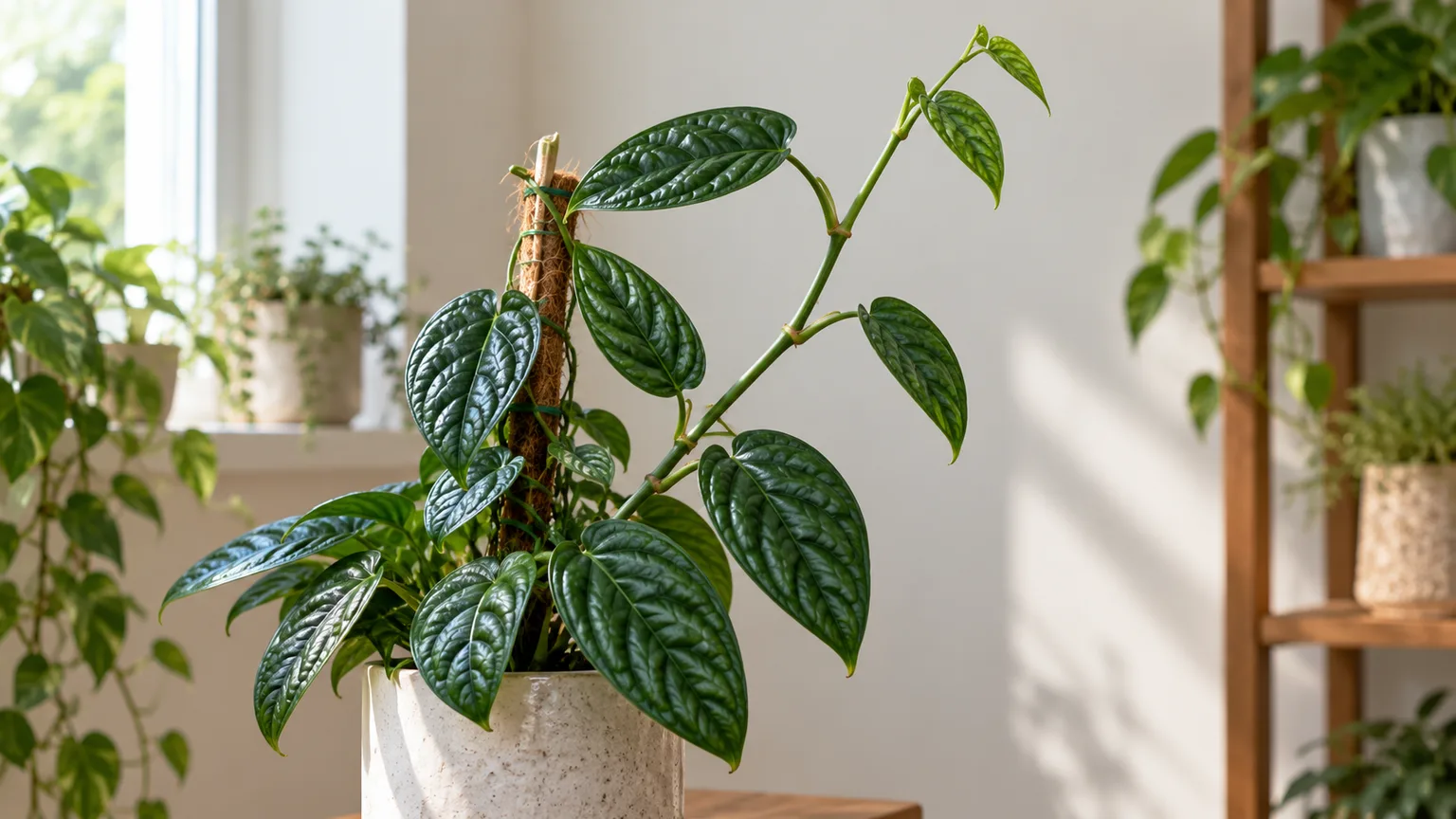
Leggy Growth on Monstera Peru: Causes, Checks & Fixes
This guide covers leggy growth on Monstera Peru. See also the general Leggy Growth guide, watering, and light pages for this plant.
Leggy Growth on Monstera Peru: Causes, Checks & Fixes
Quick answer
First, move a Monstera Peru that is stretching into a brighter indirect-light position. Make that one change and leave pruning, fertilizer, and repotting for later. Legginess is most often a light problem: the newest vine sections lengthen, the leaves sit farther apart, and the growth may point toward the nearest window. A long unsupported vine is a lookalike, though, so check the latest growth before cutting.
Monstera Peru is a climbing aroid grown for its deeply veined, leathery leaves. Compare it with its own older leaves rather than judging it against a larger split-leaf Monstera. For broader identification and everyday care, start with the Monstera Peru overview; this guide focuses on a vine whose new growth is becoming unusually stretched.
What leggy growth looks like on Monstera Peru
Look at the stem between leaf attachments, not only at the overall length of the plant. Those bare sections are internodes. On a leggy Peru, the newest internodes are noticeably longer than the older ones, and the newest leaves may be smaller or less substantial than the plant’s established quilted leaves. The Spruce notes that less light can produce smaller, less showy leaves on Monstera deliciosa; treat that as related-genus context, not as proof for Monstera Peru. The vine may lean or turn toward a window instead of growing evenly.
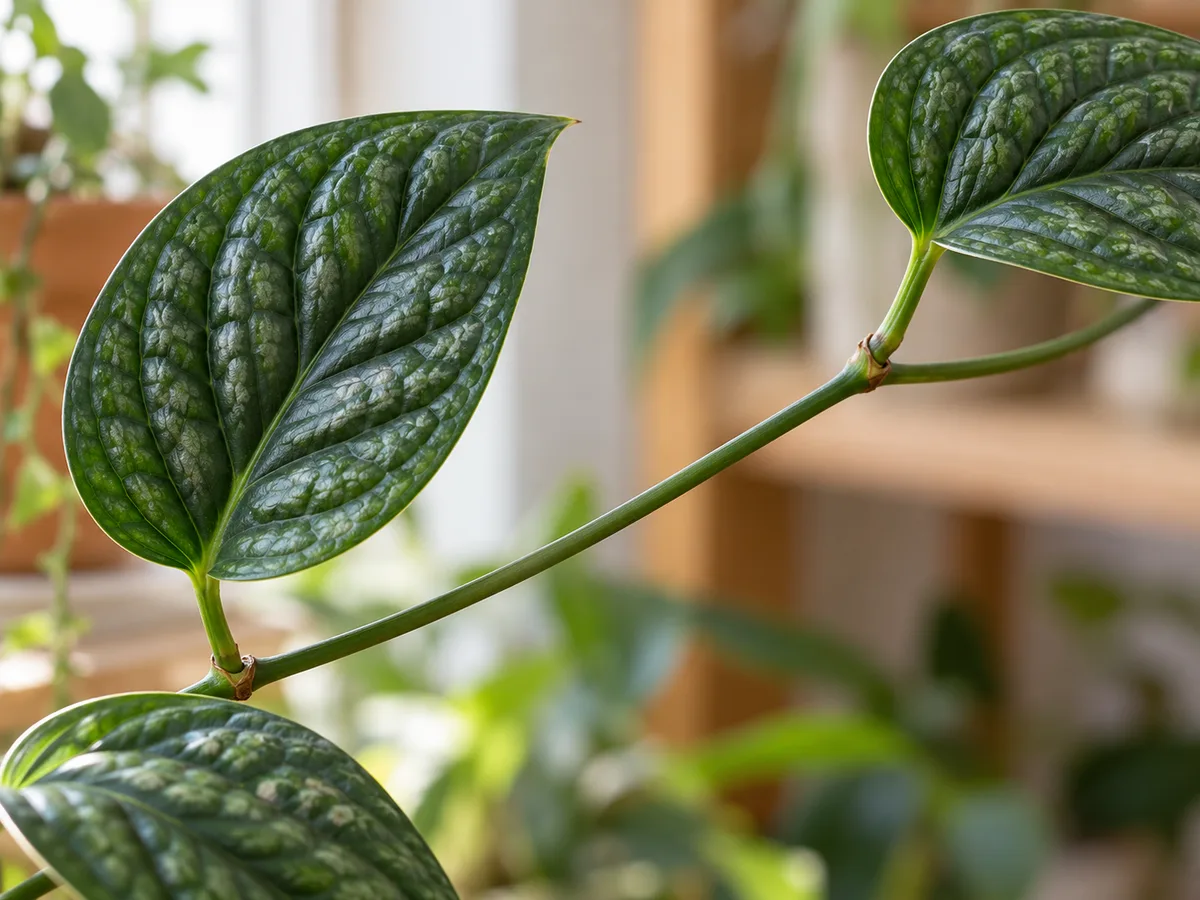
Long gaps between otherwise healthy quilted leaves can point to stretching; compare the newest spacing with the older sections of the same Monstera Peru.
A long stem by itself is not enough to diagnose a problem. Monstera Peru is a climber, and a vine that has been allowed to trail can cover a surprising distance while still producing healthy, well-formed leaves. If the leaves remain firm, retain their usual thick texture, and stay similar in size, you may be looking at an unsupported growth habit rather than light starvation.
The useful comparison is the plant against itself. Choose three recent leaves and look at the length of stem between them. Then compare those gaps with three older leaves lower on the same vine. A gradual change toward longer gaps and smaller leaves is more informative than a single measurement, because normal spacing varies with the vine’s age, support, and the direction it is growing.
Why a Monstera Peru vine stretches
The newest growth is reaching for more light
Insufficient light is the leading cause to investigate when new sections are both longer and weaker. Penn State Extension says Monstera can become leggy in lower light and recommends a bright site near a sunny window without harsh direct sun; its advice is written for Monstera houseplants generally, not a Peru-specific trial. Brittany Goldwyn’s Monstera Peru guide also identifies too little light as a cause of leggy or unsightly growth on this trade plant. Taken together, the sources support light as the first variable to correct while leaving room for differences between species and individual rooms.
A low-light Peru may stay alive while making a poor display. The room can feel bright to you even when the plant sits several feet from its window, behind a wall, or below a deep shelf. A short winter day, a new curtain, a tree leafing out outside, or moving the pot to a darker corner can reduce the light reaching the actual leaves without changing anything else about your routine.
Do not diagnose by the window label alone. An east-facing window can be bright at the plant’s position, while a north-facing room with an obstruction can be dim. Watch the leaf surface during the brightest part of the day. If the plant is far from the opening, receives only a brief patch of light, or has stretched progressively since a move, light is a stronger explanation than a lack of fertilizer.
An unsupported vine can look sparse without being weak
A Peru trained upward can keep its textured leaves close to a board or pole; without a place to climb, the same vine may trail outward and appear less compact. That change in silhouette is not proof of low light. Penn State lists moss sticks, trellises, stakes, and boards as possible supports for Monstera, and NC State describes Monstera as a climbing vine that needs sturdy support to keep stems from breaking. Those are genus-level recommendations, but they fit the climbing habit growers use for Monstera Peru.
Check where the plant is growing before you change its care. A healthy trailing vine often has firm stems and leaves of consistent size. A light-starved vine tends to show the change most clearly in the newest leaves and internodes, often with the tip reaching toward a brighter direction. Support can improve the plant’s position and presentation, but it cannot fill in bare stem that has already formed.
One-sided light changes the direction, not always the whole plant
If only the side facing the window is compact, or the growing tip repeatedly bends toward a bright opening, the plant may be receiving uneven light rather than uniformly too little. Turn the pot slightly so another side faces the window over time. Do not spin a plant that is tied tightly to a board or pole; loosen and retie the vine without twisting its stem.
A sudden move from a dim room to strong afternoon sun is not the answer. Monstera Peru’s textured leaves can be damaged by intense direct exposure, especially through hot glass. Aim for a brighter filtered position, then make further changes gradually if the leaves bleach, scorch, or become unusually warm.
How to confirm the cause before changing more than one thing
Work through these checks in order. The goal is to distinguish a genuine light response from a vine that simply needs a better route upward.
- Compare recent internodes. Find the last three leaves and compare the spacing with older sections of the same stem. A clear increase near the growing tip is more useful than judging the longest old runner.
- Compare leaf size and texture. New leaves that are smaller, thinner, or less robust than earlier leaves reinforce the light-stretching diagnosis. Monstera Peru’s characteristic quilted surface is a useful reference; do not use fenestrations as a maturity test for this plant.
- Follow the direction of the vine. A tip angled toward the nearest window suggests directional light. A vine that sprawls in multiple directions but keeps producing normal leaves may mainly need support.
- Look at the actual growing position. Check whether curtains, nearby furniture, a balcony overhang, or seasonal shade blocks the leaves. Consider the position of the newest leaf, not only the pot’s distance from the window.
- Check for a separate root-zone issue. If the mix stays wet much longer than usual, do not assume it explains the longer internodes or treat it as part of the light problem. Penn State notes that overwatering can cause root rot in Monstera; use the Monstera Peru watering guide to check dry-down and the root rot guide if roots appear compromised.
- Look for evidence of a different problem. If the newest leaves are visibly damaged or the plant has active pests, follow the matching page from the Monstera Peru problems hub rather than treating a pest or damaged leaf as a light diagnosis.
A light diagnosis becomes more convincing when the new gaps, reduced leaf size, and window-facing direction appear together after the plant’s light changed. If only one clue is present, keep observing rather than treating the plant as though the cause is certain.
The first fix: give the growing tip brighter indirect light
Move the pot so bright, filtered daylight reaches the newest leaves for a larger part of the day. Penn State Extension’s Monstera guidance recommends bright light without direct sun, and The Spruce’s reviewed Monstera deliciosa guide likewise says too much shade can make a Monstera leggy. Both sources discuss other Monstera species, so use them as genus-level direction; Brittany Goldwyn’s Peru-specific guide independently points to low light as a cause of stretched growth.
If the better position is only available near a window, use a sheer curtain or place the plant back from intense midday or afternoon rays. The aim is a brighter canopy, not a dramatic jump into baking sun. If the home has no suitable window, a full-spectrum grow light can help, but follow the fixture’s own distance and schedule guidance rather than guessing a universal number. Light output differs substantially between lamps and rooms.
Give the plant time to respond. The leaves and gaps that are already on the vine formed before you moved it; the next growth is the evidence to watch. Do not add fertilizer during the same week in an attempt to make the stretched stem tighten. Feeding cannot shorten an existing internode, and adding multiple changes makes it difficult to tell whether the new placement is working.
Use the Monstera Peru light guide if you need help choosing among indoor locations. It covers the plant’s bright-filtered-light preference and how to avoid leaf damage while improving exposure.
Add climbing support after you have corrected the light
Once the plant is in better light, give the vine a stable surface if you want an upright or shingling display. A cork board, plank, moss pole, or trellis can guide the stem vertically. Penn State Extension describes several support choices for Monstera and recommends attaching the stems gently; NC State Extension also notes that sturdy support is needed for climbing stems. For this compact plant, pick a support that fits the pot and can hold the vine without bending it sharply.
Fasten the stem loosely with soft ties. Attach the vine near a node or along a strong section, leaving room for the stem to thicken. Keep leaves facing the light and do not cinch petioles or aerial roots to the support. If the plant is already board-mounted, check whether the tip has escaped to one side rather than adding a second support immediately.
Support addresses posture and stability, not the original cause of stretching. A pole in a dark corner will still receive stretched growth. Conversely, a trailing Peru with well-sized leaves does not need to be forced upright just because its stem is long. Choose the display you want after the light check, and let new growth attach gradually.
Prune only if the old sparse section still bothers you
Pruning is optional, not the first treatment. First correct light and decide whether support can make the existing vine look better. If the old bare stretch remains visually awkward, a cut can shorten that section, but it does not repair the old stem; it trades length for a different shape and leaves the plant with fewer leaves for a while.
If you do prune, make a clean cut just above the healthy node you want to keep on the parent plant, during a period when it is actively growing. If you also want to root the removed section, preserve a node on that cutting; Brittany Goldwyn’s Monstera Peru propagation guide describes a stem cutting with several leaf nodes and a cut below one. Penn State Extension also lists stem cuttings as a way to propagate Monstera; the exact success rate for Monstera Peru indoors is not established by that genus-level guidance, so do not treat a cutting as guaranteed. A healthy node-bearing section is a better candidate than a soft, damaged, or leafless piece of vine.
Avoid removing several healthy stretches at once from a small plant. It may look less full before it has time to replace the missing growth, and the remaining vine may still stretch if the light problem persists. If you want a fuller pot, root a healthy cutting and add it back only after it has established; do not use propagation as a substitute for correcting a dim growing position.
Use Monstera Peru pruning for cut placement and cleanup guidance. If the plant’s newest leaves remain smaller and growth slows after the light improves, compare the separate Monstera Peru slow growth guide before making another major change.
Lookalikes: long vine, legginess, or another problem?
| What you see | More likely explanation | What to do next |
|---|---|---|
| New gaps are longer, newest leaves smaller, and tip leans toward a window | Light-related stretching | Improve indirect light and monitor the next leaves. Compare with Monstera Peru not-enough-light. |
| Vine is long but leaves remain firm, thick, and close to their usual size | Unsupported trailing habit | Add a board, pole, or trellis if you want an upright shape. |
| Growth is slow, but new gaps are not getting longer | Slow growth rather than legginess | Check warmth, watering, and the plant’s active-growth conditions through the slow growth guide. |
| Mix remains wet much longer than usual | A separate watering or root-zone issue | Check the watering guide or root rot guide rather than pruning first. |
| Leaf edges become brown or crispy while internodes are not lengthening | A separate humidity or watering stress; the Peru-specific care guidance links brown edges with dry air | Compare the symptoms with low humidity on Monstera Peru. |
| New leaves are distorted and the undersides show stippling or webbing | Possible pest damage | Inspect closely and use the matching pest guide, rather than treating it as a light problem. |
The categories can overlap. A Peru that sits in low light may also stay wet longer, and a weak or loosely supported vine may be harder to keep upright. Treat the strongest clue first. If the plant has both stretched growth and wet, yellowing leaves, do not assume that more light alone will resolve root damage.
Recovery: judge the next leaves, not the old spacing
The long gaps already present on a vine will remain part of its shape unless you later prune them away. That does not mean the plant failed to recover. Look at the next leaves and their internodes: a useful response is a new section that is closer to the older compact growth, leaves that regain the plant’s usual thickness and texture, and a growing tip that no longer reaches sharply toward the window.
Growth speed depends on warmth, season, light, root condition, and the individual plant. A Monstera Peru may take time to produce a new leaf, especially after a move or during a dim season; one Peru care account notes slower growth in a cool winter room. Avoid setting a fixed deadline based on another owner’s plant. If it is not actively growing, maintain stable care and wait until conditions support new growth before deciding whether to prune.
If each new section remains long and sparse after the plant has had better indirect light and a clear support option, reassess the light reaching the leaf itself. A support may make the display neater without changing leaf size. If the plant also develops soft stems, persistent wet mix, widespread yellowing, or a sour smell, investigate roots and watering rather than continuing to move it around.
Prevent the next stretch
Keep the growing tip where it can receive bright filtered light. When you rotate a free-standing pot, turn it gradually so no side spends the whole season facing away from the window. If a curtain or outdoor tree changes seasonally, recheck the leaf-level light rather than assuming the placement stayed the same.
Train the vine as it grows instead of waiting until several feet of runner have accumulated. A board, pole, or trellis gives the stem a direction and helps you see whether new leaves are forming close together. Monstera forms aerial roots that can attach to a climbing surface; Penn State describes those roots as attachment points for Monstera in its native setting. Leave the aerial roots and nodes accessible, and extend or reposition the support before the growing tip sprawls across a shelf.
Keep watering tied to the mix’s dry-down rather than to the new light placement’s calendar date. Better light can change how quickly the pot dries, while a season with shorter days can slow growth. For Monstera Peru, check that the top 3–5 cm of the chunky mix has dried before watering; Penn State’s broader Monstera advice similarly recommends letting the top one to two inches dry and warns against overwatering. The Monstera Peru soil guide explains the airy mix used to support this plant’s roots; use it if the pot stays wet for an unusually long time.
Do not fertilize more often just because a vine looks long. A narrow, stretched stem is not by itself proof of a nutrient deficiency. Maintain a steady care routine, make one change at a time, and let the plant’s next growth show whether the change helped.
When to use this page vs other Monstera Peru guides
Use this leggy-growth guide when new internodes are lengthening and leaves are getting smaller or the vine is leaning toward a light source. If the leaves are simply trailing at a normal size, use the care and support advice here without labeling the plant sick. For a plant with general yellowing or a failing root system, start with the matching problem page rather than treating every symptom as legginess.
The Monstera Peru problems hub routes to other plant-specific issues. Use not enough light when the main evidence is a dim position without a clearly stretched vine; use slow growth when new leaves stop appearing but internode spacing is not increasing. For broad symptom mechanics, see the leggy growth guide once; this page applies that diagnosis to Monstera Peru’s climbing, quilted-leaf habit.
Related Monstera Peru guides
- Monstera Peru overview — confirm the plant’s trade identity and normal climbing habit.
- Monstera Peru light — choose a brighter filtered position without exposing the leaves to harsh direct sun.
- Monstera Peru watering — reassess how quickly the mix dries after the light changes.
- Monstera Peru soil — check drainage if the pot stays heavy or wet.
- Monstera Peru pruning — decide whether to shorten an old, stretched section after light is stable.
Related tool
Use the Plant Problem Diagnosis Tool if a stretched vine appears alongside yellowing, wet mix, pests, or slow growth and you need to compare the likely causes.