Low Humidity on Monstera Peru: Signs, Checks & Fixes
Quick answer
On Monstera Peru, low humidity is plausible when leaf tips or margins become crisp while a hygrometer at canopy height repeatedly reads below about 50%. First, confirm the reading; if it stays low, use a clean humidifier to bring the plant's immediate area toward 50–60% relative humidity instead of watering more.
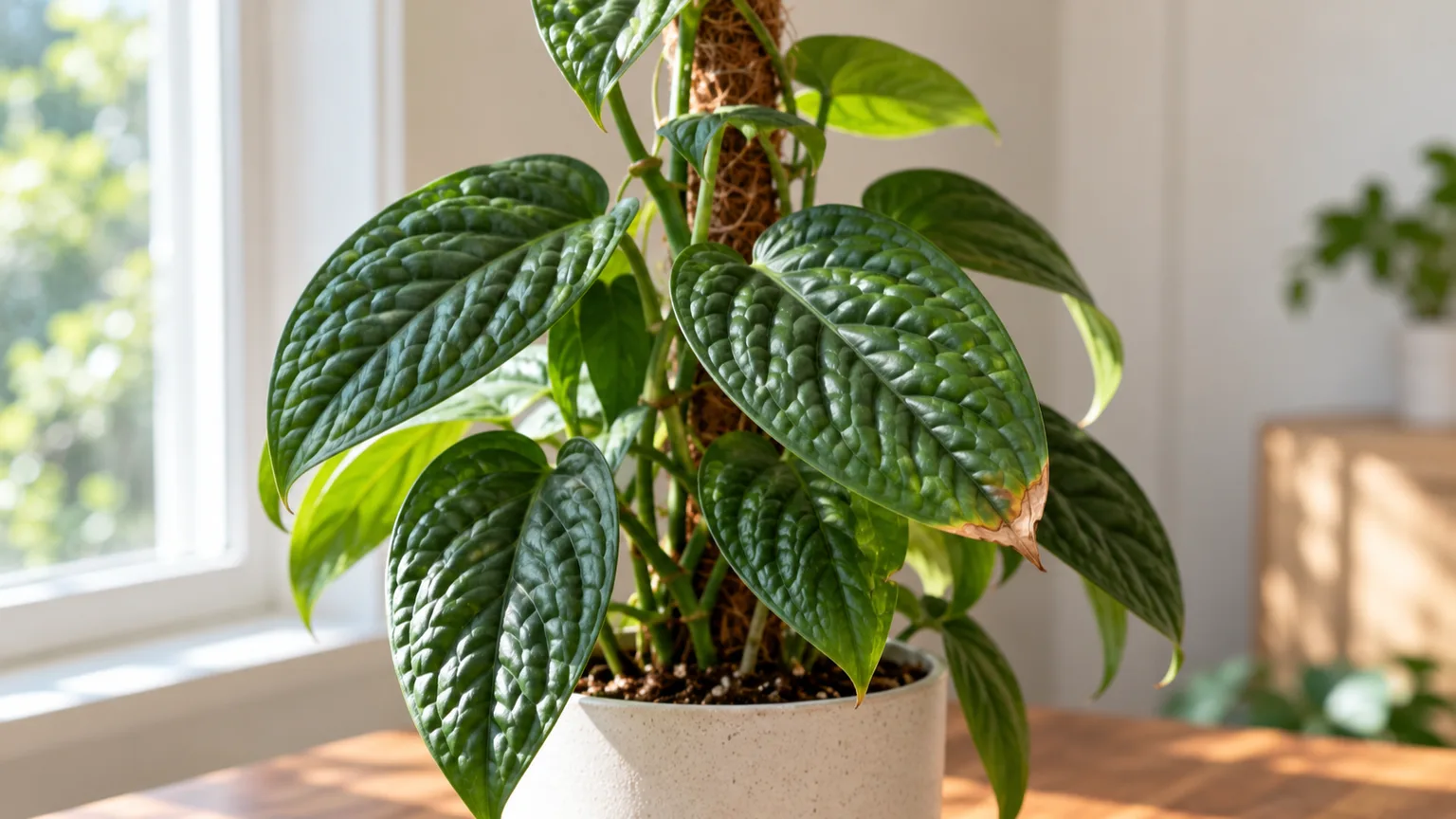
Low Humidity on Monstera Peru: Causes, Checks & Fixes
This guide covers low humidity on Monstera Peru. See also the general Low Humidity guide, watering, and light pages for this plant.
Low Humidity on Monstera Peru: Causes, Checks & Fixes
Quick answer
On Monstera Peru, dry air is a reasonable suspect when crisp leaf tips or margins appear at the same time that a hygrometer near the foliage repeatedly reads below about 50% relative humidity. A brown tip by itself cannot confirm low humidity: dry mix, a wet or damaged root zone, heat, and direct sun can leave similar marks. Start by measuring the air at the plant, then change humidity only if the reading supports that diagnosis. For general symptom background, see our low-humidity guide; this page focuses on the thick, puckered leaves and climbing growth of the plant sold as Monstera Peru.
Monstera Peru is a familiar trade name for a compact aroid with dark, deeply puckered leaves. The familiar label is useful for care, but exact indoor humidity trials for this trade plant are scarce; extension guidance for Monstera is the best-supported practical reference. Penn State Extension says Monstera prefers humidity above 50% and may benefit from a humidifier when an indoor space is very dry, while also emphasizing that houseplants differ and there is no single humidity target for every species (Penn State Extension’s Monstera guidance). Treat 50–60% near the leaves as a moderate starting range, not a hard biological threshold.
What low humidity looks like on Monstera Peru
The useful sign is a change in tissue, not the plant’s normal embossed texture. Monstera Peru’s leaves have a naturally quilted, puckered surface; those ridges are part of its identity, not a symptom of dehydration. The Spruce describes the Peru plant’s dark, puckered foliage and recommends a warm, humid setting, which helps explain why a sudden dry spell can matter even though the plant’s ridged surface is not itself damage (The Spruce’s Monstera Peru guide).
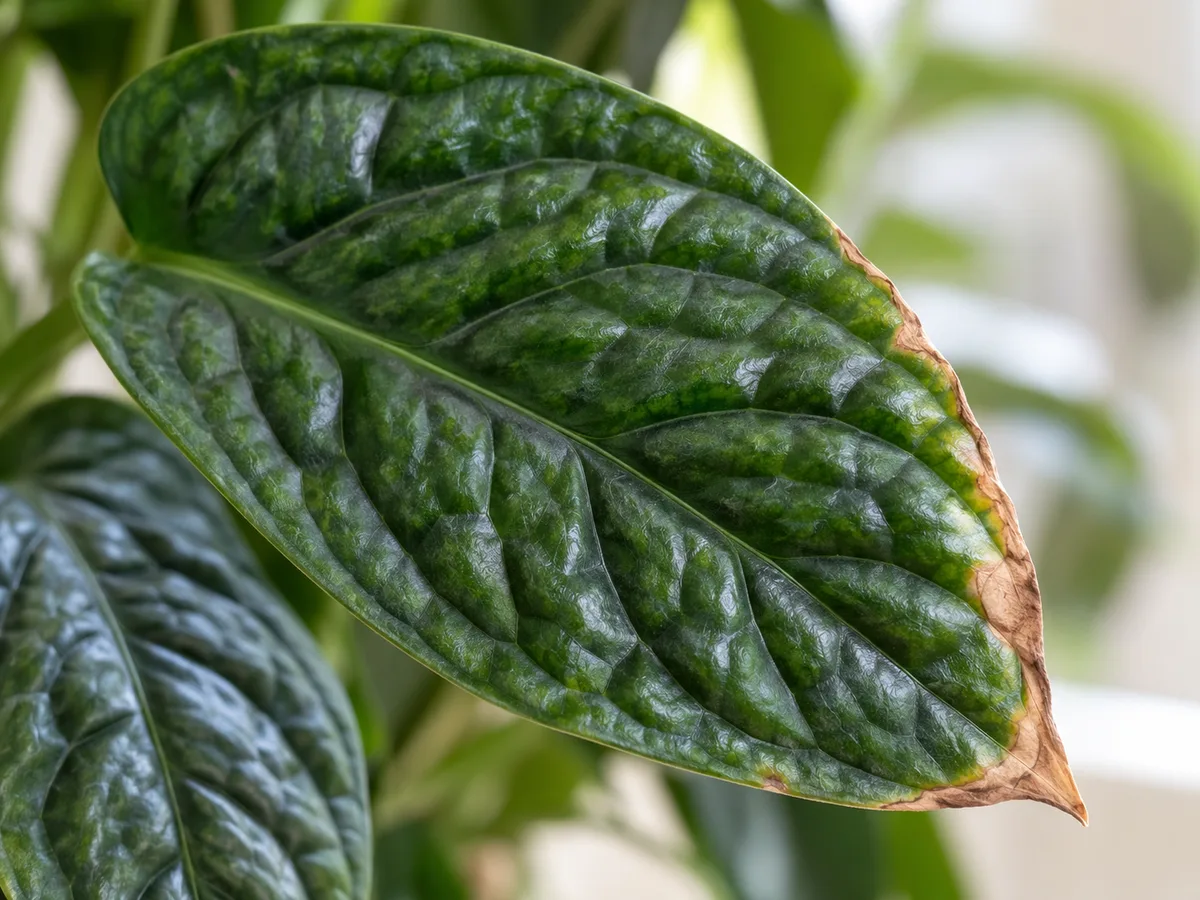
Small, dry margins on a Monstera Peru leaf can fit low humidity, but the reading and root-zone checks should agree before you treat the room air.
Dry air is more plausible when a leaf edge or tip becomes papery and crisp while the rest of the leaf remains firm and green. The margin may curl slightly inward, and more than one exposed leaf may develop similar dry edges over time. The pattern often becomes noticeable during a heating season, after a plant is moved beside an air-conditioning outlet, or when a new leaf is expanding in a room whose humidity is consistently low. Those conditions raise suspicion; they do not prove the cause.
The youngest leaves deserve careful observation, but do not call every slow or imperfect unfurl a humidity problem. A new Peru leaf can be pressed against a board, pole, nearby pot, or window treatment as the vine climbs. Physical contact, a dry root ball, or a sudden change in light can also interrupt a leaf’s opening. Check whether the blade is actually crisping, whether its surface is clean, and whether it has room to unfold before making the air wetter.
Monstera guidance often lists curled leaves as a possible low-humidity clue, but the same broad symptom can have other causes. The Spruce’s Monstera problem guide also warns that brown tips can reflect dry soil and recommends checking the plant’s watering condition; use that distinction as a reminder to measure rather than diagnose from one mark (The Spruce’s Monstera diagnosis). The leaf shape and the plant’s recent environment matter more than a single brown point.
Why dry air can trouble this climbing aroid
Monstera Peru is normally grown as a climbing or trailing aroid. Its compact, thick leaves and vining stem make it look sturdy, but “tough-looking” is not the same as independent of room conditions. The species is commonly kept indoors, where forced-air heating and dry winter air can lower relative humidity around foliage. Penn State Extension notes that cold outdoor air holds less moisture and home heating can push indoor humidity below 30% in winter; its Monstera article recommends humidity above 50% and says a humidifier can help in a very dry room (Penn State Extension on indoor humidity).
For this plant, the most convincing low-humidity pattern is not “the leaves are puckered.” It is a new or expanding area that develops dry, brittle tissue while the root ball is behaving normally and the canopy’s measured humidity is low. The plant’s deep corrugations also make it easy to misread normal ridges as a rough or damaged surface. Compare the affected part with an undamaged leaf on the same vine: look for a new tan or brown margin, brittle spots, or a tip that flakes when gently touched rather than a consistent green fold.
A climbing stem introduces another local factor. When a Peru is shingling up a board or growing against a moss pole, its leaves can sit close to the support and to one another. That arrangement creates small sheltered pockets, while the free edges and newest leaves still experience room air and heating or cooling drafts. A low reading taken across the room can miss a dry, moving stream at the plant. Measure close to the canopy, but keep the hygrometer out of a humidifier’s direct plume so it reports the air the leaves actually share rather than a temporary spray cloud.
How to confirm low humidity before changing care
Use these checks in order so that a humidity adjustment does not hide a watering problem.
- Measure where the leaves are. Place a small digital hygrometer near the middle of the vine, at leaf height, away from the humidifier outlet, direct sunlight, and a heating or cooling vent. Check the reading at more than one time of day for several days. If the room and canopy are generally above 50%, dry air is a weaker explanation for new damage; do not raise humidity just because a tip is brown.
- Check the mix before reaching for the watering can. Lift the pot and test the upper 3–5 cm of mix. Monstera care guidance recommends allowing the top one to two inches to dry before watering; frequency changes with the pot, growing medium, light, and season (Penn State’s watering guidance for Monstera). If the surface is dry and the pot is light, the symptoms may include underwatering as well as dry air. Follow the plant’s watering guide and water because the root zone is ready, not because the leaves look thirsty.
- Look at the whole root-zone pattern. A pot that remains heavy, mix that stays wet, yellowing lower leaves, or a stem that softens points toward a root problem rather than isolated low humidity. Do not unpot a firm, otherwise stable Peru just to chase dry tips. Check the Monstera Peru soil guide if the mix is staying wet too long, and reserve a root inspection for signs of actual decline.
- Trace the room air. Note whether crisping started after moving the plant beside a furnace register, air conditioner, exterior door, or sun-warmed glass. Penn State notes that Monstera dislikes cold drafts, and direct sun can scorch Monstera Peru leaves; those exposures deserve a separate check even if the room’s average humidity looks acceptable (Penn State Extension’s Monstera guidance; The Spruce’s Peru light guidance). Move a hygrometer between the affected side and a sheltered spot for comparison, then see whether the damage is concentrated on the exposed portion.
- Inspect the leaf and its neighbors. Inspect leaf undersides, petioles, and nodes for visible pests, and look for wet or spreading spots that need a separate diagnosis. Also check whether the newest leaf is rubbing on its support or trapped between leaves; give it space before assuming the room needs more moisture.
A simple confirmation is strongest when three clues agree: repeated low readings at leaf height, fresh dry margins on leaves that were previously healthy, and no matching evidence of dry mix, waterlogged roots, direct sun, pests, or physical abrasion. If only one clue fits, keep the diagnosis open and observe the next few days of growth instead of stacking fixes.
Lookalikes: what brown or curled edges can mean
| What you see | First check | Why it is different from low humidity |
|---|---|---|
| Crisp tip or margin with low canopy readings | Hygrometer and nearby vents | Dry air is plausible when the reading and the pattern agree; the old damaged edge will not turn green. |
| Limp leaf, light pot, and dry mix | Soil depth and pot weight | Underwatering affects the root supply. Water only when the top layer has dried, then track whether firmness returns. |
| Yellow lower leaves, heavy pot, or soft stem | Drainage and root-zone moisture | A wet root zone needs a watering or soil diagnosis, not extra misting or a higher humidity setting. |
| One-sided pale or scorched patch | Window exposure and hot airflow | Direct sun can scorch Monstera Peru leaves; use the light guide to adjust exposure gradually. |
| Fine stippling, webbing, sticky residue, or visible insects | Leaf undersides, petioles, and nodes | Pests require pest identification; dry air alone does not create webbing or insects. |
| Even, dark green puckering across the blade | Compare with another Peru leaf | That ridged texture is characteristic of the plant sold as Monstera Peru, not a humidity lesion. |
Use the Monstera Peru brown-tips guide when browned tissue is the main problem and you need to compare watering, light, and dry air in more detail. If the leaves are mainly limp or drooping, use the Monstera Peru problems hub to route to a watering or root issue. Low humidity can coexist with another problem, so resolving one clue does not rule out the other.
The first fix: raise measured humidity gently
If the canopy stays below about 50% and the soil and roots look normal, run a clean humidifier near the plant and adjust it until the local reading settles around 50–60%. This is a moderate target based on Monstera’s preference for humidity above 50%, not a claim that every Peru needs a precise percentage. Keep the unit far enough away that droplets do not settle on the leaves or soaking-wet soil, and follow the manufacturer’s cleaning instructions so the device does not become a source of residue or stagnant water.
Do not compensate by watering more often. Humidity changes the air around the leaf; watering changes the root zone. Penn State Extension advises that Monstera’s upper soil should dry between waterings and warns that overwatering can lead to root rot (Monstera watering and root-zone guidance). A plant with dry air but damp mix still needs its normal soil dry-down. Keep the soil guide and watering guide close at hand if the pot’s behavior is part of the uncertainty.
Misting is not a dependable first fix. Penn State explains that the humidity rise after misting lasts only until the water evaporates, which can take minutes; the same extension guide says pebble trays have little effect on overall room humidity because moisture disperses through the room (Penn State’s humidity guide). The Planters’ Guild reaches the practical conclusion that a hygrometer and humidifier are more useful than repeating a short-lived misting ritual (The Planters’ Guild’s misting review). You can still rinse dusty Peru leaves during routine cleaning, but do not count a wet leaf as evidence that the room air has changed.
If you cannot use a humidifier, first choose a better location: a bright, stable spot away from forced-air vents often reduces the daily swings without sacrificing light. A bathroom or kitchen is only a better site if the measured humidity is actually higher and the plant still receives sufficient filtered light. Grouping plants can alter a small nearby pocket, but verify the effect with the meter; a decorative pebble tray should not be treated as a substitute for a room-level change. Avoid enclosing Monstera Peru in a sealed case unless you can manage airflow and moisture, because trapped condensation is not the same as controlled humidity.
Peru’s puckered leaves and climbing support need a separate check
The thick, embossed blade changes how you read damage. A uniform pattern of green ridges and valleys is expected; a new, dry brown edge is different. Photograph one affected leaf in natural light and note whether the damaged area advances over the next week. This makes it easier to tell active drying from a stable old mark and prevents you from misting the entire plant whenever the leaf texture looks unusually rough.
The plant’s climbing habit also changes where you inspect. Follow one vine from the pot upward and check the newest node, the underside of the leaf, and the point where the blade meets its petiole. If a leaf is pressing into a board, moss pole, curtain, or neighboring leaf, gently give it clearance and watch its opening. The Spruce’s Peru care guide recommends providing support for this vining plant; that support is useful for growth, but each leaf still needs room to emerge (The Spruce’s Peru support guidance). Do not keep repositioning an actively unfurling blade, since repeated handling can crease or tear it.
If the vine trails rather than shingling, the exposed outer leaves may sit in faster-moving room air than leaves nearer the pot. If it climbs a moss pole, the pole may stay damp while the foliage is dry; pole moisture does not tell you the room’s relative humidity or the potting mix’s moisture. Read each separately: canopy humidity with a meter, pot moisture by touch and weight, and support moisture by its own surface. That distinction is especially useful for Monstera Peru because the same plant can have a damp climbing support and a dry root ball, or the reverse.
Do not prune a firm leaf just because its edge is brown. The unaffected green portion still contributes to the plant, and removing it will not raise humidity. If a tip is catching on fabric or brushing a hot window, correct that contact first. Remove a leaf only when it is mostly dead, diseased, or physically damaged enough to keep tearing; use clean scissors and leave the stem’s healthy nodes intact if the vine itself is otherwise sound.
Recovery: read the next leaf, not the old edge
Crisp brown tissue will not regain its original color after the air improves; The Spruce treats brown tips on Monstera as damaged tissue to remove, rather than tissue to revive (The Spruce’s brown-tip guidance). The goal is to stop new damage. Mark or photograph the edge of one affected leaf and compare it after several days; a stable border is more informative than expecting the brown tissue to disappear. Keep the humidifier setting and room placement steady long enough to learn whether the canopy reading is consistently in range.
For an established Monstera Peru, the most useful progress signal is the next leaf and the stem behind it. A healthy new leaf should open without fresh dry margins, and the vine should remain firm at its nodes. Depending on season and growth conditions, a Peru may not make a new leaf quickly; a quiet stretch does not prove the humidity adjustment failed. Use the reading and the condition of existing tissue together rather than demanding visible growth within a few days.
If the next leaf still crisps while the canopy repeatedly measures around 50–60%, return to the differential checks. Confirm that the meter is not sitting in humidifier mist, the plant has not moved into direct sun, and the pot is not swinging between bone-dry and saturated. If only one side of a leaf is damaged, look again for a vent, hot pane, or rubbing point. Do not keep raising humidity as a substitute for finding a persistent local stressor.
Escalate the diagnosis when several leaves yellow or collapse, stems soften, or the pot stays wet long after watering. Those signs point beyond ordinary dry air. Check the root zone and drainage, then consult the plant overview for its whole-care context or the Monstera Peru problems hub for a separate diagnosis. If roots are rotting, humidity alone will not restore them; the root problem needs its own correction.
Mistakes that make low humidity harder to diagnose
- Watering on a calendar because tips look dry. The same edge damage may appear with dry soil, and extra water in a slow-drying pot can create a second problem. Use mix dryness and pot weight before watering.
- Treating every brown margin as proof of low humidity. A low room reading is useful only when it matches new tissue damage and the root-zone pattern is otherwise sound.
- Misting repeatedly instead of measuring. A brief surface wetting does not hold a target humidity through the day. Use a meter to decide whether an adjustment is needed.
- Chasing a tropical greenhouse number. Exact Peru-specific humidity trials are limited, and extension guidance says humidity needs vary among houseplants. Start with a moderate range and stop increasing it once new damage ceases.
- Moving the plant into a dark, damp room. Humidity is only one part of care. A bathroom with poor light can slow growth and keep the mix wet; preserve bright filtered light while avoiding drafts.
- Pruning the symptom before it is understood. Removing crisp tips or whole leaves hides the pattern without changing the air. Keep a record and trim only tissue that is mostly dead or damaged.
Prevent repeat dry-air stress on Monstera Peru
Build a small routine around the plant’s position rather than the calendar. In a heated room, check canopy humidity when the heating system is running and again when it is off. Keep the meter near the foliage for a few readings across the day. If the level remains below about 50% and new growth develops crisp edges, use the humidifier consistently; if the reading is already moderate, do not add equipment merely because the leaf has its normal corrugations.
Keep Peru’s usual light and water cycle stable while adjusting humidity. It wants bright filtered light for a compact vine, and the potting mix should dry at the top before watering. The Monstera Peru light guide and watering guide help distinguish those conditions from dry air. Change one variable at a time so you can tell whether the new growth responds to humidity or to another correction.
Place the vine where the room air is steady. Avoid a heating register, air-conditioner blast, exterior door, and a pane that gets intensely warm in afternoon sun. Give a supported, shingling stem enough space that its leaves are not scraped as they emerge. Wipe dust from the puckered valleys with a soft damp cloth when needed, then let the foliage dry; routine cleaning is different from spraying the plant to create humidity.
Keep the humidifier clean, refill it with the water recommended by its manufacturer, and use the built-in control only as a starting point. A separate hygrometer near the plant is a better check than the display on a humidifier placed across the room. If the device raises the reading above the moderate range or condensation appears on nearby surfaces, lower the setting and improve air movement. The aim is stable, breathable air around the climbing vine, not a wet enclosure.
When to use this page vs other Monstera Peru guides
Use this page when the humidity meter near the foliage is consistently low and the main change is fresh crispness at leaf tips or margins. Use the brown-tips guide when that symptom needs a broader comparison with watering and light. If the pot remains heavy or leaves yellow and soften, start with watering and soil diagnosis instead of raising humidity first.
If the damage faces a bright window or appears after moving the plant, compare it with the light guide. For a complete care baseline, use the Monstera Peru overview; the problems hub routes symptoms that do not match a measured humidity problem. For a room-level estimate, the Humidity Calculator can help you plan the reading to monitor before you adjust care.
Related Monstera Peru guides
- Start here for the whole plant: Monstera Peru overview covers its climbing form and baseline care.
- Use when the mix or pot is the clue: the watering and soil guides explain dry-down and drainage; follow them when a pot is persistently light or heavy.
- Use when exposure is the clue: Light covers filtered placement and sun exposure, which can create dry-looking marks independent of humidity.
- Use when brown tissue is the main question: Brown tips compares common causes of edge damage.
- Use when the symptom set is broader: the problems hub routes yellowing, drooping, pests, and root-zone concerns to their own guides.