Aphids on Monstera Peru: How to Identify and Remove Them
Quick answer
Aphids on Monstera Peru usually cluster on tender shoot tips, partly unfurled leaves, and the leaf-to-stem joints. Confirm live, pear-shaped insects and sticky honeydew before treating. First fix: isolate the vine, then rinse the affected shoot with a controlled stream of water while supporting the stem. Recheck new growth over the next two weeks; old curled or scarred leaves may stay marked.
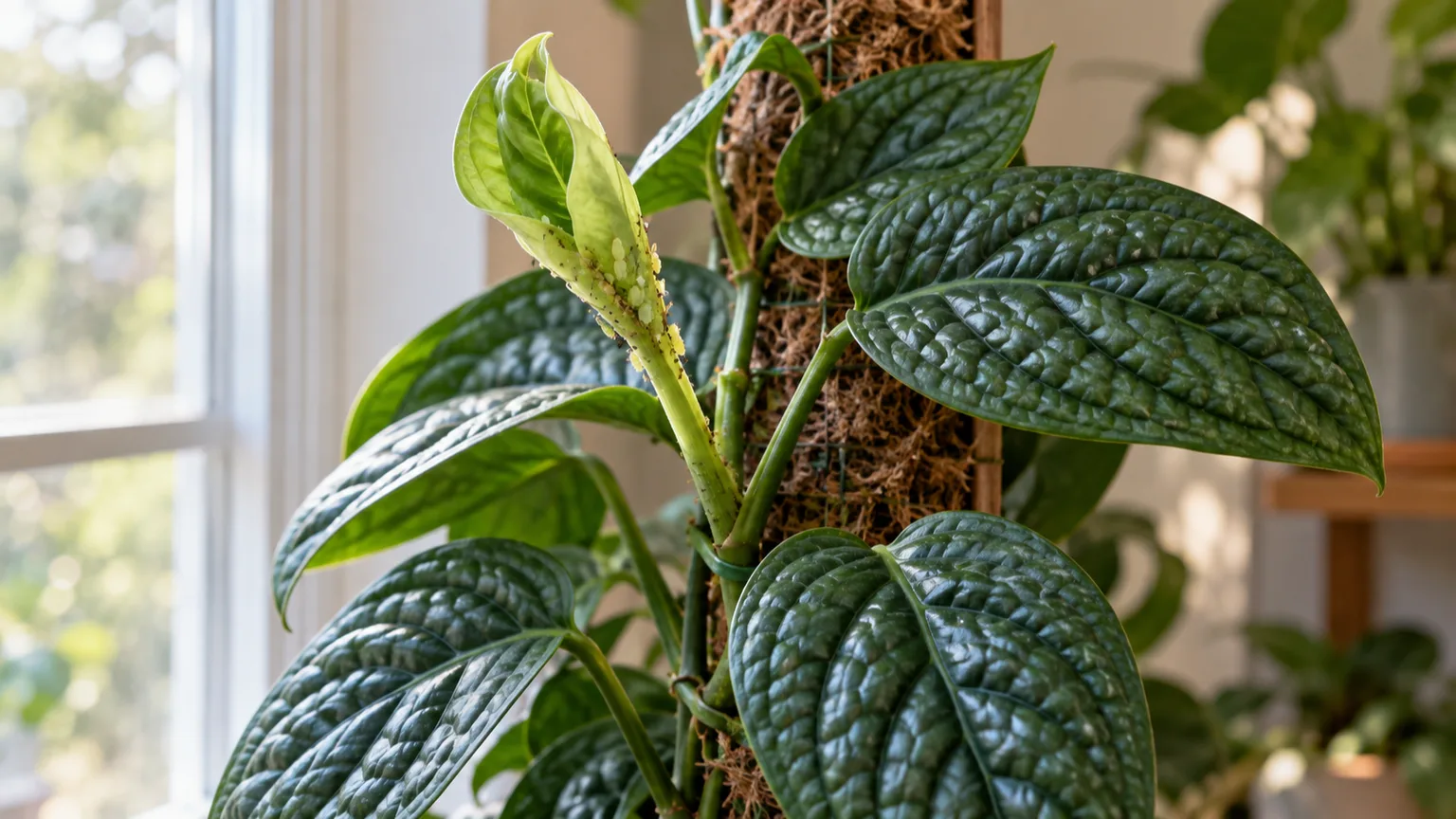
Aphids on Monstera Peru: Causes, Checks & Fixes
This guide covers aphids on Monstera Peru. See also the general Aphids guide, watering, and light pages for this plant.
Aphids on Monstera Peru: Causes, Checks & Fixes
Quick answer
If you find live aphids on Monstera Peru, move the pot away from nearby plants, then rinse the affected shoot with a controlled stream of water. Aphids usually gather on the soft tip of a vine, a partly unfurled leaf, or the joint where a leaf stalk meets the stem. Confirm the insects before changing care: curled new growth alone is not enough to diagnose a pest.
The rinse is the first treatment. It removes exposed aphids without soaking the pot or coating every leaf with a pesticide. Support the stem so the new leaf does not bend, and check the same growing tip again over the next two weeks. A leaf that was already distorted may remain that way; clean growth and no returning insects are better signs of recovery than a perfect-looking old leaf.
What aphids look like on Monstera Peru
On Monstera Peru, the first clue is often a small group of insects gathered around the newest soft stem or the lower surface of a leaf that has not finished opening. Aphids are small, soft-bodied insects, often with a pear-shaped outline; they can be green, yellow, red, purple, brown, or black. Penn State Extension describes their pear-like shape and soft bodies, but color alone is not a reliable test. Look for several insects clustered together rather than one isolated speck.
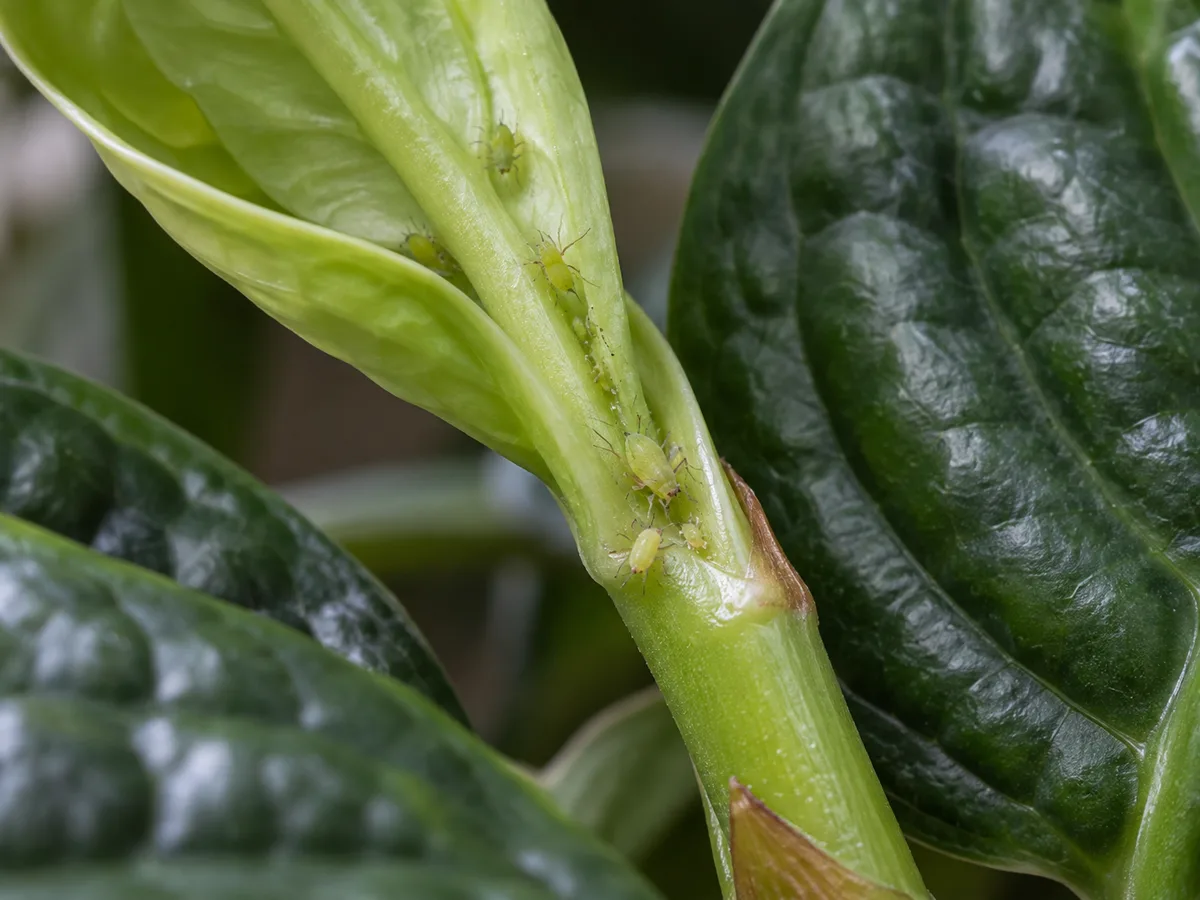
Aphids are easiest to confirm on the soft shoot and petiole; check both sides of the partly opened leaf.
The Peru’s mature leaves are thick and deeply puckered. Their embossed surface can hide an insect when you glance only at the glossy top, so turn each leaf gently and follow the veins into the folded margins. Look at the underside, the petiole, the node where the leaf joins the vine, and the soft tip above it. A phone flashlight or hand lens helps you distinguish legs and a body from dust, dried water marks, or bits of potting mix.
A young Peru leaf may still be folded as it opens; that outline is not itself damage. Aphid feeding is more likely when you can see insects or fresh sticky residue and the leaf opens unevenly, puckers in a new way, or remains smaller and misshapen. If there are no insects and the leaf is simply still opening, give it time rather than spraying the plant.
Honeydew is another clue: it feels tacky on the leaf below a colony or on a nearby surface. Aphids feed by drawing fluid from the plant and some excrete sugary honeydew; Clemson’s houseplant pest reference describes the sticky residue and possible sooty growth. Ants may investigate honeydew, but ants on their own do not prove aphids are present. Wipe a small patch clean and check whether it becomes sticky again while you look for live insects.
For general aphid biology and identification beyond this plant, see the aphids guide. On Monstera Peru, the useful diagnostic shortcut is to start at the newest vine growth and then inspect the corrugated leaves below it.
Why Monstera Peru’s newest leaves are the inspection target
Aphids are more likely to be found on young, tender growth than on the firm, older foliage. They feed on plant fluids and can leave new leaves crinkled, undersized, or distorted. The Spruce notes that indoor colonies can spread by crawling or by winged aphids, and that aphids favor new growth. A Peru vine can have several developing tips at once, especially when it is climbing or producing a new leaf after settling into a bright spot.
Do not assume the pest has a special preference for Monstera Peru because of its puckered foliage. The texture matters to your inspection, not as proof that the plant attracts aphids. The ridges and folds make the underside and edges easier to overlook, while tender new tissue is the part most likely to show feeding damage. Check each new leaf as it opens, then trace its stalk back to the node instead of only wiping the broad, visible surface.
The plant’s support can also change what you can see. If a stem is trained against a board or pole, look behind any loose tie and at the leaf joints that face the support. Penn State’s broader Monstera guidance describes climbing growth and support; its support discussion is genus-level context, not a claim that all Peru plants behave exactly like Monstera deliciosa. Keep the vine attached if it is stable; simply shift the pot or turn the support enough to inspect the hidden side.
Aphids are not caused by a wet pot, dry air, or too little light. Those conditions may stress a plant or change how quickly it grows, but they do not create insects. If a leaf is distorted without visible aphids, diagnose the watering, light, or root issue separately rather than treating an assumed infestation. This distinction prevents an unnecessary spray from adding stress to a plant whose problem is below the soil line or environmental.
How to confirm aphids before treating
Start with the growing tip, not the potting mix. Place the plant where you can see the pale new growth clearly, then inspect in this order:
- Look along the tender shoot and both sides of the newest partly open leaf. Aphids often gather where soft tissue meets the stem.
- Follow the petiole to the node and inspect the underside of the leaf, especially the valleys between its raised veins.
- Check the next older leaf below the shoot for tacky honeydew, a fresh cluster, or dark sooty-looking residue.
- Inspect the next vine tip and nearby plants. Winged aphids can move between plants, so one clear colony makes a second quick check worthwhile.
When insects are hard to see, hold a white card under the tip and tap the stem lightly. A few dislodged insects on the card are easier to inspect than a dark fold. A magnifier helps, but a visible cluster and repeated sticky residue are usually enough to justify a gentle rinse. Do not use a leaf’s curl, yellowing, or a sticky mark as the only evidence: those symptoms have several possible explanations.
The pattern across the plant matters. Aphids usually appear in groups on new growth or the undersides of leaves. If the newest leaves are clean but mature leaves show fine pale speckling, bronzing, or delicate webbing, look for spider mites instead. If you see a cottony white mass in a leaf joint, inspect for mealybugs; if a hard, shell-like bump stays fixed to a stem, consider scale. A good close inspection is more useful than repeating a broad pest treatment that may not target the insect you have.
Roots do not need to be pulled out to confirm aphids. Unpot only if the plant also shows a separate root warning, such as persistently wet mix, a sour odor, or soft roots. If those signs appear with generalized decline, compare the issue with the Peru root rot guide or overwatering guide; neither diagnosis replaces a direct search for insects on the vine.
First fix: rinse the affected vine carefully
For a small or moderate colony, use water before reaching for a spray. Take the pot to a sink or shower, hold the stem so it cannot twist, and direct a steady, gentle stream across the insects on the shoot, petiole, and leaf undersides. Work from the tip toward the node. Avoid blasting the delicate emerging leaf or bending the vine away from its support. If the plant is fixed to a board, tilt the whole support or use a damp cotton swab at the crowded joint rather than pulling the vine free.
Keep the stream controlled enough that the potting mix is not flooded. A rinse should dislodge pests from foliage, not add an extra watering event to a chunky aroid mix that has not dried down. If only a few aphids are visible, remove them with a damp cotton swab and dispose of it. Do not rub hard across the raised leaf surface; concentrate on the insects and the soft tissue around the node.
Penn State Extension recommends washing aphids from affected ornamentals when practical, and Gardening Know How describes water or gentle manual removal for houseplants. For a Peru, adapt that general method to its stiff leaves and attached climbing vine: rinse the accessible colony, support the stem, and avoid turning the plant upside down if doing so would kink the shoot or loosen the support.
After rinsing, let the leaves drain in a warm, bright room without direct midday sun. Empty water from the saucer or cachepot, and use a clean towel only to blot water that has collected in a tight fold. Do not add fertilizer, repot, prune healthy growth, and apply a pesticide all at once. If you change several things, you will not know which step removed the insects or whether a new symptom came from treatment.
Check the same tips for two weeks
One rinse can remove the aphids you see, but it cannot establish that every insect or hidden life stage is gone. Indoors, aphid populations can build quickly, so repeat inspection matters more than assuming the first wash solved the entire problem. For the next two weeks, check the same growing tip every few days and scan the next leaf down. If you find live aphids, rinse or remove them again. If you only see old honeydew or a leaf that is already misshapen, clean the residue and look for fresh insects before treating again.
Also inspect the plants that stood beside the Peru. Check their new leaves and shoot tips, especially if the Monstera had a winged aphid or a larger colony. Keep the affected plant separate while you monitor it. A yellow sticky card can help show whether small flying insects are present, but it will not remove aphids already settled on the vine and it cannot confirm that the insects caught came from this plant.
Record what you see, not just whether the plant “looks better.” Note the date of each live colony, whether it was on a new or mature leaf, and whether the next inspection finds fewer insects. This is useful because honeydew can remain after the insects are gone and old leaf distortion can persist after feeding stops. The success measure is no live aphids on repeat checks and no newly distorted growth, not an instant return to pristine leaves.
When to use insecticidal soap or another labeled product
If aphids return despite careful rinsing and hand removal, a product labeled for aphids on indoor ornamental plants may be the next step. Insecticidal soap is a contact insecticide, so it has to reach the insects; a light mist across the tops of the Peru’s quilted leaves may miss a colony tucked under a petiole. Follow the label for the plant, location, dilution, coverage, and repeat interval. Do not assume that a product sold as “natural” or a homemade dish-soap mixture is automatically safe for the foliage.
Before spraying the whole plant, test the labeled product on a small part of one mature leaf and wait the period stated by the label. Clemson notes that houseplants vary in sensitivity and that injury may take at least 48 hours to appear; its pesticide guidance stresses a small-area test and label directions. Keep the plant out of direct sun while wet if the label advises it, and do not treat a wilted or drought-stressed vine unless the label permits that condition.
Avoid improvised mixtures of dish detergent, alcohol, oils, or vinegar on Monstera Peru. Their concentration and additives vary, and rubbing a solution across the folded new leaf can expose tender tissue to more contact than intended. If you do not have a product whose directions clearly cover indoor ornamental use, continue physical removal or ask a local extension service for options available in your region. Never increase a dose or shorten a repeat interval because aphids remain after one application.
Separate aphids from common lookalikes on Peru leaves
The following visual differences help prevent a false diagnosis. A strong pest diagnosis still depends on finding the organism, not only matching a damaged leaf.
| What you notice | More consistent with | What to inspect next |
|---|---|---|
| A group of small, soft-bodied insects on a pale shoot; sticky residue on leaves below | Aphids | Check the shoot tip, petiole joints, and underside of the newest leaf |
| Fine pale stippling or bronzing across older leaf surfaces; very fine webbing in a heavier infestation | Spider mites | Use a light to inspect the leaf undersides and stem; look for tiny moving specks |
| Cottony white wax in a node or leaf axil, sometimes with sticky residue | Mealybugs | Check the sheltered joints and remove the waxy insects individually |
| A fixed, shell-like bump along a stem or leaf vein | Scale | See whether it stays attached when lightly nudged; do not assume every bump is scale |
| A silvery scrape or streak with a narrow, fast-moving insect | Thrips | Look for slender insects and fresh surface scarring on the leaf |
| A new leaf is still folded but has no insects or fresh residue | Normal unfurling or another stress | Give it time to open, then compare with the next leaf |
The aphid row is the best fit when a visible cluster and honeydew occur together. Clemson’s houseplant pest descriptions distinguish aphids from mites and mealybugs by body shape, feeding pattern, and residue. On Monstera Peru, the deep leaf texture can make a clean leaf look irregular; do not treat the texture itself as a pest sign.
What damaged Peru leaves can and cannot recover
Once an aphid-fed leaf has hardened with a crease, a curled edge, or an uneven shape, it will usually keep that mark. The plant does not rebuild that leaf surface when the aphids are removed. A partly opened leaf may still finish opening after the colony is gone, but feeding damage can leave it smaller or distorted. Avoid cutting it merely because it looks imperfect if it is still green and supporting the vine.
Judge recovery from the next growth point. A healthy response is a shoot tip that stays free of insects, a new leaf that finishes unfurling without fresh clusters, and no new honeydew on the leaf below it. If the Peru is not actively making a leaf, use repeated pest checks as the main signal; the plant’s growth rate changes with temperature, light, and season. Do not interpret a slow pause by itself as proof that the rinse failed.
Escalate if aphids cover multiple nodes, a new leaf repeatedly fails to open, or the vine keeps losing leaves after the visible insects are gone. Recheck for mites, mealybugs, root trouble, or another cause before applying a stronger treatment. If the colony is confined to one badly damaged tip, selective pruning can be reasonable, but preserve healthy nodes and leaves. Discard the removed material in a closed bag rather than leaving it beside the plant.
Keep the Peru’s care steady while it recovers
Aphids are an insect problem, not a request to water more. Monstera Peru’s care record calls for allowing the upper 3–5 cm of its chunky mix to dry before watering; a curled leaf does not justify changing that interval without checking the pot. Use the plant’s watering guide to judge its dry-down and drainage, and its soil guide if the mix stays dense or wet for too long.
Keep the vine in bright filtered light while it recovers. Low light can slow new growth and make it harder to judge the next leaf, but it does not create aphids. Avoid moving the plant between dark and harshly sunny locations just because one leaf is damaged. The Peru light guide gives the placement context for stable growth; change the location only if the existing spot is clearly unsuitable.
Do not feed extra fertilizer to force a replacement leaf. The affected leaf will not become undamaged through feeding, and new growth is most useful when the plant is otherwise stable. Do not repot solely because aphids were present: the insects you are treating are above the soil line. Repot only for a separate soil or root problem, such as failed drainage or soft, decaying roots.
Prevent another colony from settling on the vine
Inspect a newly purchased Peru before it joins the rest of the collection. Look at the newest growth, the undersides of leaves, and the stem joints, then keep the new plant apart while you watch for another flush of growth. Aphids may arrive with a nursery plant or move from a nearby infested plant; they are not generated by the Peru’s potting mix. Check neighboring plants too if a winged aphid was present.
During routine care, use the same quick inspection path each time: tip first, then petiole and node, then the lower leaf surfaces. The dark, quilted leaves are sturdy but their raised veins make a rushed glance less useful. Turn the leaf gently rather than pulling the vine off a board. If you use a support, leave enough room to see the stem and leaf joints behind it.
Keep the plant’s ordinary care consistent. Bright indirect light, a chunky mix, and a measured dry-down help the Peru maintain steady growth; constant changes to light, water, and feeding make a recovery harder to read. For a broader picture of the plant’s structure and care, use the Monstera Peru overview. That page is useful for routine setup, while this guide is for confirmed aphids.
When to use this page vs other Monstera Peru guides
Use this aphids guide when you can find live insects clustered on the shoot or leaf joints, especially with new honeydew. If there are no insects and the main issue is yellowing, compare the pattern with the Peru yellow leaves guide. If the plant droops while the soil is dry, use the underwatering guide; if the pot remains wet and leaves soften, use the overwatering guide. These are different diagnoses and need different first actions.
An aphid colony can distort the newest leaf, but it does not explain every leaf curl or every slow-growing vine. If the plant is leggy and the leaves are clean, check the Peru not enough light guide. If the vine is dropping leaves without fresh aphids, compare it with the plant’s drooping leaves guide. The Monstera Peru problems hub helps you choose the matching problem page when the symptom pattern is broader.
Related Monstera Peru guides
- Routine setup: the Monstera Peru overview covers the plant’s overall growing pattern; return here when you see a confirmed aphid colony.
- Water and mix: the watering guide and soil guide help diagnose root-zone problems that can look like general decline but do not cause aphids.
- Other leaf problems: use the yellow leaves guide or drooping leaves guide when no live insects are present.
- Related tool: the Pest Identifier Tool can help compare aphids with mites, mealybugs, and other visible pests before you choose a treatment.