Fungus Gnats on Monstera Peru: What to Check First
Quick answer
First, wait to water until the top 3–5 cm of Monstera Peru’s potting mix is dry, then use a yellow sticky card to track adults. Gnats breed in moist growing media; a card catches flying adults but does not treat larvae, so confirm the soil problem before escalating.
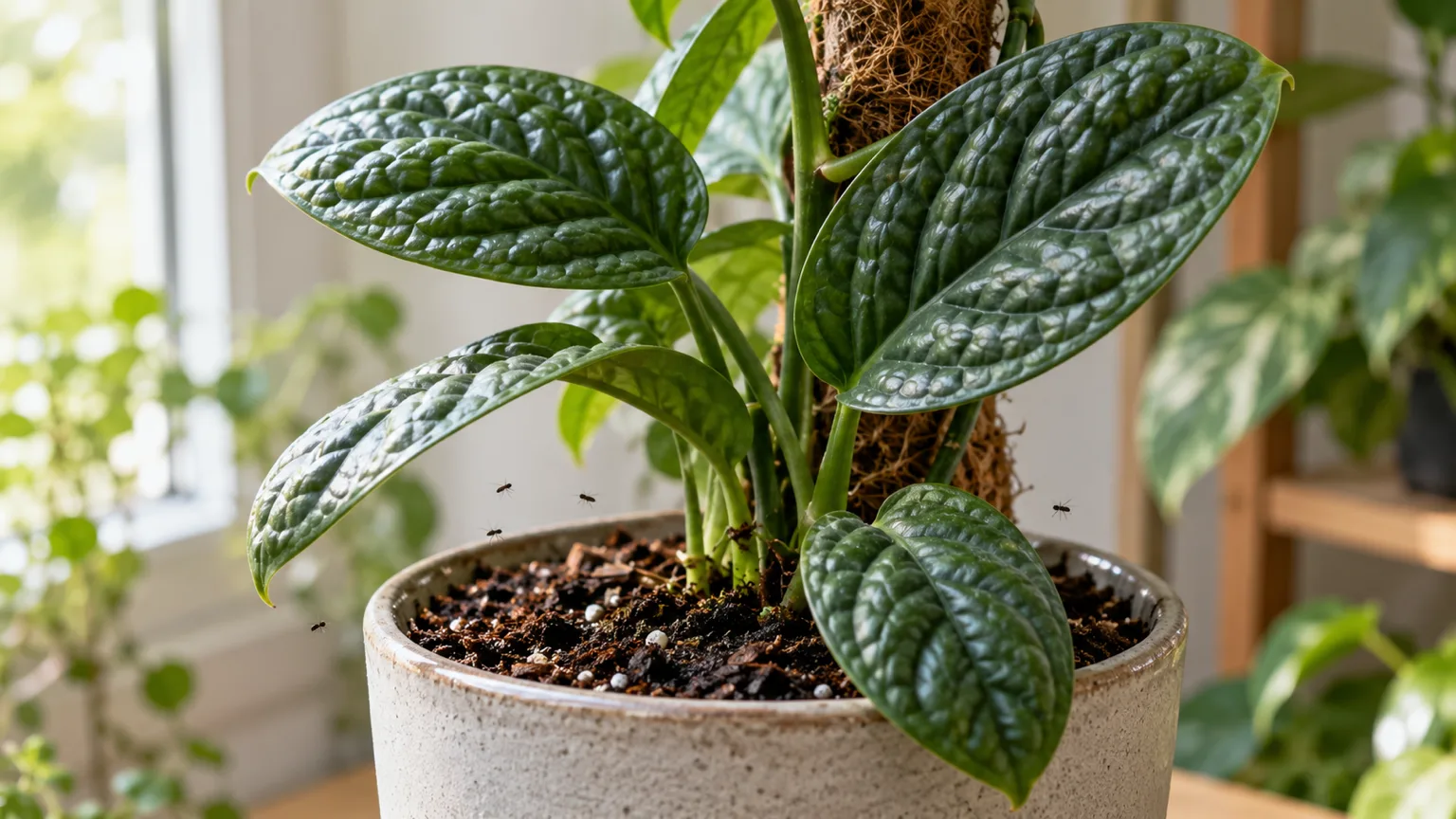
Fungus Gnats on Monstera Peru: Causes, Checks & Fixes
This guide covers fungus gnats on Monstera Peru. See also the general Fungus Gnats guide, watering, and light pages for this plant.
Fungus Gnats on Monstera Peru: Causes, Checks & Fixes
First, wait to water Monstera Peru until the top 3–5 cm of potting mix has dried. Check the mix itself rather than following a weekly schedule; this reduces the damp surface fungus gnats favor while still leaving moisture deeper in the root ball. Put a yellow sticky card beside the pot to count adults, but do not mistake a full card for a treatment: it catches fliers, not the larvae developing in the mix.
What fungus gnats look like around Monstera Peru
The clearest clue is a small dark fly lifting from the pot when you water, move the plant, or brush the soil surface. Fungus gnat adults are delicate, mosquito-like, weak fliers; their larvae are translucent or whitish worms with a dark head and live in the growing medium. The adults do not bite, and they are not chewing Monstera Peru’s ridged leaves. The larval stage is the one to look for in the potting mix, where it feeds mostly on fungi, algae, and decaying material and may also feed on fine roots.Colorado State University Extension describes the adult and larval stages.
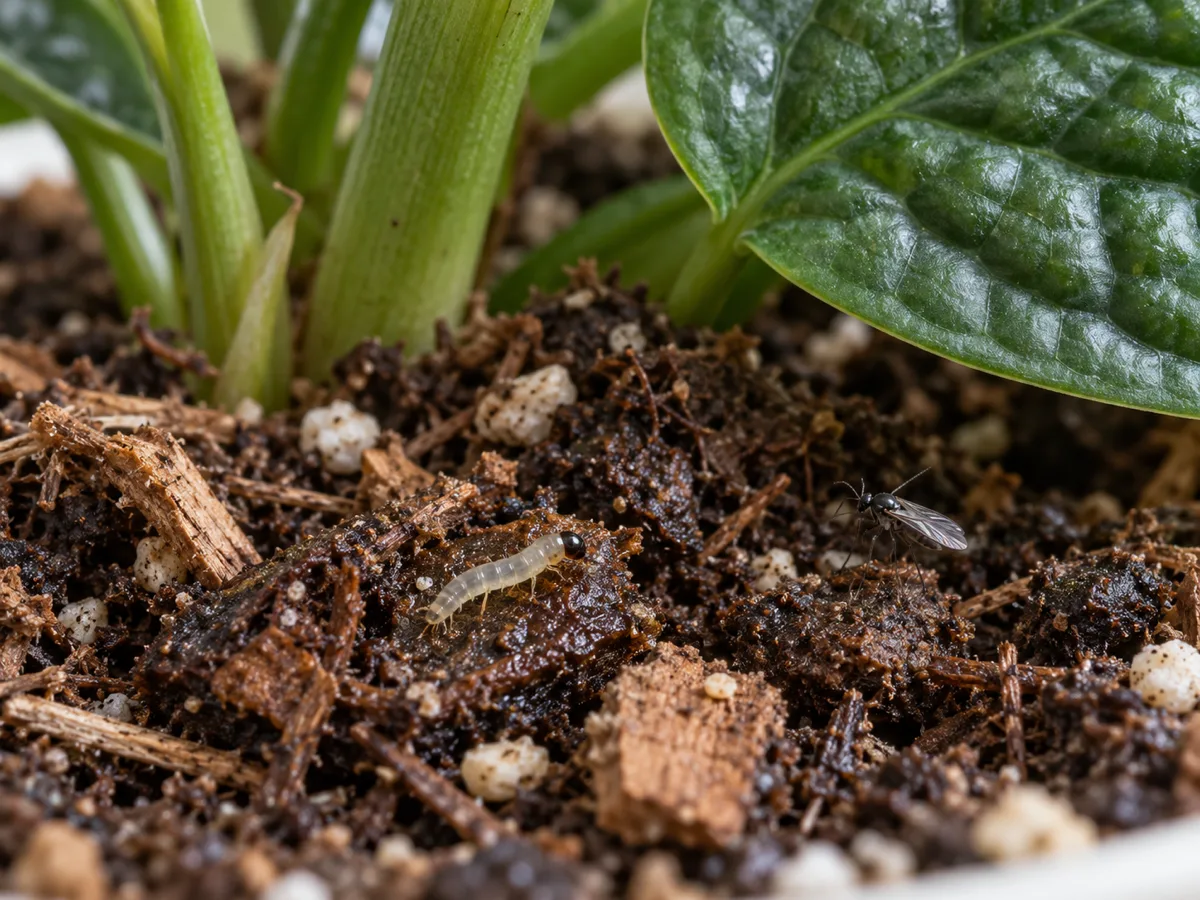
The soil line is the useful inspection point: a dark-headed larva or adult gnat near the mix is more diagnostic than a mark on a Monstera Peru leaf.
On a Monstera Peru, look first around the pot rim, drainage holes, or lower stems rather than assuming a fly among the foliage is feeding there; fungus gnat adults are usually seen near an infested pot.Colorado State Extension describes adults around houseplants. The plant’s thick, deeply puckered leaves can look perfectly firm while the mix underneath is staying wet for too long. That contrast matters: leaf appearance alone cannot confirm or rule out a soil-breeding insect. A mature Peru with only a few adults can remain otherwise healthy; root injury is more plausible when there are many larvae and the plant is also losing vigor, since larvae can feed on fine roots in a heavy infestation.BHG Australia notes that healthy mature plants can tolerate a mild infestation.
If you need a general explanation of the pest’s life cycle and common control options, use the fungus gnats guide. This page narrows that advice to the way a Monstera Peru’s small pot, climbing support, and dry-down pattern affect diagnosis.
Confirm the pot is the source before changing care
Fungus gnats are easy to suspect when any tiny fly appears indoors. Use these checks to separate an active pot infestation from a coincidental visitor:
- Watch where the insects start. Tap the pot or lightly disturb the top layer. Fungus gnats often flutter up from the soil and settle back near the same plant. A fly that remains around a fruit bowl is more likely a fruit fly; BHG Australia notes that fruit flies are tan and gather around produce, unlike the darker flies associated with houseplant mix.BHG Australia’s identification guide.
- Use a card as a monitor. Place a small yellow sticky card upright beside the potting mix, not against the Monstera Peru’s leaf blades. New catches over several days show that adults are still present near this pot. A card is a useful trend line, not a larval count.Epic Gardening describes sticky cards as a way to monitor adults. Adults can also disperse short distances from a nearby pot.Colorado State Extension notes that adults may disperse from an infested plant.
- Check the moisture pattern. Feel the top 3–5 cm with a finger or wooden skewer, then lift the inner pot. If the surface remains damp and the container still feels heavy days after watering, note that pattern. It points to a root-zone condition that should be corrected, but dampness alone does not prove gnats are present.
- Look for larvae only if confirmation will change your next step. Colorado State Extension describes a small raw potato piece placed on the mix as a bait; larvae may gather beneath it within a few days. Lift the piece and inspect its underside. Remove it afterward, and do not leave food scraps on the soil as a permanent trap.The potato-wedge check is described by Colorado State Extension.
Adults on a sticky card plus a damp pot are suggestive, not conclusive. A dark-headed, translucent larva in the medium is stronger confirmation. If you find no larvae and the adults are not repeatedly emerging from this pot, keep monitoring before treating the Monstera Peru or replacing its mix.
Lookalikes: flies, mold, and root stress
| What you notice | More likely explanation | What to do next |
|---|---|---|
| Slender dark flies rise from potting mix when the pot is disturbed | Fungus gnat adults near their breeding site | Monitor that pot and inspect its top layer for larvae |
| Tan, rounder flies gather around ripe fruit or food waste | Fruit flies rather than a soil-centered gnat problem | Check the kitchen source before changing plant care |
| White or green fuzz sits on the mix, with few or no flies | Surface mold, not a flying adult or a gnat larva | Compare with the Monstera Peru mold-on-soil guide |
| Lower leaves yellow while the pot stays heavy, but no larvae are found | Overwatering, slow dry-down, or root trouble may explain the plant symptoms (Penn State Extension links overwatering with Monstera root rot) | Use the Monstera Peru overwatering guide and inspect drainage |
| The plant wilts while the pot is light and the mix is dry | Water stress is a better fit than fungus gnat adults alone | Recheck the Monstera Peru watering guide before changing the mix |
The fly and the plant symptom do not have to share one cause. A Monstera Peru can host a few harmless adult gnats while a yellow leaf is simply an old leaf, or it can have wet-root stress without any gnats at all. Do not use leaf yellowing as proof of larvae; confirm the insect in the mix and diagnose the leaf separately.
Why Monstera Peru’s climbing setup can keep the soil damp
For this guide, focus on the potting medium rather than assuming fungus gnats target Monstera Peru as a species. The adults are drawn to moist growing media, where organic material and fungi support the larvae. Colorado State Extension notes that wet media attracts egg-laying adults and that older, degraded mix can retain more moisture; it also connects winter’s slower plant growth and water use with mix that stays wet when the old watering routine continues.Colorado State Extension explains the moisture link and seasonal pattern.
That general pattern has a Peru-specific version. The trade plant is usually grown as a compact climbing aroid with thick, embossed foliage. Its small inner pot may sit inside a decorative cachepot, beneath a moss pole, or against a board. Those arrangements make it easier to notice the vine and harder to see the actual drainage space. Water can collect in an outer pot after a thorough soak, or the mix can remain wet even when the top of the pole looks dry. Check the nursery pot and its mix separately from any support.
A board-mounted Peru and a moss pole need different checks
A board-mounted or shingling Peru may sit in a shallow container. Lift that same pot just after watering and use it as its own weight reference rather than comparing it with a different Monstera setup. On a moss pole, the support may be moistened independently from the container. Wet moss on the pole does not mean the potting mix needs another drink, and a dry-looking pole does not prove the root ball is ready either.
Keep the inspection centered on the inner pot: touch the mix at the top, look for drainage holes, and check whether water is sitting in the cachepot. Penn State Extension’s general Monstera guidance also pairs thorough watering with letting the top 1–2 inches dry and recommends a well-draining mix amended with materials such as bark or perlite; the Peru care data uses a similar 3–5 cm checkpoint for this plant’s smaller setups.Penn State Extension’s Monstera care guidance. These are checks, not a promise that every Peru pot will dry on the same day.
Why the pot, not the puckered leaf, confirms a gnat problem
The gnat evidence is around the pot: adults lifting from the mix and, when needed, larvae in it. A Monstera Peru leaf can stay visually firm while the pot needs a moisture check, and a mark on a leaf does not identify a soil pest. Use the mix, pot weight, adult flight pattern, and larval confirmation to decide whether gnats are active; inspect the foliage separately if it has damage.
If several lower leaves yellow while the pot remains heavy, treat that as a separate root-zone warning rather than a fungus gnat symptom. The Monstera Peru root-rot guide explains what to inspect if roots become soft or the base smells sour. If the vine is simply stretched or the new leaves are small, compare the placement with the Monstera Peru light guide before assuming the insects caused it.
The first fix: correct the next watering decision
If the upper 3–5 cm is still damp, delay the next watering. That is the first fix. Do not immediately drench the pot with a home mixture or repot a firm Peru plant just because adults are annoying. Fungus gnat eggs and larvae need moist media; letting the surface dry between waterings makes the growing medium less suitable, while Monstera Peru still needs moisture deeper in its root zone.Colorado State Extension recommends allowing the growing medium to dry between waterings.
Use this sequence:
- Confirm the pot is due before you pour. If the top layer is dry but the pot still feels heavy, wait and recheck rather than adding water because the calendar says so. If the mix is dry at the checkpoint and the inner pot is light, water thoroughly until excess drains from the holes.
- Empty runoff. Lift the nursery pot out of its cachepot or saucer and discard standing water. The roots should not sit in collected drainage.
- Keep the plant in stable bright indirect light. Do not move Monstera Peru into a dark corner to “slow” watering. Lower light can slow growth and water use, prolonging a damp period; a brighter, filtered location helps the plant maintain its usual growth rhythm without exposing the puckered leaves to harsh direct sun.Colorado State Extension connects slower winter growth and water use with mix that stays moist.
- Add one adult monitor. Keep a yellow card near the soil line and check it every few days. If catches decline while the top layer dries at a sensible pace, keep the routine steady.
The Monstera Peru soil guide covers a chunky, well-draining mix for this plant. Do not add more bark or perlite to the top layer as a quick fix: amendments are useful when refreshing an unsuitable mix, but sprinkling them on the surface does not repair a compacted root ball below.
If larvae persist after the dry-down correction
Expect the adult count to lag behind your watering change. Eggs, larvae, pupae, and adults can overlap in the same pot, and Colorado State Extension reports an egg-to-adult cycle of roughly three to four weeks at typical room temperatures around 65–75°F. A few new adults during the first days of correction do not automatically mean the fix failed; look for a downward trend over several weeks and confirm whether larvae remain.Colorado State Extension gives the indoor life-cycle range.
If the sticky card continues filling and the potato check finds larvae after the surface has been allowed to dry between waterings, choose a larval control designed and labeled for use on houseplants and fungus gnat larvae. Biological treatments such as a labeled Bacillus thuringiensis israelensis drench or beneficial nematodes are options described by extension guidance, but availability and instructions vary by product and location.Colorado State Extension describes these biological controls for fungus gnat larvae. Follow the package label exactly; do not improvise a concentration or assume a mosquito product is labeled for an indoor plant pot. A sticky card alone cannot reach larvae in the medium.
Repot only when there is evidence the mix itself is failing: it has collapsed into a dense, wet mass, drainage is poor, the pot stays heavy long after the normal dry-down, or roots are soft and declining. In that case, move the Peru into a pot with open drainage and a fresh, airy aroid mix, keeping the new pot only modestly larger than the root ball. Remove loose dead roots with clean tools, but do not strip healthy roots just to chase every gnat. If the mix still drains and the roots are firm, correct the watering pattern and monitor before disturbing the vine.
Recovery: read the gnat count and Peru’s vine separately
The first sign of progress is fewer adults on the card and fewer flies lifting from the pot. Assess the Monstera Peru’s vigor separately from the adult count: if the roots remain firm, compare the next leaf’s size and firmness with recent growth rather than expecting old marks to be your only recovery measure.
For the first two to four weeks, check the pot at the same depth and note whether it gets lighter between waterings. Avoid changing the light, repotting, pruning, and applying several treatments in the same week unless the plant is actively collapsing. One stable moisture correction makes it possible to see whether the gnat population is shrinking.
If the pot smells sour, the base softens, several leaves yellow in quick succession, or the plant wilts while its mix remains wet, inspect the roots and drainage rather than treating the adult count alone. These signs justify checking root health but do not by themselves confirm fungus gnat larvae. When no larvae are found and the pot and vine stay stable, keep monitoring before escalating.
Mistakes that make a Monstera Peru gnat problem harder
- Watering because the surface looks dry from above. Check a finger depth and pot weight rather than guessing from the visible surface alone.
- Letting the whole root ball become bone dry. The goal is an appropriate dry-down at the top, not drought stress that makes the Peru wilt.
- Treating sticky-card catches as proof that larvae are gone. Cards monitor adults. Continue checking the medium and the moisture pattern.
- Repotting every plant with one or two adults. Disturb roots only when the mix, drainage, or root condition calls for it.
- Using a peroxide or soap recipe without directions for this use. Treatment approaches differ for adults and larvae; if you choose a soil control, use a product whose label covers that application and follow its directions.Colorado State Extension distinguishes adult and larval treatments.
- Blaming leaf spots or holes on the flies. Adults hover around soil; inspect foliage separately if the Peru has stippling, scars, or physical damage.
- Watering a moss pole and the pot as if they were one reservoir. Check support moisture separately from the inner potting mix.
Prevent fungus gnats in the next Monstera Peru watering cycle
Keep the plant’s care pattern consistent enough that you can notice a change. Before watering, touch the top 3–5 cm, lift the inner pot, and check for runoff in the cachepot. Do not convert a past 7–12 day interval into a fixed rule; recalibrate for the room and container.
Remove dead leaf pieces and loose debris from the surface, especially around the stem base and support. Keep unused potting mix closed and dry, and look over nursery pots before bringing them beside an established Peru.
Avoid “prevention” that keeps the mix wetter: misting the leaves does not control a soil-breeding insect, and a constantly damp support does not replace a sensible root-zone dry-down. If you water a moss pole or board to help aerial roots attach, do it separately from deciding whether the inner pot is due. This distinction is especially useful on a compact Peru where the support, pot, and foliage sit close together.
When to use this page vs other Monstera Peru guides
Use this page when small dark flies repeatedly lift from Monstera Peru’s pot and you need to confirm a soil-breeding pest. Use the Monstera Peru mold-on-soil guide for fuzzy surface growth without the flying insects, and the Monstera Peru overwatering guide for a persistently heavy pot or yellowing that occurs without larvae. Soft roots or a sour smell make the Monstera Peru root-rot guide the more urgent next step.
If the plant is firm but watering intervals feel uncertain, go to the Monstera Peru watering guide. If new growth is stretched or leaves are smaller, check the Monstera Peru light guide before changing the substrate. The Monstera Peru overview and Monstera Peru problems hub help route other symptoms without treating every plant change as a gnat issue.
Related tool
Use the Plant Problem Diagnosis Tool to compare fungus gnats with moisture, mold, and root problems before changing the Monstera Peru’s mix.
Related Monstera Peru guides
- This fungus gnats page: use it when adults emerge from this pot or larvae are confirmed in the mix; it focuses on monitoring and a safe dry-down.
- Mold on soil: use it when the surface has fuzzy growth but there are few or no flying adults; the shared clue may be persistent surface moisture.
- Overwatering and root rot: use these when the pot stays heavy, drainage is poor, roots soften, or the vine declines even after the gnat count falls.
- Watering, soil, and light: use these care guides to adjust the Peru’s actual pot and room setup; they are more useful than repeating a calendar schedule.
- The overview and problems hub: use these to compare other Monstera Peru symptoms and choose the next specific guide.
Fungus gnats are usually a root-zone management problem, not a reason to discard a healthy Monstera Peru. Confirm the insect, let the upper mix dry between appropriate waterings, monitor adults separately from larvae, and escalate only when the pot or roots show that the underlying medium needs repair.