22 Indoor Vining Plants That Look Great in the Home
Explore 22 indoor vining plants for shelves, hanging baskets, and trellises, with practical light, watering, pruning, support, and pet-safety guidance.
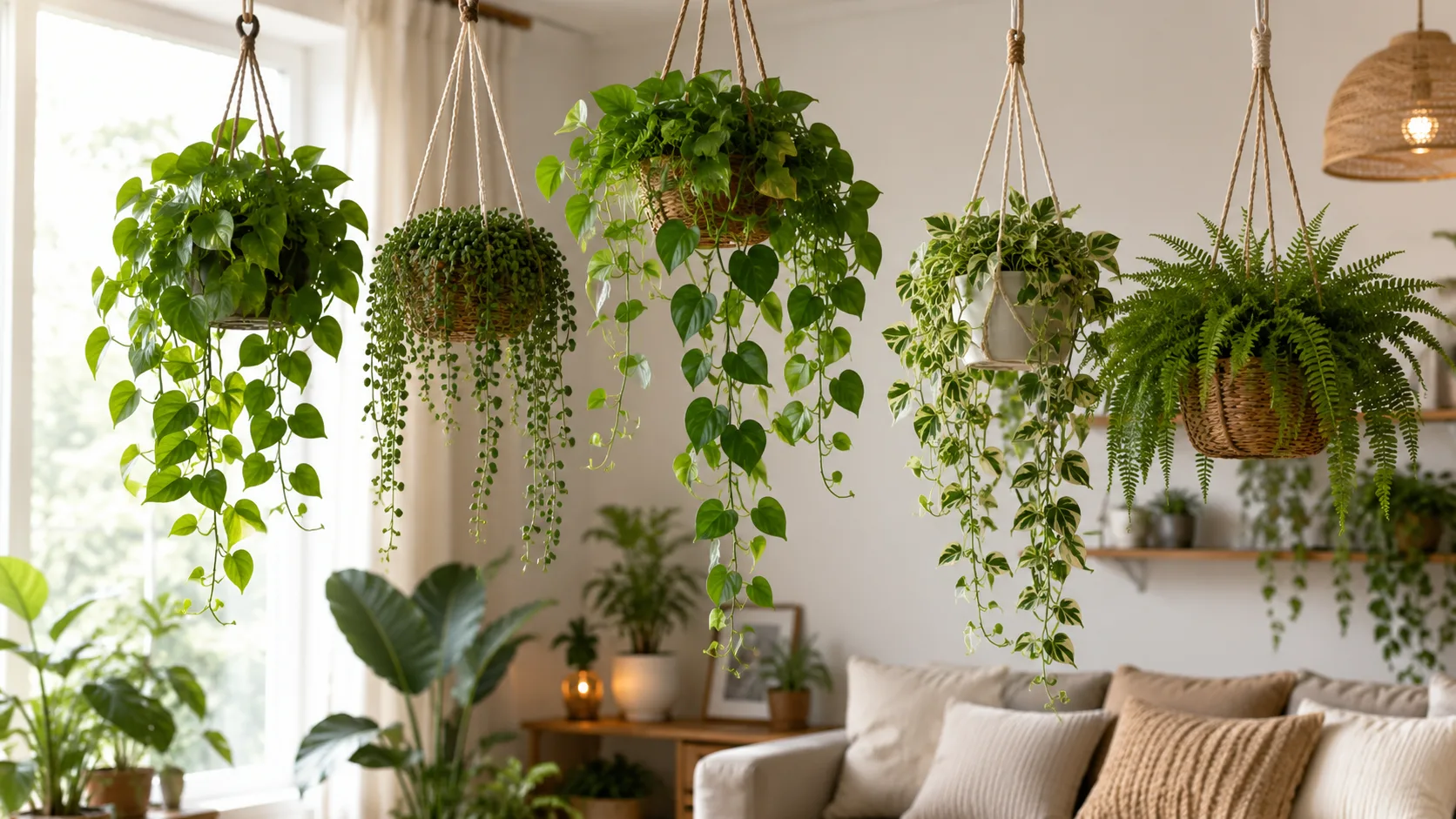
The best indoor vining plant depends on two things: the light you actually have and whether you want a soft cascade or a plant that climbs upward. A bright window can support silver foliage, flowering hoyas, and string plants, while a lower-light room is usually a better match for forgiving pothos or heartleaf philodendron than for a succulent-like vine.
This list includes 22 plants for hanging baskets, shelves, bookcases, and freestanding supports. Use the care notes as a starting point, then adjust for pot size, season, airflow, and how quickly your potting mix dries. “Water weekly” is rarely as useful as knowing what the root zone should feel like.
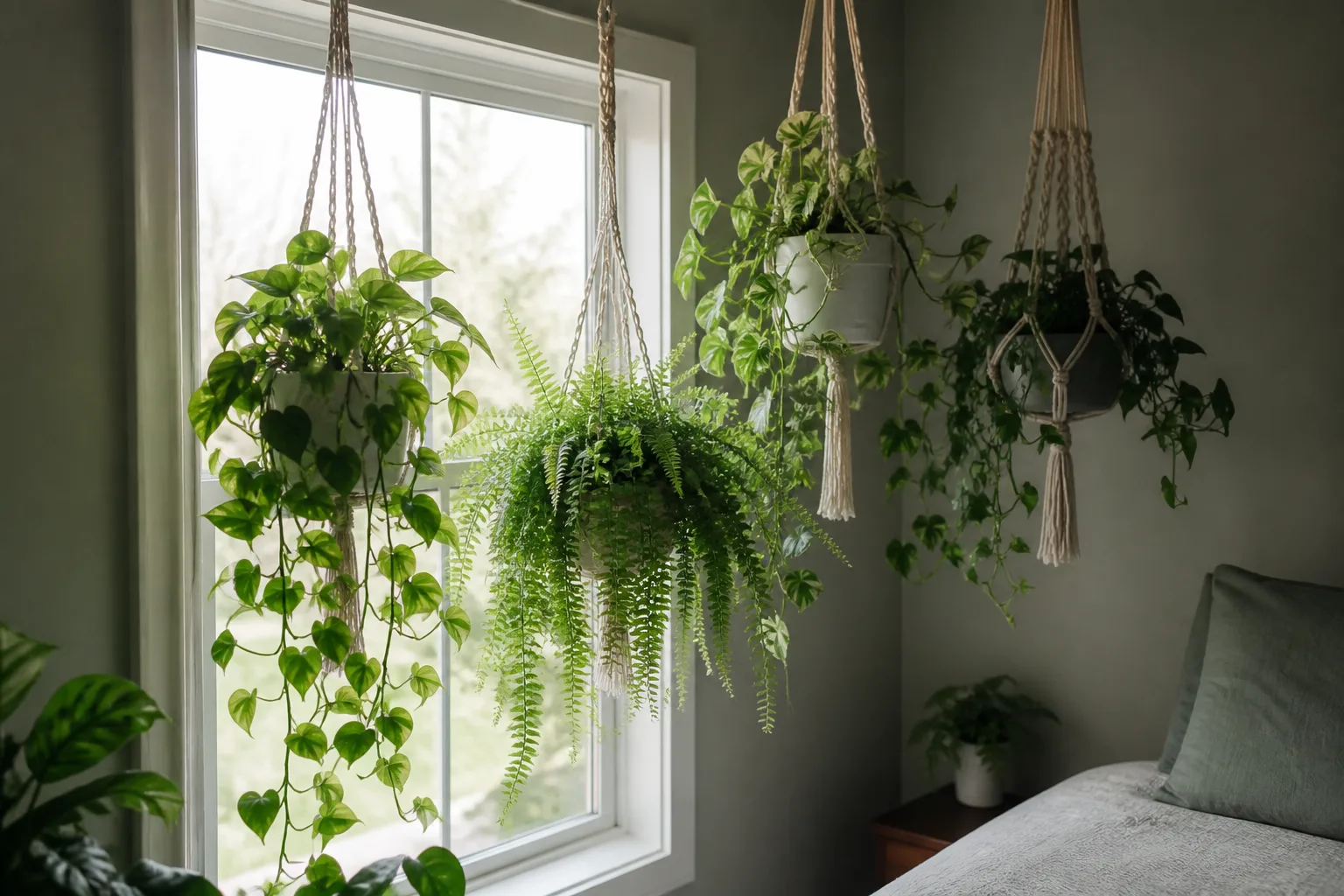
Choose an indoor vine by light, habit, and household
Start with the brightest practical spot you can offer without putting a plant against hot glass. Most tropical foliage vines prefer bright, indirect light; variegated leaves generally need more light to hold their pattern, while string plants and many hoyas can use several hours of gentle direct or filtered sun. A dim corner may be survivable for a pothos, but survival is not the same as dense, colorful growth.
For a quick match, choose a trailing pothos, heartleaf philodendron, or spiderwort when you want movement over a shelf or basket. Choose Monstera, mini monstera, a vining philodendron, or English ivy when you want to train growth around a support. Choose string of pearls, string of hearts, string of dolphins, or string of bananas for a fine-textured cascade near a bright window, provided you can resist frequent watering.
Household safety deserves a separate check before purchase. The ASPCA plant database is organized by plant names and warns that its list is not all-inclusive, so verify the exact botanical name and cultivar. As a conservative rule, keep pothos, philodendrons, Monsteras, mini monstera, satin pothos, arrowhead plants, Tradescantia, and English ivy away from pets and children who chew; ASPCA identifies golden pothos and English ivy as toxic. Hoya carnosa, Hoya kerrii, and trailing peperomia are safer starting points in the ASPCA listings, but common names can conceal a different species. If a pet eats a plant, contact a veterinarian or animal poison service rather than waiting for symptoms.
Trailers, climbers, and the support decision
Trailing plants send stems over the edge of a pot; climbing plants use a support to turn length into height and larger foliage. Pothos and heartleaf philodendrons can do either, but a hanging basket encourages a cascade, while a pole or trellis lets their nodes root against a surface and present leaves more evenly. Monsteras and mini monsteras look dramatically better when supported early, before a long stem becomes heavy and difficult to reposition.
Use a freestanding trellis, moss pole, coir pole, or sturdy stake for a climber. Do not rely on aerial roots to hold a large Monstera against painted drywall, and do not hang a saturated ceramic pot from a hook that was not rated for its full weight. Leave room for the vine to grow, keep leaves from blocking a walkway, and check the attachment points whenever you water.
22 indoor vining plants worth growing
The plants below are grouped by the way they grow and the conditions they prefer, not by a ranking. The botanical names are included because labels such as “pothos,” “mini monstera,” and “string of bananas” are often used loosely in shops.
Easy foliage vines for beginners
These are the broad-leaved choices for someone who wants visible growth without building a specialized setup. They still need a draining pot and a light level that matches the leaf pattern, but they are more forgiving of an imperfect watering routine than most string plants.
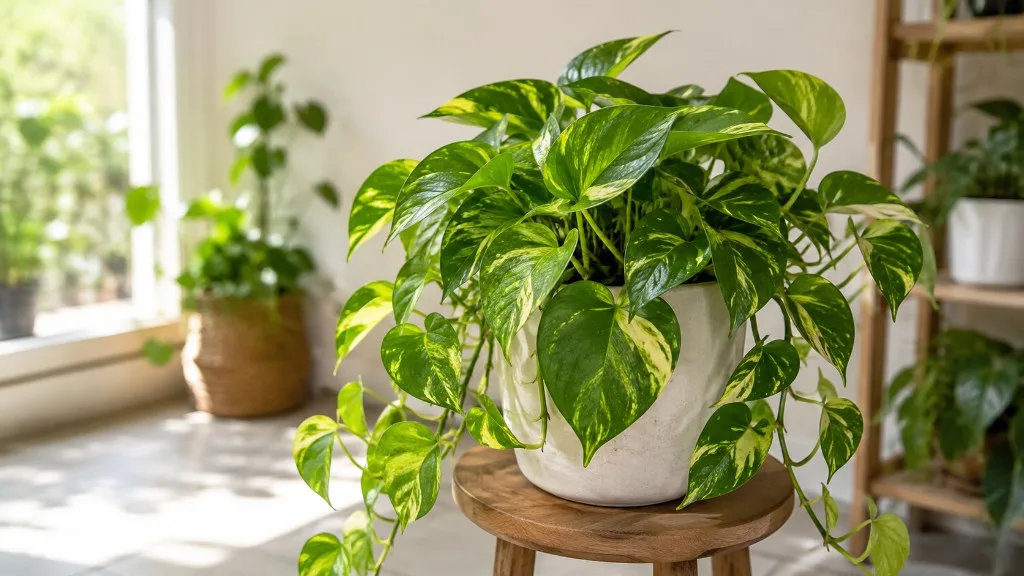
Pothos and philodendrons: forgiving foliage with different habits
1. Pothos (Epipremnum aureum) is the classic shelf and hanging-basket vine because it tolerates a wider range of indoor light than many houseplants. Give it bright, indirect light for faster growth and stronger variegation, or use it as a low-light option with the expectation of slower, greener leaves. Let the potting medium dry partway before watering, and prune just above a node to encourage branching. NC State Extension notes that pothos climbs with aerial roots and that low light can reduce variegation; the very long vines associated with the species are not a promise that one will fill a living room quickly.
2. Heartleaf philodendron (Philodendron hederaceum) has flexible stems and heart-shaped leaves that make an easy cascade from a bookcase. It prefers bright, indirect light but adapts to average indoor conditions; keep the mix lightly and evenly moist while allowing excess water to drain. The vining philodendron can also climb a small trellis, and its aerial roots make that transition more natural than trying to force a trailing stem upward with tight ties.
3. Brasil philodendron (Philodendron hederaceum ‘Brasil) adds lime and dark-green striping to the same generally forgiving heartleaf form. More light helps the variegation stay distinct, but harsh midday sun through glass can bleach or scorch leaves. Let the upper part of the mix dry before watering, rotate the pot so one side does not become bare, and trim long stems back to a node when you want a fuller basket. The NC State philodendron profile is a useful reminder that vining philodendrons are a broad group, not one uniform care formula.
4. Philodendron micans is a velvety-leaved heartleaf type with a darker, moodier look than Brasil. Its leaves show best in bright, indirect light, and sparse spacing between leaves is usually a sign that the plant needs more usable light rather than more fertilizer. Let the surface dry slightly, then water thoroughly; pinch or cut the longest stems to keep the plant from becoming a thin curtain.
Monstera, Swiss cheese vine, and mini monstera
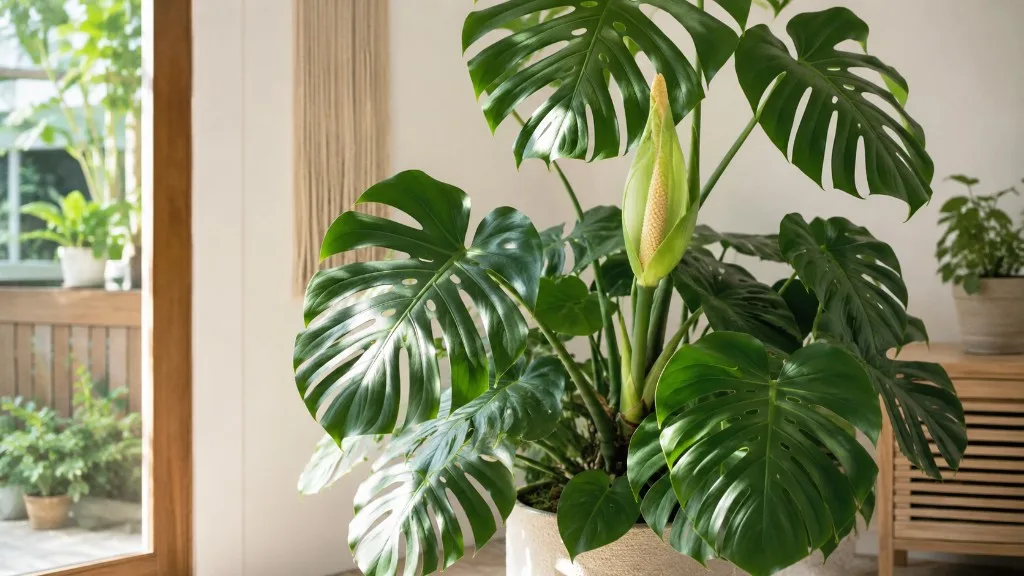
5. Mini monstera (Rhaphidophora tetrasperma) is not a Monstera, despite its common name. It is a fast, climbing aroid from a different genus, and NC State Extension recommends bright, indirect light, a well-drained moist mix, warmth, and support. Water when the top inch is dry, provide a trellis or totem before the stems sprawl, and expect a plant that can outgrow a small shelf quickly.
6. Monstera deliciosa brings large, split leaves and a strong vertical silhouette once it has something to climb. Indoors it is often much smaller than the species’ outdoor potential, but it still becomes broad, heavy, and difficult to turn around after years in a narrow corner. Give it moderate to bright indirect light, water after roughly the top quarter to one-third of the mix dries, and use a sturdy support; NC State’s plant profile also describes the plant as a climbing vine with aerial roots.
7. Swiss cheese plant (Monstera adansonii) has smaller leaves filled with natural holes and usually makes a more manageable climber than Monstera deliciosa. It prefers bright, indirect light, warmth, humidity, and a moist but well-drained mix; NC State Extension gives an indoor range of roughly 3 to 8 feet tall with support. A moss pole or narrow trellis helps it produce a deliberate column instead of a loose tangle, and good airflow matters when leaves are frequently misted or splashed.
8. Monstera Peru (Monstera karstenianum) is sold for its thick, heavily textured leaves rather than dramatic holes. It can stay more compact than the larger Monsteras, but bright, indirect light helps it keep firm leaves and shorter gaps between nodes. Let the upper layer of the mix dry, provide a small support if the stems lean, and confirm the botanical name when buying: “Peru” is a trade name that can be applied inconsistently.
Silver and patterned climbers
Patterned vines reward placement. Their silver markings are easiest to appreciate when leaves are close enough to eye level, while an overly dim spot can produce long spaces between leaves and a duller display.
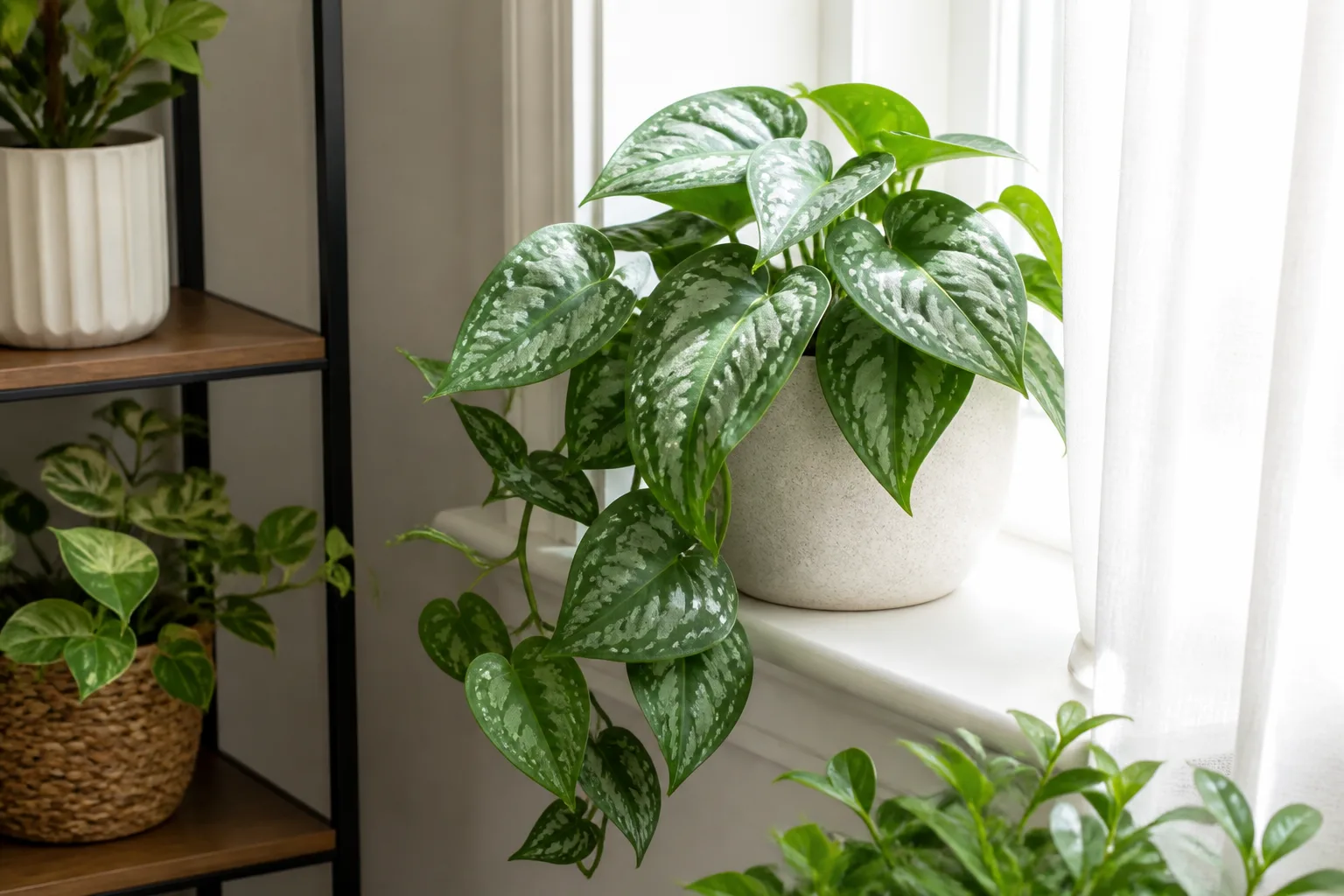
Satin pothos and the two Scindapsus choices
9. Satin pothos (Scindapsus pictus ‘Exotica’) is not a true pothos; it is a silver-marked Scindapsus with larger leaves and a slower, more deliberate pace. Give it bright, indirect light, let the mix dry somewhat between waterings, and keep it warm with reasonable humidity. It can trail, but a small trellis displays the leaves more evenly and prevents the vine from hiding its patterned surfaces.
10. Scindapsus pictus ‘Argyraeus’ has the same species identity but typically presents smaller leaves and more distinct silver spotting. Treat it much like Exotica, with bright filtered light and a pot that drains freely. Because it grows more slowly than common pothos, avoid “catching up” with extra water or fertilizer when a cutting appears unchanged for a few weeks.
11. Scindapsus treubii ‘Moonlight’ has thick, pale, silvery-green leaves and a tidy, architectural look. It is a good choice for someone who likes the Scindapsus texture but does not need a fast cascade. Provide bright, indirect light, allow the surface to dry before watering, and use a narrow support or shelf edge; its thick leaves do not mean the roots should sit in a wet pot.
Stringing plants for bright windows
String plants are often sold as easy hanging plants because their stems spill beautifully, but their small leaves and shallow-looking containers can disguise a serious watering problem. Use a pot with a drainage hole, give them brighter light than a typical low-light vine, and check the mix before each watering.
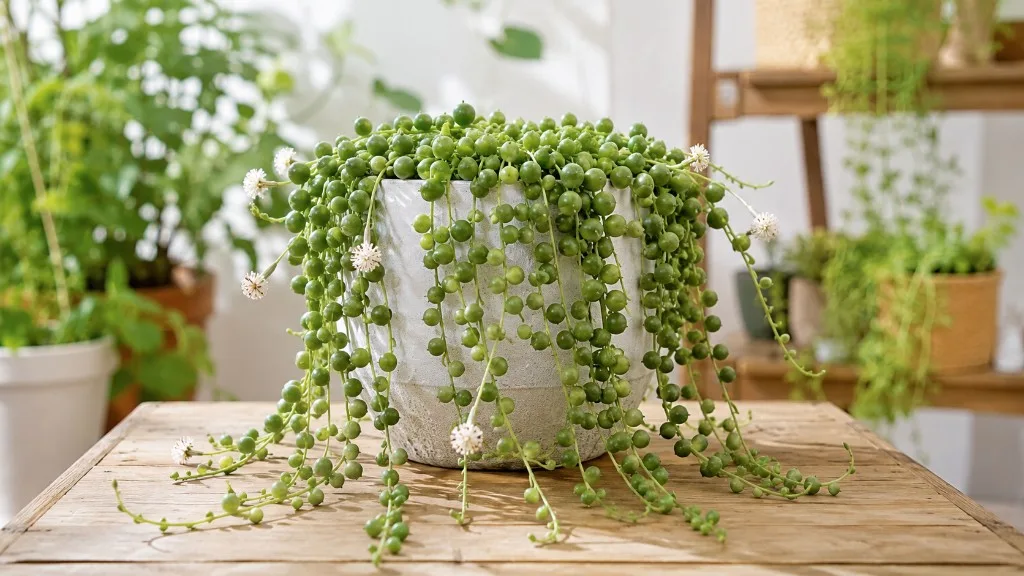
String of pearls, hearts, dolphins, and bananas
12. String of pearls (Senecio rowleyanus, often sold as Curio rowleyanus) wants a bright window and a light, fast-draining mix. Several hours of bright light, including gentle morning sun, helps keep the pearls compact; water thoroughly only after the mix has dried substantially. The pearls become slightly puckered when the plant is using stored water, but a shriveled strand can also reflect damaged roots, so do not solve every wrinkle with more water.
13. String of hearts (Ceropegia woodii) makes thin, heart-shaped leaves on delicate trailing stems. It behaves like a succulent, so use a porous mix and let it dry most of the way before watering, while still giving it enough bright, indirect light to prevent long gaps. It looks beautiful over a high shelf, but keep strands away from fans, doors, and curious pets because the vines break more easily than pothos stems.
14. String of dolphins (Senecio peregrinus, often sold as Curio peregrinus) needs a bright location and a restrained watering routine. The dolphin-shaped leaves are most distinctive when growth is compact; insufficient light can flatten the effect and stretch the stems. Let the mix dry well, water around the root zone rather than repeatedly wetting the foliage, and choose a shallow but stable pot that will not tip as the vine lengthens.
15. String of bananas (Senecio radicans, often sold as Curio radicans) has curved, banana-like leaves and similar needs to string of dolphins. Give it bright filtered or gentle direct light, gritty drainage, and a full dry-down between thorough waterings. It is a better match for a sunny sill than for a dim bathroom; if the stems lengthen without much leaf growth, improve light before adding feed.
String of turtles and string of nickels
16. String of turtles (Peperomia prostrata) is a slower, small-leaved trailer with patterned leaves that resemble tiny shells. Unlike the driest string succulents, it appreciates a little more regular moisture: let the top few inches dry, then water a well-drained mix without leaving the pot in a saucer of water. ASPCA lists trailing peperomia as non-toxic to dogs and cats, but confirm the plant’s identity if pet safety is the reason you chose it.
17. String of nickels (Dischidia nummularia) has round, coin-like leaves on trailing stems and an epiphytic growth habit. An airy, chunky mix with good airflow is safer than dense garden soil, and bright, indirect light with some gentle morning light encourages fuller growth. Water when the mix has dried partway, then let it drain completely; this plant wants access to air around its roots as much as it wants moisture.
Flowering and colorful trailers
These choices add either flowers or strong foliage color, but both respond noticeably to light. A plant can remain alive in a dim room while producing fewer blooms, duller stripes, or longer spaces between leaves.
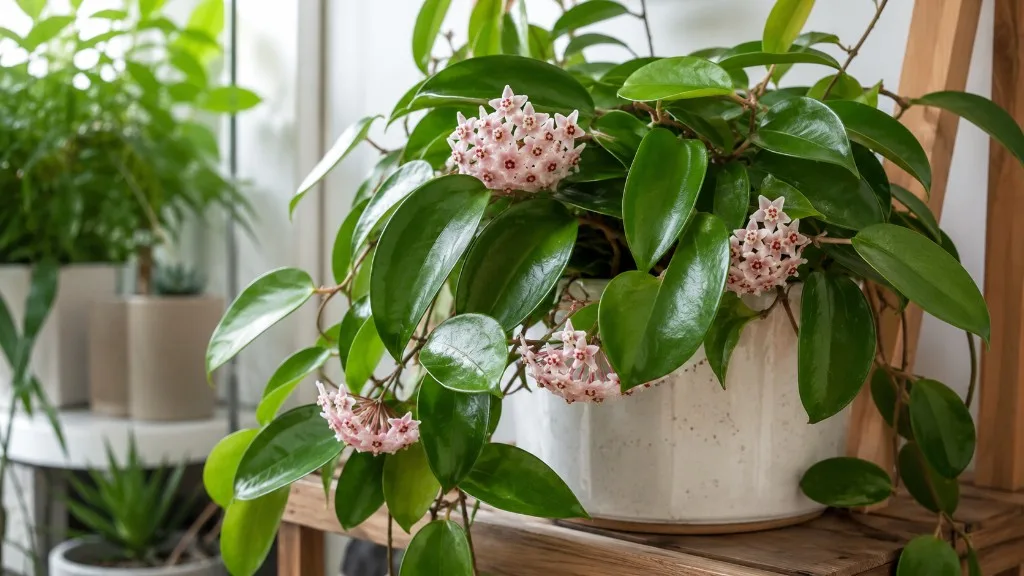
Hoyas and spiderwort
18. Hoya carnosa has thick, waxy leaves and can trail from a basket or climb a hoop. Bright, indirect light or filtered sun is the best starting point for compact growth and eventual flowering; let the mix dry well between waterings and use a pot that drains freely. Hoyas often tolerate being slightly root-bound, so repotting into a much larger container is usually a bigger risk than keeping the existing pot for another season.
19. Hoya compacta (Hoya carnosa ‘Compacta) has twisted, rope-like leaves and a slower, more sculptural habit. Give it the same bright placement and careful watering as Hoya carnosa, but avoid repeatedly bending or untangling the brittle, curled stems. If flowers are the goal, prioritize strong light and steady care; moving the plant frequently or keeping the roots wet will not speed up blooming.
20. Spiderwort (Tradescantia) includes fast-growing trailing plants with striped, purple, pink, or green foliage. Bright, indirect light keeps the color stronger, while regular pinching encourages the branching that makes a basket look full instead of stringy. Let the upper layer of the mix dry between waterings, keep the plant warm, and treat Tradescantia as a plant that benefits from frequent renewal cuttings rather than one that must be preserved at its original length.
Arrowhead plant and English ivy
21. Arrowhead plant (Syngonium podophyllum) starts with arrow-shaped leaves and can develop more lobed foliage as it matures. It works as a trailer when young and as a climber when given a moss pole or trellis, with bright, indirect light and a consistently lightly moist but well-drained mix. Better Homes & Gardens notes its vigorous growth and support potential; keep it away from pets and prune before the stems take over a narrow walkway.
22. English ivy (Hedera helix) brings classic small leaves to a hanging basket or cool, bright room. Bright light without harsh midday exposure helps it hold a compact shape, and smaller-leaved cultivars are generally easier to manage indoors than oversized forms. Keep the mix from becoming bone-dry for long periods, but do not leave the roots saturated; inspect the undersides of leaves regularly and prune long stems to maintain a dense outline. The ASPCA English ivy entry makes pet placement especially important.
A care system that works across the list
The simplest reliable system is to group plants by how quickly their root zone should dry, then check the pot rather than the calendar. A hanging pot can dry faster than a matching pot on a shelf, and a large Monstera can stay wet much longer than a small string plant in the same room. Rotate plants occasionally so every side receives usable light, but avoid moving a stressed plant from shade to direct afternoon sun in one jump.
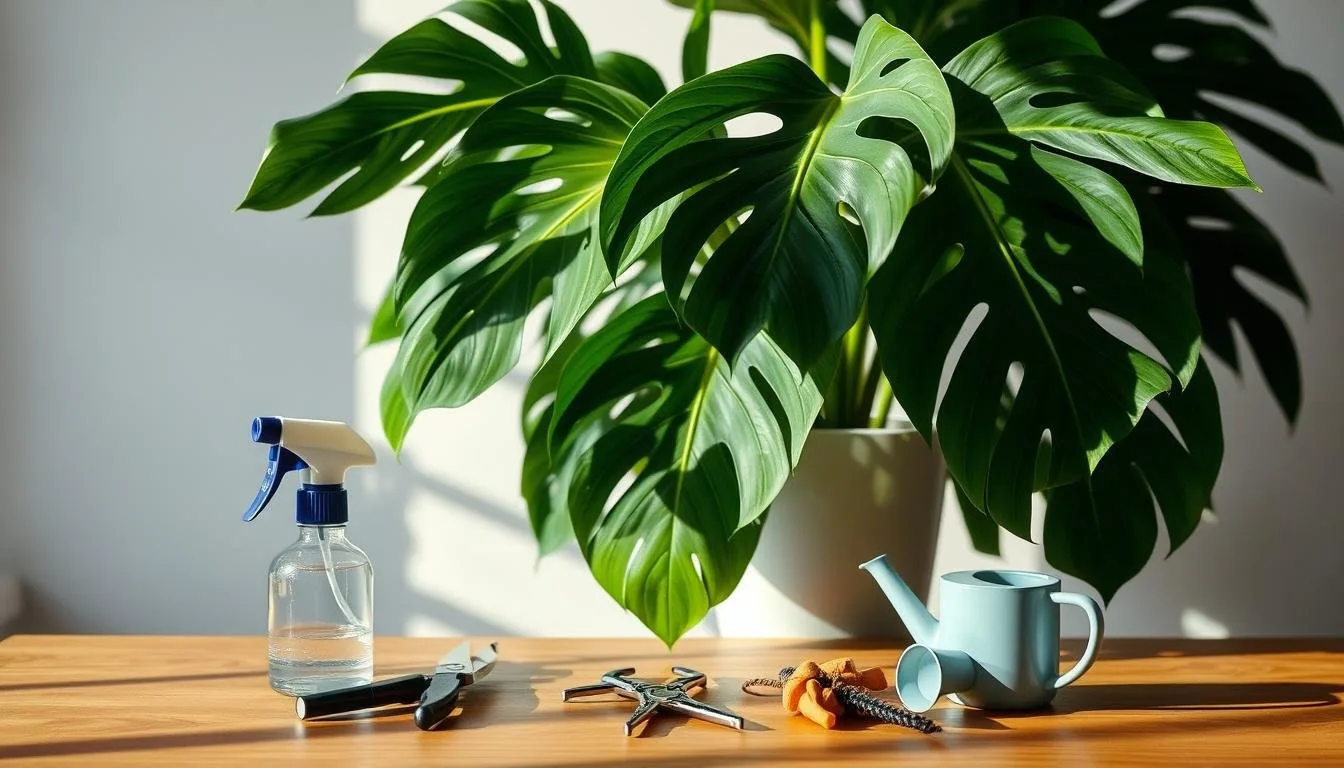
Watering and soil: read the root zone, not the calendar
Use a pot with a drainage hole and water slowly enough that the whole root ball is moistened. For most tropical aroids—pothos, philodendrons, Monsteras, and arrowhead plants—wait until the upper inch or two feels dry, or until roughly the top quarter to one-third of the Monstera mix has dried, then water thoroughly and empty the saucer. NC State Extension’s Monstera guidance and its pothos profile are useful anchors, but your pot and room still determine the interval.
String of pearls, string of hearts, string of dolphins, and string of bananas need a longer dry period in a porous mix. Hoyas also prefer a meaningful dry-down, while string of turtles, Tradescantia, English ivy, and arrowhead plants usually look better when they are not left bone-dry for extended periods. When in doubt, feel below the surface with a finger or wooden skewer and check the pot’s weight; a dry surface alone is not proof that the full root ball is dry.
Top-watering until a little water drains out is a practical default for mixed collections because it flushes accumulated salts and confirms that water is moving through the medium. Bottom-watering is useful for some small pots, but it can leave salts behind or keep the lower root zone wet if the container sits in water; Garden Myths’ comparison of watering methods explains why there is no universally best technique.
Use an airy indoor potting mix rather than heavy outdoor soil. Most aroids do well in a moisture-retentive but draining blend; hoyas and string plants benefit from more mineral or chunky material; Dischidia is especially poorly matched with dense, slow-draining soil. A pot that is only one size larger than the root ball is easier to dry evenly than an oversized decorative container.
Bright light, a draining mix, and sensible watering solve more problems than a humidity gadget. Humidity can help tropical foliage and reduce stress in a dry room, but it cannot compensate for a dark location, waterlogged roots, or leaves that never dry because air cannot move around them.
Training, pruning, and repotting without damage
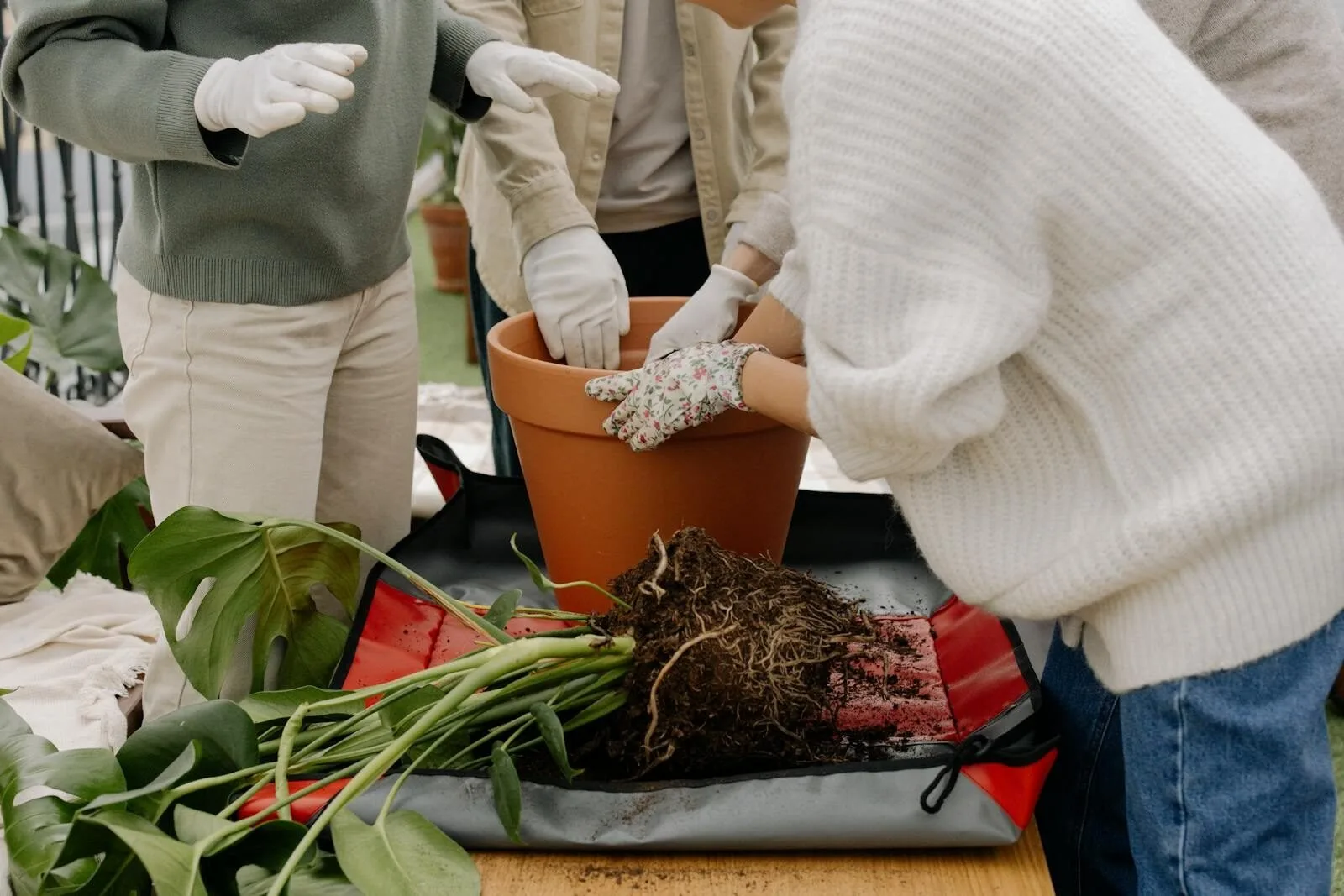
Install support while a climbing plant is still manageable. Place the pole or trellis close to the active stems, secure them with soft, loose ties, and guide new growth gradually rather than bending a woody or heavy stem sharply. For Monsteras and mini monsteras, a freestanding support is safer and more useful than trying to make aerial roots adhere to a wall.
Prune above a healthy node with clean, sharp shears when a vine has become bare, lopsided, or too long for its display. Pothos, heartleaf philodendron, Brasil, spiderwort, and English ivy can usually be made fuller by rooting healthy cuttings and planting several rooted pieces back into the pot. String plants have finer, more fragile stems, so shorten them selectively and handle the strands by the pot rather than pulling on the cascade.
Repot when roots circle densely, emerge from drainage holes, the mix has collapsed, or the plant dries dramatically faster than it used to—not simply because a year has passed. Spring or another period of active growth is usually the least disruptive time, but correcting a pot that stays wet is more urgent than waiting for a perfect season. After repotting, water the new mix evenly, return the plant to bright indirect light, and avoid stacking several major changes at once.
Common indoor-vine problems and the first fix
Long gaps between leaves, small new leaves, or a vine that reaches toward one window usually point to insufficient usable light. Move it closer to a bright window or add a suitable grow light, then prune and propagate the bare sections; adding fertilizer to a light-starved plant usually produces longer, weaker growth rather than a fuller vine.
Yellow lower leaves need a root-zone check before any diagnosis. If the mix is wet for many days, pause watering, confirm the drainage hole is open, and inspect for mushy roots if the decline continues. If the mix is bone-dry and the leaves are crisp, water thoroughly and reassess the pot size, heat, and light. One old yellow leaf is different from a pattern of yellowing across new and old growth.
Brown, crisp margins can follow a missed watering, hot direct sun, dry air, or salt buildup. Look at the whole pattern: bleached patches on the window-facing side suggest excess light, while widespread crispy edges with a very light pot suggest drought. Trim damaged tissue for appearance, but correct the root-zone and placement issue first.
Mushy stems, a sour-smelling mix, or leaves dropping from a recently watered plant are stronger warnings of excess moisture and root damage. Remove standing water, isolate the plant, and inspect the roots if the pot remains wet; only healthy, firm roots should go back into fresh, appropriately sized mix. Do not keep adding water because a wilted plant looks thirsty—damaged roots can wilt in saturated soil.
For pests, quarantine a new or declining plant and inspect leaf undersides, nodes, and the point where stems meet the soil. Wash accessible foliage, remove heavily affected growth, and use only a treatment labeled for the plant and pest, repeating it as directed. Good airflow, clean tools, and fewer crowded pots make it easier to notice a problem before a long vine becomes a tangled hiding place.
If growth is healthy but slow, first ask whether the plant is a naturally slower choice such as a Scindapsus, Hoya, or string of turtles. Feed only during active growth and follow the product label; more fertilizer cannot replace the light, drainage, and seasonal warmth that control most indoor-vine growth.
Conclusion
For the easiest start, choose pothos or heartleaf philodendron and decide whether you want the stems to trail or climb. For a bright window, consider a Hoya, Scindapsus, Monstera, or string plant; for a colorful cascade, Tradescantia is hard to overlook. Match the plant to the light, let the root zone dry at the pace that plant requires, and add support before the vine becomes heavy. That small amount of planning is what turns an indoor vining plant from a loose green tangle into a deliberate part of the room.