How to Use a Homemade Weed Killer With Vinegar
Learn how to use vinegar as a homemade weed killer, when 5% vinegar works, why it fails on roots, and which plants, lawns, and surfaces to avoid.
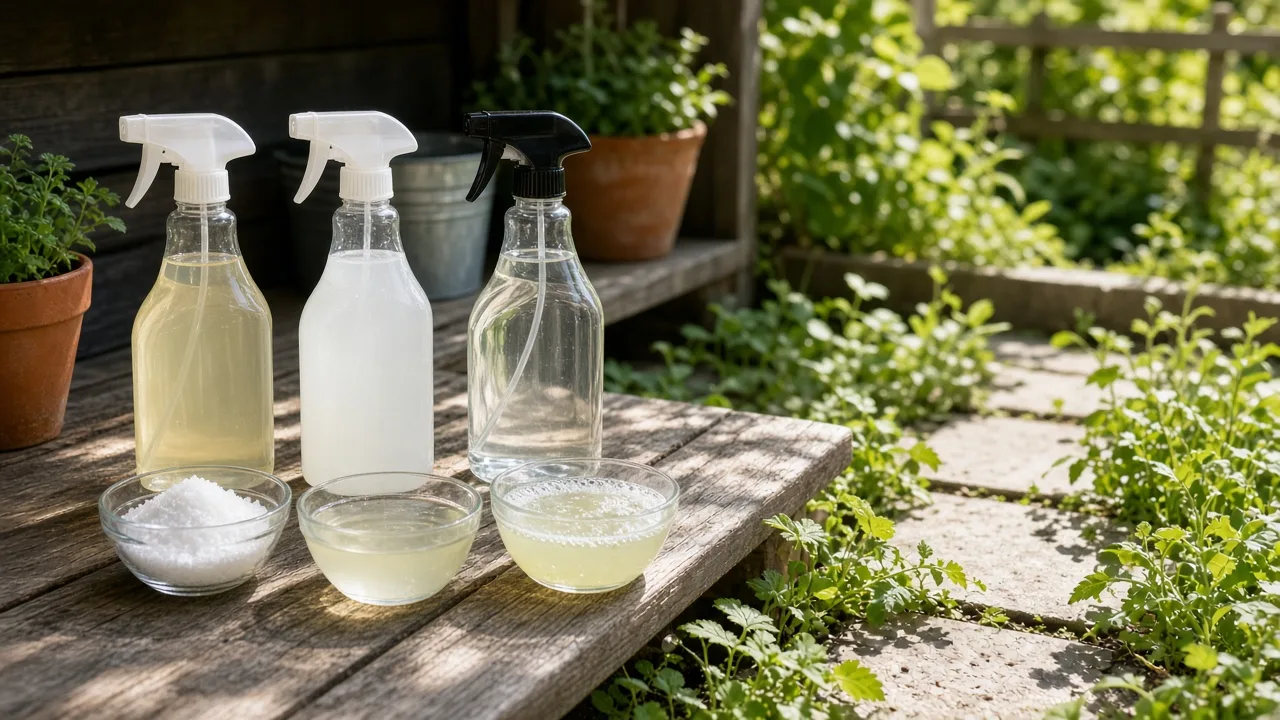
Vinegar can kill a small weed, but it is not a magic spray and it is not a lawn-safe herbicide. The acid in vinegar burns the plant tissue it touches, so it can be useful for a few young weeds in an isolated sidewalk crack or other bare hardscape. The same property makes it capable of injuring grass, flowers, vegetables, shrubs, and any other green plant in its path.
The most useful homemade weed killer with vinegar is therefore a careful spot treatment, not a blanket recipe for the garden. Use household white vinegar only where a little collateral damage will not matter, reserve concentrated horticultural vinegar for products with clear labels and protective-equipment instructions, and switch to pulling, hoeing, mulching, or covering when the weed is beside a plant you want to keep.
The short answer: vinegar can kill weeds, but it is a contact treatment
Vinegar contains acetic acid. When the solution wets a leaf, it can disrupt cells, causing the exposed tissue to lose water and turn limp or brown. You may see a dramatic response within a day or two, especially in hot, bright weather, but quick browning only proves that the leaves were injured.
It does not prove that the weed is dead. Montana State University Extension describes acetic acid as a contact, nonselective herbicide: it affects the tissue it touches, does not move through the plant to the roots, and provides no meaningful residual control in soil. That is why vinegar can finish a two-leaf seedling yet merely knock back a mature dandelion, thistle, bindweed, or grass.
What vinegar actually does to a weed
The temptation is to judge a weed killer by the speed of the visible result. Vinegar often appears successful because foliage can collapse quickly, while the underground part of a perennial remains out of sight. A better test is whether the plant regrows and whether new seedlings appear in the same site.
Contact injury is not the same as root control
A contact treatment is a surface tool. It works best when the entire target is exposed and the spray reaches the leaves and growing point, but it has little leverage over a taproot, crown, rhizome, stolon, or tuber below the soil. Leaves that are shielded by the plant’s shape, covered by dust, or missed by the spray can continue feeding the root system.
That distinction matters most with established perennials. A mature dandelion may lose its leaves and return from its taproot. Canada thistle can produce new shoots from surviving roots. Bindweed and nutsedge have underground structures that make repeated top-kill frustrating. Vinegar can still reduce the plant’s ability to flower or set seed, but it should not be sold to yourself as permanent control.
Why young annual weeds are the best targets
Young annual weeds have a small root system and depend heavily on their first leaves. Montana State Extension identifies the two- to four-leaf stage as a particularly vulnerable window because a thorough treatment can contact nearly all of the foliage and the growing point before the plant has built much underground reserve.
The practical rule is simple: the smaller and more isolated the weed, the better the case for vinegar. Young chickweed, purslane, spurge, or a small crabgrass seedling in a pavement joint is a more reasonable target than a flowering weed with a thick crown. If an annual has already set seed, remove the seed head and dispose of the plant instead of relying on a spray to solve next year’s problem.
Choose the site before you mix anything
Start with location, not ingredients. Ask what is around the weed, where the liquid will run, and what you want the space to look like after the leaves turn brown. This quick check prevents the most expensive mistake: killing a wanted plant while saving yourself only a few minutes of hand work.
Where a vinegar spot treatment makes sense
Vinegar is most defensible on a small, isolated target in a place where no wanted foliage is within reach. Examples include a few seedlings in a sealed concrete joint, a gravel area with no nearby ornamentals, or a bare edge beside a fence where you can direct every drop.
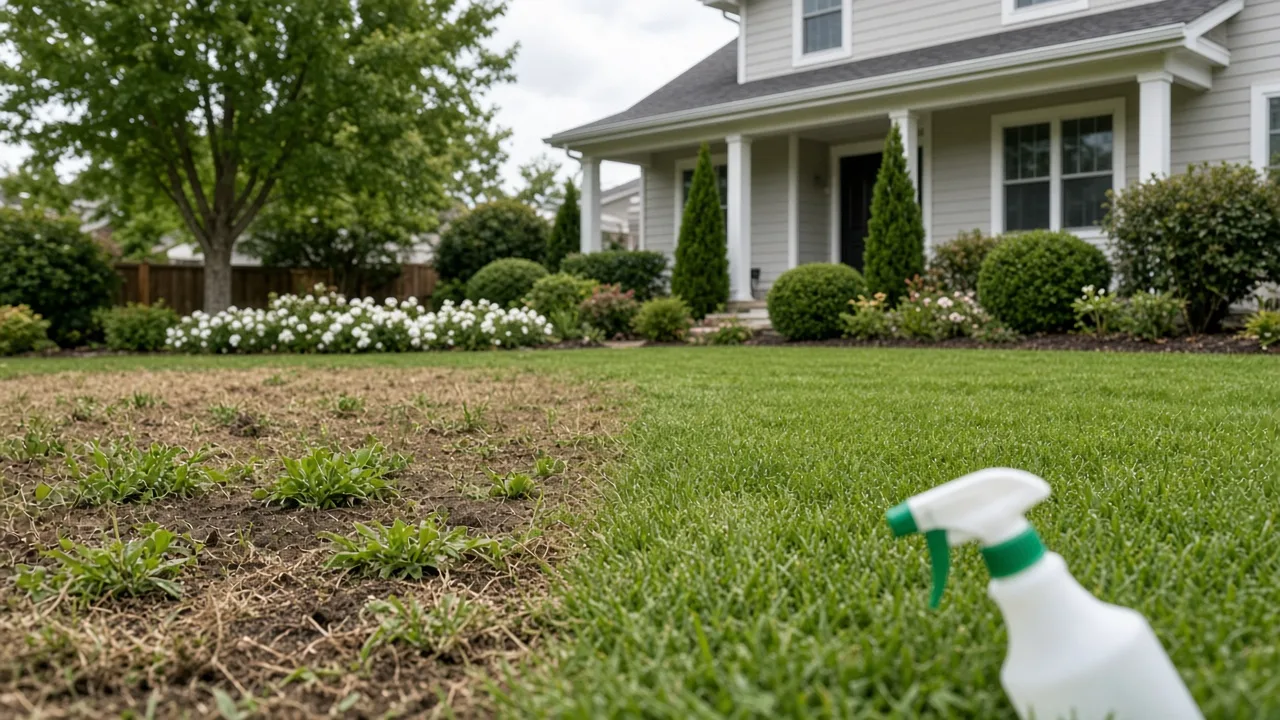
Even in these locations, look for drainage routes first. A crack may lead toward a flower border, a storm drain, a pond, or the roots of a street tree. If the weed can be pulled with a narrow weeder, scraping or digging is usually more controllable and leaves no question about acid drift.
Why lawns and planted beds are poor targets
There is no practical way for a homemade vinegar spray to tell a dandelion from the turf surrounding it. Purdue Consumer Horticulture calls vinegar-based products generally nonselective contact herbicides that can damage flowers, vegetables, and other plants as well as the weeds. Aiming carefully at the center of a lawn weed may still leave a brown ring or patch where droplets landed.
The same problem appears in flower and vegetable beds. Leaves may be separated, but roots overlap below the soil, and a single splash can injure a young crop or ornamental. In a planted bed, pull weeds after watering, hoe tiny seedlings just below the soil surface, or use mulch to block new emergence. The small amount of time saved by spraying rarely justifies the risk to the plants you chose.
Household vinegar versus horticultural vinegar
Read the acetic acid percentage before you decide what you are holding. Ordinary white household vinegar is commonly about 5% acetic acid, while herbicidal vinegar products may be 20% or 30% acetic acid or more. University of Illinois Extension makes this distinction directly: stronger solutions are more effective against young leaves and growing points, but they are not simply “better kitchen vinegar.”
Concentration changes the safety category as well as the weed response. Purdue notes that solutions at 11% or greater can cause skin burns and eye injury, while the Montana State material says 20% and 30% products are strong acids that require protective equipment. A product marketed as natural, organic, or plant-derived can still be dangerous to handle.
Do not make a high-strength formula by guessing at a ratio from a social-media post. If you buy horticultural vinegar, use a product that is labeled for herbicidal use where you live, follow its exact dilution and application instructions, wear the listed protective equipment, and keep people and pets away as directed. The label is part of the product; the acid percentage alone is not enough information.
A low-risk household vinegar spot treatment
For a tiny, isolated annual weed on expendable hardscape, use 5% white distilled vinegar at full household strength rather than trying to make a stronger solution in your kitchen. Diluting a low-strength product makes it less useful, while adding salt or several cleaners creates new risks without solving the root-control problem.
Use a dedicated trigger sprayer or a small paintbrush, waterproof gloves, eye protection, long sleeves, and closed shoes. Keep the bottle clearly labeled, never store the mixture in a food container, and do not use a sprayer that will later be used for edible crops or ordinary plant care without thorough cleaning.
If you want to improve wetting, a very small amount of plain, unscented dish detergent can help a liquid spread across a waxy leaf, but it is optional—not a requirement. Detergent formulas vary, and too much can increase leaf injury. I prefer leaving it out when the target is small enough to paint or wet with a close, controlled stream.
How to apply it without spreading the damage
- Identify the target and clear the area. Remove toys, bowls, tools, and pet items. Confirm that the green plant you are about to treat is not a seedling or ornamental you want to save.
- Choose a calm, dry window. Do not spray when wind can carry droplets or when rain, irrigation, or heavy dew will wash the treatment away.
- Wet the foliage, do not flood the ground. Spray from close range or paint the leaves until they are coated, stopping before liquid runs into the soil or across the hardscape.
- Protect the edge. Use a piece of cardboard as a temporary shield if a desirable plant is nearby, but do not assume a shield makes a windy application safe.
- Let the target dry and observe it. Browning may begin quickly, but wait several days before deciding whether the plant is finished. Pull any dead material and watch the exact spot for regrowth.
The goal is complete contact with a small amount of liquid. A fine mist increases drift, and a large pour wastes vinegar while expanding the area that can be injured. If you cannot clearly separate the weed from the plants or surfaces around it, do not spray it.
Weather and timing that improve results
Dry, bright weather generally gives a contact treatment a better chance to remain on the leaf and produce visible injury. Montana State Extension notes that hot, sunny conditions and good coverage improve acetic acid’s performance, while repeated applications are expected as new weeds emerge. A forecast of rain or irrigation soon after application is a reason to wait.
Do not confuse “sunny” with “spray during the hottest possible hour.” Work only when you can handle the bottle safely and the label permits the conditions. Avoid wind, and avoid spraying a drought-stressed weed if your purpose is to compare results; a stressed plant may respond unpredictably, and the treatment can still damage anything nearby.
Timing within the weed’s life cycle matters more than chasing a particular clock hour. Treat young weeds before flowering, seed production, or a large root reserve. For a mature perennial, remove the plant mechanically or choose a long-term plan instead of repeating a contact spray until the surrounding soil and hardscape have received unnecessary exposure.
The dish soap question and other recipe add-ins
Dish soap is often described as a surfactant because it can reduce surface tension and help a liquid spread. That does not make every dish detergent a safe or predictable herbicide adjuvant. Household products vary in concentration and additives, and a soapy spray can burn wanted foliage just as readily as vinegar.
Fine Gardening’s practical garden guidance treats vinegar as a nonselective tool that needs careful placement, while its broader organic weed-control advice emphasizes early removal and physical barriers. That is a useful hierarchy: coverage and site choice matter more than turning a simple spot treatment into a complicated pantry formula.
Skip salt, Epsom salt, bleach, ammonia, and random cleaners. Salt can persist and move with water, making soil harder to replant. Bleach can harm soil life and wanted plants, and mixing bleach with vinegar can release hazardous chlorine-containing gas. Epsom salt is magnesium sulfate, not a gentler weed killer, and adding it can create a nutrient problem after the weed is gone.
Why common homemade weed-killer recipes backfire
The most common failure is treating all weeds as though they have the same biology. A recipe that browns a tiny seedling looks persuasive, but the same mixture may leave a perennial’s crown alive, damage the turf around a dandelion, or ruin a nearby ornamental. The visible result is real; the conclusion is wrong.
Another failure is using too much liquid. Repeatedly wetting soil can move a mixture beyond the target, and a hardscape crack can carry runoff into planted areas or drains. Purdue’s weed-science guidance recommends considering the harm of home-garden herbicide use carefully because natural vinegar products can affect any green tissue they touch.
A third failure is choosing vinegar when the real problem is a gap. Weeds return because a joint is open, mulch is thin, a bed is bare, or seed is arriving from nearby plants. Killing the current leaves without closing the opportunity simply creates a recurring chore.
Match the method to the weed problem
Use the smallest tool that solves the actual problem. For one weed beside a rose, a hand weeder is safer. For a cluster in a sidewalk crack, scraping, boiling water, or a precise vinegar treatment may all be reasonable depending on who can safely perform the job. For a vacant bed, a light-blocking cover or cardboard-and-mulch system is usually more scalable than spraying each plant.
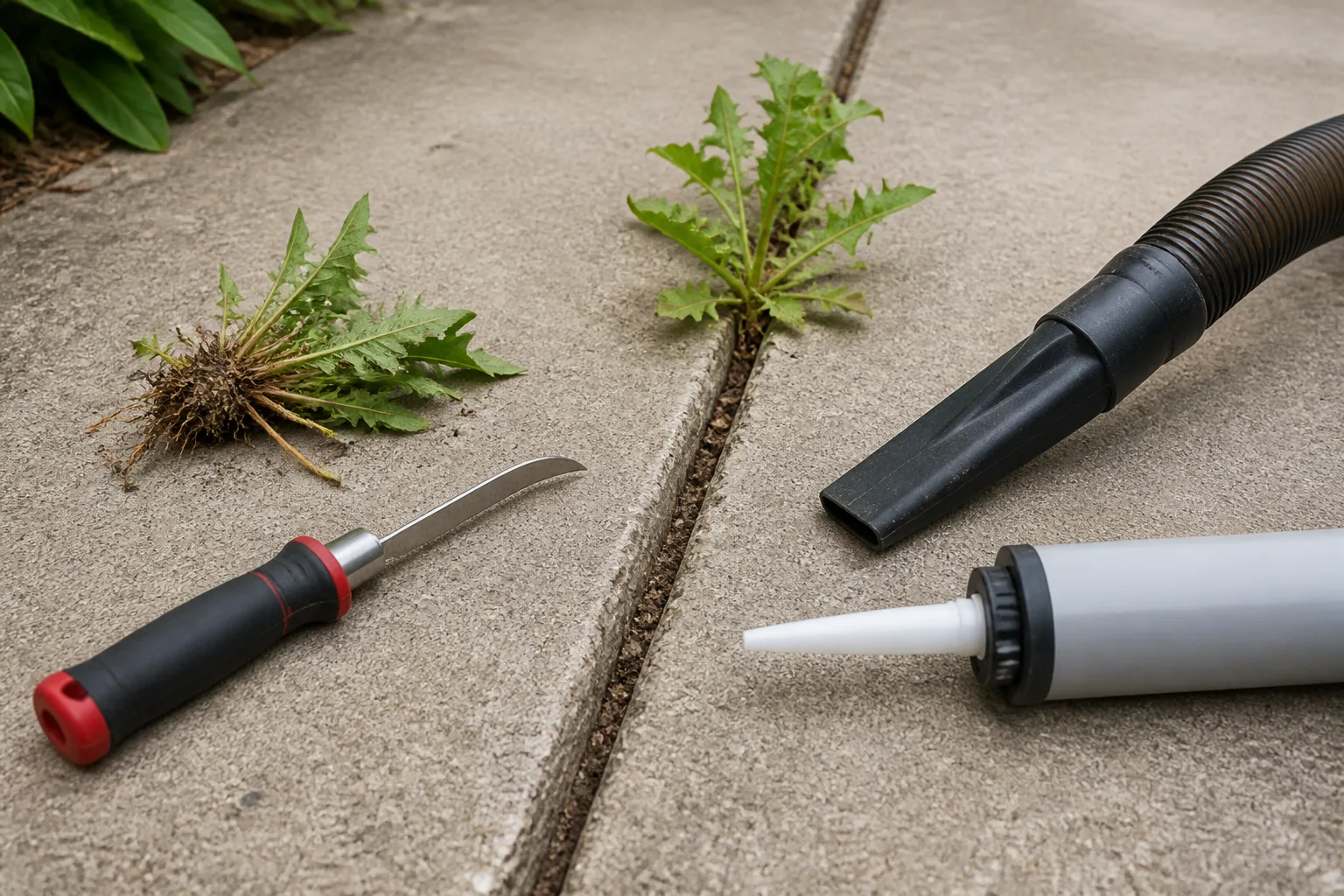
Here is a practical choice guide:
| Situation | Better first move | Why |
|---|---|---|
| One weed beside a wanted plant | Pull or dig | You can remove the target without risking foliage nearby. |
| Tiny annual in a sealed pavement crack | Scrape, pull, or carefully spot-treat | The target is isolated and the root system is small. |
| Several weeds in a lawn | Mow, dig, overseed, or use a selective labeled lawn product | Vinegar will injure turf because it is nonselective. |
| Weeds among vegetables or flowers | Hoe, hand-pull, mulch, or use a crop-labeled option | A homemade spray cannot protect the crop from drift or splash. |
| Large vacant patch | Cardboard, mulch, or an opaque cover | Blocking light handles many seedlings without repeated spraying. |
| Deep-rooted perennial | Dig, cut repeatedly, cover, or seek a site-specific plan | Top-killing alone rarely ends the root system. |
Savvy Gardening’s organic weed-control guidance reaches the same broad conclusion from practical experience: prevention, early intervention, mulch, and regular inspection outperform a single dramatic treatment. Vinegar belongs in that toolbox as a narrow option, not as the foundation of a whole-yard program.
Annual weeds and perennial weeds need different follow-up
Annual weeds complete their life cycle in one season. If you remove a young annual before it flowers, you prevent it from adding more seed to the soil. Vinegar can help on the right isolated seedling, but pulling is often faster when only a few plants are present.
Perennial weeds live for several seasons and store energy below ground. A brown top may be followed by fresh leaves from the crown, taproot, rhizome, or tuber. Inspect treated sites after a week and again after the next flush of growth; if new leaves appear, switch to digging, repeated cutting before flowering, light exclusion, or a product and timing plan specific to the weed.
USDA Agricultural Research Service research summarized by Purdue found that acetic acid controlled several weed species more effectively at higher concentrations and that older plants required more strength. The same research also reported temporary top-kill on Canada thistle because its roots survived. That combination—better foliage injury but persistent roots—is exactly why concentration does not replace diagnosis.
Safety, cleanup, and protection for nearby plants
Treat any weed-killing mixture as a pesticide for handling purposes, even if the ingredient came from a pantry. Wear gloves and eye protection, keep the spray out of your face, and wash exposed skin after the job. Never spray over your head, spray toward another person, or use a fine mist when a close stream or brush will work.
Concentrated horticultural vinegar needs stricter precautions. Read the signal word, first-aid information, storage rules, and re-entry instructions on the label before opening it. Do not assume that a product is safe because it says organic, natural, or vinegar-based; A Way to Garden’s interview with Montana State weed specialist Noelle Orloff makes the same point about serious eye and skin hazards from strong acetic acid.
Keep children and pets away until the treated area is dry and the label says it is safe to re-enter. Protect ponds, drains, edible crops, and pollinator plantings from spray and runoff. Vinegar breaks down quickly in soil and is not a long-lasting soil sterilant, but “short-lived” does not mean that a misdirected spray cannot injure a plant or contaminate a route to water.
After the foliage has died, remove the residue when practical. Sweep or rinse hardscape only in a way that will not carry the mixture into a drain or planting bed, and clean the sprayer according to the product instructions. If you used a brush, wash it separately from household cleaning tools.
Prevent weeds from returning after treatment
Prevention begins with the opening where the weed grew. In a pavement crack, remove loose soil and plant residue, then repair or refill the joint with a suitable material. In a gravel area, improve the edge and remove accumulated organic debris that creates a seedbed.
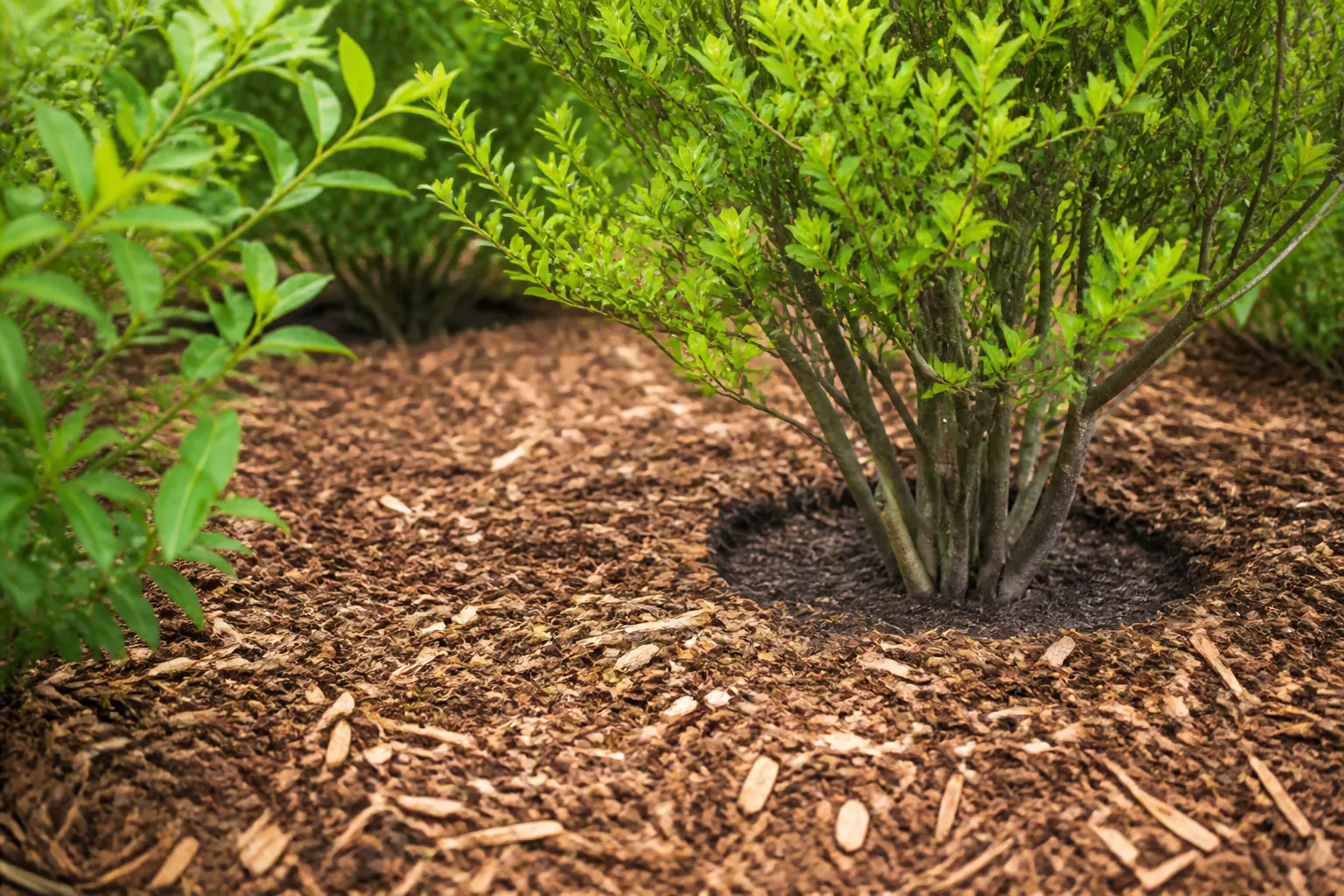
In garden beds, cover bare soil with an appropriate layer of mulch while leaving space around plant crowns and woody stems. Mulch will not stop every perennial or weed that arrives at the surface, but it reduces light and makes new seedlings easier to spot and pull. Dense, healthy plantings can also close the canopy and reduce empty ground.
Inspect weekly during the growing season. Pull annuals while they are small, remove seed heads before they mature, and do not till an established perennial patch unless you understand how fragments spread. Purdue weed scientist Stephen Meyers emphasizes weed-free inputs, suitable spacing, early intervention, and removing the whole plant; those habits prevent more work than any one bottle.
When to choose another approach
Do not use homemade vinegar weed killer when the target is mixed into a lawn, surrounded by vegetables, growing beside a prized shrub, or rooted in soil you plan to plant immediately. Do not use it as a shortcut for an invasive or poisonous weed that requires careful identification and disposal. Do not escalate to stronger acid just because a mature perennial survived the first spray.
Choose a labeled herbicide only after identifying the weed and confirming that the product is approved for the exact site and use. Follow the label rather than copying a kitchen ratio. For a large infestation, a weed with dangerous sap or spines, an invasive plant, or a problem near water, contact your local extension service for a site-specific plan.
The right answer may be no spray at all. A narrow weeder, a hoe used at the soil surface, a layer of mulch, an anchored opaque cover, or a few minutes of weekly inspection can be more effective and more selective than a homemade chemical treatment. Fine Gardening and Savvy Gardening both place mechanical removal and prevention at the center of low-impact weed management, and that is usually where a home gardener should begin.
Conclusion
Vinegar can be a useful homemade weed killer for a very small, young, isolated weed on expendable hardscape. Use ordinary 5% white vinegar as a close spot treatment, keep it off every plant you want to keep, work in calm dry weather, and judge the result by regrowth rather than by fast browning.
Skip vinegar in lawns and planted beds, avoid salt and hazardous cleaner combinations, and treat 20%–30% horticultural vinegar as a labeled high-strength pesticide product with serious handling requirements. When the weed is perennial, established, widespread, or growing beside valuable plants, pulling, digging, hoeing, mulching, covering, or getting a site-specific recommendation will usually give you better control with less collateral damage.