How to Grow and Care for Venus Flytrap Plants Indoors
Learn Venus flytrap care indoors: the right light, mineral-free water, soil, feeding, dormancy, repotting, and fixes for black traps.
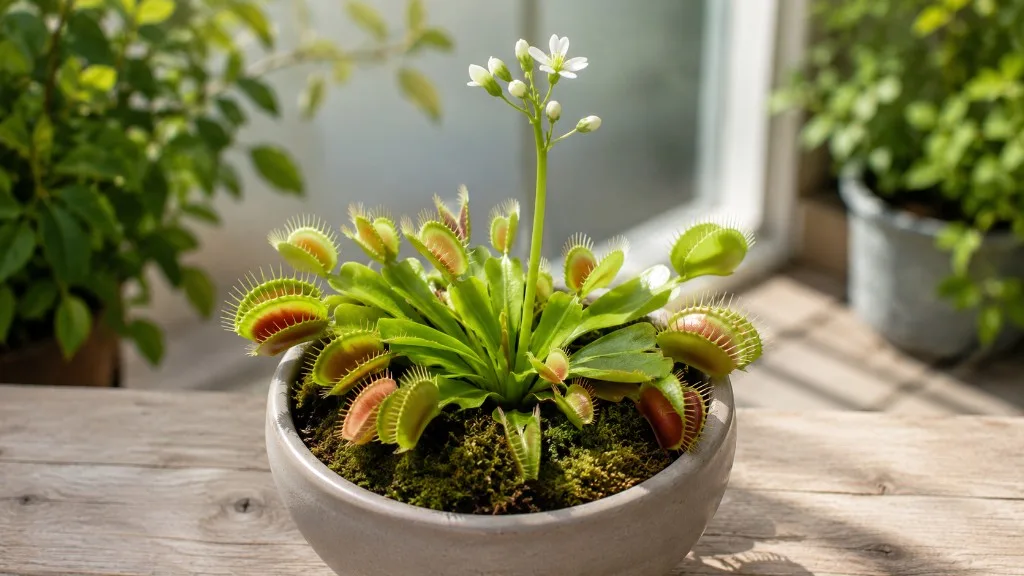
Venus flytraps are not miniature tropical plants that happen to eat bugs. Dionaea muscipula is a temperate perennial from a very small area of the coastal plain in North Carolina and northeastern South Carolina. It grows in wet, sunny, nutrient-poor habitat, and nearly every indoor-care rule follows from that origin.
That is good news for a beginner. You do not need a greenhouse, a complicated terrarium, or a constant supply of insects. You do need to get a few strict variables right: strong light, mineral-free water, unfertilized growing medium, reliable moisture, moving air, and a winter plan. Once those are in place, the plant becomes much less mysterious.
Start with the right setup
Before you worry about feeding, build the root environment. Use a plastic pot with drainage holes, a shallow water tray, and a nutrient-free carnivorous-plant mix. Put the plant in the brightest practical location you have, keep it away from hot or cold drafts, and reserve a cool place for winter dormancy if your home stays warm.
The minimum shopping list is short: a pot about 4 inches deep, unfertilized sphagnum-based medium, distilled or reverse-osmosis water, a saucer, and either a truly sunny window or a grow light with a timer. Skip fertilizer, compost, regular potting soil, decorative rocks mixed into the root zone, and sealed glass containers. Those additions solve problems for ordinary houseplants but create them for a flytrap.
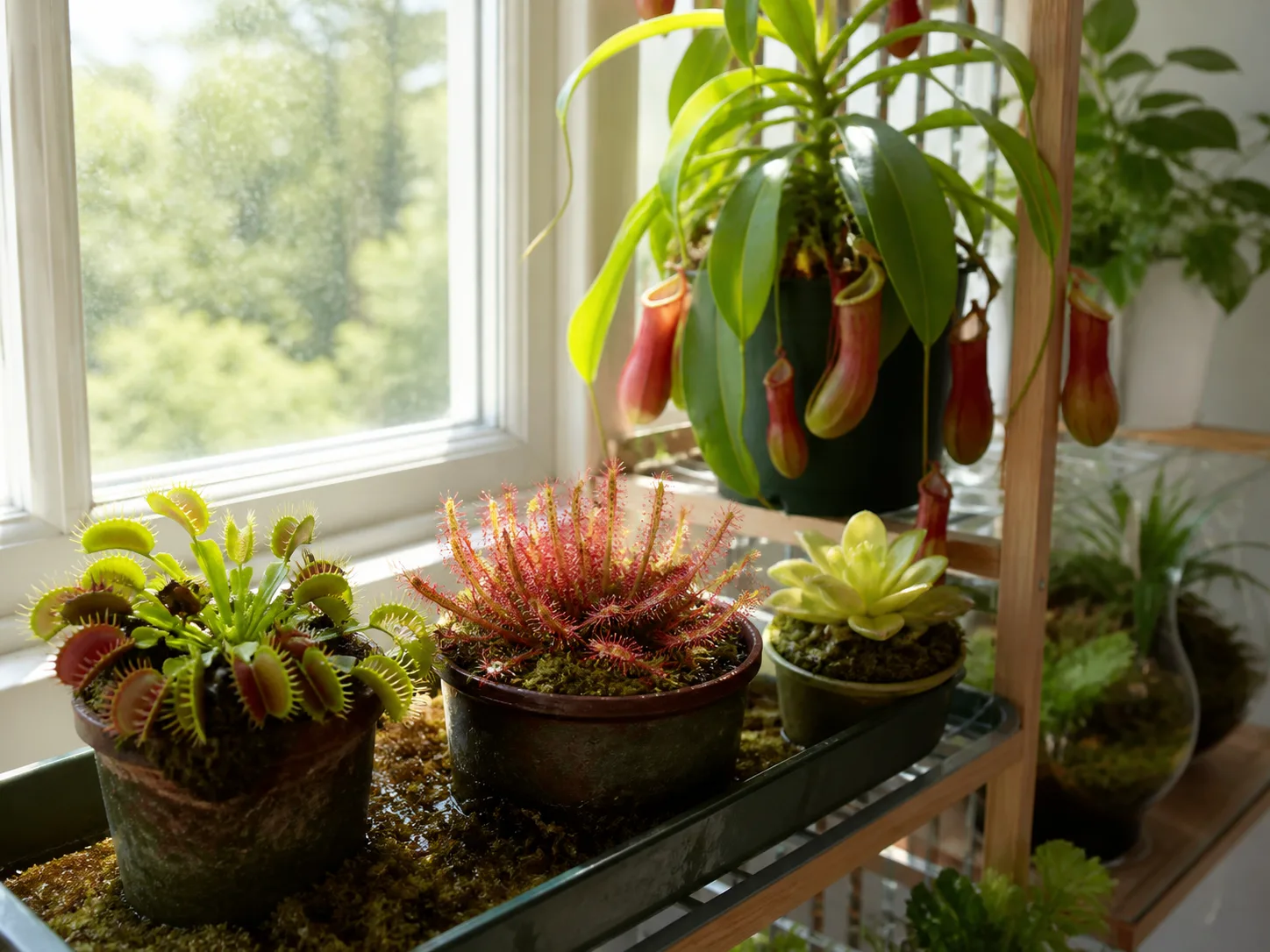
For a newly purchased plant, change as little as possible during the first week. Moving it from a dim store to intense sun, repotting it immediately, and changing its water and temperature at the same time can produce a flush of black traps even when each individual choice seems reasonable. Stabilize light and water first; repot only if the supplied medium is clearly unsuitable, contaminated, or drying out dangerously fast.
Why it needs unusual care
Photosynthesis supplies the plant’s energy, but its roots evolved in acidic, wet ground with very little available mineral nutrition. In that setting, insects provide nitrogen and other nutrients that ordinary plants usually obtain from soil. Carnivory is a supplement to photosynthesis, not a replacement for light.
The trap is a modified leaf, not a mouth in the mammal sense. A small insect must contact trigger hairs inside the open lobes, usually more than once in a short interval, before the trap closes. The struggling prey then helps stimulate the digestive process. Penn State Extension describes the active trap as two hinged lobes that seal around prey, with digestion taking several days before the trap reopens.Penn State Extension
This explains three common beginner mistakes. A trap that closes on a finger, toothpick, or falling leaf has spent energy without getting nutrition. A plant in weak light cannot be rescued with extra bugs. And fertilizer in the medium is not “food”; it is a concentrated mineral load in a root zone adapted to scarcity.
Choose the right plant, pot, and soil
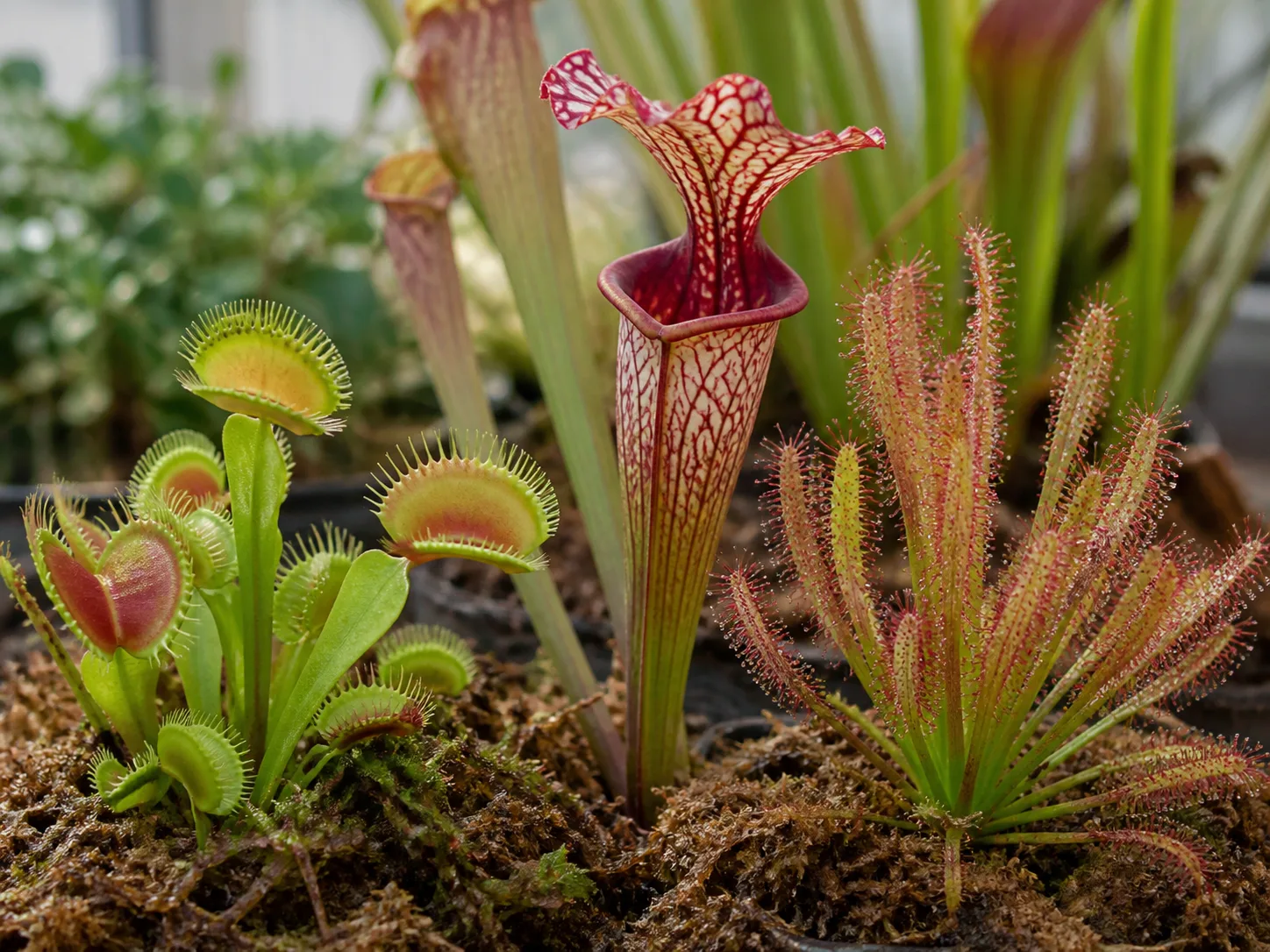
Buy a nursery-propagated plant from a reputable specialist or garden center. Wild collection is both harmful and, in some places, illegal. The species is native to a limited Carolina range under pressure from habitat loss, fire suppression, and poaching; UNC-Chapel Hill’s conservation reporting describes the importance of protecting both habitat and genetic diversity.UNC-Chapel Hill conservation reporting
Most healthy starter plants are small rosettes with a firm center, several green traps, and some older leaves that may already be browning. A few black traps do not automatically mean a bad plant. Avoid a crown that is soft, collapsing, foul-smelling, or detached from the medium, and be cautious with plants presented as “wild” or sold without a clear nursery source.
Pot and medium details that prevent slow decline
Use plastic, fiberglass, or another inert container with drainage. Glazed ceramic can work when the glaze is intact and the pot is not leaching material into the medium, but plastic is the simplest low-risk choice. A tall pot is useful because it buffers moisture and temperature changes around the roots; the plant does not need a huge diameter.
Make a simple mix from equal parts unfertilized sphagnum peat moss and perlite, or use long-fiber sphagnum with a little perlite for extra air space. Coarse horticultural silica sand can replace perlite if it is clean and free of lime, salt, and additives. Never use compost, manure, all-purpose potting mix, cactus mix, garden soil, or a product labeled “feeds for months.” Do not substitute beach sand or play sand unless you have verified its composition; unknown salts and fine particles are not worth the gamble.
The plant’s white rhizome should sit just below the surface, while the crown remains at the soil line. Do not bury the center of the rosette or pack the mix tightly around it. The medium should hold water while still allowing air into the root zone, because “wet” and “stagnant” are not the same condition.
Give it enough light
Light is the indoor requirement people most consistently underestimate. New traps need enough energy to develop, and strong light usually brings better structure and richer red color inside the traps, although color also varies by cultivar. NC State Extension lists full sun to partial shade for the species; New York Botanical Garden recommends at least six hours of strong direct sun and notes that many indoor growers need supplemental light, especially in winter.NC State University Extension Plant Toolbox
A bright window means direct sun actually reaches the plant, not simply that the room feels bright to you. A south-facing window in the Northern Hemisphere is the best starting point; east or west windows may work if they deliver several hours of unobstructed sun. Keep the pot close to the glass, while protecting it from a pane that becomes dangerously hot in a closed room.
If the plant makes long, weak leaf stalks, tiny traps, and little red coloration during the growing season, assume insufficient light before assuming it needs fertilizer. A full-spectrum LED grow light is more predictable than a marginal window. Place it according to the manufacturer’s distance guidance, run it on a timer for a consistent long day, and adjust the distance if the foliage bleaches, scorches, or heats up.
Acclimate gradually when moving a store-bought plant into direct sun. Start with gentler morning light or a short daily exposure and lengthen it over roughly a week or two. California Carnivores notes that some older traps may burn and die back during the transition to full sun; what matters is whether new growth emerges healthy after the adjustment.California Carnivores Do not use that normal acclimation response as a reason to keep a mature plant permanently in dim indirect light.
Water from below, but watch quality
Water quality matters more than a rigid calendar. Use distilled water, reverse-osmosis water, or clean rainwater. Tap water, spring water, mineral water, and many filtered or bottled waters can contain enough dissolved salts to accumulate in the medium and injure the roots. Letting tap water sit out may remove some chlorine, but it does not reliably remove the minerals or chloramine treatments that matter here.
During active growth, set the drainage pot in a shallow saucer containing about 1/2 to 1 inch of safe water. Let the medium wick it upward, then refill as the tray nearly empties. This keeps the root zone evenly moist without requiring you to pour water over the crown every day. New York Botanical Garden describes this shallow-dish approach and warns that the soil surface should remain above the water level rather than sitting submerged.New York Botanical Garden
The tray is a tool, not a license to keep the pot in a deep aquarium. If the medium smells sour, algae or mold spreads, or the crown feels soft, remove standing water long enough to let the mix become merely moist, improve airflow, and check for root or crown rot. Do not allow the medium to become dry, either: a brief full dry-out can damage fine roots and make recovery difficult.
If you use rainwater, collect it in a clean container rather than from a roof or gutter that may add contaminants. A TDS meter can help verify water, but a meter does not make contaminated or chemically treated water safe by itself. When in doubt, distilled water is the straightforward choice.
Humidity and airflow
Average household humidity is often adequate when the pot stays moist, especially if the plant receives strong light. The goal is not to create a sealed jungle. Keep it away from heating and air-conditioning vents, and provide gentle room air movement so leaves and the crown do not remain wet and stagnant.
An open-top terrarium or ventilated plant case can help in an exceptionally dry home, but a sealed jar is a poor long-term default. Trapped heat, saturated air, and weak light create a perfect setup for mold and crown rot. If you use a cover, leave an opening, monitor temperature, and make sure the light is strong enough for the enclosed plant.
Feed sparingly and correctly
An indoor flytrap may catch an occasional fungus gnat or small fly, but feeding is optional when the plant has adequate light. Do not feed a stressed, recently repotted, dormant, or severely light-starved plant as a rescue treatment. Correct the environment first.
During active growth, one small prey item every few weeks is plenty for most indoor plants. New York Botanical Garden gives a broader practical range of about once every one to two weeks, while specialist growers commonly feed less often; the useful principle is to feed a healthy plant lightly rather than fill every trap.New York Botanical Garden Outdoor plants usually catch their own prey.
What counts as safe prey
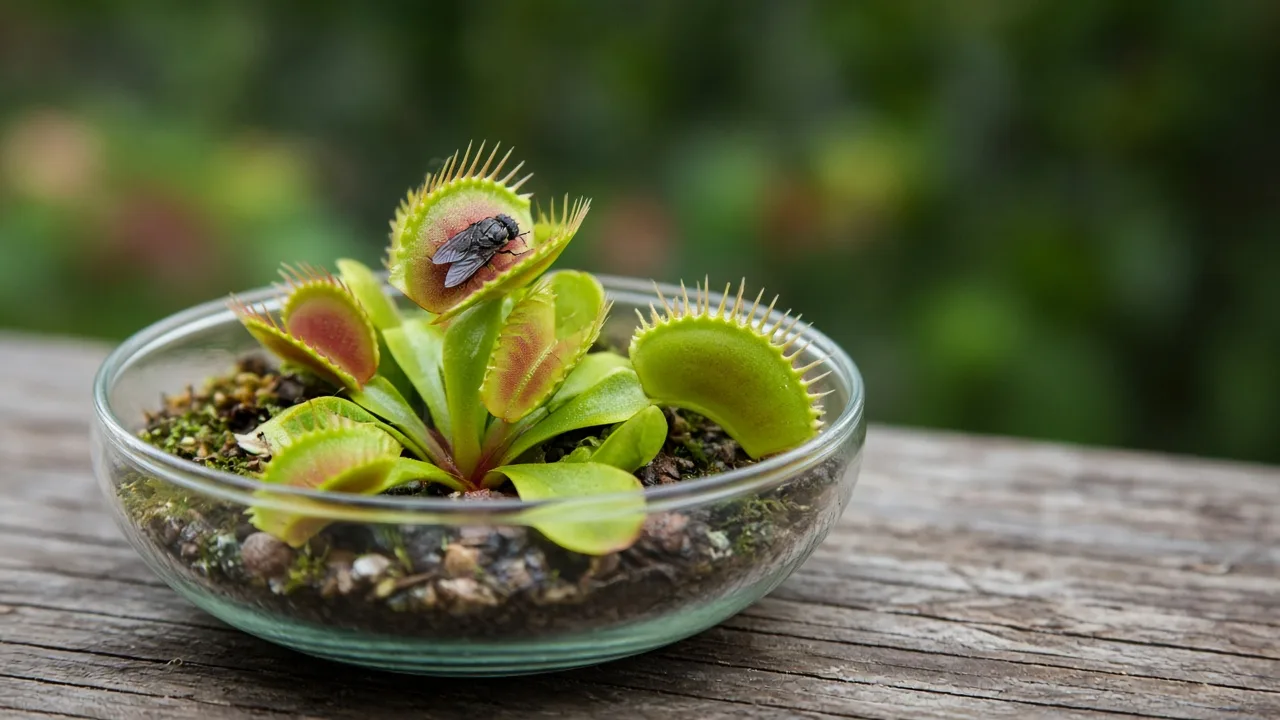
Choose a small live insect such as a fly, small cricket, or appropriately sized mealworm. The prey should be no more than about one-third the trap’s length. An oversized insect can protrude from the seal, decay, and cause the trap to die prematurely. Avoid caterpillars that may chew their way out, ants from areas exposed to pesticide, and anything collected where its chemical history is unknown.
Do not feed hamburger, chicken, cheese, pet food, fish flakes, or any other human food. These foods contain fats, salts, and complex material the trap is not adapted to handle. A dried bloodworm product without additives can be used by experienced growers when rehydrated and placed in a tiny portion, but live prey is the simpler choice for a first-time owner.
To hand-feed, place the prey deep enough in an open trap that it contacts the inner trigger hairs. If it is freshly killed and does not move, gently brush the trap’s inner surface once or twice so the plant receives the signal to seal. Remove tweezers or the brush as soon as the trap starts closing. Never force the lobes shut and never keep stimulating the same trap for entertainment; repeated closure costs energy and traps naturally have a limited working life.
Plan for winter dormancy
Venus flytraps are temperate perennials, not tropical houseplants. In their native range, shorter days and cooler weather trigger a seasonal rest. Growth slows, traps become smaller, and older leaves may blacken or disappear while the plant survives from its rhizome. The change can look alarming, but a gradual winter dieback is often the correct seasonal behavior.
Dormancy guidance is not completely uniform for every indoor setup. New York Botanical Garden says an indoor plant can be grown without dormancy when strong light, pure water, and food are controlled, while specialist growers and many extension-oriented care guides treat an annual cool rest as the safer long-term pattern for ordinary homes.New York Botanical Garden For a beginner without a carefully managed grow-light system, a cool dormancy is the conservative choice.
Three indoor dormancy options
Cool room: Move the plant to a bright, unheated room, enclosed porch, or cool windowsill as days shorten. A roughly 40–55°F (4–13°C) range is a practical target, but do not let the pot freeze. Keep the medium moist rather than continuously flooded, stop feeding, and check the plant every week or two.
Protected garage: A garage or basement can work if it stays cool but does not experience sustained freezing, fumes, or complete darkness. Keep the plant away from stored chemicals and inspect for mold. If the space is dark, a low-intensity light may help; do not assume darkness is automatically healthier.
Refrigerator method: Bare-root refrigeration is a specialist technique for growers who cannot provide a suitable cool space. It involves cleaning the rhizome, wrapping it in barely damp long-fiber sphagnum, sealing it in a breathable or carefully monitored bag, and checking for mold. Because a small mistake can desiccate or rot the plant, use a reputable carnivorous-plant protocol rather than improvising from a generic refrigerator guide.
Give the plant roughly three months of rest, then bring it back to warmth and strong light gradually. Resume the tray method as new growth starts, but do not push fertilizer or frequent feeding. If you keep the plant warm under strong artificial light year-round, you are choosing a more controlled cultivation method; monitor vigor and be prepared to provide dormancy if growth weakens over successive seasons.
Repot and propagate at the right time
Repot in late winter or early spring, just before vigorous new growth, or sooner if the medium has become compacted, contaminated, or mineral-crusted. A newly purchased plant often does not need immediate repotting if it is already in suitable sphagnum-based medium. New York Botanical Garden notes that a good starter container can last a year or two, with repotting prompted by crowded growth, stalled trap production, or degraded medium.New York Botanical Garden
Prepare the new pot and pre-moisten the fresh mix with safe water. Slide the plant out by the root zone rather than pulling on the traps, rinse away old medium gently if needed, and inspect the rhizome. Remove only dead or clearly rotten material with a clean blade. Replant at the same depth, keep the crown above the mix, and water thoroughly with distilled, RO, or rainwater.
Divide a mature clump
Division is the most practical propagation method for a home grower. A mature plant may form multiple rosettes connected by a rhizome. Separate it during dormancy or early spring when the plant is not investing heavily in new traps, making sure each division has a piece of rhizome and roots attached.
Pot each division into the same unfertilized medium and keep it evenly moist in bright but slightly gentler light while it recovers. Avoid feeding until new growth appears. Growing from seed is rewarding but slow, and seedlings need careful moisture, light, and patience before they resemble the robust plant sold in a garden center.
Grooming, flowers, and trap behavior
Old traps naturally turn brown or black after digestion, repeated closure, or ordinary leaf turnover. Leave a partly green leaf attached because it can still photosynthesize. Once a leaf is fully black and dry, remove it with clean scissors or wait until it loosens and pull it away gently. Dead tissue should not be allowed to mat over the crown in a humid enclosure.
Mature plants produce a tall flower stalk with small white flowers in spring. Flowering is not inherently wrong, but it takes energy away from a small or recently stressed plant. Cut the stalk close to its base when it is still short if the plant is young, weak, or recovering. A large, established plant can be allowed to flower, especially if you want seed, but do not mistake flowers for proof that the plant’s light and water are otherwise correct.
The trap itself is not a disposable toy. Touching an open trap will not hurt a person, but repeated triggering gives the plant work without nutrients. Watch natural captures, use feeding as an occasional supplement, and judge success by steady new growth rather than how often the plant snaps shut.
Diagnose black traps and weak growth
Black traps are a symptom, not a diagnosis. One or two old outer traps turning black while the center produces new, firm leaves is usually normal. Widespread blackening immediately after a move can be acclimation shock. Blackening accompanied by a soft crown, sour medium, white mineral crust, or shrinking new traps needs prompt investigation.
Start with the highest-impact checks in this order: water source, light intensity, crown firmness, medium condition, recent temperature change, and feeding history. If tap water or mineral-rich bottled water was used, move the plant into fresh appropriate medium and switch to distilled, RO, or rainwater. If the plant is pale and making smaller traps, improve light before changing the watering rhythm.
When blackening means trouble
Old traps only: Continue normal care and remove them when fully dead.
New traps blacken while the plant shrinks: Check light and water quality first; a recent repot or abrupt environmental change may add stress.
Crown is soft or smells rotten: Unpot immediately, cut away black mushy tissue if viable rhizome remains, and repot in fresh airy medium. This is an emergency, not a cue to add humidity.
Soil is dry through the root zone: Rehydrate gradually with safe water and restore the shallow tray. Do not drown a severely stressed plant in a deep container of water.
Traps stay closed for a long time: A trap may remain closed while digesting. If it is closed with no prey, it may be old or have been triggered. Look at the whole plant rather than trying to pry it open.
Pests, mold, pet safety, and sourcing
Aphids can cluster on soft new growth, while spider mites may cause stippling or fine webbing in hot, dry conditions. Fungus gnats are small enough to evade the traps and may indicate persistently wet, stagnant media. Start with isolation, removal of visible pests, better airflow, and correction of the environment. Do not spray a random houseplant pesticide onto the traps or into the crown; read the product label and confirm plant safety before using any treatment.
Gray mold on dead leaves is a sign to improve sanitation and air exchange. Remove fully dead tissue, open a terrarium, and reduce stagnant moisture. Do not seal the plant more tightly in an attempt to “raise humidity.” A firm crown, strong light, and clean water do more for recovery than a humidifier aimed directly at wet foliage.
The ASPCA lists Venus flytrap as non-toxic to dogs, cats, and horses.ASPCA That does not make the plant indestructible: a pet can still knock over the pot, and repeated chewing damages traps. Place it where curious animals and small children can observe without constantly handling it.
Source plants from nursery-propagated stock and never remove a Venus flytrap from the wild. NC State Extension identifies the species as endangered and widely available from propagated plants, so wild collection is unnecessary.NC State University Extension Plant Toolbox
Follow a simple yearly care calendar
Spring: Increase light and restore the active-growth tray level as new leaves emerge. Repot or divide only when needed. Watch for a flower stalk; remove it on small or weak plants.
Summer: Give the strongest light available, keep the medium evenly moist with safe water, and provide gentle airflow. Feed occasionally only if the plant is healthy and not catching prey. Acclimate gradually before moving it outdoors for extra sun.
Autumn: Expect growth to slow as days shorten. Stop feeding when dormancy begins, remove fully dead tissue, and move the plant to its planned cool location before freezing weather arrives.
Winter: Keep the dormant plant cool and the medium barely but consistently moist. Check for mold and desiccation without disturbing it every day. Return it to stronger, warmer growth conditions gradually in late winter or early spring.
Conclusion
Successful indoor Venus flytrap care is less about feeding a dramatic plant and more about respecting a narrow ecology. Give Dionaea muscipula strong light, low-mineral water, airy nutrient-poor medium, steady moisture, moving air, and a thoughtful seasonal rhythm. Those conditions matter far more than a novelty terrarium or a crowded menu of insects.
When something goes wrong, diagnose the whole system. A black old trap may be normal; black new growth with a soft crown is not. Fix the water, light, or medium before adding food, fertilizer, or humidity. With a nursery-propagated plant and a stable routine, this unusual little perennial can remain healthy and fascinating indoors for years.



