How to Grow Water Lettuce in Ponds and Aquariums
Learn how to grow water lettuce in a pond or aquarium, manage light and warmth, thin fast-growing rosettes, overwinter plants, and prevent accidental spread.
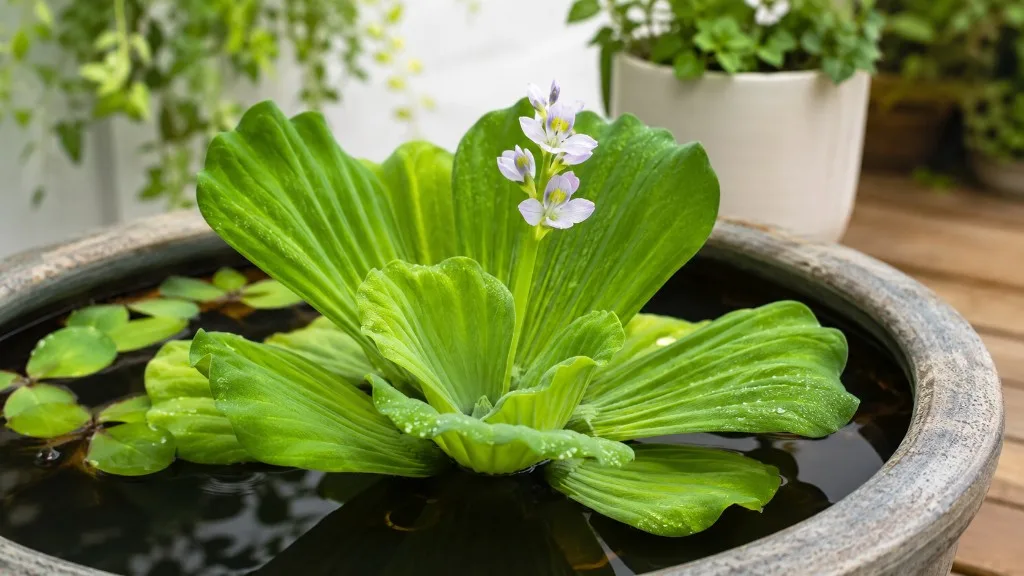
Water lettuce (Pistia stratiotes) is a tropical floating plant with ribbed, velvety rosettes and long roots that hang below the surface. It needs no pot or soil, but it does need warm, mostly calm freshwater and regular thinning. The more important question comes first: can you keep it legally and prevent it from reaching a natural waterway?
Its ornamental use does not make it harmless outside a controlled setting. In warm regions, detached plants can multiply into dense mats that shade submerged vegetation, impede water movement, and reduce oxygen as plant matter accumulates. Check local rules before buying or moving it; if your pond can overflow into a ditch, stream, storm drain, or wetland, choose a different plant.
Before Buying, Check Where It Is Legal to Keep
Water lettuce is treated differently across regions. The University of Florida IFAS Center for Aquatic and Invasive Plants flags it on Florida’s prohibited aquatic-plant list, while the USGS Nonindigenous Aquatic Species Database tracks established populations in multiple U.S. states. Those records describe occurrence, not a complete current legal list. A plant permitted in one county or country may be restricted in another, and rules can change.
The species’ native history is also more complicated than a single-origin label suggests. The USGS profile describes competing evidence about its origins, and UF/IFAS notes evidence for historical nativity in peninsular Florida even while identifying serious management concerns. For a gardener, the practical rule is not to infer safety from a “native” or “invasive” label alone: check the current plant-sale, possession, transport, and release rules that apply where you live. Start with your state or regional agriculture, fisheries, or invasive-species agency and ask before ordering if the guidance is unclear.
If keeping it is allowed, assess the site just as carefully. A closed aquarium or watertight tub is easier to contain than an outdoor pond, but indoor plants can still be dumped, rinsed into drains, or carried outdoors with pond water. An outdoor basin should have no overflow route to a natural waterbody, ditch, or storm drain, and you should be able to retrieve every rosette and daughter plant. If you cannot guarantee those conditions, do not grow water lettuce.
Identify Water Lettuce and Understand “Dwarf” Labels
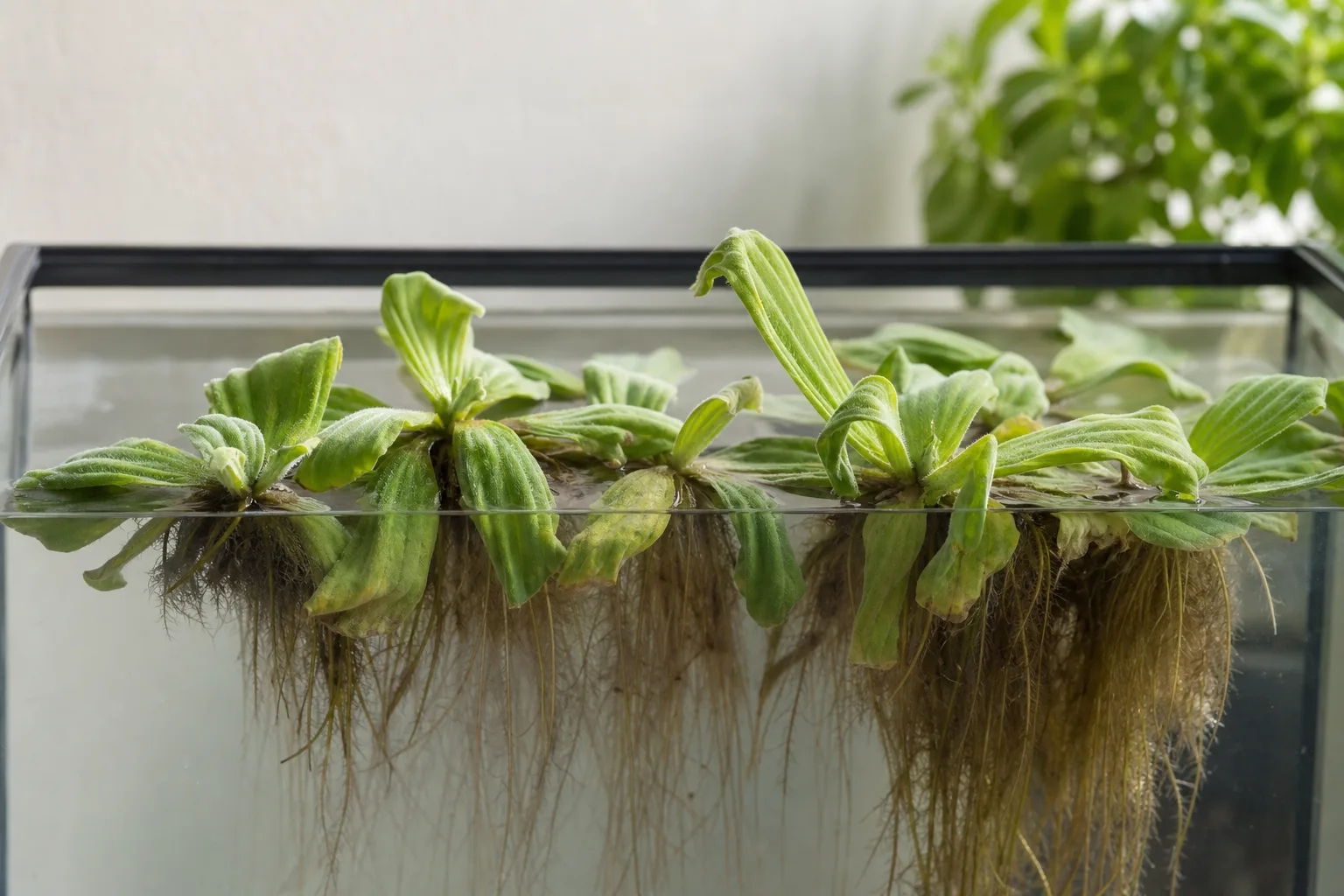
Water lettuce grows as a floating rosette rather than a rooted pond marginal. Its overlapping leaves are pale to gray-green, softly ribbed, and covered in fine hairs that give them a velvety look; feathery roots trail beneath the plant. Small flowers can form tucked inside the center of a mature rosette, but the foliage is what most people notice. The USGS species profile describes rosettes, stolons, and long hanging roots as identifying features of Pistia stratiotes.
The common name describes the shape, not a food use. Do not harvest it as salad lettuce or feed it to pets or livestock. The “dwarf water lettuce” label also deserves caution: aquarium sellers commonly use it for compact plants, but size changes with growing conditions, and the label is not a reliable promise that a rosette will remain miniature in a warm, nutrient-rich pond.
A practical identification check is to look for a free-floating, lettuce-like rosette with parallel ridges and a fringe of roots, not a plant anchored in a pot at the pond edge; the USGS species profile describes those features in more detail. If a seller cannot identify the plant or explain any local restrictions, wait to buy until you can verify both the species and its status.
Choose the Right Growing Setup
Water lettuce is an obligate floater: place it on the water, with its roots hanging freely, and do not bury it in gravel or pond soil. It takes nutrients from the water column and uses its leaves above the surface, so a planted basket is unnecessary. Choose the water body around containment, temperature, surface movement, and the needs of any fish or submerged plants already there.
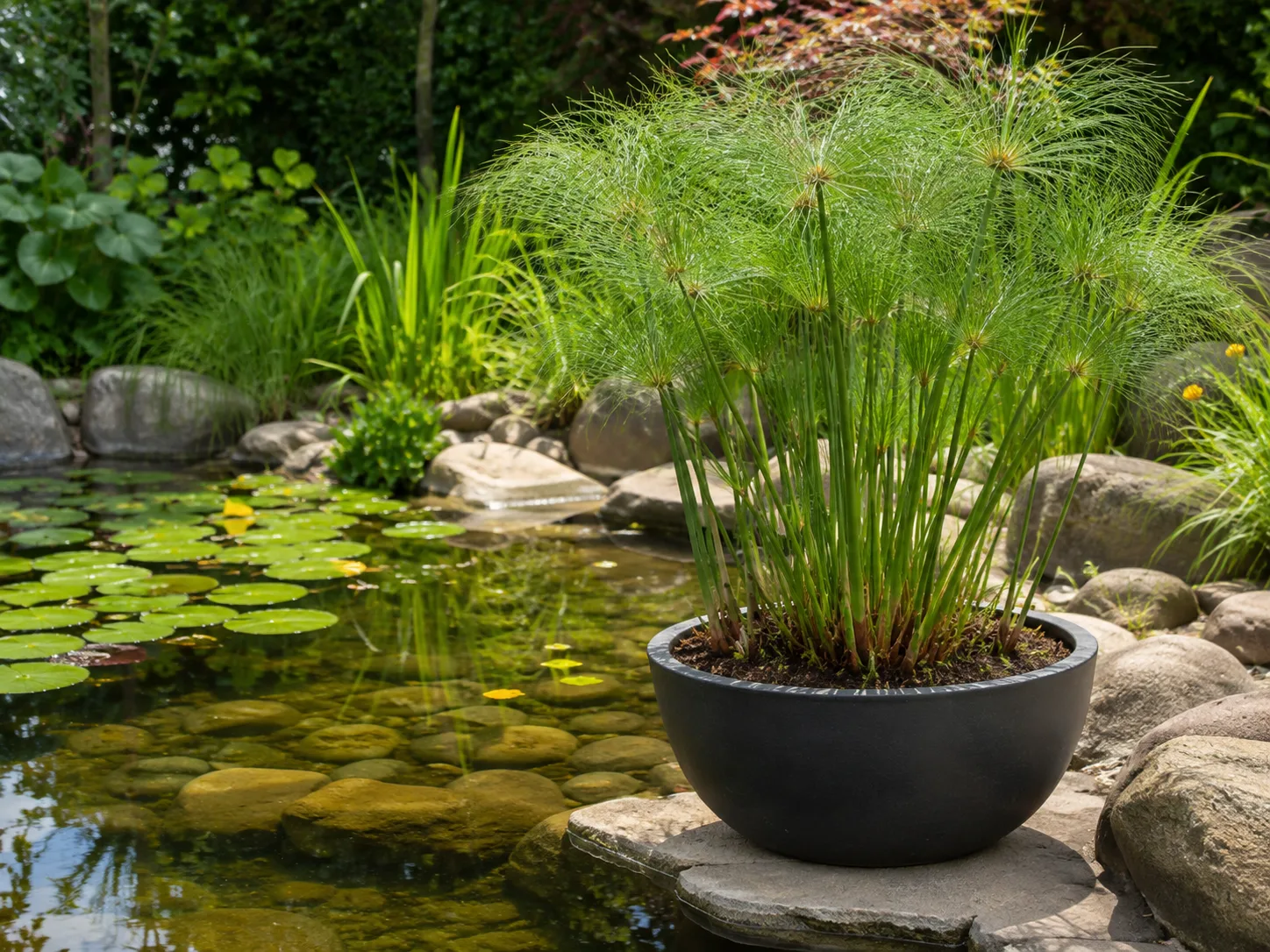
Pond or Container Water Garden
In an outdoor water garden, start with one or a few rosettes rather than trying to cover the surface on day one. Give them a calm area away from fountain spray, waterfall turbulence, and strong return jets. A floating ring or protected corner can keep plants from being pushed under, but it is a spacing aid, not a biosecurity barrier; runners and loose fragments still need to be collected.
Keep a meaningful portion of the surface open. Water lettuce can use nutrients and cast shade, but a solid mat blocks light from plants below and can interfere with air exchange. UF/IFAS describes how dense infestations can reduce dissolved oxygen through shading, restricted gas exchange, and decomposition. That is why “more plants” is not a reliable water-quality treatment. If you cannot keep the cover in check, remove it rather than letting the pond become a monoculture.
Aquarium or Indoor Tub
An aquarium gives you more control over escape and winter cold, but its lid, lighting, and filter flow can create problems. Keep the leaves above the water and away from condensation that drips back onto them; leave enough headroom that they are not pressed against a wet lid. Use a floating ring or quiet surface zone if the filter outlet keeps spinning the rosettes or tangling their roots.
Do not let a dense root curtain block the filter intake or fill the entire surface. Leave open water for light to reach submerged plants and for the tank’s gas exchange. Aquarium Source’s practical care guide likewise recommends a calm surface and routine thinning; its advice is useful for tanks, not a substitute for local invasive-plant rules or pond management guidance. A small indoor tub can work too, provided it stays warm, clean, and physically contained.
Light: Bright, but Not Scorching
Water lettuce grows well in bright light, including full sun in suitable climates, but the hottest afternoon sun can stress plants in shallow containers or during a heat wave. In a hot summer, morning sun with afternoon shade is often easier to manage than all-day exposure. For aquarium-grown plants, moderate to bright aquarium lighting can support compact growth, while their surface position means they receive light before it passes through the water column.
Acclimate a new plant instead of moving it abruptly from a shaded shop tank to intense midday sun. Begin in bright shade or filtered light, then increase exposure over several days while watching the newest leaves. Pale, bleached, or scorched patches after a sudden move suggest excessive light or heat; rosettes that stay small and stretch toward the brightest area may need more usable light. Do not compensate for weak growth by leaving a pond in direct heat all day—first rule out cold, surface agitation, and nutrient scarcity.
Light is also a pond-design choice. A little floating shade can benefit fish and temper the appearance of a sunny pond, but a continuous canopy can deprive submerged plants of light. Treat coverage as something to manage, not a target to maximize.
Water, Flow, and Temperature
Use freshwater with a stable water level and gentle movement. Water lettuce does not require a special substrate or a narrowly tuned pH recipe; in an aquarium, avoid changing otherwise suitable water chemistry just to chase a number from a care chart. In a pond, source-water hardness, rain, evaporation, fish load, and other plants all affect conditions, so observe the whole system rather than treating this floater in isolation.
The roots should hang in the water, while the leaves stay mostly dry above it. Strong current can push a rosette underwater, tangle roots, or keep droplets sitting on the foliage. If the plant is moving constantly, redirect the outlet or create a quiet pocket before changing fertilizer or buying a water test kit.
Warmth matters more than fine adjustments to pH. Aquarium and aquatic-gardening guides commonly place active growth around 70–86°F (21–30°C), while the species is widely described as tropical and frost-sensitive. Use that as a practical growing range, not a guarantee that every plant will thrive at each endpoint; cultivar, acclimation, light, and water conditions all affect response. Growth usually slows as water cools, and exposed plants are not a dependable perennial where winter freezes.
| Growing condition | Practical starting point | What to watch |
|---|---|---|
| Water | Fresh, stable water; no soil needed | Sudden changes, poor water quality, or salt exposure |
| Surface movement | Still to gently moving | Plants repeatedly spin, submerge, or collect against an intake |
| Light | Bright light; shade during extreme heat | Bleaching or scorching versus persistently small growth |
| Temperature | Warm conditions, roughly 70–86°F (21–30°C) for active growth | Slowing, wilting, and decline as cold sets in |
| Surface cover | Keep clear openings | Shading below, blocked equipment, or trapped debris |
Feeding Without Overfertilizing
In a stocked aquarium or fish pond, dissolved nutrients from fish waste and decomposing material may be enough to support water lettuce. A fast-growing plant can absorb nutrients from the water, but that does not mean it will permanently “clean” the system: when excess foliage dies and decomposes, nutrients return to the water and add to the organic load. Regularly removing healthy surplus biomass is part of nutrient export.
If growth slows or new leaves look pale, check light, temperature, surface wetness, and current before adding fertilizer. In a separate, fish-free container, an aquatic-plant fertilizer may be appropriate if the product label allows that use. Do not pour ordinary garden fertilizer into a pond or aquarium, and do not dose a shared water body without considering fish, invertebrates, algae, and other plants. The goal is steady growth you can harvest, not maximum multiplication.
The 2019 species spotlight from AMAZONAS Magazine describes water lettuce thriving in outdoor ponds and in indoor tanks under moderate light and warm water. Aquarium Source similarly emphasizes nutrients available in an established tank. These are useful growing observations, not a reason to fertilize every setup or assume that faster growth is always beneficial.
Add Plants Without Importing Hitchhikers
Buy from a source that can identify the plant and confirm that its sale and possession are permitted in your area. If you keep fish or shrimp, inspect the roots and leaf bases for snails, eggs, algae, or other hitchhikers. A short quarantine in a separate container lets you observe the plant and remove unwanted organisms before it enters a display aquarium.
To introduce it, gently set the rosette on the surface with the leaves upright and the roots hanging down. Do not push the leaves underwater, trim roots immediately, or add fertilizer on the first day. Give the plant time to adjust, then watch the new growth rather than judging it by older leaves that may be adapting from different light or water conditions.
Keep a small net or scoop for this plant alone if you can. After thinning, check the rim, filter guard, and nearby floor for fragments, and do not move wet plant material or water between outdoor water bodies. The UF/IFAS guidance stresses prevention and careful handling because fragments and improper disposal can contribute to spread.
Propagate Daughter Rosettes
Water lettuce makes daughter plants on short runners, also called stolons. A new rosette is easier to handle once it has several leaves and visible roots; it can then be separated by snipping the connecting runner with clean scissors. There is no need to root the daughter in soil—float it in the same contained setup if growing another plant is legal and you have room to manage it.
Propagation is also how a small purchase becomes a surface-cover problem. USGS describes both vegetative spread from offshoots and seed production, so do not assume every loose plant can be controlled simply by cutting one runner. In warm, nutrient-rich water, inspect often and remove unwanted daughters before they form a thick raft.
Do not give away, sell, or move daughter plants unless local rules permit it and the recipient can contain them responsibly. When regulations prohibit propagation or transport, remove the plant according to local instructions instead of treating a neighbor’s pond or aquarium as a disposal option.
Thin a Pond or Aquarium Without Spreading Fragments
Check the surface at least weekly during warm, bright growth, and more often if the plants have begun producing runners. In a well-fed tank or a hot outdoor pond, weekly thinning may be necessary; in a cooler or low-nutrient setup, growth may be slower. Use the plant’s behavior—not a fixed calendar—as the cue: separate rosettes, roots crowding equipment, leaves touching one another, or disappearing open water all mean it is time to remove some.
Lift whole rosettes with a scoop or gloved hand and place them directly into a secure container. Avoid tearing the plants into pieces, which makes it easier to leave viable fragments behind. Remove yellowing or decaying foliage promptly, because dead biomass consumes oxygen as it breaks down and can undo the benefit of harvesting.
Do not aim for a completely shaded surface. A practical small-aquarium approach is to keep water lettuce to a limited zone and leave the rest clear; hobbyist guides sometimes use roughly one-quarter of the surface as a starting point, but the right amount depends on the plants below, tank lighting, fish, and filtration. In a pond, maintain broad open patches and inspect after storms, since wind can gather plants against an edge or push them toward an overflow.
Overwinter Water Lettuce or Replace It in Spring
In frost-free climates, water lettuce may persist and continue growing outdoors; where winter freezes, exposed plants commonly decline or die. Do not rely on a hardiness-zone label alone for a floating plant in a shallow pond: the basin’s depth, local cold snaps, and whether the water is sheltered all affect survival. If the outdoor plant is unlikely to make it through winter, removing it before cold damage creates decaying biomass is often simpler than trying to save it.
To overwinter a permitted plant indoors, move a small number of healthy rosettes into a clean aquarium or tub before nights turn cold. Keep the water warm, provide bright light, and make sure leaves do not rest beneath condensation or splash. Quarantine plants moved from an outdoor pond before placing them with aquarium livestock, and do not bring them indoors if local rules prohibit possession or movement.
Growth may slow in winter even with adequate light. Remove deteriorating leaves, keep the surface calm, and avoid heavy feeding while the plant is not actively growing. If the indoor setup is too dim, cold, or cramped to maintain healthy plants, dispose of them safely and start again only when the growing season returns and local rules allow it.
Pests, Fish, and Root Damage
Fish are often the more obvious source of damage than insects. Koi and goldfish may graze on roots or leaves, while strong swimmers can tear apart a loose cluster; a floating ring can protect a small patch, but it will not stop a determined fish from reaching the roots. If plants are repeatedly shredded, accept that the pond’s livestock and water lettuce may not be a good pairing.
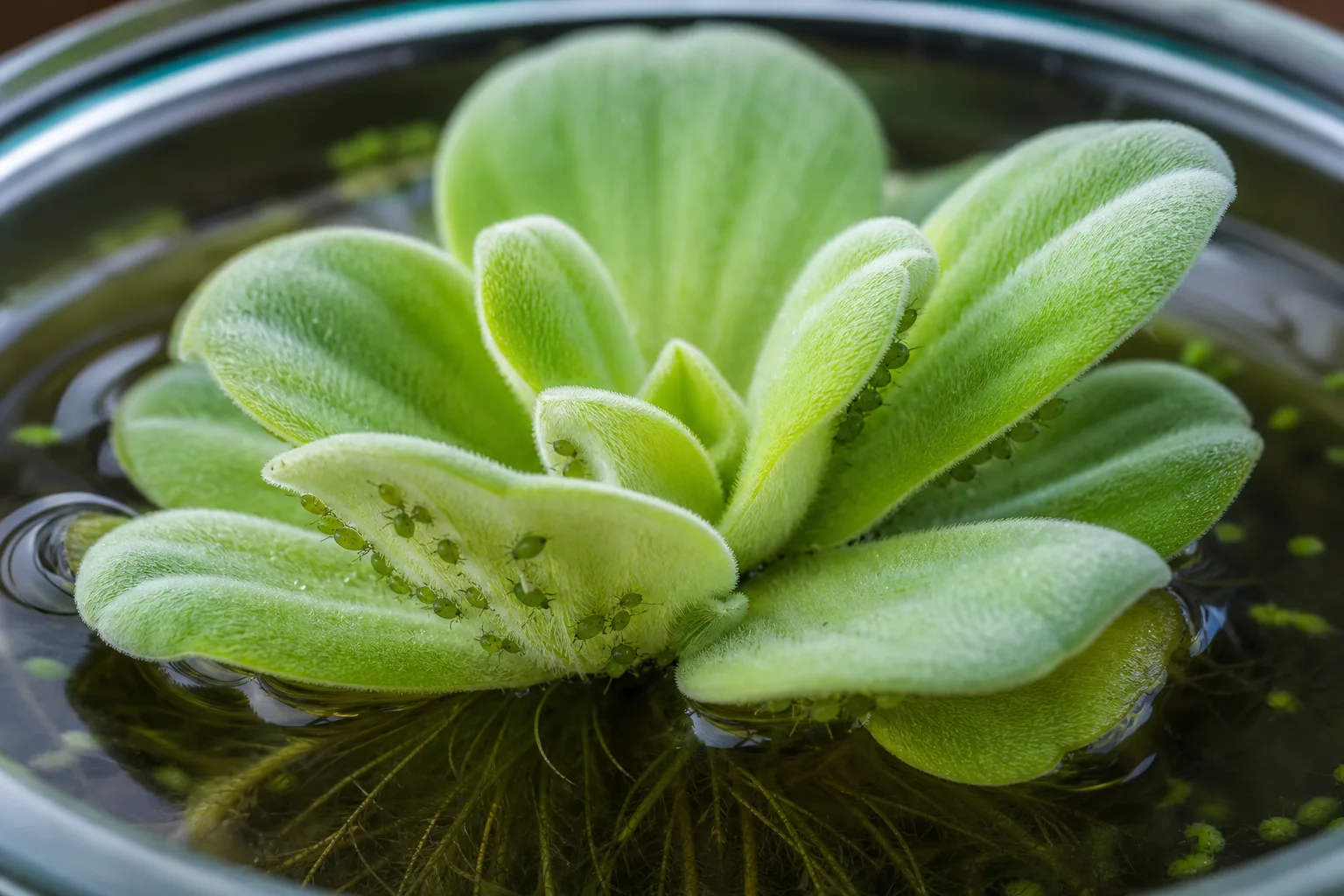
Aphids can gather on leaf surfaces or around tender growth, especially where plants are crowded. Remove affected rosettes and inspect neighboring plants; for an aquarium, avoid spraying household insecticide or applying a pesticide directly over water, where it can harm aquatic life. In a pond-scale infestation or a problem you cannot identify, ask a local aquatic-plant extension specialist before trying chemical control.
Roots may look darker as older sections age, but black, mushy roots together with collapsing leaves point to broader stress rather than a reason to fertilize automatically. Check whether roots are being eaten, trapped against a filter, or left in cold or stagnant, poor-quality water. Keep the response low-risk: remove dead material, restore a calm floating zone, and reassess new growth over the next week.
Diagnose Yellow, Small, or Declining Rosettes
Several stresses produce similar symptoms, so look at the plant and its setup together. If one rosette is failing while the rest look healthy, suspect local damage or a single crowded position; if many decline at once, look for a system-wide change such as a cold front, new filter flow, sudden lighting change, or water-quality issue. Do not treat every yellow leaf as proof of a nutrient deficiency.
Yellow or Browning Leaves
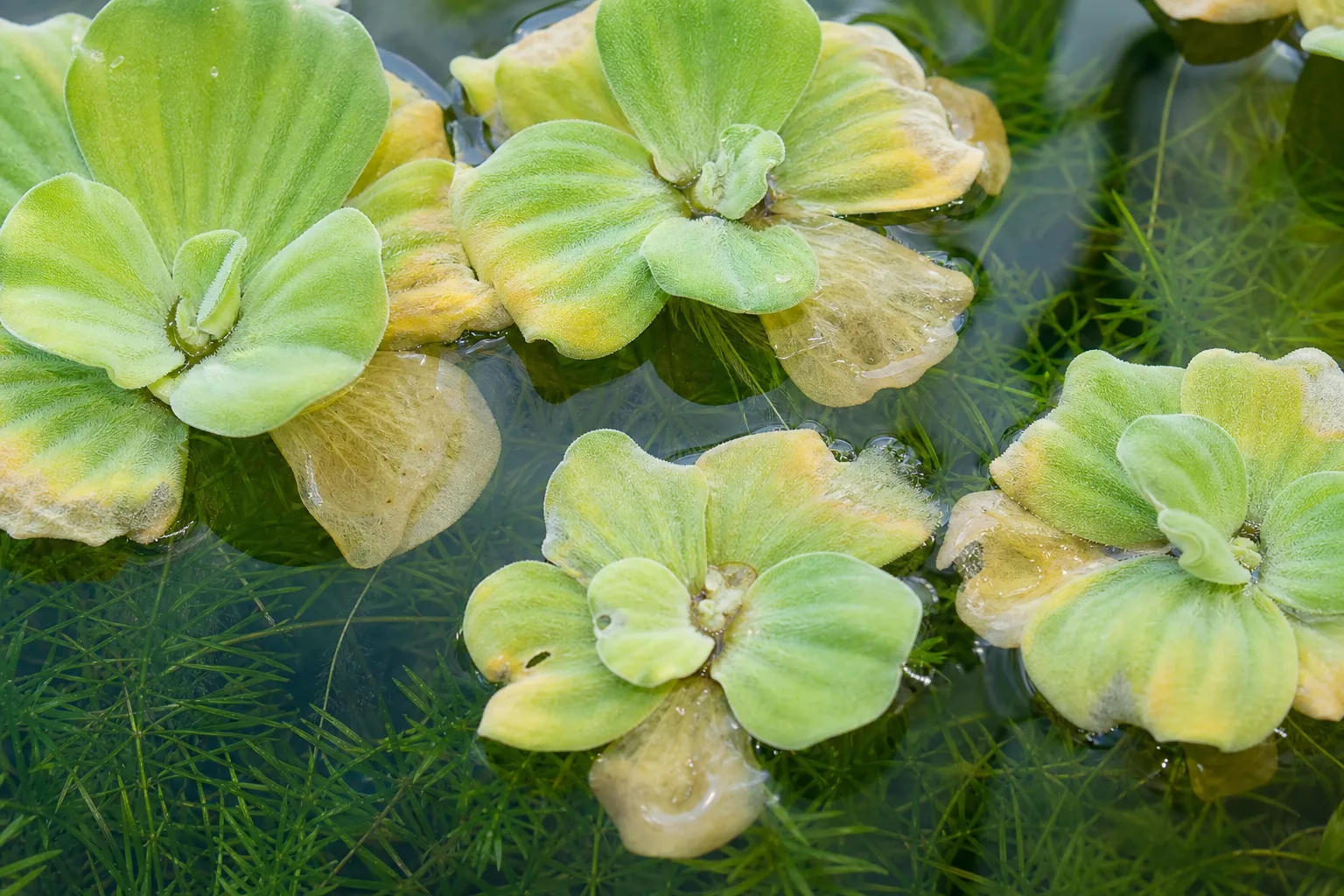
Start with four checks. First, see whether water is sitting on top of the leaves or the plant is repeatedly submerged; correct splashing or condensation. Second, check the water temperature, especially after a cold night or seasonal shift. Third, consider intense sun or a recent move into brighter light; provide shade during heat and acclimate gradually. Only after those checks should you suspect insufficient nutrients, particularly if the setup is very lightly stocked and new growth is pale.
Remove leaves that are fully brown or mushy, but keep healthy green leaves while the plant recovers. If new growth improves after you correct wet leaves, cold, or light exposure, additional fertilizer would have been unnecessary. If yellowing continues across several rosettes, check water quality and the health of the whole pond or tank before changing conditions again.
Small Plants, Few Runners, or Wilting
Small rosettes and few runners usually mean growth is limited by one or more conditions: insufficient light, cool water, low available nutrients, recent transplant stress, or damage to roots. Compare the newest leaves with older ones, then change one factor at a time so you can see whether the plant responds. A pale but upright plant in a lightly stocked tank calls for a different check than a plant with wet, collapsed leaves in a turbulent corner.
Wilting or collapsing rosettes after cold weather are a signal to remove damaged plants, not to force outdoor overwintering. If the same thing happens in warm water, check whether the leaves are staying wet, whether fish are eating the roots, and whether an intake or current is pulling the plant underwater. If conditions are otherwise stable and the plant still declines, isolate one healthy daughter rosette in a calm, bright container as a small diagnostic trial.
Safe Disposal and Pond Recovery
Never release water lettuce or rinse fragments into a pond, river, roadside ditch, storm drain, or outdoor water garden. Do not pour aquarium water containing fragments into a drain that leads to surface water, and do not leave pulled plants on a shoreline where wind or rising water could carry them back. UF/IFAS recommends prevention and cautions against moving the plant; its management guidance also notes that even mechanical removal must be planned to avoid spreading plantlets.
For a small aquarium or container, collect the plants and fragments in a sealed bag and follow municipal or regional guidance for invasive-plant waste. If no specific instructions are available, contact your local waste service before using green-waste collection or compost; a household compost pile is not a verified kill step. Clean the net, bucket, and hands or gloves over a contained area, and keep all rinse water away from outdoor drains and waterways.
For a large pond or any connected water body, do not improvise with herbicides or heavy harvesting. Treatment choices depend on water use, fish and wildlife, non-target plants, and local permits; consult the responsible agency or a qualified aquatic-plant manager. After removal, take out decaying material, restore circulation or aeration if the pond needs it, and keep checking for seedlings or fragments rather than assuming one cleanout ends the problem.
Conclusion
Water lettuce is straightforward to grow when it has warm, calm freshwater, bright but manageable light, and room for its roots to hang. It is only a good choice, though, if local rules allow it and your aquarium, tub, or pond can be kept separate from natural waterways.
Start small, leave open surface for light and air exchange, inspect at least weekly during active growth, and remove whole excess plants before they form a mat. When winter, pests, or yellowing cause trouble, check the water and growing conditions before adding fertilizer or pesticide. And when you are finished, contain every rosette and fragment for disposal; never let a floating plant become someone else’s waterway problem.