What Animal Is Digging Holes in My Yard? Clues
Identify the animal digging in your yard with a practical hole-size guide, clues for moles, voles, skunks, raccoons, squirrels, and more.
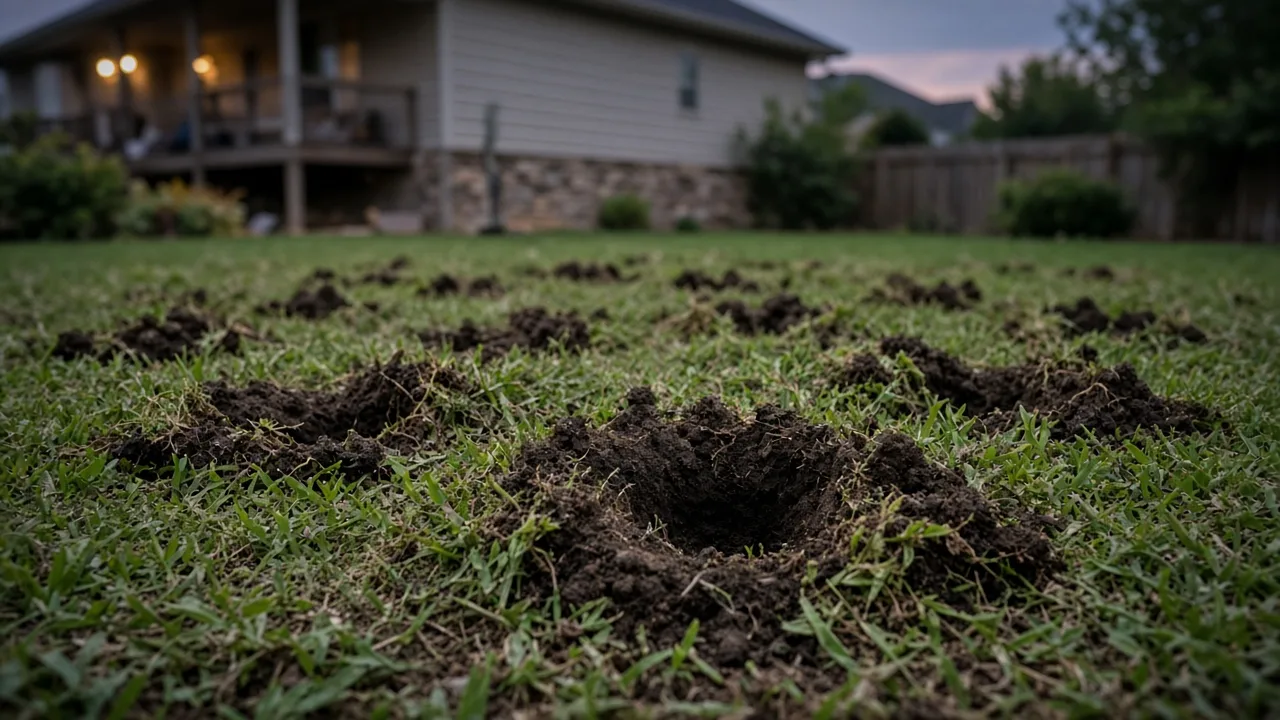
If holes are appearing in your lawn, do not fill them immediately and hope the problem is over. First photograph the damage, measure the openings, and look for the clue that separates a burrow from a quick feeding stop: a tunnel, mound, runway, rolled piece of sod, paw print, or chewed plant nearby.
The most likely diggers are squirrels, chipmunks, rats, voles, moles, skunks, raccoons, groundhogs, and armadillos, but the right answer depends on where you live and what the soil looks like. A few small holes may also come from crayfish, cicada killer wasps, ground bees, or earthworms. The useful goal is not to guess an animal from a single mark; it is to collect enough evidence to choose a control that fits.
The quick answer: the hole is only the first clue
The animal digging holes in your yard is often a forager rather than a resident. Squirrels bury food, chipmunks collect seeds, and skunks or raccoons may make shallow pits while looking for grubs. In those cases, the holes are separate events and the animal may never use one as a nest.

A true burrower leaves a more organized pattern. Moles push soil upward into mounds and ridges, voles connect small openings with protected runways, and groundhogs maintain a large entrance near a sheltered edge. The distinction matters because removing birdseed will not fix a mole tunnel, while trapping or sealing a burrow is an unnecessary response to a squirrel that visits for five minutes.
NC State Extension’s yard-hole chart is a useful starting point because it pairs approximate hole sizes with mounds and locations. The Internet Center for Wildlife Damage Management’s ground-hole guide adds a useful first question: does the opening end, or does it continue into a burrow? Treat all measurements as clues, not a laboratory key; soil texture, rain, foot traffic, mowing, and the animal’s age can change the appearance.
Diagnose the damage before you disturb it
Make your first inspection in daylight, then return around dusk or after dark with a flashlight pointed from the side. Low-angle light reveals shallow ridges, loose soil, footprints, and the direction that grass has been pressed. Keep children and pets away from the area until you know whether an opening leads under a deck or near a utility trench.

Measure the opening and inspect the edges
Put a ruler or a familiar coin beside the hole and take a photo from directly above. Record the widest point, not the longest irregular scratch. A clean, round, silver-dollar-sized entrance suggests a different set of animals from a ragged depression several inches across, but the measurement is meaningful only with the surrounding evidence.
Look at the rim. Freshly excavated soil that is pushed outward can indicate a burrow entrance; a hole with almost no loose soil may be a feeding or caching hole. Smooth, compacted edges suggest repeated traffic. A ragged scrape, grass torn in one direction, or a shallow scoop suggests an animal was searching rather than building a home.
Do not put your fingers, a hose, or a stick down an unknown hole. You could encounter a snake, a defensive animal, a trap, a sharp piece of metal, or a collapsing cavity. A photo, ruler, and surface observation provide better evidence with less risk.
Read mounds, tunnels, runways, and timing
Mound shape is more informative than the mere presence of dirt. Mole mounds are commonly rounded, while pocket-gopher mounds tend to have a crescent-like shape and a plugged opening. A raised grass ridge that continues across the lawn is a tunnel clue, not a normal animal footprint.
Look for a runway where grass is flattened into a narrow path. Voles often create several small openings connected by protected, aboveground routes beneath dense grass or mulch. A hole beside a runway and fresh green clippings is stronger evidence for voles than a lone hole in open turf.
Timing adds context. Fresh holes appearing overnight in a lawn with no tunnels point toward nocturnal foraging by skunks or raccoons. Neat holes multiplying during autumn near trees or feeders fit squirrel caching. Daylight sightings near a large entrance make a groundhog more plausible than a skunk, but no single schedule rules out every species.
A practical yard-hole decision table
| What you see | Most likely possibilities | What to check next |
|---|---|---|
| About 2 inches, clean, scattered, no mound | Squirrel, chipmunk, local ground squirrel | Nut trees, bird feeders, nearby logs, daytime activity |
| About 1 to 2 inches with flattened grass runways | Vole | Dense vegetation, mulch, green clippings, gnawing at roots or bark |
| Raised ridges or rounded soil mounds | Mole | Connected surface tunnels; do not assume root chewing |
| Closed or crescent-shaped mounds, plant roots clipped below ground | Pocket gopher | Plugged openings, underground feeding, regional presence |
| Several 3- to 5-inch shallow pits or peeled turf | Skunk or raccoon | Grubs, claw marks, tracks, nocturnal activity |
| Large entrance with a dirt “porch” near a bank, shed, or foundation | Groundhog or another large burrower | Daylight activity, flies, droppings, structural risk |
| Around 1 inch near water with a mud chimney | Crayfish | Stream, pond, drainage ditch, or saturated soil nearby |
 |
The table narrows the field; it does not prove an identification. If two animals fit, choose a low-risk step that helps both—secure food, remove spilled seed, reduce hiding cover, and protect a vulnerable garden bed—while you keep monitoring.
Small clean holes: chipmunks, squirrels, rats, and ground squirrels
Small, tidy holes in open lawn or garden soil are often made for food rather than shelter. Squirrels bury acorns and other food, especially where mature trees, bird feeders, or fruiting plants are nearby. Chipmunks may excavate near a foundation, retaining wall, log pile, or slab, then use a concealed entrance to reach a nesting area or food cache.

Squirrel caching holes are commonly scattered and quickly abandoned. You may see the animal during the day, a small plug of loose soil beside the opening, or freshly disturbed mulch around bulbs and containers. Chipmunk entrances tend to be especially clean because the animals carry excavated soil away from a doorway; a hidden burrow entrance beside masonry or a woodpile is more suggestive than a random hole in the middle of turf.
Rats can also make smooth holes roughly 2 to 3 inches wide, often near a slab, shed, dense vegetation, compost, or a food source. A rat hole may be reused and look polished at the entrance. Shredded plastic, food packaging, droppings, gnaw marks, or a route along a wall raise the priority because the issue may extend toward the house rather than stay in the lawn.
Ground squirrels are regional. Where they occur, a very clean entrance with another similar hole nearby and a narrow travel groove through the grass can point to a colony. Do not close a suspected rodent entrance before checking whether an animal is using it; an occupied burrow can have more than one opening, and an animal may simply reopen it elsewhere.
The first response for these small diggers is usually source control. Move birdseed and pet food into secure containers, clean up fallen fruit, use a feeder design and placement that reduce access, and remove brush or stacked materials that create a protected route. If bulbs or seedlings are the target, a physical mesh barrier is usually more dependable than a scent sprayed over the soil.
This identification-first approach also aligns with Gardening Know How’s practical yard-hole guidance, which separates animals by the depth, extent, and surrounding clues of their digging before suggesting a deterrent. The useful lesson is to avoid buying a general “animal repellent” until you know whether the animal is caching food, nesting, or feeding on plants.
Tunnels and mounds: moles, voles, and pocket gophers
Moles, voles, and pocket gophers are often confused because all can be associated with underground activity. Their diets and damage patterns differ, so the fastest way to separate them is to inspect what the soil is doing and what the plant is losing.

Moles are insect-eating mammals, not rodents. UC Integrated Pest Management’s mole guidance describes the classic signs as rounded soil mounds, surface ridges, and shallow tunnels. A permanent tunnel may sit several inches below the surface, while temporary feeding tunnels rise closer to the grass. Moles can dislodge roots while digging, but extensive chewing of roots, bulbs, or bark is more likely to involve a rodent such as a vole or gopher.
If you suspect a mole, gently tamp down a short section of each active ridge and check it daily. A ridge that is raised again is more useful for identifying an active tunnel than a fresh-looking mound by itself. Trapping, where legal and appropriate, works best in a tunnel the animal is actually reusing; random placement in a dry or abandoned run wastes effort.
Voles are smaller, plant-eating rodents that favor cover. Their openings are commonly about 1 1/2 to 2 inches wide, and the openings connect to narrow runways beneath grass, mulch, or other vegetation. UC IPM’s vole notes also describe green clippings, small droppings, root feeding, and gnawing around the lower trunks of young trees. A vole problem is therefore more likely when holes are paired with disappearing roots, girdled bark, or a web of flattened paths.
Pocket gophers may leave soil mounds rather than open holes. The mound can be crescent-shaped, with the tunnel entrance plugged from inside. Because the animal feeds below ground, a plant may wilt while the foliage still looks untouched. Gophers are not present in every region, so confirm local distribution before committing to a control plan.
The practical comparison is simple: moles rearrange soil while hunting; voles create protected routes and eat plants; pocket gophers often close their underground feeding system with distinctive mounds. If the damage does not fit one pattern, do not use a toxic bait or trap designed for a different animal.
Fine Gardening’s vole-control sequence makes the same practical point in a different way: reduce cover first, add exclusion where it protects a specific plant, and only then consider population reduction. That sequence is especially useful in a mixed garden where you want to save a young tree or bulb bed without trying to make an entire wildlife-friendly yard sterile.
Shallow pits and rolled sod: skunks, raccoons, and armadillos
Shallow, cone-shaped pits scattered through otherwise intact grass are a classic sign of an animal hunting for soil insects. Skunks may make individual holes roughly 3 to 5 inches across as they search for grubs and earthworms. UC IPM’s skunk guidance notes that skunks can also roll back sections of turf, especially where food is abundant.

Raccoons may do similar work, and fresh sod is particularly vulnerable because it can be peeled back to reach insects beneath the roots. Distinguish the two by collecting more than the hole: look for five-toed tracks, claw marks, rolled turf, a faint odor, or a denning site under a deck. A wildlife camera pointed at the damaged zone can answer the question without requiring you to approach a nocturnal animal.
Armadillos are mostly a southern-U.S. possibility and can create larger, more destructive excavations while foraging. They favor insects and may also dig a long burrow near wooded, moist ground. If the damage includes a shallow groove, broad disturbed areas, or a large den near a walkway, do not assume it is just a skunk. The National Pesticide Information Center’s wildlife guidance recommends identifying the species and contacting local wildlife or Extension resources when control becomes necessary.
Do not automatically treat the entire lawn for grubs because a skunk or raccoon is digging. Lift a small flap of turf in the damaged area and check whether grubs are actually present, then identify the lawn pest and use only a treatment labeled for that site and problem. Reducing a food source may help, but it does not guarantee that a visiting animal will disappear, especially if garbage, fruit, pet food, or a den site remains attractive.
Large burrows: groundhogs, rabbits, and other local diggers
A large opening beside a bank, shed, porch, retaining wall, or foundation deserves more attention than scattered caching holes. Groundhogs, also called woodchucks, may maintain a burrow with an entrance around 8 inches wide and a visible dirt apron or “porch.” Daylight activity, a large animal feeding on nearby vegetation, or flies around the entrance can support that identification.
Groundhog burrows can undermine paths, slabs, steps, and retaining edges. Before filling one, inspect the location for a second entrance and determine whether the animal is still inside. A one-way exclusion door or professional wildlife plan is safer than sealing a den based on a guess, especially during the season when young may be present.
Rabbits rarely create a yard full of holes, but a hidden nest or shallow burrow can appear in a brushy edge. The stronger clue is usually plant damage: neat cuts on stems, missing low foliage, and feeding close to the ground. Clear low hiding cover and protect plants with a properly installed fence rather than trying to remove every rabbit from the property.
Other large diggers—including foxes, badgers, prairie dogs, and region-specific species—may occur depending on geography. A large hole near livestock, a waterway, a building, or a collapsing path is a good reason to use your county Extension office or state wildlife agency for identification before taking action.
Do not overlook insects, crayfish, and ordinary soil activity
Not every hole in a lawn is a mammal burrow. NC State Extension lists several lookalikes: a roughly 1-inch opening with thinly scattered soil can be a cicada killer wasp entrance; a small mud tower near water can be made by crayfish; and clusters of small soil mounds without an obvious hole may be earthworm castings or ground-bee activity.
Location is the shortcut. Crayfish need wet ground or nearby water, ground bees often create many small mounds in sunny, compacted soil, and cicada killers are more likely in warm, sandy, sparsely vegetated areas. These are different management problems from a mole or raccoon, so a broad animal repellent is unlikely to solve them.
Use caution around any active stinging insect entrance. Do not pour gasoline, bleach, boiling water, or household chemicals into the soil. If the area is beside a walkway, play space, or entrance and you cannot identify the insect, ask a local Extension office or licensed pest professional for a species-appropriate option.
What to do tonight while you are still identifying the animal
You can reduce repeat damage without knowing the species with certainty. Take dated photos of the holes, mark their locations on a rough yard sketch, and lightly smooth one or two edges so you can see what is disturbed next. Do not smooth every opening; preserving a few tracks and rims makes the next inspection easier.
Secure the obvious attractants before nightfall. Bring in pet food, close trash lids, collect fallen fruit, sweep spilled birdseed, and remove standing water that is not essential. If a vegetable bed or fresh sod is being damaged, cover that target with a temporary physical barrier while you gather more evidence.
Watch from indoors or use a motion-activated camera. Never corner an animal, block an exit, or let a dog investigate a den. If you see a wild animal acting unusually tame, aggressive, disoriented, or trapped near a structure, keep your distance and call local animal control or a wildlife professional.
Make the yard less rewarding
Wildlife usually chooses a yard because it supplies at least one of three things: food, water, or shelter. NPIC’s yard guidance recommends identifying the pest first, then treating the resource that keeps it returning. This approach is more durable than repeatedly disturbing the newest hole.
Remove food and water without harming useful wildlife
Do not assume bird feeding and wildlife exclusion are always compatible. Use a feeder that keeps seed off the ground, place it where squirrels cannot leap from nearby branches or structures, and store seed in a secure container. Pick up spilled seed and fruit rather than leaving a feeding zone beneath the tree.
Keep garbage in a tight-fitting can and do not leave pet food outside overnight. Compost piles should not contain meat scraps or easily accessible food waste. If a birdbath, fountain, pet bowl, or leaking hose is drawing animals into the exact area you need to protect, move or pause it temporarily while you address the damage.
Check for grubs only where the digging is concentrated. A lawn insect may be part of the chain, but blanket pesticide use can expose pets and non-target wildlife without fixing a den or food cache. Follow the product label if treatment is justified, and ask Extension for local thresholds and timing.
Reduce cover around the lawn and garden
Trim vegetation that creates a concealed corridor along a foundation, fence, or garden edge. Remove brush piles, loose boards, thick leaf piles, and unused materials from the areas where holes are appearing. Stack firewood neatly and keep it elevated and away from the house when possible.
This is especially important for voles, which use dense cover and mulch as protection while moving between burrows. Reducing cover also makes fresh tracks, runways, and new holes easier to see. Keep the change targeted: a wildlife-friendly yard can still contain shrubs, leaf litter, and habitat, but high-use lawn, play space, and vulnerable beds should not be connected to an unmanaged hiding strip.
Protect plants, beds, decks, and buried structures
Exclusion is often the cleanest fix when the damage is concentrated. For a vegetable bed, bulbs, or young tree, use hardware cloth or another durable mesh with openings small enough for the animal you are excluding. Bury the lower edge so the animal cannot simply dig underneath, and check the barrier after rain or frost heave creates a gap.
For voles, UC IPM describes mesh no larger than 1/4 inch, with the lower edge buried several inches. For an animal denning under a deck or shed, a 1/4-inch hardware-cloth screen can exclude more than one rodent species, but only after you are sure the space is empty. A one-way outward-swinging door can allow an animal to leave, but young that cannot walk create a different situation that may require professional help.
Do not install a barrier over a hole just because it is inconvenient. First check for additional openings, fresh soil, tracks, or animal sounds. A barrier that traps an animal under a building can turn a lawn problem into an odor, welfare, or structural problem.
Traps, repellents, and the methods to avoid
Trapping can be effective for a correctly identified animal in a location where it is legal, but traps are species-specific. A mole trap is not a vole trap; a rat trap is not appropriate for a raccoon; and a live-catch trap is not automatically a humane solution if you cannot check it, protect it from heat, or arrange lawful handling.
If you use a trap, follow the manufacturer and local wildlife rules, keep pets and children away, and inspect it as required. Wear gloves when handling dead rodents and wash your hands afterward. If you are unsure about the species or the legal status, stop before setting the trap and contact your county or state resource.
Be skeptical of dramatic home remedies. UC IPM’s mole guidance says research does not support vibrating devices, frightening gadgets, broken glass, bleach, mothballs, or similar materials as reliable mole control, and flooding tunnels is ineffective. NPIC specifically warns that mothballs cannot be used outdoors as animal repellents.
Repellents may have a role when a product is labeled for the exact animal, site, and use, but they usually work by making one area less attractive rather than removing the underlying food or shelter. They can also fail after rain or move the animal to another part of the yard. Never use rodent poison to target a skunk or raccoon, and do not use an unlabeled pesticide, fuel, chemical, or sharp object in a burrow.
Repair the lawn only after the digging stops
Once new holes stop appearing, rake loose soil back into shallow depressions and press lifted sod into contact with the ground. Water enough to help the roots reestablish, but do not keep a damaged area constantly wet. Reseed or patch after you have corrected the cause and the season is suitable for your grass type.
For tunnels, level the surface gradually rather than burying large amounts of soil over living grass. For peeled sod, check whether the roots have dried out; re-seat viable pieces quickly and replace sections that have separated or died. If the soil is compacted, repair compaction after the wildlife issue is under control so you do not mistake a lawn-recovery problem for fresh digging.
Keep a simple seven- to fourteen-day log: date, new-hole count, size, location, weather, nearby food or water, and any tracks or plant damage. A declining count after attractants are removed is evidence that the plan is working. New holes in a different zone may mean the animal shifted routes rather than left the property.
When to call a wildlife professional
Get help when a hole is under a foundation, porch, shed, walkway, or utility area; when the soil is collapsing; when a large burrow threatens a structure; or when an animal is repeatedly entering the home. Professional help is also sensible when you cannot distinguish a protected species from a nuisance species, when young may be present, or when local rules govern trapping, relocation, or removal.
Do not approach a sick-appearing or unusually bold mammal. A bite or scratch from a wild mammal needs prompt medical or veterinary advice and local health-department guidance, especially when rabies exposure is possible. Skunks can spray when cornered, and even a normally shy animal may defend a den.
Choose a provider who will identify the animal, explain how entry points will be closed, check for dependent young, and describe what happens after capture. Ask whether the plan includes habitat changes and exclusion; removing one animal without changing the resource that attracted it often produces a repeat visit from another.
Conclusion: let the evidence choose the fix
The answer to “what animal is digging holes in my yard?” is usually found in the pattern around the opening. Small clean holes suggest caching or a small burrow; ridges and rounded mounds suggest underground tunnel work; shallow pits and rolled sod point toward nocturnal foraging; a large entrance beside a structure raises a denning and safety question.
Photograph first, measure second, and look for mounds, runways, tracks, plant damage, food sources, and timing before you trap or seal anything. Then remove the resource that keeps the animal returning, protect the area that matters most, monitor for fresh activity, and bring in a local professional when the hole is structural, occupied, unsafe, or legally complicated.



