What Are Air Plants? A Guide to Tillandsia
What are air plants? Learn how Tillandsia live without soil, absorb water through leaf scales, flower, and grow pups, plus how to display them well indoors.
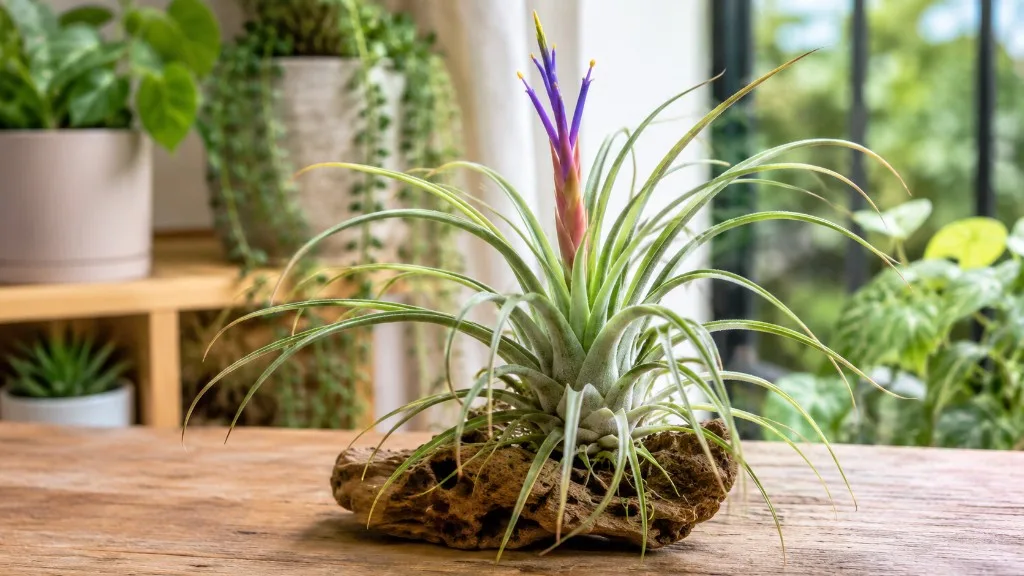
An air plant is not a plant that survives on air alone. The name usually refers to Tillandsia, a large genus of bromeliads whose leaves can take up water and dissolved nutrients without relying on potting soil. Many species attach themselves to trees or rocks, so their unusual growth habit is easy to mistake for a lack of needs.
That distinction matters in a home. You can display a Tillandsia without a pot of soil, but it still needs suitable light, real watering, and enough moving air to dry after it gets wet. Once you understand what the plant’s roots and leaves actually do, its care and the best way to display it make much more sense.
What Is an Air Plant?
In houseplant shops, “air plant” most often means a species of Tillandsia. Tillandsias are evergreen perennial plants in the bromeliad family, Bromeliaceae—the same broad family that includes pineapples and many familiar ornamental bromeliads. NC State Extension describes the genus as including hundreds of species, with forms that range from small rosettes to long, pendant growths such as Spanish moss. (NC State Extension)
The name describes how many Tillandsias grow, not what they eat. They do not need soil around their roots, but they still photosynthesize, take up water and nutrients, and respond to their environment like other plants. The phrase “grows in air” is useful shorthand for a soil-free growth habit; taken literally, it leads people to neglect watering or place a plant in a dim, stagnant corner.
“Air plant” is also a common name rather than a precise description of one uniform plant. Species differ in leaf width, shape, color, flower form, preferred moisture, and habitat. If a label gives a botanical name, keep it: the species or hybrid name is more useful than the broad retail label when you look up a particular plant’s needs.
How Tillandsia Lives Without Soil
Most houseplants use soil as an anchor and as a reservoir from which roots collect water and minerals. Many Tillandsias instead settle on a stable surface and obtain much of what they need through their foliage. In the wild, rain, fog, dew, and small amounts of organic debris around the plant provide moisture and nutrients; the air itself is not a complete food source.
This is an adaptation to life above the forest floor or on exposed rock, where a conventional root system would have little soil to explore. It also explains why an air plant can be mounted on a piece of bark or set in an open holder without being “planted.” It does not explain why a plant can be left dry indefinitely: the leaves still need to become wet often enough for the plant to hydrate.
Epiphytes, Lithophytes, and Holdfast Roots
An epiphyte grows on another plant for physical support, while a lithophyte grows on rock. Neither term means parasite. A Tillandsia perched on a branch uses the branch as a place to attach and grow; it is not tapping into the host tree’s tissues as a root parasite would. The RHS describes air plants as tropical epiphytes or lithophytes, and NC State notes that they also occur in varied settings such as forests, deserts, and mountains. (RHS)
Some air plants make short, wiry roots. These are primarily holdfast roots: they grip bark, stone, or a mounting surface and help keep the plant in place. They are not equivalent to the absorbing root system of a pothos or fern, and placing Tillandsia roots in potting mix does not solve its need for leaf hydration and airflow. If a plant arrives with roots, do not assume you should cut them off; they may help it attach to a display.
Trichomes Make the Leaves the Main Uptake Surface
Look closely at many Tillandsia leaves and you may see a silvery, powdery, or softly fuzzy surface. That appearance comes largely from trichomes, specialized leaf scales that help collect water and nutrients. Their density varies: in some species the coating is prominent and silver, while in others the leaves look greener and smoother. The RHS identifies these scales as the plant’s main means of taking up moisture from rain or fog. (RHS)
This leaf-level adaptation is the practical answer to “How do air plants get water without soil?” Water wets the leaves and is absorbed through the scales; a brief mist that beads on the outside may not hydrate a dense rosette as effectively as a thorough rinse or soak. Afterward, water needs to leave the leaf bases rather than sit in the center of the plant. Hydration and drying are a pair, not competing care instructions.
The scales also explain why hard-water residue can become visible on some plants. If repeated watering leaves a chalky film, consider switching to rainwater or another clean, low-mineral source when practical, and rinse off buildup gently. Avoid treating every pale leaf as dust or disease: on many air plants, the silver coating is a normal feature, not something to scrub away.
Where Air Plants Grow in Nature
Tillandsias are native across parts of the Americas, from the southern United States and Mexico through Central and South America. Their habitats are not all identical. NC State Extension notes that Tillandsia can be found in forests, deserts, and mountains, while the RHS describes species that grow on trees, rocks, sand, and other surfaces without ordinary soil. (NC State Extension; RHS; Better Homes & Gardens)
This range is why a single care rule can be misleading. A plant adapted to a humid, sheltered forest can respond differently from a gray-leaved plant adapted to drier, brighter conditions. In both settings, however, water arrives intermittently and the plant is exposed to air movement; the important pattern is not “always dry” or “always wet,” but enough moisture followed by a chance to dry.
The naturally exposed position also helps explain the plant’s appeal as a mounted houseplant. Branches, bark, and stone are familiar supports in its ecology. A shelf ornament or glass globe is a human-made substitute, though, and it only works when the plant can receive light and when water can drain away after care.
How to Recognize Common Air Plant Types
Tillandsias vary enough that two plants sold as air plants may look unrelated. Some form compact, spiky rosettes; others have broad, curling leaves; still others hang in strands. The common name is therefore a starting point, not a reliable identification. A nursery tag with a species or hybrid name helps you connect a plant’s shape and growth habit with more specific guidance.
Three familiar examples show the range. Tillandsia ionantha is a small rosette often sold in clusters and may color up around flowering. Tillandsia xerographica forms a much larger, sculptural rosette with broad, curling leaves. Tillandsia usneoides, commonly called Spanish moss, grows as long hanging strands rather than a compact ball. The NC State profile lists these among the genus’s recognizable forms, and the Epic Gardening Tillandsia overview illustrates how much growth habit can vary across the group.
Spanish moss is not a true moss, and it is not a clump of dead material hanging from trees. It is a living Tillandsia, with fine stems and leaves adapted to collect moisture from the environment. Likewise, not every plant called an air plant is a miniature rosette: size and architecture depend on species and maturity, so avoid buying based on a generic height range alone.
Silver-Leaf Forms and Green-Leaf Forms
Leaf color and texture can offer a rough clue about habitat and care, but they do not replace an identification. Many gray or silvery Tillandsias have a denser trichome covering and come from relatively drier or more exposed conditions. Greener, smoother-leaved forms often come from moister settings and can dry more quickly indoors. Better Homes & Gardens describes this broad contrast, while emphasizing that species still vary. (Better Homes & Gardens)
Use the cue as a first question, not a rigid formula. A silvery plant may tolerate brighter light or a longer interval between waterings than a thin-leaved green one, but room temperature, airflow, potting or mounting, and the plant’s condition all affect how fast it dries. If you know the name, check species-specific advice; if you do not, begin with bright filtered light and observe whether the leaves remain firm and the base dries completely after watering.
What Happens When an Air Plant Flowers?
An air plant’s bloom can be a striking event: a flowering stalk or cluster of bracts rises from the center, and small flowers may appear in colors such as blue, purple, pink, yellow, or white, depending on the species. Some plants also change color near the center as they approach flowering. That shift can be normal for the plant’s life cycle, though sudden bleaching or browning across the foliage points to a different problem such as excessive sun or stress.
Most Tillandsia rosettes flower once. That does not mean the whole plant should be thrown away as soon as the flowers fade. Many produce offsets—commonly called pups—around or after flowering, and the mother rosette may remain alive while those young plants develop. The RHS describes Tillandsia as generally monocarpic: an individual rosette flowers, then eventually declines after producing offsets. (RHS)
Flowering is not guaranteed on a schedule. A plant needs to reach maturity, and light, nutrition, and general health affect whether it blooms indoors. Fertilizer is not a button that forces flowers; avoid overfeeding in pursuit of a bloom, especially when a plant is stressed or its species is unknown.
The Mother Plant, Pups, and the Next Generation
After flowering, look for small new rosettes at the base or sides of the mature plant. These are pups, not new leaves on the old flower stalk. The mother plant may slowly lose vigor as the pups grow, but it can continue to support them for a considerable period. Keeping both mother and pups together creates a clump, which is a natural way for the plant to fill out over time.
You can leave the pups attached or separate them once they are large enough to handle. The RHS recommends waiting until an offset is about one-third the size of its mother before detaching it; removing a tiny pup too early makes it harder to handle and leaves it with less stored capacity. (RHS)
Do not mistake a flowering plant for a dying plant and discard healthy green tissue. Continue giving the clump suitable light, water, and airflow, then remove only the fully spent mother rosette when it has naturally dried and the offsets are established. This gradual transition is part of the plant’s growth cycle, not proof that the care routine suddenly failed.
What an Air Plant Needs at Home
The useful indoor-care shorthand is light, hydration, and drying. Air plants do not need a pot of soil, but they do need enough bright light to grow, water applied to the leaves, and moving air so wet foliage does not stay trapped in a display. Humidity can slow drying and reduce water loss, but it is not a substitute for watering in most homes.
Start with the plant’s identity, then adjust to your room. If the species is unknown, avoid extremes: do not leave it in a dark corner or in harsh midday sun, and do not keep it continuously damp. A stable location where you can see the leaves and remove the plant easily for watering is more practical than a decorative position that makes care difficult.
Light: Bright, Filtered, and Species-Aware
Bright, filtered light is a dependable starting point for many indoor Tillandsias. A bright east- or west-facing window can work; a south-facing window may also suit a plant when a sheer curtain or greater distance softens the strongest sun. Light through glass can become intense and hot, particularly in a small globe or during summer, so watch for bleached, scorched patches rather than assuming every pale area is a lack of water. The RHS recommends bright but diffused light, and NC State notes that light levels matter especially when a plant is expected to flower. (RHS; NC State Extension)
Low light causes a quieter problem. The plant may remain alive for a while but grow weakly or fail to flower; meanwhile, slower drying makes frequent watering riskier. If a room has no bright window, a suitable grow light can help, but follow the manufacturer’s distance and duration guidance and assess the plant’s response rather than placing the lamp inches away by guesswork.
Outdoor summer air can benefit some Tillandsias when temperatures are mild and the plant is gradually acclimated. Start in bright shade, protect it from harsh afternoon sun and heavy weather, and bring it indoors before cold nights or frost. Outdoor placement is not automatically better: a hot, dry balcony can dehydrate a plant faster than a bright indoor shelf.
Water: Hydrate Fully, Then Let It Dry
Air plants need deliberate watering even though they do not grow in soil. For many common indoor Tillandsias, a thorough soak or rinse about once a week is a reasonable starting point, not a universal prescription. Better Homes & Gardens describes soaking for roughly 30 minutes as one practical method; the RHS gives more frequent immersion guidance for active growing periods. That difference reflects the diversity of species and environments, so use the plant’s leaf condition and drying time to adjust. (Better Homes & Gardens; RHS)
To soak, use a clean bowl of room-temperature water and submerge the plant long enough for the leaves to become thoroughly wet. Lift it out, gently shake away water, and set it upside down or angled so water cannot pool in the center. Let the plant dry fully in a well-ventilated place before returning it to a holder. If the base stays wet for hours in a cool room or enclosed display, improve airflow and lengthen the interval before watering again.
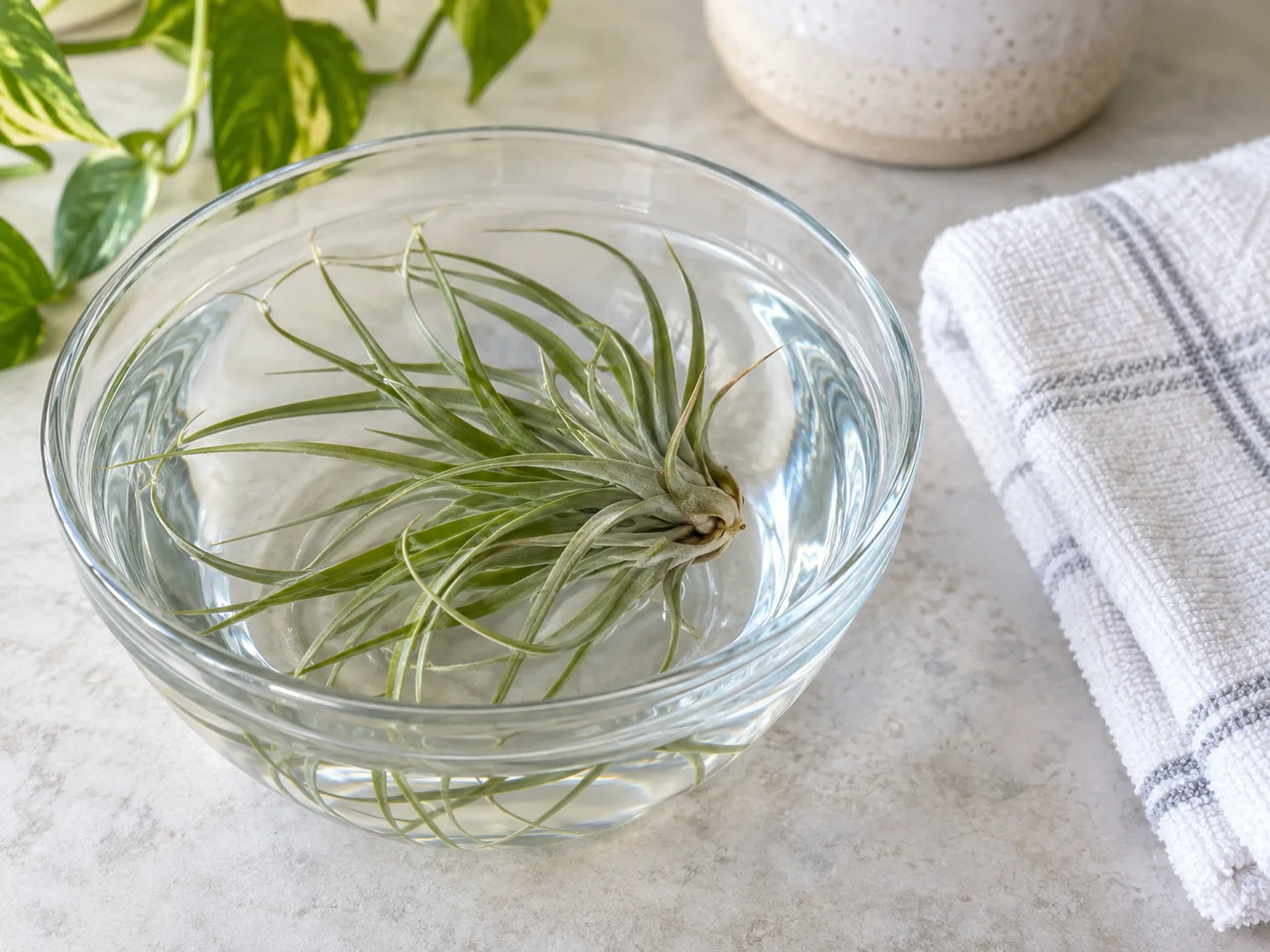
Misting can be useful between more thorough waterings when the air is very dry, but a quick spray is often an unreliable sole method: it may wet only the outer leaves and evaporate before a dense plant has hydrated. Conversely, repeated misting in a closed globe can leave the plant damp without the benefit of fresh air. The goal is not to keep the foliage wet; it is to wet it adequately and then allow a complete dry-down. (Epic Gardening)
Water quality can matter over time. If tap water is hard and leaves a visible mineral crust, try rainwater or filtered water and rinse the leaves occasionally. The RHS cautions that deposits from hard water can build on the leaf scales, while NC State describes those scales as the surfaces that absorb water and nutrients. (RHS; NC State Extension)
Temperature, Humidity, and Fertilizer
Most Tillandsias sold as houseplants prefer warm, frost-free conditions. Keep them away from cold drafts, air-conditioning blasts, and windows that become very cold at night. A humid room can be helpful, but high humidity without ventilation is not: moisture that lingers in the rosette or at the base encourages decay. Prioritize a bright, airy placement over a permanently steamy nook.
Fertilizer is optional, not the price of admission. If you choose to feed, use a product formulated for bromeliads, air plants, or epiphytic plants and follow its label at a conservative rate. Do not pour concentrated fertilizer on dry leaves or assume stronger feeding means faster growth; excess salts can injure foliage, and a stressed plant needs its basic light, water, and drying conditions corrected first. NC State Extension and the RHS both describe air plants as capable of growing without soil while still needing suitable environmental care. (NC State Extension; RHS)
Pick a Display That Keeps the Plant Healthy
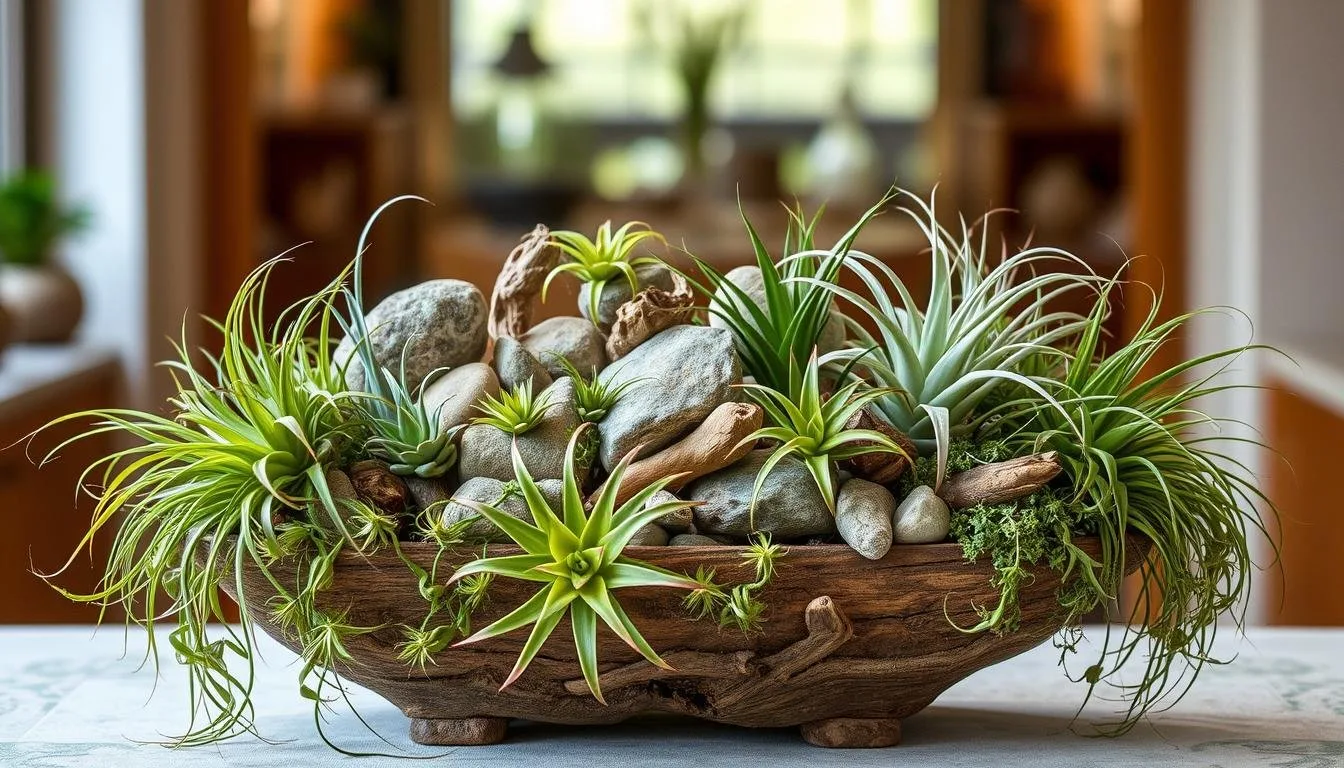
An air plant can rest in an open dish, attach to cork or driftwood, or hang in a holder that leaves its leaves exposed. Choose a display that allows light to reach the plant and lets air move around it. The best holder is also easy to remove from when you water; if a plant is permanently glued into a tight ornament, the setup can turn a simple soak-and-dry routine into an awkward task.
Open glass globes can work when they have generous openings and the plant dries completely outside them after watering. A sealed container is a different environment: water evaporates more slowly, air movement is limited, and sunlight can heat the glass. Avoid standing water at the bottom and avoid packing the plant into wet moss. In a terrarium, use a plant suited to that enclosed humidity rather than assuming every soil-free plant belongs in a closed vessel. (Epic Gardening)
Mounting should support the plant without covering its growing point or holding moisture against its base. A removable wire or loose tie is practical because you can take the plant out to water and dry it. If using an adhesive, keep it away from the crown and avoid coating the leaves; the plant needs its foliage exposed, not sealed to the ornament.
Common Myths and Mistakes to Avoid
“Air plants live on air.” They do not. The name refers to their soil-free habit, while water and nutrients still need to reach their leaf scales. A plant that never gets soaked or rinsed can gradually dehydrate even in a humid room.
“No soil means no roots.” Some Tillandsias have visible roots that fasten them to supports. Those roots are not a reason to bury the plant in potting mix, nor are they useless debris to remove automatically. Leave healthy roots in place when they help the plant hold onto a mount.
“Misting once in a while is always enough.” That depends on the plant and the room, and it often under-waters a plant in dry indoor air. If leaves become unusually curled or crisp, revisit the amount and frequency of hydration. If the center turns soft or dark, stop adding water until the plant has been inspected and can dry properly.
“Any bright window is safe.” Sunlight through glass can overheat foliage, especially when a plant sits in a closed ornament. Acclimate a plant gradually and look for bleaching or dry, scorched patches. On the other hand, a plant kept far from the window may not receive enough light to grow or bloom.
“A pretty container is automatically a good home.” A narrow vase, sealed globe, or wet moss arrangement can trap moisture and block air movement. If your display prevents you from soaking, draining, and drying the plant, change the display rather than trying to compensate with an increasingly complicated watering schedule.
Propagating Air Plants: Pups Versus Seed
For a home grower, pups are the practical way to propagate most Tillandsias. Wait until a pup is about one-third the size of the mother plant, then hold the base of both plants and gently twist or ease the offset free. If it resists, do not yank it; wait until it grows larger or use a clean blade to separate it carefully at the attachment point. The RHS identifies offsets as the straightforward propagation method and recommends allowing them to reach a useful size before detaching. (RHS)
Keep a newly separated pup in bright filtered light and continue the same cycle of thorough hydration and complete drying. It may look small for some time, so judge progress by firm, healthy leaves and gradual growth rather than expecting an instant miniature adult. Leaving pups attached is equally valid if you prefer a growing cluster and have room for it.
Seed propagation is possible but much slower and more demanding. Tillandsia seeds are tiny, seedlings need stable warmth, moisture, light, and air movement, and young plants take time to become display-sized. For someone with one flowering houseplant, saving or trading a healthy pup is generally more practical than trying to raise a mature plant from seed.
Conclusion
Air plants are Tillandsia bromeliads adapted to grow on supports rather than in ordinary soil. Their roots mainly anchor them, while specialized scales on the leaves take up water and nutrients; that is why a healthy plant still needs real hydration, appropriate light, and enough airflow to dry. The diversity within the genus means species names and visible plant cues are more useful than a one-size care rule.
Choose an open display you can water easily, let the plant dry fully after soaking, and treat flowering pups as the next stage of its life rather than a reason to discard it. For a deeper, step-by-step routine, see our Tillandsia care guide.