What Type of Lawn Mower Oil Should I Use?
Compare SAE 30, 10W-30, and synthetic 5W-30 lawn mower oil. Find the right grade, capacity, change interval, and safe refill method for your mower.
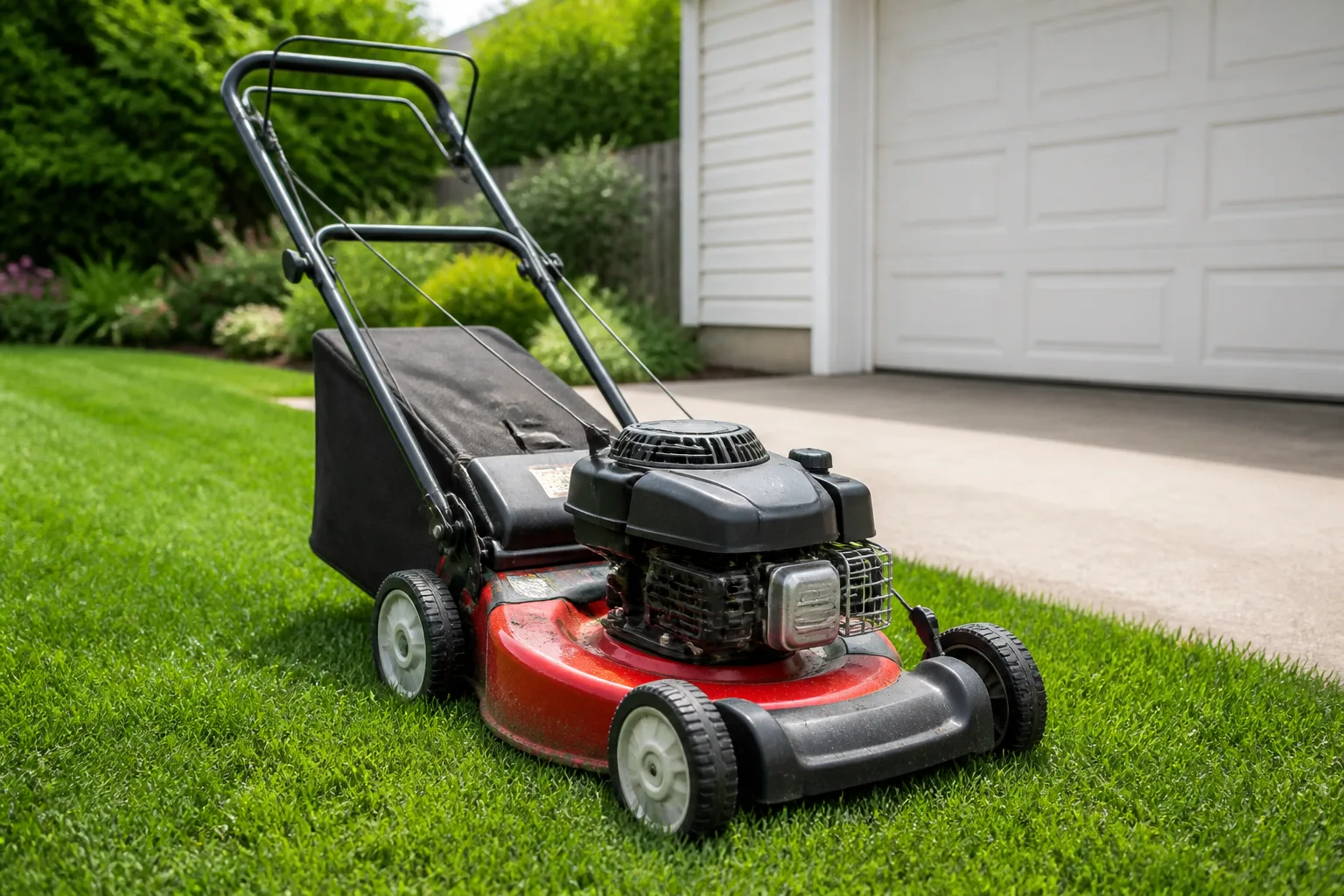
For most gas-powered four-cycle lawn mowers, the right oil is the viscosity and service grade listed in the engine or mower manual. In broad terms, SAE 30 suits warm mowing, 10W-30 handles a wider range of temperatures, and synthetic 5W-30 is useful where cold starting matters—but the manual always outranks a generic chart.
Do not choose by the words “lawn mower oil” alone. First determine whether the engine is four-cycle or two-cycle, then match the viscosity, API service classification, and capacity. That short sequence prevents the two expensive mistakes that cause most oil trouble: putting crankcase oil into a fuel mix engine or filling a separate-oil engine past its full mark.
The short answer
If your mower has a separate gasoline tank and an oil-fill tube with a dipstick, it is almost certainly a four-cycle engine. Use a high-quality detergent motor oil in the grade the manufacturer specifies. A typical warm-weather starting point is SAE 30; 10W-30 is often the more flexible choice when mowing temperatures vary; and synthetic 5W-30 can improve flow during cold starts when the manual allows it.
The best answer for your exact mower is still printed on the engine label, under the oil cap, or in the operator’s manual. As a useful manufacturer example, Briggs & Stratton’s oil guidance lists SAE 30, 10W-30, synthetic 5W-30, and other grades by temperature and use, while warning that synthetic oil does not change the required oil-change schedule.
If the mower is electric or battery-powered, it does not have a gasoline engine crankcase to lubricate. Do not pour motor oil into a battery mower simply because the machine has moving blades; follow its manual for blade bearings, gearboxes, and other service points.
Identify your engine before buying oil
Oil selection becomes much simpler once you identify the engine cycle. Look for an oil dipstick or fill cap, a shared fuel-and-oil tank, and the wording on the engine badge. The mower’s appearance is not enough: a walk-behind mower is usually four-cycle, but the cycle is determined by the engine design, not by whether the mower is pushed or self-propelled.
Four-cycle engines use a separate crankcase
A four-cycle engine stores gasoline in one tank and engine oil in a separate crankcase. The oil circulates inside the engine and is checked through a dipstick or oil-fill tube. Most modern residential push mowers and riding mowers use this arrangement.
For these engines, buy detergent motor oil that meets the manual’s viscosity and service classification. “Detergent” describes an oil formulated to help keep contaminants suspended so they can be removed at an oil change; it does not mean you should add a separate bottle of detergent or an aftermarket additive. If the manual says API SJ or higher, the oil label should show that level or a later compatible category.
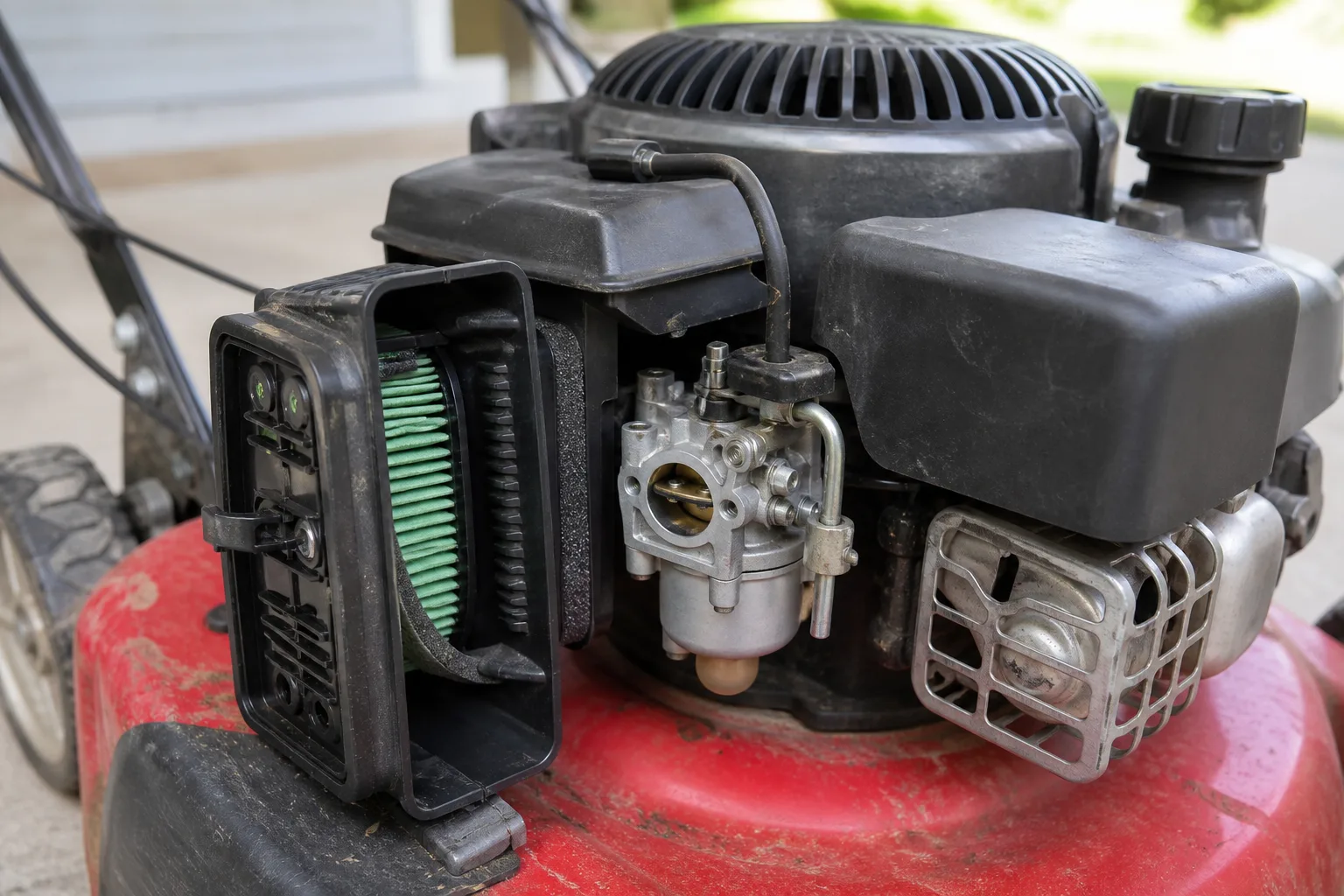
A good close-up of the machine’s air-filter and carburetor side can help you locate the engine components, but it cannot replace the model number and manual. Honda’s owner-manual library is a useful example of why model identification matters: the manufacturer organizes guidance by engine family rather than by a single universal mower recipe.
Two-cycle engines use an oil-and-fuel mixture
A two-cycle engine burns gasoline that has been mixed with the specified two-cycle oil, or it uses a built-in oil-injection system. It generally does not have a normal four-cycle crankcase and dipstick. Adding SAE 30 or 10W-30 to the fuel tank, or pouring it into a place intended for a premixed fuel, is the wrong procedure.
The oil-to-fuel ratio is not something to guess from another machine. Use the ratio printed in the manual or on the equipment label, and measure both liquids accurately. If you cannot find that information, stop and identify the engine before starting it; a wrong mixture can cause poor lubrication, excess smoke, fouled ignition parts, or running damage.
Read the manual and oil label in the right order
Use this hierarchy whenever generic advice and a bottle label seem to disagree:
- Operator’s manual or engine model lookup: Confirm the cycle, approved viscosity, capacity, service classification, and change interval.
- Oil-fill label or dipstick markings: Check whether the engine is filled to a Full mark, an Add mark, or a stated volume.
- Temperature and workload: Use the approved grade that fits the conditions in which you actually mow.
- Oil type and formulation: Choose conventional, synthetic blend, or full synthetic only after the grade and classification are correct.
The number before the “W” describes low-temperature flow behavior; the number after the dash describes the oil’s viscosity at operating temperature. Thus, 10W-30 is designed to flow more readily in cool conditions than a straight SAE 30 while still carrying a 30 operating-temperature grade. The W means winter, not weight.
The API service category is another useful label check. Do not treat a newer-looking marketing phrase such as “high mileage,” “racing,” or “performance” as a substitute for the mower maker’s specification. If the manual calls for a detergent oil of a particular API level, make sure the container actually states a matching or higher service category.
SAE 30 vs. 10W-30 vs. synthetic 5W-30
These grades are not interchangeable in every engine or climate, but the choice is easier when you understand the trade-off. Toro’s operator manual for one 22-inch Recycler model specifies SAE 30 or SAE 10W-30 detergent oil, API SJ or higher, and an 18-fluid-ounce capacity. That is a model-specific example, not a capacity promise for every Toro or every walk-behind mower.
| Oil grade | Where it often fits | Main advantage | Main caution |
|---|---|---|---|
| SAE 30 | Warm-weather small-engine mowing | Simple, stable single-grade choice | Can make cold starting harder; not right if the manual excludes it |
| 10W-30 | Seasonal climates with cool starts and warm operation | Better low-temperature flow with a 30 operating grade | Some air-cooled engines may use more oil in sustained heat; check levels more often |
| Synthetic 5W-30 | Cold starts or wide temperature swings when approved | Good low-temperature flow and broad operating range | Costs more and does not extend the service interval by itself |
| 15W-50 | Certain continuous-use engines when explicitly approved | High-temperature and heavy-use application | Never substitute it just because the mower runs hot |
SAE 30 for warm mowing
SAE 30 is a single-grade oil commonly specified for small engines used in warm weather. It is a sensible choice for a summer-only push mower when the manual lists it and the mower is not expected to start in cold conditions. It is also easy to find in small-engine packaging, but the label still needs to meet the required service classification.
Its limitation is cold flow. Briggs & Stratton warns that SAE 30 can make starting difficult below about 40°F (4°C). That does not mean every engine fails at the same temperature, but it is a useful reason to avoid choosing SAE 30 for early-spring or late-season mowing when the engine regularly starts cold.
10W-30 for variable temperatures
10W-30 is a multigrade oil. The “10W” portion describes its lower-temperature behavior, while the “30” portion describes its operating-temperature viscosity. That makes it a practical fit for a mower used across spring, summer, and fall—provided the engine manual approves it.
There is a trade-off in very hot or continuous use. Briggs & Stratton notes that 10W-30 may increase oil consumption above about 80°F (27°C), so a mower using that grade in hot weather deserves more frequent level checks. Seeing the level fall is not a reason to overfill; it is a reason to check for leaks, consumption, or an application-specific recommendation.
Synthetic 5W-30 for cold starts and wide ranges
Synthetic 5W-30 can be a strong choice for approved engines that start in cold weather or operate across a broad temperature range. Its lower-temperature rating helps the oil move during startup, and a synthetic formulation may resist some heat-related breakdown and sludge formation better than a basic conventional oil.
That benefit should be kept in proportion. Synthetic oil is not a license to skip an oil change, ignore a low dipstick reading, or stretch a manufacturer’s service interval. Briggs & Stratton specifically says synthetic oil does not alter required oil-change intervals, and the same manual-first rule applies to other engine brands.
How much oil a mower takes
Capacity is determined by the engine, not just the mower category. As a broad shopping estimate, many walk-behind mowers take roughly 15 to 20 fluid ounces, while many riding mowers take about 48 to 64 fluid ounces. Treat those figures as a way to decide whether to buy an 18-ounce bottle or a larger container—not as the fill instruction.
For comparison, Briggs & Stratton lists typical capacities of 15 or 18 ounces for walk-behind mowers and 48 or 64 ounces for riding mowers. A specific Toro manual gives 0.5 liter, or 18 fluid ounces, for the model it covers. Different engines, oil filters, drain methods, and crankcase shapes change the actual amount.
Do not pour the whole container into an empty engine automatically. Add most of the expected amount first, wait for the oil to settle, then use the dipstick to reach the Full mark. The full mark—not the last drop in the bottle—is the controlling measurement.
How to check the oil level correctly
Check the level before each use, especially at the beginning of the mowing season or after the mower has been stored. Low oil can starve moving parts; high oil can also cause damage, so a quick level check is more valuable than guessing from how much oil you added last time.
- Park the mower on a level surface and stop the engine. Let the machine settle, and keep the blade fully stopped.
- Find the oil cap and dipstick. Wipe dirt from the fill area so debris cannot fall into the crankcase.
- Remove the dipstick and wipe it completely clean.
- Reinsert it exactly as the manual directs. Some dipsticks are screwed in for the reading; others are inserted without threading, so do not assume one method fits every engine.
- Remove it again and read the oil against the Full and Add or Low marks. The oil should be within the marked range, not above Full.
- If it is low, add a small amount—only a few ounces at a time—through a funnel. Wait for it to settle, then recheck.
- Tighten the cap and wipe away any spilled oil before starting the mower.
Do not check by holding the mower at an angle or by estimating from the color of the oil. A level surface and the correct dipstick procedure are what make the reading meaningful. If the oil is milky, smells strongly of fuel, contains visible metal, or rises unexpectedly, stop using the mower and have the engine assessed rather than simply draining and refilling it.
How to change mower oil without overfilling
An oil change needs a catch pan, funnel, rags, gloves, the correct oil, and a stable work area. A small amount of warmth helps old oil drain, but a hot engine and spilled oil create burn and fire hazards. Run the mower briefly if the manual allows, shut it off, and give it enough time to handle safely.
Choose the drain method and tilt direction
- Move the mower outdoors or to a well-ventilated work area, park it securely, and disconnect the spark-plug boot or other starting connection as directed by the manual. This is especially important before working near the blade or tipping a walk-behind mower.
- Place cardboard and a drain pan under the oil-fill or drain area. Clean around the cap and drain plug first so grit does not enter the engine.
- Use the mower’s drain plug if it has one. On a riding mower, the plug is often the cleanest route; remove it over the pan, let the oil drain fully, replace the plug, and check for a sound seal.
- If the walk-behind design requires tipping, follow the manual’s direction. As a general safety rule, keep the air filter and carburetor facing upward so oil does not run into the filter housing or intake. The exact tilt direction still belongs to the manufacturer’s instructions.
- An oil extractor can remove oil through the fill tube on compatible engines. It reduces tipping, but it does not remove the need to follow the capacity and dipstick procedure.
- Transfer used oil to a clean, sealed container. Do not pour it on soil, into a drain, into a storm sewer, or into household trash. Lawn Love’s oil-change walkthrough describes the common drain options and recommends taking used oil to an approved recycling or collection facility.
The tilt warning matters because oil in the air filter can cause smoke, a saturated filter, and a hard restart. Gardening Know How also emphasizes checking the manual and keeping the air filter side up when a mower must be tilted. That is a practical maintenance detail many generic oil charts leave out.
Settle, run, and recheck after the refill
- Set the mower level again and use a clean funnel in the oil-fill opening.
- Add about three-quarters of the expected capacity, not the entire estimate. If the manual says 18 ounces, you might begin around 13 to 14 ounces, then measure.
- Wait several minutes for the oil to move through the crankcase. Toro’s manual uses a three-minute settling period before the dipstick reading.
- Wipe and read the dipstick using the correct insertion method. Add small increments until the oil reaches Full.
- Reinstall the cap securely, reconnect the spark-plug boot, and run the engine briefly in a safe outdoor area.
- Shut it off, look for leaks at the drain plug or filter, wait for the oil to settle, and check the dipstick one more time.
The final check catches two easy-to-miss problems: oil that was trapped in an oil filter or passage during the first reading, and a drain plug that was not sealing. If the level is above Full, correct it before mowing. “More lubrication” is not better when the crankcase is overfilled.
Can you use car oil in a lawn mower?
Often, a four-cycle lawn mower can use automotive motor oil if it matches the engine manufacturer’s approved viscosity and service classification. The label “for lawn mowers” is not a magical chemical category; many small four-cycle engines use the same basic classes of detergent motor oil used in other gasoline engines.
That does not make every car oil a safe substitute. Do not use an unapproved grade because it is already in the garage, and do not assume a car-oil recommendation covers a two-cycle fuel mixture. Check the manual for viscosity, API classification, synthetic approval, and any break-in restrictions. When those specifications are unknown, finding the engine model is safer than relying on a leftover bottle.
Do not add special oil additives unless the manufacturer explicitly calls for one. Additives can change the formulation without solving the actual problem, which is usually a wrong grade, low level, dirty oil, a leak, or an engine fault.
Oil-change timing and seasonal storage
The correct interval is the one in the manual, measured by operating hours or calendar time. As general manufacturer guidance, Briggs & Stratton lists 50 hours or once a year for many walk-behind engines and 100 hours or once a year for many riding-mower engines, whichever comes first. Heavy dust, long mowing sessions, high heat, and commercial use can justify a shorter interval when the manufacturer permits it.
Change oil at the end of the season even if the mower did not reach its hour limit, unless the manual gives a different storage procedure. Old oil carries combustion contaminants and moisture, and storage is a poor time to leave a contaminated fluid sitting in the crankcase. Before the first spring cut, check the oil level, inspect for leaks, confirm the air filter is serviceable, and make sure the blade and deck are safe.
Keep oil containers sealed, labeled, and stored away from heat. Used oil should go to a local approved collection or recycling point; rules and accepted container sizes vary by location. If you also need to handle stale gasoline, keep that as a separate waste stream and follow your local hazardous-waste guidance rather than mixing fuel with used oil.
For the lawn itself, oil maintenance is only one part of a reliable mowing routine. Pair it with proper mowing height and timing and a sharp, balanced blade; a healthy engine cannot compensate for scalping wet turf or shredding grass with damaged metal.
Wrong oil and overfill troubleshooting
The mower smokes after an oil change.
A brief puff can come from oil spilled on a hot engine or oil that entered the air filter during an incorrect tilt. Persistent blue-gray smoke, an oil smell, or smoke that grows worse under load points to overfill, oil entering the intake, worn engine components, or another fault. Shut the mower down, let it cool, check the level on a flat surface, inspect the air filter, and drain excess oil before trying again.
The engine is hard to start after service.
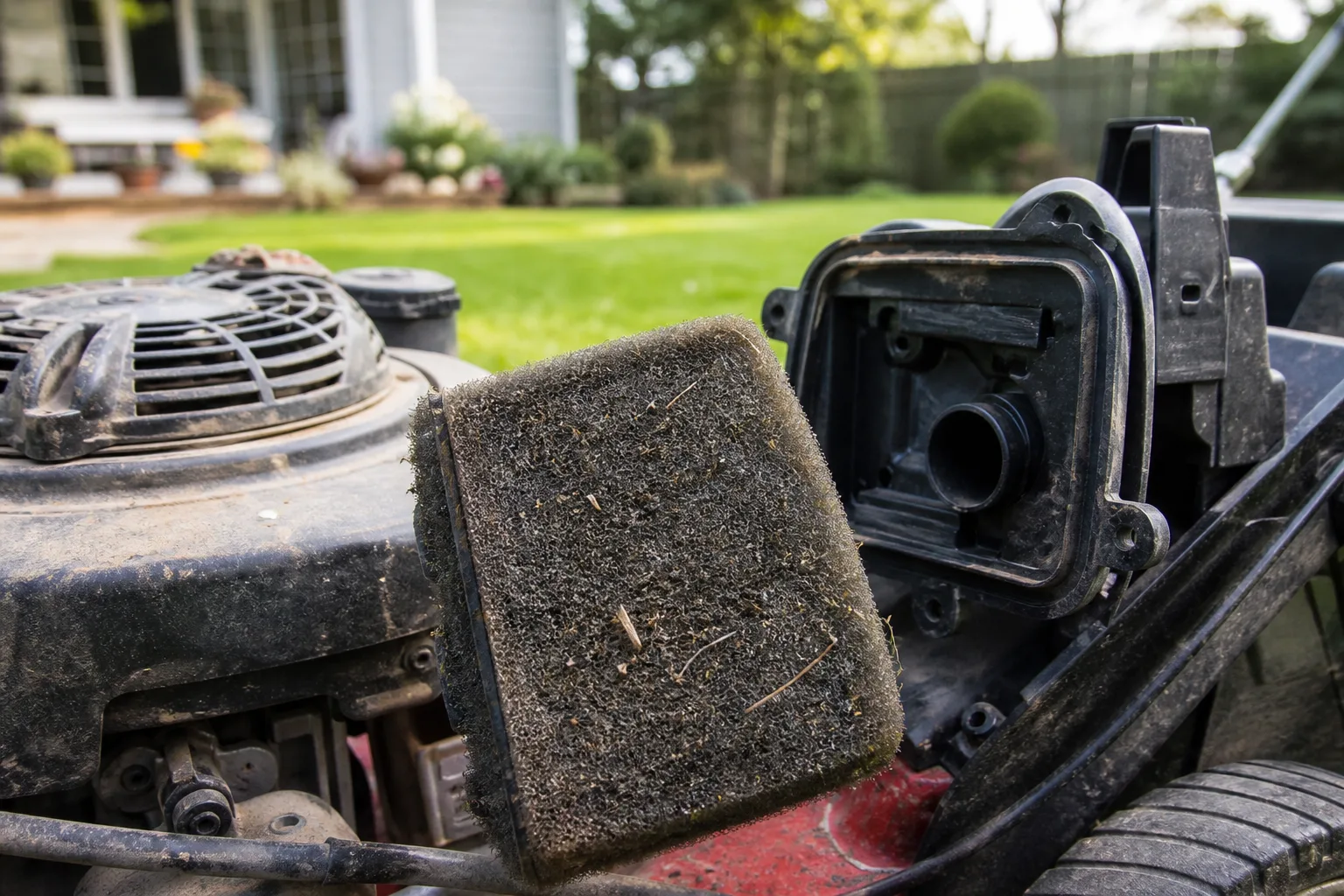
Recheck the oil level first, then look at the tilt direction and air filter. Oil-soaked filter media can restrict airflow, and a flooded engine may need the procedure in its manual rather than repeated pulling of the starter. Also verify that the spark-plug boot is fully connected after maintenance and that the oil cap is installed.
You used the wrong viscosity.
If you have not run the engine, drain the oil and refill with the approved grade. If you ran it briefly, stop, correct the level and grade, and watch for smoke, leaks, unusual noise, or loss of power. A single short mistake is not automatically an engine failure, but continuing to mow with the wrong level or an unapproved oil compounds the risk.
You mixed two approved grades.
Do not panic over a small accidental mix of compatible four-cycle oils, but do not make mixing your maintenance strategy. If both oils meet the manual’s service classification and the resulting viscosity is approved, the immediate priority is a correct level; at the next change, use one approved grade. If either oil is unknown, contaminated, intended for two-cycle mixing, or outside the manual’s specification, drain it and replace it.
The oil level keeps dropping.
Top-ups are not a diagnosis. Check for a wet drain plug, oil around the fill cap, smoke from the exhaust, and oil in the air-filter housing. A level that falls without visible leakage can indicate consumption or an internal problem, so a small-engine service shop is the right next step before the mower runs low enough to damage itself.
The oil level is above Full.
Do not start the engine. Remove excess oil with the approved drain method or an extractor, then recheck on level ground. Toro warns that running an engine with oil that is too low or too high can damage it. If the mower has already been run while overfilled and continues to smoke or runs unevenly, correct the level and have the machine inspected.
Conclusion
Choose lawn mower oil by engine cycle first, manufacturer specification second, temperature third, and formulation last. For a typical four-cycle mower, that may lead to SAE 30 in warm conditions, 10W-30 across changing seasons, or synthetic 5W-30 for approved cold-weather use—but the exact manual and dipstick decide the final answer.
Buy less oil than your guess tells you to pour, add it gradually, wait for it to settle, and recheck the level on a flat surface. That habit, combined with the right change interval and responsible used-oil recycling, does more for engine life than chasing an expensive bottle that the mower was never designed to use.



