When to Apply Winter Fertilizer to Your Lawn by Grass Type
When to apply winter fertilizer depends on grass type, growth and local rules. Learn when cool-season lawns benefit, when to skip it and spread it safely.
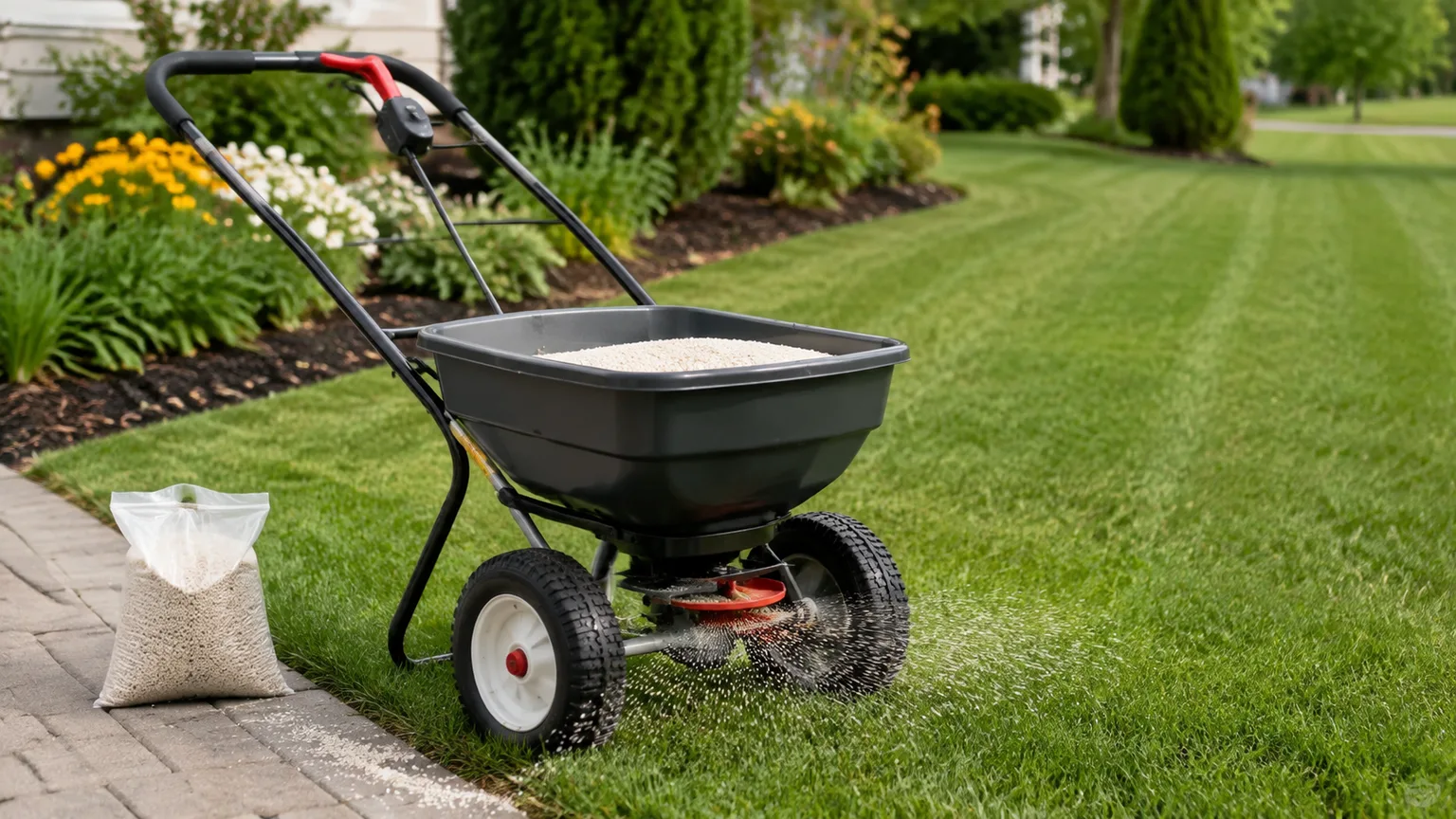
If you have a cool-season lawn, a final fertilizer feeding may fit in late fall, while the grass is still green and the soil is unfrozen—but only if your local lawn calendar, soil test, and annual nitrogen plan support it. “Winterizer” is a bag label, not a universal date or a requirement. For many warm-season lawns, fall nitrogen is precisely what to avoid as the grass prepares to go dormant.
The most dependable timing rule is to follow your local Cooperative Extension calendar for your grass type, then apply only during the recommended window and according to the fertilizer label. A month that works in central Illinois can be too late in Minnesota, too early in the Mid-Atlantic, or the wrong season for bermudagrass in Georgia.
The Short Answer: Time It to Grass Growth, Not a National Date
For established cool-season turf such as Kentucky bluegrass, tall fescue, fine fescue, and perennial ryegrass, a late-fall nitrogen application can be an option after top growth slows, while the lawn is still green and the soil is not frozen. In some regions, Extension guidance places that optional “winterizer” in late October or November; in other regions, the main fall feeding window ends earlier. Check your state or county Extension calendar and any local fertilizer restrictions before you spread.
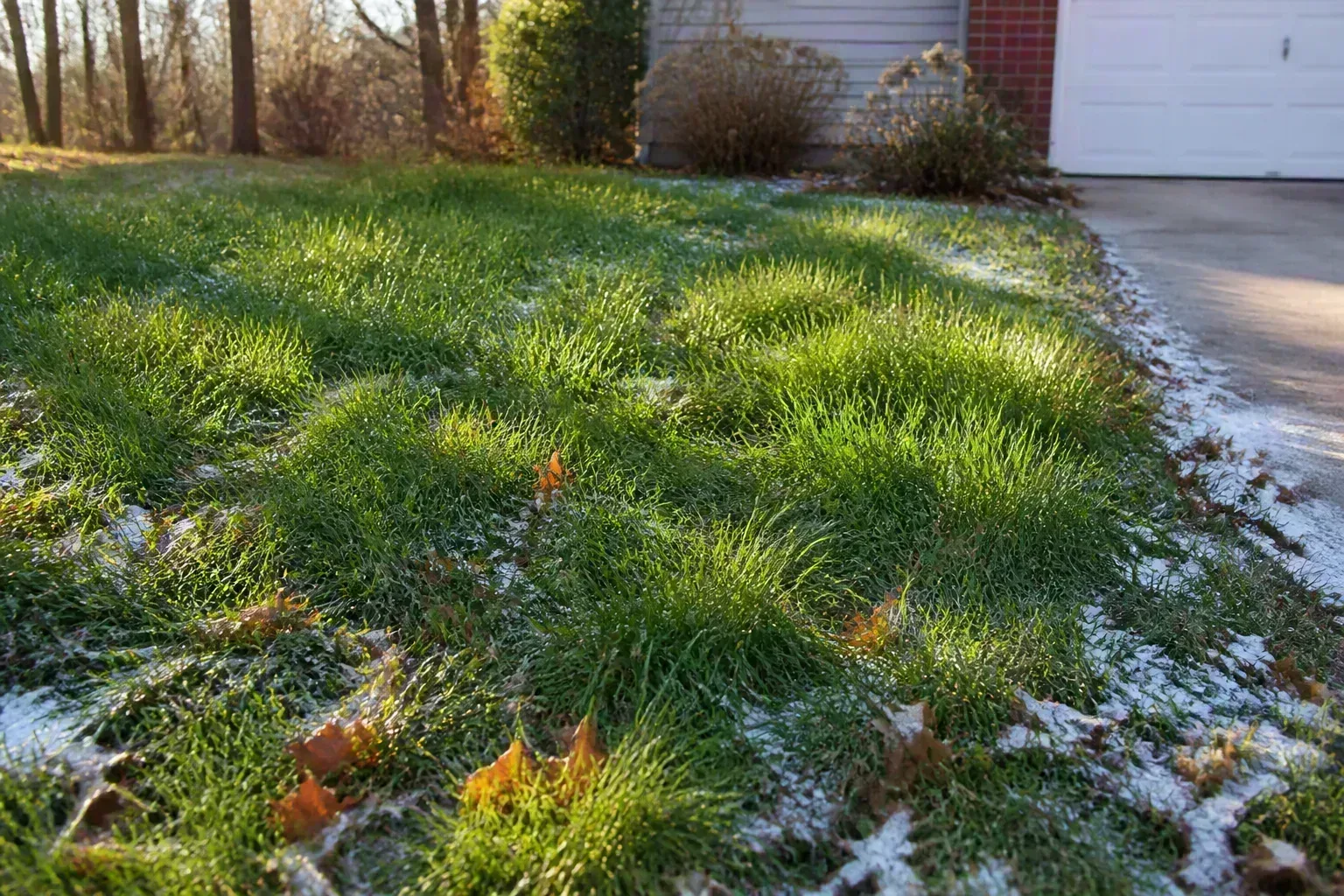
Do not treat winter fertilizer as a product you apply during winter dormancy. Once the lawn is frozen, snow-covered, saturated, or fully dormant, stop. Fertilizer cannot solve a late-season problem by being dumped on top of a lawn that is no longer in a useful uptake window, and granules left exposed can move with runoff or snowmelt. If you miss the local window, wait for the next recommended feeding period rather than trying to catch up.
An optional late-fall application also is not a substitute for the more important growing-season care that comes before it. If your lawn already received its recommended fall nitrogen, looks healthy, and has clippings returned to the soil, another bag may add little. A soil test and your local turf schedule tell you more than the word winterizer on the package.
What “Winterizer” Fertilizer Is—and Is Not
“Winterizer” is a marketing term for lawn fertilizer sold for a late-season application. These products often contain nitrogen and sometimes potassium, but they do not all have the same analysis or release characteristics. University of Minnesota Extension describes winterizers as commonly containing urea nitrogen and potassium, while noting that the benefit may be modest when a lawn is not low in potassium. University of Minnesota Extension and Illinois Extension both frame it as one possible part of a cool-season lawn program rather than a required winter treatment.
The three numbers on the bag show the product’s percentage by weight of nitrogen, phosphorus, and potassium, in that order. A 21-0-20 bag, for example, is 21% nitrogen, 0% phosphate, and 20% potash by weight. Those numbers do not tell you that the mix is right for your lawn, whether the nitrogen is fast- or slow-release, or how much product to use per 1,000 square feet.
The name also does not make a fertilizer effective while grass is frozen or dormant. Winterizer usually means “intended for late-season use”; it does not mean “apply anytime in winter.” Check the nutrient analysis, release form, label application directions, and any state or local rules before you buy it.
The Late-Fall Window for Cool-Season Lawns
Cool-season grasses resume growth in fall as air temperatures moderate after summer heat. The useful window for a late feeding is when the lawn has slowed its visible leaf growth but has not reached frozen-soil conditions. It is a transition, not a single date: your region, turf species, recent weather, soil drainage, and earlier fertilizer applications all change the answer.
University of Minnesota Extension says cool-season roots grow when soil temperatures are above 32°F and grow most actively around 50°F to 65°F, while its Minnesota lawn calendar lists routine fertilizing from early August through mid-October. That calendar and Minnesota Extension’s separate late-fall discussion show why “winterizer” advice can differ even within one state: an optional late application is not the same thing as a core fall feeding for every lawn. Minnesota Extension’s lawn calendar rather than treating one source’s date as a national rule.
Use local dates as examples, not rules
Published calendars are snapshots of regional conditions. Illinois Extension, for example, lists a late-season winterizer around late October to early November in northern Illinois, November in central Illinois, and late November in southern Illinois, and says to apply about a week after the last mowing. That schedule is for Illinois cool-season turf. In Maryland, nitrogen applications are restricted after the state’s cutoff date, and Minnesota’s general calendar ends routine fertilizing earlier. Those schedules cannot be swapped just because the same fertilizer bag is sold everywhere. Illinois Extension’s schedule illustrates how much a date can shift within a state.
Use local guidance in this order: identify the turf, find the final recommended nitrogen window, note whether winterizer is optional or discouraged, then check the cutoff date and product directions. If you have a mixed lawn or live in a transition zone, ask your county Extension office. Turf writer John C. Fech describes timing his own Fine Gardening fall feeding around Halloween as his local grass goes dormant; it illustrates a growth cue, not a date to copy. Fine Gardening’s autumn turf discussion is a useful regional example.
| Lawn situation | Practical timing cue | What to check |
|---|---|---|
| Cool-season lawn in a northern climate | Late-fall feeding may be an option while turf is green and soil is unfrozen | County Extension schedule, prior nitrogen, and state cutoff |
| Cool-season lawn in a milder or transition climate | Early fall may be the main feeding; late feeding may be limited or optional | Local calendar and annual nitrogen limit |
| Warm-season lawn entering dormancy | Do not use a cool-season winterizer schedule | Species-specific Extension calendar and last active-growth window |
| Dormant, frozen, or saturated lawn | Hold the fertilizer | Wait for the next safe, locally recommended season |
Treat the last mow as a clue, not a deadline
A final mowing can help you recognize that leaf growth is winding down, and some Extension calendars use it to describe timing. It is not a universal trigger. Illinois Extension’s “about a week after the final mowing” guidance is a local schedule; another region may set a legal fertilizer cutoff before a homeowner’s actual last mow, or recommend its main feeding weeks earlier.
Mowing shorter does not make fertilizer reach the roots. Granules need to land on or move through the turf canopy, and then be incorporated only as the product label directs. Do not scalp the lawn to prepare for fertilizer. Keep mowing at the appropriate height while the grass is actively growing, and let local guidance—not a last-mow hack—set the fertilizer window.
Why a Late-Season Feeding Can Help Cool-Season Turf
Cool-season grass does not switch all activity off at the first cold night. Shoots slow before the root system completely stops growing, and a well-timed, appropriate nitrogen application can contribute to the plant’s reserves and spring growth. Penn State Extension defines late fall as the period when foliar growth slows or stops while soils remain unfrozen; it notes that correctly timed late-fall fertilization can support earlier spring green-up with less top growth than an early-spring nitrogen push. Results still depend on turf, weather, product, and the rest of the annual program. Penn State Extension’s turfgrass guide explains both that potential and the limits.
The goal is not to force a lawn to keep growing through cold weather. Nitrogen is most useful when the grass can take it up and use it, and excess nitrogen does not guarantee a stronger turf stand. Too much can create lush leaf growth, increase disease or stress vulnerability, and raise the amount of nutrient available to move off-site. A late-season application is best thought of as one carefully sized part of a full-year plan—not a repair treatment for every yellow, thin, or damaged lawn.
A winterizer cannot guarantee earlier spring color. Weather, shade, drainage, disease, and winter injury all affect green-up; fertilizer supplies nutrients but cannot fix the wrong grass for a site or poor drainage.
Warm-Season Lawns Usually Need a Different Plan
Bermudagrass, zoysiagrass, centipedegrass, and St. Augustinegrass are warm-season grasses. In much of the South, they grow most vigorously in warm weather and naturally slow as days shorten and temperatures fall. They are not candidates for the late-fall feeding schedule used for a northern Kentucky bluegrass lawn.
For example, UGA Extension advises homeowners with bermudagrass, centipedegrass, and zoysiagrass to avoid unnecessary nitrogen as the turf slows toward dormancy; new growth can delay that transition and raise the risk of cold injury. A UGA county Extension calendar advises against fertilizing warm-season lawns after August. Local timing can differ across Florida, the coastal Southeast, and inland regions, so check the calendar for your species and county rather than treating “after August” as a nationwide date. UGA Extension’s current fall guidance and UGA Extension’s warm-season lawn advice show why fall nitrogen that suits one grass can be a bad fit for another.
Do not try to keep a warm-season lawn green by adding nitrogen after it has begun to enter dormancy. If you want to improve soil pH or correct a confirmed nutrient deficiency, use soil-test recommendations and follow your local Extension calendar for the right amendment and timing. Potassium may be useful when the soil test says it is needed, but adding a high-potassium product automatically is not a substitute for a test.
Identify Your Grass Before Buying a Bag
Many Northern and Midwestern lawns contain a blend of cool-season grasses: Kentucky bluegrass spreads by underground rhizomes, while tall fescue and perennial ryegrass grow in bunches, and fine fescues often appear in shady or low-input areas. Southern lawns are more likely to include warm-season species such as bermudagrass or zoysiagrass. There are regional and mixed-turf exceptions, so do not infer species from a state name alone.
Start with the seed or sod label, a past lawn renovation record, or a local Extension identification guide. If you cannot identify the lawn, take a clear close-up photo and ask your county Extension office, Master Gardener program, or a reputable turf professional. Correct identification matters because the same late-fall nitrogen that may fit cool-season turf can interfere with warm-season dormancy.
For a mixed lawn, look at how the grasses are arranged. If zoysia and tall fescue occupy separate front and back areas, treat each zone as its own lawn and apply only the fertilizer schedule appropriate for that area. If they are intermingled, use local mixed-turf guidance instead of choosing the fertilizer timing for whichever patch looks less healthy.
Test the Soil and Set a Nutrient Goal
A soil test is the best way to decide whether phosphorus, potassium, or lime belongs in the plan. It also helps avoid applying fertilizer just because a bag is labeled for winter. Most established lawns primarily need nitrogen, but phosphorus and potassium needs depend on the soil and turf, and excess nutrients can become runoff. Missouri Extension describes testing as a way to identify deficiencies and avoid unnecessary applications; Missouri Extension’s lawn soil-testing guide also discusses how clippings and leaf litter return nutrients to the yard.
Collect and submit the sample according to your state lab or Extension service’s instructions. For a representative result, sample the lawn area you plan to treat rather than mixing soil from unrelated garden beds, compost piles, or several differently managed zones. Test every few years or when a new lawn problem suggests soil pH or nutrient availability may be limiting growth.
Do not add phosphorus because a fertilizer’s second number makes the product seem “complete.” Many established soils already have enough, and several state or local rules restrict phosphorus on established lawns unless a soil test supports it. The EPA recommends phosphorus-free lawn fertilizer near ponds, lakes, and streams because excess phosphorus can contribute to algae growth. Check the EPA’s lawn-care guidance and your local fertilizer law before purchasing.
The Royal Horticultural Society also notes that most lawns recover without an autumn feed and recommends feeding only when needed. Its advice reflects UK conditions, so use local U.S. Extension guidance for dates and rates; the useful principle is not to make a seasonal product an automatic annual chore. RHS autumn lawn care explains that distinction.
Count earlier feedings and recycled clippings
A winterizer application is part of the lawn’s annual nitrogen total. Write down the approximate dates and rates of earlier feedings, and include any fertilizer applied with seed, weed control, or another lawn treatment. A fall fertilizer schedule is not an invitation to stack a late product on top of a full annual program.
Mulched clippings also return nutrients. When you mow regularly and leave fine clippings in place, the material decomposes into the lawn rather than leaving the property. Maryland Extension says returning clippings and leaf litter can provide a meaningful share of annual lawn nutrients over time, potentially reducing the need for a fertilizer application. That does not mean clippings provide a predictable, labeled nitrogen dose, but it is another reason not to assume that every established lawn needs the same number of feedings. University of Maryland Extension discusses nutrient recycling and lawn-specific nitrogen schedules.
A lawn that already looks dense, has received its recommended fall feeding, and returns clippings may have no reason for a separate winterizer. A thin lawn may need seeding, improved drainage, less shade, or a soil-pH correction; fertilizer alone will not solve those site problems.
Choose Fertilizer by Nutrient Need, Not the “Winterizer” Label
If a local schedule recommends late-fall nitrogen, choose a lawn fertilizer that supplies the needed nutrient at the recommended rate and is labeled for your turf. Do not buy a product solely because it has “winter,” “winterizer,” or “winter guard” in its name. Compare the N-P-K analysis, nitrogen release type, application rate, and any directions about watering or temperature.
Granular and liquid products can have different directions. Some products should be watered in; others may specify a rain-free period or a different incorporation method. There is no single watering rule that overrides the label. Avoid combination weed-and-feed products unless the weed-control ingredient is also appropriate for the weed, turf, and season; a fertilizer timing window and herbicide timing window do not always match.
Read the N-P-K analysis
The first number is nitrogen, the second is phosphate, and the third is potash. Nitrogen supports green leaf and shoot growth, while phosphorus and potassium should be based on soil needs and local guidance. A high-potassium winterizer is not automatically safer or more effective than a balanced lawn fertilizer; the nutrient ratio should follow the soil test and local recommendation.
Phosphorus is particularly important to handle carefully because it can contribute to water-quality problems when it leaves a lawn. Maryland and Washington, D.C., are examples of places with specific lawn-fertilizer rules around phosphorus, seasonal timing, or application rates. The precise requirements change by jurisdiction and can apply to organic as well as synthetic fertilizer, so check the current rules where you live. In D.C., for example, the official lawn guidance lists a November 15–March 1 restriction for professional applications and describes runoff precautions for residents. The District’s Department of Energy and Environment publishes the local requirements and best practices.
If a soil test shows potassium is adequate, there may be no need to pay extra for a product with a high K number. University of Minnesota Extension specifically notes that the benefit of a winterizer can be minimal when a lawn is not potassium-deficient. Your lawn’s nutrient results, not a product’s winter-themed package, should drive the choice.
Calculate nitrogen instead of cutting the label rate in half
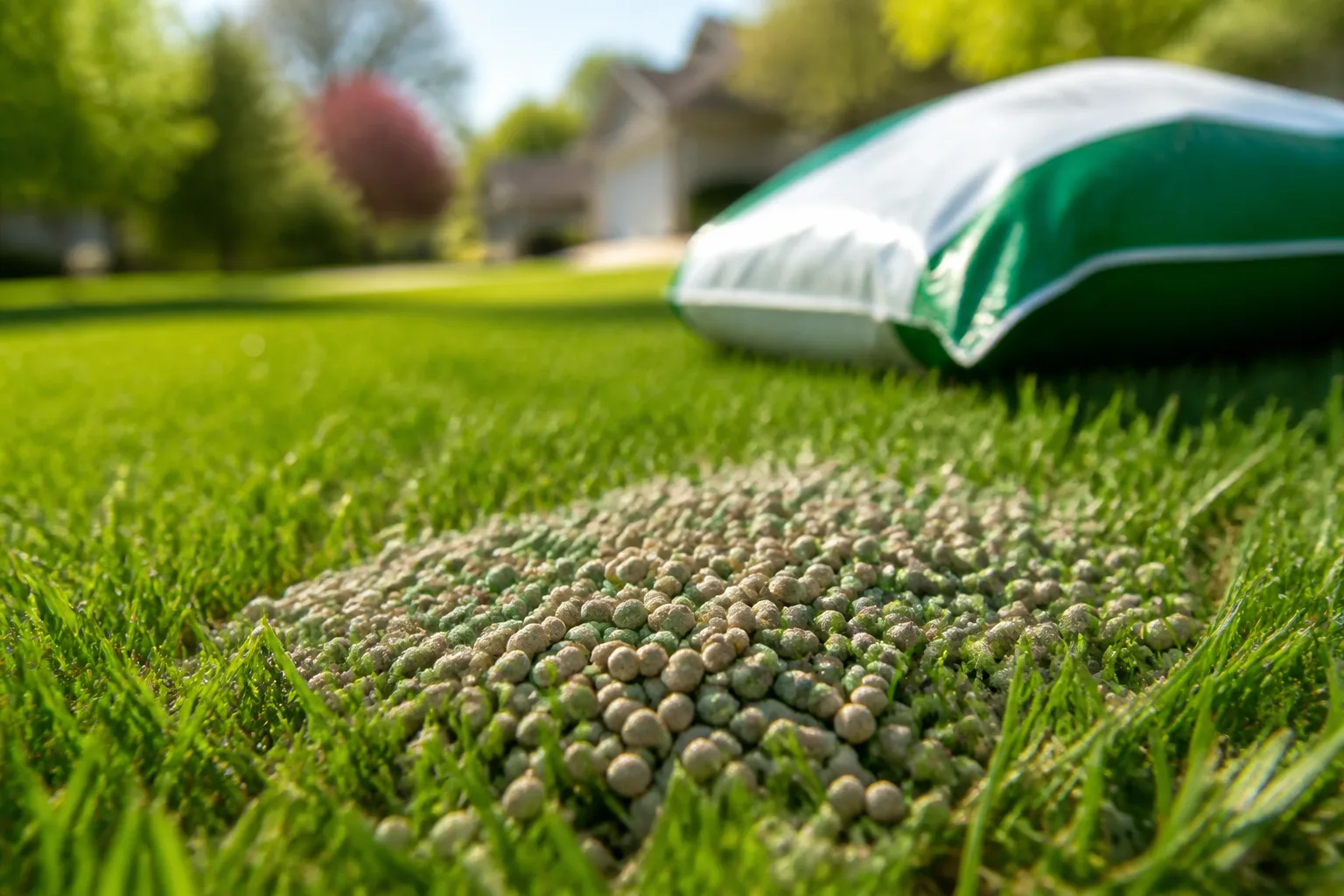
The first N-P-K number tells you the percentage of nitrogen in the bag. If a local Extension recommendation calls for a particular number of pounds of nitrogen per 1,000 square feet, use the percentage to calculate the product amount. Illinois Extension gives the formula: desired pounds of nitrogen per 1,000 square feet divided by the fertilizer’s nitrogen percentage in decimal form, multiplied by lawn square footage divided by 1,000. See the Illinois calculation method.
For example, if your local recommendation calls for 0.5 pound of nitrogen per 1,000 square feet, and your lawn is 2,000 square feet, a 15-0-10 product would require this amount to deliver that target:
0.5 ÷ 0.15 × (2,000 ÷ 1,000) = about 6.7 pounds of product.
That example shows the math only; it is not a universal late-fall rate. Your Extension schedule, annual nitrogen total, fertilizer label, and local law determine the appropriate target. Do not automatically apply half the bag’s stated rate: an arbitrary cut can make an application unpredictable and can also conflict with the product directions. If the local rate is lower than the bag directions allow, use an appropriate product and calibrated setting that delivers the correct amount, or ask Extension for help calculating it.
When to Hold Off
Skip the application if the lawn is frozen, covered in snow, waterlogged, or no longer in the recommended uptake window. Do not spread before heavy rain, on saturated ground, or where runoff will carry granules toward a curb, storm drain, ditch, pond, or stream. Nutrients that leave the lawn are wasted and can reach waterways. EPA guidance recommends applying only when fertilizer is needed, following the recommended rate, avoiding rainy or windy conditions, and keeping fertilizer off pavement. EPA’s yard guidance explains those runoff precautions.
Hold off when the lawn is drought-stressed, diseased, newly established and already on a starter-fertilizer schedule, or has reached dormancy. A dormant lawn cannot be “woken up” by fertilizer. For warm-season turf, this is especially important: late nitrogen can encourage growth while the plant should be slowing down for cold weather.
If you have sandy soil, steep slopes, drainage channels, or a lawn beside water, be more conservative and ask your Extension service about timing and nutrient source. Penn State notes that nitrogen loss depends on soil type, precipitation, rate, source, and timing, and warns about leaching risk in some late-fall conditions. If the forecast is unsettled, wait for a calmer interval rather than applying just before a storm. Do not water a saturated lawn simply to force fertilizer downward.
Apply the Product Evenly and Keep It Out of Waterways
Once the timing and nutrient plan both check out, measure the lawn area and weigh or measure only the amount calculated for that area. Check the spreader setting chart for the exact fertilizer; a setting that worked with a different granule size may not meter this product the same way. If you do not know your spreader’s accuracy, test its output on a measured area before applying it across the whole lawn.
Apply only to turf, not sidewalks or driveways. Stop or close the spreader before crossing pavement, and use an edge guard or deflector near gardens, drains, and waterways. Avoid windy conditions that can send granules into beds or onto hardscape. Do not pour leftover fertilizer into a storm drain or dump it in one spot on the lawn.
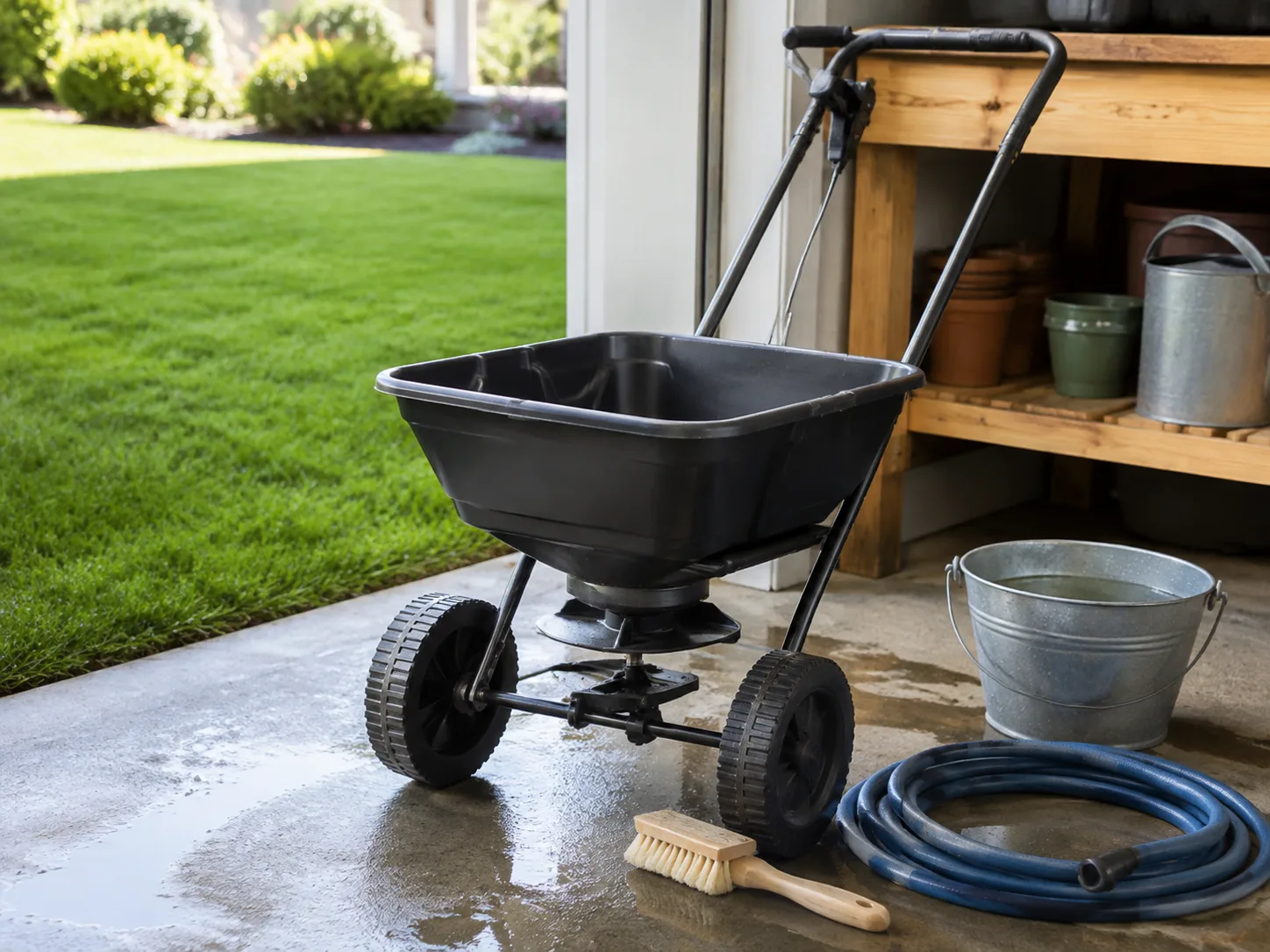
Calibrate the spreader and make two passes
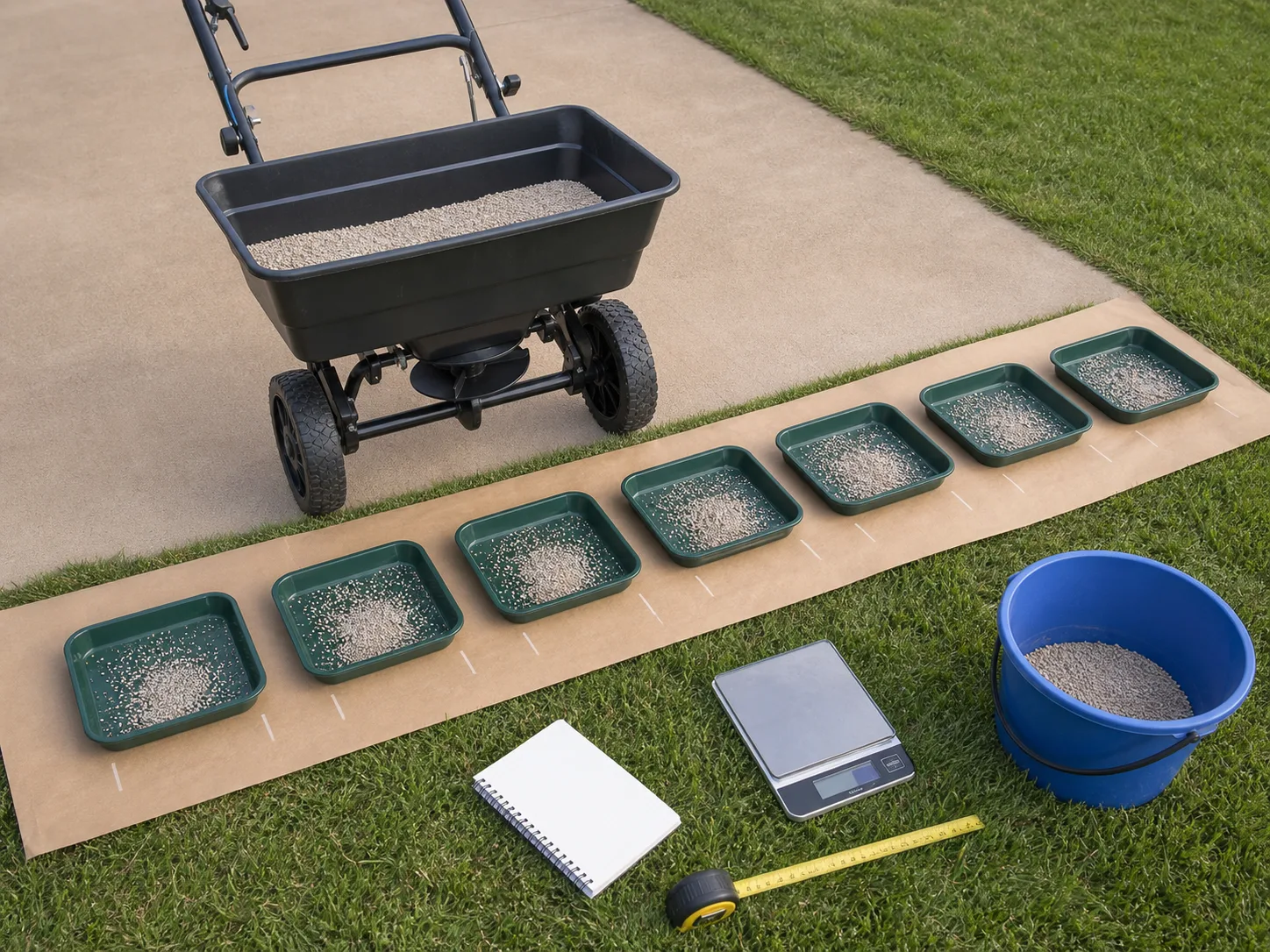
For more even coverage, divide the measured product into two equal portions and apply them in perpendicular directions if the label and spreader permit that method. Set a steady walking pace, slightly overlap each pass according to the spreader instructions, and shut off the gate before turning or crossing a hard surface. Two lighter passes reduce the chance of stripes and heavy bands compared with trying to empty the whole amount in one direction.
A rotary spreader can throw granules farther than you expect, so use a deflector near beds or pavement. A drop spreader keeps material in a narrower path and can be easier to control along edges. Whichever type you use, keep the hopper closed when stopping and sweep spilled granules back onto the lawn promptly. The EPA notes that fertilizer on pavement can wash into storm drains, which often carry water directly to nearby waterways. EPA’s lawn-product guidance recommends sweeping stray fertilizer from sidewalks and driveways back onto turf.
What to Do After the Application
Follow the product label for watering. If it calls for irrigation, use enough water to move granules off the leaves and into the soil without creating puddles or runoff. If the label says to wait or the product is intended to be watered by natural rainfall, do not automatically soak the lawn. A gentle, label-compliant watering is different from applying fertilizer ahead of a downpour.
Keep children and pets off treated turf for the period stated on the product label, and store unused fertilizer sealed in a dry place. Pick up any granules that remain on pavement after application. If fertilizer spilled into a drain or waterway, follow local environmental guidance for reporting or cleanup rather than hosing it farther into the storm system.
Then let the lawn follow its seasonal cycle. Continue mowing only while the grass is actively growing, clear heavy leaf mats, and avoid walking repeatedly on frozen turf. In spring, do not compensate for a missed winterizer with an oversized early feeding. Wait until grass is actively growing and use your local calendar to decide whether a spring application is needed. Minnesota Extension advises against fertilizing too early in spring because it can prompt growth before the lawn is ready; its lawn calendar provides Minnesota-specific timing.
Conclusion
The right time to apply winter fertilizer depends first on grass type. For an established cool-season lawn, an optional late-fall feeding may fit after top growth slows but before soil freezes, if local Extension guidance, the soil test, and your annual nitrogen plan all support it. The final mow can be a useful seasonal clue, but it does not set a universal date or make fertilizer reach roots.
Warm-season lawns usually need to stop nitrogen earlier as they enter dormancy. Any lawn should skip fertilizer on frozen or saturated ground, before heavy rain, or when its nutrient plan does not call for another feeding. Read the analysis and directions on the bag, calculate the amount rather than guessing, and keep granules off pavement. If the window has passed, leave the bag on the shelf and resume with the next locally recommended season.