When to Plant Onions for the Best Harvest
Match onion variety to daylight and frost dates with a practical planting calendar for seeds, sets, transplants, fall planting, and harvest.
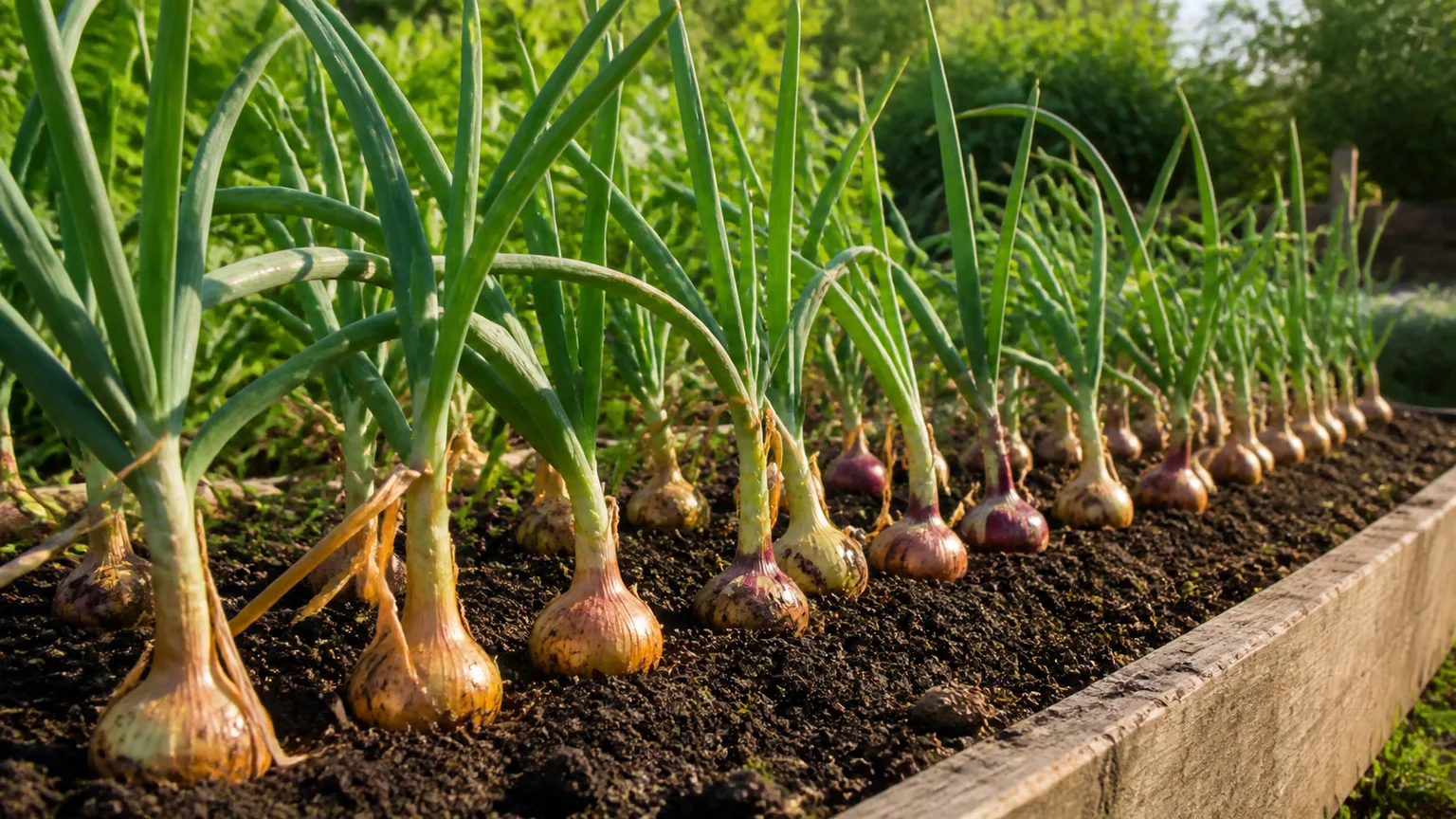
The best time to plant onions depends on two clocks: day length and weather. Day length tells the plant when to stop making leaves and start swelling a bulb; your local frost date and soil condition tell you when that plant can safely settle into the garden.
For most cool- and temperate-climate gardens, plant onion sets or transplants in early spring, roughly two to four weeks before the average last spring frost if the bed is workable. Start onion seeds indoors about eight to twelve weeks before you plan to transplant them. In mild-winter regions, the better window for short-day onions is often late summer through fall, so they can grow through winter and bulb in spring.
That is the useful short answer, but it is not a universal calendar date. First choose a variety adapted to your latitude, then choose seeds, sets, or transplants, and only then use frost and soil conditions to set the day.
Start with day length, not a generic date
Onions are photoperiodic: the length of daylight triggers bulb initiation. The plant does not simply read “March” or “April”; it responds to reaching a daylight threshold written into its genetics. Johnny’s Selected Seeds explains that varieties overlap on a continuum, but groups them by the approximate day length that begins bulbing: 10–12 hours for short-day, 12–14 for intermediate-day, and 14–16 for long-day onions. That day-length and latitude guide is a better starting point than a zone-only chart.
Bulb size is largely determined by how much healthy leaf growth the plant has built before that switch. Leaves are the plant’s solar panels; once bulbing begins, the existing leaf canopy supplies the bulb rather than continuing to expand the top at the same rate. If you choose a type that starts bulbing too early for your location, you can get a healthy-looking row of small onions. If you choose one that never reaches its preferred signal, you may harvest a lot of green leaves and very little bulb.
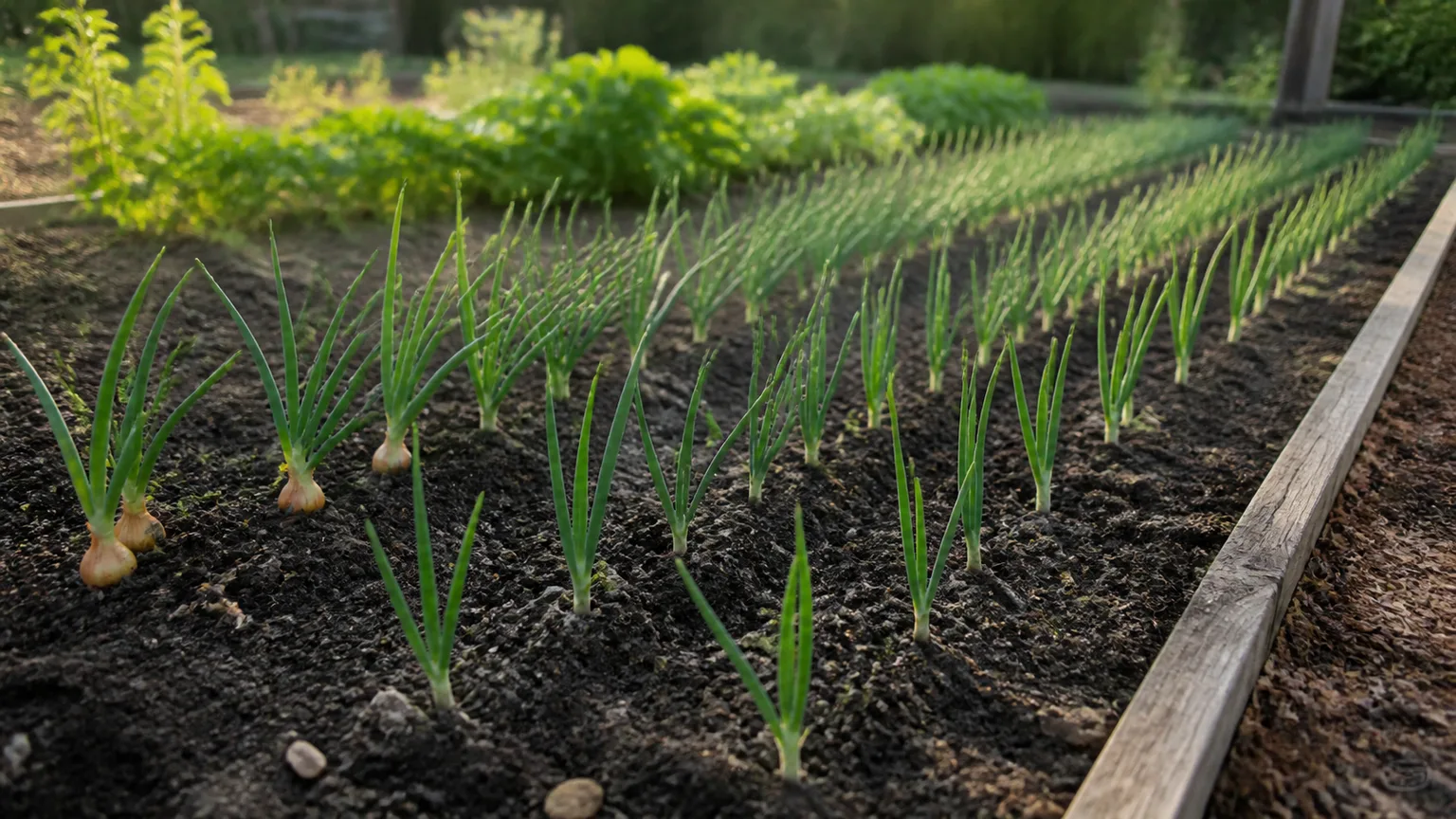
This is why “plant onions as soon as the ground thaws” is incomplete advice. Early planting helps a cool-season crop build leaves, but it cannot correct a day-length mismatch. Read the variety description for short-day, intermediate-day, or long-day adaptation before you buy, especially if you are gardening near a boundary between regions.
Match day length to latitude
Latitude is a more useful guide to onion type than the color of the bulb or the name of your USDA zone. Zones describe winter cold, while onion groups are matched to the daylight pattern of the growing season; two gardens in the same zone can still have different planting results if their latitude, heat, or season length differs.
Use the table as a first pass, not a rigid border. Seed catalogs may place a variety in more than one group, and local conditions such as heat, irrigation, and the speed of spring warming can move the practical result.
| Onion type | Bulbing trigger | Typical latitude fit | Usual planting pattern | Good starting examples |
|---|---|---|---|---|
| Long-day | About 14–16 hours of daylight | Roughly 37–47° north | Late winter or early spring | Walla Walla, Yellow Spanish, Red Zeppelin |
| Intermediate-day, sometimes called day-neutral | About 12–14 hours | Roughly 32–42° north | Spring; fall in some mild-winter climates | Candy, Super Star, Red Candy Apple |
| Short-day | About 10–12 hours | Roughly 25–35° north | Fall through winter in mild climates | Texas Grano, Granex, Red Hamburger |
Long-day onions
Long-day onions suit northern gardens where summer daylight becomes very long. They generally start forming bulbs when days reach about 14 to 16 hours, so they are planted early enough to make a substantial leaf canopy before that summer signal arrives.
In a cold-winter garden, that usually means starting seed indoors in late winter and planting sets or hardened transplants as soon as the soil can be prepared in spring. Long-day storage onions are a strong choice where you want a crop that can cure well and last into the colder months, although storage life still depends on variety and curing.
If you garden around the northern edge of the long-day range, compare the packet’s listed adaptation with a local recommendation. A long-day onion that performs beautifully farther north may bulb earlier and finish smaller in a slightly more southerly garden.
Intermediate-day onions
Intermediate-day onions bridge the central band of the country and are often the most forgiving choice for gardeners who are not clearly in a short-day or long-day region. Their bulb signal generally arrives at about 12 to 14 hours of daylight, and many popular sweet types fall into this group.
Spring planting is the default for intermediate-day onions in frost-prone areas. In a mild-winter garden, some intermediate varieties can be planted in fall for overwintering, but the packet should specifically say that the variety is suitable for that use; a spring variety left in wet winter soil is not automatically an overwintering onion.
Short-day onions
Short-day onions are designed for southern latitudes and mild winters. They begin bulbing at about 10 to 12 hours of daylight, which is why they are commonly planted in fall or early winter there: the plants establish during cool weather and build bulbs as spring days lengthen.
If you plant a short-day onion in a far-northern garden, it may receive its bulbing cue before it has made enough leaves for a large bulb. The result can be perfectly edible but undersized onions. In the reverse mistake, a long-day onion in the South may grow tops without forming the bulb you expected.
Pair the variety with frost and soil conditions
Once you have the day-length group, use your local average last frost date as a scheduling anchor. That date is an average, not a promise, so watch the actual forecast and the bed: onions appreciate cool weather, but planting into saturated soil compacts the root zone and can rot sets or slow seeds.
A workable bed crumbles when you squeeze it rather than forming a sticky ribbon. If the soil clings to your boots and shovel, wait a few days or use a raised bed that drains more quickly. The goal is not to protect onions from every chilly night; it is to give them a well-aerated root zone in which cool-season growth can proceed steadily.
Established onions tolerate light frost better than tomatoes or peppers, but that does not make every early date safe. Repeated cold followed by rapid warming can increase stress and bolting risk, particularly in large sets and overwintering crops. The RHS notes that spring low temperatures can contribute to bolting and that heat-treated sets reduce the risk, so cold tolerance should be treated as a useful trait, not an excuse to ignore the forecast. The RHS onion-growing guide also recommends avoiding autumn planting in heavy, winter-wet soil.
Your final planting date is therefore the overlap of three conditions:
- The onion variety fits your latitude and intended season.
- The soil is loose, drained, and workable.
- The plants have enough runway to build leaves before the variety’s bulbing trigger or the season’s heat.
That framework is more reliable than asking whether onions belong in one particular month. A warm raised bed may be ready before a low clay bed, while a mild coastal garden may use a fall window that is risky in a colder inland yard.
Choose seeds, sets, or transplants
The planting material changes the timing decision because each option begins at a different point in the onion’s life. Seeds give you the most control over variety and age, sets are convenient dormant bulbs, and transplants buy you a head start when the season is short.
Seeds
Choose seed when you want a specific day-length type, unusual color or flavor, a dependable storage cultivar, or a large number of plants at low cost. Starting from seed also avoids inheriting the dormant-bulb size and storage history of a set, which is one reason seed is useful when bolting has been a recurring problem.
For spring planting, sow indoors about eight to twelve weeks before the date you expect to move plants outside. Penn State Extension describes greenhouse transplants being seeded 10 to 12 weeks before field planting, while Utah State University gives about eight weeks for transplants; the difference reflects variety, growing conditions, and the size of plant you want to set out. Penn State’s onion production guidance is a helpful reference for the longer end of that range.
Sow seeds about one-quarter to one-half inch deep in a fine, free-draining seed-starting mix. Give seedlings strong light as soon as they emerge, keep the mix evenly moist rather than wet, and provide gentle air movement; weak, crowded seedlings are harder to harden off and establish.
When the tops are sturdy and the plants are roughly pencil-thick or several inches tall, begin hardening them outdoors over about a week. Start in bright shade sheltered from wind, extend the time outside each day, and bring them in if the forecast turns unusually cold. Hardened plants handle the move much better than seedlings taken straight from a warm windowsill to full sun.
Sets
Sets are small, dormant onion bulbs grown the previous season and sold for quick planting. They are the simplest option for a first crop: press or plant the set with the pointed end up, water it in, and wait for green growth.
Convenience comes with tradeoffs. Sets usually offer fewer varieties than seed or specialty transplants, and large sets are more likely to bolt than small ones; Utah State University specifically flags sets or transplants larger than about 5/8 inch as more prone to producing a seed stalk. Choose firm, dry sets that are not soft, moldy, or already pushing a long shoot.
For full-size bulbs, plant sets in early spring as soon as the bed is workable, often around two to four weeks before the average last frost in a typical cool-season garden. Set them about three-quarters to one inch deep, or deep enough that the tip is just showing above the soil, and leave about three to four inches between plants for medium bulbs. Wider spacing can produce larger bulbs; closer spacing gives more onions but smaller individual bulbs.
If your main goal is green onions, you can plant more closely and harvest the thinnings. Do not judge a dense green-onion row by the same bulb-size expectations as a widely spaced storage crop.
Transplants
Transplants are young onion plants started in a greenhouse or nursery and sold in bundles. They are often the best compromise for a short growing season because they arrive with leaves already built, yet you can still choose a variety suited to your latitude.
Buy plants with bright, upright tops, firm bases, and healthy white roots. Avoid a bundle with thick, swollen bulbs or a mix of wildly different sizes; a plant that has already been strongly cued toward bulbing has less time to build the leaf growth that supports a large final bulb.
Set transplants in the same early-season window as sets, once the bed is workable and the plants are hardened to outdoor conditions. Plant them at the depth they were growing, firm soil around the roots without burying the neck, and water immediately. If tops are exceptionally tall and floppy, a light trim can make handling easier, but never remove the entire leaf canopy the plant needs to feed the bulb.
Use this seasonal timing calendar
Think of the calendar below as a sequence you can slide forward or backward using your frost dates and climate. The exact month matters less than the order: select the variety, start the plant early enough, establish it in cool conditions, and give it uninterrupted leaf growth before bulbing.
Spring planting in cold and temperate regions
For long-day and many intermediate-day onions, order seed or transplants before spring supplies sell out. Count back eight to twelve weeks from your target outdoor planting date if you are starting seed; if you are buying sets or plants, prepare the bed and watch for a cool, workable window rather than waiting until warm-season crops are ready.
Direct-sow seed outdoors in early spring when the soil is beginning to warm and can be prepared without compaction. Utah State University notes that onion seed germination slows in cold soil and that later sowing can allow heat to trigger bulbing before enough leaves have developed; its regional guidance places much of the crop in an early spring window. The USU home-garden onion guide also emphasizes that drought stress reduces yield and bulb size.
In the northern third of the country, spring-planted long-day onions may go in while nights still feel wintry. In central regions, use the same early-spring logic for intermediate types, but let the packet and your local extension recommendation overrule a generic zone chart.
Fall and winter planting in mild regions
Fall planting is a real onion strategy, not a universal upgrade. In mild-winter areas, short-day varieties can be sown or planted from late summer into fall, grow roots and leaves through the cool season, and finish in late spring or early summer. Intermediate-day overwintering varieties can also work where the supplier recommends them.
In cold-winter areas, spring planting remains the dependable default. Fall crops need a variety bred or tested for overwintering, well-drained soil, and enough time to establish without making a lush, vulnerable canopy before hard freezes. Savvy Gardening recommends looking for small sets, bolt resistance, and a timing that allows roughly four or five leaves before the first hard freeze; its fall-onion guide is useful for understanding the tradeoff.
If your winter soil stays wet, skip fall planting even if your zone seems mild. The RHS warns that sets are likely to rot in heavy, waterlogged soil; a later spring crop in an aerated bed is better than an earlier crop that spends winter without oxygen.
Plant onions for a deep, healthy root run
Onions have a limited, relatively shallow root system, so the bed matters as much as the planting date. Give them full sun, loose soil rich in organic matter, good drainage, and a pH close to 6.0–7.0 unless a soil test recommends a different correction for your site.
Prepare the bed before the plants arrive. Remove large stones, break up compaction without pulverizing the soil, and mix in finished compost or other well-rotted organic matter; never rely on fresh manure in a small onion bed. Utah State University recommends working any needed fertilizer into the top six inches and limiting compost to a modest, well-composted application, while Penn State describes onions performing best in friable, moisture-holding soil.
Space for the bulb you actually want. A practical home-garden starting point is three to four inches between plants for medium bulbs and four to six inches for large bulbs, with about 8 to 16 inches between rows so you can weed without stepping into the bed. Fine Gardening uses four to six inches in the row and one to two feet between rows; its planting guide also stresses hardening off before planting.
Seeds can be sown shallowly and thinned in stages: first close enough to keep the row visible, then to the final spacing before the plants start competing or bulbing. Sets should sit upright with the tip just above the soil surface, and transplants should be planted at their original depth. Deeply burying the bulb or packing wet soil around the neck can slow establishment and increase rot risk.
Raised beds often make the early window easier because they drain and warm sooner, but they can also dry faster. Containers work for green onions and modest bulb crops if they have drainage holes, a quality growing mix, full sun, and enough width to maintain the final spacing; do not cram full-size onions into a narrow pot and then blame the variety for small bulbs.
Protect early growth from competition and drought
The first weeks after planting are when small onions lose the most ground. Their narrow leaves cast little shade, their roots do not explore far, and weeds can outgrow them quickly. Weed shallowly or pull close weeds by hand so you do not sever the onion’s roots.
Keep the soil evenly moist while roots establish and bulbs begin swelling. A rough one-inch-per-week benchmark can help in a well-drained bed, but rainfall, soil texture, heat, and container size determine how often you actually irrigate; check the soil and use a rain gauge instead of watering by the calendar alone.
Drip irrigation or a low, targeted soak is useful because it puts water in the root zone without keeping the foliage wet. Utah State University recommends maintaining moisture through a deep soak because onions root shallowly, and it warns that drought reduces yield, bulb size, and flavor. Mulch can conserve moisture and suppress weeds, but keep it loose and do not bury the onion neck.
Feed according to a soil test or a labeled vegetable fertilizer, not according to the hope that more nitrogen will rescue the crop. Nitrogen helps build the leaf canopy early, but late heavy feeding can encourage soft, leafy growth when the plant should be maturing and can reduce storage quality; Utah State University advises stopping nitrogen applications after mid-July in its regional guidance.
As bulbs begin to swell and the tops naturally start yellowing or falling, reduce irrigation rather than keeping the bed constantly wet. Excess moisture near maturity delays curing and increases storage problems, particularly in a humid season.
Prevent bolting and undersized bulbs
Bolting is the production of a flower stalk before you have a mature storage bulb. Once an onion commits to flowering, bulb growth and storage quality suffer, so prevention is more useful than trying to reverse the process.
The main controls are variety, plant size, and timing. Choose the day-length group for your latitude, avoid oversized sets, buy heat-treated or bolt-resistant material when available, and do not let an overwintering crop grow too lush before a hard freeze. Sudden shifts between cold and warm weather can add stress, but a single chilly morning is not the only explanation for every flower stalk.
If a central flower stalk appears, cut it off close to the base as soon as you notice it. The bulb may still be edible, but it is unlikely to cure and store as well as a non-bolted bulb, so use it first instead of putting it in the longest-term storage pile. The RHS likewise recommends removing flower stems promptly because the plant’s energy is diverted into flowering.
Small bulbs need a more careful diagnosis. If the leaves are healthy and the bulbs stop early, suspect the wrong day-length type or a planting date that missed the leaf-building window. If the plants are pale or stunted, investigate weeds, poor fertility, root damage, or cold wet soil; if the crop looks healthy but repeatedly wilts between waterings, correct moisture consistency before adding fertilizer.
If you’re planting late, change the goal
Late planting does not mean the bed is useless, but it may change what a successful harvest looks like. After the season has become hot or the variety has already reached its bulbing trigger, there may not be enough time for large storage bulbs even with excellent care.
First, confirm that the variety still fits your latitude. A correctly matched, fast-maturing transplant has a better chance than a late direct-sown long-season type, while a wrong day-length group can fail regardless of how much fertilizer you add. If the timing is truly late, buy healthy transplants or sets rather than starting seed that will spend weeks catching up.
You can also plant closer and harvest the crop as green onions. That gives you a useful, tender harvest while avoiding the false expectation that every late plant will produce a keeper bulb. Another option is to wait for the next appropriate fall window in a mild climate, but only with an overwintering variety and a bed that drains through winter.
Do not try to solve late planting by watering constantly or applying high nitrogen. Those actions can produce weak, lush tops and disease-prone soil without restoring the lost cool-season runway.
Read planting date forward to harvest and storage
Days to maturity on a seed packet or transplant label are estimates, and they may be measured from different starting points. A “100-day onion” started as a transplant is not the same calendar proposition as one sown outdoors as seed, so write down both the planting date and the method you used.
Spring-planted bulb onions commonly take roughly 100 to 120 days to mature, while some varieties finish earlier or later. Use the number as a planning range, then watch the plant: yellowing leaves and tops that begin to fall over are more meaningful than a countdown that ignores a cool spring, drought, transplant shock, or a heat wave.
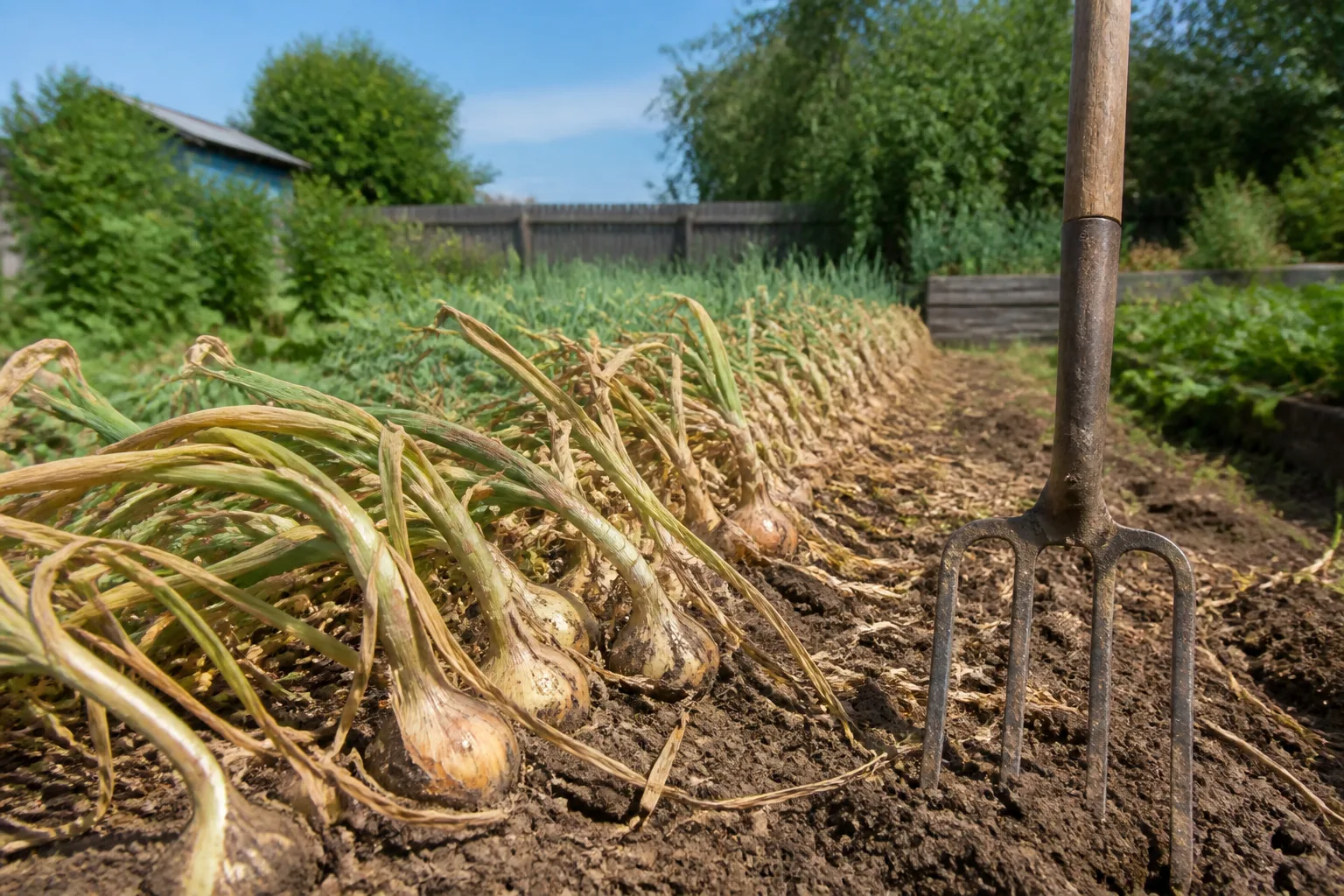
Harvest for immediate use whenever the bulb has reached a useful size. For storage onions, wait until the tops naturally yellow and fall, then lift the bulbs carefully with a fork so you do not bruise them. Do not force the tops down simply to make the crop look ready; the RHS no longer recommends bending or breaking the foliage as a maturity shortcut.
Move harvested bulbs into a dry, airy place and cure them until the outer skin is papery, the roots are dry, and the neck is tight. Depending on humidity and airflow, that may take about two to four weeks; Penn State Extension notes that curing can take two to four weeks, while the RHS recommends about two weeks in dry, ventilated conditions. Penn State’s harvest and storage guidance explains why the neck must dry before storage: an open, damp neck is an easy route for rot.
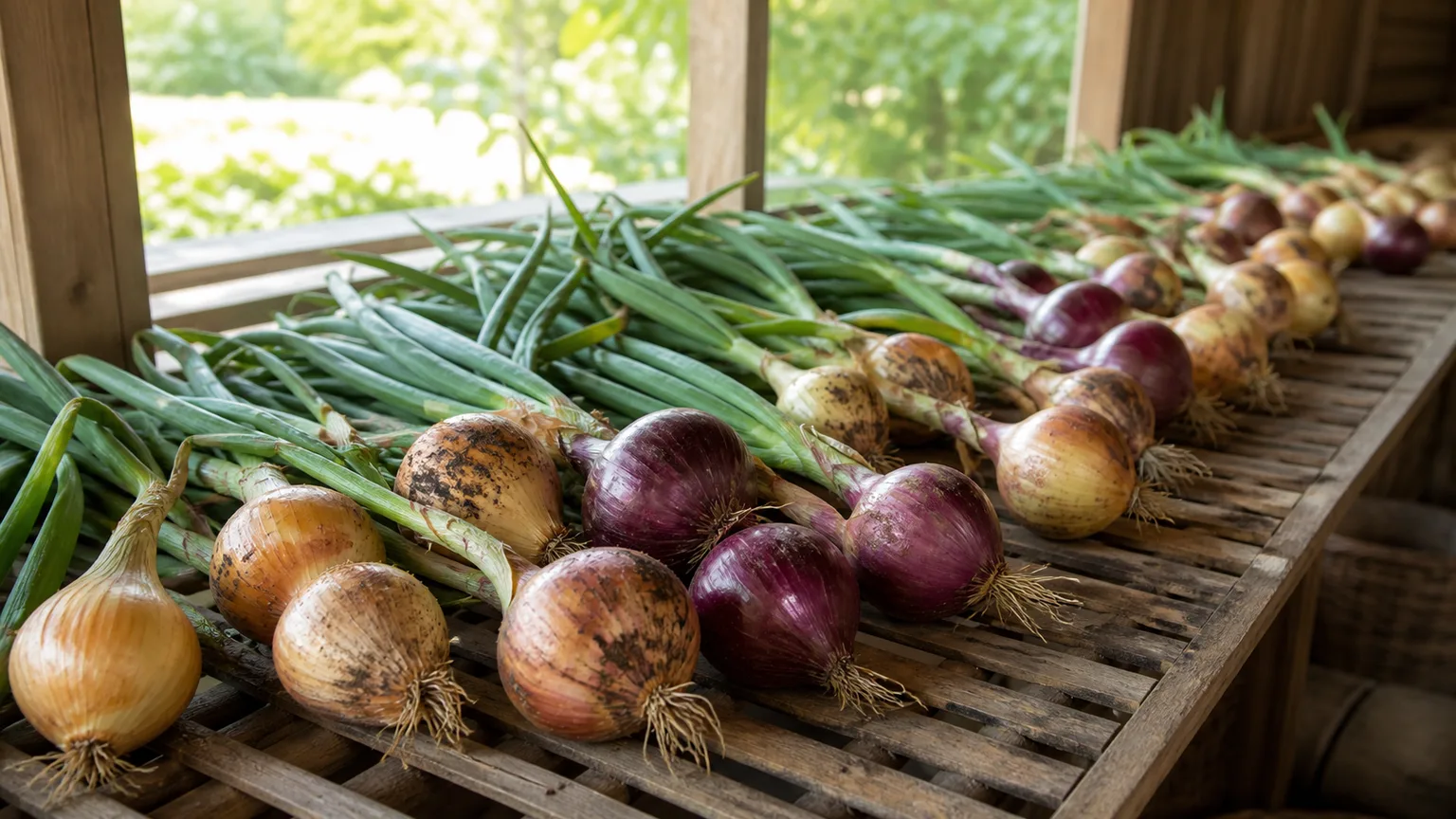
After curing, trim the tops to about one or two inches, brush off loose soil, and sort out bruised or soft bulbs for immediate use. Store sound onions in mesh bags, slatted trays, or another ventilated container in a cool, dry place, checking regularly and using any softening or sprouting bulbs first. Storage length is a variety trait as well as a curing result: sweet onions often keep for a shorter period than pungent storage types.
Conclusion
To decide when to plant onions this year, begin with the variety’s day-length group. Long-day onions generally belong in northern spring gardens, short-day onions are commonly fall-planted in mild southern climates, and intermediate-day onions bridge the central range; the packet’s adaptation and your latitude should settle the choice when the boundaries overlap.
Then match that choice to the planting material and the weather. Start seed indoors eight to twelve weeks ahead, put sets or hardened transplants into a loose bed during the early cool-season window, and delay only when soil is saturated or the forecast is genuinely punishing. Give the crop sun, final spacing, steady moisture, early weed control, and no late nitrogen surge, and you will give every plant the time it needs to turn leaves into a harvestable bulb.