When to Prune Citrus Trees for More Fruit
Prune lemon, orange, lime, and grapefruit trees with a climate-aware schedule, clean-cut technique, sucker control, and a simple aftercare plan.
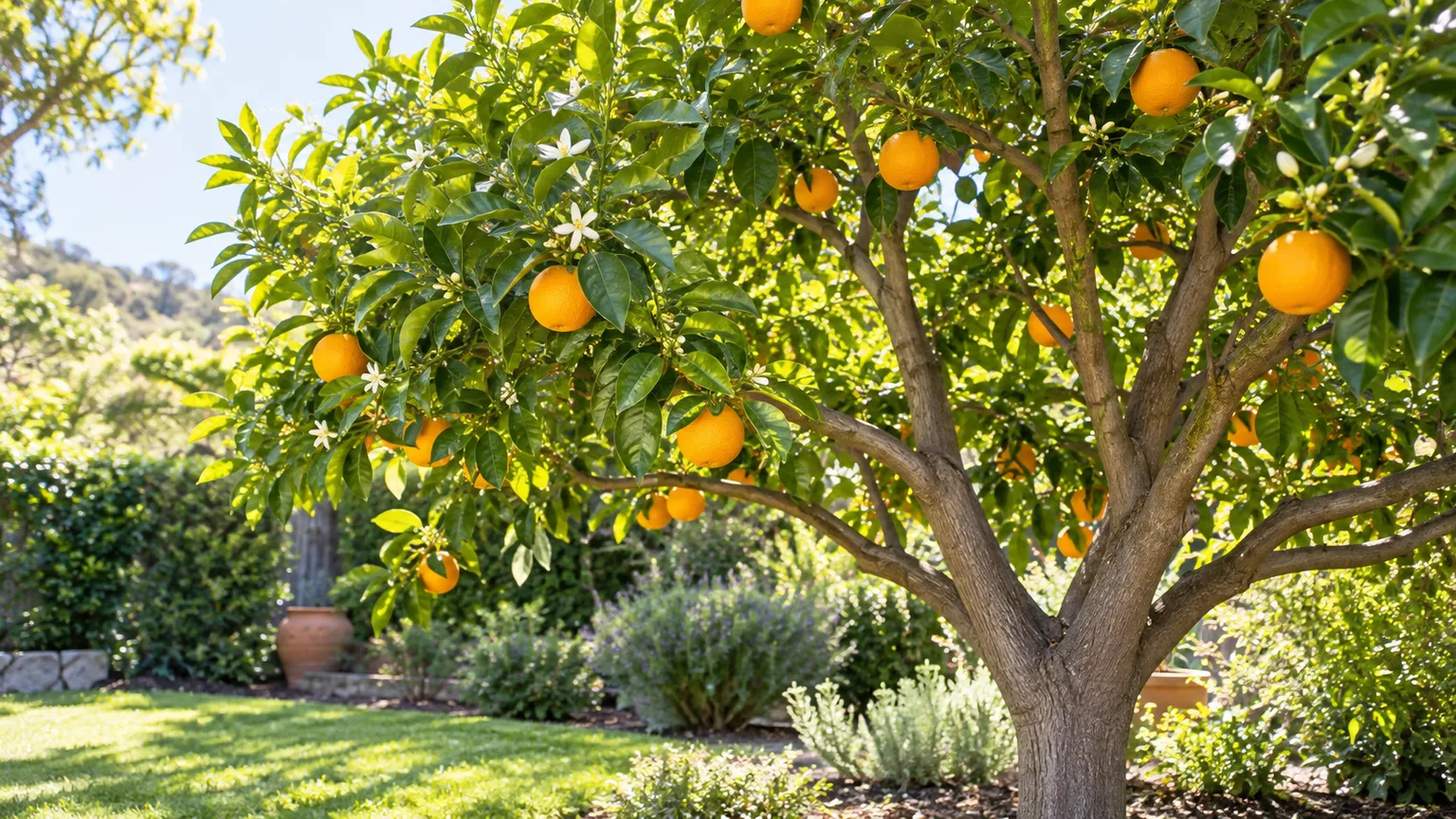
The best time to prune citrus trees is usually after the risk of damaging frost has passed and before the tree’s main flush of new growth. In a warm, frost-free region, that window may follow harvest or fall just before bloom. In a colder region, the calendar matters less than waiting for a reliable warm spell and a clear forecast.
Pruning citrus is mostly a light-maintenance job, not an annual tree haircut. Remove wood that is dead, broken, diseased, crossing, or growing from the wrong place first. Then make only the few structural cuts needed to bring light into a crowded canopy, keep fruit within reach, or correct a branch that threatens the tree’s shape. The goal is a productive balance, not the smallest possible tree.
The quick answer: prune after frost risk and before the main flush
If you want one practical rule, use this: schedule routine citrus pruning in the first safe window after your area’s last damaging frost, before vigorous spring growth begins. That timing reduces the chance that tender shoots will be killed by a late freeze and gives the tree a long, bright growing period to replace foliage.
The practical Nature Hills lemon-tree pruning guide uses the same decision point—after frost danger but before the next strong flush—while allowing light summer touch-ups when conditions are safe. That is a useful middle ground between doing nothing and treating citrus like a dormant apple tree.
The rule is not a fixed month. Citrus stays evergreen and can grow in several flushes, so “late winter” in coastal California, Florida, or a Mediterranean garden does not describe the same conditions as late winter in a frost-prone inland yard. UF/IFAS notes that the response to hedging and topping changes with variety, rootstock, age, location, severity, and growing conditions; that same caution is useful for a backyard tree. (UF/IFAS guidance on mechanical citrus pruning)
Remove an immediately dangerous broken limb or clearly diseased wood when necessary, even outside the ideal shaping window. Make that a targeted sanitation cut, not an excuse to thin the entire tree. If a tree is drought-stressed, heat-stressed, in active recovery from a freeze, or carrying a crop you want to keep, postpone nonessential shaping.
What pruning changes in a citrus tree
Citrus pruning changes the ratio between leaves, branches, roots, and fruit. Removing a crowded branch can improve light penetration and air movement, but removing too much leaf area also removes the tree’s ability to make energy. That is why a freshly “cleaned up” tree can look attractive while producing less fruit in the short term.
Better light reaches interior leaves and developing fruit when a canopy is overcrowded. UF/IFAS explains that sunlight supports flowering, fruit set, fruit quality, and color development, while greater penetration can help foliage dry more quickly after rain. Pruning helps only when it opens the canopy selectively; a severe cut that leaves large areas exposed can create new stress instead. (UF/IFAS on light, hedging, and citrus yield)
Think of each cut as a trade: you gain space, access, airflow, or a better-directed shoot, and you give up leaves or fruiting wood. That mental model prevents the common mistake of cutting every branch that points inward. Some interior twigs are productive; remove the ones that are weak, rubbing, shaded out, diseased, or clearly working against the tree’s structure.
Before you cut, identify the tree, graft, and goal
Walk around the tree and decide what you are actually trying to fix. A low branch brushing the soil needs a different response from a lemon tree that is too tall for harvesting, and both need a different response from a young grafted tree still building its framework.
Look for the graft union, a swelling or change in bark texture low on the trunk where the desired fruiting variety was joined to the rootstock. The canopy above it is the scion you bought. Shoots that emerge below the union belong to the rootstock and can grow vigorously without producing the desired fruit. Remove those suckers as soon as you see them, cutting or snapping them cleanly at their origin rather than leaving a stub.
Young trees, mature trees, and container citrus need different cuts
Young citrus trees need leaves more than they need a perfect shape. During the first few years, focus on a strong, evenly spaced framework: remove rootstock suckers, broken growth, badly rubbing branches, and shoots that compete with the main structure. Avoid stripping the canopy or removing every low branch simply because the trunk looks tidier. A young tree with too few leaves has less energy to establish roots and branch structure.
Mature trees usually need light annual observation and occasional corrective pruning, not a major cut every year. Lemons and limes often make vigorous shoots and may need more frequent light shaping than a slower, better-balanced orange or grapefruit tree, but cultivar and rootstock matter more than a universal schedule. Potted citrus can be pruned lightly to stay within its space, yet it also needs enough foliage to support fruit while it is already working with a limited root volume.
For an overgrown tree, set a two- or three-year renovation plan. Remove the most dangerous or unproductive branch each season, then let new shoots reveal which ones are well placed. A single skeletonizing cut can delay fruiting, trigger a flush of weakly attached shoots, and expose previously shaded wood to sunburn.
Suckers and water sprouts are not the same thing
A sucker rises from the root system or from the trunk below the graft union. It is usually vigorous, upright, and poorly matched to the fruiting variety. Remove it at the base while it is small; do not simply shorten it, because the remaining rootstock bud can push again.
A water sprout is a fast, upright shoot from the trunk or a mature branch above the graft. It is not automatically useless. Keep one if it fills a useful gap and is attached securely; remove it if it crowds the center, competes with a scaffold, or grows straight through the canopy. The distinction matters because blindly removing every upright shoot can leave the tree with fewer options for renewal.
This is also why a blanket rule to remove every upright shoot is risky. A hands-on citrus pruning walkthrough from Rooted in Nature recommends shaping toward an open form while reserving the decision for each shoot’s position, attachment, and future role.
Choose the pruning window by climate and tree condition
Use the tree’s weather exposure and growth stage as your schedule. General horticulture guidance often points to late winter or early spring, while practical citrus growers also use post-harvest or light summer windows in climates where frost is not a concern. The correct choice is the one that gives a clean recovery period without sacrificing the crop you are trying to harvest.
Warm, frost-free climates
In a frost-free climate, do structural work after the main harvest or just before the next flush, provided the tree is not in extreme heat or drought. A post-harvest window lets you see the canopy more clearly and avoids cutting fruit that is nearly ready. If the tree flowers and fruits in several cycles, use a lighter touch and preserve branches carrying an active crop.
Light summer cleanup can be reasonable in warm regions: remove a broken branch, a sucker, or a shoot blocking a path. Avoid turning summer maintenance into a deep canopy reduction. Fresh, soft regrowth can attract or support pest pressure, and exposed branches can scorch when the sun is intense.
Frost-prone climates
Do not make heavy cuts just before a freeze. Pruning stimulates new growth, and tender shoots are less cold-hardy than established wood. Severe hedging or topping in winter can also expose internal scaffold branches that were protected by the outer canopy; UF/IFAS specifically warns that winter exposure can reduce citrus cold hardiness. (UF/IFAS timing guidance)
After a freeze, wait until the extent of damage is visible and the next damaging frost has passed before doing a large cleanup. Dead leaves can stay temporarily if they are helping shield living wood. Scratch a small area of bark to check for living green tissue, then cut back only as far as healthy wood once the timing is safe. Your local cooperative extension can help identify freeze injury that resembles disease.
Harvest, heat, drought, and disease exceptions
If a tree is carrying a heavy crop, routine thinning can remove the very leaves and fruiting wood that support that harvest. Remove only hazards and infected material, and save shaping for after harvest or the next suitable growth window. Pruning does not compensate for poor light, irregular watering, damaged roots, or a nutrient problem.
Avoid significant pruning during a heat wave or prolonged drought. A tree that is already short of water has less capacity to replace leaves and protect exposed branches. Water the root zone deeply when needed, correct the underlying stress, and wait for moderate conditions.
Disease changes the decision. Citrus canker, greening, dieback, and trunk problems cannot be diagnosed from a generic pruning article, and pruning alone will not cure them. If several branches decline, leaves are mottled, or symptoms spread beyond one damaged limb, photograph the pattern and contact a local extension service before making a large cut. The RHS citrus problem guide also emphasizes that leaf loss, poor flowering, fruit drop, and root problems can result from growing conditions rather than one pruning mistake.
Tools, sanitation, and personal safety
Start with sharp bypass pruners for thin twigs, loppers for branches too large for hand pruners, and a pruning saw for heavy limbs. A dull blade crushes bark and makes it harder to place a clean cut. Wear eye protection when sawing overhead and use a stable platform; if the top of the tree requires a tall ladder or awkward reach, reduce the height in stages or hire an arborist.
Clean soil and sap from blades before disinfecting them. A practical routine is to wipe or spray the cutting surfaces with isopropyl alcohol between trees and whenever you move from a suspect branch to healthy wood. This is especially important when you are removing disease-affected tissue. Do not use a dirty hedge trimmer across multiple citrus trees as a substitute for inspecting individual cuts.
Lay out a disposal plan before you begin. Remove diseased clippings from the growing area rather than leaving them under the tree, and do not chip questionable wood into mulch you intend to spread around citrus. Follow local guidance if a serious regulated citrus disease is suspected.
How to prune a citrus tree step by step
Work from the least controversial cuts to the most structural. After every few cuts, step back and look through the canopy. If light is already reaching the interior and the tree is within reach, stop.
Remove hazards and problem wood first
- Remove dead, broken, cracked, or rubbing branches.
- Cut out branches with clear disease or pest damage, returning to healthy wood when practical.
- Remove suckers from below the graft union at their origin.
- Thin one or two weak, inward-growing, or badly crossing branches if they create real congestion.
Do not start by taking the top off or outlining the tree’s silhouette. The priority list above removes growth that is already costing the tree more than it contributes. It also gives you a useful pause point: many citrus trees need nothing beyond this maintenance pass.
Make cuts at the right place
Find the slight swelling at the base of a branch where it joins a larger limb or trunk. This is the branch collar, and the raised line along the upper side is the branch bark ridge. Make the final cut just outside this natural junction. Do not cut flush against the trunk, and do not leave a long stub. The tree’s natural wound-response tissues are concentrated around the collar; removing them or leaving excess wood slows the process and creates a poor-shaped wound.
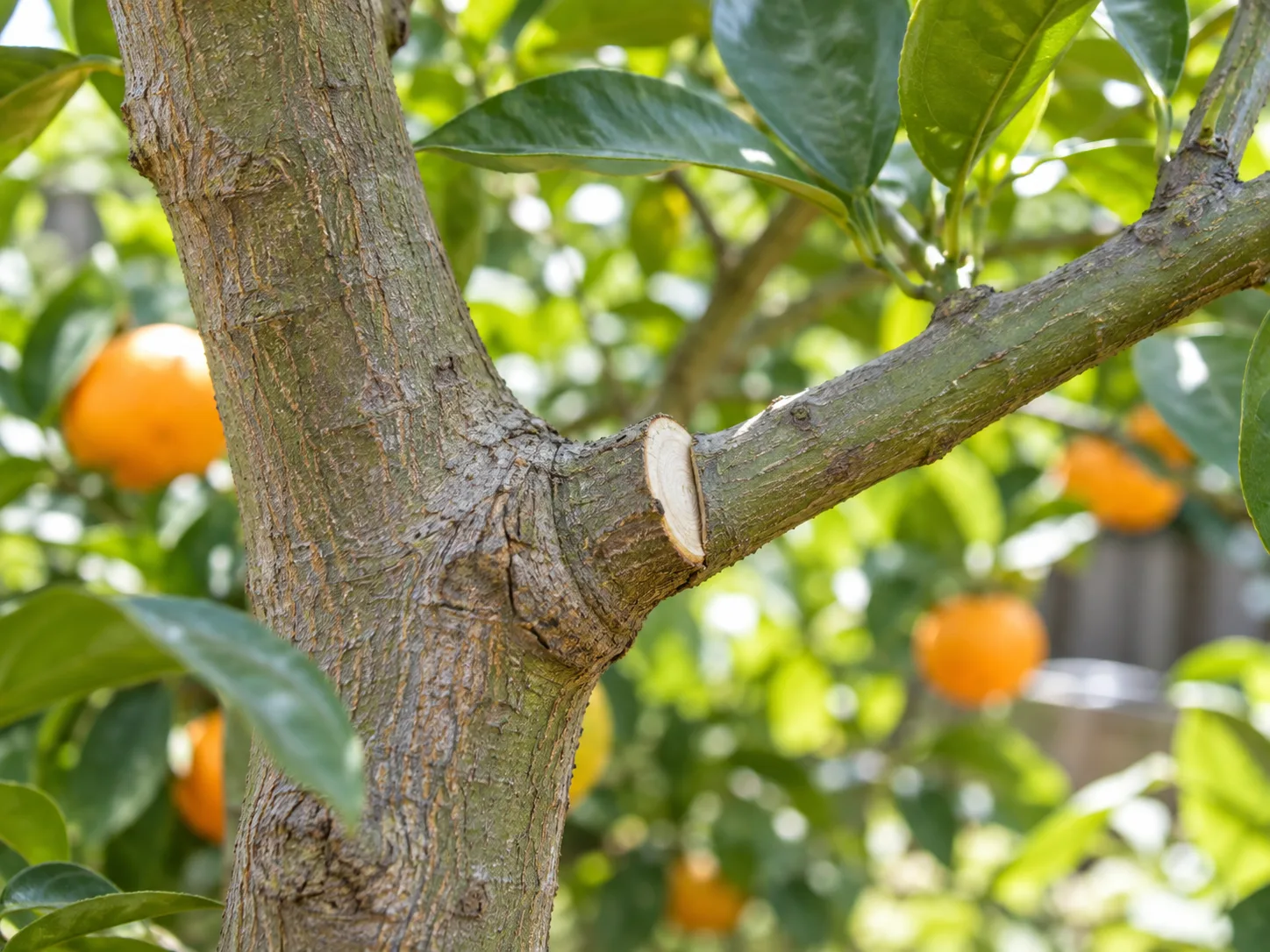
A correctly placed cut preserves the swollen branch collar instead of cutting into the trunk or leaving a long stub.
For a smaller branch, support the branch so it does not tear as it falls, then make one clean cut just outside the collar. When shortening a healthy shoot rather than removing it, cut just above a well-placed lateral branch or bud that points toward open space. That choice directs the next flush without leaving a dead stick above the bud.
For a heavy limb, use a three-cut sequence. First make an undercut a short distance from the collar. Next cut from the top a little farther out until the limb’s weight breaks away. Finally remove the remaining stub with a careful cut just outside the collar. The sequence prevents bark from tearing down the trunk or the lower side of the branch. General RHS pruning guidance likewise treats pruning as selective removal, not flush cutting or indiscriminate reduction.
Routine citrus cuts do not need a sealant. Wound paints can trap moisture or hide a poorly placed cut, and copper products should not be applied casually without a crop-specific label or local disease recommendation. If a major cut exposes previously shaded trunk or scaffold wood in a hot climate, ask a local extension professional about sunburn protection rather than coating every wound by default.
Open the canopy and reduce height slowly
Choose removal cuts that create a window through the canopy rather than a flat outer shell. An inward-growing branch that crosses a stronger scaffold is a good candidate; a healthy branch that carries fruit on the sunny edge may be worth keeping. Remove one competing limb at a time and inspect the light pattern before making another cut.
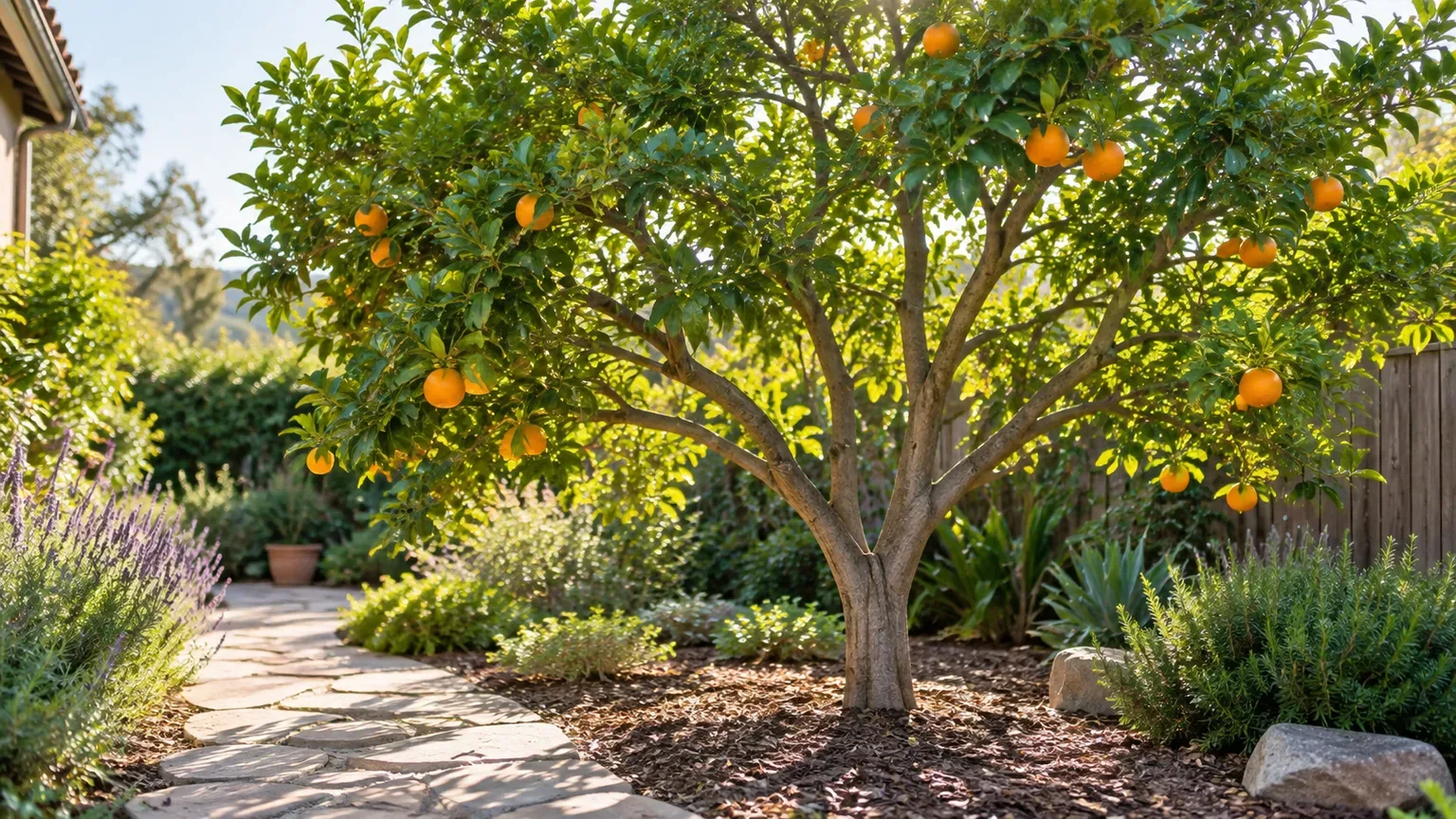
Selective cuts let sunlight reach the interior while preserving enough leafy fruiting wood for recovery.
For height, reduce a long branch back to a substantial side branch instead of cutting the top of the tree to a blunt stub. Topping produces a flush of vigorous shoots near the cut, weakens the tree’s natural structure, and can leave the new growth exposed. If harvesting is difficult, bring the tree down over multiple seasons. A reachable tree that still retains a broad, leafy canopy is a better target than an aggressively shortened tree with sunburned limbs.
Raise the skirt only when the site needs it
Skirting means removing low branches so fruit and foliage are not dragging on soil or interfering with irrigation, mowing, paths, or inspection of the trunk. It can also improve clearance for watering and reduce contact between low fruit and contaminated soil. It is not a requirement for every backyard citrus tree.
Raise the lowest limbs only as far as the site demands. A tree in a clean mulched bed may need little skirting, while a low-branched satsuma beside a walkway may need more. Make the cut at the collar and keep enough lower foliage to protect the trunk and maintain a balanced canopy.
How much to remove without sacrificing the crop
There is no single percentage that is safe for every citrus cultivar, rootstock, age, climate, and pruning history. As a cautious home-maintenance starting point, remove roughly 10–20% of the canopy, then stop and reassess. A small, healthy tree in a pot may need far less; a severely overgrown tree may require staged renovation over several years.
Use the priority order, not the percentage, to decide what stays. Dead and broken wood comes out first. Then remove suckers and genuine conflicts. Only after that should you consider height, skirt, or light cuts. If your planned work would remove a large portion of fruiting branches, postpone it or divide it into seasons.
Pruning can help balance alternate bearing, the pattern in which a heavy crop is followed by a light crop. UF/IFAS reports that pruning after a light crop and before an expected heavy crop can help in some commercial citrus situations, but the response depends on variety and production conditions. For a home tree, treat this as a reason to prune thoughtfully—not as a promise that a hard cut will force a bigger harvest. (UF/IFAS on alternate bearing and pruning)
Aftercare that helps the tree recover
Return the tree to steady care rather than trying to “make up” for pruning with extra fertilizer. Keep the root zone evenly supplied with water, but do not keep wet soil constantly saturated. A thick mulch layer can buffer moisture and temperature; keep it pulled back from the trunk so the bark stays dry.
Watch the first new flush. A few vigorous shoots are normal after a cut, especially if the root system is large relative to the remaining canopy. Rub or prune misplaced shoots while they are small, but do not remove every new shoot at once. Keep the ones that point into open space and can become useful laterals.
Inspect exposed branches for sunscald during the first hot weeks, especially if you opened a dense canopy dramatically. Watch for wilting, sudden leaf drop, oozing lesions, or dieback that extends beyond the cuts. Those signs point to stress or disease that needs diagnosis, not more pruning.
Citrus-pruning mistakes that reduce fruit
Pruning by the calendar alone. “March” or “August” means different things in different climates. Use frost risk, heat, harvest, and the tree’s growth flush as your schedule.
Topping the tree. A flat cut across the top removes a large energy-producing surface and encourages poorly attached regrowth. Reduce height to a side branch over time instead.
Removing more because the first cuts feel easy. A clear pile of branches can create momentum. Step back after each small group of cuts and preserve a leafy, balanced framework.
Confusing a sucker with a useful shoot. Check the graft union before cutting. Rootstock growth belongs below it; above it, judge a water sprout by its position and future value.
Leaving stubs or cutting into the collar. Both errors create a badly shaped wound. Take the final cut just outside the natural branch junction.
Pruning a stressed tree. Heat, drought, freeze injury, root problems, and active disease all reduce recovery capacity. Fix or diagnose the stress before routine shaping.
Sealing every wound. Clean placement, sanitation, and good timing matter more than a blanket coat of wound dressing. Reserve specialty products for a clearly identified, locally advised problem.
Conclusion
Prune citrus trees when the next flush can grow into safe, moderate weather: usually after frost danger and before vigorous new growth, or after harvest in a warm frost-free climate. Start with dead, broken, diseased, crossing, and rootstock growth; then make only the structural cuts that improve light, airflow, access, or balance.
The best citrus pruning is restrained enough that the tree still looks leafy when you finish. Keep the graft union visible, protect the branch collar, reduce height in stages, and give a stressed tree time to recover before reshaping it. Those choices do more for a reliable harvest than a dramatic cut ever will.



